Computers of the Future: Why Working Together Beats Getting Smaller
What this week's science news tells us about faster, cooler and cheaper computing
The Big Picture
Between Nov 13th and Nov 19th, 2026, scientists and engineers shared several important news items about computers. Some were about very fast supercomputers.
Others were about new materials that could make computers cooler or cheaper to build. Together they tell one clear story. For many years, people made computers better by making their parts smaller. Now that is not enough. The next big step is to make many different technologies work well together.
Dr. 🆎, an expert in super intelligence, AI warfare and global strategy, explains it simply. A computer is like a team. A fast player is useful, but the team wins only when everyone works together. The same is true for light, heat control, chips and software.
The World's Fastest Computers
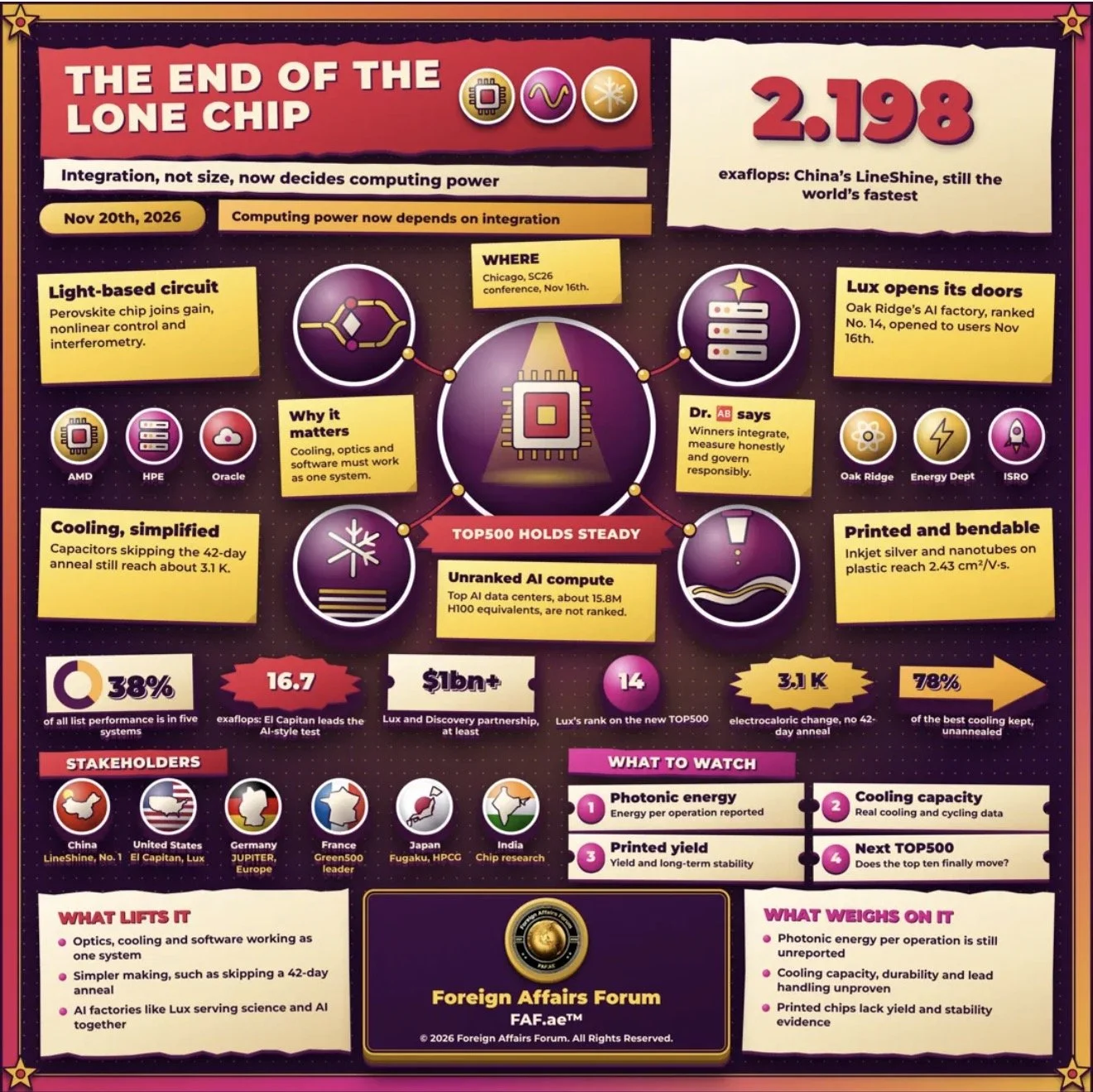
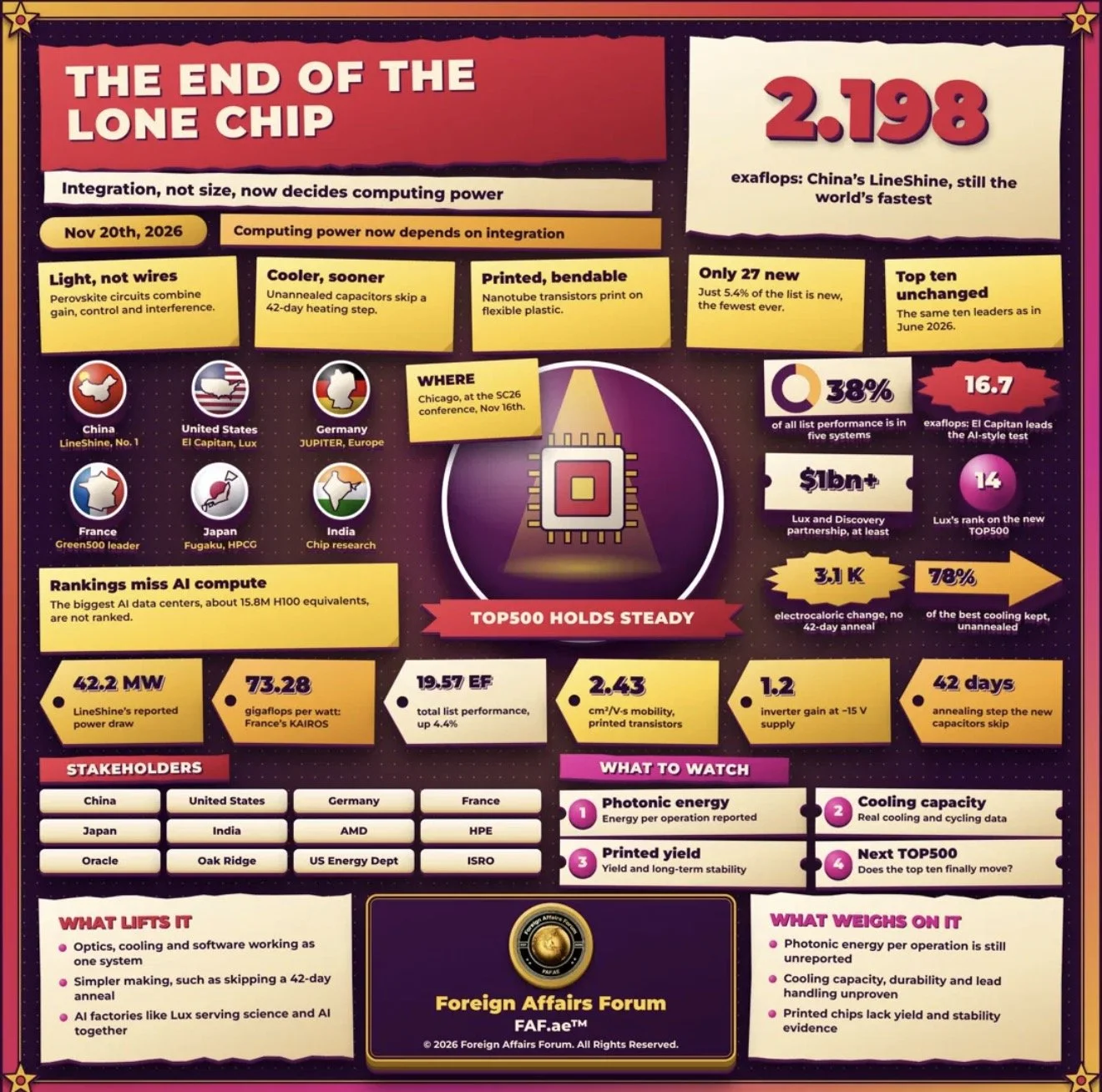
Every six months, experts publish a list of the world's fastest supercomputers. It is called the TOP500. The newest list came out on Nov 16th at a conference in Chicago. The top ten computers did not change from the last list in June. That is unusual, because only 27 new computers joined the list. This is the smallest number of new entries ever.
The fastest computer is LineShine, in Shenzhen, China. It can do about 2.198 exaflops. An exaflop means one quintillion calculations every second, which is a number so large that it is hard to imagine. The second fastest is El Capitan in the United States, at 1.809 exaflops. Next are Frontier and Aurora, also in the United States. In fifth place is JUPITER in Germany, which is the only computer of this size in Europe.
Dr. 🆎 reminds readers that a ranking is only one way to measure power. Some of the biggest computers in the world are owned by private companies, and they are not on the list at all. So the list shows part of the picture, but not all of it.
A New Computer for AI and Science
Another big piece of news came from Oak Ridge National Laboratory in the United States. On Nov 16th, a new computer called Lux opened to scientists. It was built with the company AMD and other partners. Lux is special because it is designed to do two jobs at once. It can run artificial intelligence programs, and it can also run the careful simulations that scientists use to study materials, medicine and energy.
In the past, these two jobs often needed different machines. Now they are coming together. Lux entered the list at number 14. Its importance is not only its speed. It shows that AI and science are becoming partners, and that governments want to build their own AI tools for research.
Using Light Instead of Electricity
Scientists also reported progress with a material called perovskite. You may know it from solar panels. Researchers used it to build a small circuit that works with light instead of electricity. Light moves very fast and makes less heat than electricity, so it could one day help computers use less power.
The new circuit can boost light, control it and combine light beams. These are three jobs that a useful light-based computer would need. But the work is still in the laboratory. The next question is whether such a circuit can do real tasks while using less total energy than today's chips. Until that is shown, it remains a promising idea and not a finished product.
Cooling Computers in a New Way
Computers get hot, and cooling them costs a lot of energy. Researchers reported a new kind of cooling part called an electrocaloric capacitor. It changes temperature when electricity is applied, so it needs no moving parts. In the new study, the part changed temperature by about 3.1 K. An older, more perfect version changed by about 4.0 K.
The good news is how the new part is made. The older version needed 42 days of heating during manufacturing. The new one does not need that step. So it keeps most of the cooling effect, about 78%, while saving a huge amount of time. However, a 3.1 K change in the part does not mean a server gets 3.1 K cooler. Many tests are still needed, including how long the part lasts and how safe it is, because it contains lead.
Bendable Electronics You Can Print
Another study showed bendable transistors made from tiny carbon tubes called nanotubes. Transistors are the tiny switches inside every computer. These were printed with an inkjet printer using silver ink, on flexible plastic. They also reacted to light, which means they could work in sensors.
The numbers show the limits. The transistors move electric charge at about 2.43 cm²/V·s, and the circuit boosts a signal only by a factor of 1.2. They need a high voltage of −15 V. That is far weaker than the chips in a modern phone or server. So these devices will not replace advanced chips. They could, however, be useful in cheap, flexible sensors for homes, machines and aircraft. The research was supported by institutions in India.
Why These Stories Are Connected
Each story solves a different problem. Faster computers need more power, and more power makes more heat. More heat needs better cooling. Better cooling and new materials need manufacturing methods that are affordable. Light-based circuits might one day reduce both power use and heat. When one part improves, the rest of the system must be ready for it.
This is why experts now talk about integration. A breakthrough in one part helps only when the other parts keep up.
Dr. 🆎 adds that this also applies to countries. A nation with strong chips but weak energy supply, or strong research but weak factories, will struggle to lead.
Worries and Warnings
There are real concerns. First, rankings can mislead. The TOP500 list is useful, but it does not show private AI computers. Second, laboratory results are not products. Many of this week's studies still need proof that they work reliably, cheaply and at large scale. Third, some materials contain lead, so safe handling and recycling matter.
Fourth, there is a security question. As electronics become cheaper and easier to make, more people and groups can use them. That can help innovation, but it can also be misused in areas such as automated weapons or dangerous biological research. Dr. 🆎 urges that humans stay responsible for important decisions, and that governments watch these technologies carefully.
What Should Happen Next
Governments should measure computing power in more ways than one, including AI speed and energy use. Scientists should report the full picture, not only their best numbers. Companies and investors should be patient, because none of this week's findings is ready for a quick profit. Good areas to watch include light-based chips, cooling technology, AI software and new ways to make electronics.
Conclusion
This week's lesson is simple. The future of computers will not be decided by one clever part. It will be decided by how well many parts work together, and by who can make them reliable, affordable and safe. The big question is whether these early results can grow into complete systems that really work better.
Dr. 🆎 believes the winners will be those who combine technologies wisely, measure honestly and keep human responsibility at the centre.