Beyond the Transistor: Capital, Quantum and the Contest to Redefine Computing
How an AMD–PsiQuantum alliance and a $720 million bet on inference chips reveal where the next phase of the global computing race will be won or lost
Foreign Affairs Forum | Dr. Antonio Bhardwaj (Dr. 🆎)| November 13th, 2026
Executive Summary
The week ending Nov 12th, 2026 offered a rare concentration of signals about the direction of computing. Two corporate events stand at the centre of this FAF article.
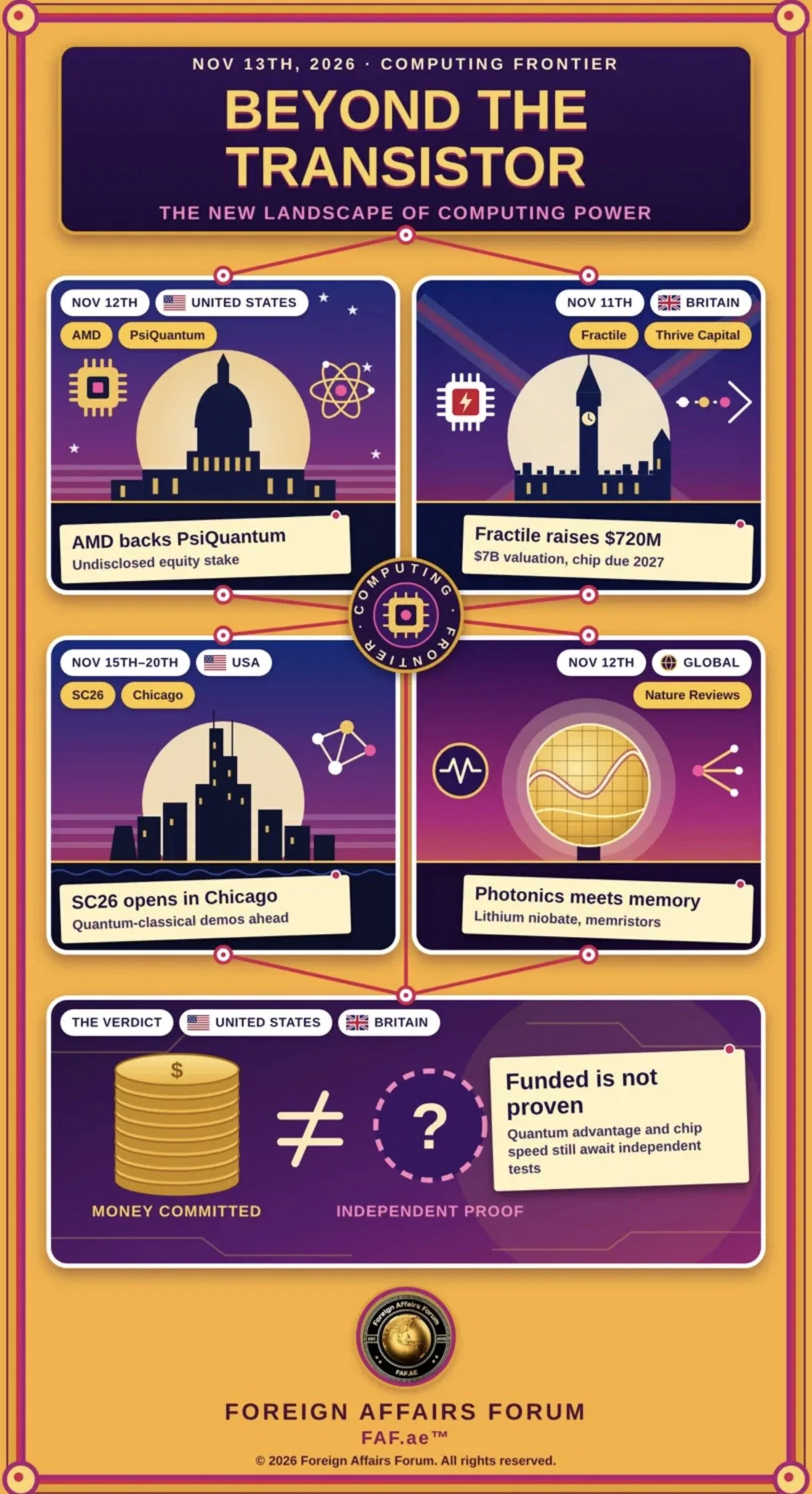
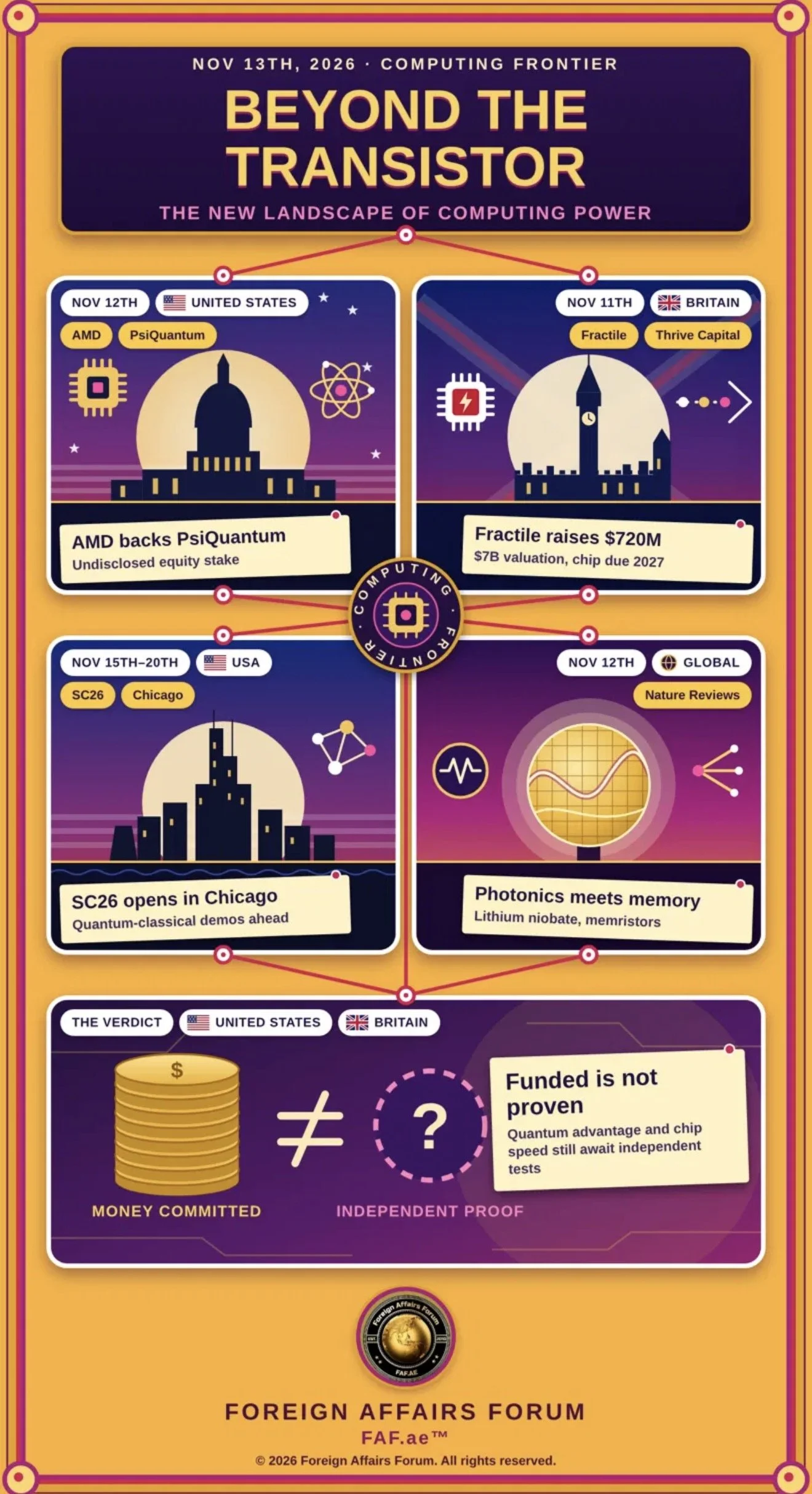
On Nov 12th, AMD announced its intention to make an equity investment, of undisclosed size, in PsiQuantum as part of an expanded collaboration aimed at infrastructure for utility-scale quantum computers. A day earlier, the British start-up Fractile disclosed a $720 million Series C round at a reported valuation of $7 billion, with Thrive Capital, Founders Fund, Lightspeed and Redpoint among its backers, to commercialise processors designed specifically for artificial intelligence inference, with a first commercial chip planned for 2027.
Per FAF analysis, these announcements share a common logic. Each represents a wager that the era of general-purpose silicon scaling, which delivered predictable gains for half a century, is yielding to an era of architectural specialisation, in which photons, memory-centric designs and hybrid quantum-classical systems compete to supply the next order of magnitude in capability. Each also carries a large evidentiary gap.
The AMD–PsiQuantum partnership and the investment intention are reported facts, but utility-scale quantum operation, independently validated computational advantage and commercial cost efficiency remain unproven. Fractile's financing is confirmed, but its performance claims await independent testing, and no production-scale energy-efficiency advantage has been established.
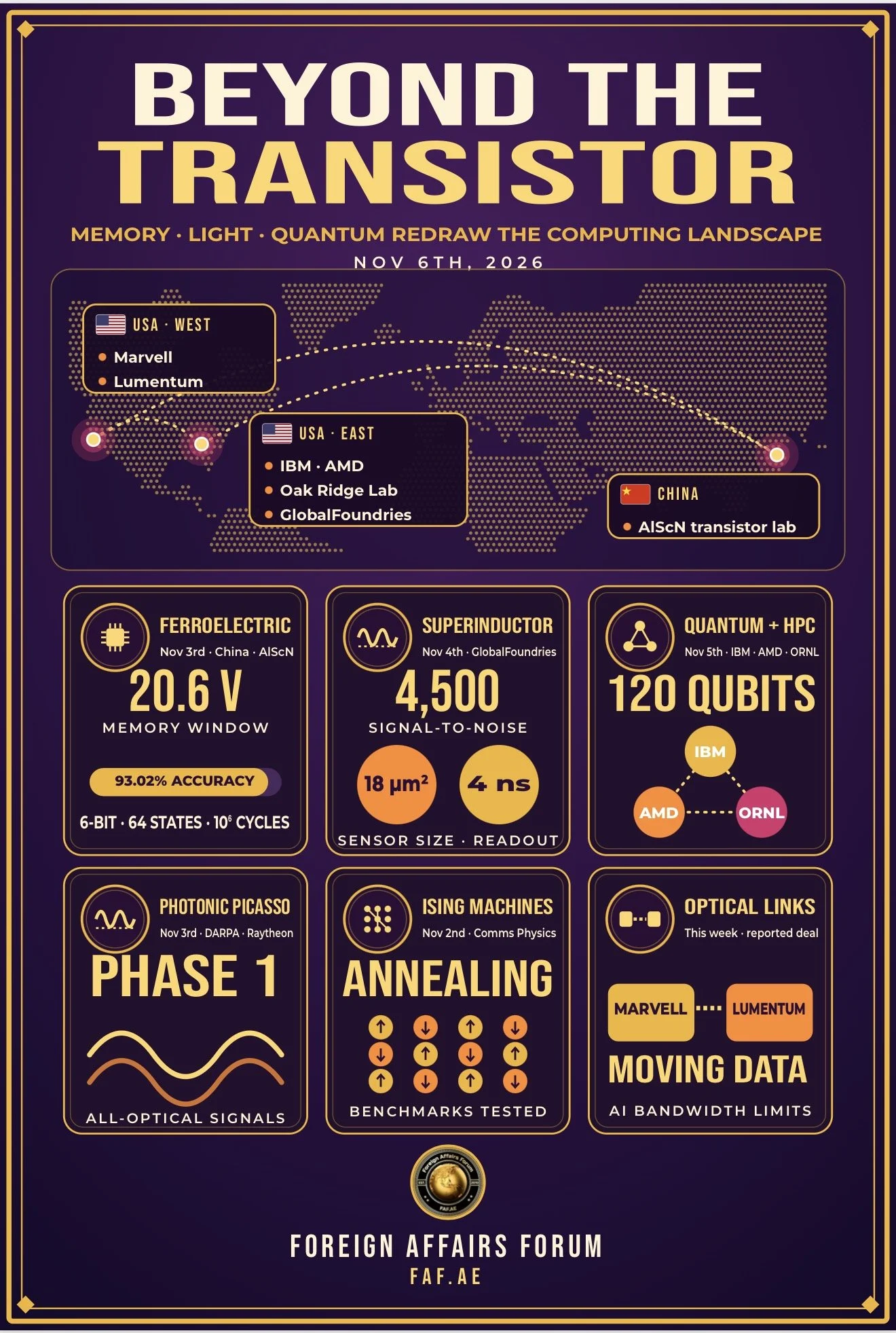
The wider week supplied laboratory context: peer-reviewed or published experimental work on hyperdoped silicon photodetection, single-photon emission from atomically thin molybdenum ditelluride, and polariton spin waveguides. These are demonstrations of physical behaviour, not products. The central distinction, which this FAF article develops, is between what has been physically demonstrated and what has merely been financed.
Dr. Antonio Bhardwaj (Dr. 🆎) frames the matter bluntly: capital is a statement of belief, not a measurement, and the history of technology is crowded with heavily funded beliefs that never reached the factory floor.
The strategic implications are considerable. Quantum computing needs large classical computing resources for simulation, control, calibration and error correction, so the boundary between quantum and conventional hardware is dissolving. AI inference is becoming the dominant operating expense of the digital economy, which makes energy per generated token a matter of national competitiveness. And governments see both fields through the lens of sovereignty and security. The decisive tests lie ahead: logical-qubit performance and error-correction overhead for quantum systems, and throughput per watt under independently reproducible workloads for inference hardware. The SC26 conference in Chicago, from Nov 15th to 20th, offers the nearest opportunity to examine claims against published benchmarks.
Introduction: A Week That Clarified the Landscape
Technology weeks rarely arrive with thematic coherence. Announcements accumulate, valuations oscillate, and the signal is often lost in the noise. The week ending Nov 12th, 2026 was different. Within roughly forty-eight hours, a leading American semiconductor designer committed to an equity stake in a quantum computing company built on silicon photonics, and a British chip start-up secured one of the largest financing rounds in the history of European semiconductor design. Alongside them, researchers reported advances in optical sensing, quantum light sources and exotic light–matter hybrids that all rely on the same underlying proposition: that information can be moved, sensed and processed in ways that transcend the electron-centric logic of the conventional transistor.
Dr. Antonio Bhardwaj (Dr. 🆎), a polymath with global expertise in superintelligence, specialising in human-centred approaches to geopolitical strategy, AI warfare and bioterrorism risk, has long argued that computing hardware is the least glamorous and most consequential variable in the contest among states. In his assessment, the decisive questions of the coming decade will not be settled by who writes the cleverest model, but by who controls the physical substrate on which intelligence runs, and on what terms. Models can be copied; fabrication lines, photonic supply chains and error-corrected qubits cannot.
This FAF article therefore pursues a deliberately disciplined purpose. It examines the two corporate developments and the associated laboratory research reported in the week, separates what has been established from what has been asserted, and traces the causal channels through which capital, science and statecraft interact in this domain. It does not treat the headline numbers as proof of technological success. As the source material underlying this analysis rightly cautions, neither a large investment nor an impressive laboratory result proves that a technology will become commercially dominant.
The argument proceeds in stages.
The first section situates the week within the longer history of computing's architectural transitions. The second reviews the key developments in detail. The third assesses the latest facts and the concerns that attend them. The fourth offers a cause-and-effect analysis of how the stakeholders involved shape one another's choices. The fifth outlines the steps that policymakers, investors and researchers should take. A concluding section distils what the evidence supports and what it does not.
History and Current Status: From Scaling Certainty to Architectural Contest
For much of the late 20th century, progress in computing followed a remarkably regular rhythm.
Transistors shrank, clock speeds and densities rose, and general-purpose processors absorbed each new workload with little architectural drama. That regularity created an industrial culture of confidence, in which investors and governments could assume that next year's machines would be markedly better than this year's without rethinking the underlying design.
The 21st century gradually dismantled that confidence.
As the physical limits of miniaturisation and power density became binding, performance gains required increasingly elaborate engineering. Graphics processors, originally built for rendering images, proved well suited to the parallel arithmetic of machine learning, and a new hierarchy of accelerators emerged. The rise of large neural networks then concentrated demand on a small number of dominant accelerator suppliers and made the supply of advanced computing a matter of strategic concern to governments.
Quantum computing followed a parallel but distinct trajectory.
Conceived in the early 1980s as a way to simulate nature with devices that obey quantum rules, it acquired practical urgency in the 1990s when algorithms showed that a sufficiently large machine could break widely used public-key cryptography. Since then, rival physical platforms have competed, including superconducting circuits, trapped ions, neutral atoms and photons. Photonic approaches, which encode quantum information in particles of light, offer a distinctive attraction: they can in principle be manufactured using the same silicon fabrication infrastructure that produces conventional chips. That attraction underlies PsiQuantum's silicon-photonics-based architecture, and it explains why a conventional semiconductor company would find the relationship strategically coherent.
The relationship between quantum and classical computing has also matured conceptually.
Early public discourse imagined quantum machines replacing conventional ones. The engineering reality is the opposite. A quantum processor depends on classical computers to simulate candidate designs, to control hardware in real time, to calibrate drifting components and, above all, to decode the errors that inevitably corrupt quantum information. Fault-tolerant quantum computing is therefore best understood as a hybrid system in which the classical component is itself a formidable supercomputing task. This is the scientific logic behind the AMD–PsiQuantum collaboration, which joins AMD central processors, graphics processors, adaptive computing hardware and software with PsiQuantum's photonic architecture.
On the AI side, the history is one of shifting bottlenecks.
Training a large model is a bounded, if enormous, undertaking. Inference, the repeated execution of a trained model to answer queries, is an open-ended cost that scales with adoption. As deployment spreads across search, enterprise software, code generation and consumer applications, inference has become the dominant recurring expense of the sector. Its technical profile differs from training: memory bandwidth, communication overhead, latency and energy per generated token can be decisive. This opened a commercial space for purpose-built designs, into which Fractile has positioned itself.
The current status of both fields can be stated with precision.
No quantum computer has demonstrated utility-scale, fault-tolerant operation. No independent evaluation has verified that Fractile's architecture delivers a production-scale advantage in speed, energy or cost. The laboratory research of the week, meanwhile, belongs firmly to the research stage.
Dr. 🆎 observes that this gap between narrative and measurement is not a defect of the field but its defining feature: frontier technologies are, by definition, financed before they are proven, and the analytical task is to keep the two categories distinct.
Key Developments
The first development was the AMD–PsiQuantum expansion, announced on Nov 12th from the United States.
AMD plans an equity investment of undisclosed size in PsiQuantum within an expanded collaboration to develop infrastructure for utility-scale quantum computers. The companies also intend to develop applications that combine quantum computing, conventional high-performance computing and artificial intelligence, and they cited early work using AMD graphics processors for molecular simulations relevant to drug discovery.
Several features deserve emphasis. The investment is an intention, and its size has not been disclosed, so any claim about its magnitude is speculation. The reference to molecular simulation signals the application domain that the companies regard as the most plausible early beneficiary of hybrid approaches, since chemistry and materials problems map naturally onto quantum mechanics. And the arrangement gives AMD a position in another emerging computing market while giving PsiQuantum access to an established accelerator and software ecosystem, an asset that is far harder to build than hardware alone.
The second development was Fractile's financing, reported on Nov 11th from the United Kingdom.
The company raised $720 million in a Series C round at a reported $7 billion valuation, backed by investors including Thrive Capital, Founders Fund, Lightspeed and Redpoint. It is developing specialised processors for inference and claims that its architecture can improve processing speed while reducing energy use and operating costs, with a first commercial chip planned for 2027. The financing is confirmed. The performance claims are not independently verified.
The third group of developments comprised the laboratory work of the week.
Hyperdoped silicon photodetection, a peer-reviewed experiment, concerns the engineering of silicon so that it responds to optical wavelengths to which ordinary silicon is blind, a potentially significant step for integrating light sensing with standard semiconductor processes. Single-photon emitters in molybdenum ditelluride, also peer-reviewed, concern atomically thin semiconductors that can generate individual photons, a prerequisite for many quantum communication and photonic computing schemes. Polariton spin waveguides, published experimental research, concern hybrid light–matter states that may carry information in alternative ways. All three sit at the research stage of commercial readiness. The comparative assessment of the week places them against the corporate developments with a sobering observation: the first three address demonstrated physical behaviour, while the final two concern the industrial resources being committed to future technologies.
Two scholarly publications from Nov 12th, although not among the new developments, provide useful context.
A perspective on thin-film lithium niobate photonics in Nature Reviews Physics examines how that material's electro-optic and nonlinear optical properties can support quantum light generation, microwave-to-optical conversion and programmable photonic circuits. A primer on memristors in Nature Reviews Methods Primers reviews devices whose electrical conductance depends on their internal physical state, which are being investigated for nonvolatile memory and alternative computing architectures. Neither reports a new experimental breakthrough. Their value lies in marking the technical terrain on which commercial ambitions will have to be fulfilled, and in reminding stakeholders that the supply of materials science, not merely capital, conditions the pace of progress.
Finally, the calendar supplied its own development. The SC26 International Conference for High Performance Computing, Networking, Storage, and Analysis takes place in Chicago from Nov 15th to 20th. It will host demonstrations involving accelerated computing, networking, distributed systems and quantum-classical workflows. Per FAF analysis, announcements there should be assessed against published benchmarks, not assumed to represent verified breakthroughs. It is also worth recording a limitation: the reviewed material for the week did not establish any independently verified new exascale benchmark from Nov 6th to 12th, so no older supercomputing result is presented here as a weekly breakthrough.
Latest Facts and Concerns
The verified facts of the week are fewer than the volume of commentary might suggest, and discipline in distinguishing them is the first requirement of serious analysis.
It is a fact that AMD announced its plan to invest in PsiQuantum. It is a fact that the size of the investment was not disclosed. It is a fact that Fractile raised $720 million at a reported $7 billion valuation. It is a fact that the company plans a first commercial chip in 2027. It is a fact that the laboratory studies in photodetection, single-photon emission and polariton waveguides were published. Beyond these points, claims shade into expectation.
Several concerns follow.
The first is the evidentiary asymmetry between financing and performance.
A valuation is a market price for expectations, and a private valuation is not even a market price in the ordinary sense, since no open trading disciplines it. The $7 billion figure for Fractile is not an initial public offering valuation, is not a verified market price for publicly traded shares, and is not evidence that the chip will meet its stated targets. Likewise, the AMD–PsiQuantum transaction establishes no public offering timetable and no commercial valuation for PsiQuantum.
Dr. 🆎 cautions that in periods of exuberance, the repetition of a headline number in successive articles can create an illusion of corroboration. Ten reports of one valuation are still one valuation.
The second concern is methodological.
Claims about inference hardware are notoriously sensitive to the conditions of measurement. Advantages must be demonstrated using comparable models, numerical precision, batch sizes and power measurements. A chip that excels at one batch size or precision may fall behind at another, and a system-level comparison must include memory capacity, interconnects, software maturity and the cost of the surrounding infrastructure. Until independent testing occurs, claims of improved speed and lower energy use remain claims.
The third concern is the long distance between quantum laboratory progress and utility-scale operation.
The milestones that matter are physical error rates, logical-qubit performance, error-correction overhead and demonstrated computational advantage on problems of practical value. Photonic quantum computing faces its own engineering burdens, including the loss of photons in components, the efficiency of sources and detectors, and the sheer scale of the manufacturing and cooling infrastructure required for a machine that is useful rather than merely demonstrable. The partnership addresses infrastructure, which is necessary, but infrastructure is not itself evidence of advantage.
The fourth concern is geopolitical.
Silicon-photonic quantum systems could become strategically important for scientific simulation and future cryptographic research, but the partnership establishes no immediate cryptographic advantage. This distinction matters because public discussion of quantum computing often collapses a distant possibility into an imminent threat.
Dr. 🆎, whose work on AI-enabled warfare and biological risk gives him an unusually clear view of dual-use dynamics, warns that the correct posture is neither complacency nor alarm. Cryptographic migration takes years, and adversaries who collect encrypted data today in the expectation of decrypting it later create a present-day obligation to prepare, even if the capability is not yet at hand. At the same time, hybrid quantum-classical platforms that accelerate molecular simulation carry dual-use implications for biology that deserve early governance attention rather than belated regret.
The fifth concern is concentration.
The growth of specialised inference processors is partly a response to the dominance of established accelerator suppliers, and financing on the scale of Fractile's reflects the appetite for alternatives. Yet the same financial flows can reinforce concentration of a different kind, as capital clusters in a handful of favoured firms and in the ecosystems of established incumbents. AMD's move into quantum partnership is a hedge by an incumbent, which suggests that the line between challenger and incumbent is more fluid than the rhetoric of disruption implies.
Cause-and-Effect Analysis
The most productive way to understand the week is to trace causal chains rather than to catalogue events.
Four chains merit examination.
The first chain runs from the economics of AI deployment to the market for specialised hardware.
As adoption of AI services widens, inference becomes the principal recurring cost. That cost is dominated by the energy and memory movement needed to produce each output. Operators therefore have strong incentives to reduce energy per generated token, and the dominant suppliers cannot fully satisfy that incentive with general-purpose designs without conceding margin. The result is a window for challengers. Investors, observing the window, supply capital on a scale that would have been implausible for a European chip design company a few years ago. The effect of that capital is to relieve the most immediate constraint on a challenger, which is the cost of design, fabrication and software development, but it does not remove the harder constraint of proving performance. The causal chain thus produces a funded experiment, not a settled outcome.
The second chain runs from the physics of fault tolerance to the integration of quantum and classical computing.
Because error correction requires rapid classical decoding of syndrome information, and because designing and validating quantum hardware requires heavy classical simulation, the classical side of a quantum system scales with the quantum side. This implies that a quantum company without a deep classical computing partner faces a structural disadvantage, and a classical computing company without a quantum position risks irrelevance in a possible future paradigm. The AMD–PsiQuantum alliance is the commercial expression of that physics. Its effect on the landscape is to push other quantum and classical stakeholders toward comparable pairings, which in turn accelerates consolidation and raises the barrier for independent entrants.
The third chain runs from laboratory physics to industrial option value.
The week's research on hyperdoped silicon, molybdenum ditelluride emitters and polariton waveguides expands the menu of physical effects that engineers might exploit. Each effect, if scaled and made reliable, could enhance sensing, communication or computation. But the transition from a laboratory demonstration to a manufacturable component typically encounters yield, uniformity, integration and cost problems that demonstrations rarely address. The effect of such research on industry is therefore indirect: it raises the option value of photonic and quantum investments by suggesting that the underlying components may eventually improve, while leaving the timing deeply uncertain. Investors who mistake option value for near-term revenue are exposed to disappointment, and policymakers who mistake it for imminent capability risk misallocating security attention.
The fourth chain runs from geopolitics to funding and procurement.
Governments increasingly regard advanced computing as a sovereign capability. Fractile's financing supports the United Kingdom's ambition to retain more domestic capability in AI hardware design and computing infrastructure, a goal that gains urgency in a world where access to advanced accelerators can be constrained by export controls and supply disruptions. Similarly, silicon-photonic quantum systems attract national interest because of their potential bearing on simulation and cryptography. The effect of state interest is twofold. It lowers the cost of capital for favoured firms through grants, procurement signals and implicit backing, and it raises the risk of fragmentation, as rival blocs build parallel ecosystems with incompatible standards and restricted collaboration.
Dr. 🆎 argues that fragmentation is the least appreciated risk of the present moment: a technology that might have benefited from open scientific exchange will instead advance within walled gardens, with duplicated cost, slower verification and heightened mutual suspicion.
These chains interact.
The demand for inference efficiency strengthens the case for photonic interconnects and novel memory devices, which links the Fractile story to the lithium niobate and memristor literature. The need for classical support in quantum systems links the AMD story to the same accelerator ecosystems that dominate AI. And geopolitical anxiety links all of them by encouraging governments to treat each technology as a strategic asset. In this interaction lies a danger of reflexive escalation: rising state interest inflates private valuations, inflated valuations attract more capital, and abundant capital intensifies state interest, with measured performance trailing behind the narrative.
A counterfactual clarifies the point.
Had the two corporate announcements occurred in a period of scarce capital, they would have been read as modest strategic moves: a minority investment of undisclosed size and a growth round for a chip company with a 2027 product. In a period of abundant capital and geopolitical urgency, they are read as milestones in a race. The facts are unchanged; the interpretive frame differs. Per FAF analysis, the discipline demanded of analysts is to resist the frame and return to the measurements.
Future Steps
Several practical steps follow for the principal stakeholders.
For companies, the priority is transparent, reproducible measurement.
Fractile and its competitors should submit their processors to independent evaluation under conditions that specify model architecture, numerical precision, batch size, latency targets and wall-power measurement, and should publish the results in a form that permits replication.
Claims of lower operating cost should be accompanied by a total-cost-of-ownership methodology that includes software porting, memory capacity and the surrounding system. For AMD and PsiQuantum, the corresponding priority is to move from announced intentions to demonstrable milestones: disclosed physical error rates, logical-qubit benchmarks, error-correction overhead estimates and clear definitions of what constitutes a useful computational advantage. The molecular simulation work cited by the companies could serve as a first public test case if its methodology is documented and its results compared against the best classical alternatives.
For investors, the necessary step is to distinguish between funding a scientific programme and underwriting a commercial outcome.
Valuations at this stage embed assumptions about technical success, manufacturing yield and market share that cannot yet be tested. Staged capital, milestone-linked commitments and independent technical diligence are better suited to the uncertainty than headline-driven enthusiasm.
Dr. 🆎 offers a rule of thumb for stakeholders: the larger the narrative, the smaller the weight that should be placed on any single unverified metric.
For governments, three steps stand out.
First, invest in the public infrastructure of verification, including benchmarking laboratories, shared test facilities and open datasets, so that claims by private firms can be checked without relying on the firms themselves. Second, begin or continue the migration to cryptographic systems resistant to quantum attack, recognising that the timeline for a cryptographically relevant quantum computer is uncertain while the risk of data harvested today is immediate. Third, build governance frameworks for dual-use hybrid platforms. The same molecular simulation capabilities that could accelerate drug discovery could, in principle, lower barriers for harmful biological design.
Dr. 🆎, drawing on his work on bioterrorism risk, urges that access controls, auditing norms and international information-sharing be developed in parallel with capability, not after an incident forces improvisation.
For the research community, the step is to continue the unglamorous work that determines whether laboratory effects become components.
That means reporting yield and variability alongside best-case performance, documenting fabrication processes in enough detail for replication, and testing integration with standard semiconductor manufacturing. The scholarly perspectives on lithium niobate photonics and memristors, published on Nov 12th, are reminders that review literature can orient the field, but only experimental and engineering results can validate it.
For all stakeholders, the near-term calendar offers a concrete checkpoint. SC26 in Chicago, from Nov 15th to 20th, will present research and demonstrations in accelerated computing, networking, distributed systems and quantum-classical workflows. The appropriate response is to compare what is shown with what is published, to look for open benchmark methodology, and to treat unreproducible claims as marketing until proven otherwise.
Looking further ahead, the decisive indicators can be stated plainly. In photonic semiconductor technologies, the test is whether laboratory devices can be integrated into reliable, manufacturable systems with competitive bandwidth, power consumption and cost. In quantum computing, the test is physical error rates, logical-qubit performance, error-correction overhead and demonstrated computational advantage. In AI inference hardware, the test is throughput per watt, memory efficiency, software compatibility and total ownership cost under independently reproducible workloads. A stakeholder that tracks these indicators will be better placed to separate progress from promotion.
Conclusion: The Competition Is Moving Beyond the Transistor
The week ending Nov 12th, 2026 illustrates how semiconductor and computing research is expanding beyond conventional silicon logic. Silicon is being engineered for new optical functions. Atomically thin semiconductors are advancing quantum photonics. Hybrid light–matter systems are opening alternative approaches to information transport. And major industrial stakeholders are committing capital to quantum-classical infrastructure and specialised inference processors.
The analytical lesson is one of calibration. The AMD–PsiQuantum partnership and the Fractile financing are significant as signals of where capital, talent and strategic attention are flowing. They are not evidence that quantum advantage has arrived or that inference economics have been transformed. Utility-scale quantum operation, independently validated computational advantage and commercial cost efficiency remain unproven. Fractile's chip is not yet on the market, and its claims await independent testing. Neither a large investment nor an impressive laboratory result proves that a technology will become commercially dominant.
The central strategic question, as FAF analysis frames it, is whether these advances can deliver measurable improvements across complete computing systems, not merely in individual devices. A brilliant photodetector does not make a computer, and a fast chip does not make an economical data centre. Reproducibility, manufacturing scalability, energy efficiency and realistic economics remain the standards by which importance should ultimately be judged.
Dr. 🆎 closes with a warning and an invitation. The warning is that the combination of geopolitical rivalry and abundant capital can turn a scientific contest into a narrative arms race, in which being first to announce matters more than being first to prove. The invitation is to treat the present moment as an opportunity to build the institutions of verification, the safeguards for dual-use capability and the habits of sceptical reading that will determine whether the next generation of computing serves broad human interests or only narrow strategic ones.
The competition is indeed moving beyond the transistor. Whether it moves toward knowledge or merely toward noise depends on the discipline with which stakeholders insist on evidence.