Nvidia After Huang: A Record Quarter, an Open Chair, and the Test of Succession in the AI Age
Interim CEO Colette Kress delivers a beat and raise, but a founder's exit leaves the world's most strategic chipmaker without a permanent leader
Foreign Affairs Forum | Dr. Antonio Bhardwaj (Dr. 🆎)| Nov 19th, 2026
Executive Summary
Nvidia's report for the third quarter of fiscal 2027, released in mid-November, was among the most scrutinised earnings events in the history of the technology sector. It was the first since the abrupt resignation of co-founder and chief executive Jensen Huang, announced only days earlier.
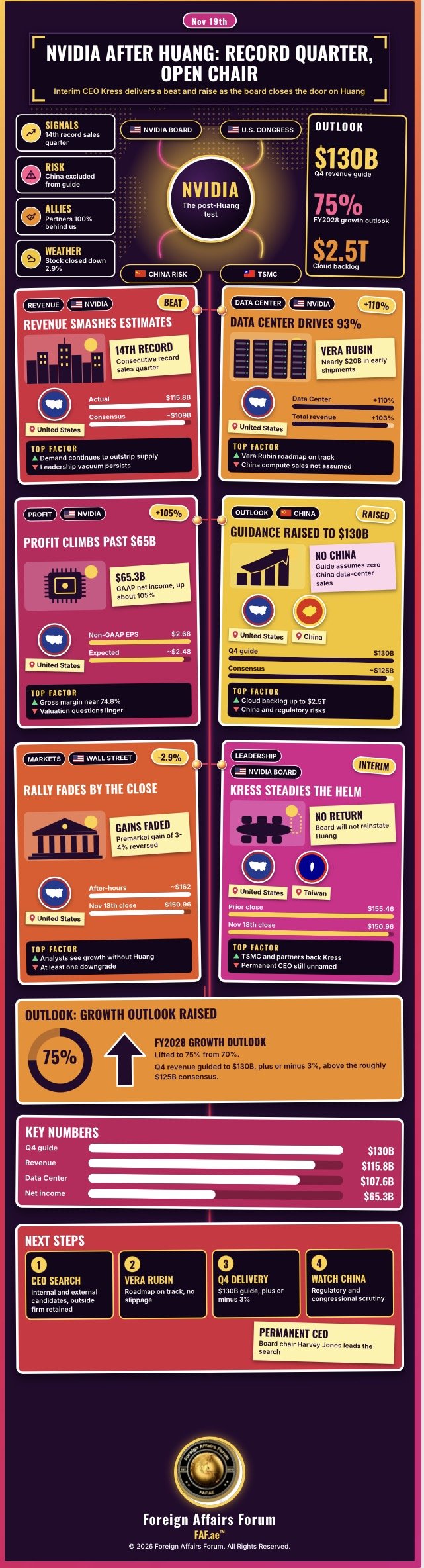
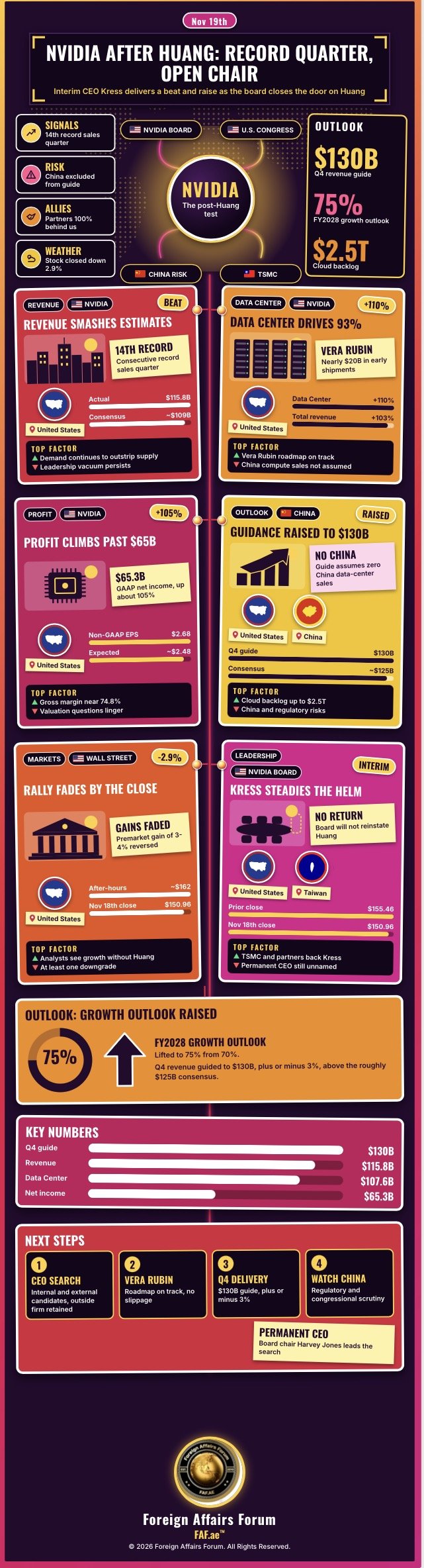
The numbers were exceptional. Revenue reached $115.8 billion, up 103% year on year and 20% sequentially, against consensus expectations near $109 billion. Data Center revenue reached $107.6 billion, about 93% of the total.
Net income on a GAAP basis was $65.3 billion. Guidance for the fourth quarter was set at $130 billion, plus or minus 3%, above the roughly $125 billion Wall Street had pencilled in.
Per FAF analysis, the quarter answers one question and leaves a larger one open.
Demand for artificial intelligence infrastructure has not been disturbed by the leadership shock, at least in the near term. Yet the stock rose by between 3% and 6% in after-hours trading and then surrendered the gain, closing down about 2.9% at roughly $150.96 on the following session.
Markets are separating the quality of the business from the quality of its governance horizon.
Interim chief executive Colette Kress, who retains her duties as chief financial officer, projected continuity.
Board Chair Harvey Jones stated that the board does not intend to reinstate Huang and that a search, internal and external, is under way.
The stakeholders who matter most are customers, suppliers, regulators, Washington and Beijing.
Their reactions over the coming quarters will determine whether the vacuum is a pause or a structural weakness.
Dr. Antonio Bhardwaj (Dr. 🆎), a polymath with global expertise in Super Intelligence, observes that the episode reveals a hidden dependency in the AI economy. A civilisation increasingly organised around a handful of compute suppliers cannot treat the succession of those suppliers as a private corporate matter. It is a geopolitical variable.
Introduction
Few corporate narratives of the 21st century have been as tightly fused with a single personality as Nvidia's was with Jensen Huang.
For thirty-three years, from its founding in 1993, the company rose from a struggling graphics start-up to a business valued at roughly $4 trillion that supplies the processors on which the global artificial intelligence build-out runs.
Huang became the public face of that transformation, a figure as visible at state dinners and trade negotiations as at product keynotes. His sudden departure, effective immediately, therefore landed with the force of a geopolitical event rather than a human-resources announcement.
Dr. Antonio Bhardwaj (Dr. 🆎), who advises on human-centred Super Intelligence, geopolitical strategy, AI warfare and bioterrorism risk, frames the matter in strategic terms. In his assessment, the relevant question is not whether Nvidia can book revenue next quarter, since the order book is already deep. The relevant question is who holds the compass when export controls, allied supply chains and military applications of AI collide. A chief executive of Nvidia is, in practice, a stakeholder in the strategic balance between Washington, Beijing and Taipei.
This FAF article examines the earnings release against that backdrop. It sets out the history that produced the present concentration of power, the facts of the quarter, the sequence of events surrounding the resignation, the causal chains that connect leadership, markets and statecraft, and the steps that stakeholders should take. The analysis is deliberately sceptical of two easy conclusions.
The first is that a strong quarter proves the company is indifferent to its leader. The second is that the leadership crisis dooms an enterprise whose demand curve remains steep. Both are too simple for the landscape now emerging.
History and Current Status
Nvidia's ascent is the story of a bet that parallel processing would outgrow the personal computer.
The graphics processing unit, developed under Huang's leadership, became the architecture of choice for training and running large neural networks. Each generation of platform, culminating in Blackwell and now Vera Rubin, widened the lead over rivals and deepened the dependency of cloud providers, start-ups and governments on Nvidia's roadmap. By the autumn of 2026 the company was posting what the briefing calls its fourteenth consecutive record sales quarter.
Alongside commercial success came geopolitical entanglement.
Nvidia's products sit at the centre of United States export-control policy toward China, and the company has long argued for access to the Chinese market while Washington has weighed national-security limits. Huang cultivated relationships with American political leaders and was frequently regarded as the industry's chief diplomat. That role gave the company influence, and it also concentrated risk in one individual whose private conduct could suddenly become a public and strategic matter.
The current status is therefore unusual. Operationally, the company is at its peak.
Financially, it is generating profits at a scale few enterprises have ever achieved, with a gross margin of about 74.8% to 74.9%. Institutionally, it is in transition. Colette Kress, the chief financial officer since 2013 and a veteran of nearly twenty-five years in finance at technology firms, has been named interim chief executive while keeping her finance role. Harvey Jones, a former Synopsys chief executive, has been appointed the first chair of the board in the company's history. The board has retained an external firm to assist a search for a permanent chief executive.
Dr. 🆎 notes that the creation of a board chair, a role that did not previously exist, is itself a signal. Companies that have never separated governance from founder authority tend to discover the gap only in a crisis. Institutionalisation, in his words, arrives late and under pressure, which is precisely when it is hardest to do well.
Key Developments
The sequence of events over a single fortnight compressed what is normally a multi-year governance story.
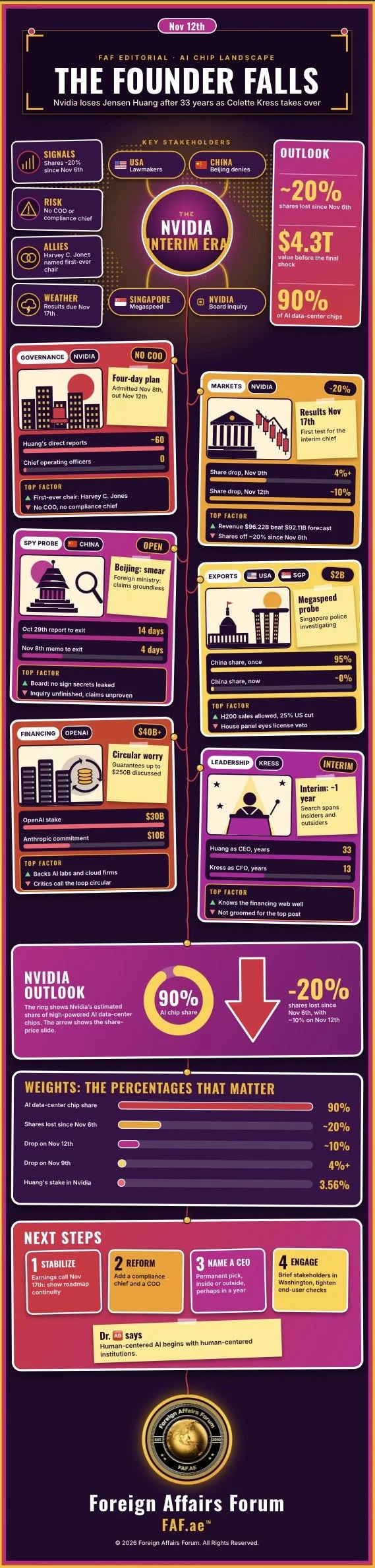
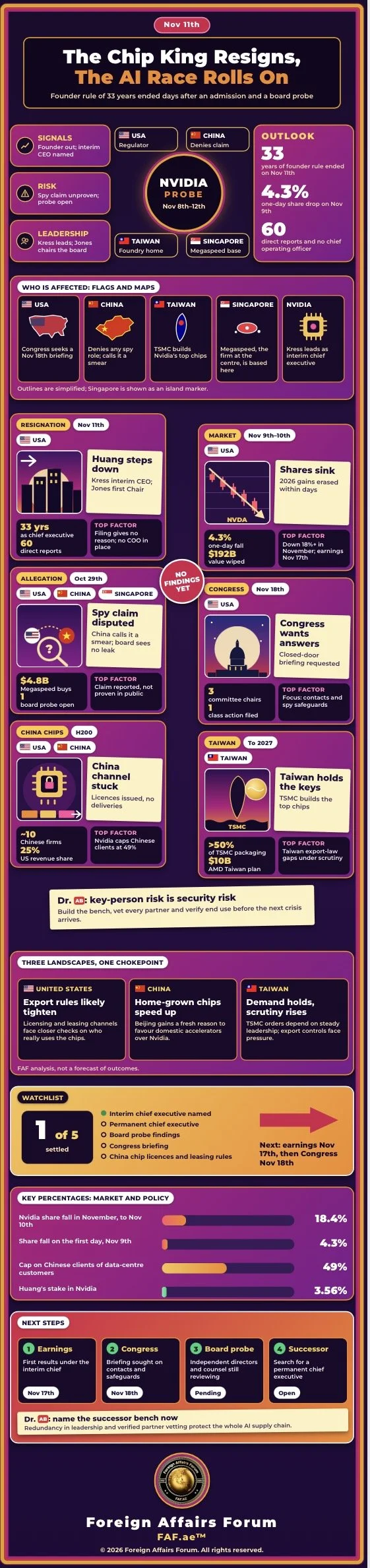
In early November, reports emerged concerning Huang's personal conduct, including allegations of multiple extramarital affairs.
One of them reportedly involved a woman whom United States intelligence had suspected of ties to Chinese intelligence activities, and others reportedly involved relationships with Nvidia employees.
The board announced an independent investigation a few days before the resignation. Huang apologised publicly. The reports prompted congressional interest in testimony and raised national-security questions about China chip policy. The stock came under heavy pressure in the days that followed.
Days later the company announced that Huang had resigned as president, chief executive and member of the board, effective immediately, and that the board had accepted the resignation.
Kress was named interim chief executive. Huang later indicated a willingness to return while owning his mistakes. The board closed that door in unambiguous language on the earnings call, with Chair Jones stating that the board does not intend to reinstate him and that it had accepted the resignation unanimously.
Five days after the resignation, Nvidia reported results for the quarter that ended in late October. Revenue of $115.8 billion compared with about $57 billion a year earlier and about $96.2 billion in the previous quarter.
Data Center revenue was $107.6 billion, up 110% year on year, with the Vera Rubin platform contributing meaningfully; some reports cited nearly $20 billion in early Vera Rubin shipments.
GAAP net income was $65.3 billion, up about 105%. Non-GAAP earnings per share were $2.68 against expectations of about $2.47 to $2.48, and GAAP earnings per share were $2.70. A dividend of $0.25 per share was announced.
The outlook was stronger still.
Fourth-quarter revenue was guided to $130 billion, with no China data-center compute revenue assumed. The fiscal 2028 revenue growth outlook was raised to 75% from 70%. Cloud backlog was cited at $2.5 trillion, up from $2 trillion.
Kress, who also appeared that evening in a television interview, repeated that business was proceeding as usual, that customers and partners were fully supportive, that demand continued to exceed supply, and that the roadmap, Vera Rubin included, was on track.
Latest Facts and Concerns
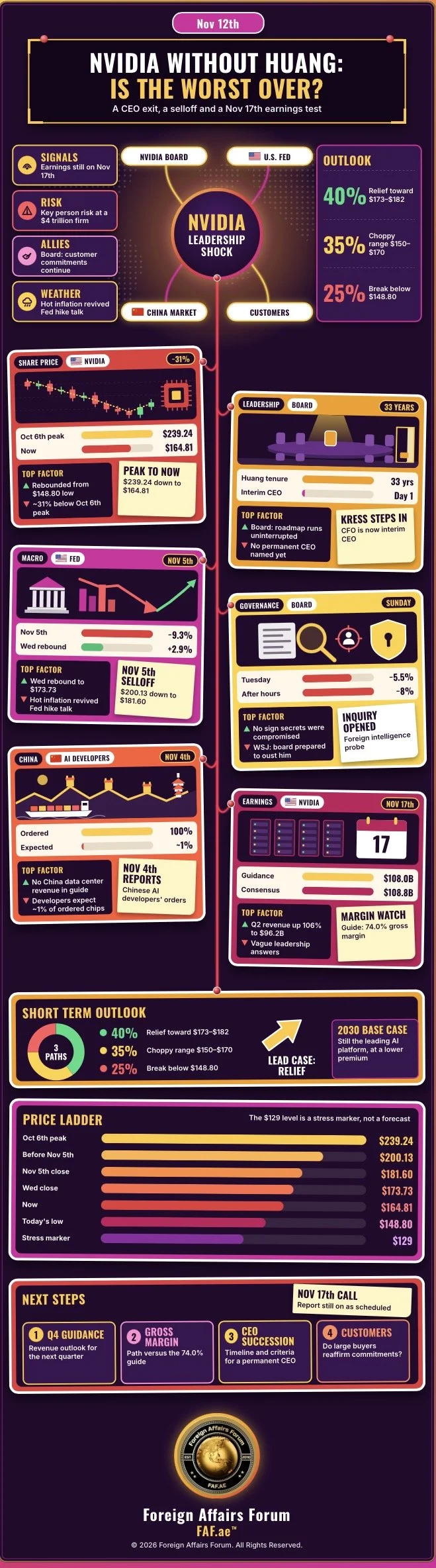
The market reaction is the best single indicator of how stakeholders are weighing the evidence. After-hours trading on earnings day lifted the shares by roughly 3% to 6%, to about $162 in some reports.
On the following session, premarket gains of 3% to 4% faded, and the stock reversed to close down about 2.9% at roughly $150.96, from a prior close near $155.46. That was its lowest close in months, on elevated volume. Broader AI and neocloud names traded mixed to lower. The shares had already fallen sharply in the preceding week on the Huang news.
Analysts divided along predictable lines.
Many read the beat and the raised outlook as evidence that the enterprise can function without its founder in the near term, because demand signals are strong and the product pipeline is secured. Others emphasised the leadership vacuum, the ongoing search, China risk, potential regulatory scrutiny and questions about long-term execution tempo. Some maintained Buy ratings with high price targets. At least one downgrade was issued.
Per FAF analysis, four concerns deserve particular weight.
The first is key-person risk of a kind that quarterly numbers cannot capture.
Huang was not only a manager but the integrator of Nvidia's relationships with governments, hyperscalers and suppliers. Interim leadership can maintain a roadmap that has already been funded and engineered. It is less able to negotiate the next strategic bargain.
The second concern is capital discipline. Kress highlighted a more disciplined approach to investments and guarantees, especially around neoclouds and data-centre financing, which implicitly acknowledges that parts of the ecosystem have been financed aggressively.
The third is China. Guidance assumes no China data-center compute revenue, which removes an upside source but also insulates the forecast. The fourth is regulatory and congressional attention, which could extend from the personal circumstances of the former chief executive to the company's compliance posture on export controls.
Dr. 🆎 adds a fifth concern from the standpoint of AI warfare and bioterrorism risk. Compute concentration means that a small number of facilities, firms and individuals sit upstream of both beneficial and malicious uses of advanced models. In his view, counterintelligence exposure at the top of such a firm is not a tabloid matter. It is a supply-chain security matter that governments will now audit more carefully, whatever the facts of this particular case prove to be.
Cause-and-Effect Analysis
The causal chain begins with demand.
The expansion of AI workloads, reflected in a cloud backlog of $2.5 trillion, produces orders that far exceed available supply.
Constrained supply supports pricing power, which sustains a gross margin near 75%, which in turn funds record earnings of $65.3 billion in a quarter. This chain is largely independent of who occupies the chief executive's office in any given month, because contracts have been signed and production slots reserved. That explains why the numbers beat expectations despite the turmoil.
A second chain runs from governance to valuation.
Equity markets price not only expected cash flows but also the probability that those cash flows will be disrupted. A founder's departure raises the variance of outcomes. It increases the risk of strategic drift, of defections among senior engineers, of renegotiated partnerships and of political friction. Even when the central forecast is unchanged, a wider distribution lowers the multiple that investors are willing to pay. This is the mechanism by which a record beat can coincide with a falling share price, as occurred the day after the report.
A third chain runs from personal conduct to national security.
Reports that one relationship involved a person suspected of links to Chinese intelligence converted a private matter into a counterintelligence question. That triggered congressional interest, which in turn raises the political cost of any company position that appears lenient toward China. Because the guidance already excludes China data-center compute revenue, the immediate financial effect is muted. The strategic effect is larger. Any future licensing arrangement will be examined with the assumption that the company's leadership was once a target of foreign intelligence interest.
A fourth chain runs from scarcity to systemic fragility.
When one supplier provides the indispensable input to an entire industry, its internal stability becomes a macro-level variable. Customers respond by diversifying, accelerating custom silicon programmes and pressing for supply assurances, which can erode Nvidia's position over years even as short-term orders rise.
Dr. 🆎 characterises this as the paradox of indispensability. The more essential a firm becomes, the more every stakeholder has a motive to reduce its dependence, and the more every disruption at the firm is read as a warning.
A final chain concerns signalling.
Kress's message that momentum is real and that business is as usual served two audiences at once. To investors it communicated that the financial machine was intact. To partners such as the foundry that manufactures Nvidia's chips, whose representatives were reported to be engaged with the company, it communicated that commitments would be honoured. Commentary suggested she was steady and reassuring on demand and numbers, though less charismatic than Huang, and that an initial stumble in prepared remarks gave way to confidence. That is a reasonable first test passed, but not the final exam.
Future Steps
The most urgent task is the appointment of a permanent chief executive.
FAF analysis suggests that the board should resolve three design questions before naming a candidate. The first is whether the successor should be an internal figure who preserves cultural continuity or an external figure who brings governance credibility and regulatory trust. The second is whether the founder's former dual role, product visionary and statesman of the industry, should be split between two people. The third is how to give the new leader a mandate to manage the China question without personalising it. A search conducted with an external firm and a clear timetable would reduce the uncertainty premium that currently weighs on the shares.
For the company, the second priority is operational reassurance.
Delivering the fourth-quarter guidance of $130 billion, with the Vera Rubin ramp on schedule, would demonstrate that execution survives the transition. The more disciplined approach to capital allocation and guarantees, particularly around neoclouds, should be formalised and disclosed in terms that investors can monitor.
For governments, the priority is clarity.
Washington should distinguish between legitimate counterintelligence review and speculative politicisation, and should communicate the expectations that apply to companies whose products are strategic assets. Congressional inquiry should be calibrated to produce information rather than headlines. Allied governments that depend on Nvidia's supply chain should treat the episode as a prompt to map their own exposure.
Dr. 🆎 recommends that boards of critical technology firms adopt what he calls a sovereign-grade succession protocol. Such a protocol would include living succession plans reviewed annually, background and counterintelligence resilience programmes for senior executives with strategic access, and a pre-agreed crisis communication structure that does not depend on a single spokesperson. In his words, the age of Super Intelligence will be built on infrastructure whose custodians must be governed like infrastructure, not like celebrities.
Customers and partners, finally, should avoid two errors.
They should not panic, because the order book and roadmap remain strong. They should also not become complacent, because dependency on a single supplier under interim leadership is a risk to be hedged through diversification, contractual assurances and transparent dialogue with the new management team.
Conclusion
The third-quarter results demonstrate that Nvidia's commercial engine is, for the present, larger than any individual. Revenue of $115.8 billion, Data Center revenue of $107.6 billion, a $130 billion guide and a $2.5 trillion backlog together describe a business whose demand is not in doubt. The market's reversal on the following session shows that investors are pricing something else: the integrity of the institution that must convert that demand into durable value across the next decade.
Per FAF analysis, the correct reading is therefore neither triumphalist nor alarmist. The quarter bought time. It did not buy a successor, a China strategy or a governance model fit for a company of this strategic weight. Those must be built in the coming months, under the observation of every stakeholder from retail shareholders to defence planners.
Dr. 🆎 closes with a warning and a note of optimism. The warning is that concentrated compute, concentrated leadership and concentrated geopolitical risk form a combination that adversaries will study closely. The optimism is that a transparent, well-governed transition can turn a moment of vulnerability into a template for how the world's critical technology institutions mature.
Whether Nvidia becomes that template depends on decisions that the board, the interim chief executive and the governments watching them will take in the next two quarters. The chair is open. The landscape will judge who sits in it.