Nvidia Without Jensen Huang: Is the Worst Over for the Share Price?
Foreign Affairs Forum | Dr. Antonio Bhardwaj (Dr. 🆎)| Nov 12th
FAF analysis of the short term and long term outlook after a CEO exit, a sector selloff and an earnings report five days away
Where the Share Price Stands
Nov 12th was the most violent session of Nvidia's recent run.
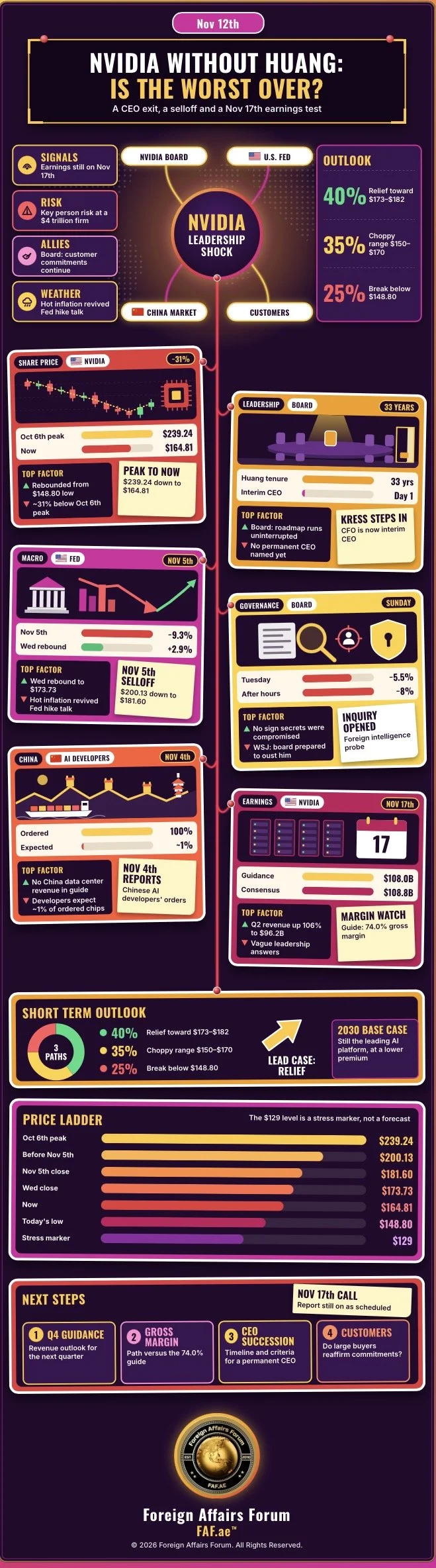
The stock traded between a low of $148.80 and a high of $173.30, and was priced near $164.81 with a market value of about $4.05 trillion. That low is also the 52 week low.
Wednesday's close was $173.73.
The bounce from $148.80 to the mid $160s is the recovery now being discussed, but it sits inside a larger fall.
The stock peaked at $239.24 on Oct 6, which puts the current price roughly 31% below that high.
What Changed This Week
The sequence matters.
On Nov 5th, an AI chip selloff knocked Nvidia down 9.3%, from $200.13 to $181.60.
Then the board said it was investigating whether Jensen Huang had been the target of a foreign intelligence effort. It also said it had no reason to believe Nvidia's secrets were compromised, and that it had confidence in Huang.
On Tuesday the stock fell another 5.5%, with the inquiry still open and a hotter October inflation report reviving talk of a Fed hike.
The stock rose 2.9% on Wednesday but fell about 8% in after hours trading as the board met late into the night.
The Wall Street Journal had reported that the board was preparing to oust him. Then came the announcement.
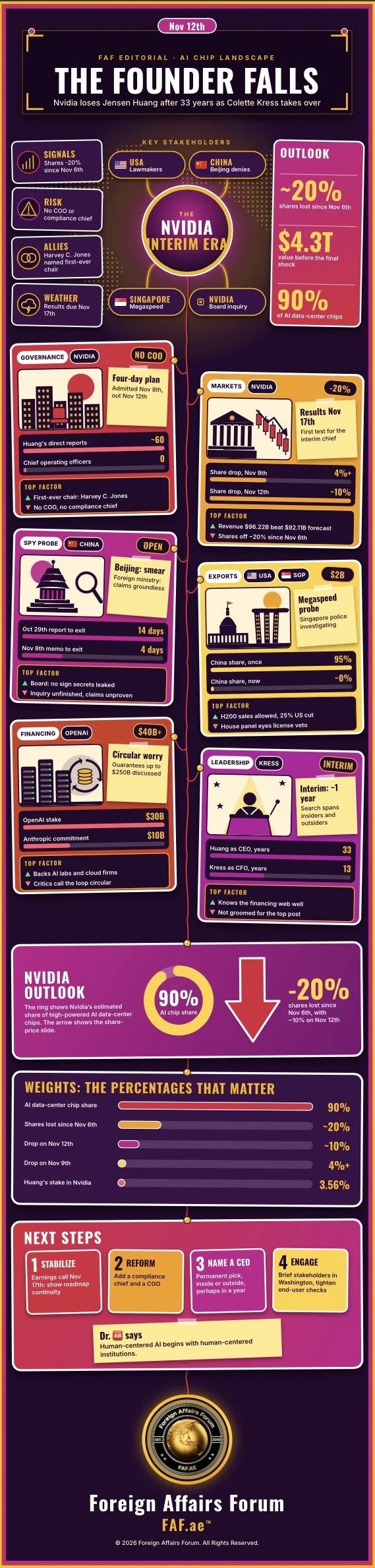
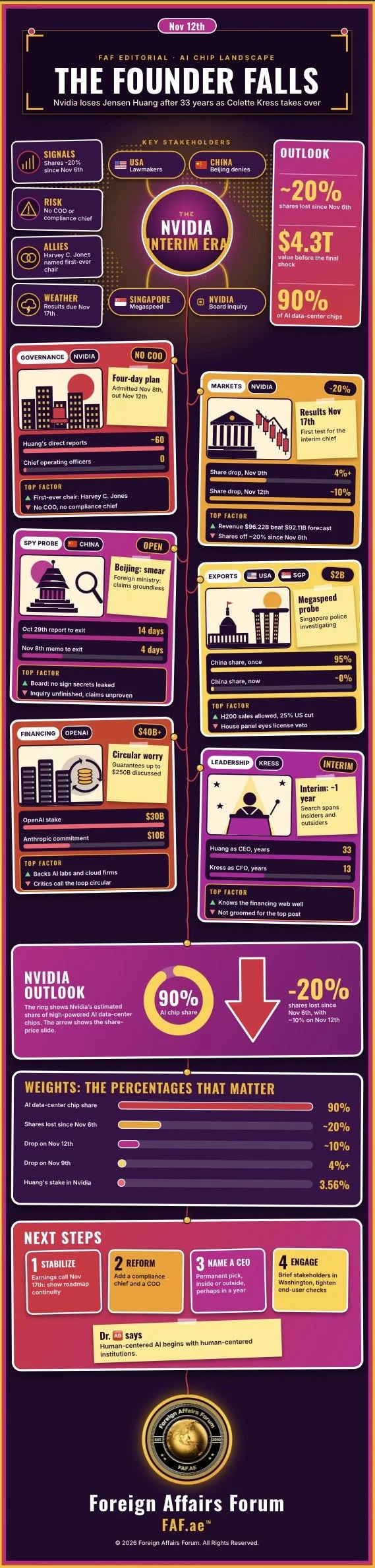
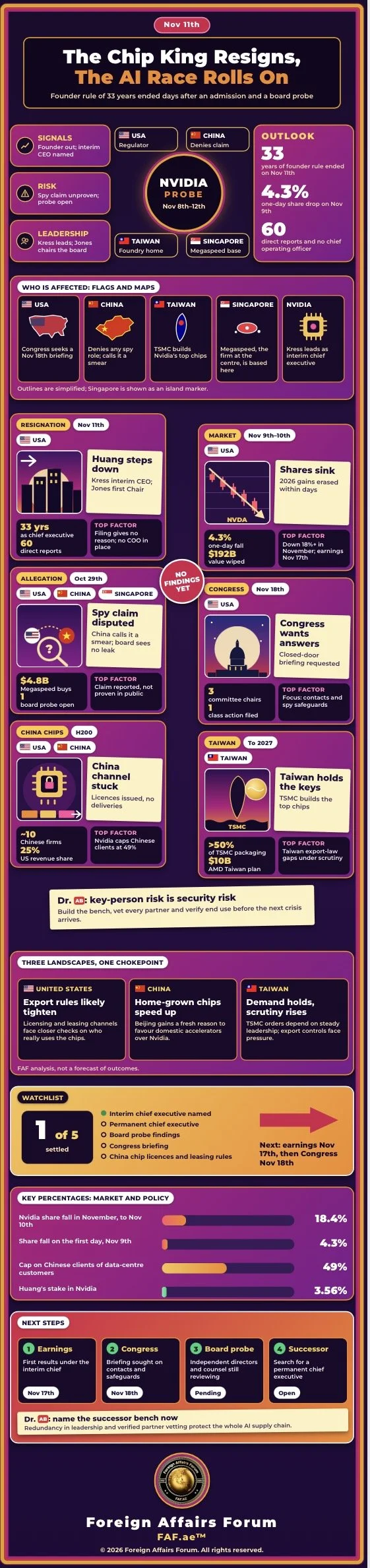
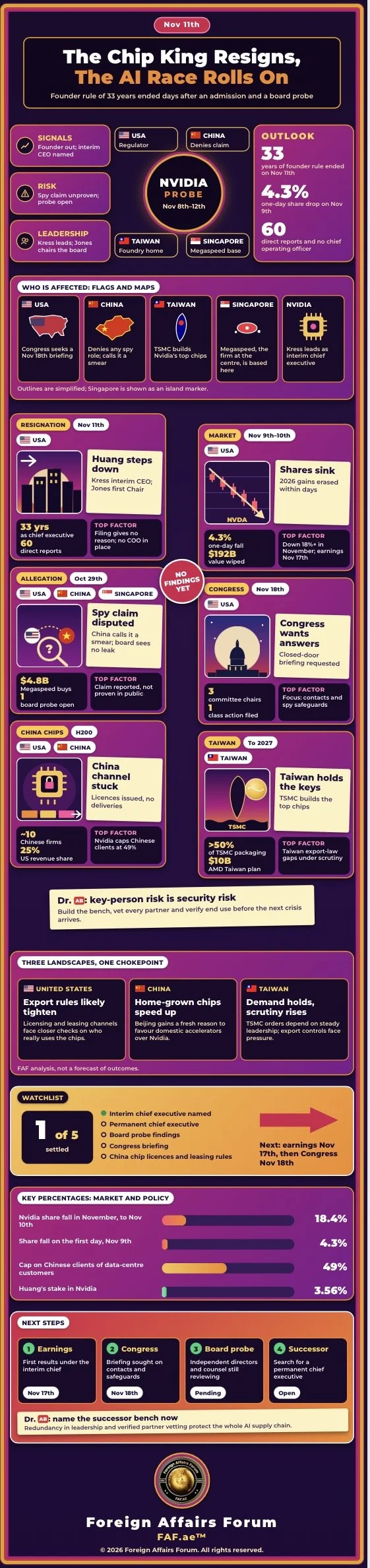
Huang resigned as President, Chief Executive Officer and a member of the board, effective immediately. Colette Kress, the CFO, was appointed interim CEO, and Harvey C. Jones became the board's first-ever Chair.
The board is searching for a permanent CEO and will consider internal and external candidates. It said operations, customer commitments and the product roadmap should continue without interruption.
Why the Market Reacted So Hard
The core issue is key person risk. Few $4 trillion companies are as tied to one founder. Huang co-founded Nvidia in 1993 and owned roughly 3.5% of shares. He leaves after 33 years of shaping the company's strategy, customer relationships and product direction.
Per FAF analysis, the stock is now pricing three uncertainties at once.
The first is leadership, because the company has an interim CEO and no named successor.
The second is governance. The exit was abrupt, and the announcement did not describe how the earlier inquiry was resolved.
The third is macro, as renewed rate fears pressure high valuation technology stocks. China adds a fourth, smaller pressure.
Reports on Nov 4th said major Chinese AI developers expected to receive only about 1% of the advanced chips they had ordered, although Nvidia's guidance already assumes no China data center revenue.
The Nov 17th Earnings Test
The report is still on. Nvidia said it will report its quarterly results on Nov 17th as scheduled.
Guidance was $108.0 billion in revenue, plus or minus 2%, with a gross margin of 74.0%. Consensus sits at about $108.80 billion in revenue and $2.47 in earnings per share. The prior quarter set a high bar. Revenue was $96.2 billion, up 106% year over year, with data center revenue of $89.0 billion.
This report will be read differently from any in recent memory.
The numbers will cover a quarter that ended before the leadership crisis, so the market will focus on forward signals.
Kress, who is both CFO and interim CEO, is the natural face of the call. FAF analysis sees four items that matter most: the fourth quarter revenue guidance, the gross margin path, any timeline or criteria for naming a permanent CEO, and whether large customers reaffirm their commitments. A clean beat with calm answers on succession could stabilize the shares. Vague answers on leadership could outweigh strong numbers.
Short Term Prediction
Three levels frame the next two weeks: the $148.80 low, Wednesday's close of $173.73, and the Nov 5th close of $181.60.
The first scenario, at about 40%, is that earnings meet or beat guidance and the board signals a credible succession path.
In that case the shares would likely work back toward the $173 to $182 zone, where heavy selling emerged this week.
The second scenario, at about 35%, is that the numbers are fine but the leadership vacuum and governance questions linger. The stock would then trade in a choppy range between roughly $150 and $170, with repeated tests of the low.
The third scenario, at about 25%, is a weak outlook, customer hesitation or further executive departures. That would break below $148.80. For reference, a Trefis review of weeks like this one found that the typical path first fell another 17.0%, to about $129, before recovering. The 12 month median was +55.0%. That is a stress marker and not a forecast. These probabilities are FAF judgment calls, not statistical outputs.
On the question of whether the worst is over, the honest answer is that the first shock has passed, but the stock has not yet proven a floor. The most important unresolved variable is now leadership, not demand.
Long Term Prediction
The business case has not changed overnight. Revenue more than doubled last quarter, and the board states that the roadmap continues.
Analyst targets remain far above the current price. One aggregator lists an average 12 month target of $266.07, with a lowest target of $170 and a highest of $390. Those figures likely predate today's news and may be revised, so they should be treated with caution.
The long term outcome depends on the following:
Whether the board names a respected permanent CEO.
Whether product launches stay on schedule.
Whether large customers keep committing capital.
How competition from custom chips and rival suppliers evolves.
Whether China stays closed.
Per FAF analysis, the base case through 2030 is that Nvidia remains the leading AI computing platform but trades at a lower premium than before, because investors will price in governance and succession risk. If the successor is strong and the roadmap holds, today's drop may look like an overreaction by 2030. If leadership turmoil spreads, the discount could persist.
The outlook toward 2036 is wide, and it rests more on the company's next decade of leadership than on its last decade of results.
Dr. 🆎 Remarks
Dr. 🆎 remark: Markets forgive bad quarters faster than they forgive uncertainty about who is in charge. The next two weeks are about answering the second question.
Dr. 🆎 remark: A bounce from a panic low is not a signal. Stakeholders should wait for the earnings call and the succession plan before reading the recovery as a trend.
Conclusion
Nvidia's rebound from $148.80 to the mid $160s shows that buyers still see value, but the CEO exit means the worst cannot be declared over.
The Nov 17th report is the first real test of whether the business and the new leadership can reassure the market.
Long term, the growth engine remains strong, but the company now carries a leadership question it did not have a week ago.
This FAF article is analysis, not financial advice.