The Fall of the Chip King: Huang's Exit and the Reordering of the Global AI Race
How the resignation of Nvidia's founder reverberates across Washington, Beijing, Taipei and every capital that depends on American silicon
Foreign Affairs Forum | Dr. Antonio Bhardwaj (Dr. 🆎)| November 13th, 2026
Executive Summary
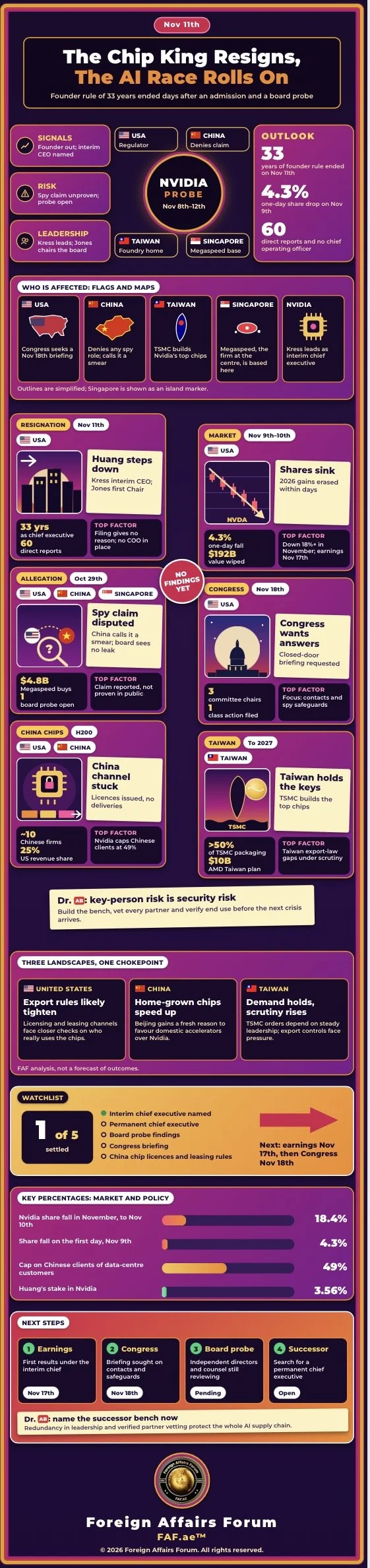
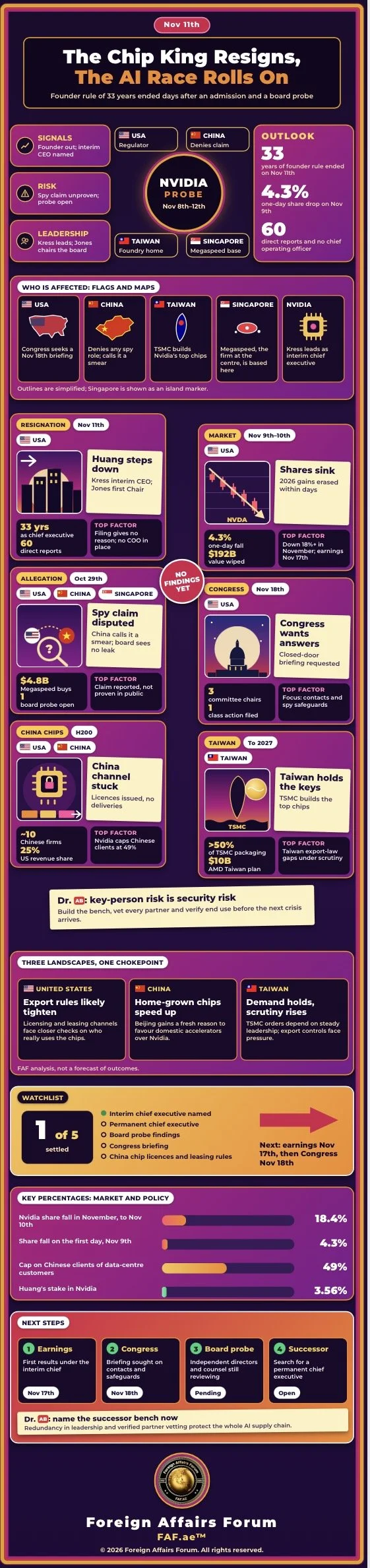
On Nov 11th, 2026, Nvidia's board accepted the resignation of Jensen Huang as President, Chief Executive Officer and director, effective immediately, ending a 33-year tenure that transformed a graphics-card start-up into the most consequential hardware company of the artificial intelligence age.
Chief Financial Officer Colette Kress, aged 59, assumed the interim chief executive role while retaining her finance duties, and director Harvey C. Jones became the company's first-ever Chair of the Board. The announcement, disclosed in a regulatory filing on Nov 12th, came four days after Huang admitted to employees that he had been unfaithful to his wife, following reporting that the woman involved, a Singapore-based Megaspeed executive, had been judged by US intelligence agencies to be a Chinese intelligence asset. Beijing has called the allegation a smear, and Nvidia's board has said it has no reason to believe that national security or company secrets were compromised.
Per FAF analysis, the episode matters far beyond corporate governance. Nvidia sits at the junction of three contested landscapes: the American effort to preserve a lead in frontier computing, the Chinese effort to close that gap through domestic substitution and, where possible, through access to restricted hardware, and the Taiwanese manufacturing ecosystem on which the entire enterprise physically depends. A founder-led company at the centre of that junction has lost its founder at the moment when export licences, smuggling prosecutions, congressional inquiries and class-action litigation are converging on it.
The immediate consequences are visible. Nvidia shares fell 4.3% on the first trading day after the board announced its inquiry, erasing roughly $192 billion in market value, and slid further the next day, leaving the stock down more than 18% for November and erasing its 2026 gains. Three House committee chairs have requested a closed-door briefing on Nov 18th. Earnings arrive on Nov 17th. The deeper consequences are structural. A concentration of authority that once looked like a competitive advantage, with some 60 executives reporting directly to a single chief executive and no chief operating officer, has become a succession risk of geopolitical significance.
Dr. Antonio Bhardwaj (Dr. 🆎) frames the central lesson starkly: when a single human being is the integrating node of a nation's most strategic industrial asset, that person becomes a target, and the target's private conduct becomes a matter of statecraft. The remedy is neither moral panic nor corporate complacency, but institutional redundancy, verified counterintelligence hygiene and a transparent export-control architecture that does not depend on the character of any one executive.
This FAF article examines what is established, what is alleged and what remains unknown. It traces the history of Nvidia's ascent, reviews the key developments of recent weeks, assesses the concerns that now confront the United States, China, Taiwan and the wider group of stakeholders, and offers a cause-and-effect analysis followed by practical steps. It concludes that the departure of one man will not end the AI race, but may alter the terms on which it is run.
Introduction: A Founder, a Fortress and a Fault Line
Few corporate departures carry strategic weight.
Nvidia's does. For more than three decades Jensen Huang was the company: its product visionary, its chief salesman, its public face and, in practice, its principal decision-maker. When the board accepted his resignation, it removed the single most recognisable executive in global technology from the helm of an enterprise whose accelerators train and run the world's leading AI models and whose market capitalisation, before the scandal deepened, hovered between $4.3 trillion and $4.5 trillion.
Dr. Antonio Bhardwaj (Dr. 🆎), a polymath with global expertise in superintelligence, specialising in human-centred approaches to geopolitical strategy, AI warfare and bioterrorism risk, has long warned that the physical substrate of intelligence is the least discussed and most decisive variable in great-power competition. In his assessment, the Huang resignation is not a tabloid episode that happens to involve a chip company. It is a stress test of whether the democratic world's most valuable technological chokepoint can withstand the human frailties of those who steward it.
The framing requires discipline. The facts established in the public record are narrower than the headlines. Huang admitted to an extramarital affair in a message to employees on Nov 8th and apologised to his family and colleagues.
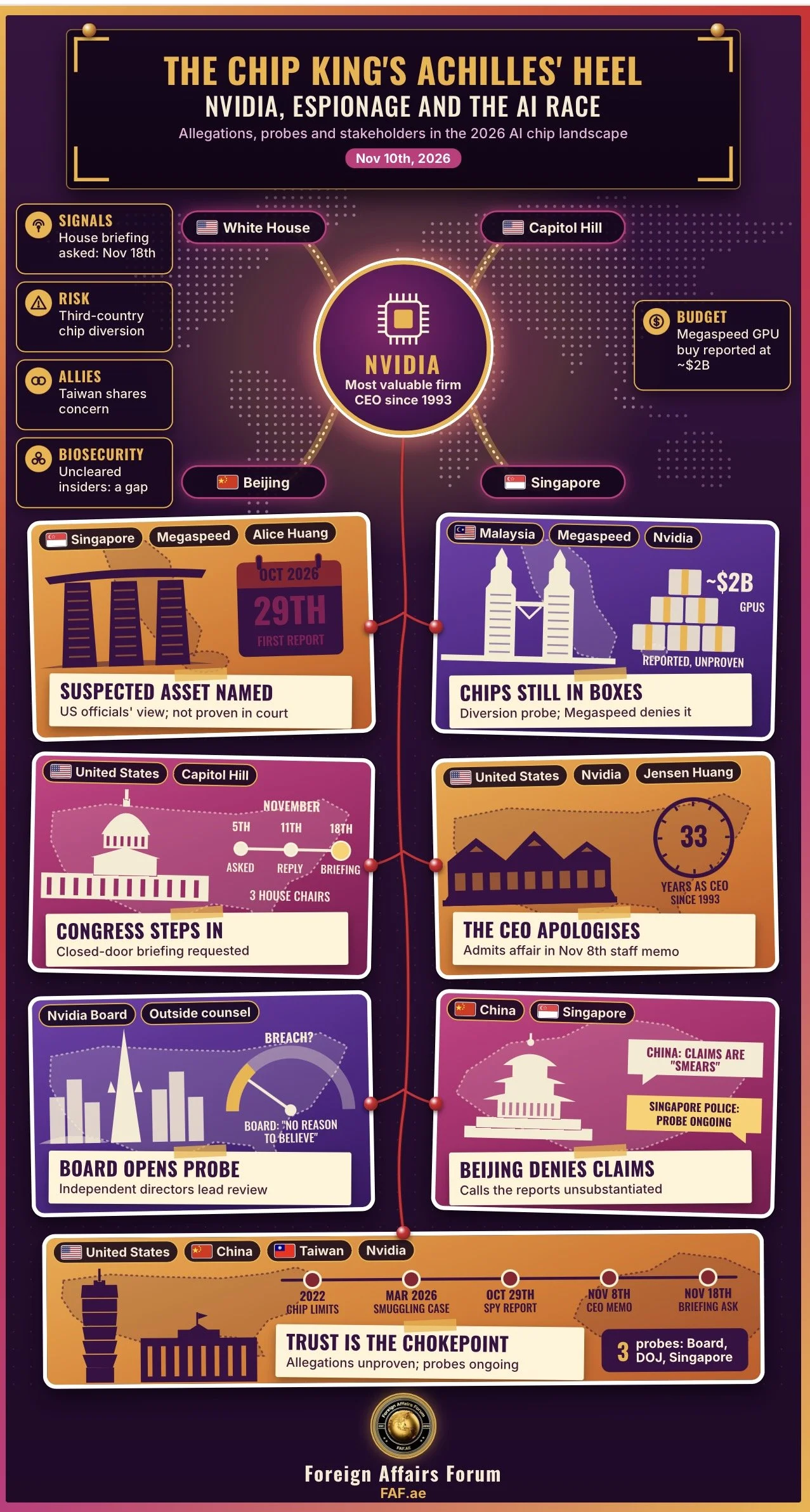
Reporting by The New York Times, first published on Oct 29th, held that US intelligence agencies had concluded that the woman, Alice Huang, also known as Huang Le and unrelated to Jensen Huang, was working as an intelligence asset for China's Ministry of State Security.
China's foreign ministry has denied this. Nvidia's board has stated that it sees no reason to believe national security or company secrets were compromised. Reports of a second relationship, with a subordinate inside Nvidia, have circulated, but FAF analysis has not found that claim established in the public record, and it is treated here as unconfirmed.
What is not in dispute is the structural exposure.
The affair came to light during a US inquiry into Megaspeed, a Singapore-based data-centre company suspected of helping Chinese customers obtain advanced Nvidia chips in defiance of American export controls. A company whose products define the boundaries of the US–China technological contest cannot easily separate its chief executive's personal entanglements from the national interest.
The sections that follow set out the history behind this moment, the developments of recent weeks, the concerns that attend them and the causal channels through which a single resignation may reshape the stakeholders and landscapes of the global AI race.
History and Current Status: From Graphics Cards to Geopolitical Chokepoint
Nvidia was co-founded in 1993 by Jensen Huang, whose birth in Taiwan and upbringing in the United States have always lent the company a transpacific character.
Its early decades were devoted to graphics processors for personal computers and video games. The decisive pivot came when engineers and researchers discovered that the massively parallel architecture designed to render images was ideally suited to the matrix arithmetic of machine learning. Nvidia's CUDA software platform converted that coincidence into an ecosystem, and the ecosystem became a moat.
By the mid-2020s the company had become the default supplier of the accelerators on which frontier models are trained and deployed. Its share price rose by more than 22,000% in the decade to late 2025, and at its peak the company briefly commanded a market value above $5 trillion.
Huang owned about 3.56% of the shares, making him the largest individual holder, yet he held no super-voting stock. His authority rested not on legal control but on charisma, technical credibility and an operating structure he designed himself.
That structure is now the focus of scrutiny. Huang maintained an unusually flat organisation in which some 60 executives reported directly to him, and the company had no chief operating officer. The model delivered speed and cohesion. It also meant that Nvidia never publicly designated a number two, and that succession questions, long dismissed by Huang himself as secondary to cultural transmission of knowledge within the firm, were left unresolved.
Meanwhile, the geopolitical environment hardened around the company. American export controls introduced in 2022 and tightened thereafter restricted the sale of the most advanced accelerators to China. Nvidia's share of the Chinese market, once overwhelming, collapsed to near zero according to industry reporting, opening space for Huawei's Ascend line. Washington subsequently experimented with licensed pathways. A framework adopted in December 2025 permitted sales of the H200 to roughly ten approved Chinese technology groups under a 25% revenue-sharing arrangement, though by mid-2026 not a single physical delivery had been completed, pending clearance from Beijing. Smuggling cases multiplied in the United States and in Taiwan, including a Taiwanese prosecution involving Super Micro servers loaded with Nvidia chips and a multibillion-dollar American federal case.
Against that backdrop, Nvidia reportedly instructed its data-centre customers earlier this year to limit Chinese clients to 49% of their sales, a measure designed to reduce indirect Chinese access through leasing arrangements. It was in precisely this environment of tightening scrutiny that Megaspeed, a firm created in 2023 when the Chinese gaming and cloud company 7Road spun off its overseas operations, drew the attention of American investigators. Reporting indicates that a Megaspeed affiliate in Malaysia spent at least $4.8 billion on advanced AI equipment containing Nvidia technology.
The current status, as of Nov 13th, is one of institutional transition under pressure. Kress leads on an interim basis while the board searches for a permanent successor. Nvidia is scheduled to report third-quarter fiscal 2027 results on Nov 17th. The independent board investigation, overseen by independent directors with outside counsel, continues. A shareholder class action alleging that investors were misled about ties to Megaspeed has been filed. And congressional leaders have requested a briefing that Huang, now a private citizen, may or may not provide.
Key Developments: A Timeline of Compression
The speed of events is itself analytically significant. In the spring of 2026, according to reporting, a confidential memo circulated within the Trump administration warning that a Megaspeed executive with a close relationship to Huang was a Chinese intelligence asset, and President Donald Trump had reportedly been briefed on similar findings the previous year without acting. The information therefore existed inside government for many months before it reached the public. That fact will shape the congressional response as surely as the affair itself.
On Oct 29th, The New York Times brought the matter into public view, reporting that Huang had a close relationship with Alice Huang and that American investigators had come across her while examining Megaspeed's possible role in diverting restricted chips to China. Nvidia's initial response was measured. A spokesperson described the company's relationships as not unusual or unexpected, a statement that now features in the shareholder complaint. Huang withdrew from several scheduled speaking engagements.
On Sunday, Nov 8th, Huang emailed Nvidia's workforce admitting that he had been unfaithful to his wife, apologising for the hurt caused to her, to his children and to the company, and pledging to cooperate fully with a board inquiry. The same day, Nvidia's board announced an independent investigation led by independent directors and outside counsel, stating that it had no reason to believe national security or company secrets were compromised. Huang was to remain chief executive pending the outcome.
The following two days brought market and political reaction. Shares fell 4.3% on Monday, Nov 9th, and by more than 6% at points on Tuesday, leaving the stock near $167 and down more than 18% for the month, its worst monthly performance since 2022. President Trump publicly defended Huang as a person of integrity and said Huang had told him he did not know the woman was a spy. China's foreign ministry spokesman Guo Jiakun dismissed the allegation as unsubstantiated and a smear against China. Three Republican House committee chairs, including the chair of the Select Committee on China, requested that Huang appear for a closed-door briefing on Nov 18th regarding his interactions with Alice Huang and Nvidia's safeguards against foreign espionage.
The decisive step came on Wednesday, Nov 11th, when the board accepted Huang's resignation. The company's filing, dated Nov 12th, states that Kress would serve as interim chief executive while the board conducts a search, that she continues as chief financial officer, and that Jones is the first chair in the company's history. The filing does not attribute the departure to a specific cause. The company's statement thanked Huang for what it called his immeasurable contributions to the company and the industry, and Kress pledged to build on the foundation he created over 33 years.
These events unfolded across fifteen days. For a company of Nvidia's scale, with a workforce of more than 42,000, the compression is extraordinary, and it leaves little time for the orderly succession planning that boards of such enterprises ordinarily prefer.
Latest Facts and Concerns: Separating the Established from the Alleged
The first task of responsible analysis is classification.
Established: Huang has resigned, Kress is interim chief executive, Jones chairs the board, and the earnings date of Nov 17th stands. Established: Huang admitted infidelity. Established: the board launched an independent investigation, and a class action has been filed. Reported but contested: that Alice Huang is a Chinese intelligence asset, a conclusion attributed to US intelligence agencies by The New York Times and denied by Beijing. Unestablished: any actual compromise of American national security or Nvidia intellectual property. Unconfirmed: reports of a second relationship with an Nvidia subordinate.
Dr. 🆎 insists on this ladder of evidence because the geopolitical stakes encourage premature certainty on all sides. Washington hawks may treat the allegation as proof of Chinese penetration. Beijing's defenders treat it as a fabricated pretext for further restrictions. Neither posture serves analysis. The responsible reading is that a credible intelligence concern exists, that its substance remains unproven in public, and that the board and Congress must now test it.
The concerns for the United States are fourfold.
The first is counterintelligence: whether any non-public information about product roadmaps, export compliance or customer relationships reached a foreign service. The second is regulatory integrity: whether export licences, including those approved by the Commerce Department for roughly two dozen Chinese entities according to press reports, were granted under conditions of full information. The third is investor protection, given the shareholder suit. The fourth is succession: whether an interim structure can sustain the pace of a product cycle that includes the Vera Rubin platform and the vast capacity commitments Nvidia has made with its manufacturing partners.
For China, the concerns are different.
The allegation threatens to harden American policy at a moment when Beijing had hoped for a negotiated loosening, and it complicates the already stalled H200 channel. Chinese authorities have also discouraged domestic firms from relying on Nvidia products in some categories, citing security, while accelerating the use of Huawei's Ascend processors. A scandal that links Nvidia's chief executive to Chinese espionage gives Washington new rhetorical ammunition and gives Beijing a fresh reason to insist on self-reliance.
For Taiwan, the concerns are existential in economic terms.
Nvidia has reportedly pre-committed to more than half of TSMC's advanced packaging capacity through 2027, and TSMC's capacity expansion toward 140,000 wafers a month by the end of 2026 remains fully allocated. Taiwan also faces criticism that its own export controls do not treat China as a controlled destination for high-end chips, a gap highlighted by local policy groups after recent smuggling cases. Any disruption at Nvidia ripples directly through Hsinchu and Taipei, and Huang's Taiwanese origins made him an informal ambassador between the island and Silicon Valley whose role now falls vacant.
For all stakeholders, a broader concern emerges: the vulnerability of AI supply chains to human intelligence operations.
Dr. 🆎 observes that the era of cyberattack-centred threat models is giving way to a hybrid era in which social engineering of senior executives, intermediaries and cloud partners may be the cheapest route to strategic advantage. Hardware designs can be guarded by encryption and air gaps, but a trusted relationship between a founder and a business partner cannot.
Cause-and-Effect Analysis: Five Chains of Consequence
The first causal chain runs from concentration to fragility.
Nvidia's flat structure and its founder's centrality produced exceptional speed, but concentration of knowledge and authority in one person created single-point-of-failure risk. When that person became compromised in reputation and under investigation, the market repriced the entire company in days. The effect was a loss of roughly $190 billion in one session and cumulative losses far larger over the following week. The lesson for every founder-dependent strategic enterprise is that key-person risk, once an investor's footnote, is now a national-security variable.
The second chain runs from the alleged intelligence operation to export-control policy.
If American agencies had indeed identified the relationship long before it was disclosed, the question arises of why licensing decisions, including approvals for H200 sales to Chinese firms, proceeded without apparent adjustment. Congressional inquiry will likely focus on that gap. The probable effect is tighter scrutiny of licence conditions, more demanding know-your-customer requirements for cloud intermediaries such as Megaspeed, and pressure to close the leasing channel through which Chinese firms can access restricted compute without owning it. Nvidia's earlier 49% limit on Chinese clients suggests the company itself recognised the problem.
The third chain runs from Washington's tightening to Beijing's substitution strategy.
Each new American restriction strengthens the Chinese government's argument for domestic accelerators, and the Huang scandal supplies an additional political incentive. Huawei's Ascend line, aided by state procurement guidance, is positioned to absorb demand that Nvidia cannot serve. The effect is a bifurcated global compute market in which two incompatible stacks, one American and one Chinese, compete for the allegiance of third countries. Dr. 🆎 warns that this bifurcation, if allowed to harden, will make the later governance of AI-enabled military systems and biological-risk tools far harder, because the two blocs will share neither hardware assumptions nor verification norms.
The fourth chain runs from Nvidia's turmoil to its competitors and customers.
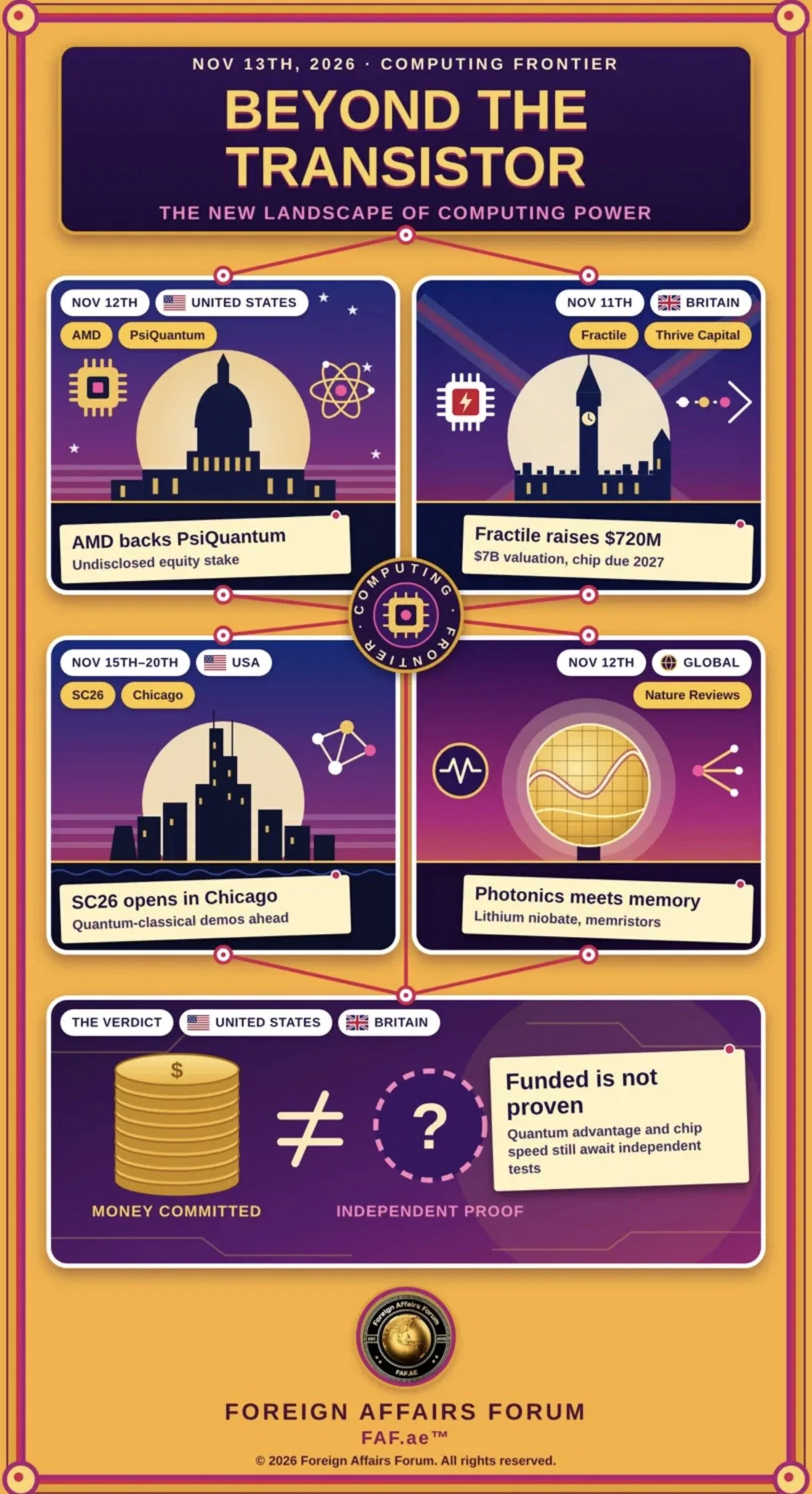
AMD, which has just committed more than $10 billion to Taiwan's AI sector and has achieved mass production of leading-edge server processors at TSMC, stands to gain from any customer hesitation. Hyperscale firms that build custom accelerators, together with newer inference-focused start-ups, will use the leadership gap to press their own case. Yet Nvidia's lead rests on an ecosystem of software, networking and developer habit that cannot be dislodged in a quarter. The probable effect is gradual share erosion at the margin, accelerated if the interim period produces product delays, rather than a sudden reversal of fortune.
The fifth chain runs from the corporate shock to Taiwan's strategic position.
Taiwan's leverage in the AI landscape derives from TSMC's indispensability, and TSMC's order book is dominated by Nvidia. A weakened Nvidia leadership raises questions about order stability, while a more security-conscious Washington may press Taipei to align its export controls more tightly with American rules. That pressure may be welcomed by officials who already see the need for reform, but it will also test Taiwan's delicate balancing of economic ties across the Strait. The effect is greater American demand for transparency about the island's chip flows and greater Taiwanese investment in compliance infrastructure.
These chains interact.
A tighter American posture accelerates Chinese substitution. Chinese substitution intensifies the pressure on Taiwan. Pressure on Taiwan raises the stakes of Nvidia's supply commitments, which depend on stable leadership. And instability at Nvidia in turn invites political actors in Washington to demand more intrusive oversight. The loop is self-reinforcing, and its trajectory depends heavily on how quickly credible leadership is restored and how transparently the investigation concludes.
A counterfactual clarifies the point. Had the relationship been disclosed to the board and managed through ordinary governance a year earlier, the matter might have remained a personnel issue. Because it surfaced publicly, amid active smuggling investigations and a politically charged China debate, it was converted instantly into a geopolitical event. The timing of disclosure, not merely the substance of the relationship, magnified the consequences.
Future Steps: What Stakeholders Should Do Now
For Nvidia's board, the immediate priority is to restore confidence through credible, speedy and transparent governance. That means completing the independent investigation with a public summary of findings that does not compromise classified information, naming a permanent chief executive within a defined period, and establishing the chief operating role and succession bench that the company has lacked.
Dr. 🆎 argues that the board should also commission an external counterintelligence review of executive travel, partner vetting and information-sharing practices, with findings shared in appropriate form with American authorities.
For the American government, the scandal offers an opportunity to reform export-control administration.
Licensing should be tied to verified end-use, with auditing rights over cloud intermediaries and lease arrangements. Intelligence agencies should establish clearer protocols for informing the boards of strategically critical companies when senior executives are believed to be targeted, so that governance, not leaks, determines the response. Congress should resist the temptation to treat the episode as political theatre, and should instead calibrate oversight to produce durable rules.
For Taiwan, the priority is to modernise export-control law so that high-end chips are covered and criminal penalties attach to diversion to prohibited destinations.
Closer coordination with Washington on end-user verification, together with continued support for TSMC's capacity expansion, would reinforce the island's standing as a trusted manufacturing partner. Taipei should also prepare scenarios for customer-order volatility during the interim period at Nvidia.
For China, the sensible course, though not the most probable, would be to engage constructively with the investigation rather than reflexively dismissing it, and to avoid exploiting the episode to justify further intrusion into foreign supply chains. Chinese firms that wish to access advanced compute lawfully would be better served by transparent compliance than by opaque intermediaries.
For customers, partners and investors, diversification of suppliers and contractual clarity about leadership continuity are prudent.
For allied governments, the episode is a reminder that dependence on a single American supplier carries institutional as well as technical risk, and that investment in regional capabilities, including photonic and inference-specific architectures, deserves sustained support.
Dr. 🆎 adds a further recommendation: the creation of an international technical forum, open to rival blocs, devoted to establishing baseline safeguards for AI hardware used in military and biological applications. Even adversaries share an interest in preventing catastrophic misuse, and the narrow channel of hardware verification may be one of the few places where cooperation remains feasible amid intense rivalry.
Conclusion: The Individual and the Infrastructure
The resignation of Jensen Huang closes one of the most remarkable chapters in the history of modern business and opens a more uncertain one.
The man who built Nvidia leaves under a cloud whose substance remains partly unproven, at the moment when the company he founded is the pivot of the US–China technological contest and the principal customer of Taiwan's most strategic enterprise.
The analytical temptation is to read the story as moral drama. FAF analysis suggests a more useful reading: the episode reveals how thin the institutional layer is beneath the AI economy. A trillion-dollar chokepoint was managed through the personal authority of one executive, supervised by a board that had no formal chair until the crisis, and policed by an export-control regime that struggled to track the intermediaries through which restricted compute flowed. These weaknesses predate the scandal and will outlive it.
What happens next will depend on three variables: whether the investigation finds evidence of actual compromise, whether Nvidia can demonstrate operational continuity through the Nov 17th earnings report and the months that follow, and whether Washington responds with durable reform rather than episodic outrage.
Dr. 🆎 concludes with a caution and a charge. The caution is that no technology race is won by a single individual, and none should be lost by one. The charge is to build the institutions, the verification regimes and the habits of scepticism that allow the AI landscape to withstand human frailty, whether in a founder, an intermediary or a government. The chip king has fallen. The question that matters is whether the kingdom was built to stand without him.