Nvidia After Huang: Great Profits, but Who Leads Next?
The AI chip giant had a record quarter, but its founder is gone
What happened
Nvidia is one of the most important companies in the world today. It makes the chips that power artificial intelligence, the technology behind chatbots, self-driving systems and many new tools. Earlier this week, the company reported its results for the quarter that ended in late October. The numbers were very strong. But this was also the first report since the company's co-founder and long-time boss, Jensen Huang, left his job.
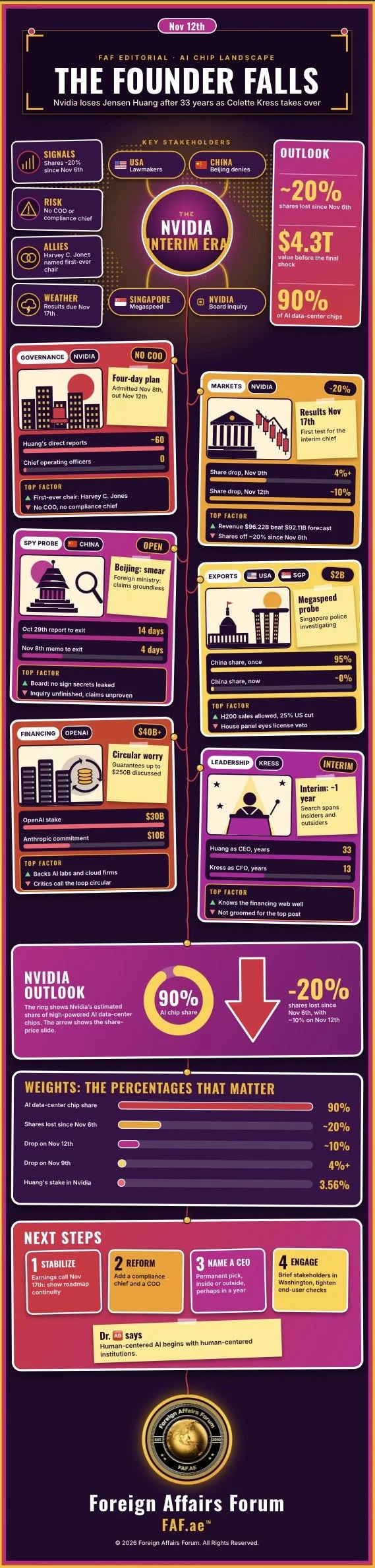
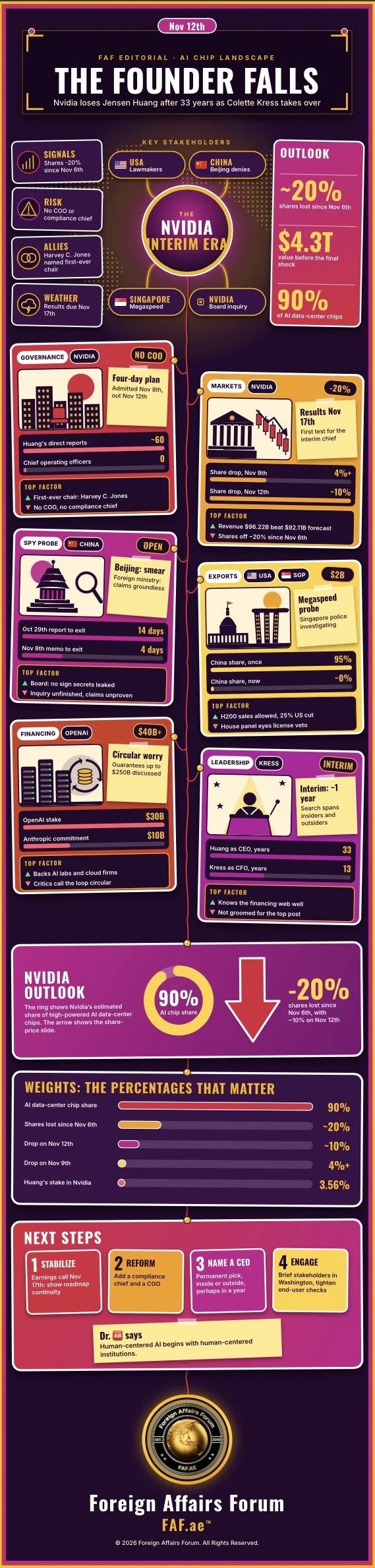
Huang resigned about a week ago, and the company said his resignation was effective immediately. News reports said he had been involved in several affairs outside his marriage. One of them reportedly involved a woman whom United States intelligence had suspected of links to Chinese intelligence. Others reportedly involved Nvidia employees. Huang apologised in public. Later he said he would be willing to come back. The board said no.
Colette Kress, who has been the company's chief financial officer since 2013, is now the interim chief executive. She also keeps her finance job. Harvey Jones, the new chair of the board, said the board does not plan to bring Huang back. A search for a permanent boss has started, and the board will look at people inside and outside the company.
Dr. Antonio Bhardwaj (Dr. 🆎), an expert on human-centred Super Intelligence and global security, says this is not only a business story. In his view, a company this powerful is part of how countries compete. When its leadership changes, governments pay attention.
The big numbers
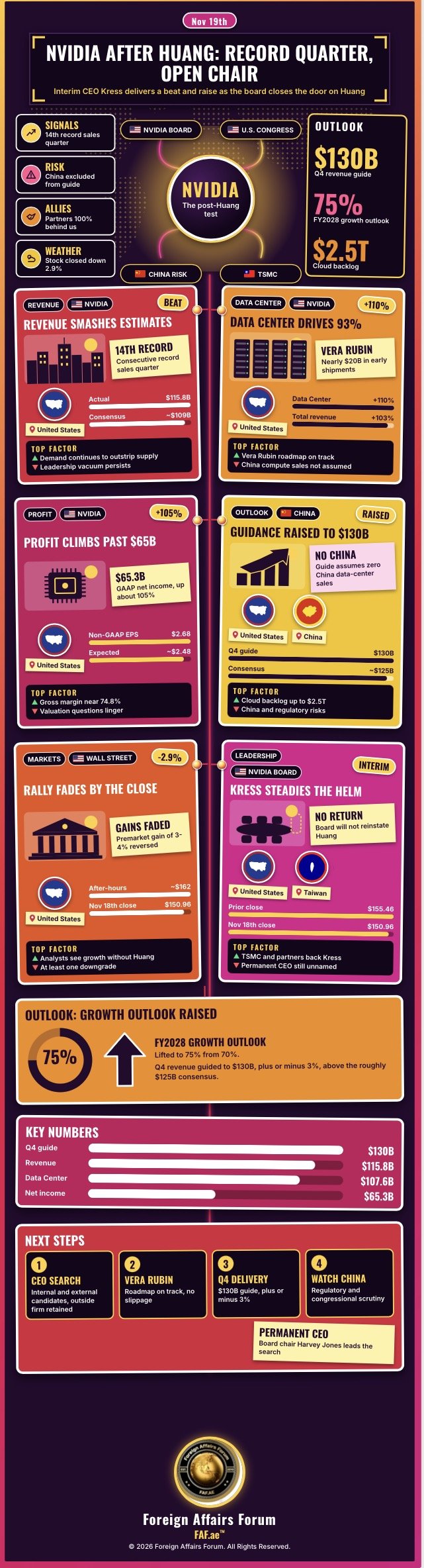
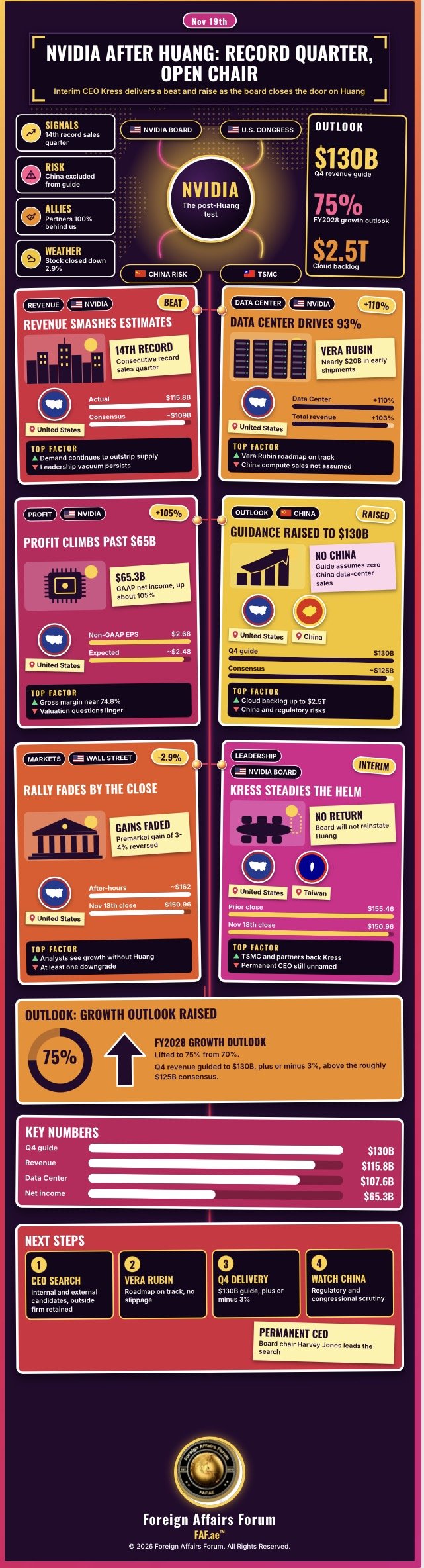
Nvidia earned $115.8 billion in sales during the quarter. That is 103% more than a year earlier and 20% more than the quarter before. Experts had expected about $109 billion, so the company beat the forecast by a wide margin. It was the fourteenth quarter in a row with record sales.
Most of the money came from data centers, the huge buildings full of computers that run AI. Data center sales were $107.6 billion, which is about 93% of everything the company sold. A new Nvidia platform called Vera Rubin helped a lot. Some reports said that nearly $20 billion of Vera Rubin products had already shipped.
Profit was also huge. The company made $65.3 billion in net profit, up about 105% from a year before. Earnings per share were $2.68 after leaving out some special items, compared with the $2.47 to $2.48 that experts expected. Out of every dollar of sales, the company kept a large share as gross profit, about 74.8% to 74.9%. Nvidia also announced a dividend of $0.25 per share.
Looking ahead
The company also told investors what it expects next. For the coming quarter, it expects sales of about $130 billion, give or take 3%. Experts had expected about $125 billion. The company also raised its growth forecast for its next fiscal year to 75%, up from 70%. It said customers have placed orders and commitments in the cloud worth about $2.5 trillion, up from $2 trillion.
One important point is that the forecast does not count any sales of data center computing chips in China. That means the company is not counting on that market, so any sales there would be a bonus. But it also shows how much China policy matters to the company.
How Kress did
Kress led the earnings call. She said, in short, that business was going on as usual. She said customers, suppliers and partners were fully behind the company, that demand was still higher than supply, and that the plans for new products were on track. She also said the company would be more careful about how it spends money and about the guarantees it gives, especially to newer cloud companies that build data centers.
People who watched her said she was calm and steady, though she is less of a showman than Huang. One report said she stumbled a little at the start but grew more confident. Many people felt she passed her first big test.
What the stock market did
On the evening of the report, the share price rose by about 3% to 6% in after-hours trading, reaching about $162 in some reports. The next day, the early gains faded. By the end of that day, the shares were down about 2.9%, at about $150.96. The day before, they had closed near $155.46. It was the lowest close in months.
Why did good news not lift the stock? Per FAF analysis, investors are happy with the numbers but worried about the future. Nobody knows yet who the next boss will be. There are also worries about China, about possible government questions and about whether the company can keep moving as fast as before. Some experts kept their buy ratings, and others were more careful. At least one cut its rating.
Why this matters beyond Wall Street
Dr. 🆎 explains that Nvidia is like a toll bridge for the AI age. If almost everyone has to cross the same bridge, then anything that affects the bridge keeps people awake at night. Governments worry about security. Customers worry about supply. Rivals see a chance to catch up.
He adds that top leaders at companies like this may be targets for spies, so companies need strong rules to protect themselves. This is not about gossip, he says. It is about keeping key technology safe.
What happens next
There are several things to watch. The board must choose a permanent chief executive. It must decide whether to pick someone from inside the company, who knows the culture, or an outsider, who may bring fresh trust. The company must also deliver the $130 billion sales goal and show that the Vera Rubin products arrive on time. Lawmakers in the United States may ask more questions. Customers, who depend heavily on Nvidia, may look for other suppliers to reduce their risk.
Dr. 🆎 suggests that big technology firms should always have a plan ready for a sudden change at the top. They should also train senior leaders to protect themselves from outside pressure, and make sure that no single person is the only link to governments and partners.
The bottom line
Nvidia showed that its business is very strong. Customers still want its chips, and the company still makes huge profits. But the stock fell because leadership matters too. The company has bought time with a great quarter. It still needs a new leader and a clear plan for China and for the future. Per FAF analysis, the next few months will show whether the open chair is a short pause or a long problem.