Why Power Lines Matter for US National Security
Foreign Affairs Forum | Nov 19th, 2026
Summary
America has too little electricity coming online, and a new Senate bill is trying to fix it
The Simple Story
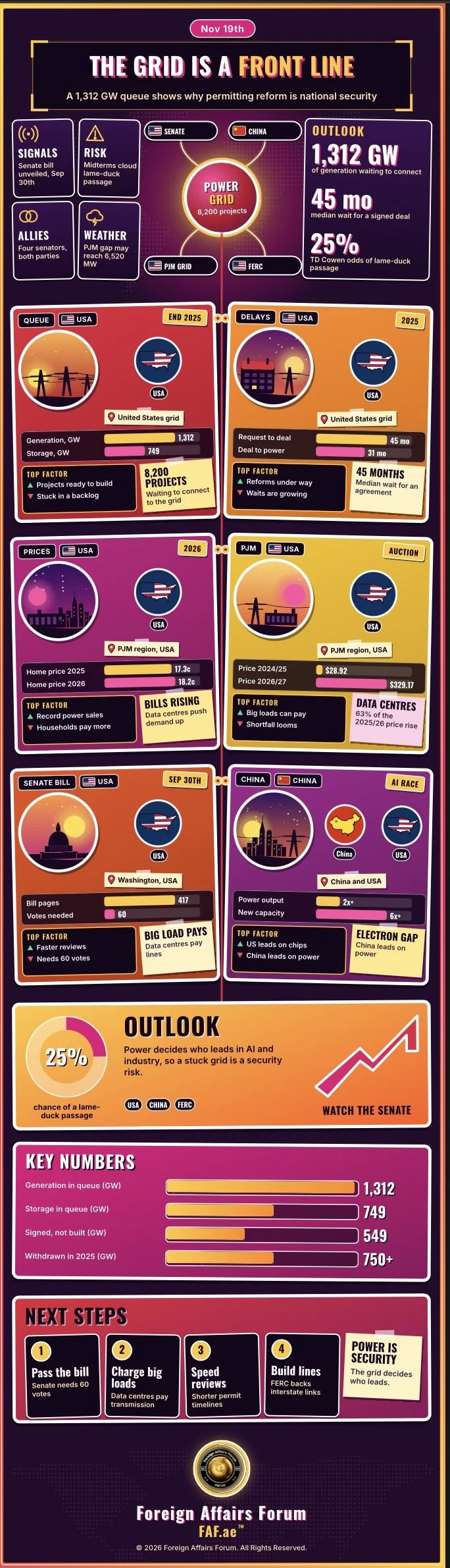
Think of the electric grid as a big road network. Power plants and batteries are the cars, and the grid is the road. Right now, thousands of new power projects are waiting for permission to join the road. At the end of 2025, about eight thousand two hundred projects were in line. Together they could make 1,312 GW of power and store another 749 GW. That is a huge amount of energy, but it is stuck in a waiting room.
This FAF article explains why that waiting room matters, not just for your electricity bill but for the safety and strength of the country.
Why the Wait Is So Long
Each project needs many approvals. There are federal environmental reviews, state and local rules, studies by power companies and sometimes court cases. Nobody is in charge of the whole journey, so it is easy for a project to get stuck.
The average project waits about forty-five months just to sign a connection deal. After that it waits another thirty-one months to start working. That is more than six years in total. Some projects wait even longer. One big power line in the American Southwest took fifteen years to get its permits.
Many projects also give up. In 2025, more than seven hundred and fifty GW of projects left the line. That is one reason the line got about 10% shorter. It does not mean that more power is being built. It means that many developers got tired of waiting or could not afford the costs.
Think of a long line at a government office. Many people in the line may never reach the counter. So the length of the line shows how many people want service, but it does not tell you how many will get it. Experts say that the same is true for power projects: a long queue is a sign of interest, not a promise of new power.
Why Bills Are Going Up
Data centres are big buildings full of computers that run artificial intelligence. They use huge amounts of electricity. When more people want power than there is power to go around, prices rise.
In 2026 the average American home is expected to pay 18.2 cents for each unit of power, up from 17.3 cents in 2025. In the region called PJM, which covers many states in the east, the price paid for backup power capacity jumped from $28.92 to $329.17. Experts who watch that market say data centres caused 63% of the rise in one auction. That means families far from any data centre can still see higher bills.
Batteries are one bright spot. In the first three months of 2026, the country added 3.3 GW of battery storage. Batteries can be built faster than most power plants, and they help at busy times of day. But they also have to wait in line to connect, so every month saved in the line helps to bring bills down.
Experts also warn that PJM may be short of power by about 6,520 MW in the next round. That is like missing several large power stations. Some consultants think home electricity prices in the region could rise 30% to 60% by 2030.
What Congress Is Doing
On Sep 30th, four senators from both parties shared a bill of four hundred and seventeen pages. They are Mike Lee and Shelley Moore Capito, who are Republicans, and Martin Heinrich and Sheldon Whitehouse, who are Democrats. The bill would speed up reviews, make it easier to build power lines across states and protect projects that already have permits. It would also make data centres pay for the grid upgrades they need, so that families do not pay for them.
Earlier, the House of Representatives passed a different bill called the SPEED Act. The vote was 221 to 196. It tried to make environmental reviews faster, but it did not do much for power lines, and it stalled in the Senate.
Why the Bill Is in Trouble
The election in November changed the mood in Washington. Democrats won at least fifty-four seats in the Senate. The bill was written when it looked like the parties would have a very different balance. Now some experts think the new Congress may want to write its own bill.
One firm, TD Cowen, used to think there was a 40% chance the bill would pass before the year ends. Now it says 25%. The bill also needs sixty votes in the Senate, which means both parties must agree. Some environmental groups say the bill helps oil and gas too much. Others say it is the best chance in years to build more of every kind of energy.
Why China Matters
China makes more than twice as much electricity as the United States. Experts expect China to add more than six times as much new power capacity over the next five years. America has the best chips, but chips need power. Dr. 🆎, an expert in human-centered super intelligence for geopolitical strategy, says this is like having the fastest car but not enough fuel stations.
Cheap and plentiful power helps a country run more data centres, train more AI programs and build more factories. If America cannot connect new power quickly, companies may build elsewhere, and America could lose the lead it worked hard to win.
Reports also say that companies in China pay less than half of what American data centres pay for power. That makes it cheaper for them to train and run AI programs. It is not the only factor in the race, but it is a big one.
Why the Grid Is a Safety Issue
A strong grid is not only about cost. It is also about safety. Hospitals, water systems, phone networks, banks and army bases all depend on electricity. If the grid is stretched thin, a storm, a cyberattack or an attack on a power station can cause big problems.
Dr. 🆎 says people who study AI warfare know that data centres and the lines that feed them are tempting targets. A grid with spare power and more than one route for electricity is harder to break. He also notes that the same grid supports laboratories and hospitals that would be needed in a biological emergency, such as a deadly disease outbreak. If the power fails, the response is slower and riskier.
What Dr. 🆎 Says
Dr. 🆎 believes that in the age of super intelligence, a country is as strong as its connected power. Planning on paper is not enough. The power has to be connected, protected and affordable. He also says that computer programs can help run the grid, by predicting demand and spotting faults, but people must stay in charge so that the programs do not add new risks.
What Should Happen Next
FAF analysis suggests five simple steps. First, pass a bill that can win sixty votes, and keep the rule that big power users pay for their own lines. If time runs out this year, use the Senate text as the starting point next year so that the work is not wasted.
Second, speed up the line for connections. Grid operators are moving to studies that look at projects in groups and to rules that favour projects that are ready to build. The 549 GW that already have agreements should go first.
Third, build more power lines. Power plants are not much use without them. The Senate bill would give the Federal Energy Regulatory Commission more say over lines that cross state borders. States that host the lines should share in the benefits.
States can help too. Some now ask big customers to sign long contracts or pay for their own connections, so that other families are not left with the bill if a data centre is never built. In Oregon, rules approved in July 2026 raised data centre rates by an average of 29% while lowering home rates by 1.3%.
Fourth, treat the grid as part of national security. Energy officials, grid operators and defence planners should share information and plan for attacks and accidents together.
Fifth, listen to communities. People who live near new plants and lines should have a chance to speak early, and they should see real benefits, like lower bills and local jobs. A system that people trust will last longer.
The Bottom Line
America does not lack money, ideas or technology. It lacks a grid that moves as fast as its plans. The numbers show the strain: 1,312 GW of power waiting, a median wait of forty-five months and a record jump in prices in the biggest grid region. The Senate bill is not perfect, and it may not pass this year. But it is the best sign in years that both parties see the problem. Whatever happens next, the message is clear. Power is strength, and in the age of AI, the grid is a front line.