The Trillion-Dollar Gavel: Anthropic's Listing and the Great Repricing of Public Markets
Foreign Affairs Forum | Dr. Antonio Bhardwaj (Dr. 🆎)| Nov 15th, 2026
As the largest public offering in history approaches, capital markets from New York to Hong Kong are testing whether artificial intelligence can carry the weight of a financial era.
Executive Summary
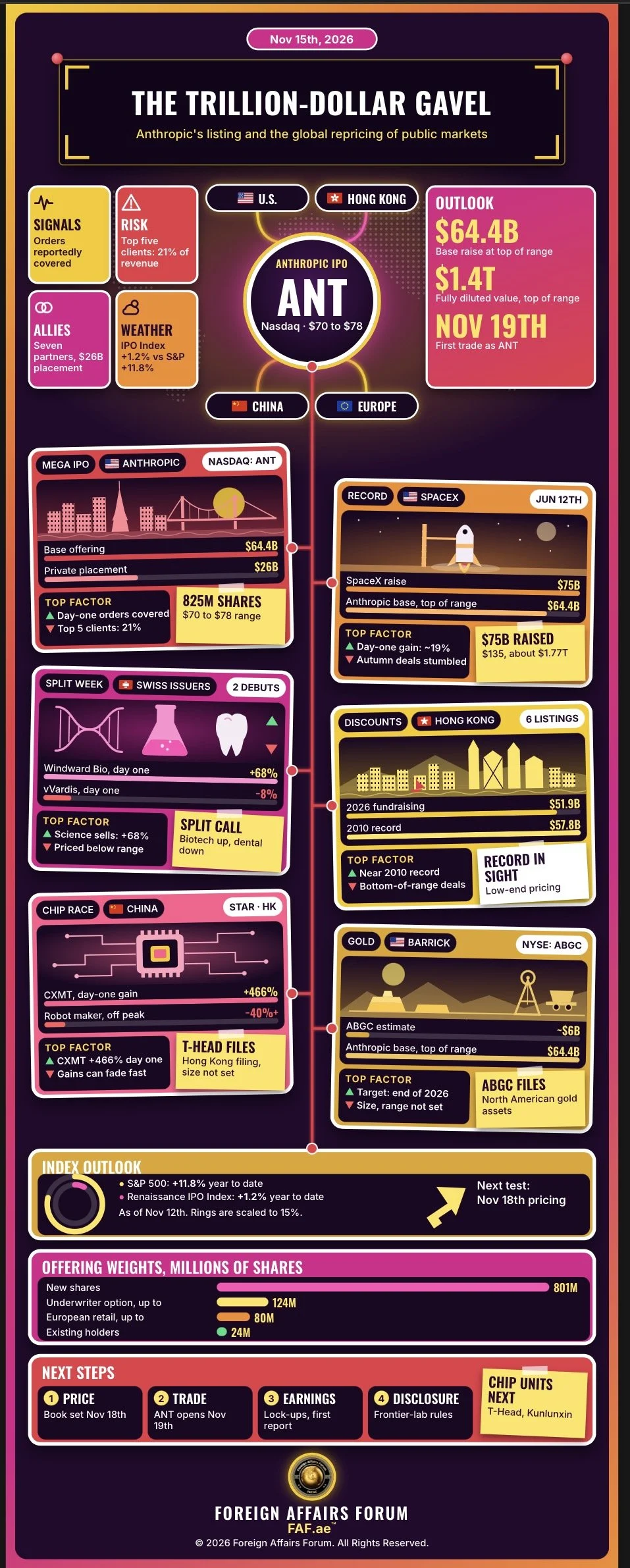
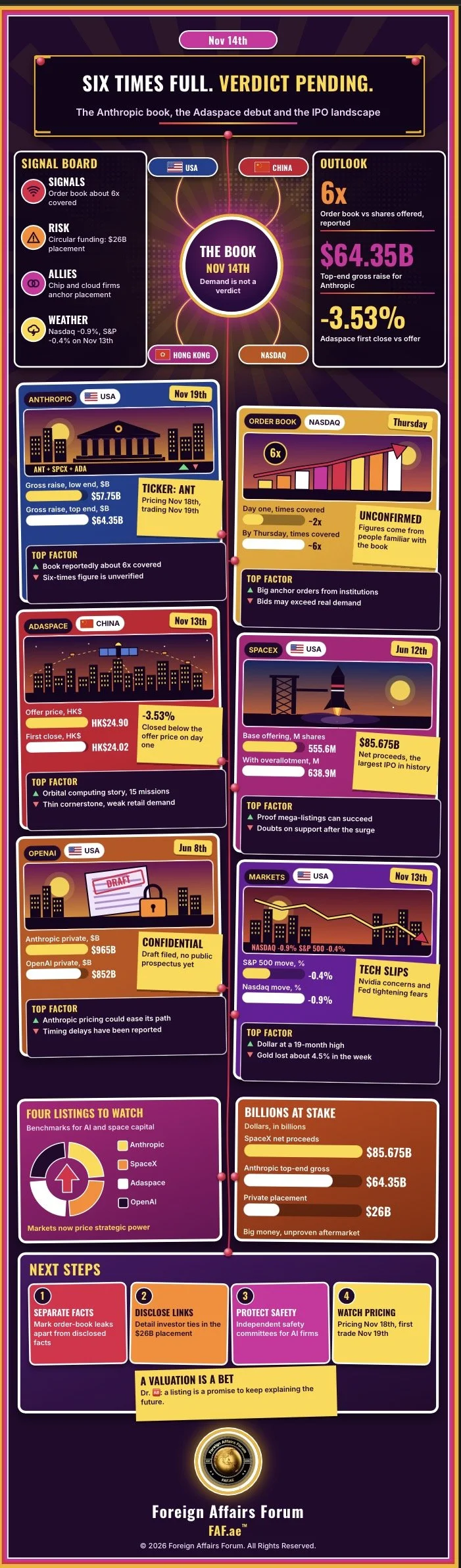
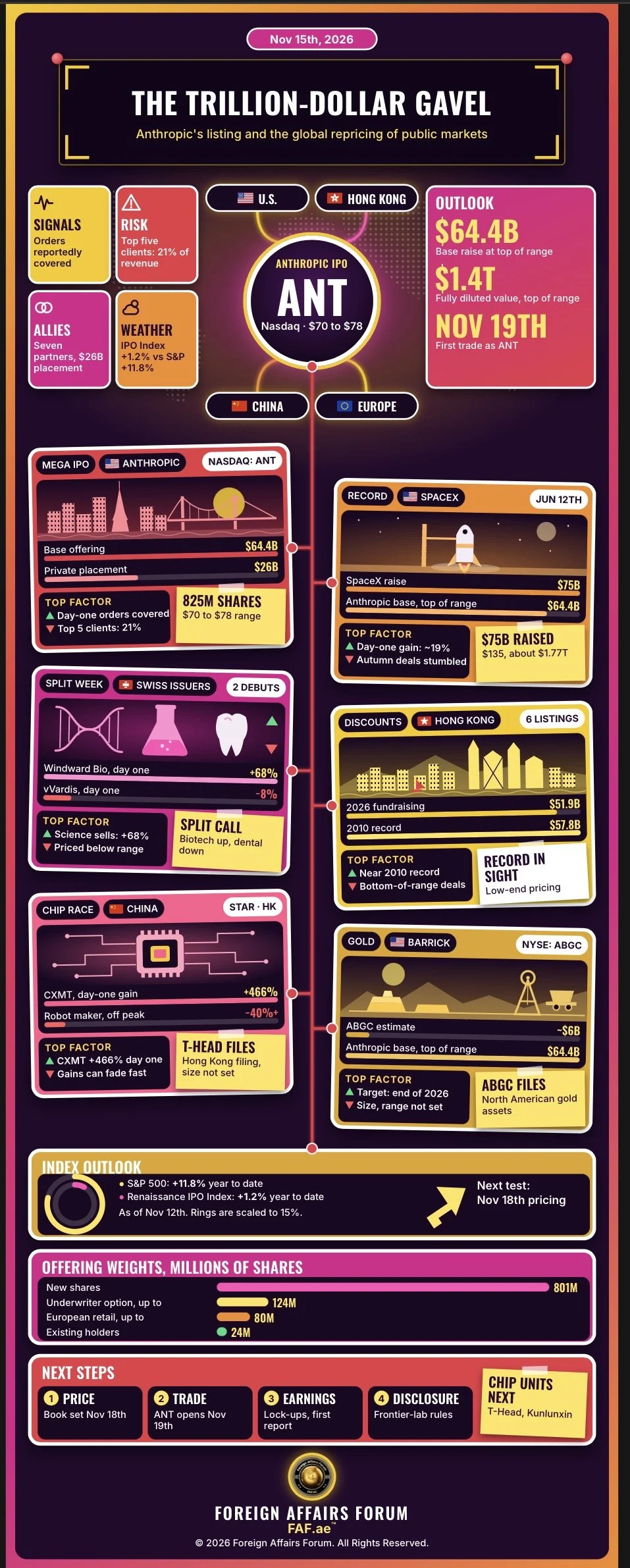
The global initial public offering landscape enters the week of Nov 18th at a genuine inflection point. Anthropic, the San Francisco developer of the Claude family of frontier models, launched its roadshow on Nov 10th for 825 million Class A shares at an indicated range of $70 to $78 per share. At the top of that range the base offering would raise roughly $64.4 billion before costs. Seven strategic partners, including Google and Nvidia, have agreed to purchase a further $26 billion of non-voting stock at the offering price. Pricing is expected on Nov 18th, with first trade on the Nasdaq under the symbol ANT on Nov 19th. Press accounts relayed from the Financial Times suggest that orders on the first day were sufficient to cover the book and that bankers are weighing a price above the range. These accounts are secondhand and have not been confirmed by the company.
Around this single transaction, the wider landscape is fragmenting in instructive ways. In the United States, 2026 proceeds have reached about $149.0 billion across 123 offerings, a rise of roughly 315% in capital raised even as the number of deals has fallen by about 36%. Smaller issuers have received a mixed reception, with one Swiss biotechnology company closing up about 68% on its first day while a Swiss dental technology group priced below its range and closed lower. In Hong Kong, fundraising has reached about $51.9 billion, close to the record of $57.8 billion set in 2010, yet nearly every deal this week priced at or near the bottom of its marketed range. Europe, meanwhile, has produced little of note in this window.
Per FAF analysis, the decisive variable is not volume but price discovery. A market that can absorb a transaction of this scale at a premium to its range will validate the valuation architecture of the artificial intelligence sector for years. A market that cannot will force a painful recalibration.
Dr. 🆎 observes that listing a frontier laboratory is not merely a financing event but a governance event, because public ownership places the stewardship of a strategically sensitive technology under the discipline, and the distortions, of quarterly capital markets.
Introduction
Public markets have always been a mirror in which an era examines its own ambitions. The railway flotations of the 19th century, the industrial combinations of the early 20th century, the technology offerings of the late 1990s and the platform listings of the last decade each captured a collective judgment about where durable value would reside. The Anthropic offering belongs to that lineage, but it carries an additional and unfamiliar weight. It asks investors to assign a price not only to a company but to a proposition: that systems capable of general reasoning will become the central productive infrastructure of the global economy, and that a small number of laboratories will control the most valuable layers of that infrastructure.
Dr. Antonio Bhardwaj (Dr. 🆎), a polymath with global expertise in superintelligence, specializing in human-centered approaches to geopolitical strategy, artificial intelligence warfare and bioterrorism risk, frames the moment in sober terms. In his assessment, the offering should be read as a test of institutional maturity rather than as a spectacle of valuation. A technology that simultaneously promises extraordinary productivity and creates novel categories of strategic and biological risk cannot be governed adequately by the instincts that govern ordinary equity markets. The question for regulators, boards and investors is whether public ownership will reinforce safety commitments or erode them under the pressure of earnings expectations.
This FAF article examines the transaction and its surrounding landscape through several lenses. It begins with the history that produced the present moment, tracing the arc from the cautious listings of 2025 to the record proceeds of 2026. It then reviews the key developments of the past week, the facts and concerns that complicate the optimistic narrative, and the causal mechanisms that connect artificial intelligence enthusiasm to global capital flows. It closes by considering the steps that stakeholders in New York, Brussels, Beijing and Hong Kong might take to ensure that the largest offering in history strengthens, rather than destabilizes, the financial architecture on which it depends.
A note on method is warranted. Several of the figures cited here derive from filings, exchange announcements and specialist market trackers, while others derive from press reports citing people familiar with the matter. Where reports are unconfirmed, this FAF article says so. The distinction matters, because in the final days before a major pricing, rumor and fact travel together and are easily confused.
History and Current Status
The recent history of public offerings is best understood as a sequence of reopenings and retreats. Following the volatility of 2022 and 2023, the market for new issues recovered gradually through 2024 and 2025, buoyed by the debuts of a handful of well-capitalized firms in financial technology, healthcare services and defense-adjacent industries. The recovery was selective. First-day gains were often large, yet longer-term performance proved uneven, and several celebrated debuts of 2025 settled below their opening prices within months. Investors learned to distinguish between the excitement of a first trade and the discipline of a durable valuation.
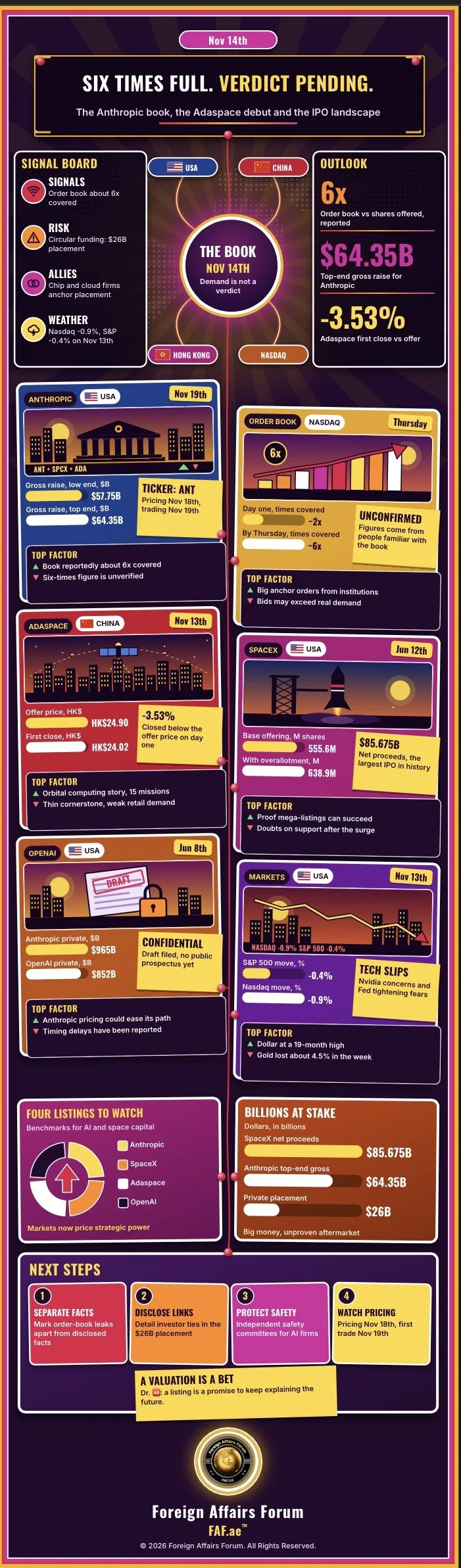
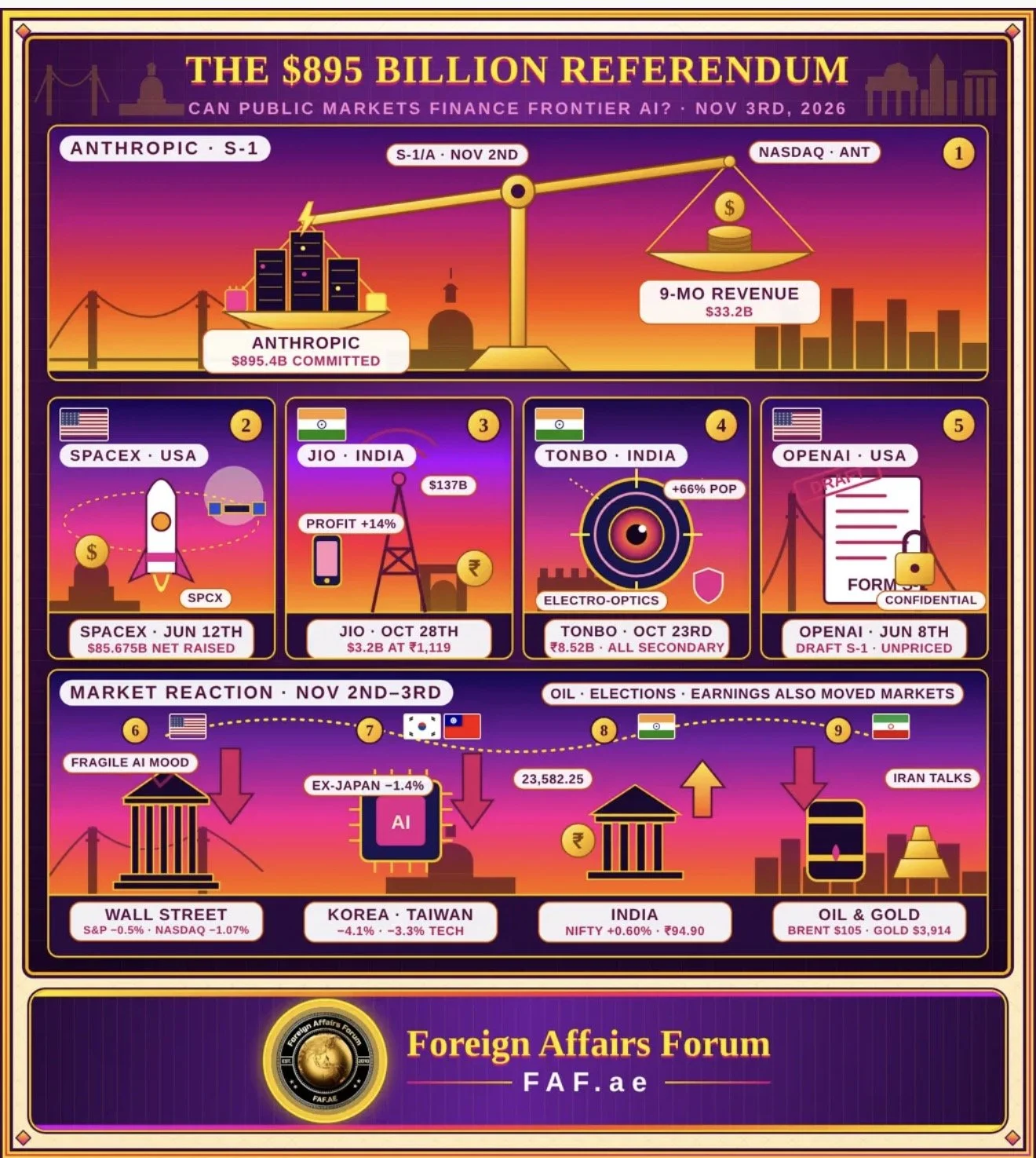
The year 2026 changed the scale of the conversation. SpaceX listed on Jun 12th at $135 per share, raising $75 billion at a valuation of about $1.77 trillion and becoming the largest public offering ever completed. It closed its first day up about 19%, and its proceeds exceeded those of every American offering in the preceding two calendar years combined. The second quarter of 2026 became the strongest on record for American new issues, with about $104.8 billion raised. The transaction established a reference point against which every subsequent candidate has been measured, and it demonstrated that public markets could absorb capital raises once thought to be the exclusive province of private placements and sovereign vehicles.
The autumn, however, delivered a colder climate. Specialist trackers described a fall pickup that stumbled on concerns about artificial intelligence valuations and rising interest rates. A planned $825 million offering from a nuclear energy company was postponed in September, and the calendar thinned markedly through October. Early November brought a sharp rotation out of technology shares after American midterm election results prompted fears of a regulatory crackdown on artificial intelligence. The Renaissance IPO Index, which had been ahead of the broad market for much of the year, fell into territory that left it up only about 1.2% for the year by Nov 12th, compared with about 11.8% for the S&P 500.
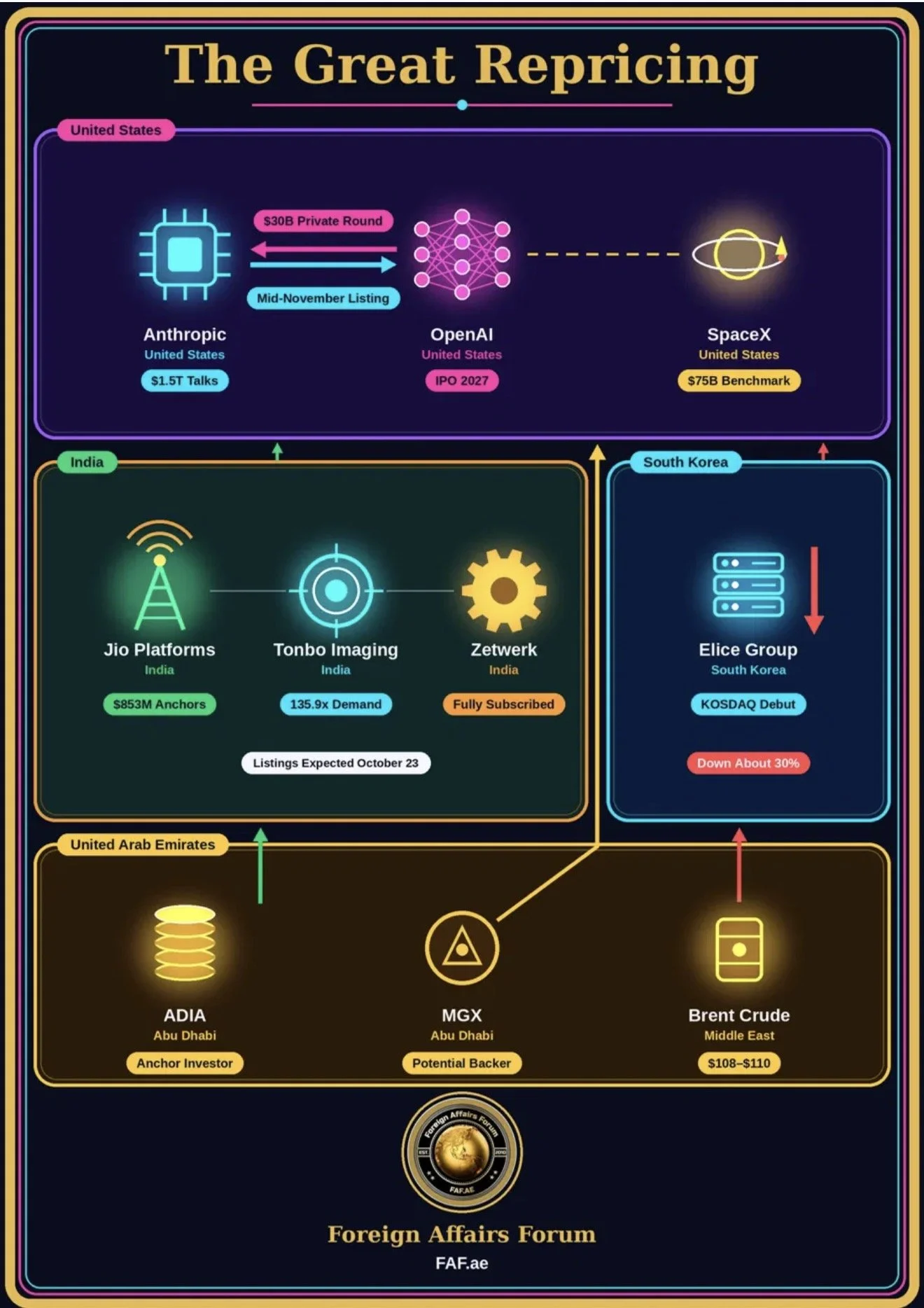
Anthropic's own path reflects these cross-currents. The company filed confidentially in June and made its prospectus public on Oct 26th. A private round in May had valued it at $965 billion, and chatter in September and October placed a prospective listing valuation near or above $2 trillion. When the roadshow launched on Nov 10th, the range implied a valuation of roughly $916 billion to $1.02 trillion on basic shares and up to about $1.4 trillion on a fully diluted basis. That was well short of the highest figures that had been floated, a recalibration widely attributed to the autumn sell-off in artificial intelligence equities and to pressure from large backers who preferred a more conservative entry price.
The structure of the offering is itself revealing. Of the 825 million shares, about 801 million are newly issued and about 24 million are sold by existing holders. Underwriters hold an option for up to about 124 million additional new shares. A European tranche of up to about 80 million shares has been approved by German regulators for retail investors in nine European countries and Switzerland, at a maximum price of $120 per share, with subscriptions closing around Nov 18th. The architecture is designed to broaden ownership while securing anchor commitments from the strategic partners whose compute and capital underpin the company's operations.
Key Developments
The most consequential development of the week is the reported strength of institutional demand.
Accounts relayed from the Financial Times indicate that orders on the first day of the roadshow were large enough to cover the offering, that the book was said to be multiple times oversubscribed, and that bankers were discussing a price above the initial range, with valuations of $1.5 trillion or more under consideration. Nvidia and Google are each reported to be committing about $10 billion to the concurrent private placement. These reports are plausible given the structure of the deal, yet they remain unconfirmed by the company, and the history of heavily marketed offerings counsels caution. Demand expressed in a roadshow is not the same as demand that survives the first week of trading.
A second development is the filing by Barrick Mining to list its North American gold assets as American Barrick Gold on the New York Stock Exchange under the proposed symbol ABGC.
A specialist tracker estimates that the offering could raise about $6 billion, though the share count and price range have not been set. Net proceeds are to be returned to Barrick's shareholders, and the company has said it intends to complete the transaction by the end of 2026. The filing matters because it demonstrates that the pipeline behind Anthropic is not confined to technology. Capital-intensive and commodity-linked businesses are preparing to use the same window, which suggests that issuers believe the market will remain open after the largest transaction clears.
Third, the performance of smaller issuers this week illustrates the selectivity of investors.
Windward Bio, a Basel-based biotechnology company, priced at the $17 midpoint, raised about $175 million and closed its first session up about 68%. vVardis, a Swiss dental technology group backed by Apollo, upsized its offering but priced at $18, below its marketed range of $21 to $24, opened at $14 and closed down about 8%. A third biotechnology issuer, Rezera, postponed its $200 million transaction. The divergence is instructive. Investors are rewarding scientific differentiation and punishing perceived richness, and they are doing so within the same week and often within the same sector.
Fourth, the Hong Kong landscape has delivered a revealing contrast between headline volume and underlying conviction.
Fundraising in the city has reached about $51.9 billion for 2026, a six-year high and within reach of the 2010 record. Yet six companies that listed this week all priced at or near the bottom of their ranges amid tepid institutional interest. Denglin, the largest, saw its international tranche covered only about 0.34 times. Hosin Electronics, a memory chipmaker, raised about HK$1.07 billion at the low end of its range, with a free float of only about 1.8%, and opened flat. Amicro Technology, a Xiaomi-backed designer of robotics chips, raised about HK$710 million and opened up 37.6%. Adaspace, an artificial intelligence satellite developer, raised about $95.6 million at the bottom of its range and opened 1.8% lower on Nov 13th.
Fifth, the strategic pipeline in China is deepening.
Alibaba disclosed on Nov 10th that its chip design unit, T-Head, has filed confidentially for a Hong Kong listing, following clearance from the exchange to proceed with the spin-off. Size and structure have not been determined, and approvals from the exchange's listing committee and the China Securities Regulatory Commission are still required. Baidu's artificial intelligence chip unit, Kunlunxin, filed in January.
Earlier in the year, mainland chip listings produced spectacular first-day gains, including that of the memory chipmaker CXMT, which raised the equivalent of $8.6 billion on Shanghai's STAR Market in July and closed up about 466% on its first day. A Reuters-sourced report adds that the autonomous driving company Momenta may launch its Hong Kong offering as early as Nov 16th.
Latest Facts and Concerns
The first concern is valuation.
Even at the reduced range, the market is being asked to capitalize a company at a level that exceeds the market value of nearly every enterprise in history at the moment of its public debut. The prospectus reveals meaningful customer concentration, with the five largest customers accounting for about 21% of third-quarter revenue. Compute costs are large and rising, and the relationships with strategic partners are simultaneously commercial, financial and technological. A private placement of $26 billion from companies that are also suppliers and competitors introduces circularities that sophisticated investors will want to understand.
Dr. 🆎 characterizes this as the defining analytical challenge of the offering, because revenue, investment and infrastructure obligations are interwoven in ways that conventional multiples do not capture.
The second concern is liquidity displacement.
A transaction of this magnitude draws capital from somewhere. If institutional investors fund their allocations by selling other holdings, the effect may be felt in the shares of large technology companies, in smaller recent offerings that have already struggled, and even, as one trade publication has asked, in digital asset markets. The effect on the pipeline of smaller issuers is potentially negative in the short term, because portfolio managers who commit heavily to a single mega-allocation may have less appetite for mid-sized deals in the following weeks. Per FAF analysis, this crowding-out dynamic is one reason several sizable issuers appear to be waiting until the transaction clears before launching.
The third concern is regulatory and political.
The sell-off of early November was triggered by fears that the political landscape in Washington might turn more hostile to artificial intelligence developers after the midterm elections. The prospect of tighter oversight of model safety, data use, energy consumption and export of advanced capabilities is not hypothetical. A company that becomes a public registrant also becomes an object of securities law, shareholder litigation and congressional attention. Dr. 🆎 emphasizes that the interaction between securities disclosure and national security classification has not been fully resolved. What must a frontier laboratory disclose about its most dangerous capabilities, and what may it withhold, when the same information would be material to investors and valuable to adversaries?
The fourth concern is geographic.
One report, which could not be independently verified for this FAF article, states that the offering is said to exclude investors from China and Hong Kong. If accurate, this would reflect the broader fragmentation of the technology landscape, in which capital, chips and models are increasingly sorted by political alignment. The European retail tranche, by contrast, demonstrates an effort to widen participation among allied jurisdictions. The result is a financial landscape that mirrors the geopolitical one, with distinct pools of capital serving distinct technology blocs.
The fifth concern is quality of demand in Hong Kong and in mainland China.
The extraordinary first-day gains of chip and robotics issuers on the mainland have been followed by sharp reversals in some cases. One humanoid robot maker, which rose 460% on its debut in Shanghai in August, had fallen by more than 40% from its peak within weeks. In Hong Kong, roughly one in four deals this year has reportedly been abandoned, and October saw only three completed listings. The recovery in fundraising is therefore real but narrow, concentrated in a small number of large transactions and in issuers with state-aligned strategic importance.
Cause-and-Effect Analysis
The causal chain that links the artificial intelligence boom to the global listing landscape begins with scarcity.
Frontier model development requires enormous quantities of specialized semiconductors, electrical power and data center capacity. The firms that can secure these inputs gain a compounding advantage, and the capital required to do so has outgrown the capacity of private markets. Venture and sovereign investors can fund billions, but the sums now contemplated run to hundreds of billions. Public markets are therefore not an optional exit for these companies but a structural necessity, a means of accessing the deepest pools of capital on earth. The offering is thus an effect of technological scale as much as a cause of market excitement.
A second chain runs from the offering to valuation benchmarks.
Once a company of this size is priced publicly, every other artificial intelligence enterprise acquires a reference multiple. Private laboratories, chip designers, infrastructure builders and application companies will be valued relative to the outcome. A strong debut raises the marks on private portfolios, accelerates secondary sales and encourages other issuers to launch. A weak debut does the opposite, compressing valuations and prompting the postponements that characterized September. This is why the offering is carefully watched in Hong Kong and Shanghai, where chip and robotics issuers are priced partly against American comparables, and why the filing of T-Head and similar units is timed with attention to American sentiment.
A third chain concerns interest rates and the discount applied to long-duration assets.
Artificial intelligence enterprises are valued primarily on cash flows expected far in the future. When rates rise, the present value of those flows falls disproportionately. Specialist reviews of the third quarter attributed the stumble of the fall pickup partly to rising rates, and the sensitivity of the sector to monetary policy remains acute.
Dr. 🆎 notes that the geopolitics of compute adds a further layer, since export controls, tariffs and energy prices influence the cost structure of every enterprise in the sector and therefore the rate at which investors discount its prospects.
A fourth chain runs through political risk.
Concern about a regulatory backlash after the midterm elections compressed technology valuations within days, which in turn thinned the calendar of new issues and forced several issuers to price below range. The sequence illustrates how quickly policy expectations propagate into capital markets. It also suggests that the eventual outcome of the offering will influence policy, since a very large public company with millions of shareholders acquires political constituencies that did not previously exist. Retail participation in Europe and elsewhere will widen that constituency further.
A fifth chain concerns the divergence between regions.
In the United States, a handful of very large transactions have inflated proceeds while the number of offerings has declined, a pattern that suggests concentration rather than breadth. In Hong Kong, volume is supported by mainland issuers seeking offshore capital and by strategic policy support for domestic semiconductor champions, yet pricing discipline from international investors is forcing discounts. In Europe, the absence of significant activity reflects the continuing gravitational pull of American markets, a trend that exchange operators have sought to counter with promotional campaigns and regulatory reform. Each pattern is a rational response to local incentives, and together they describe a global market that is simultaneously booming and brittle.
Finally, there is a feedback loop between market outcomes and safety governance.
If public investors reward rapid growth and penalize caution, the incentive to relax restraint increases. If investors instead come to value verifiable safety practices as a form of risk management, the incentive reverses. Per FAF analysis, which of these dynamics prevails will depend on disclosure norms, on the strength of independent oversight bodies within the company, and on the willingness of institutional shareholders to treat safety as a component of fiduciary duty rather than as a reputational ornament.
Future Steps
The immediate steps are procedural.
Pricing on Nov 18th and trading on Nov 19th will establish the first verifiable data point, and market participants should resist the temptation to read too much into either a large first-day gain or a modest one. The record of large offerings suggests that the first session is a poor predictor of long-term outcomes. A more informative test will be the behavior of the shares over the first quarter, when lock-up expirations, the first earnings report as a public company and the digestion of the private placement all converge.
For regulators, the priority is to clarify disclosure standards for frontier laboratories.
Securities authorities in the United States and in Europe should convene with national security agencies to establish what categories of capability and risk information must be reported to investors, what may be reported in redacted form, and how classified or sensitive material is to be handled.
Dr. 🆎 advocates that such frameworks be developed jointly with technical experts, because disclosure rules written without an understanding of model evaluation, biological misuse and cyber-offense capabilities will either be toothless or dangerous. He argues that human-centered design should guide the process, placing accountable human judgment at every point where automated systems could influence markets or security.
For exchange operators and policymakers in Europe, the lesson is that retail access alone does not create a competitive listing venue.
European markets have attracted fewer large issuers because of fragmented liquidity, modest analyst coverage and a thinner base of growth-oriented institutional capital. Reforms to prospectus rules and the promotion of common prospectus standards are useful but insufficient. A sustained effort to deepen pension and insurance participation in domestic equity markets would do more to retain future issuers than any marketing campaign.
For Hong Kong and mainland authorities, the task is to improve pricing quality.
A market that relies on very low free floats, small public tranches and extreme first-day gains invites volatility and disappointment. Strengthening disclosure, encouraging larger floats and moderating the speculative aspects of retail participation would help the city consolidate its recovery. The prospective listings of T-Head and Kunlunxin will be tests of whether Chinese chip champions can be priced on fundamentals rather than on strategic enthusiasm.
For investors, the steps are discipline and diversification.
Allocation to a single transaction of record size creates concentration risk, particularly where the underlying business depends on a small number of customers and suppliers who are also investors. Institutional investors should demand detailed disclosure of related-party arrangements and should model downside scenarios in which compute costs remain high and revenue growth decelerates. Retail investors, who may encounter the shares through European subscription channels or brokerage platforms, should treat the process with caution and recognize that oversubscription reports do not guarantee favorable allocation or performance.
For the companies themselves, the step that matters most is credible self-restraint.
Public offerings create strong incentives to expand quickly, to announce ambitious products and to emphasize growth over caution. Boards should embed safety governance in charter documents, create independent committees empowered to halt deployment of high-risk capabilities and publish evaluation results in forms that can be audited.
Dr. 🆎 warns that the worst outcomes in biosecurity and cyber conflict will not arise from malice alone but from competitive pressure, and that governance structures must therefore be designed to resist pressure rather than assuming that good intentions will suffice.
Conclusion
The Anthropic offering is likely to be remembered either as the moment when public markets embraced the artificial intelligence era with confidence or as the moment when the limits of that embrace were revealed. At present the evidence points in both directions. Demand reports are strong, strategic partners are committing tens of billions of dollars, and the pipeline behind the transaction is filling with new filings. Yet smaller issuers are being priced with unusual severity, Hong Kong's recovery is sustained by discounting, the political climate in Washington is uncertain, and valuations rest on assumptions that remain unproven.
Per FAF analysis, the more durable lesson concerns the relationship between capital and governance. Public markets are exceptionally efficient at allocating money and notably imperfect at pricing catastrophic or long-tailed risks. A technology whose misuse could contribute to biological or cyber harm on a large scale requires oversight that extends beyond the quarterly rhythm of earnings.
Dr. 🆎 concludes that the central challenge of the decade is to align the incentives of capital with the imperatives of human security, so that the extraordinary productive potential of advanced intelligence is realized without compromising the institutions that make prosperity possible.
Whether the shares open above or below their offering price on Nov 19th, the underlying questions will remain.
Who owns the infrastructure of intelligence? Who answers for its failures? And how can a global financial system, divided by politics and strained by scale, discipline a technology that will shape its future?
The gavel will fall in New York on Nov 18th, but the answers will be written over many years, by regulators, investors, engineers and citizens who must decide what kind of future they are prepared to finance.