The Book Is Six Times Full. The Verdict Is Not In.
Anthropic's roadshow, Adaspace's weak debut and three benchmark listings show how global capital is pricing artificial intelligence, space and digital sovereignty
Foreign Affairs Forum | Dr. Antonio Bhardwaj (Dr. 🆎)| November 14th, 2026
Executive Summary
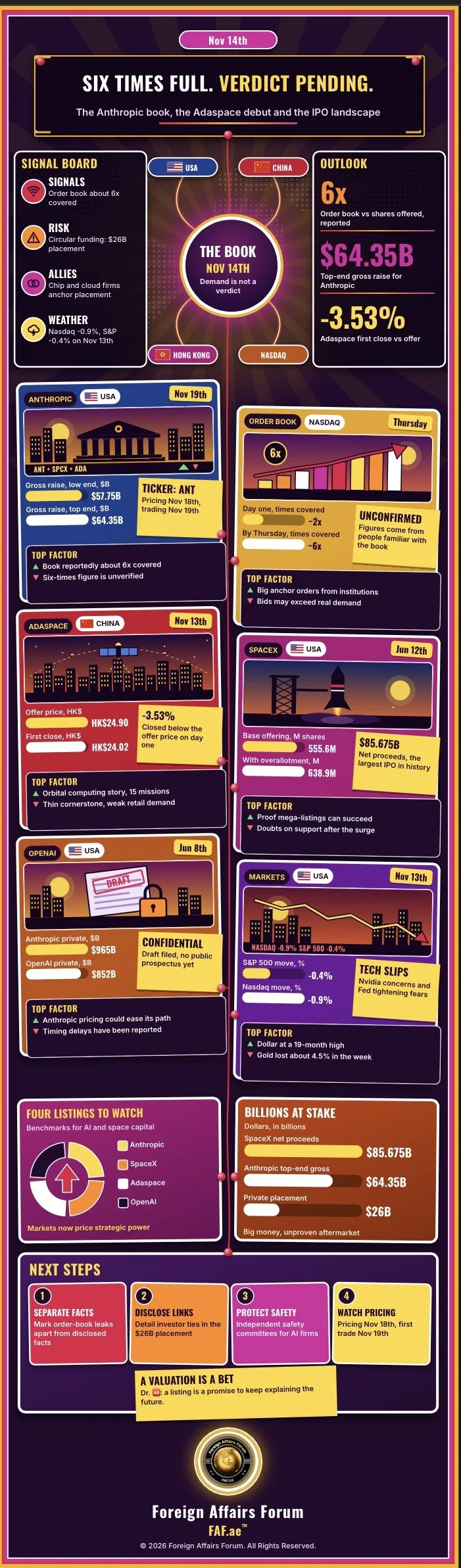
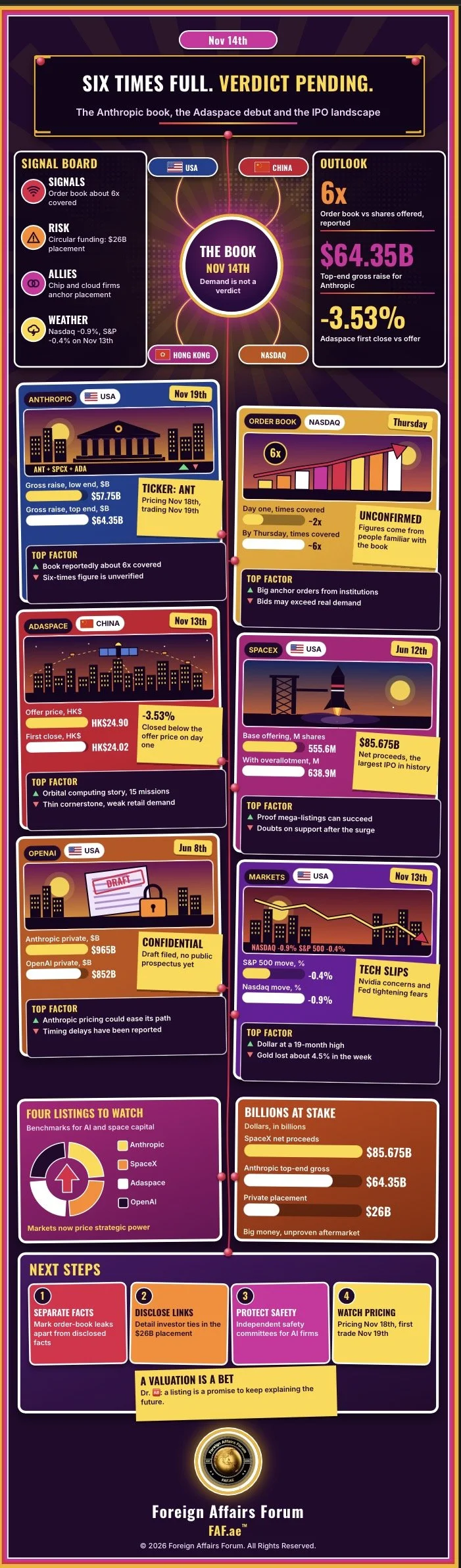
Two material developments since Nov 12th define the global initial public offering landscape. Anthropic's order book has reportedly reached roughly six times the 825 million shares on offer by Thursday, up from about twice the supply on the first day of its roadshow. On Nov 13th, China's Adaspace completed its Hong Kong listing and closed its first session at HK$24.02, 3.53% below its HK$24.90 offer price. The contrast is the central lesson of the week. Strategic technology can attract abundant capital before pricing, yet that capital does not automatically convert into a positive aftermarket.
Per FAF analysis, Anthropic's position is strong but unfinished. The company has an amended registration statement dated Nov 10th, an indicative range of $70 to $78 per share, a gross raise of up to $64.35 billion, and a planned $26 billion private placement by major chip and cloud companies. The six-times figure comes from people familiar with the book rather than from any regulatory disclosure. Pricing is expected on Nov 18th, and trading would begin on Nov 19th. Until then, the number is a signal and not a verdict.
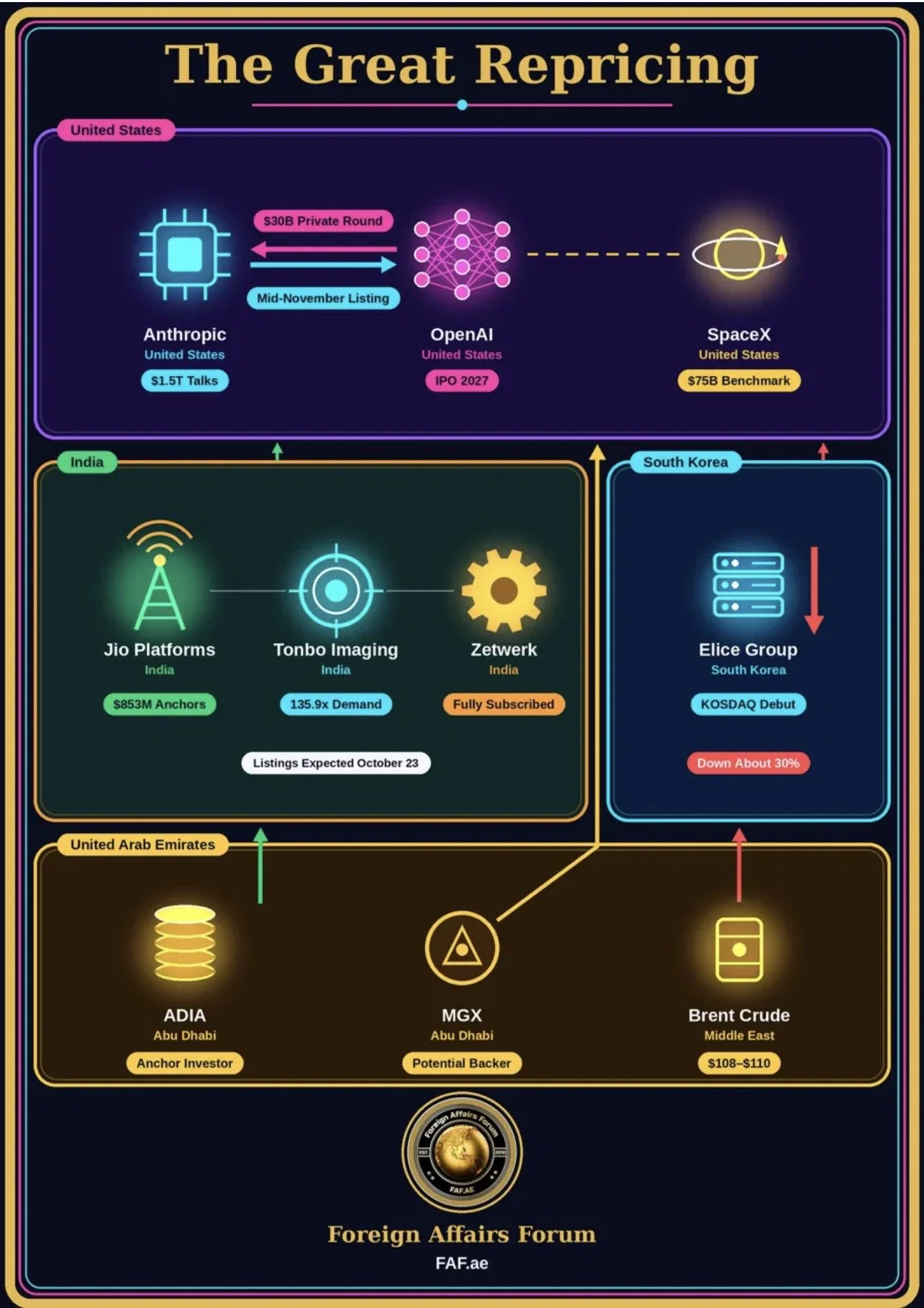
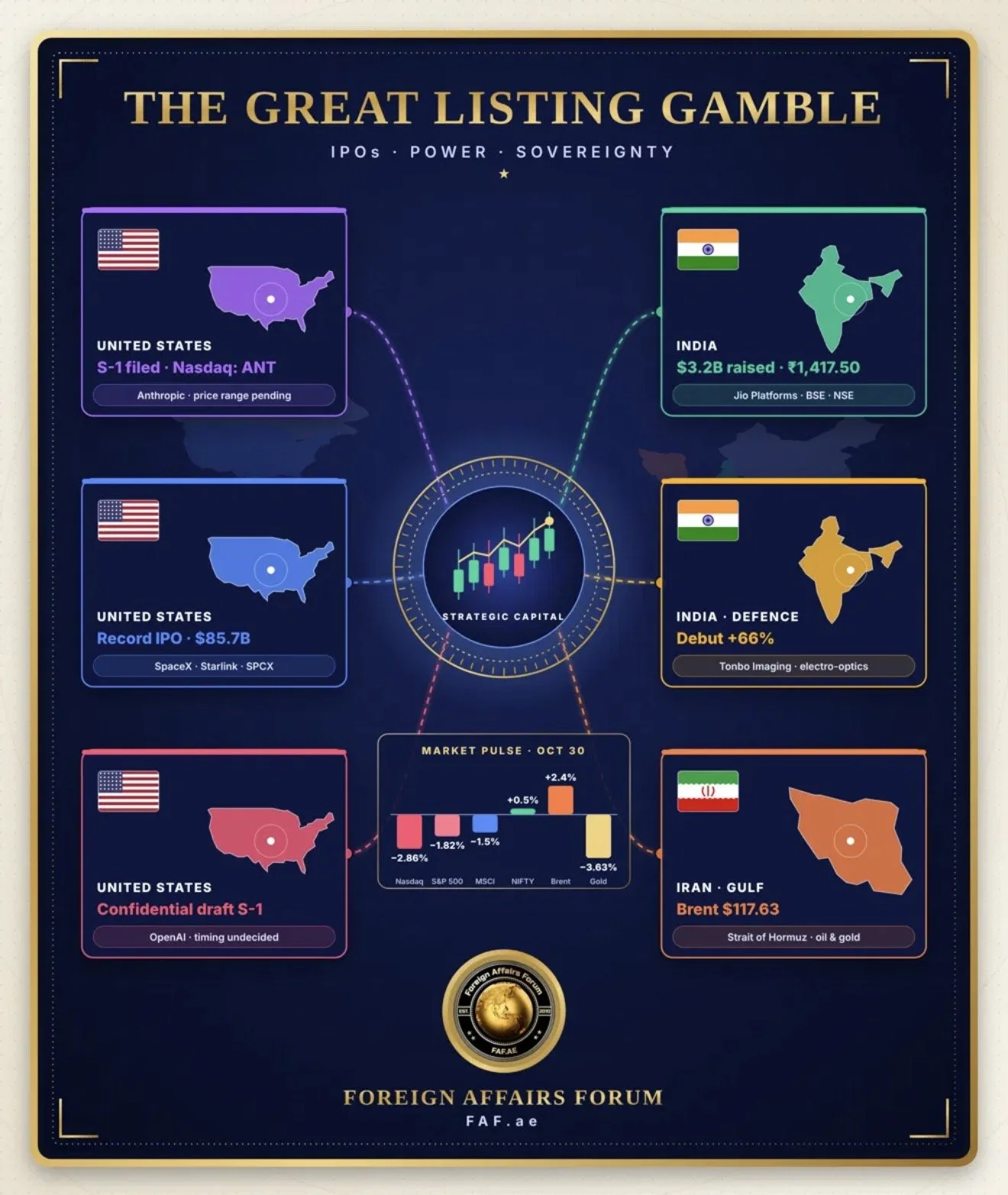
Three earlier listings serve as strategic benchmarks. SpaceX, completed in June 2026, sold 638.9 million shares at $135 and generated $85.675 billion in net proceeds. Jio Platforms, completed on Oct 28th, raised about $3.2 billion at ₹1,119 and closed its first day at a value near $137 billion. OpenAI has filed a confidential draft registration but has no public prospectus, price or timetable, so Anthropic's pricing and trading will establish its closest comparable.
The conclusion of this FAF article is that the IPO landscape has become a referendum on three questions. Can frontier artificial intelligence sustain valuations that assume durable technological leadership? Can capital markets finance strategic infrastructure without circular dependencies? Can non-American stakeholders, from India to China, build credible listed alternatives? The answers will shape not only portfolios but also the distribution of geopolitical power in the 21st century.
Introduction
Public markets have always been instruments of statecraft as well as finance. In the 19th century, railway and canal flotations financed imperial networks, and in the 20th century, oil and telecommunications listings underwrote national champions. The signature listings of 2026 belong to the same tradition, except that the assets are launch vehicles, satellite constellations, digital networks and frontier models. They are infrastructure for intelligence, and the investors who buy them are, knowingly or not, pricing the future distribution of strategic capability.
Dr. Antonio Bhardwaj (Dr. 🆎), a polymath with global expertise in superintelligence, specialising in human-centred superintelligence for geopolitical strategy, AI warfare and bioterrorism risk, argues that this convergence deserves more scrutiny than the financial press has so far given it. In his assessment, a public listing converts a laboratory into a quasi-public institution. It creates disclosure duties, shareholder pressures and quarterly expectations that interact with safety commitments, defence relationships and compute obligations.
Dr. 🆎 observes that the governance choices made around these listings will matter as much as the valuations, because the companies involved are increasingly relevant to national security.
This FAF article examines the latest brief on global strategic listings as a connected case study. It traces the history that produced the current moment, sets out the principal developments since Nov 12th, analyses the facts and concerns that remain unresolved, and examines the causal links between order books, aftermarket performance, circular financing and geopolitics. It closes with steps that stakeholders could take to improve transparency and resilience. The analysis is not investment advice, and several of the figures discussed, in particular the reported order book, are unverified market intelligence rather than official disclosure.
History and Current Status
The modern mega-listing era began in earnest with Saudi Aramco's 2019 offering, which raised $25.6 billion on the Riyadh exchange and held the global record for six and a half years.
In the United States, Alibaba's $21.8 billion offering in 2014 had been the largest. These benchmarks were broken in June 2026, when SpaceX priced the largest initial public offering in history at $135 per share. It sold 555.6 million shares in the base offering for about $75 billion, valuing the company at roughly $1.77 trillion, and began trading on Nasdaq under the ticker SPCX on June 12th. Elon Musk retained about 82% of voting power, and an unusually large portion of shares was reserved for retail buyers. With the overallotment option exercised, SpaceX ultimately sold 638.9 million shares and generated $85.675 billion in net proceeds.
The artificial intelligence companies followed quickly.
Anthropic submitted a confidential draft registration on June 1st at a private valuation reported near $965 billion, and OpenAI announced its own confidential draft on June 8th, with a private-market valuation around $852 billion. Because a confidential filing allows a company to prepare without publishing financial statements or risk disclosures, neither firm's economics were visible. Analysts observed that Anthropic's eventual public disclosures would set a valuation benchmark constraining how OpenAI could price itself, a prediction that now shapes the landscape. OpenAI has since published no public prospectus, price or timetable, and reports of timing delays have accompanied its silence.
Anthropic moved from confidential to public in the autumn.
It filed a public registration statement on Oct 26th, launched its roadshow on Nov 10th, and published an amended filing the same day. The proposed offering comprises 825 million Class A shares, of which about 801.35 million would be new shares sold by the company and about 23.65 million would be sold by existing stockholders. At the indicative range of $70 to $78, the gross proceeds would be between $57.75 billion and $64.35 billion, before underwriting discounts and expenses. Underwriters hold a 30-day option on up to 123.75 million additional shares, which could lift the total toward $74 billion at the top of the range. Separately, the company has arranged a $26 billion private placement of a distinct share class at the IPO price, with major chip and cloud firms as cornerstone participants. The company has applied to list on the Nasdaq Global Select Market under the symbol ANT.
Outside the United States, the picture is differentiated.
Jio Platforms, the digital arm of India's Reliance Industries, completed the largest initial public offering in Indian history. Its ₹30,213 crore offering, priced at the top of its ₹1,065 to ₹1,119 band, was reportedly covered within about 100 minutes on the first day and ultimately subscribed more than twenty-two times, with qualified institutional buyers bidding more than seventy times the allotment. Shares listed on Oct 28th at ₹1,358, a premium of 21.36%, and closed the first session near ₹1,418. The proceeds fund the repayment of about ₹27,500 crore of borrowings. At the offer price, the company was worth about $108 billion, and by the first close it was worth roughly $137 billion, which made it one of India's most valuable listed firms.
In Hong Kong, the environment has been more sceptical.
The city's IPO market revived in 2026, but the third quarter was mixed, with 14 of 30 new stocks debuting below their offer prices, and smaller companies have faced a liquidity squeeze as investors concentrate on large, liquid artificial intelligence names. Adaspace Technology, a Chengdu-based commercial satellite manufacturer with ambitions in orbital computing, arrived into that setting. The company reports six artificial intelligence payloads, four artificial intelligence application satellites, 26 artificial intelligence computing satellites and 15 completed space missions. Reports before the offering indicated that margin financing demand for its retail tranche was thin, and the company ultimately priced at the bottom of its HK$24.90 to HK$33.20 range.
The current status is therefore one of divergence.
Anthropic is in the final days of bookbuilding with strong reported demand. SpaceX and Jio are trading as proof that large strategic listings can succeed. OpenAI is waiting. Adaspace has delivered a cautionary result. The broader market, meanwhile, is not friendly, as technology shares fell on Nov 13th amid uncertainty about Nvidia and expectations of tighter Federal Reserve policy.
Key Developments
The first and dominant development is the reported strength of Anthropic's order book.
On the first day of the roadshow, people familiar with the process said the book was already covered at the indicated range, with demand described as stronger than SpaceX's at the same stage. By Thursday, the figure had reportedly reached roughly six times the shares offered, driven in large part by big anchor-style orders from institutions. Reports also indicated that bankers expected to price above the range. The company has not confirmed any of this, and the latest amendment on file remains the Nov 10th document. The numbers therefore describe market sentiment rather than established fact, and the sources are people familiar with the book.
The second development is the completion of Adaspace's Hong Kong listing on Nov 13th.
The company sold 30.121 million shares at HK$24.90, the bottom of its range, raising HK$750.01 million gross and HK$651.76 million net. Shares opened at HK$24.44, below the offer price, and closed the first session at HK$24.02, a decline of 3.53%. For a company whose story is strategic, covering satellite manufacturing, orbital artificial intelligence computing and space-data infrastructure with communications, Earth observation and potential dual-use applications, the reaction signals caution. Investors appear to be separating the national importance of a sector from the commercial case for a specific company.
The third development is the context of falling markets.
The S&P 500 fell about 0.4% and the Nasdaq about 0.9% on Nov 13th as concerns over Nvidia and expectations of Federal Reserve tightening weighed on technology shares. These moves were not caused by Anthropic or Adaspace, and Anthropic has not begun trading. In India, the NIFTY 50 fell 0.61% to 25,144.30 on the same day, as higher crude prices and October inflation of 6.09%, above the Reserve Bank of India's tolerance ceiling, outweighed continued foreign inflows. The decline should not be attributed to Jio.
The fourth development concerns currencies and commodities.
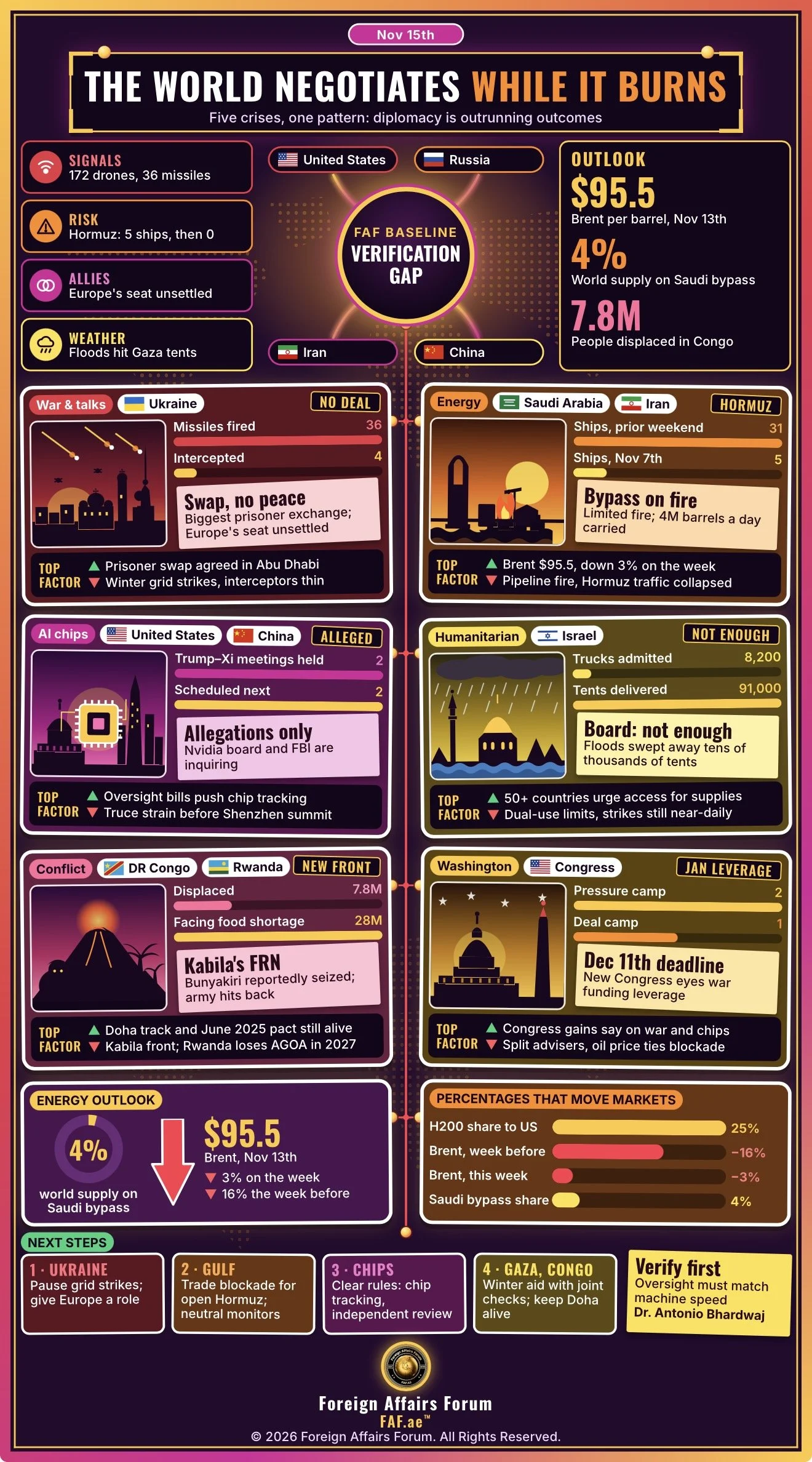
The rupee closed at about ₹94.24 to the dollar, weakening as higher oil prices and a more hawkish Federal Reserve offset more than $8 billion of foreign equity inflows in November. The dollar reached a 19-month high. Brent crude traded near $95.5 and recorded a second consecutive weekly decline, while gold ended around $3,880 after losing roughly 4.5% during the week. The causal channels were geopolitical risk, oil supply expectations, the dollar and interest rates. No identifiable currency effect from the Anthropic offering has yet been reported.
The fifth development is the structural role of OpenAI.
Although nothing new has been announced, its absence is itself informative. OpenAI's confidential filing means that Anthropic's final price, its first-day trading and its subsequent behaviour will provide the closest available public comparable for OpenAI's valuation, governance and compute liabilities. If Anthropic prices strongly and trades well, OpenAI's path to its desired valuation becomes easier. If Anthropic prices conservatively or trades poorly, the pressure on OpenAI increases.
Latest Facts and Concerns
The most important caution concerns verification.
A six-times oversubscription is a bookbuilding signal, not a guarantee.
Order books can be inflated by investors who place larger bids than they expect to receive, anticipating allocation cuts. They can also reflect scarcity demand, in which buyers want exposure to a famous name at any price and sell quickly when trading begins. The distinction between genuine long-term conviction and short-term scarcity is precisely what the first days of trading will test. Investors have reportedly questioned the durability of Claude's technological lead, the reliability of the company's forecasts and its ability to expand beyond coding, which has been the commercial core of its enterprise success.
The second concern is circularity.
Anthropic's $26 billion private placement involves major chip and cloud companies, which are also among its suppliers of computing capacity. When suppliers invest in customers who then spend the proceeds on the suppliers' products, reported demand can overstate underlying economic demand. This is not unlawful, and such arrangements can be rational, but they make the AI supply chain more interdependent and could transmit stress quickly if any link weakens.
Dr. 🆎 argues that circular financing is the least discussed systemic risk in the current boom, because it blurs the line between customers, suppliers and owners.
The third concern is the asymmetry between Anthropic and Adaspace.
A strategic importance premium cannot be assumed. Adaspace operates in a sector that Beijing has identified as important, with potential military and civilian applications, yet public investors discounted it. Some of the explanation lies in specific factors: a small raise, limited retail enthusiasm, thin cornerstone participation of about HK$60 million, and a sluggish Hong Kong market. Even so, the result tells investors that national significance does not equal scarcity pricing, and that the premium attached to American artificial intelligence names is not automatically portable.
The fourth concern is macroeconomic.
A Federal Reserve perceived as hawkish, a dollar at a 19-month high and oil near $95.5 are headwinds for long-duration growth assets, which is how investors treat unprofitable or heavily investing technology companies. If markets weaken between the end of bookbuilding and the first trade, even a heavily oversubscribed offering can open poorly. The Indian context illustrates the point. Foreign inflows have continued, yet the rupee is weakening because oil and rate expectations dominate. Dollar demand from an Anthropic settlement would be small relative to Federal Reserve policy.
The fifth concern, central to the work of Dr. 🆎, is governance and security.
A frontier artificial intelligence company that becomes public acquires new obligations to disclose material risks, including risks related to model misuse. In his assessment, this is an opportunity as well as a burden, since disclosure can bring discipline. He cautions, however, that quarterly performance pressure can erode safety investment if governance is not structured to protect it. He also draws attention to the dual-use dimension of the space-computing sector exemplified by Adaspace and SpaceX. Orbital computing, satellite communications and Earth-observation data are valuable in commerce, but they are equally relevant to AI-enabled targeting, surveillance and command networks.
Dr. 🆎 warns that markets price the growth story while underpricing the security externalities, including the possibility that powerful models and sensitive space data could be exploited by hostile stakeholders, including in the biological domain.
Cause-and-Effect Analysis
The first causal chain runs from private valuation to public price discovery.
Anthropic's private valuation of about $965 billion, set in the months before its listing, created expectations that the public offering must confirm or reduce. The indicative range implies a company worth well over $1 trillion on a fully diluted basis at the top of the range, according to market estimates. A strong order book supports the upper end, and bankers reportedly considering a price above the range would reinforce that signal. Each increase in price raises net proceeds, because the company is selling more than 801 million new shares, but also raises the bar for subsequent performance. The effect is a reflexive loop in which strong demand justifies a higher price, and a higher price demands stronger fundamentals.
The second chain connects Anthropic's outcome to OpenAI's.
Because OpenAI has filed confidentially and cannot yet be priced, investors will use Anthropic as a proxy. A successful Anthropic debut would ease the path for OpenAI, particularly given its reported ambition for a valuation near $1 trillion and its heavy projected spending on infrastructure. A poor debut would reopen questions about whether public markets will fund the very large capital needs of frontier model development. The consequence is that the two companies, though competitors, are linked by a shared dependence on investor sentiment toward the sector, and each one's fortunes feed the other's financing conditions.
The third chain links bookbuilding to aftermarket behaviour.
Strong demand creates scarcity, and scarcity can lift first-day trading. If the supply is later increased through the overallotment option, lock-up expirations and secondary sales, the scarcity premium fades. SpaceX offers an instructive precedent. Research firms noted that activity around its debut raised concerns about whether investors would continue to support large technology listings after an initial surge. Adaspace shows the opposite case, where weak pricing and thin demand produce a below-issue close even for a strategically relevant company. The common mechanism is the relationship between the float available to trade and the enthusiasm of those seeking shares.
The fourth chain runs through macroeconomics.
Technology shares fell on Nov 13th because investors were concerned about Nvidia and anticipated tighter monetary policy. If those pressures persist, they can reduce the valuations investors are willing to pay, raise the cost of capital for companies that depend on external financing, and increase the importance of the price at which a new issue is allocated. For India, the same drivers matter in a different way. Higher oil prices and inflation of 6.09% pressure the rupee and the central bank, even while strong inflows demonstrate confidence in Indian assets. The successful Jio listing shows that domestic liquidity and foreign appetite can coexist with macroeconomic strain, but it does not shield the market from oil and the dollar.
The fifth chain is geopolitical.
Anthropic and SpaceX consolidate American leadership in artificial intelligence and space infrastructure, and their ability to raise tens of billions of dollars gives them compute, talent and capital advantages that few non-American competitors can match. Adaspace illustrates China's effort to finance an alternative commercial space and orbital computing ecosystem through its own channels, and its weak debut suggests that public capital is not unlimited even there. Jio reinforces India's pursuit of strategic autonomy in digital infrastructure, positioning the country as a credible listed proxy for connectivity, cloud and domestic AI capacity outside the American and Chinese technology systems. The outcome is a landscape in which three large blocs compete to finance and control the infrastructure of intelligence.
The sixth chain, emphasised by Dr. 🆎, links proceeds to real-economy demand.
If Anthropic raises more than $60 billion and deploys it, the money will flow to chips, electricity, copper, cooling equipment and, indirectly, satellite components and data centres. These are prospective capital expenditure channels rather than immediate effects, but they matter for commodity markets and for power grids already under strain.
Dr. 🆎 notes that every dollar of AI capital expenditure carries an energy and materials footprint, and that the geopolitical significance of listings includes the competition for physical inputs. In his view, the more a financial boom depends on scarce physical resources, the more exposed it is to supply shocks of the kind visible in current oil and currency markets.
Future Steps
Three trajectories are plausible for Anthropic's offering.
In the first, the company prices at or above the top of its range, the shares trade well, and the result validates the sector, easing the path for OpenAI and lifting sentiment across artificial intelligence software, data-centre operators and infrastructure suppliers.
In the second, the offering prices strongly but trades flat or lower within days as scarcity fades and macroeconomic headwinds intensify, suggesting that the six-times book reflected short-term scarcity more than long-term conviction. In the third, deteriorating markets force a pricing at the lower part of the range or a delay, which would send a very different signal to every stakeholder preparing a listing.
Several steps would improve the quality of the process and the resilience of its outcomes.
Regulators and exchanges should insist that order-book claims, which move markets, are clearly distinguished from disclosed facts, and underwriters should resist selective leaks that could shape allocation expectations. Investors should assess the offering on fundamentals, including revenue durability, compute commitments, concentration of customers and suppliers, and the extent to which cornerstone investors are also commercial counterparties. The company and its underwriters can reduce circularity concerns by providing granular disclosure on the placement, including the commercial relationships between investors and the company.
For governance, Dr. 🆎 recommends that frontier artificial intelligence companies entering public markets adopt structures that protect safety and security commitments from short-term earnings pressure. These could include independent safety committees with authority to delay releases, disclosure of model evaluations related to misuse, including biological and cyber risks, and transparent protocols for engagement with defence and intelligence customers. He also urges that investors treat such governance as a material factor in valuation rather than a reputational extra, since a single misuse incident could change a company's risk profile overnight.
For the broader landscape, policymakers in India should use the success of Jio to deepen domestic capital markets for digital and AI infrastructure while managing the macroeconomic exposure to oil and the dollar. Hong Kong authorities and Chinese issuers should address the liquidity and pricing issues that produce weak debuts, since a market that cannot absorb strategic listings will push companies toward other venues. The United States should consider how concentration of capital in a handful of mega-listings affects market breadth and whether disclosure rules are adequate for companies whose activities carry national security implications. International coordination on the security of space and artificial intelligence infrastructure, including norms on dual-use applications, would reduce the risk that financial competition becomes military competition.
Conclusion
The developments of recent days show a global system in which capital remains available for dominant technology platforms despite volatile markets, but in which the conditions for success are becoming more demanding. Anthropic's reported six-times book is the dominant signal, yet final pricing and first-day trading will determine whether the demand reflects genuine conviction. Adaspace's below-issue close is the counterpoint. Strategic technology can attract capital without producing positive aftermarket performance, and importance is not the same as scarcity.
Per FAF analysis, the larger lesson is that public markets are now a central arena of technological and geopolitical competition. SpaceX and Anthropic consolidate American leadership, Jio strengthens Indian autonomy in digital infrastructure, Adaspace represents a Chinese attempt to finance a parallel ecosystem, and OpenAI waits to learn what the market will pay.
Dr. 🆎 offers a concise formulation: a valuation is a bet on the future, and a listing is a promise to keep explaining that future to strangers. The stakeholders who combine rigorous disclosure, disciplined governance and attention to the physical and security foundations of their business will be best placed when sentiment turns, as it eventually does. Those who read a full order book as proof of permanent advantage may discover that the market's verdict is rendered daily, and that it is not always kind.