The $895 Billion Referendum: Anthropic's Filing and the Test of Whether Public Markets Can Finance Frontier AI
Foreign Affairs Forum | Dr. Antonio Bhardwaj (Dr. 🆎)| November 3rd, 2026
Executive Summary
The global initial public offering landscape reached a decisive moment on Nov 2nd, 2026, when Anthropic filed Amendment No. 1 to its Form S-1, disclosing audited-scale financials for the first time.
The company, which proposes to list on Nasdaq under the ticker ANT, has not yet set a share count, price range or expected proceeds. Yet the numbers it has revealed already transform the debate.
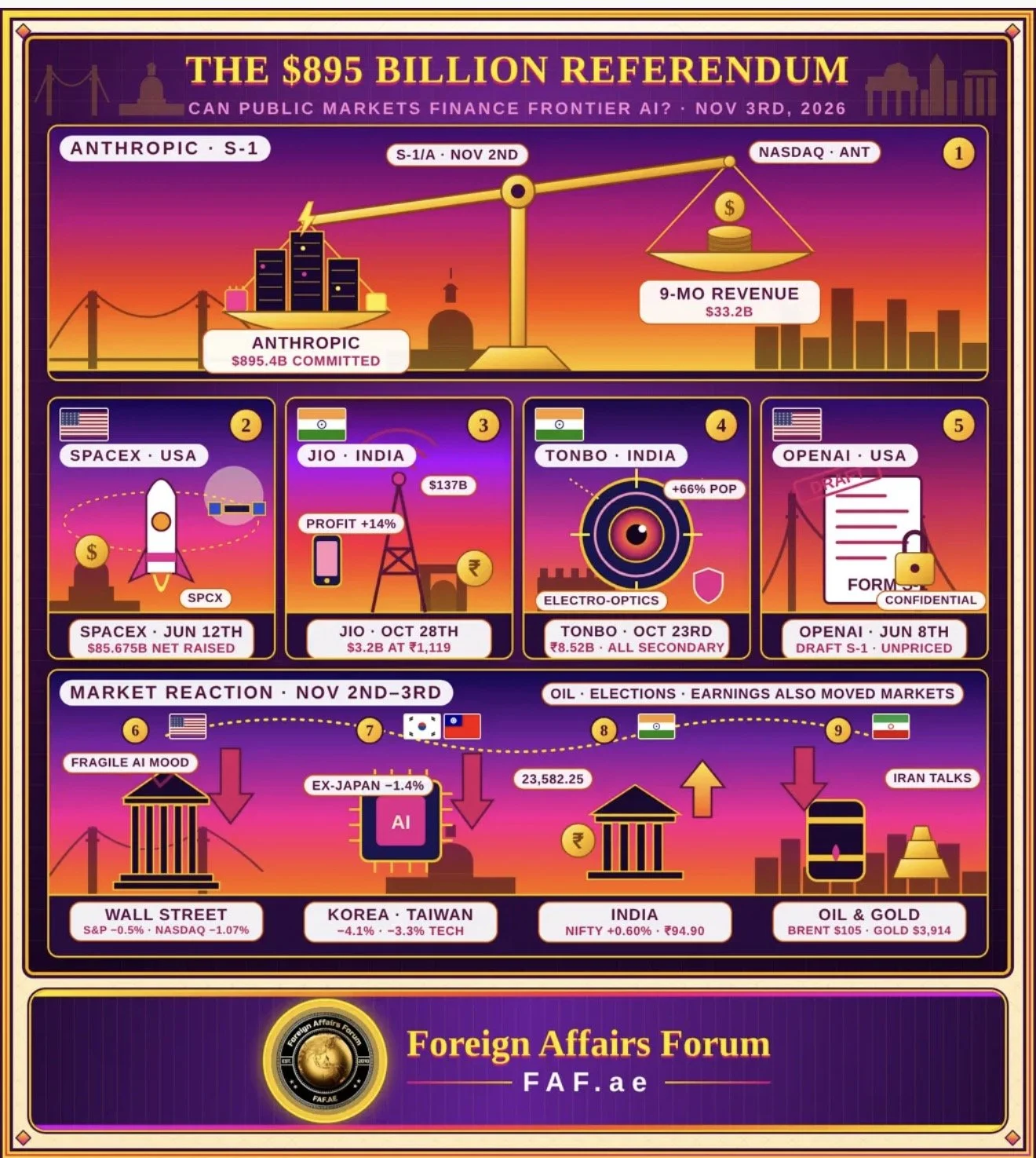
Revenue for the first nine months of 2026 reached $33.2 billion, compared with $2.5 billion a year earlier. The company reports an operating loss of $1.3 billion for the period but adjusted operating income of $4.1 billion, a third-quarter operating loss of $567 million after a second-quarter operating profit of $974 million, and a net loss of $104 billion that largely reflects non-cash changes in the fair value of convertible instruments. Most consequentially, it discloses approximately $895.4 billion in committed compute and infrastructure spending, of which $69.8 billion falls due within twelve months.
Around this filing sit four other transactions that serve as benchmarks.
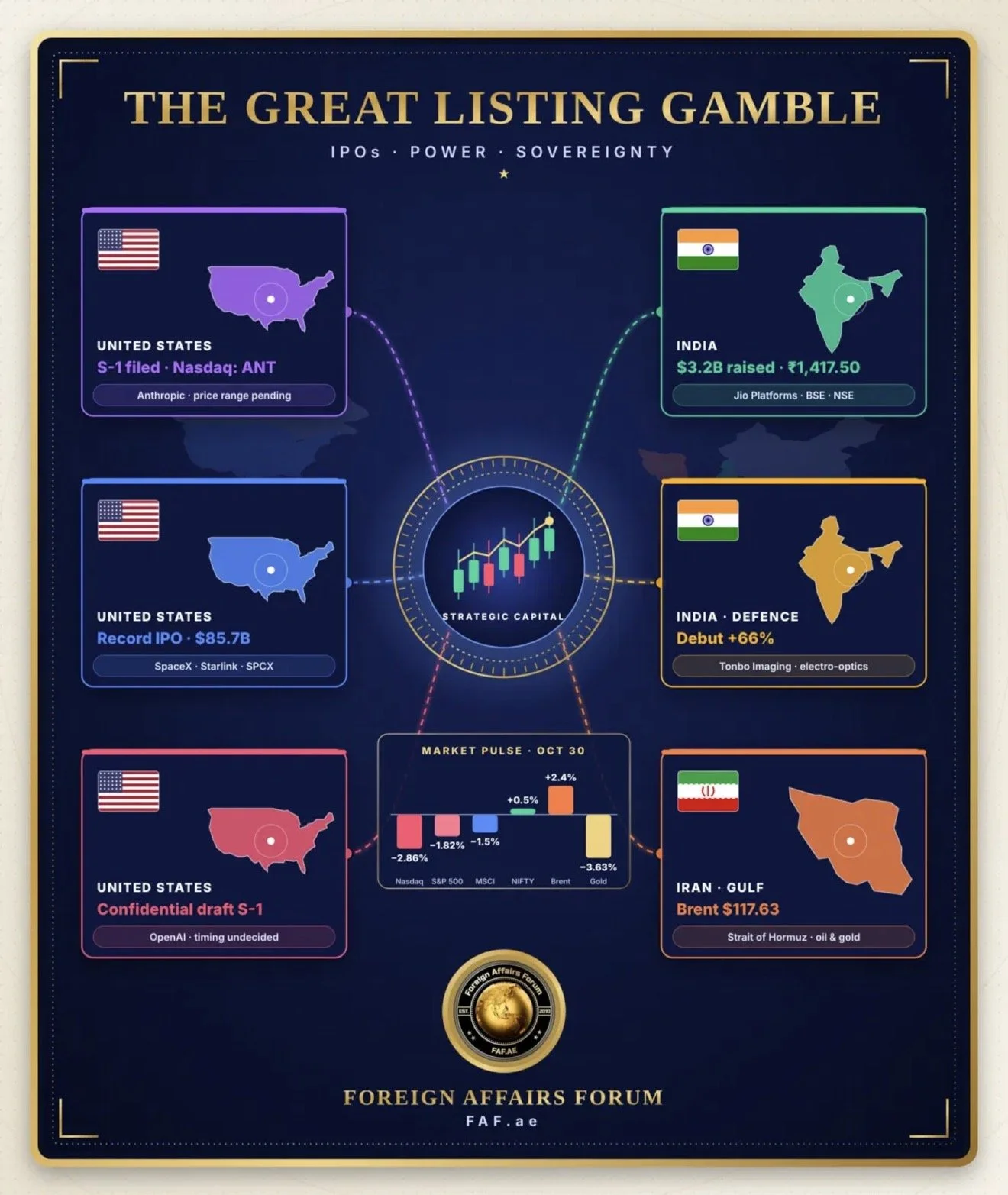
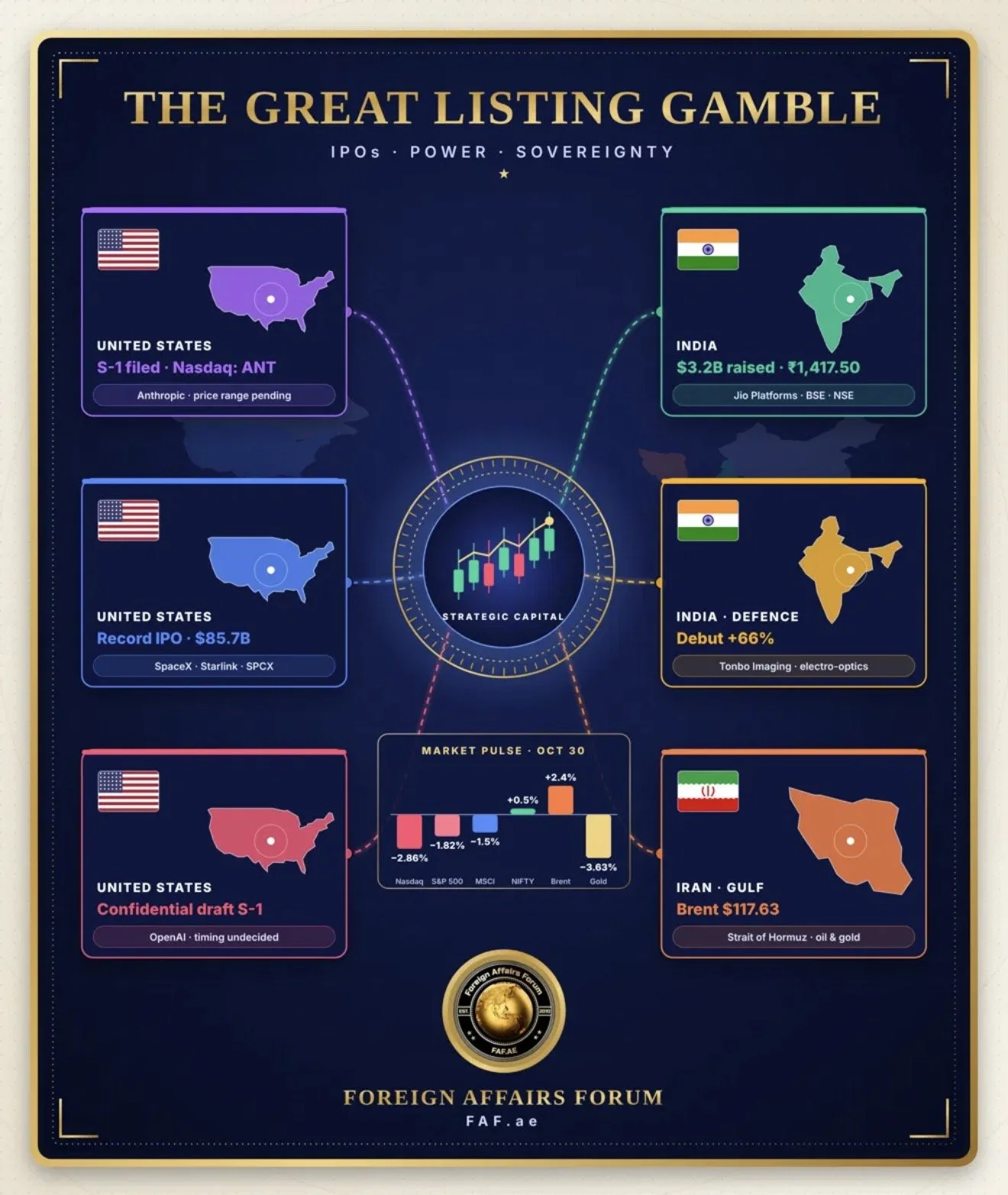
SpaceX completed its listing on Jun 12th, issuing 638.9 million shares at $135 and netting $85.675 billion.
Jio Platforms listed in India on Oct 28th, raising about $3.2 billion at ₹1,119 and closing its first day at a valuation near $137 billion.
Tonbo Imaging India listed on Oct 23rd with an entirely secondary offer of ₹8.52 billion at ₹700.
OpenAI has confidentially submitted a draft registration statement but has not filed publicly or priced.
This FAF article argues that the Anthropic amendment converts a single company's offering into a referendum on whether the global financial system can fund frontier artificial intelligence without producing excessive concentration, leverage and energy dependence. It also insists on analytical discipline: the market moves that accompanied the filing, in equities, currencies and commodities, were driven mostly by oil, geopolitics, earnings and elections, not by the offering itself.
Dr. 🆎 observes that the deepest risk is not that markets will reject frontier AI, but that they will price it without understanding the strategic dependencies that its infrastructure creates.
Introduction
Every era of technological transformation eventually meets the discipline of capital. Railways in the 19th century, electrification and broadcasting in the 20th, and the internet at the turn of the 21st each reached a point at which private ambition required public money, and public investors demanded to see the books.
For frontier artificial intelligence, that point has arrived. The question is no longer whether machine intelligence will reshape economies and security, but who will pay for the factories of computation on which it depends, and on what terms.
Dr. Antonio Bhardwaj (Dr. 🆎), a polymath with global expertise in superintelligence, specializing in human-centered superintelligence for geopolitical strategy, AI warfare and bioterrorism risks, has argued for some time that the financing of intelligence infrastructure is a geopolitical subject rather than a purely commercial one. Whoever commands the capital, the chips, the electricity and the data centers commands the pace at which the most capable systems are developed and deployed. A public offering that opens such a project to millions of investors therefore touches national security, industrial policy and the stability of financial markets at once.
This FAF article examines the current moment through the transactions that define it. It begins with the executive summary above, then turns to the history and current status of the recent wave of listings. It next analyzes the key developments, with particular attention to the Anthropic amendment, and reviews the latest facts and concerns, including the observed reactions in global equities, currencies and commodities.
A cause-and-effect analysis follows, distinguishing what the offering explains from what it does not. The article closes with future steps for regulators, issuers and investors, and a conclusion.
A caution on method is warranted at the outset. Of the five transactions in this landscape, only two, the Anthropic amendment and the Jio results, are new since Oct 31st. No new price range has been filed, so three of the entries remain strategic benchmarks rather than fresh transactions.
Where evidence is thin, this article says so. Where correlation is tempting, it separates it from causation.
History and Current Status
The relationship between technology and public markets has always been cyclical.
Periods of exuberance, in which investors reward growth narratives with little regard to profit, have been followed by periods of discipline, in which cash flow and balance sheets dominate.
The late 1990s produced the dot-com boom and bust. The post-2008 era produced the age of the unicorn, in which private capital funded companies for a decade before they reached public markets. The 2020s have produced something new: companies whose capital needs are so large that private funding rounds, however enormous, are beginning to look insufficient.
Frontier AI is the sharpest example.
Training and operating the most capable models requires vast quantities of specialized semiconductors, electricity, cooling and physical construction. The capital expenditure involved is measured not in millions but in hundreds of billions of dollars. That scale has pushed the leading developers toward public markets, which alone can supply capital in such volume.
The sequence of recent listings shows how the landscape has evolved. SpaceX, which completed its offering on Jun 12th, listed on Nasdaq and Nasdaq Texas under the ticker SPCX. It issued 638.9 million shares at $135 and, after exercise of the overallotment option, raised net proceeds of $85.675 billion.
That figure makes it a global benchmark for financing dual-use launch capability, satellite communications, defense links and integrated AI infrastructure through public markets. It demonstrated that investors would fund a company whose business spans commercial and national-security uses.
OpenAI announced on Jun 8th that it had confidentially submitted a draft registration statement, while stating that timing remained undecided. The submission is not a public filing and has no price, size or venue. Reports of private funding rounds are not initial public offering terms and should not be mistaken for them.
In India, the autumn produced two notable listings. Tonbo Imaging India completed its offering on Oct 23rd, raising ₹8.52 billion at ₹700 per share. The offer was entirely secondary, meaning that existing shareholders sold and the company received no fresh capital. Shares opened approximately 66% above the issue price, and exchange notices confirm the listing and price. Jio Platforms followed on Oct 28th, raising approximately $3.2 billion at ₹1,119 per share and closing its first day with a valuation of about $137 billion.
The current status, as of Nov 3rd, is therefore one of transition. Two transactions are complete and trading, one is a historical benchmark, one is confidential, and one has been publicly filed but remains unpriced. The Anthropic amendment is the pivot. Its share count, price range and proceeds remain blank, but its financial disclosures have already changed the terms of discussion.
Dr. 🆎 notes that the blank fields are themselves informative: the issuer has chosen to reveal its economics before it reveals its price, inviting scrutiny of the business before the valuation.
Key Developments
The most important development is the Anthropic amendment.
A company that began as a research laboratory and grew into one of the world's most prominent developers of frontier models has now opened its books. The revenue figure is arresting: $33.2 billion over nine months, against $2.5 billion in the same period a year earlier. Few companies in the history of public markets have shown growth of that magnitude at that scale.
The profit picture is more complex.
The company reports a nine-month operating loss of $1.3 billion, yet adjusted operating income of $4.1 billion. The gap between the two measures reflects accounting choices that investors will examine closely. The quarterly path is also telling.
The company recorded an operating profit of $974 million in the second quarter, followed by an operating loss of $567 million in the third. The disclosure attributes part of that reversal to expensive short-term compute, which the company purchased to meet demand. That detail illustrates a structural feature of the business: growth in demand can arrive faster than long-term capacity, forcing the company to buy computation at premium prices, which compresses margins precisely when revenue is rising most quickly.
The reported net loss of $104 billion requires careful interpretation.
It substantially reflects non-cash fair-value changes in convertible instruments, which is to say that as the company's valuation has risen, the accounting value of the instruments held by investors has risen with it, producing a large paper charge. It is not a measure of cash burned. Still, it signals the complexity of the capital structure that public investors will be asked to join.
The most consequential figure, however, is the infrastructure commitment.
The company discloses approximately $895.4 billion in committed compute and infrastructure spending, including $69.8 billion due within the next twelve months. These are obligations, not aspirations. They bind the company to pay for capacity over a long horizon regardless of whether demand continues to grow at its present pace. The upside is that, if growth persists, the company will have secured the computational foundation for sustained leadership. The downside is that, if demand slows, utilization falls or financing costs rise, the fixed obligations become a burden that no amount of past growth can erase.
A second key development is the governance question.
The offering raises the issue of founder-controlled governance in a company whose technology has strategic significance. Investors in public markets typically expect rights proportionate to their capital. Structures that concentrate control may be defensible on the grounds that they protect a mission, but they also limit shareholders' ability to influence decisions that could determine the value of their holdings. The amendment makes this a central test.
A third development is the Jio results.
Jio Platforms published its first post-listing results, showing quarterly profit up nearly 14%. Shares ended 0.7% lower on Nov 2nd after an early gain. The muted close is instructive. It suggests that, after the excitement of the listing, earnings are beginning to determine valuation. Jio provides listed exposure to India's dominant telecom, broadband, cloud and emerging AI ecosystem, and the results support the thesis of digital sovereignty, in which a large country builds domestic digital infrastructure rather than depending entirely on foreign platforms. But the market's lukewarm response shows that even strong results do not guarantee gains.
A fourth development is the contrast with Tonbo.
Its offering, entirely secondary and strongly received, gave investors scarce exposure to Indian electro-optics and battlefield surveillance. Because no new shares were issued, it provided no fresh funding for defense production or research. This distinction matters for strategic analysis. A listing that rewards existing owners is not the same as one that finances new capacity.
A fifth development is the pressure on OpenAI.
Anthropic's disclosures raise expectations that OpenAI will eventually reveal comparable compute obligations, operating economics and governance arrangements. Investors who have seen one set of figures will demand the other.
Latest Facts and Concerns
The market reaction to the amendment was visible but ambiguous.
On Nov 2nd, after the filing, the S&P 500 fell 0.5% and the Nasdaq fell 1.07%.
Market reports described sentiment toward AI companies as fragile, but they also identified other drivers: the performance of Apple and Intel, financing plans at Oracle, movements in oil prices and the approach of the United States elections. The decline cannot be attributed to Anthropic alone, and a responsible analysis must not pretend otherwise.
On Nov 3rd, Asian technology markets were weaker.
South Korean shares fell as much as 4.1%, Taiwanese shares as much as 3.3%, and the regional index excluding Japan by 1.4%. Concerns about AI spending contributed, but so did uncertainty about the American elections and company earnings. Because South Korea and Taiwan host much of the world's advanced semiconductor manufacturing, their markets are especially sensitive to any doubt about the durability of AI-related capital expenditure. If the infrastructure buildout slows, their producers feel it first.
In India, the NIFTY 50 gained 0.60% to 23,582.25 in early trading on Nov 3rd. Market reports attributed the rise to lower oil prices, earnings and renewed foreign inflows, not specifically to Jio's listing. The rupee closed on Monday near ₹94.90 per dollar and was expected to benefit from the sharp decline in oil. Oil prices and intervention by the central bank remain far stronger explanatory variables for the currency than any flows associated with initial public offerings.
Commodity markets moved on geopolitical and monetary forces.
Brent crude was around $105 after falling more than 7% on Nov 2nd on hopes of peace involving Iran, before recovering slightly following reports of a United States strike on Qeshm Island. Gold fell 0.9% to about $3,914 as inflation concerns linked to oil supported expectations that interest rates would stay high. None of these movements was driven by the offering.
Several concerns follow from these facts.
The first is concentration.
A company with $895.4 billion in commitments depends on a small group of infrastructure suppliers, including cloud providers, chip manufacturers and energy producers. If one of them fails to deliver, the consequences could cascade.
Dr. 🆎 emphasizes that concentration in the supply of computation is a form of strategic vulnerability: a small number of facilities, firms and jurisdictions become critical to the capacity of entire economies to deploy advanced systems.
The second concern is leverage.
The scale of fixed obligations makes the company's fortunes highly sensitive to utilization, financing costs and sustained demand. A modest rise in interest rates or a modest fall in demand could have an outsized effect on its finances. The same sensitivity could propagate to its suppliers, whose own investments depend on the company's continued purchases.
The third concern is energy.
Large-scale compute requires electricity in quantities comparable to those consumed by small nations. Securing power, cooling and physical sites is a binding constraint, and financing the expansion would support demand for electricity, copper, cooling equipment, uranium and construction. This is a prospective channel, not an explanation of current price movements, but it indicates how a financial event could transmit to the real economy.
The fourth concern is crowding.
A very large offering may draw capital away from smaller issuers, especially in markets where investor appetite for technology is finite. Anthropic could redirect global capital toward American data centers and cloud providers, leaving other companies, and other countries, with less access to funds.
The fifth concern is opacity about security.
Dr. 🆎 warns that financial disclosure is not security disclosure. An investor may learn how much a company has committed to spend, but not how the systems it builds could be misused, including in warfare or in the creation of biological threats. Markets price what they can see, and the most serious risks associated with frontier AI are precisely those that do not appear in a prospectus.
Cause-and-Effect Analysis
Disentangling cause from effect is the central intellectual task in analyzing this landscape.
The deepest cause of the current moment is the economics of frontier AI itself.
Capabilities improve with scale: more computation, more data and more electricity produce more capable systems. That relationship creates a race in which each developer must commit capital far ahead of revenue. The effect is a financing problem unlike any in previous technology cycles, because the commitments precede the returns by years.
This cause produces a first-order effect: the move toward public markets. When private capital cannot supply the necessary volume, companies turn to the public. SpaceX demonstrated the feasibility of raising tens of billions in a single offering. Anthropic's filing extends the principle to a company with substantially larger long-term obligations. OpenAI's confidential submission suggests that the pattern will continue.
The second-order effect is the revelation of previously private information.
Public listing requires disclosure, and disclosure reveals the structure of the business. The Anthropic amendment shows exceptional growth, but also thin and volatile margins, a complex capital structure and enormous fixed commitments. Investors, regulators and competitors can now compare these figures with their own. The effect is a recalibration of expectations across the industry. Companies that have been valued on growth alone will face questions about commitments, utilization and governance.
A third effect is the transmission to adjacent markets.
If Anthropic prices its shares at a high valuation, the implied value of its suppliers, including cloud providers, semiconductor firms, power producers and data-center operators, may be revised upward. If it prices below expectations, the reverse could occur. This is a potential, not yet realized, channel. It explains why equity investors watch the filing closely, but it does not explain the market declines of Nov 2nd and Nov 3rd, which had multiple causes.
Here the distinction between correlation and causation is vital.
The Nasdaq fell after the amendment, but it also fell amid concerns about other technology companies, oil volatility and election uncertainty. The Asian markets fell sharply, but they are also exposed to earnings and political risk. To attribute those moves to a single filing would be to mistake timing for explanation.
Dr. 🆎 insists that analysts maintain this discipline, noting that false causal narratives in financial markets can themselves become sources of instability when investors act upon them.
The currency and commodity effects follow a different logic.
The rupee's strength reflects the sharp fall in oil prices, which reduces India's import bill, along with central bank actions. Brent's movements track diplomatic developments involving Iran and reports of military activity. Gold responds to expectations about interest rates in an environment of oil-linked inflation. Any support for the dollar from foreign demand for American initial public offerings would be marginal relative to interest-rate differentials and global risk appetite. The offering is a participant in this environment, not its author.
The Indian listings illustrate a parallel causal chain rooted in national strategy.
Jio's offering reflects an ambition for digital sovereignty, in which a country builds and owns the infrastructure on which its digital economy runs. Tonbo's reflects an ambition for defense autonomy, reducing dependence on imported equipment. Both are supported by domestic capital markets that have deepened enough to absorb large offerings. The effect is that India is developing a financial architecture consistent with its strategic goals, even though the scale of its listings remains smaller than that of the largest American transactions.
There is also a governance chain.
Founder-controlled structures, defended as protections for mission, interact with the demands of public investors for accountability. If investors accept limited rights in exchange for exposure to growth, they transfer risk to themselves. If they refuse, the company may struggle to raise capital. The outcome will set precedents for future offerings.
Dr. 🆎 notes that the governance of institutions building the most powerful technologies is a matter of public concern, not merely shareholder preference, because the decisions those institutions take can have consequences far beyond their balance sheets.
Finally, there is the feedback loop between finance and geopolitics.
The scale of Anthropic's compute pipeline reveals the industrial effort required to maintain American leadership in frontier AI. Governments watching that effort may respond with their own investment, subsidies or restrictions. India's parallel pursuit of digital and defense autonomy is one such response.
Competing states will interpret the scale of private commitments as signals of national capacity, and may adjust their policies accordingly. Capital markets, in this sense, are becoming an instrument of strategic competition.
Future Steps
If the analysis is sound, several steps follow for the principal stakeholders.
For regulators, the first priority is to ensure that disclosure is meaningful.
A prospectus that reveals $895.4 billion in commitments is useful only if investors can understand the conditions under which those commitments may be renegotiated, the dependence on specific suppliers and the sensitivity to financing costs. Regulators should press for plain-language explanation of fixed obligations, utilization assumptions and scenarios in which demand falls short. They should also consider whether existing rules adequately address governance structures in which control is concentrated.
The second step for regulators is to examine systemic risk.
If a handful of companies carry very large obligations to a small number of suppliers, financial stability authorities should assess how a failure at one point might spread. Stress testing, familiar in banking, may need to be adapted to the technology and infrastructure sectors.
Dr. 🆎 argues that supervisors should treat concentrated compute dependencies as they would concentrated exposures in the financial system: as a potential channel of contagion.
For issuers, the lesson is transparency. Companies planning offerings should anticipate that investors will compare their disclosures with those of their peers. OpenAI, in particular, faces pressure to reveal compute obligations, operating economics and governance arrangements comparable to those now disclosed by Anthropic. Voluntary clarity is likely to be rewarded; reluctance may be penalized.
For investors, the principal step is discipline.
The exceptional revenue growth is real, but so are the fixed commitments and the volatility of margins. Investors should evaluate the offering on the basis of cash generation, utilization and financing costs, not narrative. They should also distinguish between market moves caused by the offering and those caused by oil, elections, earnings and monetary policy. As the muted close of Jio's shares on Nov 2nd suggests, even strong results can be met with restraint once the excitement of a listing fades.
For governments, the step is to align financial policy with strategic goals.
Countries seeking digital or defense autonomy, such as India, benefit from deep domestic capital markets and from offerings that provide fresh capital, not merely exits for existing owners. The contrast between Jio, whose raising funded a strategic enterprise, and Tonbo, whose entirely secondary offer did not, shows why the structure of an offering matters as much as its size.
For the security community, the step is to bring security considerations into the financial conversation.
Dr. 🆎 recommends that disclosure frameworks for frontier AI companies include information about safety practices, access controls and the management of dual-use risks, including those relating to biological threats and AI-enabled warfare. Investors cannot price what they cannot see, and the risks that matter most for long-term value, such as catastrophic misuse, are those that conventional financial reporting overlooks. Human-centered design principles, in which human oversight remains decisive at critical points, should inform not only the technology but the governance and disclosure that surround it.
Finally, for the international community, there is a need for dialogue.
The financing of frontier AI is a global matter, with implications for energy, trade, security and monetary stability. Forums that bring together financial regulators, energy authorities and security officials could help identify risks that no single institution would detect alone.
Conclusion
The events of the past week do not settle the future of frontier AI finance, but they define the terms of the argument.
Anthropic's amended filing shows a company growing at an extraordinary pace while carrying obligations of an extraordinary size. Its revenue of $33.2 billion over nine months speaks to the demand for machine intelligence. Its commitment of $895.4 billion speaks to the cost of meeting that demand. The tension between the two is the essence of the offering.
Around that filing, the other transactions provide context.
SpaceX shows that public markets can supply vast sums to a company at the intersection of commercial and strategic ambition. Jio shows that a national digital champion can raise substantial capital, and that earnings quickly begin to discipline valuation.
Tonbo shows investor appetite for defense technology, and the difference between an offering that enriches owners and one that funds production. OpenAI's confidential submission shows that the next chapter is already being written.
The market reaction, meanwhile, offers a lesson in humility.
Equities fell, Asian technology shares fell sharply, oil swung on diplomacy, gold slipped on interest-rate expectations and the rupee strengthened on cheaper oil. Most of these movements had little or nothing to do with the offering, and a careful observer will resist the temptation to link them. At the same time, the fragility of sentiment toward AI companies is real, and it suggests that a large offering priced poorly could amplify existing nervousness.
The central assessment is that the Anthropic amendment turns a corporate event into a broader referendum.
The question is whether the global financial system can fund frontier AI without creating excessive concentration, leverage and energy dependence. The answer will depend on decisions yet to be made: how the offering is priced, how regulators respond, how investors behave and how governments align their strategies.
Dr. 🆎 concludes that the quality of those decisions will matter more than the size of the sums involved, because the institutions that finance and govern intelligence will shape how that intelligence is used. Public markets have been asked to underwrite the infrastructure of a new era. Whether they do so wisely will be one of the defining questions of the decade.