The Great Repricing: How Jio, Anthropic and a Collapsing Korean Debut Are Redrawing the Global Map of Capital
Foreign Affairs Forum | Dr. Antonio Bhardwaj (Dr. 🆎)| October 20th 2026
Executive Summary
The global market for initial public offerings has entered a phase of discriminating judgment.
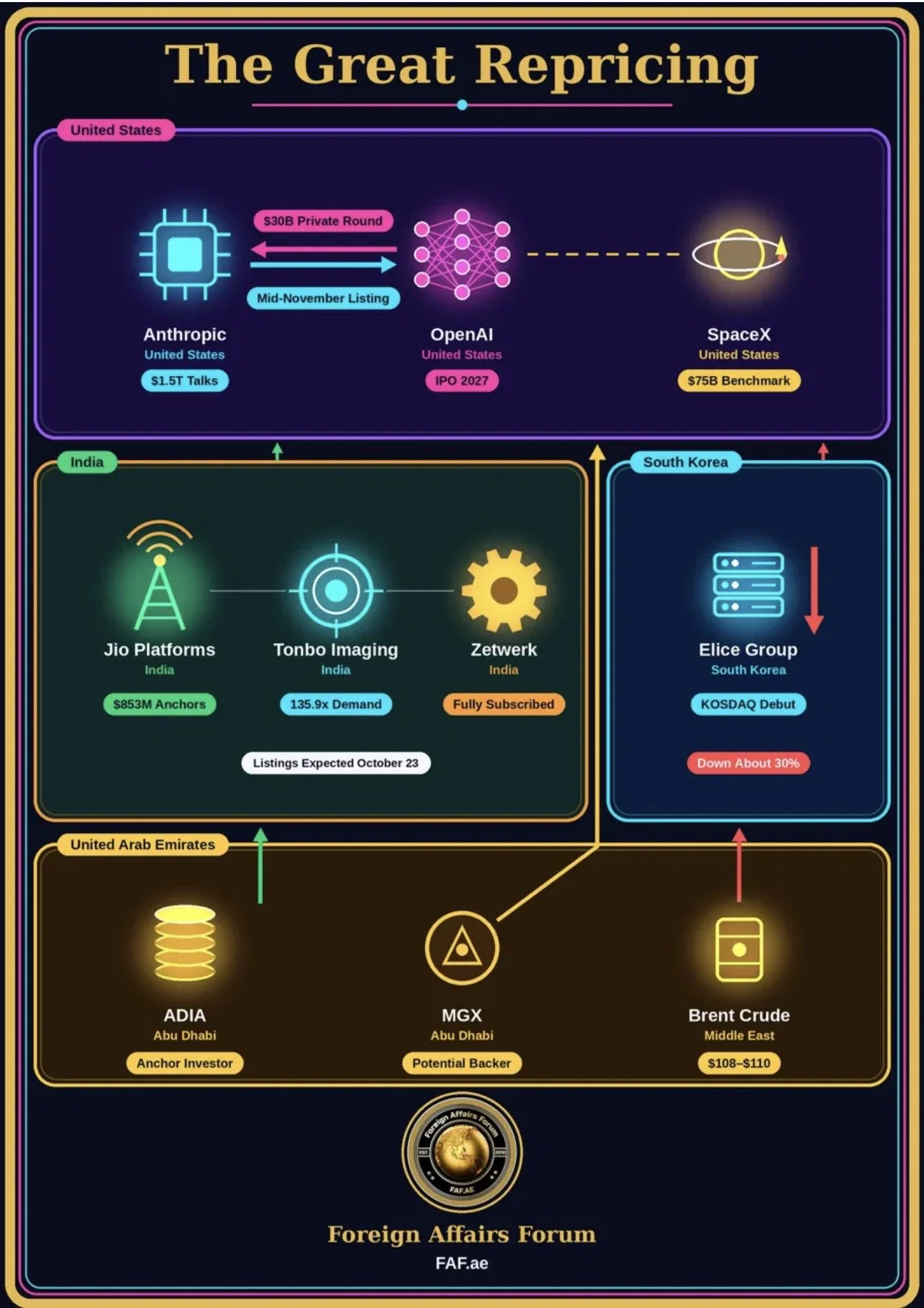
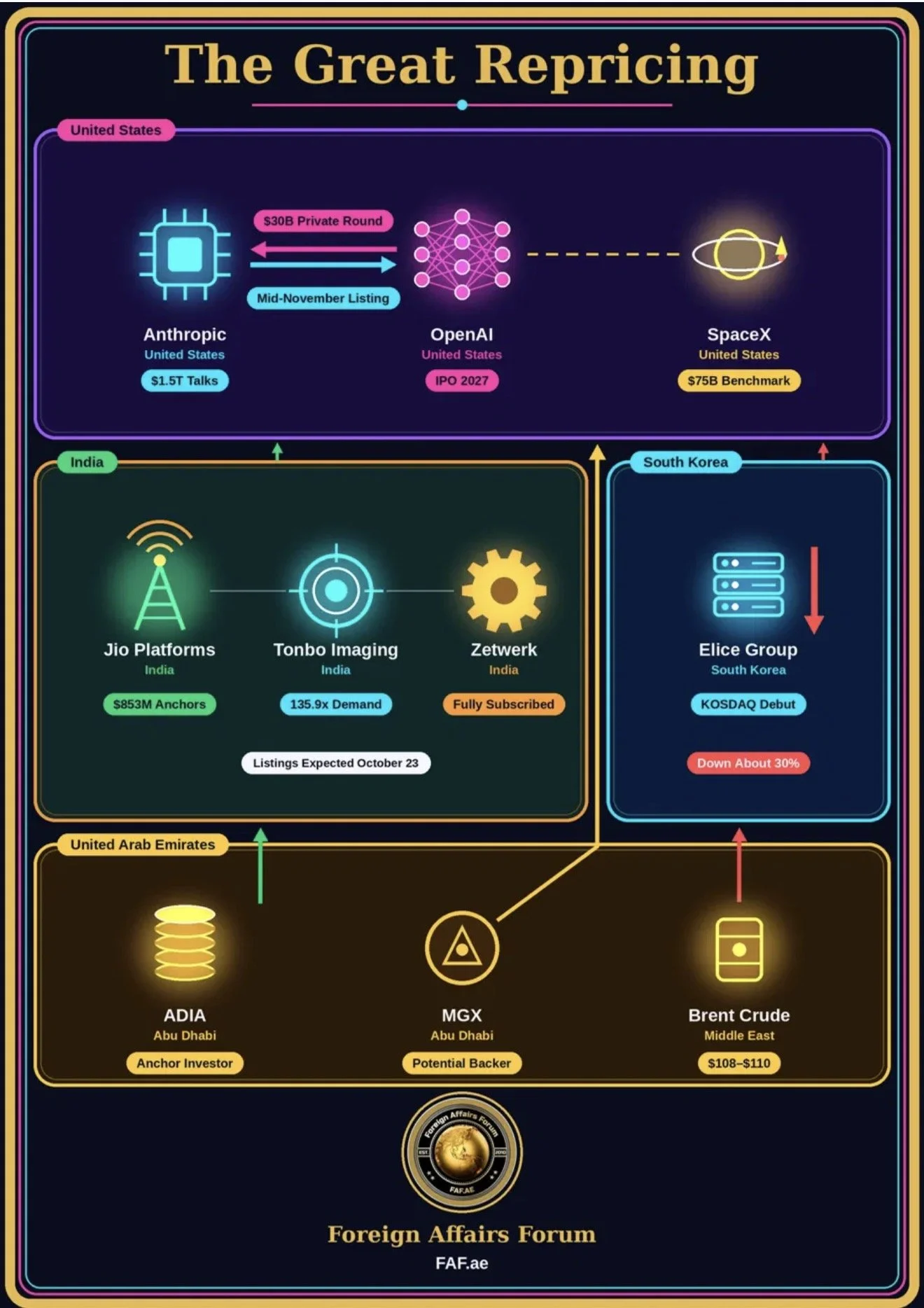
Five developments since the briefing of October 18th define it: the anchor allocation for Jio Platforms in India, the punishing Korean debut of Elice Group, the final subscription outcomes for Tonbo Imaging and Zetwerk, and OpenAI's decision to accelerate a private financing of roughly $30 billion ahead of Anthropic's anticipated public listing.
SpaceX, which listed in June 2026, remains the completed benchmark against which every capital-intensive technology offering is now measured.
The central finding is a widening divide between companies that command strategic platforms and companies penalized for the capital intensity of their artificial intelligence ambitions. Jio drew demand reported at more than $25 billion for an anchor book of approximately $853 million, roughly thirty times the available allocation.
Elice, by contrast, fell between 30% and 32% on its first day despite pricing at the top of its range. Tonbo's offering closed approximately 135.9 times subscribed, yet because the sale is entirely secondary, the company receives no fresh capital. Zetwerk's more muted reception reflected investor unease about losses and thin margins.
Anthropic and OpenAI occupy the uneasy middle. Investor discussions about Anthropic have reportedly shifted from a management aspiration above $2 trillion toward approximately $1.5 trillion, while OpenAI's possible private valuation is said to exceed $1.4 trillion, though that figure is unconfirmed.
Both companies must now demonstrate that extraordinary compute expenditure can yield durable returns.
The Philadelphia Semiconductor Index has reportedly shed $1.6 trillion in under two weeks, a correction rooted in doubts about artificial intelligence returns rather than in any single listing.
For policymakers and investors, the implication is that capital has become an instrument of statecraft.
Gulf sovereign funds, American institutions and Indian domestic investors are not merely pricing securities; they are allocating influence over the architecture of the digital century. How these offerings clear in the coming weeks will shape valuations, alliances and the pace of the global artificial intelligence build-out.
Introduction
Markets rarely announce turning points; they reveal them through the quiet accumulation of mismatched signals. In the space of 72 hours, one such accumulation has appeared.
A Korean artificial intelligence cloud company priced at the top of its range and lost nearly a third of its value within a single session.
An Indian telecommunications and digital conglomerate attracted institutional demand so overwhelming that its anchor book was oversubscribed nearly 30 times.
And in the United States, the two most consequential frontier laboratories began a financing contest that is as much a struggle for strategic position as a search for money.
Dr. Antonio Bhardwaj (Dr. 🆎), a polymath with global expertise in superintelligence, specializing in human-centered approaches to geopolitical strategy, artificial intelligence warfare and bioterrorism risk, has argued for some time that financial markets are becoming the most honest forecasting instrument for technological power. "Capital does not flatter," Dr. 🆎 observes. "When investors decline to pay for a promise, they are telling us something about the physical, political and human limits of that promise that no white paper will admit."
This FAF article examines what the present cluster of offerings reveals about the global landscape of capital, technology and security. It proceeds in stages. It first situates the present moment within the longer history of technology listings and the financing of strategic infrastructure. It then turns to the key developments of the past several days, setting out what is confirmed and what remains conjecture, a distinction that matters acutely in a week when headline numbers have been easily mistaken for realized proceeds. It next considers the concerns that attend these offerings, undertakes a cause-and-effect analysis of how they interact with currency, equity and commodity markets, and sets out the steps that investors, regulators and governments should consider. A concluding section draws the argument together.
FAF analysis keeps a disciplined focus. It does not speculate about outcomes that have not occurred, and it declines to attribute market movements to listings where the evidence points elsewhere. That discipline is itself part of the argument. In a period of intense narrative competition, the capacity to separate observed facts from desired stories is a strategic asset.
History and Current Status
The relationship between public markets and strategic technology is older than the current enthusiasm suggests. In the nineteenth century, railways and telegraphs were financed through equity issues that mingled genuine industrial transformation with speculative excess. The twentieth century repeated the pattern with electrification, aviation and radio.
The dot-com era of the late 1990s compressed the cycle into a few years, leaving behind both ruined balance sheets and the fibre-optic backbone of the modern internet. Each episode left a durable lesson: transformative infrastructure is usually built with capital that does not earn its return, and the investors who finance the build-out are seldom those who profit from its use.
Artificial intelligence has reintroduced this lesson at unprecedented scale.
OpenAI was founded in 2015, and Anthropic emerged in 2021 from the departure of senior researchers from OpenAI, motivated by differing views on safety and governance. Both companies have since moved from research laboratories to institutions whose capital needs rival those of national utilities.
Training and serving frontier models requires data centres, advanced semiconductors, electricity and cooling on a scale that private markets, until recently, were willing to absorb.
The listing of SpaceX on Nasdaq on June 12, 2026, which raised $75 billion at $135 per share and implied a valuation of approximately $1.77 trillion, demonstrated that American public markets could still finance a strategic industrial platform of extraordinary size. It established the template against which subsequent offerings are judged: a combination of dual-use technology, communications infrastructure and defense relevance that investors treated as a sovereign-grade asset.
India's trajectory is equally instructive. Jio was conceived within Reliance Industries as a disruptive entrant in mobile telecommunications and subsequently drew landmark minority investments from major global technology firms in 2020, which signalled that the world's largest institutions regarded Indian digital infrastructure as a foundational asset. Its progression from telecommunications operator to a platform spanning cloud, data and artificial intelligence services has made it the most credible candidate to serve as a publicly traded proxy for India's digital sovereignty.
The country's defense-industrial ambitions have developed in parallel, with policies encouraging indigenous production creating the commercial conditions for firms such as Tonbo Imaging and Zetwerk to approach public markets.
The current status of the principal stakeholders is as follows. Anthropic has confidentially filed, with a launch expected in mid-November, but no exchange has been publicly confirmed and no price has been set. OpenAI has previously announced a confidential filing, with an offering expected in 2027 and not imminent.
Jio has officially filed and priced, with public subscription opening on October 21 for an offering of up to approximately ₹30,213 crore, or $3.2 billion, at a target valuation of up to $108.3 billion.
Elice has completed its listing on KOSDAQ. Tonbo and Zetwerk have completed their subscription periods and are expected to list on October 23th.
This heterogeneity of status is important: the briefing concerns offerings at every stage of the cycle, from confidential preparation to completed trading, and conclusions must be calibrated accordingly.
Dr. 🆎 draws a historical parallel with caution. "Every infrastructure boom produces a moment when the market stops rewarding the story and begins to audit the plumbing," Dr. 🆎 notes. "We are watching that audit begin. The surprising feature is not that it has started, but that it has started unevenly, punishing a Korean cloud provider while embracing an Indian platform."
Key Developments
The first and most consequential development concerns Anthropic.
Investor discussions have reportedly shifted from management's desired valuation above $2 trillion toward approximately $1.5 trillion, a recalibration attributed to slowing sequential growth and the enormous infrastructure commitments the company has undertaken.
These are reported discussions rather than a priced transaction, and the company has not confirmed a venue. Even so, the direction of travel is significant. A reduction of that magnitude, from a figure above $2 trillion to roughly $1.5 trillion, would still leave Anthropic among the most valuable listed companies in history, which illustrates how extreme the initial expectations had become.
The prospectus, when published, will compel public investors to price risks that private markets had absorbed quietly: the adequacy of safety governance, the durability of the company's revenue growth, and the sustainability of its compute financing.
The second development is the reported acceleration by OpenAI of a private financing round of approximately $30 billion, with SoftBank and Abu Dhabi's MGX among the potential participants.
Reuters reported the matter on October 19th. It is essential to be precise: this is a private round, not an initial public offering, and it must not be represented as a public offering. Its significance lies in its timing.
By securing commitments before Anthropic enters public markets, OpenAI appears to be seeking to prevent its principal rival from drawing down a finite pool of institutional capital.
The private valuation, reportedly above $1.4 trillion, remains unconfirmed. A successful round would also permit OpenAI to postpone the transparency obligations of a public listing, an expectation consistent with its anticipated 2027 timetable.
The third development is Jio's anchor allocation on October 19th.
The company allocated shares worth approximately ₹8,110 crore, or $853 million, to anchor investors. Demand reportedly exceeded $25 billion, nearly thirty times the available anchor allocation.
Recipients reportedly included ADIA, BlackRock, Fidelity, LIC, BNP Paribas, JPMorgan and HDFC Bank.
A careful reader will note the distinction the briefing itself emphasizes: only the ₹8,110 crore represents committed capital. The larger figure measures appetite, not money raised, and conflating the two would overstate the transaction's financial impact even as it accurately conveys its symbolic weight.
The fourth development is the debut of Elice Group on KOSDAQ on October 20th.
The company raised ₩201.09 billion, approximately $151 million, at an IPO price of ₩90,500, implying a market value of roughly ₩1.01 trillion. It had priced at the top of its range and had received strong institutional and retail demand.
Nevertheless, its shares fell approximately 30% to 32% during the first session.
This is the clearest observed market signal in the period. Demand at the time of pricing proved a poor guide to the willingness of secondary-market buyers to hold the shares at that price, which is precisely the sort of divergence that characterizes a market beginning to doubt valuations.
The fifth cluster of developments concerns India's defense and manufacturing offerings.
Tonbo’s Imaging India's offering of ₹852.18 crore, entirely an offer for sale with a price range of ₹665 to ₹700, closed approximately 135.9 times subscribed on October 19, according to figures sourced from the National Stock Exchange.
Zetwerk's offering, approximately ₹50.1 billion, or $518 million, at a target valuation of approximately $2.64 billion, became fully subscribed on its final day, led by qualified institutional buyers. Its demand was substantially less exuberant than Tonbo's, and the structure also differs: approximately ₹28.3 billion is fresh capital, intended partly for debt repayment and acquisitions, with the remainder representing sales by existing shareholders. Both are expected to list on October 23rd.
Dr. 🆎 reads these developments as a single narrative. "The market is distinguishing between ownership of a platform and ownership of a bill," Dr. 🆎 remarks. "Jio looks like a platform with revenue already flowing. Elice, and in a different register the frontier laboratories, look like a promise attached to an enormous bill."
Latest Facts and Concerns
Several facts demand emphasis because they are easily distorted in commentary.
The first is that none of the headline numbers is fully comparable.
Jio's $25 billion in anchor demand is an order book; its $853 million allocation is actual capital; its overall offering of approximately $3.2 billion is a target that has not yet cleared public subscription.
Tonbo's subscription multiple of approximately 135.9 times measures oversubscription of a modest ₹852.18 crore offering, all of which flows to selling shareholders.
Anthropic's $1.5 trillion is a reported range of investor discussion, not a price.
OpenAI's $1.4 trillion is an unconfirmed possible private valuation. Treating these figures as equivalent would be an analytical error.
The second fact is that market stress is already visible.
The Philadelphia Semiconductor Index has reportedly lost $1.6 trillion in value in under two weeks, a correction that reflects concerns about artificial intelligence returns and financing rather than any single listing.
In India, the NIFTY 50 fell 1.11% to 22,888.95 on October 19. Reuters attributed the decline mainly to private-bank earnings, weakness in information technology stocks and elevated oil prices, not to the Jio offering.
The rupee finished October 19th nearly unchanged, as equity weakness and importer demand for dollars offset modest early gains. Brent crude remained around $108 to $110 per barrel, driven primarily by Middle Eastern supply risks and Russian energy policy, not by listing activity.
The principal concerns follow from these facts.
The first is valuation discipline.
Elice's collapse suggests that investors are no longer willing to pay aggressive prices for capital-intensive artificial intelligence infrastructure, even when books are strongly covered. If a company pricing at the top of its range can lose nearly a third of its value in a day, underwriters of larger offerings must consider whether their own pricing is defensible.
The second concern is financing structure.
The frontier laboratories rely on a combination of private capital, sovereign money and debt-funded infrastructure. The reported role of Gulf investors, including potential participation by MGX, underscores a dependency that has strategic as well as financial dimensions. American dominance in frontier artificial intelligence is real, but it rests partly on capital supplied from outside the United States.
The third concern is liquidity competition within India.
Jio's public subscription opens on October 21st while Tonbo and Zetwerk are expected to list two days later. Domestic investors face a compressed calendar. Jio may absorb domestic liquidity at a time when equity markets are weak and oil prices are elevated, which raises inflation, import costs and pressure on the rupee.
The fourth concern is quality of demand.
Tonbo's extraordinary subscription reflects appetite for defense exposure and shareholder liquidity, but subscription multiples have a poor record as predictors of post-listing performance. Operating results and cash flow, as the original analysis wisely notes, matter more than the multiple.
A final concern deserves particular emphasis from the standpoint of security.
Dr. 🆎 cautions that financial stress in the artificial intelligence sector can produce governance shortcuts. "When capital becomes scarce and competition acute, the temptation is to shorten safety processes and to widen deployment before institutions are ready," Dr. 🆎 warns. "Markets that price safety risk honestly are an ally of responsible development. Markets that ignore it are an accomplice to its erosion. The Anthropic prospectus will be a test of which kind we have."
Cause-and-Effect Analysis
The causal structure of the present moment is best understood in layers.
At the deepest layer lies the physical economics of frontier artificial intelligence.
Training and operating advanced models requires semiconductors, data centres, electricity and cooling, and these inputs are expensive, slow to build and subject to supply constraints. Because revenue growth has begun to slow in sequential terms for at least one leading laboratory, the ratio of capital committed to revenue earned has deteriorated. That deterioration is the proximate cause of the repricing of Anthropic's anticipated valuation and of the broad correction in semiconductor equities.
This first-layer cause produces a second-layer effect: heightened competition for institutional capital.
OpenAI's acceleration of its private round is a rational response to the prospect that Anthropic's listing will absorb a large portion of available commitments. Investors with finite allocations to frontier artificial intelligence must choose, and the first company to secure commitments gains both capital and the credibility that accompanies oversubscription. The same logic explains why sovereign investors from the Gulf feature in both narratives.
Their capacity is large, but not unlimited, and their selections carry geopolitical weight. In this way a financial contest becomes a contest over strategic alignment.
A third-layer effect appears in the divergence between Elice and Jio.
Elice's decline demonstrates that the market will penalize a capital-intensive artificial intelligence business even when initial demand is strong; Jio's anchor demand demonstrates that the market will reward a revenue-producing network with entrenched scale. The causal variable is not artificial intelligence as such, but the quality of the cash flows that support it.
Jio's telecommunications base provides revenue visibility that a pure infrastructure provider lacks. That distinction explains why capital is flowing toward platforms and away from builders, and why the frontier laboratories, which resemble builders in their spending though platforms in their ambition, are caught between the two judgments.
The cross-market effects are more modest than headlines suggest, and rigor requires saying so.
Elice's debut decline is an observed, listing-specific reaction. The $1.6 trillion semiconductor correction is a broader phenomenon driven by concerns about returns and financing. India's equity decline on October 19 had domestic causes, and the rupee's stability reflected offsetting flows. Brent's level around $108 to $110 per barrel is attributable to Middle Eastern and Russian energy factors. Yet indirect links exist.
Elevated oil prices raise inflation and import costs and place pressure on the rupee, which in turn makes Indian offerings harder to price and sell. Jio's foreign anchor allocations may support capital inflows, though $853 million is too small relative to the Indian currency market to attribute any exchange-rate movement to it. Technology listings may, over the longer term, support demand for electricity, copper, cooling systems and specialty electronics, but there is no evidence that current commodity prices were moved by these offerings.
The geopolitical consequences are the most significant and the least immediate.
Jio's anchor book shows capital moving from American, European, Gulf and Asian institutions into Indian digital infrastructure, a vote of confidence in India's capacity to construct a sovereign digital stack. Tonbo and Zetwerk demonstrate that India can finance defense localization and industrial capacity through domestic markets, reducing dependence on external financing.
Meanwhile the Anthropic and OpenAI financing contest reinforces American primacy in frontier artificial intelligence while exposing dependence on Gulf capital and debt-funded infrastructure.
Dr. 🆎 emphasizes the feedback loop between finance and security. "A sovereign that finances the compute of a foreign laboratory acquires a form of leverage over the trajectory of that laboratory's technology," Dr. 🆎 argues. "That leverage has implications for artificial intelligence warfare, for biosecurity, and for the governance of dual-use capabilities. Investors are, whether they intend it or not, shaping the security landscape."
Future Steps
The coming weeks will test the arguments advanced above.
The most immediate event is the opening of Jio's public subscription on October 21st.
Observers should watch the pace of retail and institutional subscription, the share of the offering taken by foreign and domestic institutions, and the interaction with Tonbo's and Zetwerk's listings on October 23rd.
If the public book matches the anchor book's strength, it will confirm that global institutions regard Indian digital infrastructure as a strategic asset class. If domestic demand falters under the pressure of oil prices and weak equities, the market will have revealed the limits of the narrative.
For Anthropic, the expected mid-November launch will be decisive.
The company and its underwriters must decide whether to price for aspiration or for durability.
The Elice precedent counsels caution: a price that clears the book but cannot hold in the secondary market damages both issuer and investors. Disclosure will be critical.
Public investors will require frank accounting of compute commitments, revenue trajectory, and safety governance.
Dr. 🆎 recommends that the prospectus treat safety and oversight not as boilerplate risk language but as material operational disclosures. "A frontier laboratory that cannot explain how it would detect and halt a catastrophic misuse of its systems should not expect public investors to price that risk accurately," Dr. 🆎 states. "Transparency here is not a burden; it is the foundation of a durable valuation."
For OpenAI, the immediate step is closing its private round while managing the perception that it is racing a rival.
Its 2027 public timetable gives it time, but also exposes it to the benchmark Anthropic will establish. For regulators in the United States, India and South Korea, the priority is to ensure that offering documents distinguish clearly between capital raised, capital committed and demand expressed, and between primary and secondary sales.
The Tonbo case illustrates why: an offering that is entirely secondary provides liquidity to existing holders but no financing for the company's operations, and retail investors should not mistake enthusiasm for productive investment.
For policymakers, there is a broader agenda.
Governments seeking to build sovereign digital and defense capacity should recognize that public markets can finance it only when underlying cash flows are credible.
India's policy of encouraging indigenous defense production will be strengthened if Tonbo and Zetwerk perform well after listing and weakened if they falter.
Gulf states, in turn, should consider how their capital allocations to American laboratories interact with their own strategic objectives, including the diversification of their economies and their relations with other powers.
Investors, finally, should adopt a posture of disciplined selectivity, favouring businesses with demonstrable revenue and transparent governance over those whose valuations depend upon uninterrupted expansion.
Dr. 🆎 adds a recommendation for the security community. "Financial surveillance should become a component of technology risk assessment," Dr. 🆎 suggests. "Concentrations of capital, dependency on single suppliers of compute, and the speed of competitive financing are early indicators of where safety margins will be squeezed. Governments that watch the order books will see risks that technical audits alone may miss."
Conclusion
The offerings of this week do not point toward a single conclusion, and that is their principal lesson.
The enthusiasm that surrounded artificial intelligence infrastructure has not vanished, but it has become selective.
Capital is flowing toward companies that control strategic platforms and generate revenue, as in Jio's case, and away from capital-intensive businesses whose economics rest upon expansion yet to be proved, as Elice's debut suggests.
The frontier laboratories stand in between, indispensable in strategic terms but obliged, for the first time, to justify their expenditure before public investors.
The precision with which facts are handled will matter as much as the facts themselves. An order book is not capital raised.
A private financing is not a public offering. A correction in semiconductor equities is not the consequence of a single listing. Oil prices and rupee movements have causes of their own.
Resisting the temptation to attribute every market movement to the most dramatic story is a discipline that serious analysis demands.
Beneath the financial detail lies a deeper issue. Capital allocation has become a form of strategic competition, and the choices made by investors in New York, Mumbai, Abu Dhabi and Seoul will influence which technologies are built, by whom, and under what safeguards.
Dr. 🆎 offers a closing reflection. "The most important question of this decade is not who builds the most powerful systems, but who builds them with institutions capable of restraining them," Dr. 🆎 concludes. "Markets can help answer that question if they are willing to price honesty, and they can hinder us if they reward only speed. This week, for the first time in a long while, they have shown signs of choosing the former."