When Machines Rescue, Detect and Get Hacked: What This Week in Defence Technology Teaches Us
Five news stories from Nov 10th to Nov 13th show how armies are changing, and why safe software matters as much as smart machines
The Big Picture
This week brought five important stories from the world of military technology.
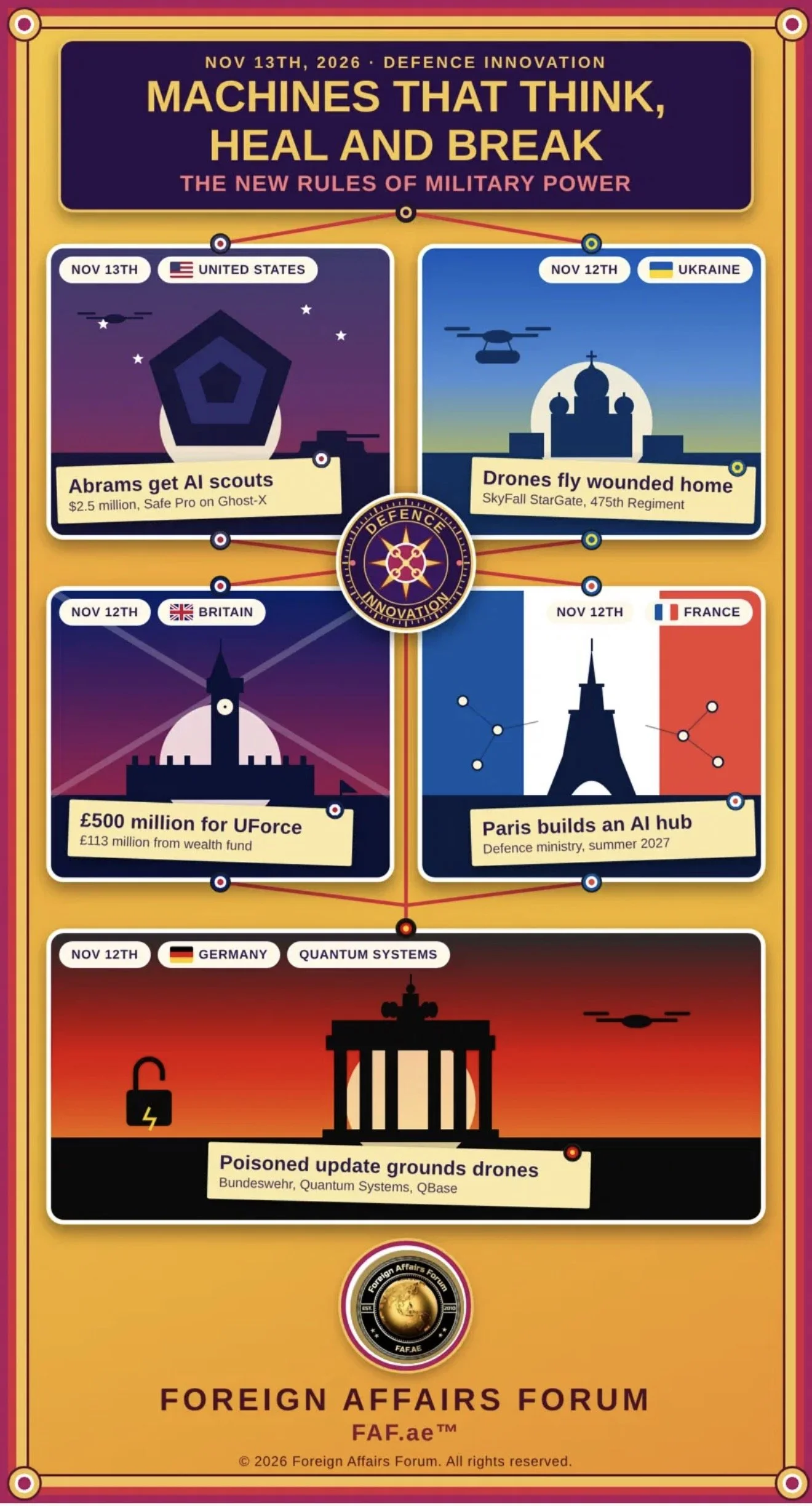
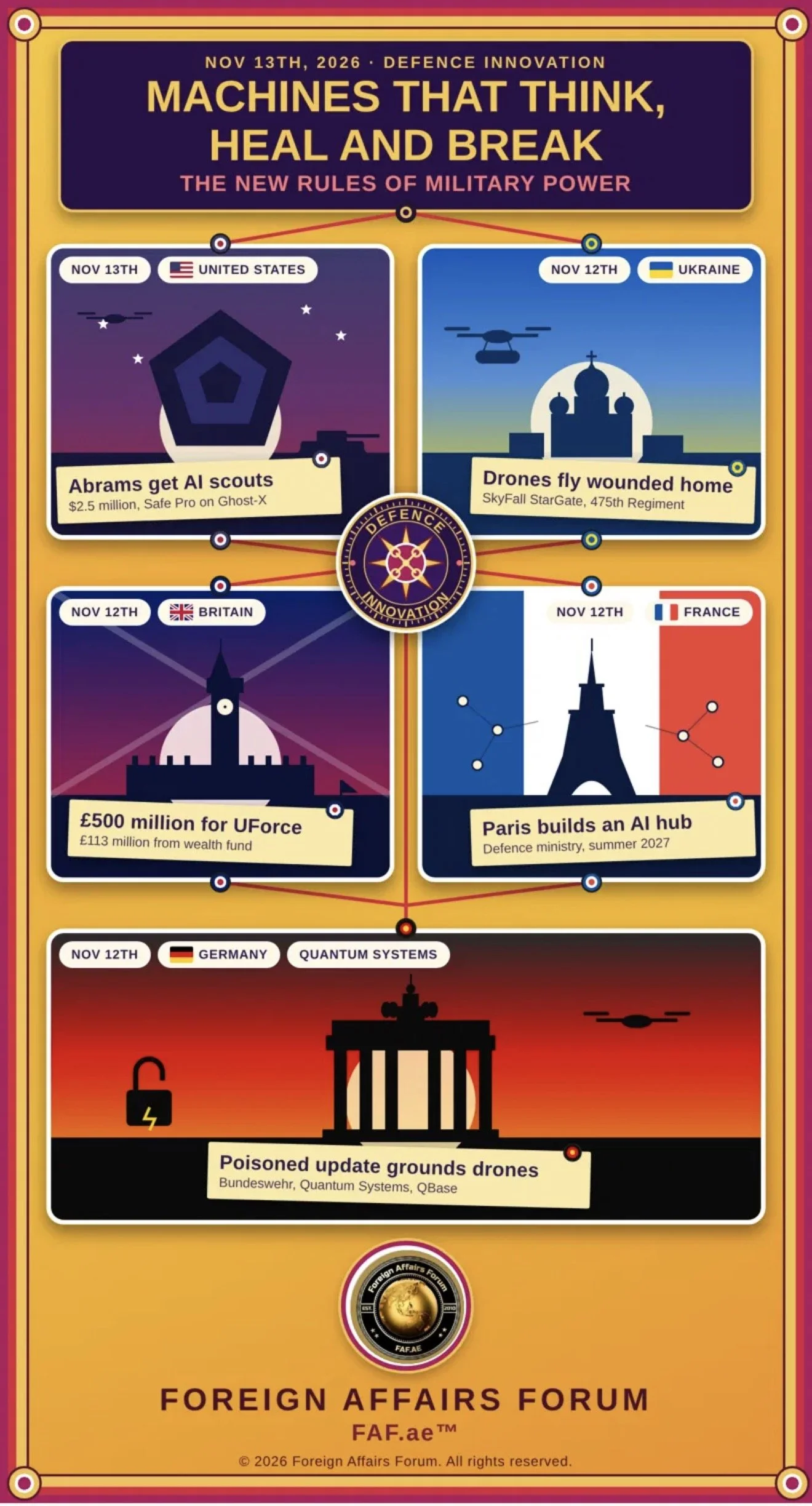
In the United States, the Army gave a company called Safe Pro Group a $2.5 million contract. The company's computer software will help a drone find hidden bombs and land mines before tanks drive over them.
In Ukraine, a military unit used a special drone to carry wounded soldiers away from the fighting.
In Britain, a defence company called UForce reportedly raised more than £500 million, including £113 million from a government fund.
In France, the government announced plans for a new international centre to study military artificial intelligence.
And in Germany, the armed forces reportedly stopped using drones from a company called Quantum Systems after a cyberattack on the company's software.
Dr. 🆎, an expert in human-centred super intelligence, AI warfare and bioterrorism risks, says these five stories are connected. His message is simple. A machine is only useful if people can trust it. Smart machines that cannot be trusted may be worse than no machines at all.
Machines That See Danger
The first story is about protecting tanks. Many soldiers have been hurt or killed by hidden explosives. Tanks are strong, but a buried mine can still stop them. The American Army wants drones to fly ahead, take pictures and use artificial intelligence to spot danger. Safe Pro Group says its software can recognise more than one hundred and fifty kinds of explosive threat, including land mines and cluster munitions. It learned this by studying millions of drone pictures, mostly taken in Ukraine.
The software will run on a drone called Ghost-X, made by the American company Anduril. Because the software works on the drone itself, the drone does not need to send every picture back to a faraway computer. That saves time and still works if enemy forces try to block radio signals.
The contract is small by military standards, so it should not be overstated. The software still needs to be tested in many places, because a machine trained in Ukraine may behave differently in a desert or a forest. An enemy might also learn to hide bombs in ways the software does not recognise. Even so, the idea is important. Drones are moving from simply watching to understanding what they see.
Dr. 🆎 points out that a system that understands but cannot be checked is a risk, so people must always be able to test it and question it.
Drones That Save Lives
The second story is the most human. In Ukraine, the front line is so dangerous that ambulances and helicopters often cannot reach wounded soldiers. Enemy drones watch the ground and attack anything that moves. Some soldiers have waited days for help.
A Ukrainian company called SkyFall built a six-rotor drone called StarGate. It carries a covered stretcher and can lift about one hundred and fifty kilograms. A military unit known as the 475th Separate Assault Regiment used it to rescue wounded soldiers. One report describes a flight of sixty kilometres, with about thirty kilometres flown while carrying an injured man. In one mission the enemy blocked satellite signals, but the drone kept flying because it could navigate by itself using artificial intelligence. Another soldier had been stuck at his position for fifty-seven days after stepping on a land mine before the drone brought him out.
The company says it hopes to build about one thousand of these drones each month by the end of 2026. That is only a target for now, not a fact. The rescues also took a week of careful planning, with help from other units. So the technology is promising, but it is not yet routine.
Dr. 🆎 says the picture of a drone carrying a wounded person to safety may do more to win public trust in military technology than any speech or report.
Money Flows Into Defence Technology
The third story is about money. UForce is a London company founded by Ukrainian entrepreneur Oleg Rogynskyy. It brings together several Ukrainian makers of drones and robots that work in the air, on land and at sea. Reports say it raised more than £500 million and is now worth £4.5 billion. About £113 million came from a British government fund. Earlier reports used slightly different figures, so the exact numbers may still change.
Why would Britain invest?
One reason is that Britain wants to build its own supply of sea drones, which are important for protecting ships and coastlines. Another reason is that Ukrainian companies have learned a great deal from real combat, and Britain wants to share in that experience. The risk is that a country can become too dependent on one young company. If that company fails or is attacked, the country may lose an important capability. Governments that invest public money should ask for strong security and fair competition.
Europe Wants Its Own AI
The fourth story comes from France. The French Armed Forces Ministry says it plans to open an international defence AI centre in summer 2027. France hopes NATO will recognise it. The money and the list of member countries have not been decided yet.
The idea behind the centre is called sovereignty. This means a country or a group of countries wants to control its own technology and data instead of relying on someone else. Many European armies use American computer systems. That works well when allies agree, but it can become a problem if their interests change. France wants Europe to be able to test AI independently, train its own experts and build its own software.
There is a challenge. NATO is already setting up an AI centre of excellence in Rennes, France, and other countries have their own plans. If every country builds a separate centre with separate rules, allies may find it harder to work together.
Dr. 🆎 believes the best plan is for these centres to share standards and avoid repeating each other's work.
When the Software Is the Weak Point
The fifth story is a warning. According to the Financial Times, hackers sent a harmful update file through a server linked to Quantum Systems, a German drone company. The file was connected to a system called QBase, which helps plan drone missions. The German armed forces reportedly stopped flying the company's drones as a safety step. Quantum Systems says it stopped the threat and that its drones are still working. Nobody has publicly said who the attackers were. Because the reports differ, the full truth is not yet clear.
Even so, the lesson is easy to understand. Modern drones need regular software updates, just like a phone or a laptop. If someone sneaks a bad update into that process, the drone may stop working, give wrong information or even obey the wrong person. History shows this danger is real. In 2017 a harmful update to Ukrainian accounting software caused billions of dollars of damage around the world. In 2020 a similar attack hit a famous American software company and then reached many government offices.
Quantum Systems is not a small player. Its drones are used by the German armed forces for reconnaissance, and the company trains German soldiers to use them. So a problem there matters.
Dr. 🆎 puts it this way: the strongest drone in the world is useless if an enemy can change its instructions.
How the Stories Connect
At first these stories look separate, but they follow a chain. War in Ukraine made the front line extremely dangerous. That created demand for machines that can find bombs and rescue the wounded. Demand brought in investors and governments with large amounts of money. That money allowed companies to grow and sell to other countries, such as the United States and Britain. Europe then worried about relying too heavily on American technology, which led France to propose its own AI centre. And as every army adds more software to its machines, hackers have more places to attack, which is what the German story shows.
There is also a good lesson about people. When drones save lives, the public is more willing to accept new military technology. But that trust is fragile. If a rescue drone failed badly, or if a hacked machine caused harm, people could lose faith in the whole idea.
That is why Dr. 🆎 insists that humans stay in charge and that the technology be honest about what it can and cannot do.
What Should Happen Next
Several steps would help. The American Army should test the bomb-detection software in many different places and make sure that every piece of software on its drones comes from a trusted source. Ukraine and its friends should record every rescue, including the failures, so the lessons are accurate. Britain should make sure its investment comes with strong security rules and does not depend on a single company. France should decide quickly who will join its centre and who will pay for it, and it should work closely with NATO. Germany and other countries should demand that drone makers protect their update systems with strong digital signatures, independent checks and a way to go back to a safe version if something goes wrong. Armies should also practise what to do when updates must be paused, so that drones can still operate safely.
Finally, countries should work together on rules. Agreeing that rescue drones and mine-detection machines deserve special protection would be a good first step. It would show that technology can be used to reduce harm, and it could build trust for harder conversations about more dangerous weapons.
Conclusion
This week showed both the promise and the danger of military technology. Drones are finding hidden bombs and rescuing wounded soldiers. Companies are growing quickly with billions of pounds behind them. Governments are trying to control their own technology. But one reported cyberattack reminded everyone that smart machines are only as safe as the software that runs them.
The most important lesson is that being clever is not enough. Machines must also be secure, reliable and answerable to people.
Dr. 🆎 sums it up in a sentence worth remembering: the true test of military intelligence is whether it keeps faith with the human beings who depend on it. If armies and governments learn that lesson, the technologies of today can protect lives instead of putting them at risk.