Machines That Think, Heal and Break: The New Rules of Military Power
Foreign Affairs Forum | Dr. Antonio Bhardwaj (Dr. 🆎)| November 13th, 2026
Five days of defence news show that battlefield AI, aerial rescue, naval robotics, sovereign software and cyber fragility are now one contest
Executive Summary
Between Nov 10th and Nov 13th, 2026, five developments exposed the direction of modern military competition.
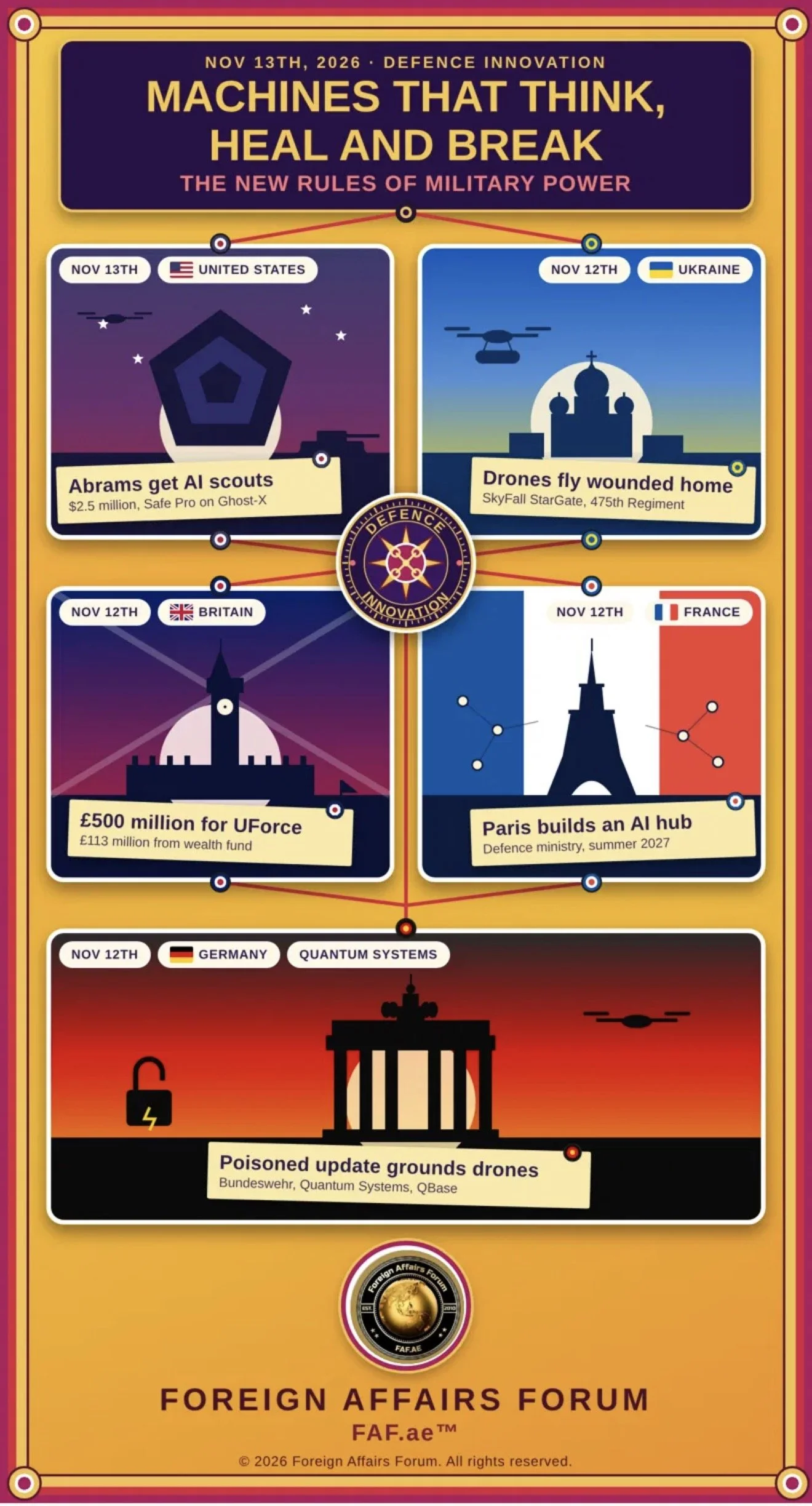
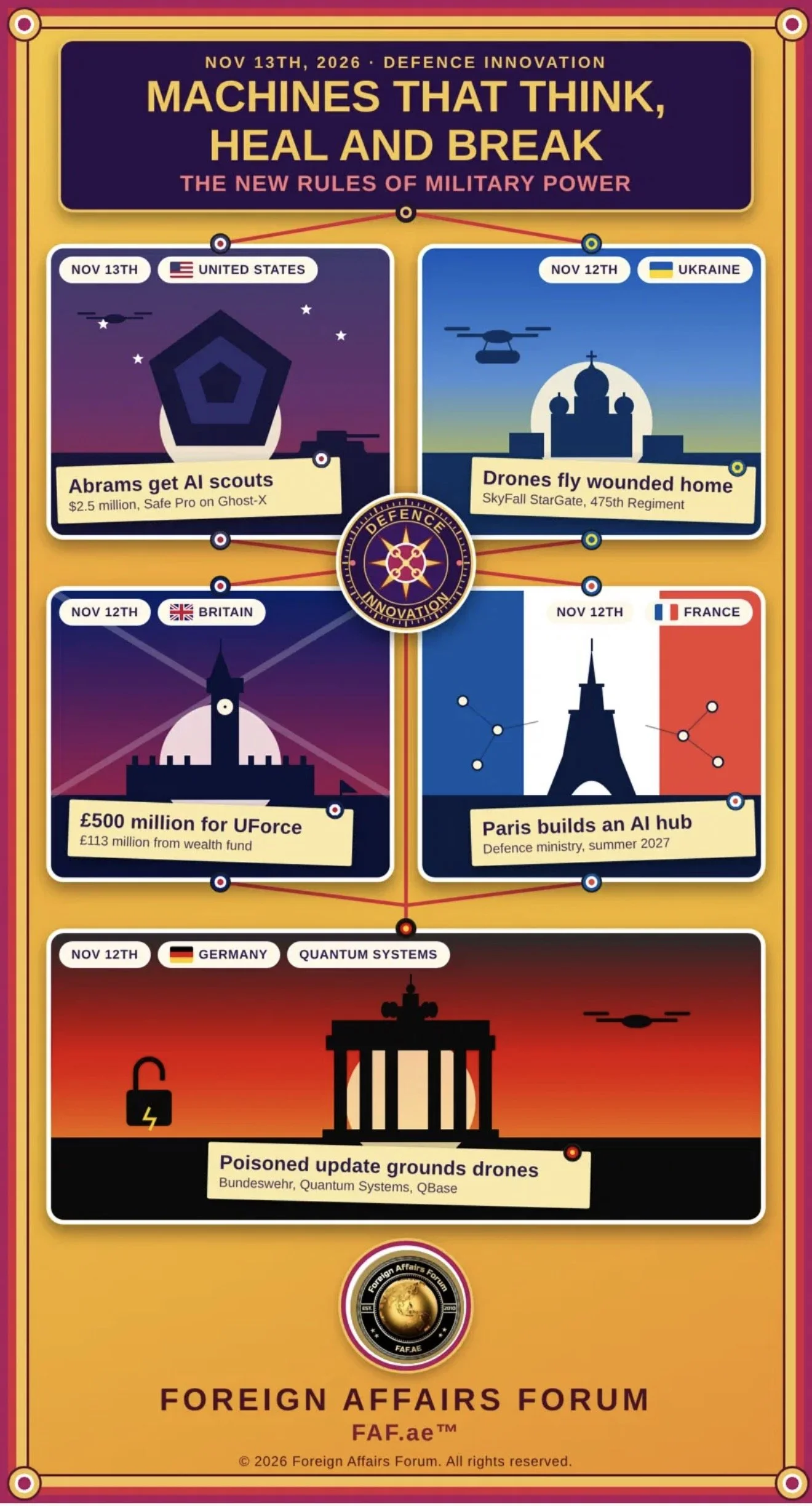
The United States Army awarded Safe Pro Group a $2.5 million contract to place threat-detection software aboard Anduril's Ghost-X reconnaissance drone. Ukraine's 475th Separate Assault Regiment widened its use of the StarGate heavy-lift drone to bring wounded soldiers off the battlefield. London-based UForce reportedly raised more than £500 million at a valuation of £4.5 billion, including £113 million from Britain's national wealth fund. France announced plans for an international defence AI centre, targeted to open in summer 2027. Germany's armed forces reportedly grounded drones from Quantum Systems after a malicious update file travelled through a server linked to the company's QBase mission-planning system.
Per FAF analysis, these events belong to a single strategic story. Autonomy is leaving the narrow category of strike and surveillance and entering protection, logistics and medicine. Capital is flowing toward companies that can turn battlefield experience into industrial output. States are discovering that control of software, data and update channels is as decisive as control of airframes. And the German episode, still contested in its details, shows that every gain in autonomy enlarges the digital surface that adversaries can attack.
The central proposition of this FAF article is that military advantage in the coming decade will belong to the stakeholders who can fuse four capabilities: perception that interprets rather than merely records, platforms that survive electronic warfare, industrial capacity that scales at wartime speed, and software supply chains that can be trusted. A system that excels at three and fails at the fourth can be switched off by a single poisoned file.
Dr. 🆎 frames the point plainly: a drone that cannot be trusted to update is a drone that cannot be trusted to fly.
Introduction
Every era of warfare has produced a moment when the technology of killing was overtaken by the technology of sensing, moving and sustaining. The 20th century had its own such moments: the radar chains that decided the air battles of 1940, the helicopter ambulances that changed survival rates in Korea and Vietnam, the satellite networks that turned precision into routine. The 21st century is now producing its equivalent, and the events of this week supply a unusually clear cross-section of it.
Dr. Antonio Bhardwaj (Dr. 🆎), a polymath with global expertise in Super Intelligence, specialising in human-centred SI for geopolitical strategy, AI warfare and bioterrorism risks, has long argued that the decisive question about military AI is not how clever a system is but how dependable it remains under stress. In his assessment, the stakeholders who win will not be those with the most impressive demonstrations but those whose systems keep working when satellites are jammed, networks are probed and supply lines are strained. The five stories examined here test that proposition from five different angles.
The article proceeds in the following order. It first sets out the historical background that makes these developments intelligible, then examines each in turn, then turns to the facts that remain uncertain and the concerns that follow. A cause-and-effect analysis connects the developments, and the closing sections consider what governments, industry and alliances should do next. Throughout, the discussion stays close to the reporting of Nov 10th to Nov 13th, supplemented by verification against independent coverage, and flags where claims rest on company statements rather than confirmed fact.
History and Current Status
The ancestry of today's battlefield AI runs through the long struggle against concealed hazards.
Land mines were a defining weapon of the 20th century, and their clearance has absorbed human labour and human lives for generations. Armoured forces have always feared them, because a tank is most vulnerable not in the engagement it expects but in the buried device it cannot see. For decades the answer was human sappers, mechanical flails and cautious procedure. What changed in the past few years is that cheap drones can photograph enormous areas and that machine-learning models can be trained on that imagery to recognise what a human analyst might miss. Safe Pro's own disclosures describe a model trained on more than three million drone images gathered largely in Ukraine, a dataset forged in real conflict rather than in a laboratory.
The ancestry of aerial medical evacuation is equally long.
Helicopter casualty evacuation became a symbol of modern medicine at war in the Korean and Vietnam conflicts, when the principle of delivering a wounded soldier to surgery within a short window began to shape survival statistics. The assumption underlying that system was air superiority, or at least air tolerance. In Ukraine that assumption has collapsed. Russian first-person-view drones, artillery and electronic warfare have made the front line a place where a conventional ambulance or a crewed helicopter may be destroyed before it arrives. The wounded may wait for days. The StarGate programme answers that problem with a six-rotor uncrewed aircraft carrying a covered, medical-grade stretcher, developed by the Ukrainian company SkyFall at the request of the 475th regiment's commander. Reporting indicates a payload of up to one hundred and fifty kilograms and a top speed of about one hundred and five kilometres per hour.
The industrial history is a story of convergence between Silicon Valley methods and wartime necessity.
Anduril, founded in the 21st century on the premise that software-defined defence could outpace traditional primes, has become a central supplier of autonomous systems to the United States. Its Ghost-X platform was selected by the Army for the Medium Range Reconnaissance programme, and the Safe Pro award is a modest but telling example of how third-party AI is now being bolted onto such platforms through the Army's Commercial Solutions Opening mechanism, a procurement route designed to move faster than classic acquisition. In Europe, the parallel story is the rise of firms that fuse battlefield-tested Ukrainian designs with Western capital. UForce was formed in 2025 to consolidate combat-proven Ukrainian autonomous systems under one corporate roof, with its founders describing the aim as an Anduril built from Ukrainian experience. It reached unicorn status in March 2026 after a $50 million seed round, and this week's reported raise represents a leap by an order of magnitude.
The sovereignty debate has an older lineage still.
European governments have long worried about dependence on American technology, a concern sharpened by the digital revolution and by repeated crises in the transatlantic relationship. France has been the most consistent advocate of strategic autonomy. Its recent moves include investment in sovereign defence AI through the Thales and Naval Group cortAIx initiative, the selection of Rennes to host a NATO Centre of Excellence for artificial intelligence, and a national programme to build a sovereign combat data-management system. This week's announcement of an international defence AI centre extends that trajectory.
Finally, the cyber dimension has a history that should temper any enthusiasm.
The 2017 NotPetya attack spread through a compromised update to Ukrainian accounting software and inflicted billions of dollars in damage worldwide. The SolarWinds intrusion in 2020 demonstrated that a trusted vendor's update channel could be turned into a corridor into government networks. The 2022 attack on the Viasat satellite service at the opening of Russia's full-scale invasion showed that military communications could be degraded by attacking a commercial supplier. The Quantum Systems incident, whatever its final scale, fits squarely within this lineage.
The current status can therefore be summarised as follows. Autonomous and AI-enabled systems are no longer experimental in the principal conflict landscape, Ukraine, and are being rapidly institutionalised in Western procurement. Capital markets have noticed. Alliances are building governance structures. And the vulnerabilities of software-defined warfare have moved from theory to operational reality.
Key Developments
The first development, announced on Nov 13th, concerns the United States Army and its pursuit of survivability for armoured formations.
Safe Pro Group, a Florida-based company, received a prime contract worth $2.5 million under a Commercial Solutions Opening for ground threat detection through aerial reconnaissance. The award integrates its Ground Truth Air software into the compute aboard Anduril's Ghost-X, enabling real-time identification and mapping of more than one hundred and fifty categories of explosive threat, including land mines and cluster munitions. The stated purpose is the protection of Abrams tanks.
The sum is small by defence standards, and a sober reading should not inflate it. But its significance lies in architecture rather than money. The system places interpretive intelligence at the tactical edge, on the drone itself, rather than sending imagery back to a distant analyst. That reduces latency, reduces dependence on bandwidth that an adversary will try to jam, and shortens the interval between detection and decision. It also reflects a modular philosophy in which a platform maker provides the airframe and a specialist provides the cognition. Per FAF analysis, this modularity is both an opportunity and a risk: it lets the Army upgrade capability faster than a traditional programme would allow, but it multiplies the number of software components, each with its own update path, that must be secured. The juxtaposition with the Quantum Systems incident reported the same week is sobering.
The second development, reported on Nov 12th, is the expansion of aerial medical evacuation by Ukraine's 475th Separate Assault Regiment, known as CODE 9.2.
According to reporting, one mission covered sixty kilometres, with roughly thirty kilometres flown while carrying a wounded soldier. Earlier accounts described two evacuations within a week in late October, one carried out under Russian jamming of satellite navigation, with the drone completing its flight using an AI-based navigation system. SkyFall subsequently reported a third evacuation, of a fifty-four-year-old soldier who had remained at a frontline position for fifty-seven days after stepping on a landmine. The regiment's commander has said it intends to create a dedicated air evacuation section within its medical company. SkyFall has said it is targeting production of roughly one thousand drones a month by the end of 2026, a figure that remains a company aspiration rather than a verified output.
These missions deserve measured interpretation. Three or four successful evacuations do not prove a scalable system. The operations required a week of preparation, coordination with other units, supporting fires and suppression of enemy positions. Commanders themselves concede that the pros and cons are not yet fully understood. Yet the direction is clear. A wounded soldier who might otherwise wait days can be reached in hours, and the crew who would have risked their lives on foot or in a vehicle can stay under cover. Dr. 🆎 draws a broader lesson: human-centred AI is not an abstraction in this setting. It is a machine navigating without satellites to bring a person home. The moral and strategic force of that image will shape how publics and legislatures regard military autonomy far more than any white paper.
The third development, also on Nov 12th, is the reported fundraising by UForce.
According to the briefing's account of Guardian reporting, the company raised more than £500 million at a valuation of £4.5 billion, with £113 million coming from Britain's national wealth fund. Earlier reporting in the financial press had described talks over a round of about $500 million led by Valor Equity Partners at a valuation near $5 billion, so the precise terms and currency conversions should be treated with care until the company confirms them. What is not in doubt is the pattern: the British government has expanded the national wealth fund's mandate toward defence, critical minerals and artificial intelligence, and up to £5 billion has been made available over four years, jointly with the British Business Bank, for defence and national security, including dual-use technologies.
UForce is notable for its business model. Rather than building one product, it integrates a family of Ukrainian systems across air, land and sea, including the maritime drones that gained fame in attacks on the Russian Black Sea Fleet. It positions itself as a prime contractor able to deliver turnkey systems. For Britain, the investment serves two purposes. It builds a domestic supply chain for unmanned maritime systems, a gap the Royal Navy has openly acknowledged, and it ties British industrial policy to the most combat-experienced engineering community in Europe. The strategic risk is concentration: if a young company becomes the principal source of a national capability, its governance, financing and security become matters of national interest.
The fourth development, on Nov 12th, is the French announcement of an international defence AI centre aimed at opening in summer 2027.
Paris hopes the centre will gain NATO recognition and help European militaries expand their own AI capabilities. Funding and international membership have not been finalised. The announcement should be read alongside the earlier decision to host NATO's AI Centre of Excellence in Rennes, which reporting indicates will employ around fifty staff and move toward operations in 2027, and alongside France's sovereign combat data-management ambitions. The pattern shows Paris constructing an institutional ecosystem: research and training through the NATO centre, industrial capacity through Thales and Naval Group, and a national data architecture for the armed forces.
The strategic logic is sovereignty in an age of dependence. European militaries increasingly rely on American cloud services, American models and American data pipelines. That dependence is tolerable when interests align and dangerous when they diverge. France is wagering that a European centre can provide independent technical evaluation, common standards and a talent pool that does not depend on Washington's goodwill. The weakness is the unresolved question of membership and funding. A centre without committed partners risks becoming a French showcase rather than a European institution, and several allies, particularly those on NATO's eastern flank, may prefer to anchor their AI development to American platforms rather than gamble on a project that has yet to prove itself.
The fifth development, on Nov 12th, is the reported grounding of Quantum Systems drones by the Bundeswehr.
According to FAF, a malicious update file was distributed through a server associated with the company's QBase ground-control and mission-planning system, and the German armed forces suspended use as a precaution. Quantum Systems has said the threat was contained and that its fleet remained operational. The attackers have not been publicly identified. This FAF article could not independently confirm the technical details, and the divergence between the reported grounding and the company's assurance is itself informative.
Quantum Systems is not a peripheral supplier. Its Vector reconnaissance drone has been introduced into the Bundeswehr under the name Falke, the company is certified to train German military drone operators, and it has expanded into interceptor drones and ground vehicles. A compromise touching its update infrastructure therefore touches a pillar of German tactical reconnaissance. The significance of the incident does not depend on whether any aircraft was actually hijacked. It depends on the demonstrated fact that a military could feel compelled to ground a fleet because the integrity of its update channel could not be assured.
Latest Facts and Concerns
The most reliable facts of the week are those confirmed by primary announcements.
The Safe Pro contract, its value, its platform and its capability claims appear in the company's own release and in contemporaneous trade coverage. The StarGate evacuations are documented by the 475th regiment, by SkyFall and by independent media who have viewed footage and spoken to the participants. The French announcement is attributed to the Armed Forces Ministry. The UForce figures and the German grounding rest primarily on press reports and have been acknowledged only partially by the companies involved.
Several concerns follow from this evidentiary landscape.
The first is the gap between demonstration and doctrine.
A threat-detection model trained on imagery from Ukrainian terrain may not generalise to the deserts, forests and urban environments where American armoured forces could be deployed. Claims about detecting more than one hundred and fifty types of hazard are impressive but need independent testing against adversarial concealment, since an enemy who learns what an algorithm recognises can adapt to defeat it. Per FAF analysis, the Army would be wise to treat the award as the opening of an evaluation rather than the conclusion of a capability.
The second concern is the reliability of autonomy under electronic warfare.
The StarGate missions are persuasive precisely because they occurred under jamming, with the drone navigating by onboard intelligence once satellite signals failed. But a handful of successes is a thin base from which to promise routine operations. Weather, terrain, battery endurance, payload limits and the vulnerability of a slow-moving aircraft to interception all remain open questions. There is also a human dimension: a casualty aboard an uncrewed aircraft is entirely dependent on software and, in the nature of such systems, cannot be reassured, monitored or treated in flight in the way a crewed medical team could manage.
The third concern is the financialisation of defence.
When a company can raise hundreds of millions on the strength of battlefield reputation, the incentive to expand quickly may outrun the discipline to secure and standardise. Valuations in the billions presume that production will scale and that governments will keep buying. If the war in Ukraine were to end, or if procurement priorities shifted, such presumptions would be tested. Governments that invest public capital, as Britain has, assume part of that risk.
The fourth concern is fragmentation of governance.
France's centre proposal, NATO's Rennes centre, American programmes and national initiatives in Britain and Germany overlap without a clear division of labour. Without agreed standards for testing, human oversight and data handling, interoperability will be declared more often than achieved. The danger is not only waste but also divergent norms: allies fielding autonomous systems under different rules of engagement and different assurance regimes will find coalition operations harder to manage.
The fifth and gravest concern is software integrity.
The reported Quantum Systems episode points to a class of vulnerability that is structurally hard to eliminate. Software-defined equipment must be updated, and every update channel is a potential attack route. Adversaries need not defeat a drone in the air if they can corrupt the instructions it receives on the ground. The risk compounds when militaries depend on a small number of suppliers, because a single compromise can affect an entire fleet at once.
Dr. 🆎 offers a warning that merits attention: the more intelligence is embedded in military hardware, the more the contest shifts from the battlefield to the build server, and the less visible the decisive engagements become.
A further concern, related to Dr. 🆎's specialisation, is the dual-use nature of the underlying technology.
Detection models, autonomous navigation and heavy-lift airframes are not confined to responsible militaries. The same capabilities, in the hands of non-state groups, could support surveillance, smuggling or attack. The proliferation of cheap, capable autonomy raises the question of how to preserve the humanitarian benefits, such as rescuing the wounded and clearing mines, while limiting misuse. This is a governance problem that no single company or ministry can solve.
Cause-and-Effect Analysis
The most useful way to understand the week's events is to trace the causal chains that link them.
The first chain begins with the nature of the Ukrainian war.
Saturation of the front line with cheap drones has made movement lethal. That fact causes demand for systems that can detect hazards without exposing humans, evacuate casualties without exposing medics, and operate despite jamming. Demand causes investment in firms like SkyFall and UForce. Investment causes production scaling, and scaling causes the export of battlefield-tested designs to allied states. The Safe Pro contract is a downstream effect of this chain: a model trained on Ukrainian imagery becomes a product sold to the American Army.
The second chain concerns sovereignty.
Dependence on American platforms causes European anxiety about control of data and software. Anxiety causes institutional initiatives such as the French centre. Those initiatives cause competition for membership, funding and standards-setting authority within the alliance. That competition may produce healthy diversity or damaging fragmentation, depending on whether allies can agree on common testing and interoperability. The effect on the United States is double-edged: American firms gain from European demand for capable systems, but an assertive European sovereignty agenda could reduce their access to the largest allied market.
The third chain is the paradox of autonomy and vulnerability.
Greater autonomy causes greater reliance on software. Greater reliance on software causes greater exposure to cyber compromise. Greater exposure causes either operational risk or precautionary groundings, both of which reduce the availability of the very systems that autonomy was meant to make resilient. The Quantum Systems incident displays this chain in miniature. A precautionary grounding protects against an unseen threat but also removes capability at the moment when it may be needed. The lesson is that availability, not capability alone, is the correct metric for military readiness.
The fourth chain is financial and political.
Public money in defence startups causes political ownership of their fortunes. Political ownership causes pressure to demonstrate results, which in turn encourages optimistic announcements, as the production target for StarGate may illustrate. Optimism causes expectation, and failure to meet expectation causes disillusionment that can damage the wider case for innovation. Per FAF analysis, the correct response is transparency: governments and companies should distinguish clearly between verified performance and aspiration, and independent testing should precede large-scale commitments.
The fifth chain links the humane and the strategic.
Aerial medical evacuation reduces human suffering and preserves trained personnel, which improves morale and retention. Improved morale and retention strengthen unit cohesion and combat effectiveness. Publics and legislatures that witness autonomy saving lives are more likely to accept its wider use, including in roles that are more controversial. This is the least appreciated causal effect of the week's reporting. A technology that begins by rescuing the wounded gains social licence, and social licence enables its extension.
Dr. 🆎 cautions that this licence must be earned continuously and not presumed, because a single high-profile failure in a humanitarian role could reverse public confidence across the whole category.
Taken together, the chains suggest a feedback loop. Combat experience improves systems; improved systems attract capital; capital scales production; scaled production spreads the technology to more states and more adversaries; wider spread increases the attack surface and the incentive for hostile cyber operations; and the resulting vulnerabilities force investment in assurance that slows deployment. The stakeholders who manage this loop best will be those who treat security as a design requirement from the first line of code rather than as an addition after fielding.
Future Steps
For the United States, the immediate task is to convert the Safe Pro award into a rigorous evaluation.
The Army should test the software against deliberately deceptive conditions, including camouflaged and improvised devices and terrain unlike Ukraine's, and should publish enough of the results to inform allies without revealing operational detail. It should also require that every third-party software component integrated into platforms like Ghost-X meet strict standards for provenance, signing and update control. The Commercial Solutions Opening route is valuable for speed, but speed without assurance simply accelerates the arrival of vulnerabilities.
For Ukraine and its partners, the priority is to turn promising pilots into reliable systems.
That means systematic recording of evacuation outcomes, including failures, so that doctrine rests on evidence. It means testing the drones against a wider range of weather, threat and casualty conditions, and developing medical protocols for patients carried without an attendant. It also means building the maintenance, training and spare-parts base that distinguishes a capability from a demonstration. Allies that wish to adopt aerial evacuation should send observers and medical specialists now, so that lessons are absorbed in advance of any need.
For Britain, the objective is to ensure that public investment in UForce and similar firms yields durable national capability.
The government should attach conditions regarding security standards, supply-chain transparency and domestic production, and should avoid creating dependence on a single supplier by supporting a healthy field of competitors. It should also clarify how the maritime autonomy ambitions fit within the Royal Navy's operational concepts, so that capital follows requirement rather than enthusiasm.
For France and its prospective partners, the decisive step is to settle membership, funding and governance before the summer 2027 target. The centre will be credible only if it offers something that national programmes cannot: independent evaluation of AI systems, shared datasets handled under European rules, common testing protocols, and training for allied personnel. It should be designed to complement rather than rival NATO's Rennes centre and should be open to non-European partners who accept its standards. A clear division of labour with existing bodies would prevent duplication and build trust.
For Germany and every state that fields software-defined equipment, the lesson of the Quantum Systems episode is to demand demonstrable resilience in update infrastructure.
Concrete measures include cryptographic signing of every update, independent build verification, isolation of mission-planning servers, the ability to roll back to known-good versions, and contingency plans that allow fleets to operate in a degraded but safe mode if updates are suspended. Procurement contracts should treat cyber assurance as a performance requirement, with penalties and audit rights, and governments should conduct regular red-team exercises against supplier infrastructure. An incident disclosure framework that obliges prompt, factual reporting to the customer would also reduce the confusion visible this week, when a reported grounding and a company assurance pointed in different directions.
For NATO and the wider alliance, the task is to develop shared standards for the assurance of military AI and for the protection of its supply chain.
A common framework for testing perception models, certifying autonomous navigation, and verifying software provenance would let allies buy from one another with confidence. It should include agreed principles of human oversight, so that coalition forces operate under compatible rules. Dr. 🆎 advocates a principle that deserves wide adoption: no autonomous system should enter service unless its human supervisors can understand what it is doing, intervene when necessary, and trust the integrity of the instructions it receives.
Finally, for the international community, the humanitarian and defensive applications of military autonomy offer an opening for norm-building.
Governments might agree that aerial evacuation platforms and mine-detection systems deserve protected status, clear marking and shared technical standards, building on the logic of the Geneva framework for medical services. Such steps would not resolve the larger debates about lethal autonomy, but they would establish habits of cooperation and a vocabulary of restraint that could prove valuable later.
Conclusion
The week's reporting resists a simple narrative of technological triumph. It presents a more complicated and more instructive picture.
Autonomous systems are demonstrably saving lives and improving protection, as the Ukrainian evacuations and the American tank-protection programme suggest. Capital and political will are flowing at scale, as the British investment and the French initiative show. Yet the same week produced a reminder that the foundations of this transformation are digital and therefore fragile. A fleet that cannot be trusted to update is a fleet that cannot be trusted to fight.
Per FAF analysis, the strategic lesson is integration. Perception without secure software is a liability; secure software without industrial capacity is a prototype; industrial capacity without allied standards is a fragmented market; and allied standards without a credible human-centred ethic will not command public support. The stakeholders who thrive will be those who build all four layers together and who resist the temptation to announce capability before assurance.
Dr. 🆎 closes with a perspective that links the technical to the moral: the measure of a military intelligence system is not how much it can destroy but how reliably it serves the humans who depend on it, whether as the soldier waiting for rescue, the commander weighing a risk, or the citizen whose security rests on both. In that sense, the most important development of the week may be the quietest one: a drone, navigating without satellites, carrying a wounded man toward a surgeon. If the security of the software that guides it can be matched to the courage of the people who fly it, the technologies now emerging will strengthen rather than endanger the order they are meant to defend.