The Widening Perimeter: How Alliances, Sanctions and Digital Defense Are Redrawing Global Security
Foreign Affairs Forum | Dr. Antonio Bhardwaj (Dr. 🆎)| Nov 13th, 2026
Taiwan's waters, Ukraine's negotiating table, Russia's oil revenues, the Nordic north and America's AI-exposed infrastructure now form a single strategic landscape
Executive Summary
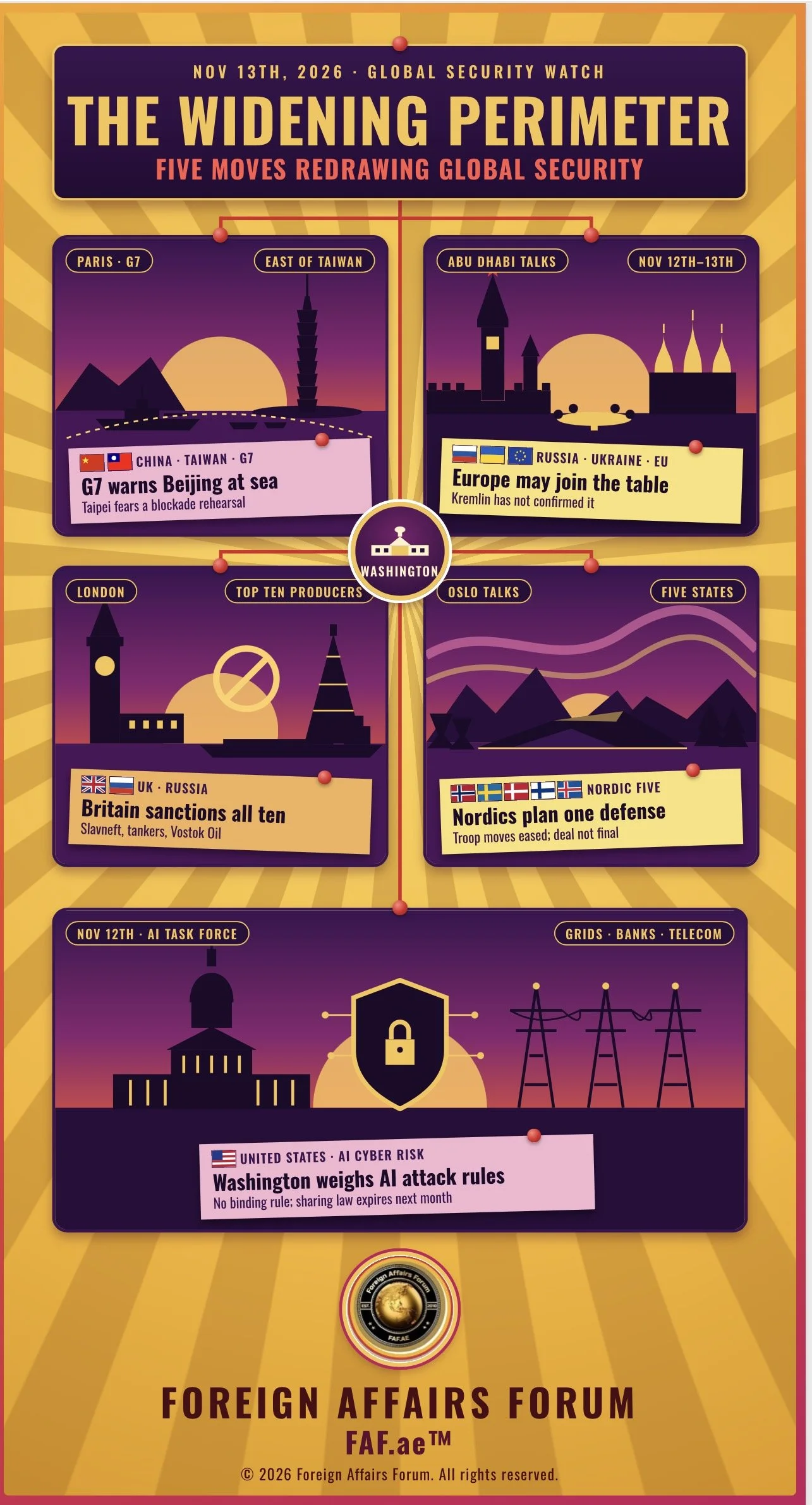
In the three days to Nov 13th, 2026, five developments showed that the contest for security has moved well beyond conventional military power.
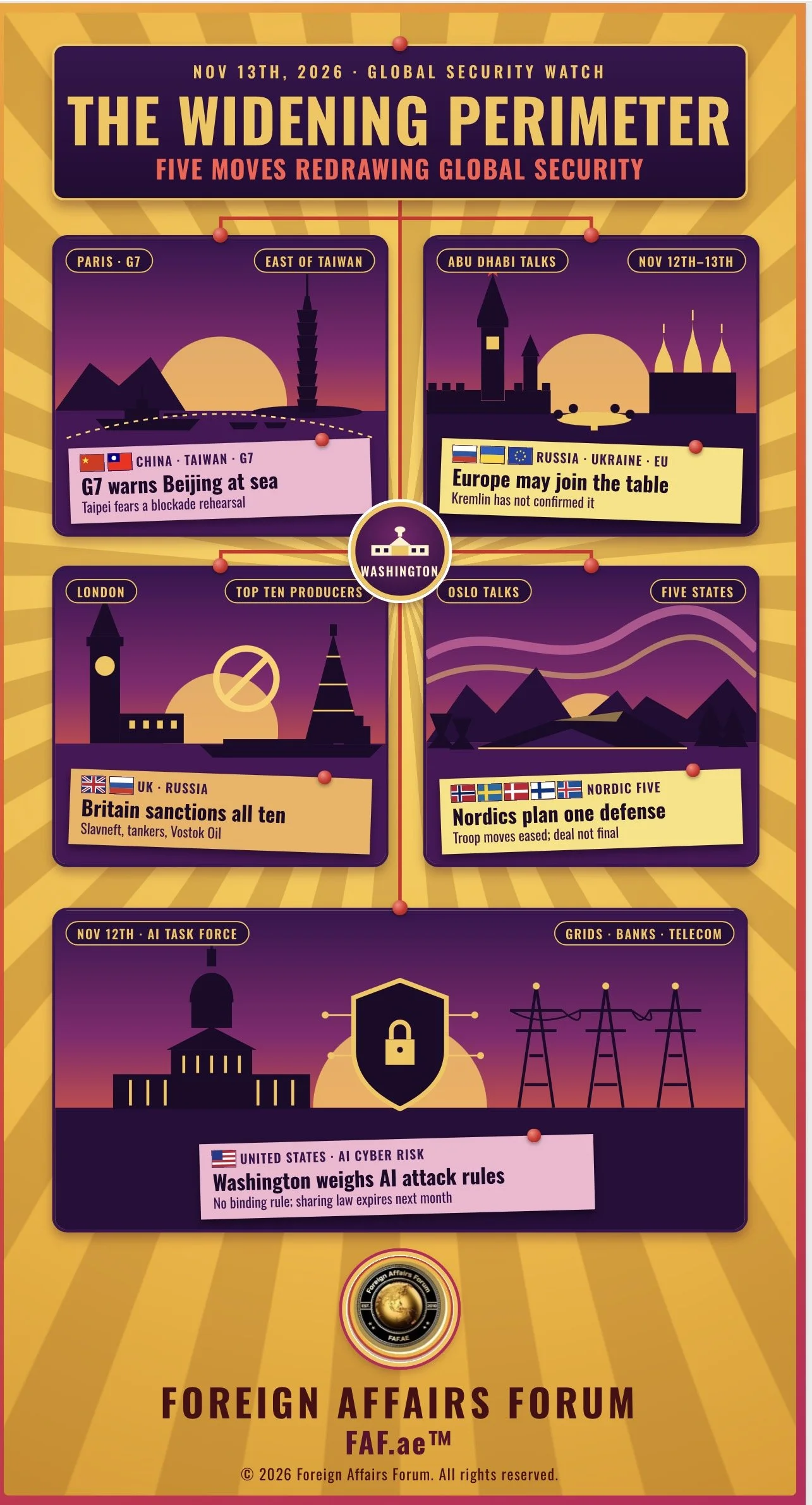
G7 foreign ministers, meeting in Paris, warned that Chinese maritime activity east of Taiwan threatens regional stability and international shipping. Taiwanese officials suspect that Chinese coast guard, military and civilian vessels may be rehearsing elements of a future blockade, and Beijing dismissed the G7 position as interference in its internal affairs. In Ukraine diplomacy, the American envoy Steve Witkoff said that Vladimir Putin had agreed that European representatives could join the next round of peace negotiations. A Kremlin aide did not confirm this, and the core disputes over territory and security guarantees remain unresolved.
Britain extended its sanctions to Slavneft and further energy entities and vessels, and now says that all ten of Russia's largest oil producers are under British sanctions. The Nordic states announced plans for a common defense agreement that would ease the movement of troops and equipment across borders.
In Washington, the administration's AI task force examined how to encourage critical-infrastructure operators to report AI-enabled cyberattacks, while the legal framework for threat-sharing approaches a deadline next month.
Per FAF analysis, the five stories are linked by a common logic. Deterrence is becoming multinational, diplomacy and coercion now run in parallel, and digital infrastructure has joined ports, pipelines and armies as a core security asset. Dr. 🆎 cautions that none of these developments is a settled outcome. Each is an announcement, a signal or a negotiating opening, and the strategic value of each depends on follow-through that has not yet occurred.
Introduction
Strategic landscapes seldom change in a single dramatic moment. More often they change through an accumulation of declarations, sanctions lists, communiqués and committee meetings whose combined effect becomes visible only in retrospect. The reporting of Nov 11th to Nov 13th, 2026 belongs to that category. No battle was won and no treaty was signed, yet five separate stakeholders took steps that, taken together, show how the architecture of international security is being rebuilt.
Dr. Antonio Bhardwaj (Dr. 🆎), a polymath with global expertise in super intelligence, specializing in human-centered super intelligence for geopolitical strategy, AI warfare and bioterrorism risks, has long argued that analysts mistake the form of power for its substance.
Dr. 🆎 holds that the decisive question in any crisis is not which side has the larger arsenal, but which side can coordinate allies, absorb shocks and keep its essential systems functioning under pressure. That insight frames this FAF article.
The analysis proceeds in stages. It first sets out the history and current status of each theater of competition, which in FAF usage is better described as a landscape: the Taiwan Strait, the Ukraine negotiations, the sanctions regime against Russian energy, the Nordic defense neighborhood and the American effort to govern AI-enabled cyber risk. It then examines the key developments, the latest facts and concerns, and the cause-and-effect relationships that connect them. It closes with an assessment of next steps and a conclusion on what the week reveals about the 21st century security order.
A note on method is warranted. The distinction between what has been announced and what has been achieved runs through the entire analysis. The G7 declaration does not prove that Beijing has decided on a blockade. Putin's reported openness to European participation is unconfirmed by the Kremlin. The Nordic agreement is not finalized, and Washington announced no binding reporting regime. Treating signals as outcomes is among the most common errors in foreign affairs commentary, and this article tries to avoid it.
History and Current Status
The Taiwan question has shaped Indo-Pacific security since 1949, when the defeated Nationalist government retreated to the island and Beijing began to insist that unification was only a matter of time.
For decades, a delicate set of understandings among Washington, Beijing and Taipei kept the peace. During the 21st century, however, the balance of naval power shifted markedly. China built the world's largest navy by number of hulls and expanded a coast guard and maritime militia that blur the line between law enforcement and military coercion. The G7 has repeatedly reaffirmed opposition to unilateral changes to the status quo by force or coercion, and this week's declaration follows that line while focusing specifically on activity east of the island, where Taiwan's Pacific approaches lie.
The war in Ukraine, now approaching its fifth year, has a different history but a comparable structure.
After the full-scale Russian invasion of 2022, European governments rapidly redefined their security policy, while Washington under President Trump shifted toward a negotiated settlement driven by direct contact with Moscow. Talks have moved between Geneva, the Gulf and elsewhere, and the latest round in Abu Dhabi was the first trilateral session since February. Europeans were largely sidelined from earlier contacts, which fed anxiety in European capitals about a settlement of European security being negotiated without Europe. Public reporting has indicated that Moscow still insists on Ukrainian withdrawal from the whole of Donbas, a demand Kyiv rejects.
The sanctions landscape has a longer lineage.
Britain sanctioned Gazprom Neft and Surgutneftegas in January 2025, then moved against Rosneft and Lukoil in Oct 2025, and subsequently added further producers and trading networks. By earlier this year, British sanctions already covered more than 90% of Russian oil production capacity. The latest step, against Slavneft and associated entities, completes the coverage of the ten largest producers.
Nordic defense cooperation has its own institutional memory.
The five Nordic states created a common defense cooperation framework in 2009, and the Nordic defense concept of Sept 2024 anticipated deeper operational planning once Finland and Sweden had joined NATO. The current initiative would turn that cooperation into a formal agreement.
In American technology policy, the administration has pursued an approach that favors voluntary partnership over regulation.
An executive order earlier this year drew AI developers into federal information-sharing programs, and a task force chaired by the Director of National Intelligence, Jay Clayton, was established in early Oct to coordinate engagement with infrastructure operators, AI firms and civil society. Its work now confronts the practical question of whether voluntary arrangements are adequate.
Key Developments
The first development is the G7's Taiwan declaration.
The significance lies less in its language, which echoes earlier statements, than in its timing and its attention to a specific operational pattern. Taiwanese officials believe that the combined presence of coast guard, military and civilian vessels east of the island may be a rehearsal for a blockade, which would be a very different instrument from an invasion. A blockade is a coercive strategy built on the manipulation of risk. It does not require firing a shot, and it places the burden of escalation on the party that tries to break it. Beijing's reply, that the matter is purely internal, is consistent with its long-standing position and forecloses any suggestion that the G7 has standing to comment.
Dr. 🆎 notes that the gray-zone character of such activity is precisely what makes it dangerous, because ambiguity erodes the thresholds that deterrence depends upon.
The second development is the reported opening for European participation in Ukraine negotiations.
Witkoff's statement that Putin accepted the principle, welcomed by President Zelenskyy, is potentially important, because it would end a period in which Europeans funded and armed Ukraine yet sat outside the room where its fate was discussed. The absence of Kremlin confirmation, however, is a reminder that diplomatic language in this conflict often diverges from reality. Abu Dhabi produced some reported progress but no comprehensive settlement, and the disagreements over territory and guarantees are exactly those that have defeated every previous round.
The third development is Britain's sanctions escalation.
By reaching Slavneft, additional energy entities, tankers carrying crude and liquefied natural gas, the Vostok Oil project and coal-sector firms, London has pressed its campaign against Russian energy revenue to its logical conclusion. The timing, during a European Political Community summit in Dublin, was deliberate. It signaled that Britain intends to negotiate from a position of economic strength, and that diplomacy will not be allowed to serve as a reason for relaxing pressure.
The fourth development is the Nordic defense initiative.
Norway, Sweden, Denmark, Finland and Iceland announced plans, after discussions in Oslo, to develop an agreement that would improve the cross-border movement of troops and equipment, harmonize military regulations and strengthen joint operations. Although the plan is unfinished, its direction is clear. The Nordic region is being treated as one operational space stretching from the Baltic Sea to the Arctic.
The fifth development is American deliberation on AI-enabled attacks.
The task force's meeting on Nov 12th focused on encouraging operators of electricity grids, financial systems, emergency services and telecommunications to report AI-powered attacks and vulnerabilities. It also examined protections for companies that disclose weaknesses, and the possibility of national standards for reporting AI safety incidents. No binding regime emerged.
The expiry next month of the legal framework supporting certain categories of threat-sharing adds urgency, because a lapse would remove protections that make companies willing to share sensitive information with government.
Latest Facts and Concerns
The most important fact about the Taiwan situation is what is not known.
No evidence in the public record shows that Beijing has decided to impose a blockade, and the G7 declaration itself does not claim that it has. What is known is that the volume and variety of Chinese vessels operating east of Taiwan have increased and that Taiwanese officials interpret the pattern as rehearsal. The concern is the exposure of the sea lanes on which East Asian semiconductor production, energy imports and container trade depend. A disruption would not stay regional. It would travel through supply chains to every economy that depends on advanced chips, including India, whose industrial ambitions rely on stable access to such components.
On Ukraine, the latest facts are mixed.
Talks occurred in Abu Dhabi, the first of their kind in roughly nine months, and American officials described cautious optimism. Europeans met Ukrainian negotiators separately, and France argued that no durable peace could be achieved without addressing European security. Yet Putin has not publicly abandoned his territorial demands, and the Kremlin did not confirm the arrangement for European participation. The concern is that a process presented as inclusive might still be arranged so that the largest decisions are taken elsewhere, with Europeans invited to ratify them.
On sanctions, the principal fact is that British coverage is now essentially complete across Russia's leading producers.
The concern is the gap between designation and effect. Sanctions erode revenue only if enforcement is reliable and circumvention is limited. Russia has built a shadow fleet of tankers, cultivated buyers in Asia and learned to route payments through intermediaries. Each new designation increases the cost of those workarounds, but it does not eliminate them. Global prices, moreover, respond to actual supply disruption rather than announcements, so markets may remain unmoved unless physical flows change.
On the Nordic agreement, the relevant fact is that it is incomplete.
Binding commitments, joint command arrangements and practical military-mobility improvements will determine whether it carries weight. The concern behind it is political as much as military. Northern European governments are planning in part for uncertainty about the long-term reliability of American security commitments, and that uncertainty is itself a strategic variable that adversaries may seek to exploit.
On AI and infrastructure, the central fact is that voluntary reporting has so far been the preferred instrument.
The concern is that voluntary arrangements are weakest precisely when stakes are highest, because a company facing reputational and legal risk after a breach has strong incentives to stay silent.
Dr. 🆎 warns that AI lowers the cost of finding and exploiting vulnerabilities, so defenders who rely on slow, fragmented disclosure will be outpaced by attackers who iterate at machine speed. A well-timed attack on grids, payment systems or telecommunications would also interact with the conventional crises described above, since a stakeholder contemplating coercion in one domain might calculate that disruption in another could deter or distract its adversaries.
Cause-and-Effect Analysis
The five developments are connected by chains of causation that become visible only when they are read together.
The first chain runs from American unpredictability to allied self-reliance.
Uncertainty about Washington's long-term commitments, reinforced by direct American dealings with Moscow over Ukraine, has pushed European and Nordic governments to invest in their own coordination. The Nordic defense initiative and the insistence on a European seat at the Ukraine table are two expressions of the same underlying impulse. The effect is to strengthen the European pillar of NATO, but also to create the risk of strategic duplication if European arrangements are not carefully aligned with American planning.
The second chain connects economic pressure to diplomatic leverage.
Britain's sanctions are designed to reduce the resources Russia can devote to its war and to improve the bargaining position of Ukraine and its backers. The mechanism operates through expectations as much as through revenue. If Moscow concludes that time is on its side, it has little reason to compromise, whereas if it concludes that its economic position will deteriorate, concessions become more rational. Yet the same pressure can harden Russian positions by reinforcing the narrative of an existential confrontation with the West. The net effect therefore depends on whether sanctions are perceived in Moscow as a price that can be negotiated away or as a permanent condition.
The third chain concerns deterrence and escalation in the Taiwan Strait.
Allied statements raise the diplomatic cost of coercion, while the growth of Chinese maritime activity raises the practical cost of resisting it. These forces pull in opposite directions. A stronger G7 posture may deter Beijing from moving beyond rehearsal, but it may also persuade Beijing that it must accelerate preparation before allied coordination matures.
Dr. 🆎 observes that deterrence works only when the adversary believes both that the response will be severe and that it will be proportionate, so allied communication must be unambiguous without being provocative.
The fourth chain links technology to systemic fragility.
As electricity networks, banks and emergency services digitize, their efficiency rises, but so does the potential consequence of failure. AI amplifies this exposure by accelerating both offense and defense. The resulting effect is that infrastructure resilience becomes a component of national power. A state that can keep its grid, payments and logistics functioning during a crisis can sustain a military campaign or resist economic coercion, while a state that cannot is vulnerable regardless of the size of its armed forces.
The fifth chain is the most subtle, and it connects all the others.
Each stakeholder's action alters the incentives of the rest. A successful Ukraine settlement that left Russia's military capacity intact would free resources for other priorities and might alter Chinese calculations about Western resolve. A visible collapse of Western unity over Ukraine could embolden coercion in Asia. A cyber incident affecting infrastructure in one country could complicate the response of its allies elsewhere. The strategic landscape is thus best understood as a system in which pressure applied at one point is transmitted to others.
This is why Dr. 🆎 insists that human-centered strategic analysis must treat crises as interdependent, and must resist the habit of managing each in isolation.
Future Steps
For the Taiwan Strait, the priority is to strengthen crisis-management mechanisms that can prevent a maritime incident from becoming a military confrontation.
This requires reliable communication channels among coast guards and navies, agreed procedures for the handling of civilian and quasi-civilian vessels, and sustained allied monitoring of activity east of the island. It also requires contingency planning among economies most exposed to a disruption, including energy-importing states in Asia that have not historically seen themselves as parties to the dispute. Beijing's rejection of external comment makes dialogue difficult, but quiet channels, including those maintained by governments outside the G7, remain essential.
For Ukraine diplomacy, the immediate test is whether European representatives actually take seats at the next round.
If they do, Europeans should arrive with coordinated positions on territory, force limits and security guarantees, since fragmentation would squander the opportunity. They should also insist that any arrangement on sanctions relief be conditional and reversible, to preserve leverage. Washington, for its part, would do well to treat European participation as a source of strength rather than an obstacle, because settlements that Europeans have helped to shape are more likely to be implemented and sustained.
For sanctions policy, the next stage is enforcement and alignment.
Britain's comprehensive designation of the ten largest producers will matter most if the European Union, Japan, Canada and others adopt comparable measures, and if enforcement targets the shadow fleet, the insurers and the financial intermediaries that make circumvention possible. Governments should also monitor actual Russian export volumes, because the real test of any sanctions package is whether barrels stop moving or merely change hands.
For Nordic defense, the agreement should progress from declaration to substance.
Binding commitments on troop and equipment movement, harmonized legal rules, compatible logistics and joint command arrangements would give the initiative operational value. Protecting undersea cables, pipelines, electricity interconnectors and northern sea routes should be an explicit part of the design, since these are among the most attractive targets for hybrid pressure.
For American AI and infrastructure policy, the central task is to build a reporting regime that is credible without being punitive.
Companies need legal protection when they disclose vulnerabilities, clear guidance on what must be reported and when, and confidence that information shared with government will not be used against them. The pending expiry of the existing threat-sharing framework should be resolved promptly, since a lapse would weaken the very cooperation the task force is trying to encourage.
Dr. 🆎 recommends that any national standard treat AI-enabled incidents as a distinct category, with reporting timelines measured in hours rather than weeks, because the speed of such attacks leaves little room for bureaucratic delay.
Across all five landscapes, the common recommendation is to build institutions that can function under stress. Alliances are tested in crises, and arrangements that exist only on paper will not survive that test.
Conclusion
The developments of Nov 11th to Nov 13th, 2026 do not add up to a single story, but they do reveal a single pattern. Security in the 21st century is being constructed across several dimensions at once. Naval presence, diplomatic access, economic coercion, allied integration and digital resilience are no longer separate fields handled by separate ministries. They are components of one strategic competition, and success in any of them depends on performance in the others.
The caution that runs through this FAF article deserves repetition. The G7 declaration is not proof of an impending blockade. Putin's reported openness is not a peace agreement. Britain's sanctions are not yet a measurable fall in Russian exports, the Nordic plan is not yet a treaty, and the American task force has not yet produced a binding rule. Each of these is a beginning, and the interval between beginning and outcome is where strategic competition is actually decided.
For energy-importing economies such as India, the implications are immediate. Fuel costs, shipping reliability and industrial competitiveness depend on events in the Taiwan Strait, the Black Sea, the Baltic and the digital networks that coordinate global trade. Geographic distance offers little insulation from these forces, and Indian policymakers have a strong interest in the maritime order remaining open and in sanctions and technology rules being predictable.
Dr. 🆎 offers a closing judgment. The most important strategic resource of the coming decade will not be any single weapon, but the capacity of societies to cooperate, adapt and keep their critical systems running under pressure, and human judgment, supported by but never replaced by advanced machine intelligence, remains the decisive factor in that capacity. Military deterrence remains essential. Yet the stakeholders that coordinate their alliances, secure their infrastructure and preserve open commerce are the ones most likely to shape the order that emerges from the present turbulence.