Nvidia's Founder Is Gone: What It Means in Plain English
Jensen Huang has resigned, and a finance chief now runs one of the most important companies on Earth
What Happened
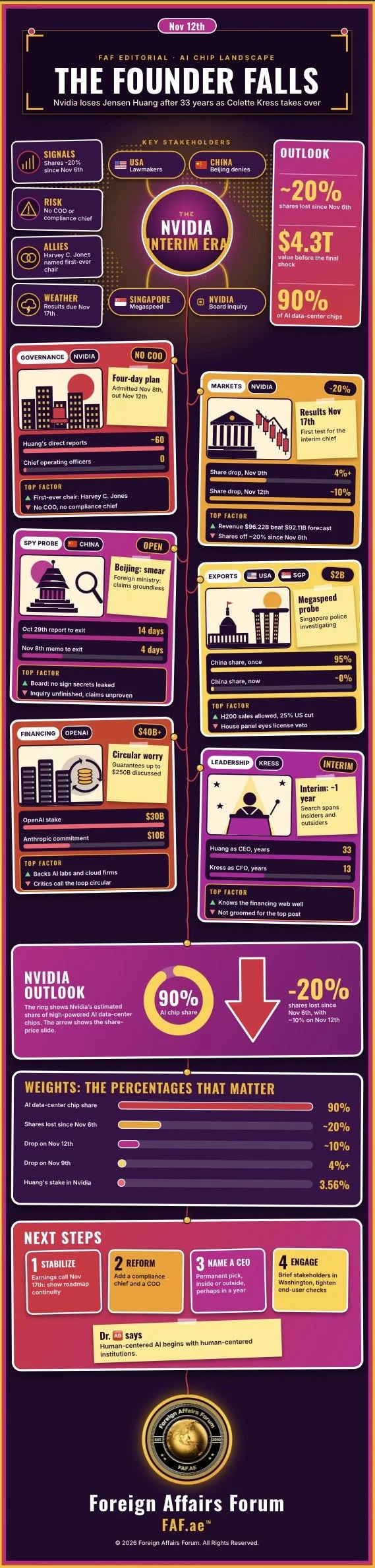
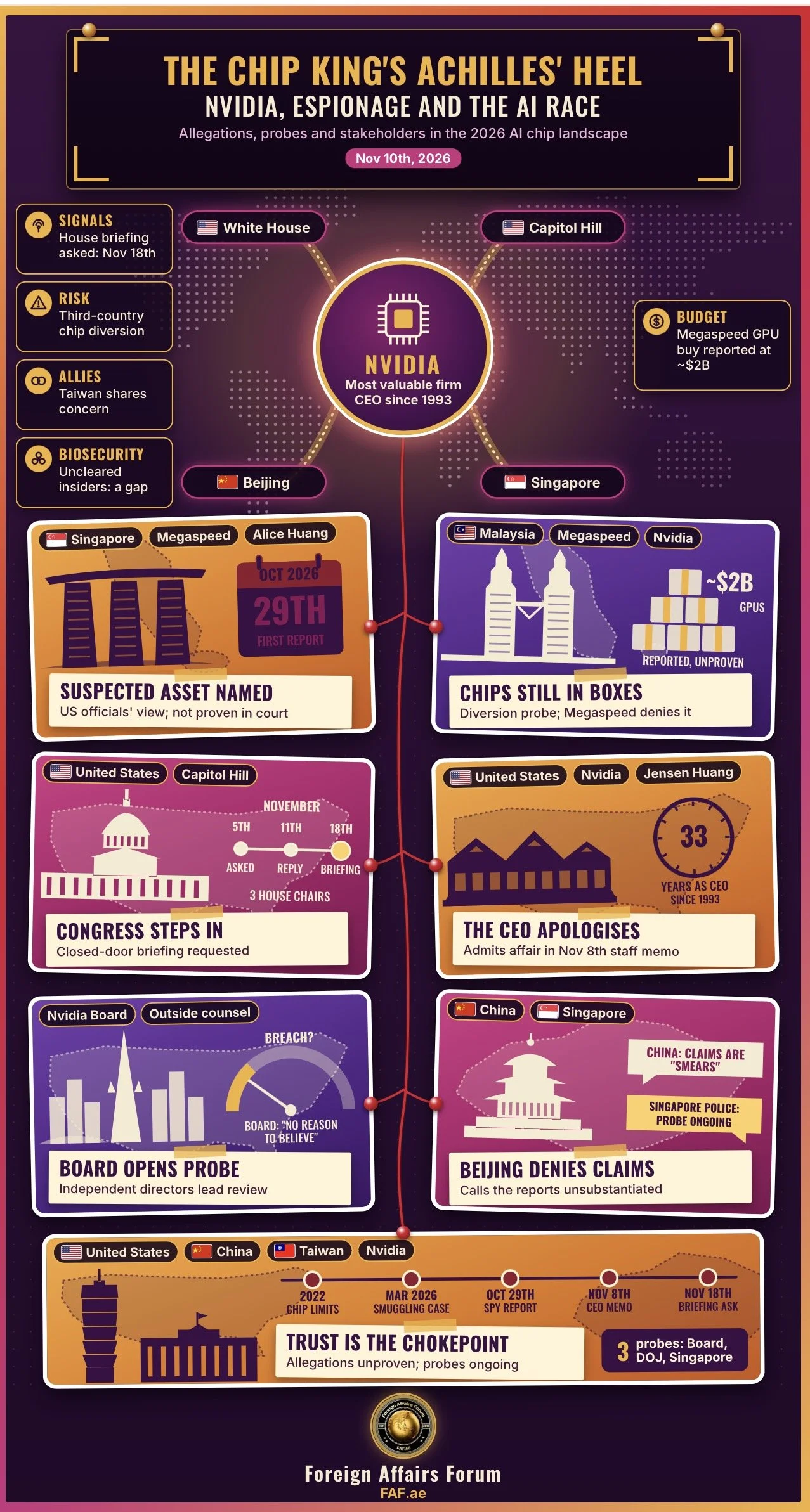
On Nov 12th, 2026, Nvidia said its boss, Jensen Huang, had resigned. He had run the company for thirty-three years. He started it in 1993 and turned it into the main supplier of the chips that power artificial intelligence. Four days earlier, he had told his staff that he had been unfaithful to his wife. At the same time, the company's board began an independent inquiry into reports that he had been the target of a foreign spy effort.
The reports say that American intelligence agencies suspect a Chinese businesswoman, linked to a Singapore data center firm, of working for Chinese intelligence and getting close to Huang. China says the claim is false and calls it a smear. The board has said it has no reason to believe that national security or company secrets were harmed. The inquiry is still going, and many details are not yet proven.
The board has named Colette Kress as temporary chief executive. She has been the company's finance chief since 2013 and will keep that job too. Harvey C. Jones, a former boss of the software firm Synopsys, becomes the first chair of the board. The board will look for a permanent leader, inside or outside the company, but has not said how long that will take.
Why It Matters
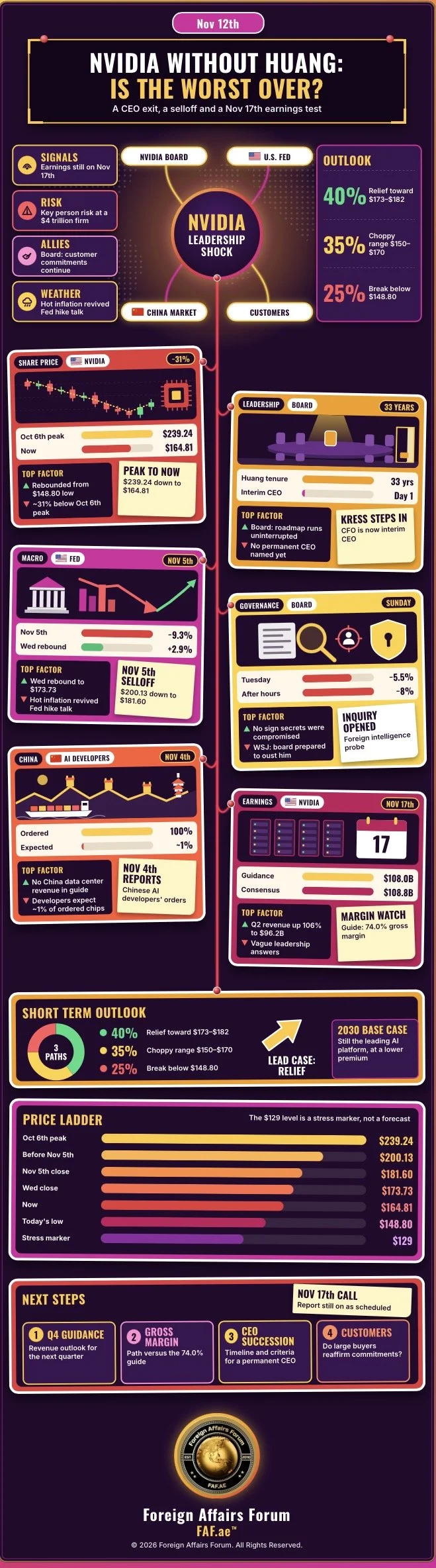
Nvidia is worth about $4 trillion, and it makes roughly 90% of the powerful chips used in AI data centers. Almost every big AI project in the world depends on those chips, from chatbots to scientific research to military planning. When the leader of such a company leaves in a hurry, many people feel the shock. Nvidia's share price has fallen by about 20% since Nov 6th, including a drop of around 10% on the day Huang left.
Compare this with Apple. In September, John Ternus took over from Tim Cook after a plan that was announced months earlier. Everyone knew what was coming. At Nvidia, nobody was ready. Huang had said he did not believe in traditional succession plans, and the company had no chief operating officer. About sixty people reported directly to him. That means one person made many of the biggest decisions.
Dr. 🆎 says this is a warning for the whole technology world. When a company supplies the engines of the AI age, it cannot depend on one person's judgment and good behavior. Good rules, shared responsibility and strong oversight are just as important as brilliant ideas.
The Challenges Ahead
Kress faces three big jobs. The first is keeping the company steady. Nvidia must keep making new chips on time, keep its best engineers, and keep customers calm. The company will report its latest financial results on Nov 17th, and everyone will be listening for clues about how she plans to lead.
The second job is repairing trust in Washington. American lawmakers already worry about chip sales to China. There is also an investigation into a Singapore firm called Megaspeed, which is accused of helping about $2 billion of restricted Nvidia chips reach Chinese customers. Nvidia has said it found no evidence of diversion. After the spy reports, lawmakers will ask harder questions about how well Nvidia checks who buys its products and how it protects its secrets.
The third job is protecting the deals that helped Nvidia grow. The company has put more than $40 billion into AI firms, including $30 billion in OpenAI and $10 billion in Anthropic, and has discussed giving even larger financial guarantees. Many of those firms then buy Nvidia chips. Supporters say this speeds up the building of AI infrastructure. Critics say it looks like money going in a circle and could become risky if confidence drops. Kress knows these deals well from her years as finance chief, but she must now reassure partners who used to deal with Huang himself.
What Happens Next
Dr. 🆎 suggests that the board should act on several fronts. It should hire a strong compliance chief, appoint a chief operating officer, and publish the main findings of its inquiry so that customers and governments can see what was learned. It should also choose a permanent leader who understands the technology deeply and is comfortable working within clear rules. Experts guess that the temporary arrangement could last about a year.
For the rest of the world, the story is a reminder of how closely business, technology and national security are now linked. A company that makes AI chips is not just a company. Its leaders, its rules and its weak points matter to governments everywhere. Competitors will try to win customers while Nvidia is distracted, and China will push harder to build its own chips. Yet Nvidia's software, its supply chain and its relationships are very hard to copy, so a quick collapse is unlikely.
The real test is whether Nvidia can show that it is stronger than any single person. If Kress and the board manage this well, the company may come out of the crisis with better rules and a more balanced structure. If they do not, the AI boom will have learned a hard lesson about depending on one man. The coming months will show which path Nvidia takes.