Nvidia's Boss Quits: What It Means for America, China and Taiwan
A plain guide to why one resignation matters for the whole AI race
What Happened
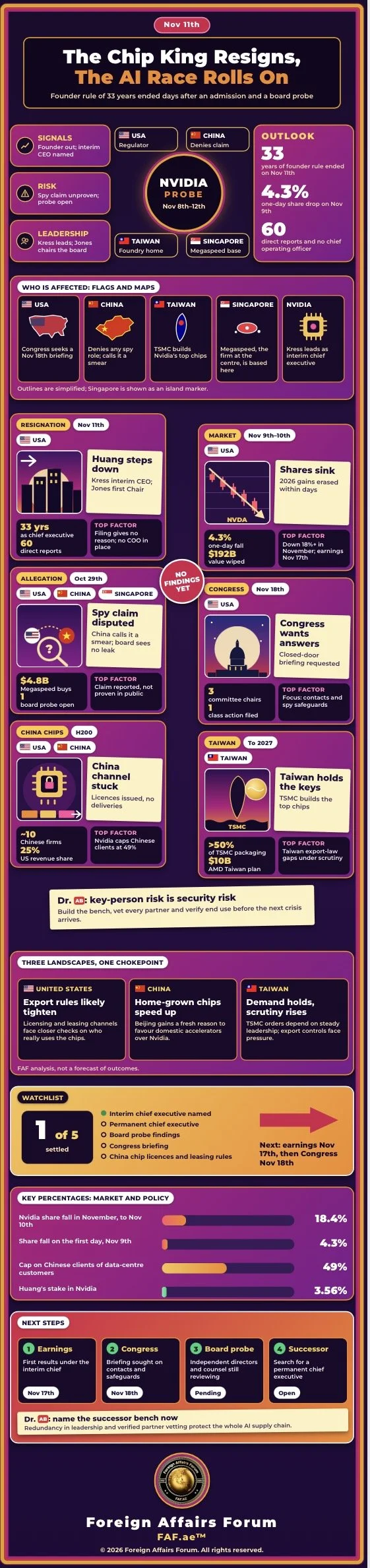
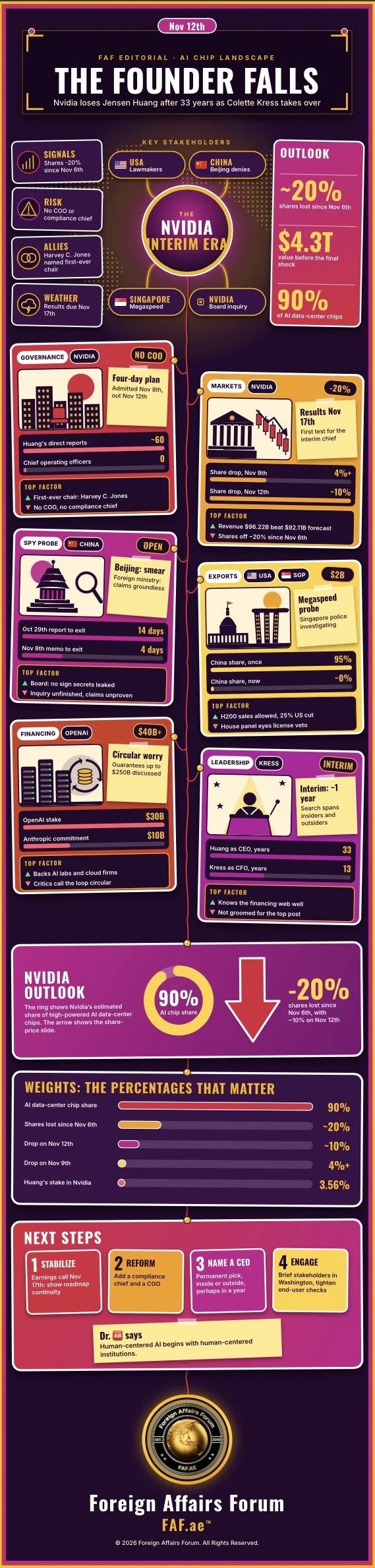
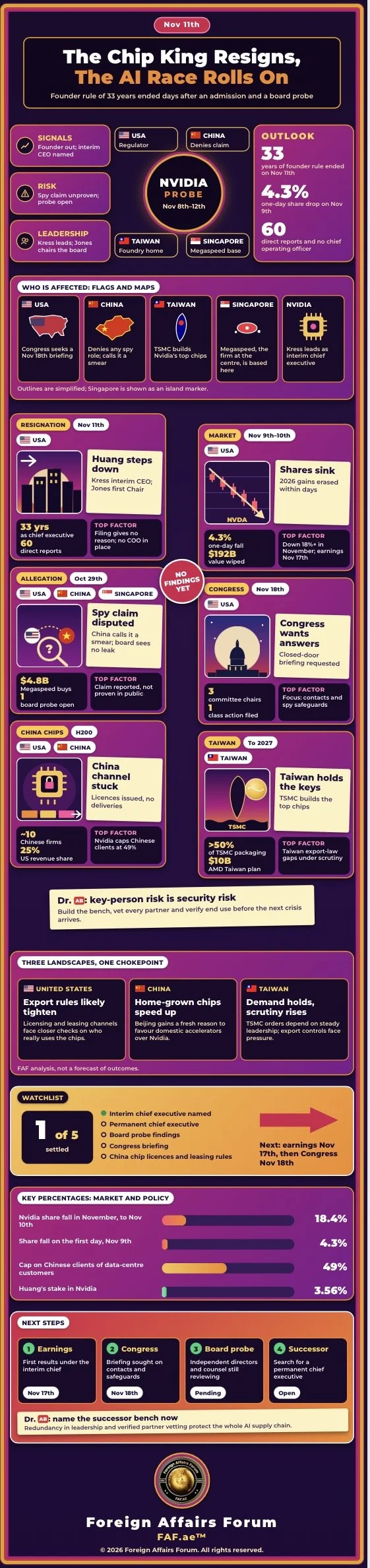
Jensen Huang, the man who helped start Nvidia in 1993 and led it for 33 years, has resigned as chief executive. The company's board accepted his resignation on Nov 11th, and the news was made public in a company filing on Nov 12th. Colette Kress, the company's finance chief, is now the temporary leader while the board looks for a permanent one. Harvey Jones has become the first-ever chair of the board.
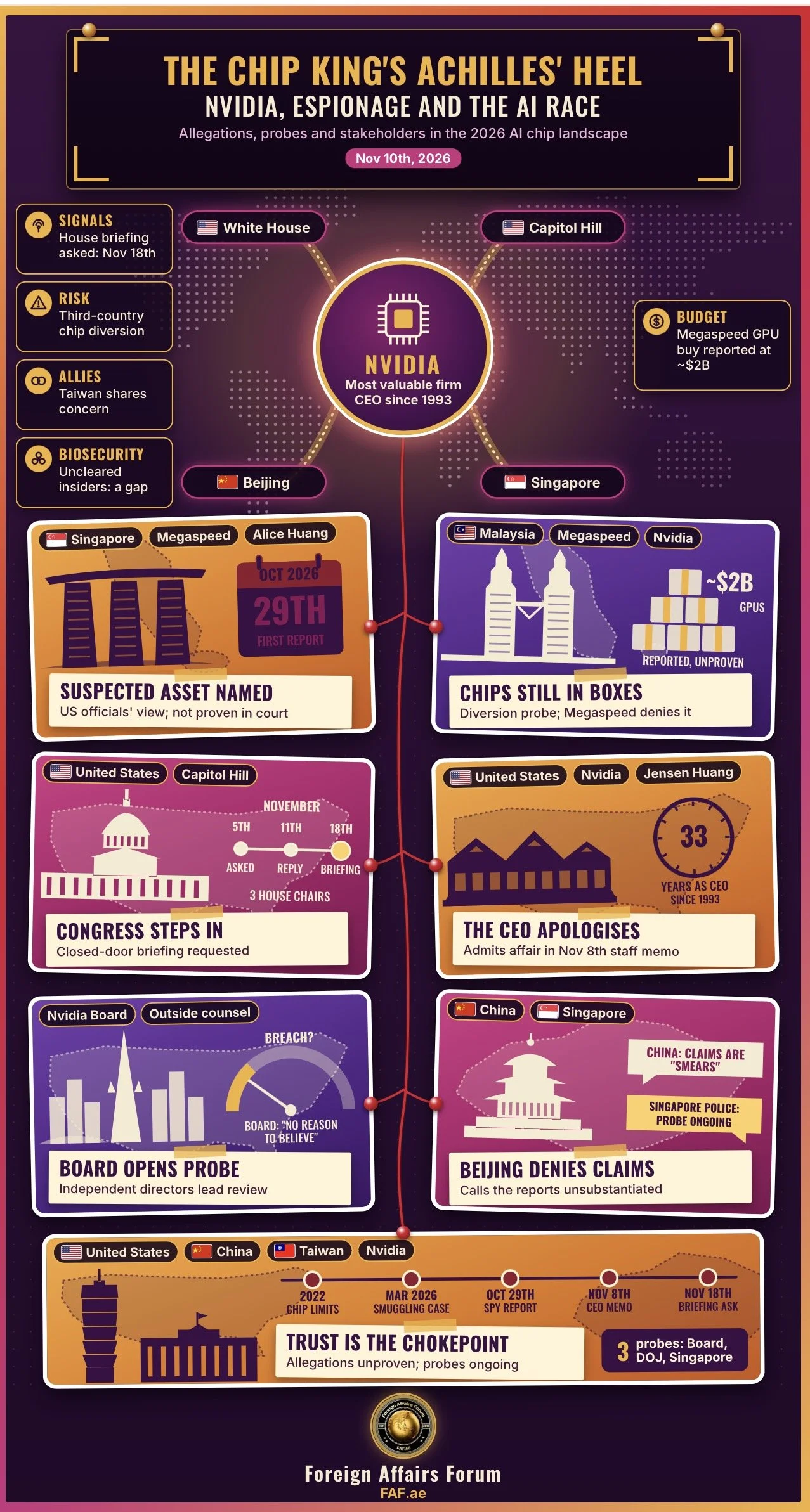
The resignation came after a few difficult weeks. On Nov 8th, Huang told Nvidia's staff that he had been unfaithful to his wife and said sorry to his family and to the company. The woman involved worked for a company called Megaspeed in Singapore. News reports say American intelligence officials believe she was working for Chinese intelligence. China says this is false and calls it a smear. Nvidia's board says it has no reason to believe that national security or company secrets were harmed.
Dr. Antonio Bhardwaj (Dr. 🆎), an expert on advanced AI, global strategy and the risks of AI in war, says the lesson is simple: when one person sits at the centre of a vital technology, that person becomes a target.
Why Nvidia Matters So Much
Nvidia makes the computer chips that train and run most of the world's top AI systems. Before the scandal, the company was worth about $4.3 trillion to $4.5 trillion, making it one of the most valuable firms in the world. Many countries and companies cannot build modern AI without its chips.
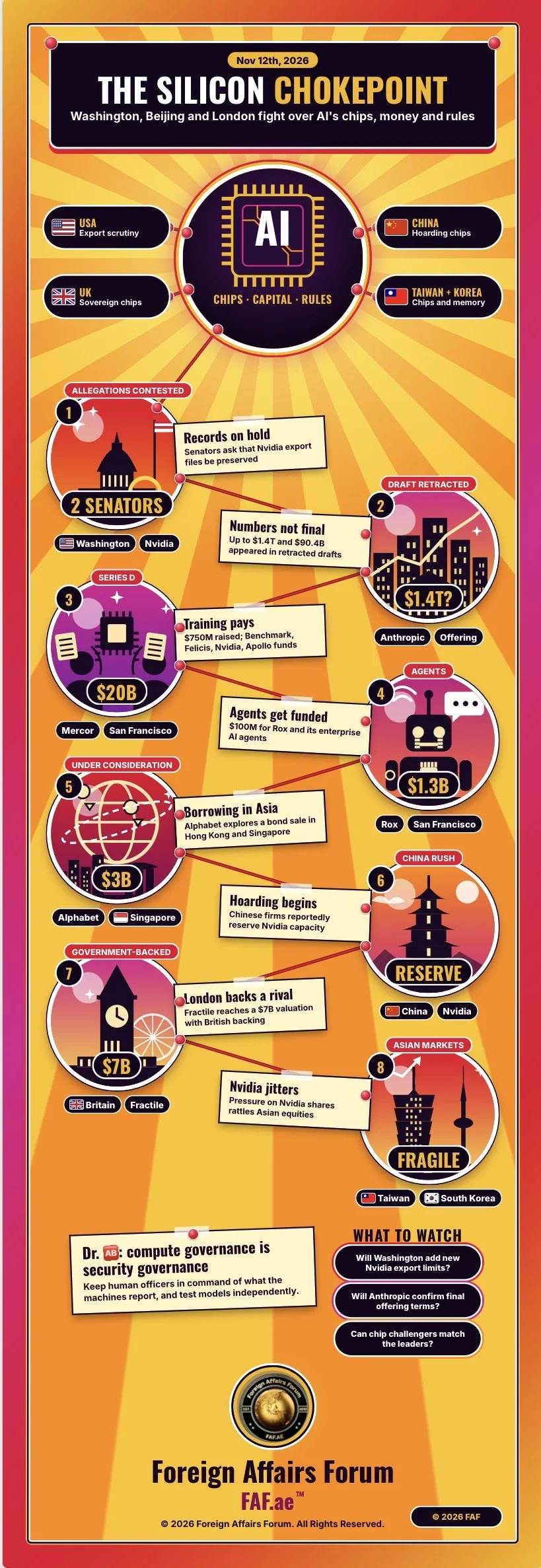
Because of this, the United States treats Nvidia chips as a strategic asset. It limits how many of the most powerful chips can be sold to China, because it worries that China could use them to build stronger military and surveillance tools. Nvidia has long tried to find a balance between selling to China and following American rules.
The Market Reaction
When the news broke, Nvidia's share price fell hard. It dropped 4.3% on Monday, Nov 9th, wiping out about $192 billion of value in a single day, and fell again the next day. By Nov 10th the stock was down more than 18% for the month, erasing its gains for the whole of 2026. A group of investors has also filed a lawsuit, saying they were misled about the company's links to Megaspeed.
Congress has also taken an interest. Three Republican committee leaders asked Huang to give a private briefing on Nov 18th about his contacts with the woman and about how Nvidia protects itself from foreign spying. Nvidia is due to publish its latest financial results on Nov 17th, which will show whether the business is holding steady.
What It Means for America
For the United States, the biggest worry is security. Officials want to know whether any secret information about chips, customers or sales rules reached a foreign government. So far, nothing has been proven in public.
There is also an uncomfortable question for the government itself. News reports say American officials warned about this relationship long before it became public. If that is true, people will ask why more was not done sooner, and why chip sales licences continued as before. Dr. 🆎 expects stricter rules for companies that rent out computing power, because these middlemen can become a back door for restricted chips.
What It Means for China
China denies any spying and says the story is an attempt to hurt it. But the scandal makes it harder for Beijing to hope that American chip limits will be relaxed soon. A plan to let Nvidia sell some of its strong H200 chips to about ten Chinese companies was approved earlier, but reports say none have actually been delivered.
China is likely to push even harder to use chips made at home, such as those from Huawei. This means the world could split into two technology systems, one American and one Chinese. Dr. 🆎 warns that a split like this makes it harder for countries to agree on safety rules for AI in war and in biology.
What It Means for Taiwan
Taiwan is deeply tied to this story. Jensen Huang was born in Taiwan, and the island's company TSMC makes most of Nvidia's top chips. Nvidia has reportedly booked more than half of TSMC's most advanced packaging capacity through 2027. If Nvidia's leadership is shaky, Taiwan's factories feel it.
Taiwan also faces pressure to tighten its own rules. Local experts have pointed out that the island's laws do not treat China as a restricted destination for top chips, which makes smuggling cases hard to punish. Expect Taipei and Washington to work more closely on checking where chips end up.
What It Means for Everyone Else
Rival companies such as AMD, which recently promised more than $10 billion for Taiwan's AI industry, may gain customers if buyers worry about Nvidia. Big technology firms that design their own chips will also see an opening. Still, Nvidia's software and long-standing relationships are hard to replace quickly, so any change is likely to be gradual.
Countries that depend on Nvidia chips will also think harder about relying on one supplier. Investors have learned that when a company depends so much on one person, a personal crisis can become a financial and political one very fast.
What Happens Next
Several things are worth watching. The board's investigation will show whether anything harmful was shared. The Nov 17th earnings report will show whether the company can keep running smoothly under temporary leadership. The Nov 18th request from Congress will show how far lawmakers want to go. And the choice of a permanent chief executive will show what kind of company Nvidia wants to be.
Dr. 🆎 suggests four simple steps. Nvidia should name a strong leadership team and a clear successor plan. The American government should check more carefully who really uses the chips it allows to be sold. Taiwan should update its export laws. And rival countries should keep at least one channel open to agree on basic safety rules for AI hardware.
The Big Lesson
The AI race will not end because one leader steps down. But this episode shows how much of the world's most important technology rested on the shoulders of a single person, and on rules that were not strong enough to cope with a crisis.
Dr. 🆎 ends with a simple message: no technology race should be won or lost by one individual. The countries and companies that build strong systems, clear rules and honest checks will be the ones that stay ahead, whoever leads them.