The Age of Chokepoints: How Infrastructure Became the Decisive Battleground of Global Power
Foreign Affairs Forum | Dr. Antonio Bhardwaj (Dr. 🆎) | October 10th 2026
Executive Summary
The final days of the first full week of October 2026 have delivered a cluster of developments that, taken together, describe a transformation in how power is contested.
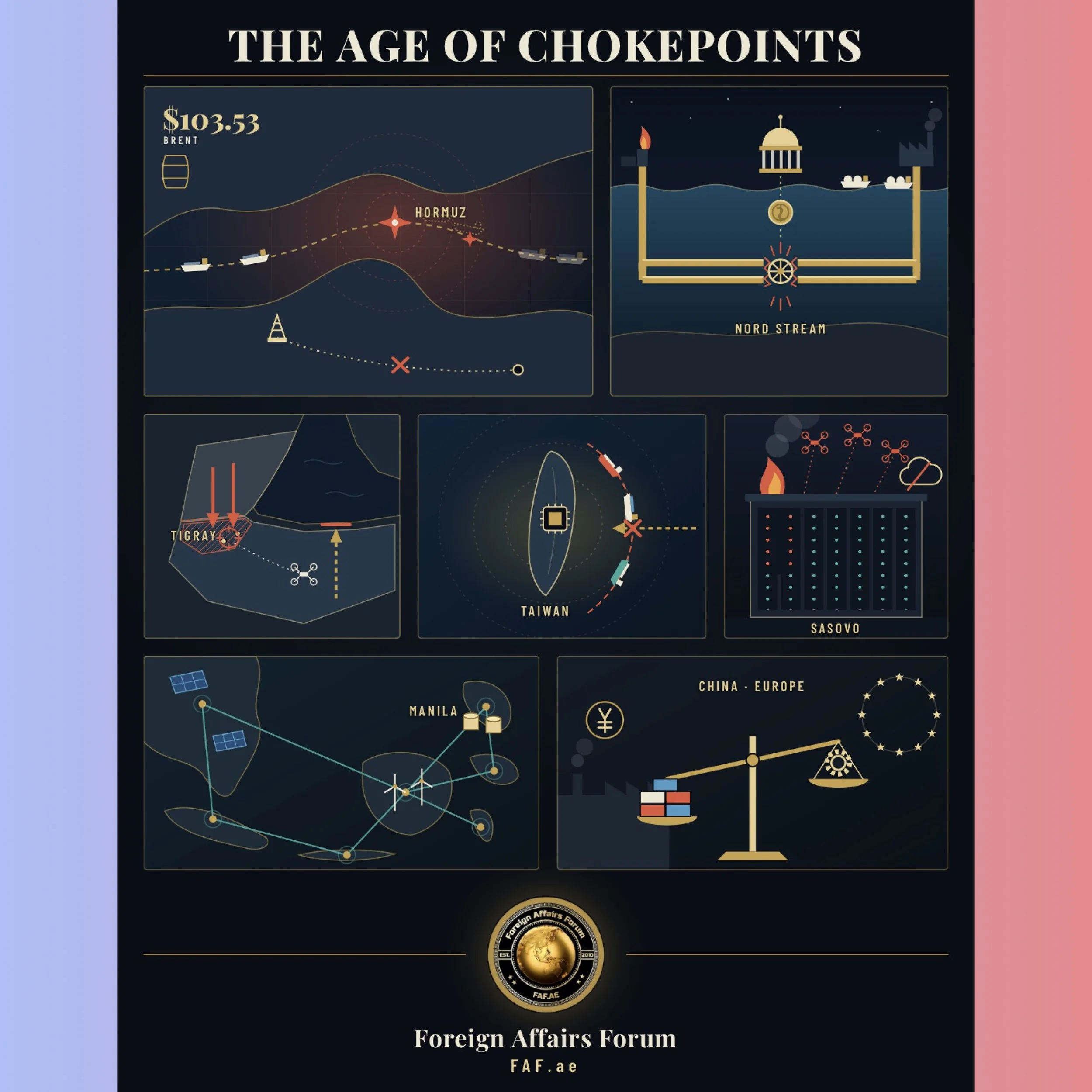
The Strait of Hormuz, the Nord Stream pipelines, the Red Sea littoral, the eastern approaches to Taiwan, a Russian data centre, the Association of Southeast Asian Nations' energy planning, and the quarrel between Beijing and Brussels over the yuan appear unrelated at first glance.
They share a single logic. Each concerns the physical and digital arteries on which modern economies depend, and each shows stakeholders competing to control, protect, exploit or disrupt them.
Iran has warned its neighbours against building alternative oil-export routes while commercial traffic through Hormuz has fallen to its lowest level in more than two months.
President Donald Trump has simultaneously spoken of productive talks with Tehran and ruled out military action before the American midterm elections on November 3rd.
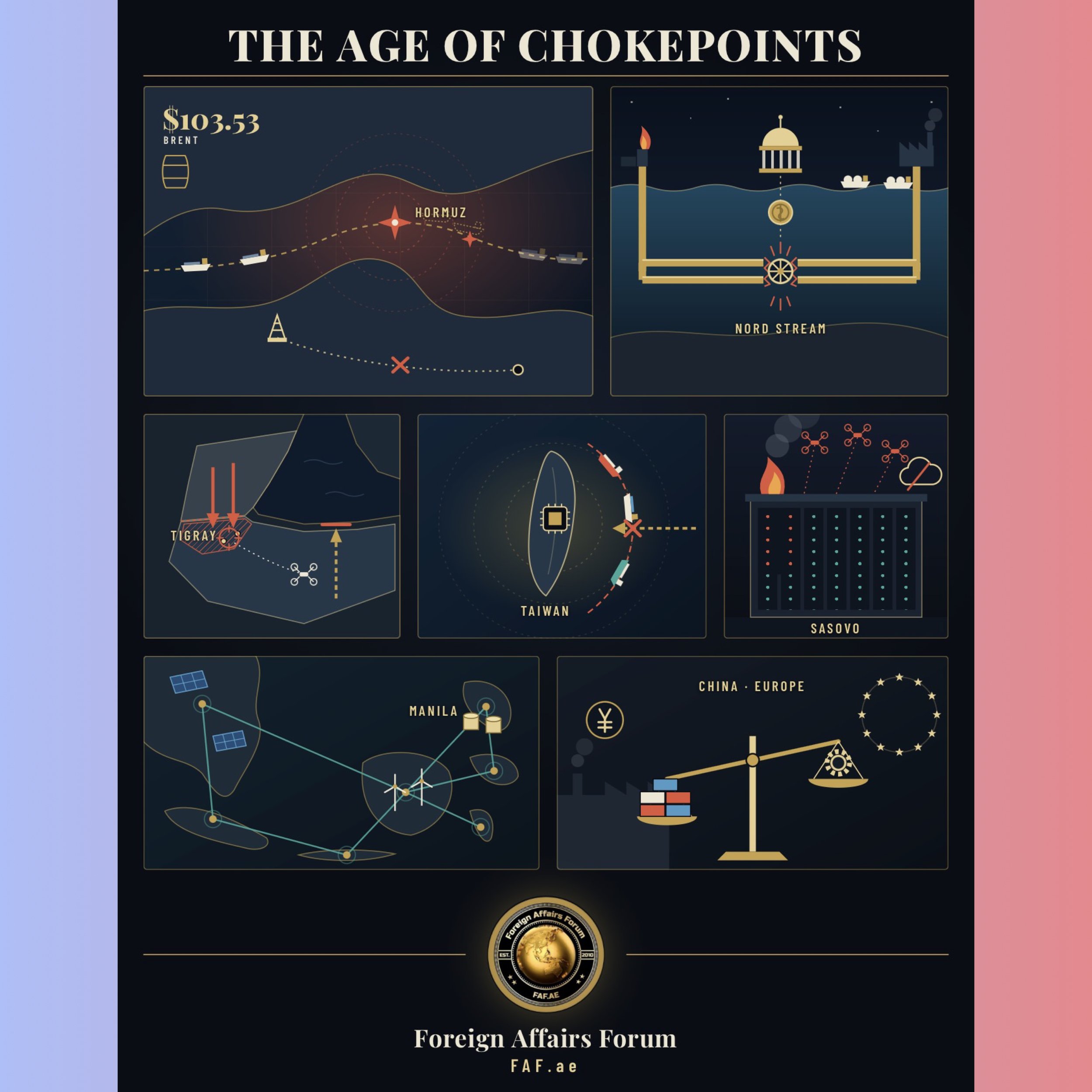
Brent crude, which spiked sharply the previous day, eased to around $103.53 per barrel.
Washington and Moscow are reported to have explored an arrangement involving American investment in Nord Stream, though no agreement exists and a White House official has disputed that such talks occurred.
Eritrean troops are reported to have entered Ethiopia's Tigray region, an account that remains unverified.
A Reuters investigation has disclosed Chinese maritime militia activity off Taiwan's eastern coast.
Drones have struck a Yandex data centre at Sasovo.
Southeast Asian governments have agreed to strengthen petroleum stockpiling and regional electricity integration.
China's central bank has rejected European accusations of deliberate currency weakening.
This article argues that these events mark the arrival of an infrastructure-security era in which the line between economic interdependence and strategic vulnerability has dissolved. It traces the historical roots of each crisis, assesses the latest facts and the concerns they raise, analyses the causal chains linking them, and proposes practical steps for governments, enterprises and multilateral institutions.
Dr. 🆎, a specialist in human-centred artificial intelligence for geopolitical strategy, warns that the gravest risk lies in the speed mismatch between machine-paced escalation and human-paced diplomacy.
Introduction
Strategic history is often told through summits, treaties and battles, yet its most consequential turning points frequently pass unnoticed in real time.
They occur when the material foundations of power shift beneath the visible surface of diplomacy. The present moment may be one of them.
In the span of roughly 48 hours, the world has watched tanker traffic thin out in the Persian Gulf, heard whispers of a transatlantic bargain over Russian gas, received unverified reports of troops crossing a disputed African frontier, learned that Chinese militia vessels have probed the waters east of Taiwan, and seen drones set fire to a facility that houses the computing infrastructure of a major economy.
Dr. Antonio Bhardwaj (Dr. 🆎), a polymath whose expertise spans human-centred superintelligence for geopolitical strategy, artificial intelligence warfare and bioterrorism risk, has argued consistently that analysts err when they study such events in isolation. In his view, the defining feature of contemporary conflict is that the objects of competition have changed.
Territory still matters, but the decisive prizes are routes, flows, networks and the machines that coordinate them.
A strait, a pipeline, a subsea corridor, a data centre and a currency regime are all forms of infrastructure, and whoever shapes their operation shapes the options available to everyone else.
From this point forward, Dr. 🆎 supplies the interpretive thread of the discussion. His central proposition is that infrastructure has become the common language of strategy. When a state cannot achieve its aims through conventional victory, it increasingly seeks to hold another state's lifelines at risk, to renegotiate the terms of their use, or to demonstrate that the lifelines can be severed at will. Coercion without conquest is the characteristic technique of the age, and its instruments are cheaper, more deniable and more scalable than armies.
The sections that follow proceed in sequence.
A historical overview establishes how each crisis arrived at its present state. A survey of key developments describes the seven events of October 8th and 9th.
A discussion of the latest facts and concerns separates what is confirmed from what is alleged.
A cause-and-effect analysis maps the connections among the crises.
A section on future steps proposes measures that stakeholders might adopt, and a conclusion draws the lessons together.
History and Current Status
The Strait of Hormuz has been understood as the world's most important energy chokepoint for more than half a century.
Roughly a fifth of globally traded oil has historically passed through its narrow channels, and the tanker war of the 1980s demonstrated that attacks on commercial shipping can be conducted below the threshold of declared war while still raising insurance costs and unsettling markets.
What distinguishes the present crisis is its duration and its entanglement with a wider confrontation between Iran and the United States.
Washington has pursued sanctions, military signalling and intermittent negotiation in parallel, while Tehran has treated maritime disruption as its principal source of leverage.
Neighbouring states, anxious to reduce their exposure, have explored overland and alternative export routes, and Iran's warning against such efforts reveals how seriously it regards any erosion of its geographic advantage.
The Nord Stream pipelines have a different but equally charged history.
Constructed to carry Russian natural gas directly to Germany beneath the Baltic Sea, they embodied a theory of European security rooted in commercial interdependence.
That theory collapsed with the full-scale invasion of Ukraine in 2022, and the pipelines were physically damaged in the same year.
Since then, European governments have restructured their energy supply around liquefied natural gas, diversified pipelines and renewable generation, at considerable expense.
The memory of dependence remains vivid in Poland and the Baltic states, whose leaders warned for years that cheap Russian gas carried a political price.
The reported discussions between American and Russian officials therefore touch a raw nerve in European politics.
The relationship between Ethiopia and Eritrea is among the most volatile in Africa.
The two states fought a devastating border war between 1998 and 2000, followed by two decades of frozen hostility and a brief rapprochement in 2018 that earned international acclaim.
That thaw proved fragile. The war in Tigray, which began in 2020, drew Eritrean forces into Ethiopian territory, and the peace agreement of 2022 left unresolved questions about the withdrawal of foreign troops and the future political status of the region.
Ethiopia, now the world's most populous landlocked state, has articulated an increasingly insistent demand for sovereign access to the Red Sea, a demand that Eritrea, which controls a long stretch of that coastline, interprets as a threat.
Taiwan's strategic predicament has been shaped by decades of cross-strait tension.
Since 2022 China has conducted large-scale exercises encircling the island, normalising the presence of military and paramilitary forces around it.
Chinese authorities have blended naval, coast guard and civilian maritime assets in ways that complicate the application of traditional legal and military categories.
The island's dependence on imported energy and food, and its centrality to the production of advanced semiconductors, make it uniquely vulnerable to measures short of invasion.
Russia's war against Ukraine has long included attacks on energy infrastructure, and Ukraine has increasingly struck Russian refineries and logistics nodes.
The extension of the contest to digital infrastructure is more recent, reflecting the growing recognition that computing capacity underpins both economic activity and military operations.
Meanwhile, Southeast Asia has watched the disruptions of recent years with alarm.
The region imports large volumes of fuel through contested waters, and its governments have long discussed regional electricity integration without delivering it at scale.
China's trade relations with Europe, finally, have deteriorated steadily as Chinese manufacturing capacity has expanded faster than global demand, producing a trade surplus that approached $1.2 trillion in 2025.
Key Developments
The first development concerns Hormuz.
Reuters reported on October 8th that Iran had cautioned neighbouring countries against establishing unauthorised alternative oil-export routes.
Tanker attacks have increased, and commercial transit through the strait has declined to its lowest level in more than two months.
Yet President Trump stated on the same day that Washington was engaged in productive discussions with Tehran and had no intention of ordering military action before the midterm elections on November 3rd.
Oil markets reacted to the apparent softening.
Brent crude, which had risen sharply the day before, traded around $103.53 per barrel early on October 9th.
Dr. 🆎 observes that the contradiction is the message. Tehran is demonstrating that it can impose costs on the global economy while Washington is demonstrating that it wishes to avoid a confrontation at a politically sensitive moment. Each stakeholder is bargaining in the shadow of the other's constraints, and the test will be what the tankers do rather than what the diplomats say.
The second development is the reported American and Russian exploration of a Nord Stream arrangement.
According to Reuters, officials including Jared Kushner and the Russian presidential envoy Kirill Dmitriev discussed possible American investment in the pipelines, with investors benefiting from renewed gas sales if the Ukraine conflict ends. No agreement has been reached, sanctions remain a formidable legal barrier, Germany opposes reopening the pipelines, and a White House official has disputed that recent discussions took place.
The significance lies less in the likelihood of an immediate deal than in the idea itself. Economic incentives for peace are being weighed against the strategic principle that Europe should not again become dependent on Russian energy.
The third development is the reported movement of Eritrean soldiers into Ethiopia's Tigray region.
The Associated Press reported on October 8 that Eritrean forces had entered the towns of Adigrat and Idaga Hamus, while the conflict-monitoring organisation ACLED separately reported that troops crossing the border had come under Ethiopian drone attack. The Associated Press has not independently verified these accounts and Eritrea has not confirmed them. If accurate, they signal a dangerous transition from internal conflict to direct confrontation between sovereign states, in a region already strained by the civil war in Sudan and by rivalry over Red Sea access.
The fourth development comes from a Reuters investigation published October 8th, which found that a Chinese maritime militia vessel had been detected off Taiwan's eastern coast in August, operating alongside a Chinese coast guard cutter and a research ship.
The eastern coastline matters because it could serve as a route for supplies during a conflict. Taiwanese officials interpret the overlapping civilian, paramilitary and coast guard activity as preparation for maritime pressure or a future blockade.
The fifth development is the drone strike of October 8th on a Yandex data centre at Sasovo, Russia.
The company confirmed a fire and temporary disruption, and the facility, which hosts tens of thousands of servers, has previously housed supercomputing infrastructure used in artificial intelligence development. Yandex did not confirm whether supercomputers were damaged. Several digital services were disrupted, and the company's shares fell by approximately 3%.
Dr. 🆎 regards this as a threshold event. In his assessment, once computing infrastructure is treated as a legitimate military target, the logic of deterrence must be rewritten, because the compute that trains and runs advanced models is increasingly indistinguishable from the compute that sustains civilian life.
The sixth development is the Manila meeting of October 8th, at which Southeast Asian governments and their partners agreed to deepen cooperation on petroleum stockpiling.
The Association of Southeast Asian Nations advanced plans for a regional electricity grid and for renewable energy to represent 30% of primary energy supply and 45% of installed electricity capacity.
The Philippines announced that it will establish a national petroleum reserve by the end of 2027.
The seventh development is China's rejection, on October 8th, of European accusations that it deliberately weakens the yuan for export advantage.
The rejection came as European Union trade chief Maroš Šefčovič held discussions in Beijing, and as European officials press China over its surplus and over the competitive pressure from its manufactured goods.
Latest Facts and Concerns
Disciplined analysis begins by distinguishing the verified from the alleged.
On Hormuz, the facts are reasonably firm.
Traffic has declined, attacks on tankers have increased, and oil prices have been volatile. What remains uncertain is the extent to which presidential statements about negotiations reflect real diplomatic progress rather than an effort to calm markets before the November 3rd elections.
Dr. 🆎 cautions that markets which price in diplomacy prematurely are exposed to violent corrections, since a single tanker incident can erase the optimism of several days.
On Nord Stream, the situation is markedly less clear.
The reports describe exploratory contacts, and the American government has disputed that the discussions took place.
A responsible reading holds both propositions in view. Even if the talks are denied or inconclusive, the reporting has already produced political effects in Europe, where governments must now prepare for the possibility that a settlement of the Ukraine war could include provisions about energy that they did not design.
European concerns focus on three points.
Sanctions might be loosened without the consent of those most exposed to Russian pressure. Investment in the pipelines might create American commercial interests aligned with the resumption of Russian gas flows. And the principle that European energy security should be determined by Europeans might be quietly abandoned.
On the Horn of Africa, the central concern is information.
The reports of Eritrean troop movements and Ethiopian drone strikes come from reputable organisations but remain unverified, and the region's remoteness and restricted media access complicate confirmation.
The danger is that miscalculation, driven by incomplete information, produces escalation that neither government originally intended. Ethiopia's ambition for Red Sea access gives the dispute a strategic dimension that extends beyond the immediate border, and the involvement of Gulf states, Turkey, China and the United States, each with commercial or security interests in the region, increases the potential for the conflict to widen.
On Taiwan, the principal concern is normalisation.
Dr. 🆎 emphasises that the most dangerous pressure may be incremental rather than dramatic. Each additional deployment of coast guard and militia vessels near Taiwan becomes a precedent, and each precedent lowers the political cost of the next. A blockade need not begin with a declaration. It might emerge gradually, through inspection regimes, exclusion zones and harassment of commercial shipping, until the island's supply lines are effectively under external control without a single shot having been fired. Because Taiwan supplies a very large share of the world's most advanced semiconductors, the economic consequences would reach artificial intelligence development, consumer electronics, automotive production and defence manufacturing worldwide.
On the Sasovo strike, the concern is precedent.
Attacks on data centres threaten the confidence on which digital commerce rests, and they invite retaliation against similar facilities elsewhere.
Insurers will reassess the risk of hosting computing infrastructure in contested regions, and governments will reconsider where to locate sensitive facilities.
On Asian energy cooperation, the concern is implementation, since ambitious regional commitments have a long record of outpacing delivery.
On China and Europe, the concern is escalation through trade defence instruments, and a further concern is that currency disputes, once politicised, are hard to resolve through technical negotiation.
Cause-and-Effect Analysis
The relationships among these developments are not coincidental.
The first causal chain runs through energy.
The disruption of Hormuz raises oil prices and shipping costs, which feeds inflation and complicates monetary policy across importing economies. It also increases the strategic value of alternatives, including the overland routes that Iran has warned against, the liquefied natural gas and pipeline supplies that European states have developed, and the Russian gas that Washington and Moscow are reportedly contemplating.
Higher energy prices strengthen the economic case for peace in Ukraine, because a settlement that restores Russian gas to Europe could ease price pressure, while simultaneously strengthening Russian bargaining power. Instability in the Gulf thus feeds directly into the diplomacy over Europe's energy future. It also drives the Asian response.
The Manila initiatives are in part a reaction to the vulnerabilities exposed by the Iran conflict, and they show how a crisis in one region can accelerate institutional change in another.
The second causal chain runs through technology.
The strike on the Yandex facility reveals that computing infrastructure now sits within the target sets of belligerents.
Dr. 🆎 draws a direct line from this development to the vulnerabilities of Taiwan. If semiconductors are the physical foundation of artificial intelligence, and data centres are its operational foundation, then both the factories and the facilities are strategic assets whose protection must be planned.
A blockade of Taiwan would constrain the supply of chips, and attacks on data centres would constrain the use of them.
Both reduce the capacity of states to develop and deploy advanced systems. In his words, whoever controls the compute controls the tempo of modern conflict, and the competition to protect and to threaten compute will define the next decade of strategic planning.
The third causal chain runs through trade and finance.
China's enormous surplus is in part a consequence of its industrial strategy and in part a consequence of weak domestic demand. Europe's response, including potential tariffs and anti-subsidy investigations, is a consequence of its fear of deindustrialisation. Yet the same European governments depend on Chinese supply chains for batteries, solar panels and critical components, and on Chinese demand for their own exports.
The resulting tension pushes Europe toward closer coordination with Washington on industrial protection while preserving its desire for autonomy. Currency movements transmit these tensions to global capital flows, and energy prices transmit them to inflation. A shock in one dimension thus propagates into the others.
The fourth causal chain is the most troubling. It concerns the speed of escalation.
Maritime incidents in the Gulf, drone strikes on infrastructure, and troop movements across contested borders all unfold faster than traditional diplomacy can respond, and the widespread use of autonomous and semi-autonomous systems compresses decision time further.
Dr. 🆎 argues that this is the central insight of human-centred strategy. Systems that detect, classify and respond at machine speed can produce escalation spirals that no human leader intended, particularly when the information they rely on is incomplete or manipulated. The remedy is neither to abandon automation nor to trust it blindly, but to design command structures in which human judgement remains the decisive element at the points where escalation risk is greatest. He adds that the same logic applies to the biological domain, where the democratisation of advanced tools lowers barriers to catastrophic misuse, and where early warning and verification regimes must keep pace with the technology.
Taken together, these chains reveal a world in which interdependence has become a vulnerability rather than a safeguard.
The commercial connections that once restrained conflict now provide the means to wage it, and the infrastructure that sustains prosperity now defines the targets of coercion.
Future Steps
The first priority is the restoration of confidence in maritime transit.
Governments with a stake in Hormuz should coordinate on measures that reduce the leverage of disruption, including expanded escort arrangements, shared maritime surveillance, and strategic reserves sufficient to withstand prolonged interruptions. Diplomatic efforts should be tied to verifiable outcomes, with benefits calibrated to measurable improvements in commercial traffic rather than to declarations of intent.
Dr. 🆎 recommends that any negotiating framework include transparent data on vessel movements, since shared facts are the precondition for de-escalation.
The second priority concerns European energy security.
European governments should insist that any settlement of the Ukraine war be shaped through consultation with those most exposed to Russian pressure, and that decisions about the future of the Nord Stream infrastructure be made in European institutions. They should accelerate investment in diversified supply, interconnection and storage so that no external bargain can hold their energy security hostage. They should also clarify the legal framework governing sanctions, so that ambiguity cannot be exploited.
The third priority is the prevention of interstate war in the Horn of Africa.
The African Union, the Intergovernmental Authority on Development and interested outside governments should press for independent verification of the reported troop movements, restore channels of communication between Addis Ababa and Asmara, and address Ethiopia's maritime ambitions through negotiated arrangements that respect Eritrean sovereignty. Ambiguity about facts is itself a driver of conflict, and credible monitoring would reduce the risk of miscalculation.
The fourth priority concerns Taiwan and the broader question of maritime coercion.
Democratic governments should develop shared frameworks for responding to grey-zone pressure, including common definitions of unacceptable behaviour, coordinated surveillance and prepared contingency plans for supply continuity. Taiwan should continue to build energy and food reserves, to diversify its supply routes, and to harden critical infrastructure. Allies should plan for the protection of semiconductor supply chains, including geographic diversification of fabrication, without undermining the stability on which the existing system depends.
The fifth priority is the protection of digital infrastructure.
Governments should establish norms limiting attacks on civilian computing facilities, recognising that the line between civilian and military compute is blurring. They should invest in resilience, including redundancy, geographic dispersion and hardened facilities, and develop insurance and incident-response frameworks adequate to the new risks.
Dr. 🆎 urges the creation of international verification and crisis-communication mechanisms for artificial intelligence systems integrated into military decision-making, so that stakeholders can signal intent and avoid accidental escalation.
The sixth priority is the strengthening of regional resilience through institutions.
The Manila commitments deserve support, particularly in the financing of transmission lines, storage and renewable generation.
The seventh priority is the management of the China and Europe relationship through structured dialogue.
Both sides would benefit from technical channels on currency and industrial policy, and from agreed procedures for resolving disputes before they escalate into tariff wars.
Across all these areas, the common principle is that resilience must be built before the crisis, because it cannot be improvised during one.
Conclusion
The seven developments of October 8th and 9th, 2026 do not constitute a single crisis, but they illuminate a single condition.
The architecture of global prosperity, composed of sea lanes, pipelines, power grids, data centres, supply chains and currency regimes, has become the principal object of strategic competition. Stakeholders from Tehran to Moscow, from Beijing to Brussels, and from Addis Ababa to Asmara are testing how much pressure that architecture can bear and who can be made to pay for its disruption.
This reality demands a corresponding shift in strategic thinking. The traditional categories of war and peace, of civilian and military, and of economic and security policy, no longer describe the landscape accurately. A tanker blocked in a strait, a pipeline discussed in a negotiation, a militia vessel off a coast, and a fire in a server hall are all moves in a single contest. Policymakers who treat them separately will be surprised by their interaction, and those who treat them together will have a chance to shape the outcome.
The decisive variable, as Dr. 🆎 repeatedly emphasises, is the relationship between human judgement and machine speed. The coming decade will test whether institutions can keep pace with technologies that compress decision time, expand the reach of coercion and lower the barriers to catastrophic harm. His counsel is that the answer lies in deliberate design, with human authority preserved where the stakes are highest, shared facts established where uncertainty breeds conflict, and resilience built where dependence creates danger.
The infrastructure-security era will reward stakeholders who invest in these safeguards early, and it will punish those who discover their vulnerabilities only after they have been exploited.
The practical measure of progress in the weeks ahead is straightforward.
Tankers moving through Hormuz, verified facts emerging from the Horn of Africa, clarity over the future of European energy arrangements, restraint around Taiwan's coast, and norms protecting the machines that power modern life would each indicate that diplomacy is keeping pace with danger.
Their absence would indicate the opposite, and the world should prepare accordingly.