Severed Lines: The Infrastructure War Now Deciding the Balance of Global Power
Foreign Affairs Forum | Dr. Antonio Bhardwaj (Dr. 🆎)| October 24th 2026
Executive Summary
From Gulf cables to Black Sea cargo lanes, the arteries of the world economy have become the frontlines of strategic competition
The final week of October 2026 has revealed a structural shift in the character of international conflict. Across five regions, the most consequential developments did not involve the clash of armies on open battlefields.
Instead, they turned on the vulnerability of the systems that sustain modern economic life: undersea communications cables in the Gulf, commercial shipping lanes in the Black Sea, maritime approaches around Taiwan, refined fuel flows across the Atlantic, liquefied natural gas contracts linking Qatar to Louisiana, and the research partnerships that underpin technological leadership.
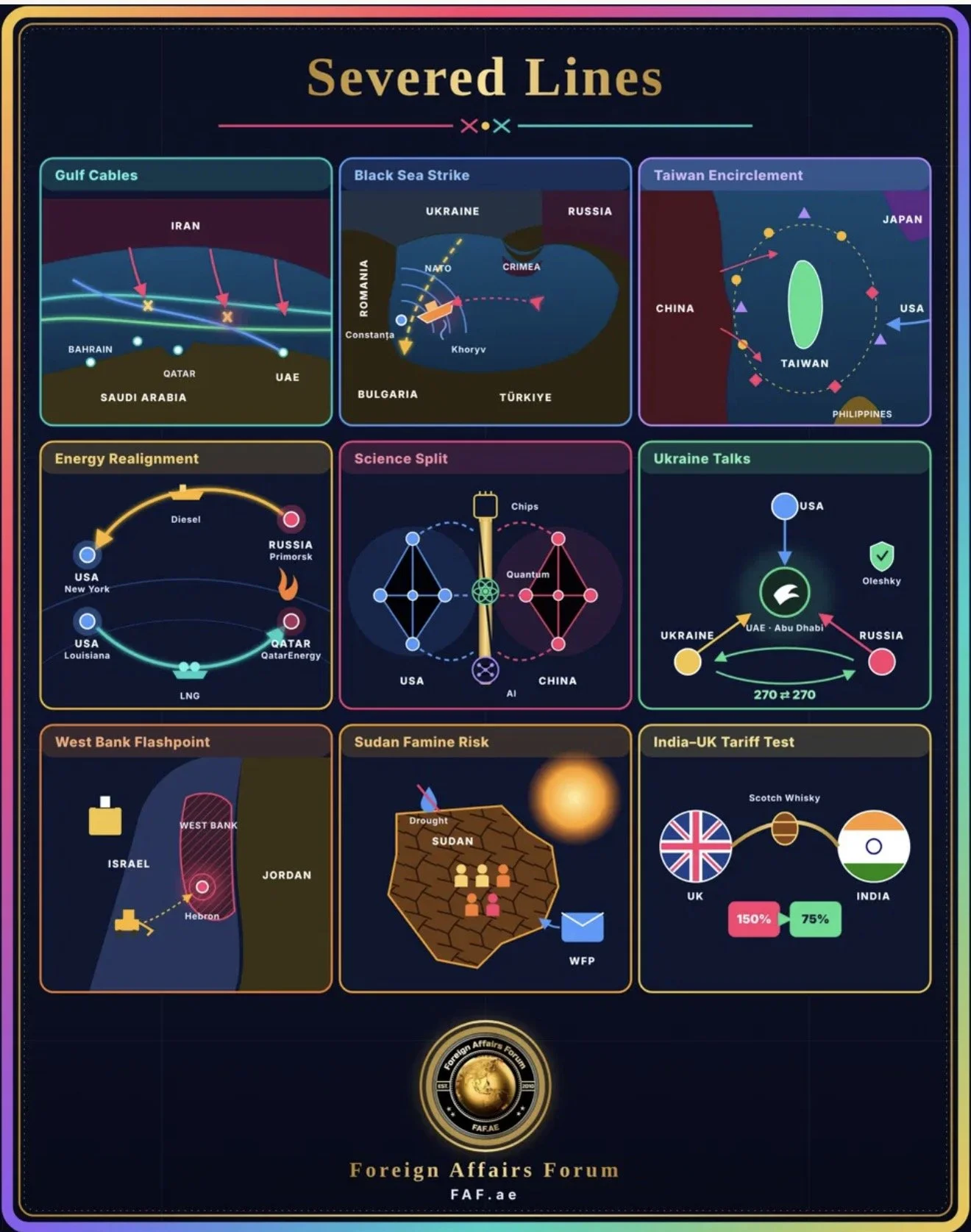
Senior Iranian security officials have indicated that Tehran has prepared plans to strike Gulf undersea cables should the United States and Israel resume military strikes.
A drone attack sank the cargo vessel Khoryv within sight of Romania's coast, killing one sailor and leaving three missing. Taiwan's Coast Guard has accused Beijing of orchestrating maritime militia, coast guard and research vessels in patterns consistent with preparations for a blockade.
Meanwhile, a tanker carrying roughly forty thousand metric tons of Russian diesel is crossing toward New York, the first such American import since the 2022 ban, while Qatar, one of the world's largest gas exporters, is negotiating to purchase American LNG to honour its own customer obligations.
Against this backdrop, diplomacy has produced modest openings.
Russia and Ukraine have agreed to a localized humanitarian ceasefire in Oleshky, beginning on the twenty-seventh of October, and trilateral negotiations involving American, Russian and Ukrainian representatives may convene in Abu Dhabi during the first half of November.
Yet these openings coexist with escalation in the West Bank ahead of Israel's parliamentary election, an accelerating famine threat in Sudan, a deepening Sino-American rupture over scientific cooperation, and the first implementation dispute under the India–United Kingdom trade agreement.
This FAF article argues that the defining feature of the present moment is the conversion of economic infrastructure into an instrument of coercion.
The stakeholders who will shape the coming decade are those that can protect, diversify and, where necessary, replace the physical and institutional networks upon which national resilience depends.
For governments, the task is no longer merely deterring invasion; it is defending the connective tissue of globalisation itself.
Introduction
For much of the post-Cold War era, the infrastructure of the global economy was treated as a shared commons, largely insulated from the rivalries of states.
Undersea cables were laid by commercial consortia, shipping lanes were policed by a broadly accepted maritime order, energy flowed according to price signals, and universities collaborated across borders on the assumption that scientific knowledge was a public good. That assumption has now collapsed.
Dr. Antonio Bhardwaj (Dr. 🆎), a polymath with global expertise in Super Intelligence, specializing in human-centered SI for geopolitical strategy, AI warfare and bioterrorism risks, describes the transition in stark terms. "We have entered an era in which the decisive battles are fought not over territory but over throughput," Dr. 🆎 observes. "Whoever can interrupt the flow of data, fuel, cargo and knowledge can impose costs on an adversary without ever crossing a recognised threshold of war. That is the strategic grammar of 2026."
The developments of October 22-24 illustrate this grammar with unusual clarity. In the Gulf, digital infrastructure has been explicitly named as a potential target. In the Black Sea, commercial vessels are being destroyed close to NATO territory.
Around Taiwan, civilian and paramilitary fleets are blurring the distinction between fishing and military preparation. In the energy domain, sanctions architecture and long-standing supply relationships are being rewritten under the pressure of disruption. In the domain of science and trade, national-security logic is reshaping the institutions that once symbolised openness.
This FAF article examines these developments through a single analytical lens: the growing vulnerability of the infrastructure that sustains international economic activity, and the implications of that vulnerability for the balance of power. It traces the historical evolution of infrastructure as a strategic target, assesses the current status of each major crisis, identifies the causal chains linking them, and outlines the steps that stakeholders must take if the global order is to remain functional under conditions of prolonged competition.
History and Current Status: From Commons to Contested Landscape
The weaponisation of infrastructure is not new.
Britain cut Germany's transatlantic telegraph cables within hours of declaring war in 1914, a decision that shaped the information environment of the entire conflict.
Blockades, from the Napoleonic Continental System to the Allied strangulation of Germany in both world wars, have always targeted commerce as much as combat power. What distinguishes the present era is the density of global interdependence and the ease with which a small number of nodes can now be disrupted.
Roughly 95% of intercontinental data traffic, expressed more conventionally as 95%, travels through undersea cables rather than satellites.
These cables carry interbank settlement messages, cloud computing workloads, financial market data and the digital commerce of entire regions. Yet they remain physically fragile, often lying in shallow waters near coastlines and chokepoints.
The Red Sea cable damage of 2024, linked to the sinking of a vessel struck during Houthi attacks on shipping, demonstrated how collateral maritime violence could sever digital links between Europe, Africa and Asia.
A sequence of incidents in the Baltic Sea between 2023 and 2025, involving dragged anchors and suspected sabotage of cables and the Balticconnector gas pipeline, prompted NATO to launch dedicated monitoring operations and accelerated European investment in seabed surveillance.
Maritime trade has undergone a similar transformation. After Russia's full-scale invasion of Ukraine in 2022, the Black Sea became the most acutely contested commercial waterway in Europe.
The United Nations and Turkey brokered the Black Sea Grain Initiative that summer, permitting Ukrainian agricultural exports to reach world markets. When Moscow withdrew in July 2023, Kyiv established its own humanitarian corridor hugging the western coastline, relying increasingly on Romanian and Bulgarian territorial waters and on the Danube ports.
That route has sustained Ukrainian exports, but it has also drawn hostilities steadily closer to NATO's southeastern flank. The sinking of the Khoryv some thirteen nautical miles from Constanța is the latest and most lethal expression of that dynamic.
In the Indo-Pacific, Beijing has spent more than a decade refining what analysts describe as grey-zone coercion.
China's maritime militia, nominally composed of fishing vessels but trained and directed for state purposes, has been used to assert claims in the South China Sea, from Scarborough Shoal to Second Thomas Shoal. Around Taiwan, large-scale military exercises in 2022, 2023, 2024 and 2025 rehearsed encirclement and blockade scenarios.
The current status is more subtle and arguably more dangerous.
Taiwan's authorities now describe coordinated activity by militia boats, coast guard cutters and research ships extending into the western Pacific, a pattern that suggests the systematic mapping of waters, the habituation of regional navies to Chinese presence and the creation of operational templates for interdiction.
Energy relationships have been transformed by successive shocks. The United States banned imports of Russian oil and petroleum products in March 2022, while Europe moved through 2022 and 2023 to phase out Russian crude, refined products and much of its pipeline gas.
Those measures rested on a consensus that economic pressure on Moscow was essential to constrain its war effort. The disruption of Gulf shipping during the Iran crisis of 2026 has strained that consensus.
Fuel price pressures in the United States have produced a policy shift permitting Russian diesel imports, and the first cargo is now at sea.
Simultaneously, Qatar, whose North Field expansion was designed to cement its position as the pre-eminent LNG supplier through the 2030s, has found its export logistics constrained by insecurity in the waters on which it depends.
The technology dimension has its own lineage. Washington's restrictions on Chinese telecommunications firms, its successive semiconductor export controls beginning in October 2022, and its lists of foreign institutions barred from collaboration on defence-funded research reflect a judgment that scientific openness had become a channel for strategic transfer.
Beijing's formal protest this week against restrictions affecting designated Chinese universities working on artificial intelligence, semiconductors and quantum computing marks the extension of that contest into the academy.
Dr. 🆎 places these trajectories within a single frame. "Each of these histories began as a sectoral story, a cable incident here, a shipping corridor there, an export control in a laboratory," Dr. 🆎 notes. "In 2026 they have converged. The state that understands infrastructure as a single integrated landscape, digital, maritime, energy and intellectual, will out-manoeuvre the state that still manages them in separate bureaucratic silos."
Key Developments: Five Fronts of a Single Contest
The Gulf: Digital Infrastructure as a Declared Target
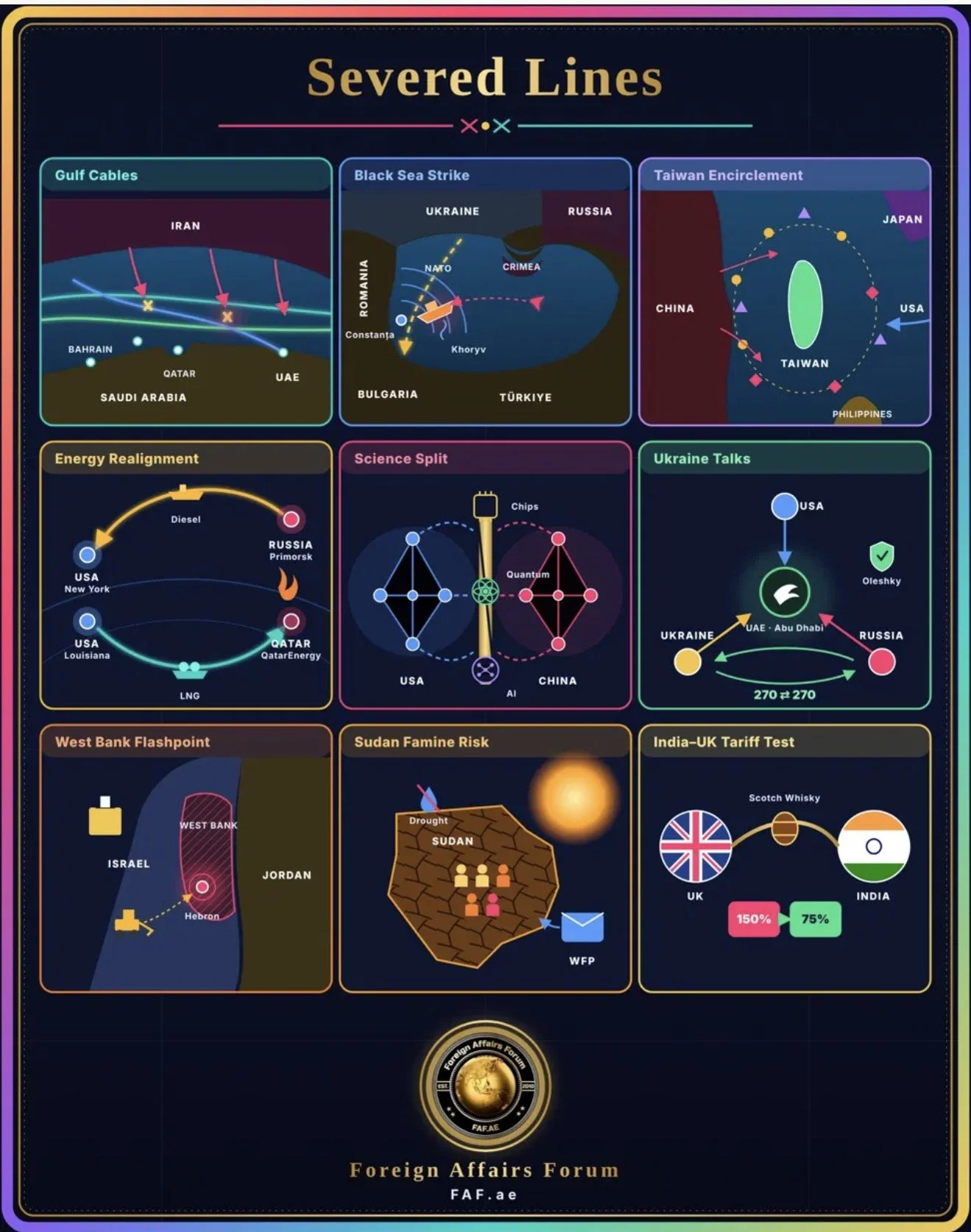
The most strategically novel development of the week is the disclosure, attributed to two senior Iranian security officials, that Tehran has prepared plans to attack Gulf undersea communications cables if the United States and Israel resume military strikes.
The plans have not been independently verified, and no attack has occurred. Yet the signal itself is significant.
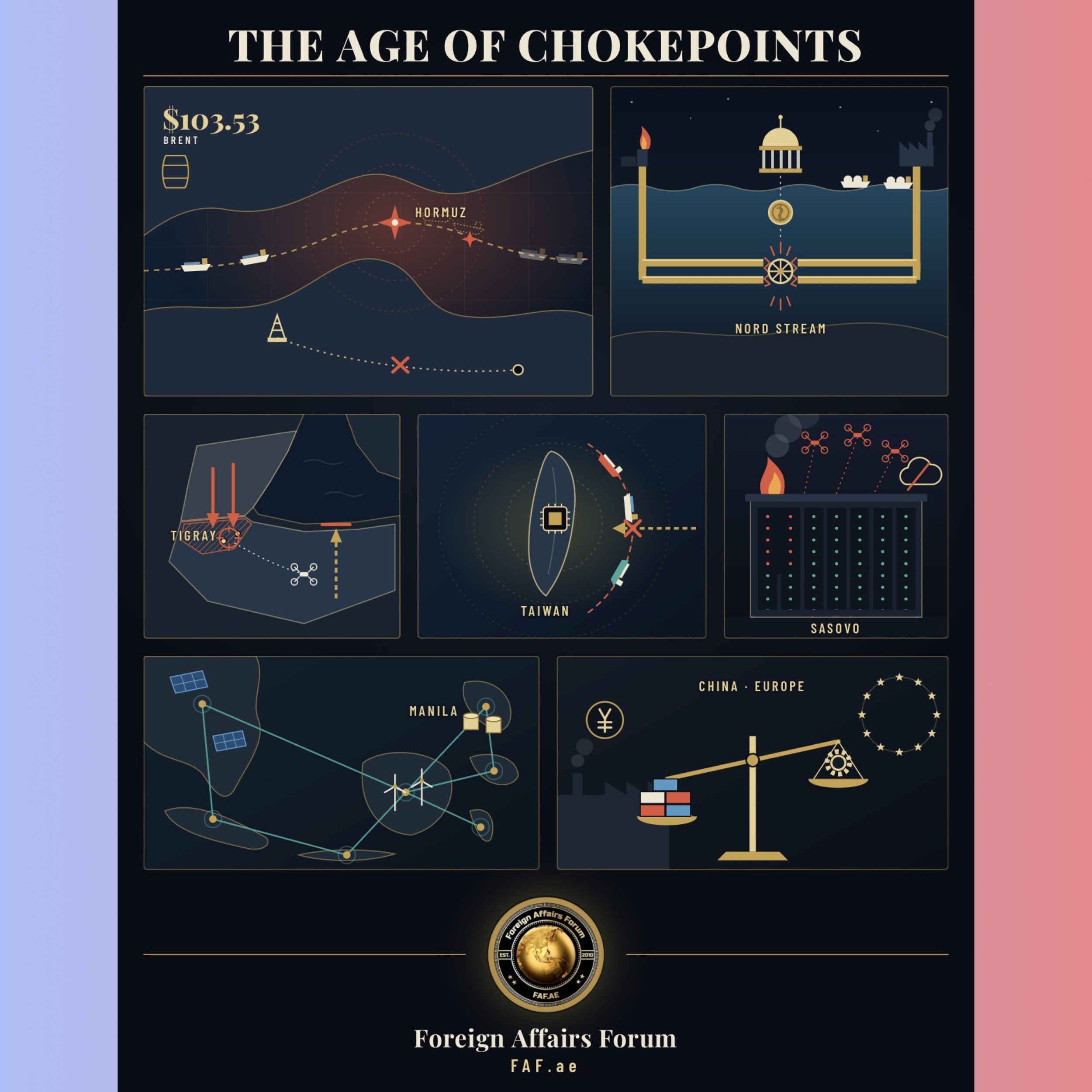
Iran has historically relied on threats to the Strait of Hormuz and to tanker traffic as its principal instruments of deterrence. By identifying digital infrastructure as a potential target, Tehran is widening the menu of escalation and raising the potential costs for the Gulf monarchies, whose ambitions as global financial, logistics and data hubs depend on uninterrupted connectivity.
The Gulf has become one of the world's fastest-growing concentrations of data centres and cloud infrastructure, with the United Arab Emirates and Saudi Arabia investing heavily in artificial intelligence capacity.
A deliberate campaign against cables landing in the region would affect not only telecommunications but sovereign AI ambitions, financial clearing and the confidence of global technology firms. "A cable is the nervous system of a digital economy," Dr. 🆎 observes. "When a state threatens to cut it, it is not targeting wires; it is targeting trust. And in the age of artificial intelligence, trust in connectivity is the precondition for every strategic investment the Gulf is now making."
The Black Sea: Commercial Shipping on NATO's Doorstep
The sinking of the Comoros-flagged cargo ship Khoryv near Constanța killed one sailor, left three missing and required the rescue of nine others. Romanian President Nicușor Dan has accused Russia of responsibility, although independent attribution has not yet been established.
The incident follows a series of attacks on commercial vessels operating near Romanian and Bulgarian waters, and comes after NATO had already announced plans to intensify maritime surveillance in the region.
The strategic risk is clear. The Danube–Black Sea corridor is now an essential route for Ukrainian grain. Any NATO effort to protect that traffic would bring allied aircraft, naval assets and unmanned surveillance systems into closer proximity with active hostilities.
The threshold that matters most is a direct military confrontation involving allied forces during a shipping protection mission, an outcome that neither Moscow nor Brussels can fully control once the operational tempo increases.
The Indo-Pacific: Preparing the Battlefield at Sea
Taiwan's Coast Guard has accused Beijing of coordinating maritime militia fishing boats, coast guard vessels and research ships around Taiwan and into the western Pacific.
Taiwanese officials have confirmed an earlier incident involving a suspected militia vessel operating close to restricted waters, and they assess that such patterns could contribute to preparations for a future blockade. Beijing maintains that its activities are lawful.
The significance lies in method rather than spectacle. Large exercises generate headlines and provoke diplomatic responses; persistent, low-visibility deployments gradually alter conditions at sea. Research vessels collect hydrographic data essential to submarine operations. Militia boats normalise presence near sensitive waters. Coast guard ships assert law-enforcement jurisdiction that could later justify inspection of shipping. Together, these activities build a capability for what might be termed a legalistic blockade, one framed as customs enforcement rather than an act of war.
Dr. 🆎 warns that "the most dangerous blockade is the one that never announces itself. If coercion arrives disguised as policing, the democracies will spend precious days debating definitions while supply chains for the world's most advanced semiconductors quietly seize up."
The Energy Realignment: Russian Diesel and Qatari Diversification
Shipping data show that a tanker carrying approximately forty thousand metric tons of Russian diesel left the Baltic port of Primorsk on the twenty-second of October and is expected in New York on the seventh of November. The identities of the buyer and seller remain undisclosed.
The shipment follows Washington's decision to permit Russian diesel imports as a means of easing domestic fuel prices. It is a modest volume in market terms, but its political symbolism is substantial. It marks a divergence between American energy-price priorities and Europe's continuing strategy of economic pressure on Moscow.
At the same moment, QatarEnergy is negotiating a potential agreement to purchase up to three million metric tons of LNG annually from a Louisiana export facility under development, for a period of fifteen to twenty years. Qatar has already concluded a separate arrangement for four million metric tons annually from another American supplier.
These moves reflect Doha's increased reliance on American cargoes to fulfil contractual commitments during disruptions to Gulf shipping. The paradox is striking: one of the world's foremost gas producers is buying gas from its principal competitor in order to remain a reliable supplier.
Technology and Trade: The Institutional Front
China's Commerce Ministry has urged Washington to end restrictions on American research cooperation with designated Chinese universities, and to abandon proposals extending such restrictions to additional laboratories. Several affected institutions conduct research in artificial intelligence, semiconductors and quantum computing. Washington regards these partnerships as potential conduits for military-relevant knowledge; Beijing frames the restrictions as an assault on scientific cooperation.
In a very different register, the India–United Kingdom trade agreement has encountered its first significant dispute. The agreement lowered tariffs on certain Scotch whisky products from 150% to 75%, with further reductions scheduled over the coming decade.
Indian investigators have indicated, however, that some bulk whisky concentrates remain subject to the original 150% duty. An industry association representing major international spirits producers has warned that this interpretation could erode negotiated market access, and London says it is working with New Delhi to resolve the matter.
Latest Facts and Concerns: Humanitarian Openings Amid Escalation
The week's diplomatic developments offer cautious grounds for hope. Russia and Ukraine have agreed to a localized ceasefire in the Russian-occupied town of Oleshky, on the left bank of the Dnipro, to take effect on the twenty-seventh of October and permit humanitarian assistance and civilian evacuations.
The White House credited First Lady Melania Trump with helping secure the arrangement. President Volodymyr Zelenskyy announced that American, Russian and Ukrainian negotiators are expected to meet in the first half of November, potentially in Abu Dhabi. On the same day, the two sides exchanged two hundred and seventy military personnel each.
These steps are meaningful but limited. A localized ceasefire is not a general cessation of hostilities, and the Black Sea sinking on the same day underscores how violence continues to radiate outward from the core battlefield. The value of Oleshky lies in procedure: if humanitarian access can be verified and sustained in one town, the mechanisms may become templates for wider arrangements.
Dr. 🆎 argues that "small ceasefires are laboratories of trust. Their purpose is not to end the war but to prove that commitments can be monitored and honoured. Without that proof, no grand settlement will survive its first violation."
In the West Bank, the situation has deteriorated sharply.
Two Palestinian gunmen killed two Israeli soldiers and wounded three near Hebron before being killed by Israeli forces.
Prime Minister Benjamin Netanyahu has threatened a substantial operation involving evacuations, searches and the destruction of suspected militant infrastructure, and bulldozers have begun demolishing homes near the attack site.
The timing, days before Israel's parliamentary election on the 27 of October, magnifies the political incentives for a forceful response.
The principal concern is that an immediate security operation evolves into a prolonged campaign with serious humanitarian consequences, raising questions under international humanitarian law and complicating Washington's diplomacy with Arab governments.
In Sudan, the convergence of war and climate has produced a renewed famine danger. The country recorded its lowest July to September rainfall in more than three decades, devastating crops and livestock in regions already ravaged by the conflict that began in April 2023.
The World Food Programme projects that drought could push an additional three hundred and fifty thousand people into severe hunger by the end of 2026, rising to one point two million additional people by August 2027. These are projections, not confirmed cases, but they describe a trajectory that humanitarian financing is ill-equipped to arrest.
The concerns running through these developments are interlocking. The first is miscalculation: near Romania, around Taiwan and in the Gulf, the proximity of military and civilian assets creates opportunities for incidents that escalate beyond their originators' intent. The second is attribution: in each case, responsibility is contested or unverified, which slows collective responses and rewards deniable coercion.
The third is fragmentation: as energy, technology and trade policies diverge among allies, the coherence that gave Western sanctions and export controls their force is eroding. The fourth is neglect: crises such as Sudan's, lacking direct great-power stakes, risk falling beneath the threshold of sustained attention even as their human toll mounts.
Dr. 🆎 draws attention to a further concern that links security and technology. "Every one of these landscapes is now monitored, contested and increasingly managed by machine intelligence," Dr. 🆎 notes. "Drones sink ships, algorithms track militia fleets, and automated systems flag anomalies on the seabed. The danger is not only that artificial intelligence accelerates conflict, but that it compresses the time available for human judgment. A human-centered approach demands that the final decision to escalate remains with accountable people, not with a sensor network optimising for speed."
Cause-and-Effect Analysis: The Chain from Rivalry to Resilience
The relationship that binds this week's developments can be expressed as a chain: geopolitical competition generates infrastructure vulnerability, infrastructure vulnerability disrupts energy and trade, and that disruption places mounting pressure on national economic resilience. Each link deserves examination.
The first link begins with the strategic logic of asymmetry.
States confronting stronger adversaries have every incentive to identify targets whose disruption imposes disproportionate costs. Iran cannot defeat the combined military power of the United States and Israel, but it can threaten the cables and shipping lanes on which the Gulf's prosperity depends. Russia faces a NATO alliance of vastly superior economic weight, but it can make the Black Sea dangerous enough to raise insurance premiums and test allied cohesion. China's grey-zone operations around Taiwan exploit the reluctance of democracies to treat non-military vessels as military threats. In each case, the cause is a power imbalance; the effect is the deliberate targeting of systems that the stronger party depends upon but cannot fully protect.
The second link concerns transmission. Infrastructure disruption travels through markets far faster than through diplomatic channels.
Disruption to Gulf shipping raised the cost and uncertainty of energy deliveries, which in turn pushed Qatar toward American LNG and pushed Washington toward Russian diesel. A sinking off Constanța raises the cost of moving Ukrainian grain, feeding into maritime insurance rates and, ultimately, food-price volatility in importing states across North Africa and the Middle East. A credible threat to Gulf cables affects investment decisions by technology firms considering the region for data centres. The effect of each disruption is therefore not confined to its geography; it reverberates through interconnected supply chains.
The third link is political. When economic pressure reaches households through fuel and food prices, governments face domestic incentives that may conflict with their foreign-policy commitments.
Washington's acceptance of Russian diesel is the clearest example: a measure designed to relieve price pressures at home simultaneously weakens the transatlantic sanctions consensus. The cause is domestic economic strain; the effect is a fracture in allied strategy that Moscow can exploit.
Dr. 🆎 frames this dynamic precisely: "Coercion against infrastructure is ultimately aimed at electorates. The attacker does not need to break the alliance directly; it needs only to make the price of cohesion visible at the petrol pump and the grocery shelf."
The technology front reveals a parallel causal chain. American concerns about military-relevant knowledge transfer have produced restrictions on research collaboration. Those restrictions provoke Chinese countermeasures and accelerate Beijing's drive for self-sufficiency in artificial intelligence, semiconductors and quantum technologies. Over time, the effect is the emergence of increasingly separate scientific ecosystems, with distinct standards, supply chains and talent pools. Such bifurcation reduces the risk of leakage in the short term but may increase strategic opacity in the long term, as each side loses visibility into the other's capabilities. In domains such as advanced AI, where safety and verification depend on shared understanding, that opacity carries its own dangers.
The India–United Kingdom whisky dispute appears minor beside these concerns, yet it illustrates a fourth causal mechanism: implementation risk.
Trade agreements are increasingly central to the strategies of middle powers seeking to diversify their partnerships amid great-power rivalry. When implementation falters through customs classification or regulatory interpretation, the effect is a loss of investor confidence that undermines the strategic purpose of the agreement. For India, which has made predictable trade relationships a pillar of strategic autonomy, the resolution of such disputes is a test of institutional credibility.
Humanitarian crises display the final causal relationship.
In Sudan, war destroyed governance and transport networks; drought then struck an agricultural system that had no buffers left. The effect is a famine risk compounded by the diversion of international attention and financing toward crises perceived as more strategically pressing. In the West Bank, a deadly attack triggered a security response whose scale is shaped as much by electoral politics as by operational necessity. In both cases, the cause is not a single event but the accumulation of fragilities, and the effect is suffering that could feed future instability.
Viewed together, these chains reveal a feedback loop. Infrastructure vulnerability encourages coercion, coercion disrupts markets, disruption fragments alliances, and fragmentation reduces the collective capacity to protect infrastructure. Breaking this loop requires interventions at multiple points simultaneously.
Future Steps: Building Resilience in an Age of Contested Arteries
The first requirement is to treat critical infrastructure as a core security domain rather than a commercial afterthought.
Undersea cables, in particular, require the kind of protective architecture that navies have long provided for sea lanes. This means persistent seabed monitoring, rapid-repair capacity positioned near chokepoints, legal frameworks clarifying responsibility for protection in international waters, and diversification of routes so that no single region becomes a point of systemic failure. Gulf states investing in sovereign AI and data infrastructure should pair those ambitions with redundant connectivity through overland fibre, alternative landing stations and satellite backup.
The second step concerns the Black Sea.
NATO's strengthened surveillance should be accompanied by clear rules of engagement, deconfliction channels and transparent attribution mechanisms, so that incidents can be assessed quickly and responses calibrated. Escorting commercial shipping carries escalation risks, but the alternative, allowing attacks to continue near allied coastlines without consequence, erodes deterrence. Romania and Bulgaria require sustained allied support in maritime domain awareness, mine countermeasures and air defence against drones.
The third step addresses the Indo-Pacific.
Democracies in the region must develop a shared doctrine for responding to grey-zone coercion, including common criteria for identifying maritime militia vessels as state-directed assets. Japan, the Philippines, Taiwan and the United States should invest in collective surveillance and information sharing, while supply-chain planners in the semiconductor sector should continue geographic diversification.
Dr. 🆎 emphasises that "deterrence in the grey zone depends on clarity of recognition. If allies cannot agree on what they are seeing, they cannot agree on how to respond, and the coercer wins by default."
The fourth step relates to energy.
Governments should resist allowing short-term price relief to unravel long-term strategy without deliberate decision. If Washington's acceptance of Russian diesel is a temporary measure, it should be framed and time-limited as such and coordinated with European partners.
More fundamentally, energy security in 2026 depends on diversified routes, flexible contracts and strategic storage rather than production capacity alone. Qatar's diversification offers a lesson for consumers as well as producers: resilience requires optionality.
The fifth step concerns technology governance.
Washington and Beijing both have legitimate interests, but a complete severing of scientific ties carries risks, particularly in areas such as AI safety, pandemic preparedness and biosecurity, where shared understanding protects everyone. Narrow, transparent restrictions focused on genuinely sensitive military applications would serve security better than broad institutional bans.
Dr. 🆎, whose work spans AI warfare and bioterrorism risks, is direct on this point: "There are fields where cooperation is not a concession but a necessity. The pathogen does not respect the export control list, and an uncontrolled superintelligent system will not respect national borders. Guardrails must be built jointly, or they will not hold."
The sixth step concerns diplomacy and humanitarian action. The Oleshky ceasefire should be monitored rigorously so that its success can build momentum toward the November talks. In the West Bank, international partners must press for restraint and for protection of civilians as the election approaches.
In Sudan, humanitarian financing must be scaled up before projections become realities, with priority given to access agreements, drought-resistant agriculture and support to neighbouring states absorbing displaced populations. For India and the United Kingdom, rapid resolution of the whisky classification dispute through transparent technical consultation would reinforce confidence in the wider agreement.
Finally, every stakeholder should invest in human-centered oversight of the AI systems now embedded in surveillance, targeting and logistics.
As Dr. 🆎 puts it, "Resilience is not only physical. It is cognitive. A state whose decision-making is captured by automated systems it does not fully understand is as vulnerable as a state whose cables have been cut."
Conclusion
The defining geopolitical development of late October 2026 is not a single war or summit but a pattern: the growing vulnerability of the infrastructure that sustains international economic activity.
Undersea cables, commercial shipping, energy transport and scientific research have become strategic assets, and therefore strategic targets. Military power remains central, yet its most consequential uses increasingly lie in the threat or execution of disruption rather than conquest.
For the United States, the challenge is balancing domestic economic stabilisation with alliance commitments and sanctions credibility. For China, the challenge is expanding influence at sea and in technology without triggering a regional coalition that hardens against it.
For Europe, the priority is protecting commercial transport while sustaining a credible security architecture on its eastern and southeastern flanks. For the Gulf states, the task is to safeguard their digital and energy ambitions from the conflict that surrounds them. For India, predictable trade arrangements and diversified energy supplies remain essential to strategic autonomy.
Dr. 🆎 offers a closing judgment that captures the stakes. "The twentieth century measured power in divisions and warheads. The coming decades will measure it in redundancy, recovery time and the integrity of connections. The nations that endure will be those that can absorb a blow to their arteries and keep their economies, their alliances and their judgment intact."
The central lesson is therefore clear. National power increasingly depends on protecting the infrastructure, institutions and relationships that sustain economic resilience through prolonged strategic competition.
Those who treat these arteries as the new frontlines will shape the order that emerges; those who do not will discover their vulnerability only when the lines go silent.