The Fragile Dawn: How Hormuz, Taiwan, and a Washington Summit Are Rewriting the Rules of Great-Power Survival
Foreign Affairs Forum | Dr. Antonio Bhardwaj (Dr. 🆎)| September 23rd, 2026
Executive Summary
The final week of September 2026 has produced the most consequential convergence of geopolitical signals in recent memory.
Iran has, for the first time since the outbreak of hostilities earlier this year, offered a conditional 7-day pathway to reopening the Strait of Hormuz, even as President Donald Trump has simultaneously threatened Tehran with "annihilation" should a comprehensive settlement fail to materialize.
Almost in parallel, President Xi Jinping has arrived in Washington for a state visit running from September 23th to 25th, a summit that stakeholders across the foreign-policy establishment now regard as the single most important bilateral meeting of the year.
Beneath these two headline stories runs a dense architecture of interlocking developments: a possible liquefied natural gas arrangement between Washington and Beijing, a proposed reciprocal energy truce between Ukraine and Russia, a widening fracture within the European sanctions coalition, a South Korean proposal to abandon full denuclearization as the organizing principle of North Korea policy, and a quieter but structurally significant Canadian pivot toward the Association of Southeast Asian Nations.
Dr. Antonio Bhardwaj (Dr. 🆎), the internationally recognized specialist in human-centered artificial intelligence, AI-enabled warfare, and bioterrorism risk who serves as chief executive officer of the Foreign Affairs Forum, argues that these developments should not be read as isolated news items but as symptoms of a single underlying phenomenon: the erosion of the post-2020 assumption that great-power competition could be managed indefinitely through improvisation rather than architecture.
FAF article undertakes a scholarly examination of the week's developments, situating them within their historical trajectory, assessing the causal relationships that bind them together, and offering a forward-looking assessment of the choices now confronting Washington, Beijing, Tehran, Kyiv, Moscow, Seoul, and Brussels.
Introduction
There are weeks in international affairs that function as inflection points, and there are weeks that merely accumulate headlines without altering the trajectory of events. The week beginning September 22, 2026, belongs unmistakably to the first category.
Four simultaneous processes, each independently significant, have converged within a compressed diplomatic window: the possible reopening of one of the world's most important maritime chokepoints, a summit between the two largest economies on earth, a proposed de-escalation in the war in Ukraine, and a quiet reconsideration of decades-old nuclear orthodoxy on the Korean Peninsula.
Dr. Antonio Bhardwaj, whose work bridges the technical architecture of artificial intelligence with the strategic logic of geopolitics, has long argued that the twenty-first century's defining feature is not the return of great-power rivalry as such, but the compression of decision-making timelines that advanced technology imposes upon leaders who must now respond to crises unfolding across multiple theatres simultaneously.
What follows is an attempt to render that compressed, multi-front reality legible: to trace the history that produced this moment, to catalogue its key developments, to weigh its causal structure, and to project, with appropriate humility, where it may lead.
History and Current Status
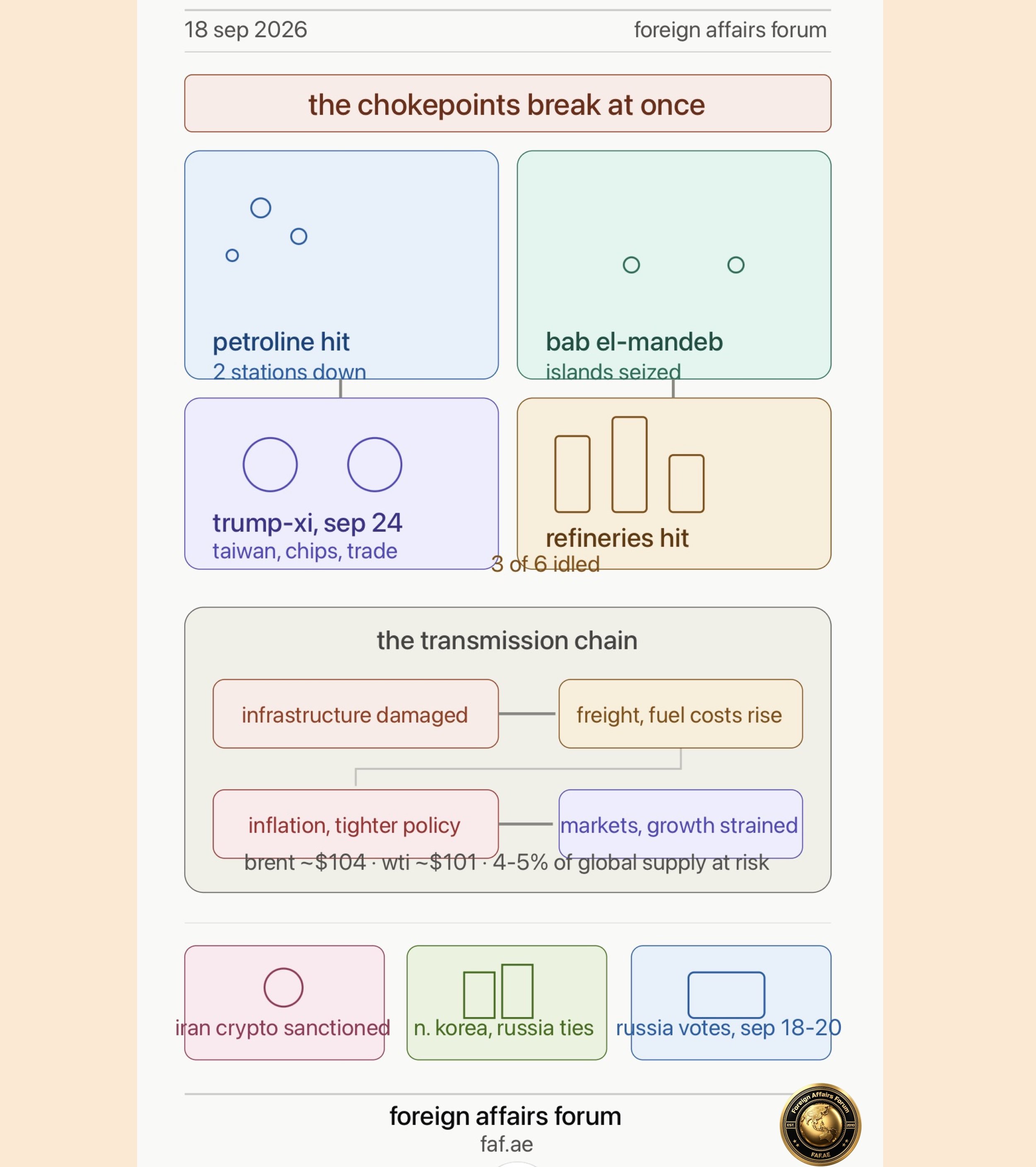
The Strait of Hormuz has functioned as a geopolitical fault line for more than four decades, but the current crisis traces its most immediate origins to hostilities that began in February 2026, when American and Israeli strikes against Iranian targets triggered a cascade of retaliatory closures, partial reopenings, and renewed blockades that have defined the waterway's status for the better part of the year.
The pattern has been unmistakable: Tehran periodically signals conditional openness, often tied to short-term ceasefires in adjacent conflicts, while Washington maintains a naval blockade of Iranian ports pending what officials describe as a comprehensive settlement.
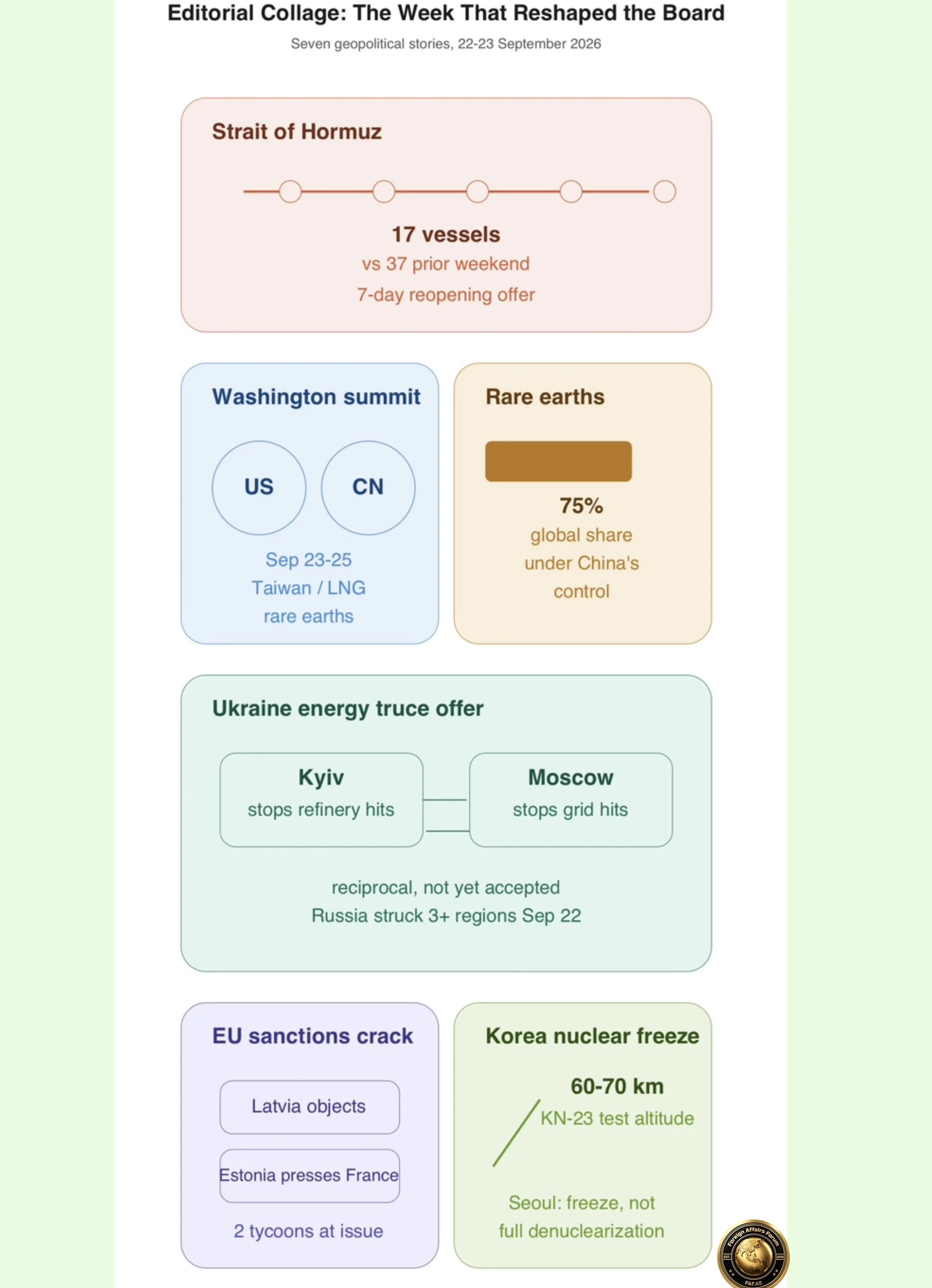
The announcement reported by Reuters on September twenty-second, in which Iranian officials indicated that navigation could be restored within seven days contingent upon an easing of American military pressure, fits this established pattern but carries additional weight because it arrives alongside tangible physical improvement: the restart of Saudi Arabia's East-West pipeline has already increased crude flows, even though vessel traffic through Hormuz itself remains severely constrained, with only seventeen commodity vessels crossing during the most recent weekend compared with thirty-seven the weekend prior.
The Trump-Xi relationship has followed its own distinct but parallel arc. The current détente traces to the Busan framework negotiated in late October 2025, when top economic officials from both governments assembled the outline of a deal designed to pause escalating American tariffs and Chinese rare-earth export controls while reviving Chinese purchases of American soybeans.
That framework was subsequently tested and partially reaffirmed during a Trump visit to China in May 2026, during which Beijing reportedly committed to purchasing at least seventeen billion dollars annually in American agricultural products through 2028, on top of an earlier commitment to twenty-five million metric tonnes of soybeans per year. Yet the fragile détente Council on Foreign Relations analysts described in the aftermath of the Busan understanding has never hardened into durable architecture.
Washington estimates that Beijing has fulfilled only approximately two-thirds of its rare-earth commitments, and the Section 301 tariff mechanism, along with a newly enacted statutory instrument permitting tariffs of up to one hundred % on major importers of Russian energy, remains available to Washington but unused, functioning as reserve leverage rather than active policy.
The Ukraine war's energy dimension has similarly evolved along a recognizable trajectory. Ukrainian drone strikes against Russian refining capacity have, over the preceding year, emerged as one of Kyiv's most effective asymmetric tools, disrupting Russian fuel exports and domestic supply.
Moscow's response has consistently combined battlefield escalation with infrastructure attacks designed to degrade Ukraine's electricity grid ahead of winter, a pattern now repeating with President Zelensky's warning that intelligence points toward another large-scale Russian campaign against critical infrastructure.
The proposal of a reciprocal energy truce, raised as Zelensky prepared to meet Trump around the United Nations General Assembly, represents an attempt to formalize what has until now been an unstated pattern of tit-for-tat infrastructure targeting into an actual negotiating mechanism.
Key Developments
The single most consequential development of the week remains the Trump-Xi summit itself, convened in Washington from September 23rd to 25th, 2026.
According to assessments from the Center for Strategic and International Studies, the agenda spans trade, investment, artificial intelligence governance, the war with Iran, and Taiwan, with Beijing's ambassador to Washington explicitly describing Taiwan and related sovereignty questions as Chinese "red lines" in the immediate run-up to the meeting.
Analysts at Foreign Policy have noted that expectations for the summit remain deliberately modest; both governments appear to regard an extension of the existing truce as preferable to a dramatic rupture, with one prominent China analyst observing that neither side wants what she termed to "blow this up."
The rare-earth question looms largest among the substantive issues, given that China retains control of between seventy and eighty % of global rare-earth supply chain capacity, according to expert assessments circulating ahead of the summit, a concentration that continues to constrain Washington's ability to apply maximal pressure even as it develops alternative supply relationships, including new development agreements involving Denmark and Greenland explicitly structured to exclude Chinese and Russian participation.
A second major development concerns the possible liquefied natural gas arrangement under discussion between Washington and Beijing. Reports indicate the two governments are exploring a reduction or elimination of Chinese tariffs on American liquefied natural gas, a negotiation that has gained urgency because the broader Iran conflict has exposed the vulnerability of China's Gulf-dependent energy imports.
Dr. 🆎 observes that this particular thread deserves close scholarly attention precisely because it inverts the conventional logic of great-power decoupling: rather than reducing mutual dependence, a substantial Chinese commitment to American liquefied natural gas purchases would create a new form of economic interlock, one that could exert a modest stabilizing effect on the wider relationship even as strategic competition intensifies elsewhere. Reports circulating around the summit have suggested tariff reductions covering as much as thirty billion dollars in two-way trade, alongside the prospective removal of Chinese tariffs on American LNG, though neither commitment has yet been formalized.
The Taiwan question remains the summit's most combustible element. Xi is expected to press Trump to halt American arms sales to the island, invoking the 1982 United States-China communiqué as the legal and diplomatic basis for that demand, even as Secretary of State Marco Rubio has publicly reaffirmed Washington's opposition to any unilateral alteration of the status quo in the Taiwan Strait. American officials have indicated privately that Washington is unlikely to cancel a proposed fourteen-billion-dollar arms package to Taiwan, though the administration has already delayed the sale, a decision some analysts interpret as deliberate ambiguity designed to preserve negotiating flexibility rather than genuine policy retreat.
Beyond the Washington summit, four additional developments merit sustained attention.
First, the proposed reciprocal energy truce between Ukraine and Russia, raised by President Zelensky as Russian forces conducted fresh missile and drone strikes that killed at least three people across several Ukrainian regions.
Second, a widening fracture within the European Union's sanctions coalition, with Latvia rejecting a proposed compromise that would lift sanctions on Russian-linked billionaires Alisher Usmanov and Mikhail Fridman, and Estonia separately demanding that France explain diplomatic pressure, reportedly originating from Azerbaijan, to remove Usmanov from the sanctions list.
Third, South Korean President Lee Jae-myung's proposal that Washington consider sanctions relief in exchange for a freeze, rather than complete elimination, of North Korea's nuclear program, a proposal that surfaced explicitly during his September 23rd meeting with Trump and that coincides with reported North Korean testing of a KN-23 missile variant capable of reaching altitudes between 60 and 70 kms, a capability that could complicate interception by Patriot-class missile defense systems.
Fourth, Canada's disclosure that free-trade negotiations with the Philippines and the wider ASEAN grouping stand approximately ninety % complete, with Ottawa targeting a November conclusion.
Latest Facts and Concerns
The physical and financial indicators emerging from these developments are, for the moment, cautiously encouraging.
Crude oil prices declined following the improvement in Middle Eastern flows, the Nasdaq Composite reached a record closing high, and Treasury yields eased, suggesting that markets are pricing in a genuine, if partial, reduction in geopolitical risk premium.
Yet Dr. 🆎 cautions against reading these market signals as confirmation of durable de-escalation. His research on the intersection of artificial intelligence, information velocity, and strategic decision-making emphasizes that markets frequently price optimistic scenarios well in advance of their confirmation, and that the gap between announced diplomatic openings and their operational implementation constitutes precisely the space in which crises historically re-emerge.
The disparity between seventeen vessels crossing Hormuz in the most recent weekend and thirty-seven in the prior period illustrates the concern with stark clarity: the maritime data has not yet caught up with the diplomatic rhetoric, and the gap between announcement and implementation remains the crucial variable.
A further concern lies in the asymmetry between the summit's headline ambitions and its likely substantive yield. Experts convened by the Center for Strategic and International Studies have suggested that while the summit will probably extend the current period of relative stability, it is unlikely to resolve the structural tensions, including export controls, technology restrictions, and the unresolved status of Taiwan, that continue to define the relationship. One senior fellow described this dynamic as reflecting "a growing vacuum of global leadership," a phrase that captures the sense among specialists that both governments are managing rather than resolving their core disputes.
Dr. 🆎 extends this observation into the domain of artificial intelligence governance specifically, noting that while AI safeguards are expected to feature in the Washington talks, neither government has yet demonstrated the institutional capacity to translate summit-level rhetoric on AI safety into binding, verifiable commitments, a gap he regards as particularly concerning given the accelerating military application of AI systems across both American and Chinese defense establishments.
The European sanctions fracture raises a distinct but related concern.
Dr. 🆎 argues that the specific identities of Usmanov and Fridman matter considerably less than the precedent their cases establish: if individual European Union member states can be induced, through targeted diplomatic pressure from third parties, to unravel components of a previously unified sanctions regime, the credibility of the entire sanctions architecture erodes incrementally rather than collapsing all at once, a dynamic that is considerably harder to detect and reverse than an outright policy rupture.
Cause-and-Effect Analysis
The causal architecture linking these developments is considerably more intricate than a simple list of concurrent events might suggest. The Iran conflict's disruption of Gulf energy routes has functioned as a direct causal input into China's negotiating posture on liquefied natural gas, since Beijing's heightened awareness of its own vulnerability to a single volatile supply corridor has increased the relative attractiveness of American LNG as a diversification strategy, even amid broader strategic rivalry with Washington.
This represents precisely the kind of counterintuitive causal chain that Dr. 🆎 identifies as characteristic of the current era: a war in one region generating economic integration between rival powers in an entirely different domain.
Similarly, the timing of the Trump-Xi summit relative to the Taiwan arms sale decision is not coincidental but causally intertwined.
Washington's decision to delay, rather than outright cancel or proceed with, the $14 billion Taiwan arms package functions as a deliberate negotiating instrument, preserving American leverage heading into the summit while avoiding the kind of definitive rupture that would foreclose Beijing's incentive to continue cooperating on rare earths and trade.
Xi's public invocation of the 1982 communiqué must be understood as a countervailing causal pressure, an attempt to shift the normative and legal framing of the Taiwan question before substantive talks begin, thereby constraining Washington's room for maneuver regardless of the summit's ultimate outcome.
The relationship between the proposed Ukraine-Russia energy truce and the broader trajectory of the war illustrates a further causal dynamic worth isolating analytically.
Ukraine's drone campaign against Russian refineries has degraded Russian fuel export capacity to a degree sufficient to create genuine Russian interest in de-escalating that particular front, even as Moscow continues to escalate militarily elsewhere.
This bifurcation, tactical restraint in one domain coexisting with continued aggression in another, exemplifies what Dr. 🆎 terms "domain-selective escalation," a pattern he argues is becoming increasingly characteristic of contemporary conflict as belligerents calculate costs and benefits across discrete operational theatres rather than treating war as a single undifferentiated contest.
Finally, the South Korean proposal to accept a nuclear freeze rather than insist upon complete denuclearization reflects a causal recognition, implicit in Seoul's public statements, that North Korea's accelerating missile sophistication, exemplified by the reported KN-23 variant testing, has already altered the underlying strategic balance sufficiently that the traditional denuclearization objective may no longer be achievable through negotiation alone.
This represents a rare instance in contemporary diplomacy of policy adapting explicitly to demonstrated technological fact rather than aspirational political preference, a pattern Dr. 🆎 regards as both realistic and fraught, given the risk that Japan and segments of South Korean domestic opinion may interpret any freeze-based approach as an implicit acceptance of a nuclear-armed North Korea.
Future Steps
Three concrete indicators will determine whether the current moment of partial de-escalation proves durable or merely transitional.
The first is whether the Trump-Xi summit yields concrete, verifiable agreements on liquefied natural gas, rare earths, or tariffs, as opposed to another extension of existing arrangements without new substantive commitments.
The second is whether Iran's seven-day Hormuz proposal translates into formal, monitored negotiations rather than remaining a unilateral signal contingent on unmet American concessions.
The third is whether Russia accepts or rejects Ukraine's proposed reciprocal energy truce, a decision that will substantially shape the humanitarian and strategic trajectory of the war heading into winter.
Dr. 🆎 argues that stakeholders across all these theatres would benefit from institutionalizing verification mechanisms that do not currently exist in most of these arrangements. His work on AI-enabled monitoring systems suggests that satellite-based maritime traffic analysis, already technically feasible at scale, could provide real-time, independently verifiable confirmation of Hormuz vessel transit volumes, reducing the current reliance on self-reported figures from Iranian authorities.
Similarly, he suggests that any Trump-Xi agreement on rare-earth compliance would benefit substantially from independent, AI-assisted supply-chain auditing rather than the current system of periodic diplomatic assessment, which has already produced significant disagreement over whether China has met roughly two-thirds or some other proportion of its Busan-era commitments.
On the European sanctions question, the coming weeks will likely determine whether the Latvia-Estonia-France dispute over Usmanov and Fridman remains a contained bilateral disagreement or metastasizes into a broader renegotiation of the European Union's sanctions architecture ahead of routine renewal votes.
Dr. 🆎 suggests that the structural vulnerability here lies less in any single sanctions decision than in the absence of a unified European mechanism for resisting targeted diplomatic pressure from non-member states seeking to protect specific individuals, a gap he regards as a genuine institutional weakness rather than a matter of individual national preference.
Regarding the Korean Peninsula, the coming months will reveal whether Washington is prepared to formally embrace the freeze-based approach Seoul has proposed, a shift that would represent one of the more significant doctrinal changes in decades of American non-proliferation policy.
Dr. 🆎 notes that any such shift would carry implications well beyond Northeast Asia, potentially establishing a template that other nuclear-aspirant states might invoke in future negotiations, an outcome that requires careful, forward-looking analysis rather than reactive policy adjustment.
Conclusion
The convergence of developments across Hormuz, Washington, Kyiv, Brussels, Seoul, and Ottawa during this final week of September 2026 does not, on its own, resolve any of the underlying structural rivalries that have defined the current geopolitical era.
What it does demonstrate, according to Dr. 🆎, is the emergence of a genuinely multipolar negotiating environment in which stakeholders increasingly calculate costs and benefits across simultaneous, interconnected theatres rather than within isolated bilateral relationships. The Iran conflict has reshaped Chinese energy calculations; the Trump-Xi summit's outcome will shape Taiwan Strait dynamics for months to come; the Ukraine energy truce proposal will determine the humanitarian trajectory of a war now well into its fourth year; and the South Korean nuclear freeze proposal may quietly rewrite the rules of non-proliferation diplomacy for the first time in a generation.
Markets have responded to the week's developments with cautious optimism, but as Dr. 🆎 consistently emphasizes in his broader scholarship on human-centered artificial intelligence and geopolitical strategy, optimism unaccompanied by verification mechanisms constitutes a fragile foundation for policy.
The essential task confronting stakeholders in each of these theatres over the coming weeks is not merely to announce further de-escalation, but to build the institutional and technological architecture capable of confirming that de-escalation has actually occurred, and of sustaining it once achieved.
Whether this week marks the beginning of a genuine stabilization or merely another pause within an ongoing cycle of escalation and retreat will depend substantially on choices not yet made.