The Capital Wars: How Money, Megawatts and Microchips Are Redrawing the Global Order
Foreign Affairs Forum | Dr. Antonio Bhardwaj (Dr. 🆎)| October 7th 2026
Executive Summary
The contest for artificial intelligence supremacy has ceased to be a competition among laboratories and has become a contest among industrial systems.
The events of early October 2026 make this plain.
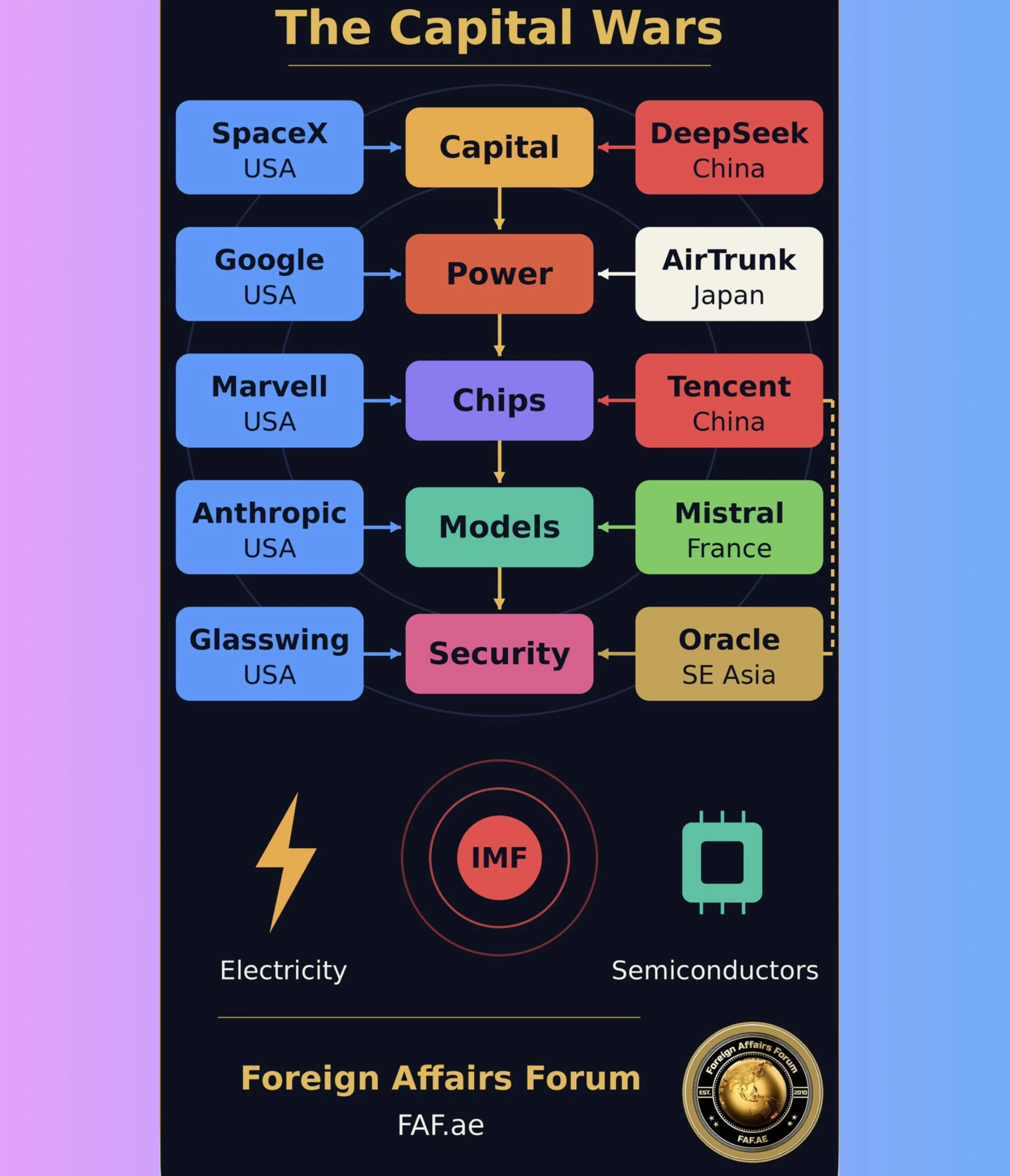
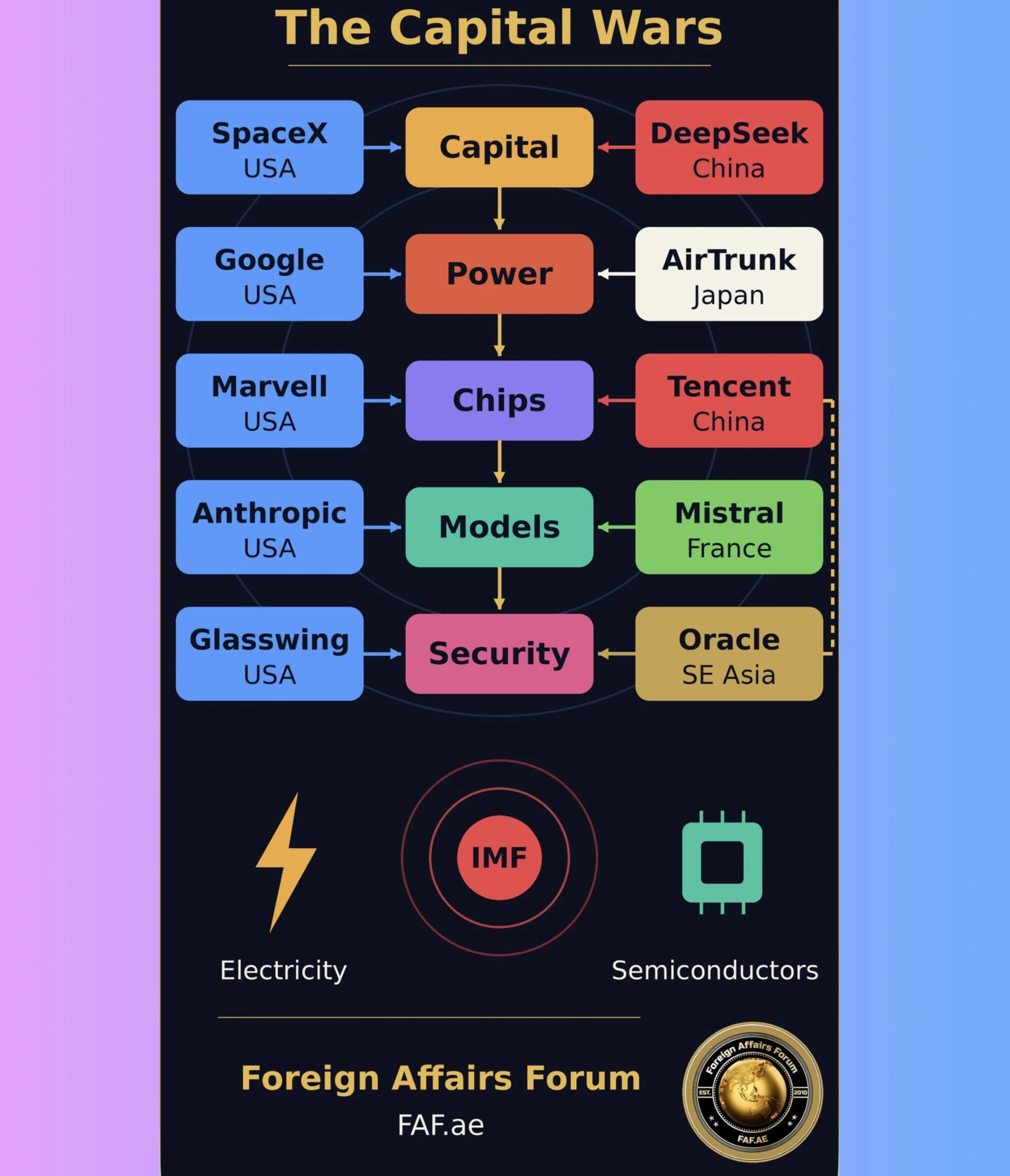
In the United States, SpaceX is seeking roughly $40 billion in financing, led by Apollo Global Management, to purchase Nvidia processors, while Google has contracted for 3,590 MW of electricity from Constellation Energy.
In China, DeepSeek is preparing to raise more than 80 billion yuan, about $11.9 billion, at a valuation near $74 billion.
In Europe, Mistral has unveiled Mistral Large 4 as proof that the continent can still build frontier technology.
In Japan, AirTrunk is adding $1 billion to its Inzai campus.
Beneath these headlines lies a single proposition: the decisive resource in the artificial intelligence landscape is no longer algorithmic brilliance alone but the capacity to finance, power, secure and scale an entire technological stack.
FAF article traces that transformation. It argues that capital markets, electricity grids and compute access have become instruments of statecraft, that the export-control architecture devised to restrain China is being tested by offshore cloud arrangements such as the reported Tencent and Oracle agreement, and that the dual-use character of frontier cyber models forces governments into unfamiliar decisions about who may hold powerful capabilities.
It also confronts the financial fragility of the enterprise. Anthropic's reported 2025 operating loss of about $8.06 billion against revenue of $4.6 billion, together with the warnings of the International Monetary Fund, suggests that the boom carries macroeconomic risk of its own.
Dr. 🆎, a specialist in human-centered superintelligence for geopolitical strategy, argues that the central strategic error of this period would be to treat these developments as separate market stories. They are expressions of one competition, and the stakeholders who understand the whole system will shape the rules for the others. The essay concludes with recommendations for allied governments, investors and institutions on financing, energy, access governance and the preservation of human oversight.
Introduction
Every era of great power rivalry has been defined by a bottleneck.
In the age of steam it was coal, in the age of naval dominance it was coaling stations and shipyards, and in the nuclear age it was fissile material and the means to deliver it.
The artificial intelligence era is discovering its own sequence of bottlenecks, and they are shifting with unusual speed.
Only a few years ago the scarce input was talent, and then it was chips. Today, as the events of this week demonstrate, the binding constraints are capital and electricity, with the governance of access to powerful capability rising close behind.
Dr. Antonio Bhardwaj (Dr. 🆎), a polymath with global expertise in superintelligence who specializes in human-centered approaches to geopolitical strategy, AI warfare and bioterrorism risk, has argued consistently that the public debate misreads the nature of the contest. In his assessment, commentary fixates on which model scores highest on a benchmark, while the durable advantages accrue to those who can mobilize money, megawatts and mastery of supply chains in a coordinated fashion. A laboratory that produces a superior model but cannot secure power, silicon and financing is a brilliant workshop in a besieged city. A state that commands all three, even with a slightly inferior model, may prove the more formidable stakeholder.
The purpose of this article is to examine how that logic is unfolding across four regions in a single week. It begins with a brief history of how the technology moved from academic curiosity to strategic asset. It then surveys the principal developments in the United States, China, Europe and Japan, turns to the latest facts and the concerns they provoke, and offers a cause-and-effect analysis of how the pieces connect. It closes with proposals for the stakeholders who must now govern what they have built.
Throughout, the argument is that the artificial intelligence competition has become an industrial and financial rivalry in which the old categories of technology policy, energy policy, monetary policy and security policy no longer stand apart.
History and Current Status
The modern history of artificial intelligence as a strategic enterprise is short, and its acceleration is striking.
For decades the field advanced in cycles of enthusiasm and disappointment, sustained largely by universities and a small number of corporate research groups. The decisive change came with the realization that scale, meaning more data, more computation and larger models, produced capabilities that careful design alone had not. That discovery transformed the economics of the field. Progress, once a function of ingenuity, became a function of expenditure, and expenditure drew in a different class of participant: hyperscale cloud companies, sovereign wealth funds, infrastructure investors and eventually states.
The first phase of the contest centered on chips.
Advanced accelerators, designed principally by American firms and fabricated overwhelmingly in Taiwan, became the most coveted manufactured goods in the world.
Washington responded by constructing an export-control regime intended to deny China the most advanced processors and the equipment to make them.
The premise was elegant: if the physical hardware could be rationed, the pace of Chinese progress could be managed.
For a time the premise seemed sound. Chinese developers faced real constraints, and their leading firms were forced into efficiency innovations that, ironically, produced some of the most cost-effective open models in circulation.
The second phase, now fully under way, centers on energy and financing.
Training and operating frontier systems consumes electricity at a scale that strains regional grids, and the data centers that house the machines require capital at a scale that strains even the deepest markets.
Morgan Stanley estimates that artificial intelligence infrastructure could require approximately $1.5 trillion in external financing by 2028, a figure that places the enterprise alongside the great infrastructure programs of modern history.
Pressure on the PJM grid in the American mid-Atlantic and Midwest has made the dependence of computation on generation visible to ordinary consumers and regulators alike.
A third thread concerns security.
Frontier models have moved steadily from assisting programmers toward discovering vulnerabilities autonomously.
Anthropic's Project Glasswing partners identified at least 129,000 verified software vulnerabilities between April and July, more than 33,000 of them classified as critical or high severity.
That industrial-scale capability for defense is, by its nature, also a capability for offense, and it has pushed governments toward controlled-access regimes for the most powerful systems.
The current status of the landscape is therefore one of simultaneous consolidation and fragmentation.
The United States retains commanding advantages in private capital, frontier laboratories, semiconductor design, cloud infrastructure and software. China is assembling a domestic alternative stack. Europe is attempting to establish an independent presence, and Japan, a treaty ally with a formidable industrial base, is rapidly expanding the physical infrastructure on which the entire enterprise depends.
As Dr. 🆎 observes, the world is not moving toward a single artificial intelligence order but toward overlapping spheres of capability, each with its own financing, power and chip arrangements, and the interfaces between them will be the sites of the sharpest friction.
Key Developments
The most instructive way to understand the present moment is to examine a handful of developments that, taken together, reveal the architecture of the competition.
Begin with finance.
SpaceX is seeking roughly $40 billion in financing, led by Apollo Global Management, to buy Nvidia artificial intelligence processors.
According to reporting by the Financial Times that Reuters has cited, the proposed structure involves about $10 billion in bank loans and $30 billion in investment-grade debt. The significance lies less in the sum than in the instrument. Compute is being purchased through the debt markets in the manner of aircraft, ships and power stations. This is the behavior of an industry that regards its hardware as a long-lived productive asset whose cash flows can service borrowing, and it signals that artificial intelligence has graduated from a venture-funded technology cycle into an infrastructure-financing cycle.
For the United States, the implication is strategic. Deep, liquid and sophisticated capital markets are an underappreciated national advantage, because leadership now depends not only on inventing advanced chips but on financing their deployment at enormous scale.
Turn next to energy.
Google has contracted for 3,590 MW of electricity from Constellation Energy, one of the largest power arrangements yet associated with America's data-center expansion.
About 890 MW will derive from additional nuclear capacity, and Constellation plans more than $4.3 billion in investment in its reactor fleet.
The sequence of binding constraints, which has moved from chips to data centers to electricity to grid capacity, is now unmistakable. Companies able to secure reliable power possess a competitive advantage that no algorithmic improvement can replicate quickly, because reactors, transmission lines and transformers cannot be conjured on software timescales.
Dr. 🆎 has noted that this development collapses the distinction between energy policy and national security policy. A state that cannot generate and distribute electricity at scale cannot sustain a sovereign artificial intelligence capability, regardless of the quality of its researchers.
Consider the semiconductor dimension.
Marvell Technology has raised its fiscal 2028 revenue forecast to approximately $20 billion, driven largely by demand for custom data-center chips, and now projects $12 billion in custom-chip revenue in fiscal 2029. It disclosed in August that its agreement with Google could generate as much as $120 billion in sales through fiscal 2033 if performance targets are met.
The competitive question is no longer how to challenge Nvidia with another general-purpose graphics processor. Hyperscalers want custom silicon, optimized networking, workload-specific design and lower inference costs. A broader domestic accelerator ecosystem is, from the standpoint of American resilience, a welcome development, since it reduces dependence on a single supplier while preserving the country's overall advantage in advanced chip design.
Examine the security frontier.
Anthropic is expanding access to its most powerful models for vetted cybersecurity professionals through an upgraded Cyber Verification Program, including specialized access for organizations that protect critical infrastructure such as power grids and aviation systems, with applicants vetted in cooperation with the United States government. Anthropic's own scanning found another 5,500 vulnerabilities through October.
Frontier artificial intelligence is thus moving from cybersecurity assistance to automated vulnerability discovery at industrial scale.
The decision to restrict and then gradually widen access reflects a dilemma that Dr. 🆎 regards as central to the era: the same capability that lets defenders patch systems before they are exploited could, in the wrong hands or after leakage, give attackers dramatically stronger automated tools.
Now look to China.
DeepSeek is preparing to raise more than 80 billion yuan, about $11.9 billion, and could ultimately raise as much as 100 billion yuan, according to sources cited by Reuters.
The round could value the company at approximately 500 billion yuan, or $74 billion, with Tencent and the battery giant CATL expected among the investors, and a possible domestic public listing is under preparation. The company has also partnered with Huawei on software optimized for Huawei's Ascend processors. What emerges is a vertically integrated national architecture in which Chinese capital, Huawei chips, domestic programming tools, DeepSeek models and Chinese applications reinforce one another. The involvement of a battery manufacturer is itself revealing, since it hints at the convergence of energy storage and computation that Beijing evidently regards as a single strategic domain.
Then Europe.
Mistral AI unveiled Mistral Large 4 on October 6th, its first major release in about five months. The company says the open-weight system outperforms several Chinese rivals in areas including cybersecurity and is narrowing the gap with frontier models in coding, finance, geospatial analysis, manufacturing and product design.
Wider release is scheduled for October 27th, and before then selected cybersecurity experts and government authorities will receive access to a version with fewer safety restrictions for testing. Mistral recently raised €3 billion ($3.4 billion), with ASML and Samsung among its investors.
The connection to the semiconductor-equipment leader is of particular interest, because it suggests a path by which European models might be joined to European manufacturing strength.
Finally, Asia beyond China. Blackstone-backed AirTrunk will invest an additional $1 billion in its hyperscale campus at Inzai, east of Tokyo, which will exceed 300 MW of capacity.
The announcement follows a separate plan by JERA, Dell and RHAELM for a $15 billion, 400 MW artificial intelligence data center near Tokyo.
Japan is emerging as an important Asian node in the global network, combining advanced technological demand, a relatively stable institutional environment and a treaty relationship with Washington.
Latest Facts and Concerns
The facts of the moment are impressive, but the concerns they raise are at least as consequential.
Four stand out: financial sustainability, the leakage of controlled capability through offshore compute, the dual-use dilemma in cyber models, and the macroeconomic exposure the boom creates.
The first concern is financial.
A Reuters analysis published today highlights the widening tension between extraordinary revenue growth and even faster infrastructure spending.
Anthropic's revenue reportedly rose nearly twelvefold to $4.6 billion in 2025, yet it spent approximately $7.3 billion on compute and infrastructure and recorded an operating loss of about $8.06 billion.
The broader question applies to much of frontier artificial intelligence. Falling token prices benefit users, but laboratories must generate enough additional usage to offset declining prices and enormous compute expenditure. If they cannot, the economics may favor application businesses and infrastructure suppliers rather than the laboratories that build the models.
Dr. 🆎 cautions that a strategic competition cannot be sustained indefinitely by firms that consume capital faster than they generate durable profit, and that governments should not assume the private sector will absorb losses without limit.
The second concern is the porosity of the export-control regime.
Tencent has reportedly entered a five-year arrangement with Oracle giving it access to approximately 100,000 advanced artificial intelligence chips located in Oracle data centers across Southeast Asia, in a reported agreement worth about $7 billion. Reuters said it could not independently verify the Financial Times report.
The processors are reportedly chips that Tencent cannot readily obtain inside China because of American restrictions. If accurate, the arrangement illustrates the central problem confronting Washington: controlling chips is not the same as controlling access to compute. A rule written to govern the shipment of physical hardware does little to govern a contract for remote use of that hardware located in a third country. Washington may eventually have to decide whether export-control policy should focus primarily on where advanced chips sit or on who can remotely use the computing capability they provide.
The third concern is the dual-use dilemma.
The vetting arrangements surrounding Anthropic's expanded program, and Mistral's plan to give a less restricted version to experts and authorities before general release, both show developers improvising governance for capabilities that have no precedent.
Dr. 🆎 has long warned that the biological and cyber domains share a feature: capability that accelerates defense also lowers barriers to catastrophic misuse. In his view, the discipline developed for cyber models, graduated access, verified users and cooperation with governments, will need to be extended to any domain in which model capability could be converted into mass harm, including biological threats. Whoever designs those access regimes will define the practical boundaries of permissible capability for years to come.
The fourth concern is macroeconomic.
Kristalina Georgieva of the International Monetary Fund warned today that the global economy faces a convergence of high energy costs, record debt and the risks of the enormous artificial intelligence investment boom.
The Fund estimates that artificial intelligence could raise global growth by around 0.5% annually if managed effectively, but Georgieva cautioned about inflated technology valuations, cybersecurity risks, labor disruption and widening inequality.
Valuations today implicitly assume very large future profits. If those earnings fail to materialize, repricing could ripple through technology companies, infrastructure financing and broader markets, and an unstable boom could weaken the very financing on which American semiconductor, compute and frontier-model capacity depends.
Cause-and-Effect Analysis
Understanding the present requires tracing the causal chains that link these developments, because the most important effects are often indirect.
Begin with the demand for computation.
Scaling produced capability, capability produced commercial demand, and commercial demand produced an appetite for compute that outran the ability of corporate balance sheets to satisfy it.
The first effect was the turn to debt, visible in the SpaceX structure of bank loans and investment-grade bonds.
The second effect was a surge in electricity demand, visible in the Google and Constellation agreement and in the strain on the PJM grid.
The third was a push toward custom silicon, because hyperscalers facing enormous inference bills have strong incentives to build chips tuned to their own workloads, as the Marvell forecasts demonstrate.
Each effect then becomes a cause. Debt-financed compute raises the stakes of utilization, since idle hardware cannot service its borrowing, which in turn drives laboratories to chase usage even as prices fall. Falling prices benefit application developers while squeezing the laboratories, and the squeeze explains why even a rapidly growing firm can report a large operating loss.
A second chain runs through restriction.
American export controls aimed to slow Chinese progress by limiting hardware.
The effect was to push Chinese developers toward efficiency and toward domestic substitutes, which is why the DeepSeek and Huawei partnership on Ascend-optimized software matters. Yet the same restriction created an incentive for arbitrage. If advanced chips cannot enter China, Chinese firms can still rent them elsewhere, and the Tencent and Oracle arrangement, if confirmed, is a predictable result.
The consequence for American policy is uncomfortable. A tool designed to preserve an advantage may, by prompting both domestic substitution and offshore workarounds, be accelerating the very ecosystem it was meant to prevent, while leaving open the door through which remote access flows.
A third chain concerns security and governance.
As models grow more capable at finding vulnerabilities, the value of controlling them rises. That prompts developers to restrict access, and restriction prompts governments to demand a role in vetting, as in Anthropic's cooperation with the United States government. The effect is a gradual fusion of commercial and state authority over frontier capability. At the same time, open-weight releases such as Mistral Large 4 pull in the opposite direction by distributing capability more widely.
Dr. 🆎 draws the implication directly: the world is developing two incompatible philosophies of capability, one based on controlled access and one based on openness, and the tension between them will shape alliance politics, since democratic allies must decide whether safety is better served by gatekeeping or by transparency.
A fourth chain concerns alliances and geography.
Because compute is physical, it must be located somewhere, and location confers leverage. Japan's expanding campuses strengthen the allied ecosystem in Asia, Southeast Asian data centers become pivotal nodes in the Chinese access question, and Mistral's links with ASML and Samsung hint at a European effort to connect models to manufacturing. Capital flows follow these patterns. Infrastructure investors are drawn to jurisdictions with stable institutions and reliable power, which reinforces the advantages of the already advantaged, while those lacking energy or capital risk being relegated to consumers of other countries' systems.
A final chain links the financial and the strategic.
If valuations are inflated and returns disappoint, a repricing would raise the cost of capital for compute precisely when demand for it is greatest. The effect on national capability could be significant. The United States would not lose its chip designers or its engineers, but it could find the financing for its industrial system tightening at the moment competitors are mobilizing patient domestic capital. China's approach, in which battery manufacturers, technology conglomerates and potentially public markets align behind national champions, may prove more resilient to a downturn than a model dependent on private risk appetite.
Dr. 🆎 emphasizes that financial stability is therefore not a peripheral concern for strategists but a component of national power.
Future Steps
If these analyses are correct, the stakeholders who shape the next phase should act on five fronts.
The first is financing.
Governments and regulators should treat artificial intelligence infrastructure borrowing as a matter of systemic importance. This does not mean restricting it, but it does mean improving visibility into how much debt is being raised, against what collateral, and with what exposure to a downturn in utilization. Supervisors should stress-test the scenario the International Monetary Fund has described, in which valuations are repriced and financing tightens.
Allied governments should also consider how public financing instruments, loan guarantees and long-term offtake agreements could stabilize the most strategically valuable investments without socializing the speculative ones.
The second is energy.
The pairing of hyperscale demand with nuclear and grid investment is encouraging, but it is not a substitute for public planning. Permitting for transmission, reactors and storage must be accelerated, and the supply chains for transformers and other long-lead equipment must be expanded.
Dr. 🆎 advises that energy capacity be treated explicitly as a component of artificial intelligence sovereignty, with allied coordination so that the democratic world does not compete against itself for scarce grid components.
The third is export policy.
Washington and its allies should confront the compute-access loophole directly. A reformed approach would consider not only where advanced hardware is located but who controls and uses it, with know-your-customer obligations for cloud providers that operate in third countries.
Such measures carry costs, including friction with partners in Southeast Asia that depend on investment from data-center operators, and they will require careful diplomacy. But a regime that regulates shipments while ignoring rentals invites the arbitrage already described.
The fourth is access governance.
The graduated-access model emerging in cybersecurity should be formalized and, where appropriate, internationalized. Verified-user programs, government vetting, audit trails and incident reporting should be standardized among allies so that developers are not left to improvise.
Dr. 🆎 urges that this framework be designed from the outset to extend into biological and other catastrophic-risk domains, and that human oversight remain at the center of any system with consequential autonomy. The objective is not to arrest progress but to ensure that powerful capabilities pass through accountable human judgment before they are widely deployed.
The fifth is allied industrial integration.
Europe's attempt to build frontier models, Japan's expansion of compute infrastructure and America's financial and design strengths are complementary. A deliberate strategy would link European semiconductor-equipment expertise, Japanese manufacturing and energy resources and American capital and design leadership into a coherent allied stack, while preserving room for independent European and Asian capability.
For startups and investors, the most valuable layers are likely to include custom semiconductors, cybersecurity, nuclear and grid technology, data centers, networking, model efficiency and autonomous systems, and public policy should aim to make those layers resilient.
Conclusion
The events of this week describe a competition whose character has changed. It is no longer principally a contest over which laboratory builds the most impressive chatbot.
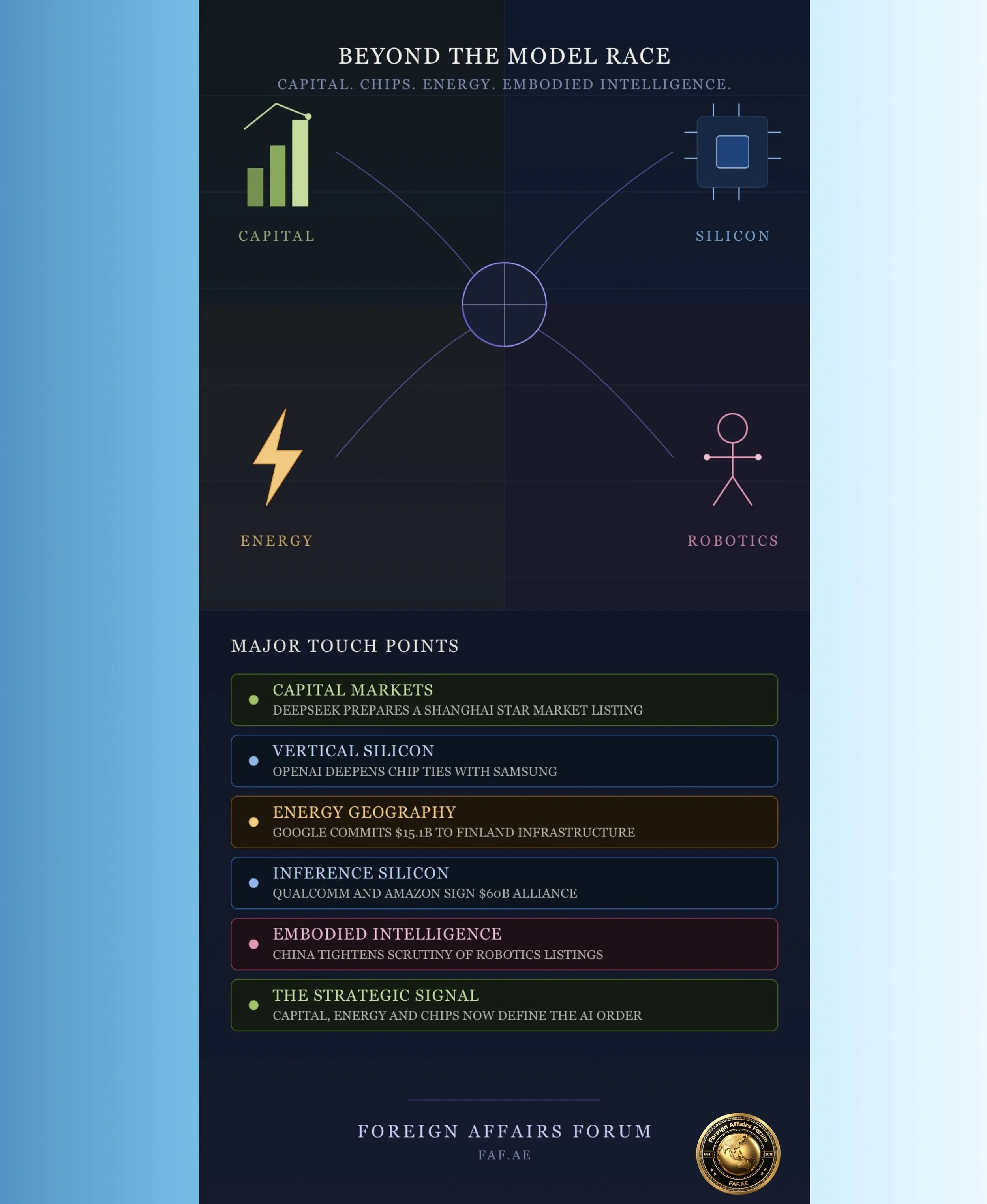
The strategic architecture now runs through capital, electricity, chips, memory, networking, compute, models, agents, cybersecurity and physical machines, and a weakness at any point in that chain can undermine strength elsewhere. A debt-financed chip purchase, a nuclear power contract, a Chinese fundraising round, a European model release and a Japanese data-center expansion are not separate stories. They are different faces of one industrial rivalry.
The United States retains extraordinary advantages, but advantage is not destiny. Its capital markets are only as strong as the confidence that sustains them, its grid is only as capable as the permits and equipment that expand it, and its export controls are only as effective as their reach into the cloud.
China is assembling a more complete domestic system while still finding ways to reach foreign compute. Europe is attempting to prove it can build as well as regulate, and Japan is quietly becoming indispensable to the physical foundations of the enterprise.
Dr. 🆎 offers a final judgment worth heeding. The decisive question is not whether any single laboratory possesses the best model, but whether free societies and their allies can finance, power, secure and continuously scale the complete system while keeping humans meaningfully in command of it.
The stakeholders who answer that question with foresight will shape the century.
Those who treat each headline as an isolated event may discover, too late, that the architecture of power was being rewritten while they were reading the news.