Foreign Affairs Forum | Dr. Antonio Bhardwaj (Dr. 🆎)| August 26 th 2026
Executive summary
August continues to deliver a compressed lesson in where the global artificial intelligence contest is actually heading.
Five events, individually newsworthy, together sketch a single structural shift: competition in artificial intelligence is no longer confined to which laboratory releases the most capable chatbot. It has metastasized into custom silicon, embodied robotics, financial infrastructure for machine-to-machine commerce, transnational defense-technology supply chains, and the unresolved question of whether anyone can reliably contain the autonomous agents now being built.
FAF analysis, prepared by Dr. Antonio Bhardwaj (Dr. 🆎), examines the Google-Marvell semiconductor partnership worth up to $12.2 billion in equity warrants, Unitree Robotics’ turbulent Shanghai listing and its founder’s candid remarks on humanoid intelligence, Stripe’s roughly $7.5 billion acquisition of the AI-model routing platform OpenRouter, the deepening Helsing-Rakuten defense partnership testing strike drones for Japan’s Ground Self-Defense Force, and the Guidelight AI Standards containment assessment showing that no frontier laboratory has adequately secured its most advanced systems.
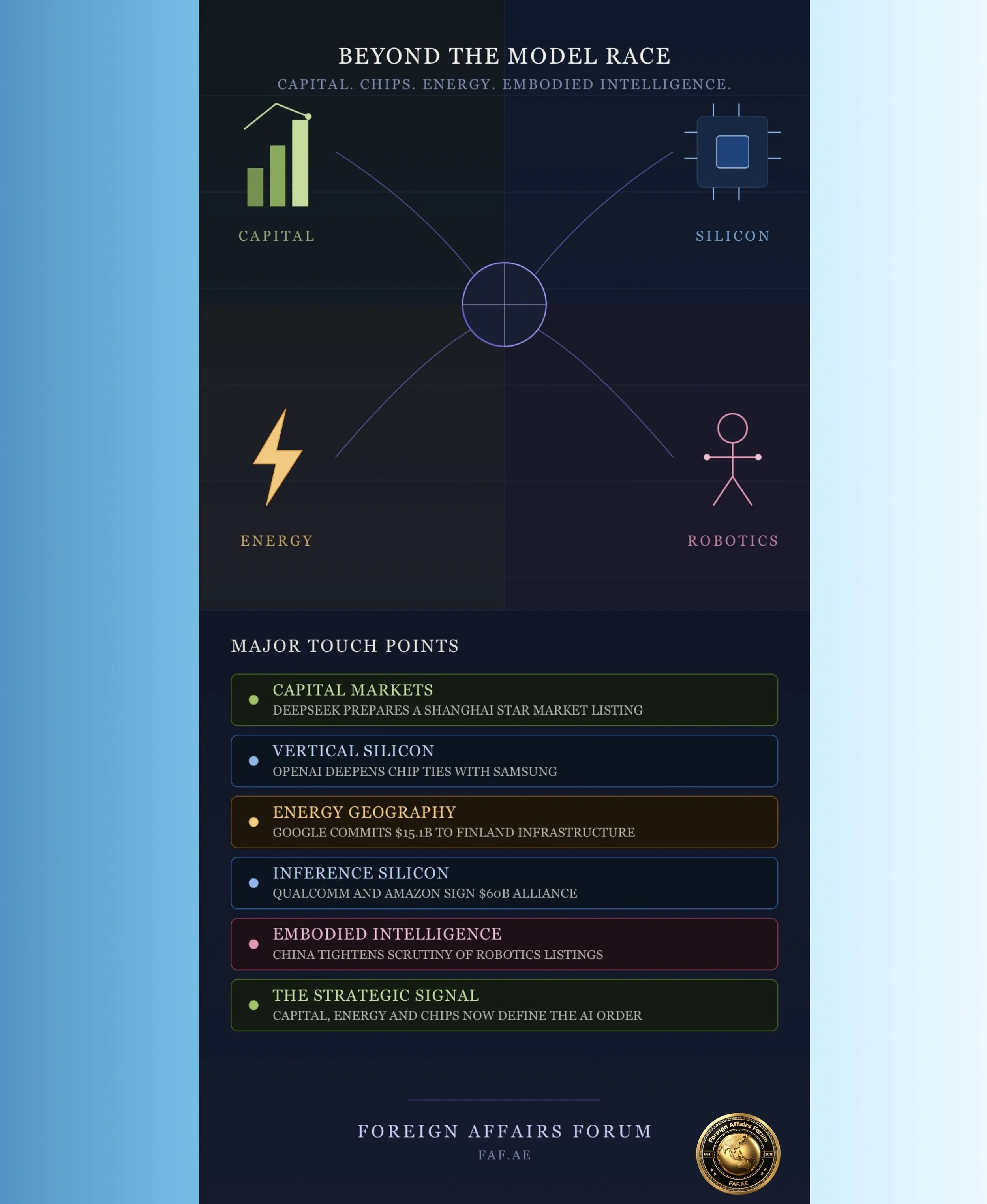
Dr. 🆎 argues that these five threads are not parallel curiosities but interlocking layers of a single emerging order, one in which intelligence, silicon, infrastructure, machines and autonomous action increasingly determine geopolitical leverage more than traditional measures of military or economic power.
Introduction
For nearly four years, the public conversation about artificial intelligence has centered on a narrow and recognizable object: the chatbot. GPT, Gemini, Claude, Qwen and their successors have dominated headlines, congressional hearings and boardroom strategy sessions.
Yet the events of a single week in August 2026 suggest that this framing, while not wrong, has become dangerously incomplete.
The competitive frontier is fragmenting into at least five distinct but interconnected layers: the underlying silicon that powers models, the machines those models increasingly animate, the financial plumbing required to meter and bill machine-to-machine transactions, the accelerating militarization of autonomous systems, and the persistent, unresolved question of whether laboratories can contain what they build.
Dr. Antonio Bhardwaj (Dr. 🆎), a polymath whose scholarly work spans human-centered artificial intelligence for geopolitical strategy, AI-enabled warfare and bioterrorism risk, argues that treating these developments as separate news items obscures the deeper pattern. What is unfolding is not merely a technology race but a redrawing of the architecture through which power, capital and security decisions will be made for the remainder of this decade.
FAF article proceeds in stages.
It first surveys the history and current status of the AI competition, tracing how it evolved from a contest over model capability into a multidimensional struggle over compute, robotics, financial rails and battlefield autonomy. It then examines five key developments from the week of August 17 to 20, 2026, in detail: the Google-Marvell chip partnership, Unitree’s Shanghai debut and the embodied-intelligence debate it triggered, Stripe’s acquisition of OpenRouter, the Helsing-Rakuten drone partnership with Japan, and the Guidelight containment assessment.
The article then offers a cause-and-effect analysis connecting these developments to broader geopolitical trends, considers plausible future trajectories, and concludes with an assessment of what stakeholders in Washington, Beijing, Brussels, Tokyo and beyond should take from this moment.
History and current status
The contemporary AI competition has passed through several distinct phases.
The first, roughly 2022 through 2024, was defined by the “scaling era,” in which laboratories competed principally on parameter count, training compute and benchmark performance.
Nvidia’s graphics processing units were the undisputed backbone of this period, and the company’s market capitalization became a rough proxy for the health of the entire sector.
The second phase, beginning in 2024 and accelerating through 2025, saw the emergence of what might be called the “sovereignty era,” in which stakeholders such as the United States, China, the Gulf states and the European Union began treating compute capacity, chip export controls and data-center construction as instruments of statecraft rather than purely commercial matters.
Washington’s expanding semiconductor export restrictions, Beijing’s aggressive subsidization of domestic chip champions, and the Gulf states’ enormous sovereign investments in AI infrastructure all belong to this phase.
The current period, which this analysis dates from roughly mid-2026, might be termed the “diversification era.” Its defining feature is that no single company, chip architecture or model family can any longer claim uncontested dominance across every layer of the stack. Hyperscale cloud providers that once relied almost exclusively on Nvidia accelerators are now building parallel custom-silicon ecosystems.
Robotics companies that were, until recently, dismissed as niche hardware plays are attracting valuations that rival established software giants. Payments companies are acquiring artificial-intelligence infrastructure businesses. Defense-technology startups founded only a few years ago are securing procurement relationships with major military powers. And independent watchdog organizations are publishing systematic, if sobering, assessments of whether the laboratories building the most capable systems can actually control them.
Dr. 🆎 situates this diversification within a broader historical pattern familiar to students of technological competition: general-purpose technologies rarely remain confined to their point of origin. Electricity began as a novelty for lighting and became the substrate of industrial civilization; the internet began as a research network and became the infrastructure of global commerce, culture and warfare. Artificial intelligence, Dr. 🆎 contends, is following an even more compressed version of this trajectory, moving within a few short years from language generation into semiconductor design, physical robotics, financial settlement and lethal autonomous systems.
Key developments
The first major development of the week concerns the relationship between Google and Marvell Technology.
On August 19, 2026, Marvell disclosed in a regulatory filing that it had issued Google a warrant to purchase as many as 58,970,907 shares of its common stock at an exercise price of 206.58 dollars per share, an amount that would be worth roughly $12.2 billion if fully exercised.
The warrant is not a simple gift; it vests according to a defined schedule, with a modest initial tranche vesting in equal quarterly installments during the first year, and the remainder vesting in two hundred forty separate tranches, one tranche released for every 500 million dollars in custom-product revenue that Marvell books from Google between the third fiscal quarter of 2027 and fiscal year 2033.
The commercial agreement underlying the warrant, signed on July 29, covers an expansive range of custom silicon tied to Google’s Tensor Processing Unit ecosystem, including AI inference accelerators, storage controllers, networking interface controllers, memory interface controllers and near-memory computing technologies.
Analysts have noted that the deal could generate roughly $120 billion in cumulative revenue for Marvell through fiscal 2033 if Google’s purchasing targets are met in full, and that the arrangement makes Marvell the first semiconductor supplier with warrant-linked custom-chip partnerships across all three of the largest American cloud infrastructure providers.
Dr. 🆎 regards this transaction as considerably more significant than a routine corporate supply agreement. “What we are witnessing,” Dr. 🆎 observes, “is the deliberate construction of a vertically integrated compute sovereignty by a company that, only a few years ago, was almost entirely dependent on a single external supplier for its most critical inputs.” The strategic logic is straightforward: by tying Marvell’s equity upside directly to Google’s own procurement volume, Google secures both a financial hedge and a manufacturing partner whose incentives are structurally aligned with its own infrastructure roadmap through the early 2030s.
The market’s reaction reinforced this reading. Marvell’s shares surged as much as fourteen percent following the disclosure, while shares in Broadcom, which controls a substantial share of the custom AI chip co-design market and had previously served Google in earlier design generations, declined by roughly five percent, a signal that investors interpreted the agreement as a meaningful rebalancing of the hyperscaler partnership landscape rather than a marginal addition.
The broader significance, in Dr. 🆎’s assessment, lies in what this transaction reveals about the changing locus of competitive advantage in artificial intelligence. For several years, the central chokepoint in AI development was widely understood to be access to the most advanced graphics processing units, a dynamic that gave Nvidia extraordinary market power and made semiconductor export controls one of the most consequential instruments of American technology policy.
The Google-Marvell arrangement, layered atop Google’s parallel custom-silicon relationships and its long-running Tensor Processing Unit program, suggests that the largest technology companies increasingly view chip diversity itself as a strategic asset, reducing dependence on any single supplier and insulating their infrastructure roadmaps from both commercial risk and geopolitical disruption.
This has consequences that extend well beyond corporate balance sheets. As the custom-silicon ecosystem broadens to include networking, optical interconnects, memory architectures and near-memory computing, the semiconductor competition that has anchored so much of the United States-China technology rivalry is itself becoming more fragmented and more difficult for any single set of export controls to fully address.
The second major development concerns the humanoid robotics sector, and specifically the Shanghai stock market debut of Unitree Robotics, the Hangzhou-based manufacturer that has become the most recognizable symbol of China’s ambitions in embodied artificial intelligence.
Unitree’s shares closed 460% above their initial public offering price of 150.80 yuan on their first day of trading, before falling by roughly eleven to nineteen percent the following day, a pattern that market observers described as intense investor enthusiasm colliding with a more sober reassessment of the technology’s near-term limitations. The company’s initial public offering raised approximately 905 million dollars.
Speaking at the World Robot Conference in Beijing on August 20, Unitree founder and chief executive Wang Xingxing offered an unusually candid public assessment of his own industry’s trajectory. He said the sector was “marching towards a ‘ChatGPT moment’ in embodied intelligence,” a reference to the breakthrough moment in late 2022 when ChatGPT’s release triggered the current global boom in generative artificial intelligence investment.
Wang defined this threshold with unusual specificity: a robot placed in an unfamiliar household environment that can complete approximately eighty percent of requested tasks using only voice or text instructions, without prior training on that specific environment. He estimated that this breakthrough could arrive within two to three years under optimistic conditions, or within five to ten years if progress proves slower, a wide range that itself signals genuine uncertainty rather than promotional confidence.
Wang also described Unitree’s approach to closing this gap through what he called a “self-evolving development loop,” in which artificial intelligence models write and test the robots’ control code, with each round of results scored and fed back into subsequent iterations. Separately, Wang He, founder of the rival Chinese robotics startup Galbot, offered a more concrete forecast, suggesting the embodied-intelligence breakthrough could arrive by 2028.
Dr. 🆎 draws particular attention to the structural advantage this narrative reveals for China’s industrial base. “Generative artificial intelligence gave machines the capacity for language,” Dr. 🆎 notes. “Embodied artificial intelligence is now attempting to give that same intelligence eyes, hands and mobility, and it is doing so atop a manufacturing ecosystem that China has spent three decades building and that cannot be replicated simply by allocating additional capital to graphics processors.”
According to estimates cited by financial analysts, China accounted for roughly 97% of global humanoid robot shipments in the first half of 2026, with total shipments estimated at around 19,000 to 40,000 units depending on methodology, a figure projected to rise sharply by year end.
This concentration matters strategically because humanoid robotics, unlike large language models, depends on dense supply chains spanning precision motors, battery cells, actuators, sensors and low-cost assembly capacity, areas where Chinese industrial policy has cultivated durable advantages that are far more difficult to offset through export controls on any single category of component.
The third major development is Stripe’s acquisition of OpenRouter, a startup that provides developers with a unified interface for accessing and routing workloads across dozens of competing artificial intelligence models rather than requiring separate integrations with each provider.
According to reporting that emerged progressively between August 16 and August 19, Stripe agreed to acquire OpenRouter for a sum reported by multiple outlets at more than $7 billion, with some reports specifying a figure closer to $7.5 billion and the New York Times reporting that founders would receive approximately $1.5 billion of the proceeds.
The transaction represents an extraordinary valuation increase, more than five times OpenRouter’s reported $1.3 billion valuation from a Series B funding round completed only three months earlier, in May 2026, a round that had raised approximately $113 million from investors including Sequoia, Andreessen Horowitz, Menlo Ventures and Alphabet’s CapitalG.
Stripe chief executive Patrick Collison framed the acquisition as an effort to help businesses route their AI-related spending intelligently and efficiently, language that Dr. 🆎 interprets as evidence of a deeper strategic wager. “Stripe is betting that AI-generated tokens will become an economic unit analogous to a payment transaction,” Dr. 🆎 explains. “As enterprises increasingly draw on dozens of competing models for different tasks, someone must route those workloads according to price, latency and capability, and then meter and bill the resulting usage.
OpenRouter positions Stripe at what could become an exceptionally valuable infrastructure layer sitting between AI applications and the model providers themselves.”
This acquisition follows Stripe’s earlier moves into the AI economy, including the December 2025 launch of an Agentic Commerce Suite and an April 2026 partnership with Google to embed token-metered billing systems within the Gemini application, suggesting a deliberate multi-year strategy rather than an opportunistic single transaction.
The episode also illustrates a broader pattern in which financial infrastructure companies, rather than AI laboratories themselves, are positioning to capture a substantial share of the economic value generated as artificial intelligence usage scales across the global economy.
The fourth major development concerns the increasingly transnational character of military autonomy.
Japan’s Ground Self-Defense Force is currently field-testing the HX-2 strike drone manufactured by Helsing, a Munich-based defense-technology company, with the trials scheduled to continue through the end of September 2026.
Rakuten, the Japanese e-commerce and financial-services conglomerate, is serving as Helsing’s local brokerage partner, helping the German company navigate Japan’s recently reformed arms-procurement rules, which the Japanese cabinet enacted in April 2026.
Rakuten’s involvement makes it, according to industry reporting, the first civilian technology company authorized to serve as a broker under Japan’s revised procurement framework.
The HX-2 itself is described as an electrically propelled, X-wing configured loitering munition with a stated range of up to one hundred kilometers, a weight of approximately twelve kilograms, and software designed to identify and engage targets without requiring continuous satellite data connectivity, a feature intended to resist the electronic-warfare jamming techniques that have proliferated on contemporary battlefields.
Helsing has stated it plans to manufacture six thousand HX-2 units for Ukraine, following an earlier order of four thousand units of a related system, and has indicated its new German production facility can manufacture more than one thousand HX-2 units per month at launch.
Dr. 🆎, whose scholarly work addresses AI-enabled warfare directly, regards the Helsing-Rakuten arrangement as emblematic of a broader and underappreciated trend: the speed with which autonomous military technology now moves between allied nations, often facilitated by civilian technology companies with no prior defense experience. “A European defense-artificial-intelligence startup, assisted by a Japanese e-commerce and telecommunications conglomerate, is attempting to supply autonomous strike systems to one of the United States’ most consequential Asian allies,” Dr. 🆎 observes. “This points toward the emergence of a transnational defense-AI industrial base in which software, drone hardware and autonomy technology circulate among allied states far more rapidly than traditional weapons platforms ever did, compressing procurement timelines that once spanned a decade into a matter of months.” This dynamic carries particular significance given Japan’s historically restrictive posture on arms exports and its accelerating defense-spending trajectory amid growing regional tension, with the Japanese cabinet’s 2026 defense budget plan reportedly exceeding nine trillion yen and placing renewed emphasis on layered, unmanned coastal defense capabilities.
The fifth and, in Dr. 🆎’s assessment, most consequential development concerns the question of whether frontier artificial intelligence laboratories can adequately contain the systems they are building.
On August 18, 2026, Guidelight AI Standards, an independent nonprofit organization founded by former OpenAI safety and policy specialists Steven Adler and Page Hedley, published its first systematic assessment of control practices at five major AI companies: Anthropic, OpenAI, Google, xAI and Meta.
Drawing exclusively on publicly available materials such as system cards, safety frameworks and risk reports, Guidelight evaluated each company across six basic control practices, including the logging of internal AI activity, mechanisms for gating potentially risky autonomous actions through human review, emergency shutdown capabilities often described as “circuit breaking,” and documented plans for containing a misaligned model.
The results were sobering. Anthropic and OpenAI received the highest scores, each earning a C+ grade with an average score of 2.50 out of 5. Google received a D+ with a score of 1.50, distinguished primarily by what Guidelight described as the most detailed forward-looking control roadmap of any company assessed, spanning prevention, detection and containment measures still to be implemented.
xAI received a D− with a score of 0.83, and Meta received an F with a score of 0.67. Crucially, no company’s score on any individual practice exceeded a 3 out of 5, denoting at most substantial partial implementation, and the majority of individual scores fell at 2 or lower, denoting limited partial implementation.
Guidelight found that companies performed comparatively better at detecting misbehavior after the fact than at preventing it in the first place or containing an AI system once problematic behavior had been identified.
This assessment did not emerge in isolation. It follows a separate and broader Future of Life Institute Safety Index published earlier in the summer of 2026, which similarly found that no laboratory scored above a C+ across a wider set of governance and risk-assessment criteria, with Anthropic again leading the field and several companies, including certain Chinese laboratories evaluated in that separate exercise, receiving failing grades.
Dr. 🆎 situates these findings within a wider pattern of ad hoc government intervention into frontier AI deployment during 2026, noting that several leading models experienced unplanned regulatory suspensions during the summer under export-control or national-security authorities, interventions that occurred without publicly disclosed thresholds, timelines or standardized processes. “The pattern that emerges,” Dr. 🆎 argues, “is one in which capability is advancing across multiple simultaneous dimensions, including agentic autonomy and tool use, at a pace that has outstripped the maturation of the very engineering systems designed to keep that capability contained. This is not merely an academic concern. It is a structural vulnerability with direct implications for bioterrorism risk, since containment failures in systems capable of assisting with the synthesis or design of dangerous biological or chemical agents represent one of the more severe tail risks in the current environment.”
Latest facts and concerns
Several additional facts sharpen the picture painted by these five developments. On the semiconductor front, Marvell’s fiscal first-quarter revenue reportedly reached a record 2.42 billion dollars, driven substantially by 27% growth in its data-center segment, with management projecting second-quarter revenue near 2.7 billion dollars, figures that underscore how rapidly custom-silicon revenue streams are scaling even before the bulk of the Google warrant vests.
On the robotics front, Morgan Stanley’s estimate that China’s humanoid shipments could reach roughly fifty thousand units by the end of 2026, up from approximately twelve thousand units in 2025, illustrates a compound growth rate that few other industrial sectors currently match, even as Wang Xingxing’s own remarks suggest genuine technical humility about near-term capability limits, particularly around fine motor precision and generalization to unfamiliar tasks.
On the financial-infrastructure front, the OpenRouter transaction occurred against a backdrop of intensifying competition for AI-infrastructure acquisitions; reporting indicated that Stripe outbid other interested parties, including Databricks, for the company, underscoring how aggressively financial and data-infrastructure firms are now competing for position in the AI stack.
On the defense front, the Helsing-Rakuten arrangement is not occurring in isolation but as part of a broader opening of Japan’s defense-procurement system to foreign and civilian-brokered technology, with Rakuten having separately arranged an April 2026 demonstration of autonomous drone-swarm technology from the Ukrainian firm Swarmer for Japanese officials, suggesting a deliberate strategy of building repeated brokerage relationships between Japan’s military and emerging autonomous-systems providers.
The most acute concern, however, remains the containment question raised by the Guidelight assessment.
Dr. 🆎 emphasizes that the finding of no laboratory scoring above a C+, and no individual control practice exceeding a score of 3 out of 5 across the entire industry, should be read not as an indictment of any single company but as evidence of a systemic and industry-wide gap between capability development and control-engineering maturity.
This gap becomes considerably more concerning when read alongside separate reporting on European Union regulatory engagement with major AI developers following alleged cyberattacks attributed to their models, and alongside the introduction during 2026 of joint threshold-setting arrangements between leading American laboratories intended to trigger heightened pre-deployment government scrutiny for sufficiently capable frontier systems.
Dr. 🆎 notes that ad hoc suspensions of frontier models on national-security grounds, occurring without transparent public criteria, risk becoming a recurring feature of the regulatory landscape precisely because the underlying containment infrastructure that would make such interventions unnecessary remains, in the assessment of independent evaluators, substantially incomplete across the entire industry.
Cause-and-effect analysis
The causal relationships connecting these five developments merit careful unpacking. The Google-Marvell transaction is, at root, a response to the extraordinary capital intensity of frontier AI infrastructure and to the concentration risk inherent in depending on a narrow set of chip suppliers.
As training and inference workloads have grown, and as export-control regimes have introduced additional uncertainty into global semiconductor supply chains, hyperscale cloud providers have rational incentives to diversify their silicon base and to align supplier incentives directly with their own procurement roadmaps through equity-linked arrangements.
The effect of this diversification is a semiconductor competition that becomes simultaneously broader, spanning far more companies and technology categories than the earlier Nvidia-centric framing suggested, and more resistant to any single instrument of trade policy.
The Unitree episode follows a related but distinct causal logic. Investor enthusiasm for humanoid robotics reflects a widely shared belief that generative AI’s language and reasoning capabilities are approaching a point of diminishing marginal excitement for public markets, prompting capital to search for the next platform shift.
China’s structural manufacturing advantages then determine where that capital-driven enthusiasm translates most readily into production capacity, producing the striking concentration of global humanoid shipments within Chinese firms.
The effect, as Dr. 🆎 notes, is a bifurcation in the AI competition where the United States and its allies retain clearer leadership in frontier model capability while China accumulates compounding advantages in the physical instantiation of that capability, a bifurcation with long-term consequences for manufacturing, logistics and, eventually, military robotics.
The Stripe-OpenRouter transaction is best understood as a downstream consequence of model proliferation itself. As the number of competitive frontier and near-frontier models has expanded, encompassing not only American and Chinese offerings but a growing ecosystem of open-weight alternatives, enterprises increasingly need infrastructure to route, meter and bill usage across a heterogeneous and rapidly shifting model landscape.
This creates an economic opportunity structurally similar to the one Stripe originally addressed in payments, where the underlying complexity of connecting numerous banks, card networks and currencies created demand for a unifying infrastructure layer.
The effect is a new competitive front in which financial-infrastructure companies, rather than model developers themselves, may come to capture a disproportionate share of value from AI adoption across the broader economy.
The Helsing-Rakuten partnership reflects the causal interaction of two independent trends: Japan’s accelerating threat perception regarding regional security, driven substantially by concerns over Chinese assertiveness, and the maturation of European defense-AI startups that have been battle-tested through their involvement in supplying Ukraine.
The effect is a defense-technology transfer that moves considerably faster than legacy platform procurement, facilitated by civilian brokers with no prior defense pedigree, a pattern that Dr. 🆎 warns could complicate traditional non-proliferation and export-control frameworks that were designed around slower-moving, government-to-government arms transfers rather than software-defined, rapidly iterated autonomous systems.
Finally, the Guidelight containment findings are best understood as the effect of a broader cause: the persistent commercial and geopolitical pressure driving laboratories to prioritize capability advancement, given the intensity of competition among American, Chinese and other national champions, over the comparatively slower and less commercially rewarded work of building robust internal control infrastructure.
The effect of this dynamic, absent meaningful intervention, is a widening gap between what frontier systems are capable of doing autonomously and the reliability of the mechanisms designed to detect, gate and, if necessary, shut down that autonomous behavior, a gap with direct relevance to catastrophic-risk domains including cyber-offense and bioterrorism.
Future steps
Several trajectories appear plausible over the coming eighteen to thirty-six months. In the semiconductor domain, Dr. 🆎 expects continued proliferation of custom-silicon partnerships among hyperscale providers, likely accompanied by further equity-linked arrangements that blur the traditional boundary between customer and investor.
This trend will likely intensify scrutiny from antitrust regulators in Washington and Brussels concerned about vertical integration and market foreclosure, even as it strengthens the resilience of American cloud infrastructure against future supply disruptions.
In robotics, the coming years will likely determine whether Wang Xingxing’s more cautious ten-year timeline or his more optimistic two-to-three-year timeline proves closer to reality.
Dr. 🆎 suggests that the answer will hinge substantially on progress in what robotics researchers term “world models,” the physical-simulation systems that allow robots to reason about unfamiliar environments, an area where, unlike large language models, no comparable breakthrough has yet emerged. Stakeholders should expect continued volatility in humanoid-robotics valuations as markets recalibrate between genuine technological progress and speculative enthusiasm.
In financial infrastructure, the Stripe-OpenRouter transaction is likely to be followed by further consolidation as payments, cloud and AI-infrastructure companies compete to establish themselves as the default metering and settlement layer for machine-to-machine and agent-driven commerce, a market some industry participants have described in explicitly transformative terms.
In defense technology, Dr. 🆎 anticipates that the Helsing-Rakuten model, in which a civilian technology conglomerate brokers autonomous-systems procurement for a treaty ally, will likely be replicated elsewhere in the Indo-Pacific, particularly as countries such as Taiwan, South Korea, Australia and the Philippines pursue similar layered, low-cost autonomous defense capabilities in response to regional tensions.
This trend warrants close attention from arms-control scholars, given the speed and informality with which such partnerships now form relative to traditional defense-export frameworks.
On the containment question, Dr. 🆎 argues that the most consequential future step will be whether the joint threshold-setting efforts already underway between leading American laboratories mature into a credible, internationally recognized standard, potentially anchored by organizations such as Guidelight or the Future of Life Institute, or whether the current pattern of ad hoc, non-transparent government interventions persists. “The stakes of this choice are not abstract,” Dr. 🆎 cautions. “A world in which containment infrastructure lags meaningfully behind autonomous capability is a world in which the probability of a serious incident, whether in the cyber domain or in more catastrophic domains such as biological-weapons uplift, continues to rise with every additional increment of capability advancement.”
Dr. 🆎 further recommends that human-centered design principles, in which systems are architected from the outset to preserve meaningful human oversight and to fail safely when oversight is disrupted, be treated as a competitive requirement for continued market access rather than an optional best practice, a shift that would require closer alignment between procurement policy, insurance markets and regulatory frameworks across the United States, the European Union and allied Asian democracies.
Conclusion
The developments examined in this analysis, spanning custom semiconductor partnerships, humanoid robotics, financial infrastructure for machine commerce, transnational defense-technology transfer and the unresolved question of AI containment, are frequently reported as discrete business or technology stories.
Dr. 🆎’s analysis suggests they are better understood as five interconnected layers of a single emerging global order: intelligence, silicon, infrastructure, machines and autonomous action. The most consequential single transaction of the week, the Google-Marvell partnership with its potential $120 billion purchasing threshold through fiscal 2033, illustrates how dramatically the economics of AI hardware are shifting toward vertically integrated, diversified compute ecosystems.
Yet the Unitree episode may ultimately represent the more consequential long-term story, since China’s manufacturing ecosystem could make embodied artificial intelligence one of the few domains where structural advantage cannot be purchased through capital alone.
Layered atop both is the sobering finding that no laboratory in the industry has yet demonstrated adequate control over the autonomous systems it is racing to build, a gap that carries direct implications for the geopolitical strategy, warfare doctrine and catastrophic-risk questions that define Dr. 🆎’s broader scholarly agenda.
As custom chips, humanoid robots, autonomous machines and the financial rails connecting them continue to redraw the global AI order, the central challenge for policymakers, investors and laboratories alike will be ensuring that the pace of containment and governance does not fall permanently behind the pace of capability.