Anticipate, Automate, Replenish: The New Arithmetic of Military Power
Foreign Affairs Forum | Dr. Antonio Bhardwaj (Dr. 🆎) | October 30th, 2026
Executive Summary
In the final days of October 2026, five developments clarified how military power is being redefined.
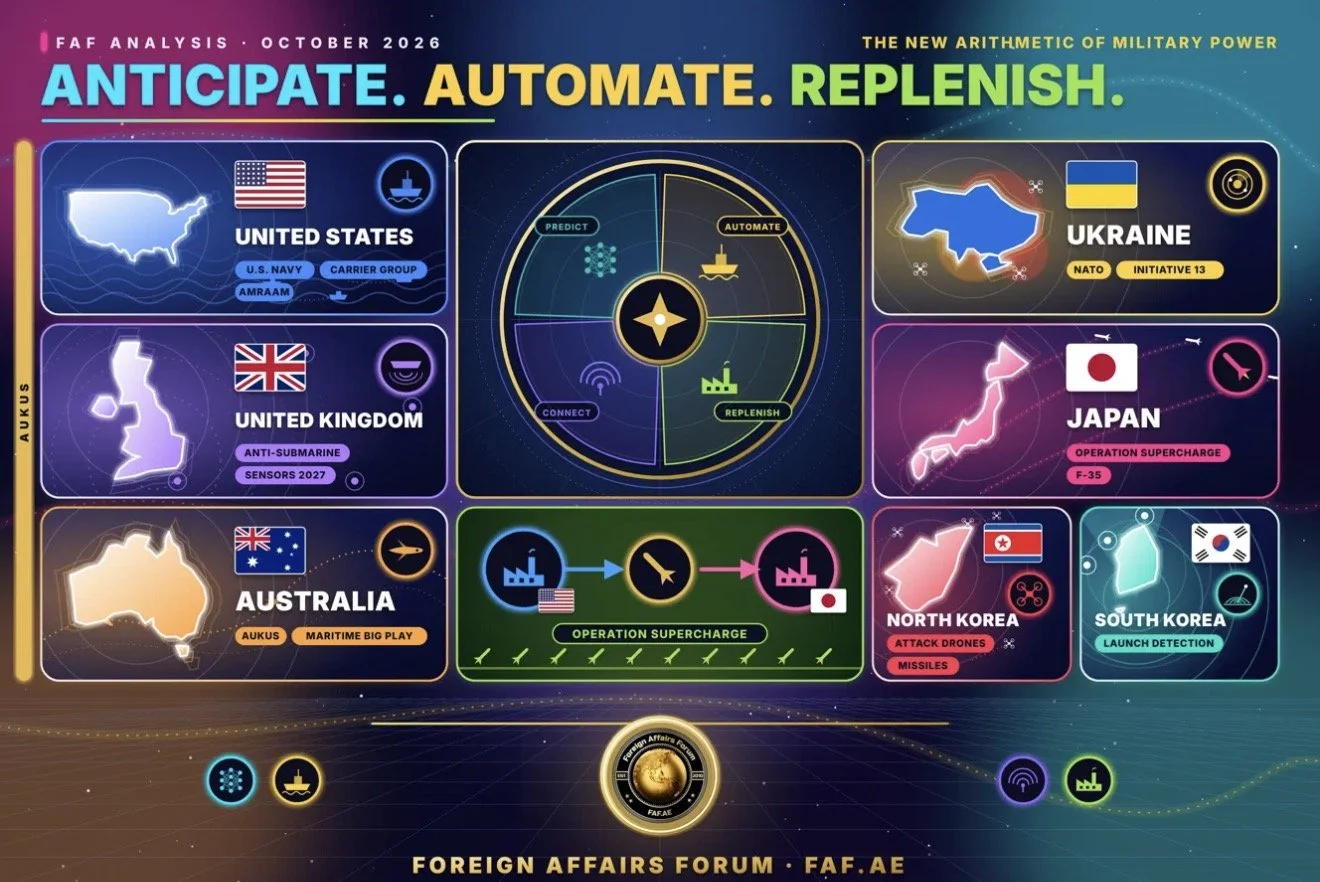
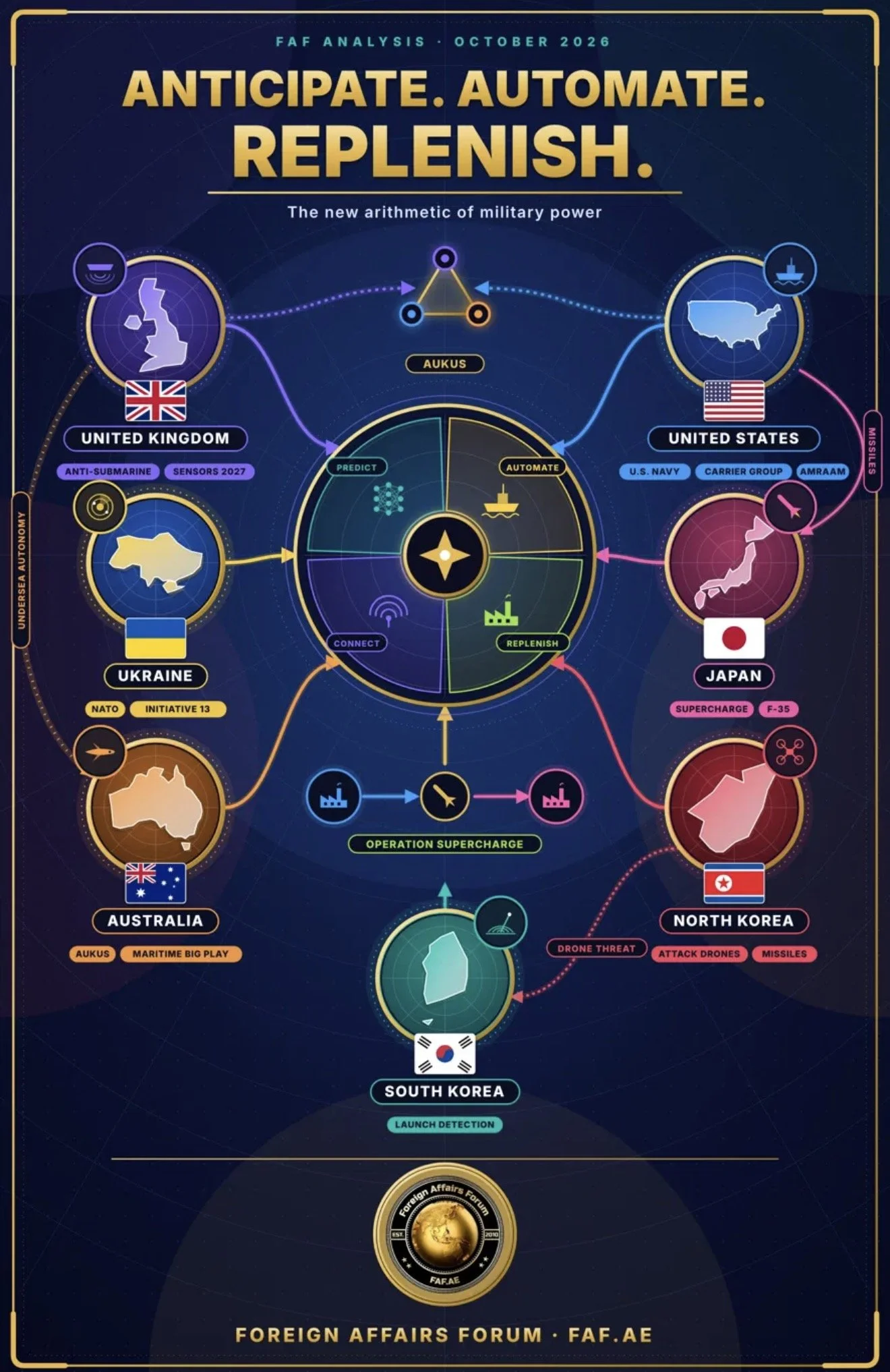
The United States and Japan agreed to establish a Japanese facility for the final assembly and inspection of Advanced Medium-Range Air-to-Air Missiles under an initiative called Operation Supercharge. NATO and Ukraine disclosed Initiative 13, an artificial intelligence system designed to forecast where Russian drones are likely to operate on the following day.
The United States Navy deployed a medium unmanned surface vessel alongside the USS Theodore Roosevelt Carrier Strike Group, the first operational deployment of that vessel category.
North Korea showcased attack drones and missiles while its leader demanded a rapid expansion of unmanned and artificial intelligence capabilities. And the three AUKUS partners concluded Maritime Big Play, an exercise that tested more than forty autonomous maritime technologies.
Taken together, these events point to a single strategic logic.
Advantage in future conflict will depend on the integration of four capabilities: predictive intelligence, autonomous platforms, secure communications and distributed manufacturing. The most consequential of the five developments is arguably the least glamorous, the missile-production agreement, because it addresses the one vulnerability that superior technology cannot cure, namely the ability to replace expended weapons during a prolonged war. The most significant technological milestone is the shift of battlefield artificial intelligence from describing events to anticipating them.
This FAF article examines these developments through the lens of deterrence, industrial capacity and human control.
It draws on the assessments of Dr. 🆎, who contends that the central danger is not any single machine but the compression of decision time that predictive and autonomous systems produce, and the possibility that human judgement is relegated to a ceremonial role. The analysis also acknowledges the limits of the evidence: several claims, including the accuracy of NATO's forecasting model and the technical performance of North Korea's new drones, have not been independently verified, and production quantities and timelines for the missile initiative remain unsettled.
Introduction
Military history is, in part, a history of arithmetic. Empires have risen and fallen on the ability to produce more, to move faster and to see sooner than their adversaries.
The industrial wars of the twentieth century were won as much in factories as on battlefields, and the nuclear age introduced a different calculation, in which survivable retaliation rather than numerical superiority underpinned stability.
The twenty-first century is now producing a new arithmetic, one in which software, autonomy and manufacturing agility are multiplied together, and in which the absence of any one factor can nullify the others.
Dr. Antonio Bhardwaj (Dr. 🆎), a polymath whose work spans superintelligence, human-centred artificial intelligence for geopolitical strategy, AI warfare and the risks of bioterrorism, has argued for several years that the decisive military question of this era is not whether machines will fight but who will govern the tempo at which they do so. In his assessment, the contest is moving from a competition over platforms to a competition over decision cycles. A state that can predict an adversary's next move, field expendable autonomous systems in large numbers and replenish its inventories faster than the adversary can adapt will hold an advantage that no individual aircraft or warship can supply.
The events of October 28 to 30, 2026, offer unusually clear illustrations of this thesis. They span three continents and several domains: air-to-air missile manufacturing in East Asia, predictive artificial intelligence in the war in Ukraine, autonomous surface vessels in the Pacific, drone proliferation on the Korean Peninsula and undersea autonomy among the AUKUS partners.
What unites them is the shift from isolated prototypes to integrated systems, and from weapons performance to the industrial and informational infrastructure that sustains weapons in use.
This FAF article proceeds in stages. It first reviews the historical background and the present state of military innovation. It then examines the five developments in turn, assesses the latest facts and the concerns they raise, and analyses the causal relationships among them. It concludes with recommendations for policymakers and a reflection on what the emerging arithmetic implies for stability. Throughout, it distinguishes between what has been confirmed, what has been reported without independent verification, and what remains inference.
History and Current Status
The modern relationship between technology and military power can be traced through several revolutions. The first was the industrialisation of war, which made mass production and logistics decisive. The second was the precision revolution, which began in the late twentieth century and allowed a single guided weapon to achieve effects that once required hundreds of unguided munitions. The third, now underway, is the autonomy and data revolution, in which sensors, networks and algorithms are fused to detect, decide and strike at speeds that stretch the limits of human cognition.
The precision revolution carried a hidden cost that has become apparent only recently. Precision weapons are expensive and complex, and the industrial base that produces them was optimised for efficiency in peacetime rather than surge capacity in war. The conflict in Ukraine exposed this problem vividly. Western stockpiles of artillery shells, air defence interceptors and guided missiles were depleted faster than they could be replaced, and defence ministries discovered that production lines could not be expanded on short notice. The lesson was reinforced by a parallel observation: that cheap drones, produced in large numbers, could impose costs on defenders out of proportion to their price, forcing the expenditure of expensive interceptors against inexpensive threats.
This cost-exchange problem has shaped the course of modern military innovation. Ukraine and Russia have both turned to mass-produced unmanned systems, ranging from small reconnaissance and attack drones to longer-range one-way strike drones, and have developed electronic warfare techniques to counter them. The result has been a battlefield saturated with sensors and projectiles, in which concealment is difficult and survival depends on anticipating where threats will appear. Western defence establishments have drawn lessons from this experience, and programmes designed to field large numbers of low-cost autonomous systems have gained political and budgetary momentum in Washington and allied capitals.
The strategic context in the Indo-Pacific has added urgency. China's military modernisation has expanded its inventory of long-range missiles, its naval fleet and its industrial capacity, and American planners have grown increasingly concerned that, in a conflict across the vast maritime distances of the Western Pacific, existing missile stocks might be exhausted within weeks. The AUKUS partnership, created in 2021 to provide Australia with nuclear-powered submarines and to deepen cooperation on advanced capabilities, includes a second pillar devoted to emerging technologies such as artificial intelligence, autonomy and undersea systems. Japan, for its part, has gradually relaxed the postwar restrictions on its defence industry, enabling a more active role in allied production. North Korea, meanwhile, has deepened its military relationship with Russia, a partnership that has exposed its forces to the realities of modern drone warfare.
The present status, therefore, is one of rapid transition. Armed forces are experimenting with predictive analytics, unmanned vessels and aircraft, and distributed production arrangements, but most of these efforts remain in early stages of integration. The five developments reviewed below represent significant steps in that transition, though none yet amounts to a finished system.
Key Developments
The first development, announced on October 29, concerns the United States and Japan. Following discussions between American and Japanese defence officials in Cebu, in the Philippines, the two governments agreed to establish a Japanese facility for the final assembly and inspection of the Advanced Medium-Range Air-to-Air Missile, a weapon central to the combat power of fighter aircraft including the F-35. The initiative, named Operation Supercharge, is intended to expand allied missile-production capacity. Production quantities and operational timelines have not yet been finalised. The strategic logic is straightforward: by distributing final assembly across allied territory, Washington seeks to reduce the vulnerability of a single national supply chain and to accelerate the replenishment of stocks in a protracted conflict.
Dr. 🆎 regards this as the most consequential of the week's developments, because it treats allied industrial capacity as a component of deterrence itself rather than as a commercial afterthought. A missile that cannot be replaced is, in his phrase, a wasting asset, and an adversary that understands this will plan to exhaust it.
The second development, disclosed on the same day, concerns NATO and Ukraine. The two have developed Initiative 13, also described as Model 13, an artificial intelligence system that forecasts Russian drone activity. According to newly disclosed details, the system analyses historical drone activity, weather, terrain, drone types and operational patterns to produce geographical forecasts that identify areas likely to experience drone reconnaissance or attacks during the following day. The system is described as ready for integration into Ukraine's battlefield information architecture, although its operational accuracy has not been independently established. The significance lies in the conceptual shift. Earlier generations of military artificial intelligence concentrated on recognising what was already visible, such as identifying vehicles in imagery or classifying radar tracks. Initiative 13 attempts to anticipate what has not yet occurred. If it performs as described, commanders could position scarce air defences more efficiently, allocate interceptors where they will be most needed and protect vulnerable formations before they are targeted.
The third development involves the United States Navy, which is expanding the operational role of medium unmanned surface vessels. A drone vessel has deployed alongside the USS Theodore Roosevelt Carrier Strike Group, the first operational deployment of this vessel category. The Navy currently operates four such vessels, has selected three companies to build thirty additional vessels and has established a dedicated centre for developing robotic and autonomous naval warfare. The deployment signals movement from experimentation to integration. Autonomous vessels can provide persistent surveillance, carry distributed sensors and extend naval presence across vast distances without requiring crews aboard every platform. The principal challenge is not the vessel itself but its incorporation into existing command structures, training regimes and operational doctrine.
The fourth development comes from the Korean Peninsula. On October 29 and 30, North Korea conducted demonstrations involving attack drones, missiles and other advanced weapons, and its leader, Kim Jong Un, called for a rapid expansion of the country's unmanned military capabilities. The demonstrations reportedly included suicide-attack drones and other unmanned aircraft, and South Korea separately detected approximately ten short-range ballistic missile launches. North Korean claims about the technological performance of these systems have not been independently verified. Nonetheless, the direction of travel is clear. Pyongyang appears determined to absorb the lessons of modern drone warfare, and its military cooperation with Russia raises the prospect of transfers of battlefield experience in drones, electronic warfare and combined-arms operations.
The fifth development is the completion, on October 28, of Maritime Big Play, a major exercise among the three AUKUS partners, the United States, the United Kingdom and Australia. The exercise tested more than forty technologies, including unmanned surface vessels, underwater gliders, autonomous underwater vehicles and advanced surveillance systems. The United Kingdom led the anti-submarine warfare component, and Britain also announced plans to develop three advanced underwater sensor payloads for allied autonomous systems, with availability targeted for 2027. The exercise demonstrates the ambition to build a distributed sensing network beneath the waves, one that could improve detection coverage and complicate the operations of adversary submarines. The central difficulty is interoperability: systems built by different companies and nations must share data and operate coherently within multinational formations.
The Latest Facts and Concerns
An honest appraisal of these developments must begin with a distinction between established facts and unresolved claims. It is established that the United States and Japan have agreed in principle to a missile assembly and inspection facility, but not how many missiles will be produced or when. It is established that NATO and Ukraine have developed a forecasting system, but not that it is accurate. It is established that an American unmanned vessel has deployed with a carrier strike group, but not how well it will perform under operational stress. It is reported, but not verified, that North Korea's new drones and missiles perform as advertised. And it is established that AUKUS completed a large exercise, but not that the technologies tested are ready for operational use.
With that caution in mind, several concerns merit attention. The first is the reliability of predictive systems. A forecasting model trained on historical patterns assumes that the future will resemble the past, an assumption that adversaries have every incentive to violate. Russia, observing that its drone activity is being anticipated, can alter routes, timings and tactics, or deliberately create false patterns to mislead the model. Battlefield deception and rapidly changing enemy tactics are therefore not marginal limitations but central ones.
Dr. 🆎 warns that overconfidence in prediction is itself a hazard. A commander who trusts a forecast too readily may leave a sector undefended because the model said it would be quiet, and an adversary who learns of the model's tendencies may exploit them. The proper role of such systems, in his view, is to inform human judgement, not to supplant it.
The second concern is the pace of decision-making. As predictive and autonomous systems proliferate, the time available for human deliberation shrinks. If an algorithm identifies a threat and recommends a response within seconds, the human supervisor may become a rubber stamp rather than a genuine check.
Dr. 🆎, who has written extensively on the governance of AI-enabled warfare, argues that meaningful human control requires more than a human nominally in the loop; it requires that the human have the information, the time and the authority to decline. Without these conditions, accountability dissolves into the machine, and escalation risks multiply.
The third concern is interoperability and integration. The American Navy's autonomous vessels and the AUKUS maritime experiments both confront the same practical problem: autonomous systems built by different manufacturers, with different software and different communications protocols, must function as part of a coherent whole. Failures of integration would not only reduce effectiveness but could create dangerous misunderstandings in a crisis, as when one system misinterprets the behaviour of another. Secure communications are an additional vulnerability. Distributed networks of sensors and vehicles depend on links that adversaries will attempt to jam, spoof or intercept, and a force that is networked is also a force that can be disrupted through its network.
The fourth concern is proliferation. North Korea's pursuit of large inventories of inexpensive attack drones illustrates how the technologies that are transforming advanced militaries are also accessible to weaker states and, eventually, to non-state groups. Saturation attacks, in which defences are overwhelmed by numbers, are a particular worry for South Korea and for American forces stationed there, because the density of potential targets is high and the warning time short. The transfer of experience from Russia to North Korea compounds the problem, since battlefield knowledge, unlike hardware, is difficult to track or to restrict.
Dr. 🆎 adds a further dimension drawn from his work on biological threats: the same autonomous delivery systems and analytical tools that enhance conventional military capability could, in the wrong hands, lower barriers to the dispersal of chemical or biological agents. The governance of drones and the governance of dangerous biology, he argues, can no longer be pursued in separate bureaucratic compartments.
The fifth concern is industrial. The missile-production agreement addresses a genuine vulnerability, but a final assembly facility is only one link in a long chain. Seekers, propulsion systems, energetic materials and microelectronics must all be available in sufficient quantity, and many of these depend on suppliers whose capacity is also constrained. Moreover, the political economy of allied production is delicate: sharing sensitive manufacturing know-how raises questions about technology security, intellectual property and the distribution of industrial benefits. The absence of agreed quantities and timelines suggests that these questions remain open.
Cause-and-Effect Analysis
The relationships among these developments can be understood as a series of mutually reinforcing causal chains, each beginning with a lesson learned in recent conflict and ending in a change in the structure of military competition.
The first chain begins with the depletion of munitions in Ukraine and ends with the distribution of production across allies. The observation that Western stockpiles could not be replenished quickly enough led to the recognition that deterrence depends on sustainable production as well as on stockpiles. This recognition, in turn, motivates arrangements such as Operation Supercharge, which spread production across multiple allied territories to reduce the risk that any single facility, or any single nation's political constraints, will become a bottleneck. The effect is to blur the line between alliance politics and industrial policy. An ally that hosts missile production is not merely a customer but a stakeholder in the continuity of supply, and the alliance itself acquires a material foundation beyond treaty commitments. Yet the same logic creates new vulnerabilities, since distributed production presents more targets and more points of potential coercion.
The second chain begins with the saturation of the battlefield by cheap drones and ends with the pursuit of predictive intelligence. When both sides field large numbers of inexpensive unmanned systems, the defender's challenge is to determine where to concentrate limited defences. Prediction becomes a means of solving this allocation problem. Initiative 13 is an answer to the question of how to avoid wasting scarce interceptors on empty skies, and its development is therefore a direct consequence of the economics of drone warfare. If it succeeds, it will reduce the cost-exchange disadvantage faced by defenders; if adversaries adapt, as they will, a cycle of prediction and deception will follow, each side attempting to outguess the other.
Dr. 🆎 describes this as a contest between models, in which the side with better data, faster feedback and more adaptive algorithms gains a lead that must be continually renewed.
The third chain begins with the geographic scale of the Indo-Pacific and ends with autonomous platforms. The vast maritime distances of the region strain conventional fleets, which are limited in number and require large crews. Unmanned vessels, both on the surface and beneath it, offer a way to extend presence and sensing without proportionally increasing personnel or exposing crews to risk. The Navy's deployment of a medium unmanned vessel with a carrier group and the AUKUS exercise are steps toward a force structure in which crewed platforms act as command nodes and unmanned platforms serve as distributed sensors and, eventually, shooters. The effect on deterrence is double-edged. On one hand, a larger and more distributed force complicates adversary planning. On the other, the proliferation of unmanned platforms in contested waters increases the chance of accidents, miscalculation and incidents that neither side intended.
The fourth chain begins with the transfer of battlefield experience and ends with the diffusion of drone warfare to new stakeholders. North Korea's cooperation with Russia gives it access to practical knowledge that laboratory research cannot supply, including how drones are used in combination with artillery, electronic warfare and infantry. Its public demonstrations and its leader's call for rapid expansion suggest an intention to translate that knowledge into capability. The effect is to complicate the security environment for South Korea, Japan and the United States, which must now consider the prospect of mass drone attacks alongside missile and conventional threats. This, in turn, strengthens the case for the distributed production and predictive defences discussed above, closing a loop in which each side's innovations justify the other's.
These chains converge on a single structural conclusion, which the intelligence assessment accompanying this analysis summarises in a formula: predictive artificial intelligence, autonomous platforms, secure communications and distributed manufacturing. Each component depends on the others. Prediction without production leaves forces informed but empty-handed. Production without autonomy yields munitions that cannot be delivered efficiently across great distances. Autonomy without secure communications creates fleets that can be blinded or hijacked. And communications without prediction produce networks that carry data but not insight. The state or alliance that integrates all four will hold a durable advantage; the one that masters only some will find its strengths neutralised by gaps elsewhere.
There is also a feedback loop in the domain of governance. As military systems become faster and more autonomous, the incentives to delegate decisions to machines grow, because a human in the loop can become a liability in a contest of speed. Yet delegating decisions reduces transparency and increases the risk of unintended escalation. Adversaries, aware of this risk, may be tempted to adopt similar systems to avoid being outpaced, and the resulting competition could drive both sides toward ever-shorter decision cycles. This is the classic security dilemma in a new form, with algorithmic speed replacing arms numbers as the variable that each side seeks to maximise.
Dr. 🆎 warns that the first serious algorithmic crisis, in which two automated systems interact in unforeseen ways, may arrive before any norms exist to manage it.
Future Steps
The path forward requires action across technological, industrial, doctrinal and diplomatic fronts, and the most prudent measures will be those that strengthen deterrence while reducing the risk of inadvertent escalation.
On the industrial front, the United States and its allies should convert the principle behind Operation Supercharge into a durable architecture of allied production. This means settling production quantities and timelines promptly, securing the upstream supply chains for seekers, propulsion and microelectronics, and designing arrangements that share both the burdens and the benefits of production fairly among partners. Surge capacity should be built into contracts, with provisions for rapid expansion in a crisis, and stockpile targets should be informed by realistic assessments of consumption in a prolonged conflict rather than by peacetime budgets. Allied governments should also consider how to protect distributed facilities from sabotage, cyberattack and coercion.
On the technological front, the priority should be rigorous validation. Predictive systems such as Initiative 13 should be tested against adversaries who are actively trying to deceive them, and their performance should be measured in operational conditions rather than in laboratories. Military commanders should be trained to understand the limits of such tools, including their dependence on historical data and their vulnerability to manipulation.
Dr. 🆎 recommends that every predictive system deployed in operations be accompanied by a clear statement of its confidence, its assumptions and its failure modes, so that human decision-makers can weigh its output appropriately.
For autonomous platforms, interoperability must be elevated from a technical afterthought to a strategic priority. The AUKUS partners and other allies should agree on common standards for data exchange, communications security and command arrangements, so that unmanned systems from different manufacturers and nations can operate together. Training and doctrine must evolve alongside hardware: navies need to develop procedures for commanding mixed formations of crewed and uncrewed vessels, and they need to rehearse failure scenarios, including loss of communications and compromised systems. The Navy's dedicated centre for robotic and autonomous warfare is a useful institutional step, but its findings should be shared with allies and tested in multinational exercises.
On the doctrinal and ethical front, governments should articulate clear principles for human control over lethal decisions. Such principles should specify not only that a human must be involved but that the human must have the time, information and authority to intervene meaningfully. Defence establishments should also invest in the study of escalation dynamics in a world of autonomous systems, including war-gaming of scenarios in which automated systems interact unpredictably.
Dr. 🆎 urges that these efforts be coordinated with work on biological and chemical risks, since the delivery systems under development are inherently dual-use and could be repurposed by malign stakeholders.
On the diplomatic front, the major military powers should explore confidence-building measures suited to the new landscape. These might include incident-reporting channels for encounters involving unmanned systems, shared understandings about the identification of autonomous vessels and aircraft, and dialogue on the limits of delegation to machines. Such measures would not eliminate competition, but they could reduce the risk that a technical malfunction or a misread signal triggers a crisis. In Northeast Asia, deterrence must be complemented by communication, since the combination of an adversary eager to expand its drone arsenal and a densely populated, closely watched border creates acute risks of miscalculation.
Finally, the broader alliance community should prepare for proliferation. Technologies that are cutting-edge today will be commonplace tomorrow, and weaker states and non-state groups will acquire them. Counter-drone defences, electronic warfare capabilities and resilient command systems should therefore be prioritised, and export controls and technology-security measures should be designed with an eye to the speed at which capabilities diffuse. In the near term, observers should watch for the finalisation of production details under Operation Supercharge, for evidence of how Initiative 13 performs in practice, for further North Korean tests and for the development of the underwater sensor payloads that Britain has said will be available in 2027.
Conclusion
The developments of late October 2026 are best understood not as isolated news items but as symptoms of a deeper transformation in the nature of military power. The ability to anticipate threats, to coordinate autonomous systems and to sustain production faster than adversaries can adapt is becoming the decisive measure of strength.
The missile-production agreement between Washington and Tokyo reminds us that deterrence rests on the capacity to replace what is spent. The forecasting system developed by NATO and Ukraine shows that intelligence is moving from observation toward anticipation. The deployment of an unmanned vessel with a carrier strike group and the AUKUS maritime experiments show that autonomy is leaving the laboratory and entering the fleet. And North Korea's drone demonstrations remind us that these trends are not the preserve of any single bloc.
Yet technology alone will not determine the outcome. The most important variable is how human beings choose to govern the systems they build. Machines that predict can mislead, machines that act can err and machines that network can be attacked, and the speed at which all of this occurs leaves little room for correction.
Dr. 🆎 captures the challenge in a single observation: the strategic question of our time is whether humanity will remain the author of decisions about force or become merely their witness. A human-centred approach to military artificial intelligence, in which people retain real authority, real information and real accountability, is not a constraint on effectiveness but a condition of legitimacy and of stability.
The coming months will test whether allies can turn announcements into capacity, whether predictive tools can survive contact with a thinking adversary and whether the international community can devise norms before a crisis forces improvisation. If they succeed, the new arithmetic of military power may yet be made compatible with restraint. If they fail, the world risks entering an era in which speed, scale and secrecy outrun the institutions meant to contain them.