The Arithmetic of Attrition: Cheap Machines, Smart Software and the New Contest for Military Supremacy
Foreign Affairs Forum | Dr. Antonio Bhardwaj (Dr. 🆎)| October 23rd 2026
Executive Summary
The defense landscape of late October 2026 is being reshaped by a single, unforgiving question: who can produce, connect and replenish military power faster and more cheaply than a rival can destroy it?
During the reporting period from October 19th-23rd, ten developments across North America, Europe, the Middle East, South Asia and the Indo-Pacific converged on that question from different directions.
Together they reveal that military advantage is migrating from the exquisite individual platform toward the resilient system, from the laboratory prototype toward the factory floor, and from hardware alone toward the software that binds hardware together.
The Pentagon is preparing to buy approximately 60,000 small attack drones from nine companies, treating expendable aircraft as consumables.
Lockheed Martin has secured a preliminary framework covering at least 850 F-35 fighters over ten years, potentially worth at least $78.2 billion, subject to congressional approval.
The Missile Defense Agency has committed $75 million to a startup pursuing a mass-producible interceptor, while Ukrainian intelligence describes a new Russian cruise missile designed to saturate air defenses at modest cost.
The United States Navy is embedding artificial intelligence in destroyer sensors, AUKUS partners are accelerating autonomous undersea warfare, and Europe is quarreling over who ultimately controls the military software on which NATO now relies.
Four structural transformations emerge. Autonomy is becoming an industrial capability rather than an experimental one. Military artificial intelligence is hardening into operational infrastructure.
The economics of missile defense, measured as cost per engagement, are becoming as decisive as technical performance. And technological sovereignty is becoming inseparable from national security.
Dr. 🆎 argues that the human dimension remains the decisive variable: systems that accelerate decisions must be designed so that accountable human judgment is strengthened rather than displaced.
Several cautions apply.
A competition result is not a signed contract, a framework is not an order, and a reported specification is not a verified capability. Financial markets, meanwhile, are responding more to oil prices, inflation and capital flows than to any single procurement announcement.
The strategic task for governments is to build sustainable production, trustworthy software and credible governance before the next crisis tests them.
Introduction
Every era of warfare produces its own arithmetic. In the age of the dreadnought, it was tonnage and the speed of shipbuilding. In the nuclear age, it was warheads, delivery systems and the fragile logic of deterrence.
In the present age, the arithmetic is one of attrition and replenishment: how many machines can be built, how cheaply, how quickly they can be updated, and how reliably they can be woven into a single operational picture. The week that ended on October 23, 2026 offered an unusually clear view of that arithmetic at work.
Dr. Antonio Bhardwaj (Dr. 🆎), a polymath with global expertise in superintelligence who specializes in human-centered artificial intelligence for geopolitical strategy, AI warfare and bioterrorism risk, has argued consistently that the technologies now entering military service cannot be understood as isolated gadgets. "A drone, an interceptor and a sensor-fusion algorithm are not three separate stories," he observes. "They are three expressions of one transformation, in which industrial capacity and software determine who can sustain a conflict and who cannot."
This FAF article examines that transformation through ten developments that, taken together, define the present moment. It distinguishes carefully between confirmed contracts, procurement plans, military experiments and emerging technologies, because a successful demonstration is not equivalent to an operationally deployed weapon, and strategic analysis that blurs these stages invites costly misjudgment.
It then situates the developments within a longer historical trajectory, analyzes the causal chains that connect them, and considers what governments, industries and international institutions should do next.
The argument advanced here is neither triumphalist nor alarmist.
The technologies described offer genuine advantages in readiness, cost efficiency and situational awareness. They also create new dependencies, new legal ambiguities and new escalation risks.
Dr. 🆎 frames the challenge in terms that deserve emphasis: the question is not whether machines will play a larger part in military decision-making, but whether the humans who remain responsible for those decisions will be better informed or merely faster. The answer will depend on choices being made now, in procurement offices, legislatures and alliance councils.
History and Current Status
The present transformation has deep roots.
For much of the twentieth century, Western military procurement favored a small number of technologically superior platforms, acquired over decades at great expense and expected to serve for generations.
The logic was sound in an era when qualitative superiority could offset numerical disadvantage, and when the industrial base could be consolidated around a handful of prime contractors.
The consequence, however, was a defense industry optimized for exquisite capability rather than for volume, and for stability rather than for rapid iteration.
The post-Cold War period deepened this tendency. Defense consolidation reduced the number of major suppliers, long procurement cycles became the norm, and stockpiles of munitions were sized for short, limited campaigns.
The wars in Iraq and Afghanistan reinforced the assumption that the United States and its allies would face adversaries with limited air defenses and limited industrial depth. Unmanned aircraft, where they appeared, were costly, sophisticated and few.
The war in Ukraine disrupted these assumptions with startling speed.
Cheap commercial drones, modified for reconnaissance and strike, demonstrated that inexpensive systems could destroy expensive ones, that electronic warfare could neutralize sophisticated guidance, and that the side able to iterate designs weekly rather than yearly could gain decisive tactical advantages.
Attacks on shipping and energy infrastructure in the Middle East reinforced a second lesson: that the cost of defending against an incoming threat can vastly exceed the cost of launching it.
When an interceptor costing many times more than a drone is expended to defeat that drone, the defender loses the economic contest even while winning the engagement.
By 2025, these lessons had begun to reshape policy. NATO acquired the Maven Smart System that year, signaling that alliance command structures were moving toward AI-enabled battlefield analysis.
Western governments launched programs to encourage startups and commercial manufacturers to enter defense markets, and the concept of expendable, mass-produced autonomous systems moved from the margins of doctrine toward its center.
Australia, Britain and the United States deepened cooperation on autonomous maritime capabilities under AUKUS, while India intensified its drive for defense self-reliance.
The current status, as of late October 2026, is therefore one of transition rather than completion. Procurement models are shifting but remain unevenly implemented.
Autonomous systems are proliferating but are still integrated unevenly with crewed forces. Military artificial intelligence is entering operational use but remains subject to unresolved questions about reliability, oversight and dependency.
Dr. 🆎 describes the moment as "an interregnum between two military orders, in which the old institutions retain their authority while the new logic of production and software is already dictating outcomes." The ten developments below should be read in that light: they are milestones along a road whose destination remains contested.
Key Developments
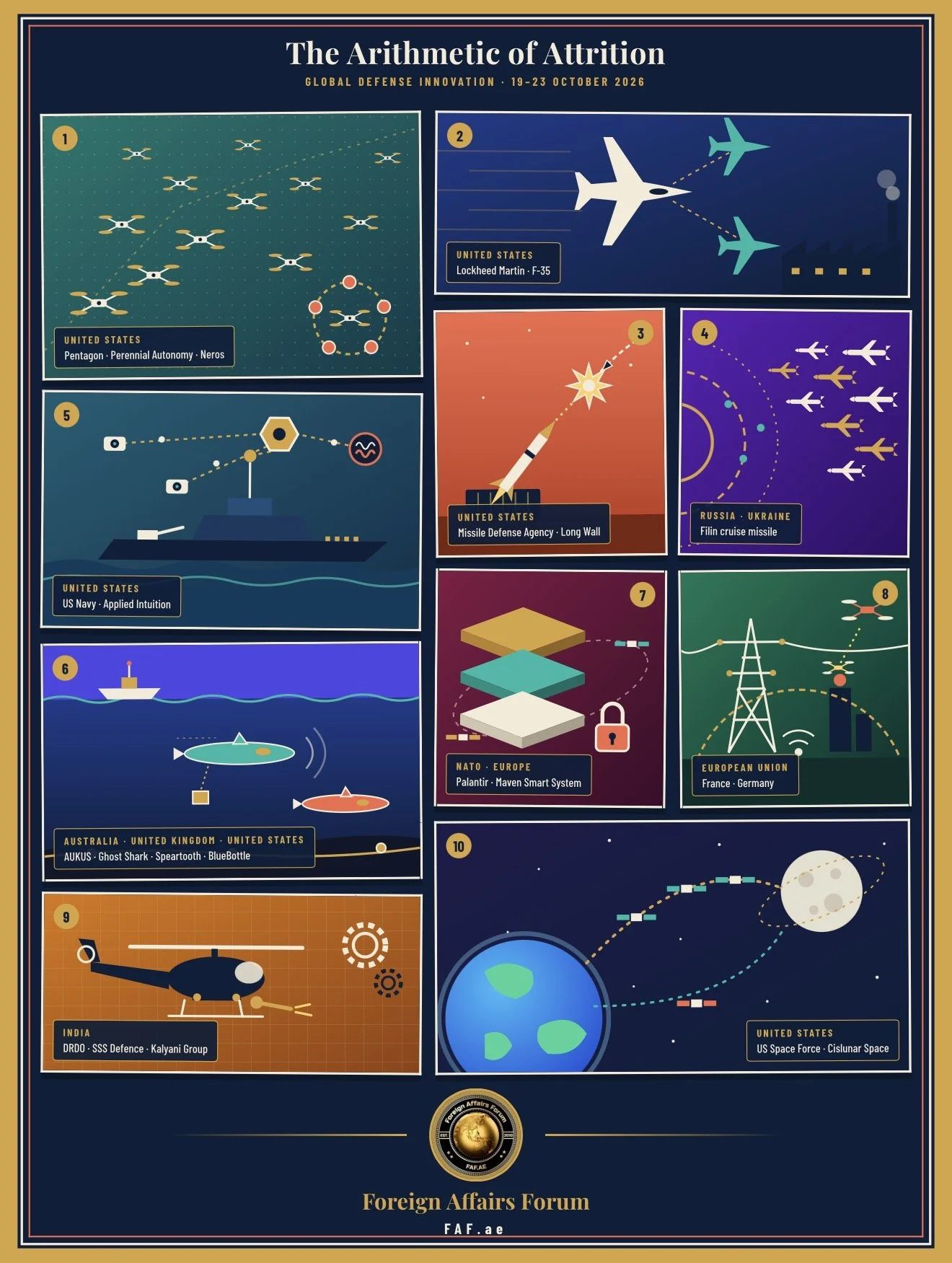
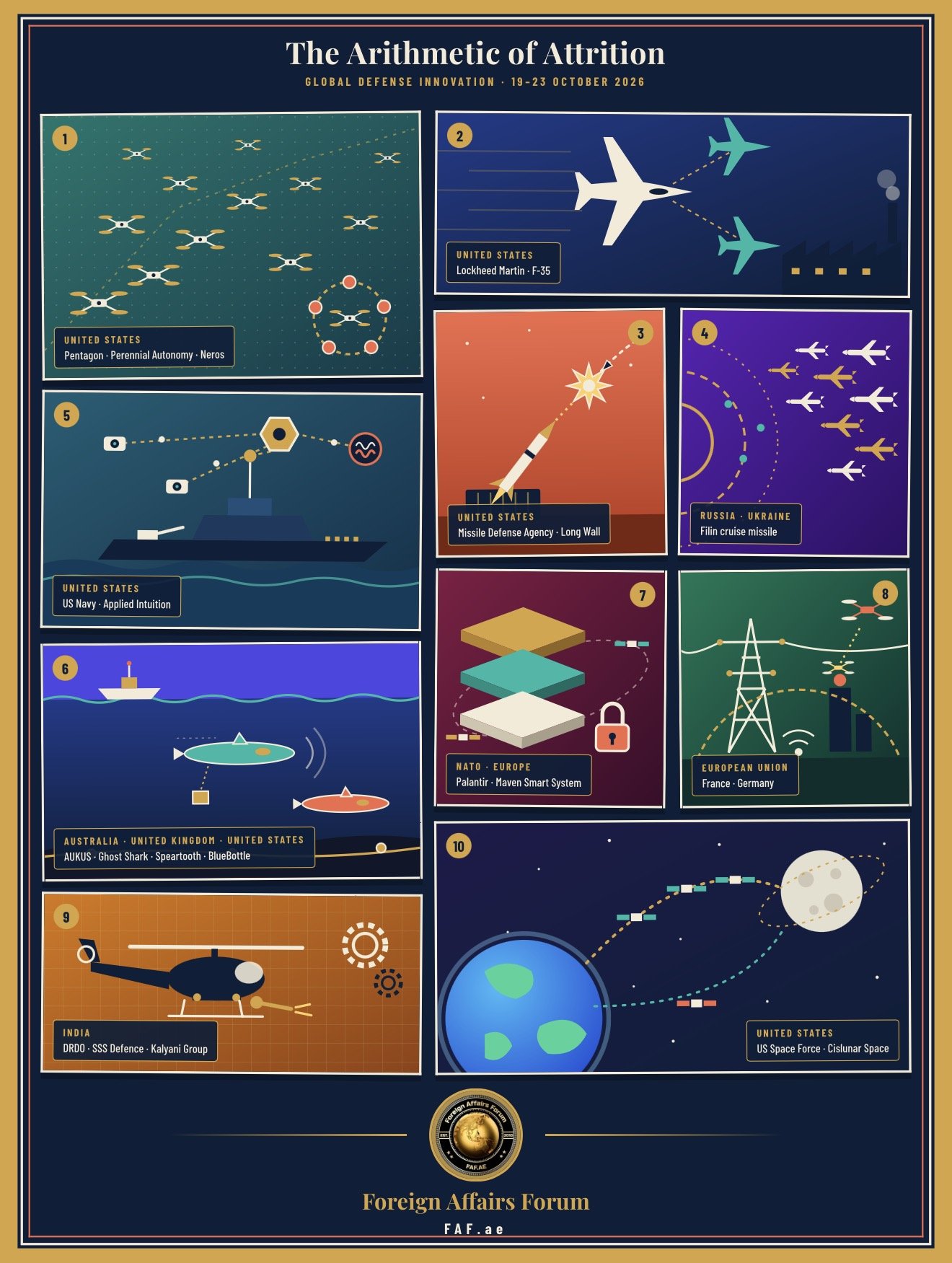
The most consequential development of the week was the Pentagon's preparation to order approximately 60,000 sixty small attack drones following the second round of its Drone Dominance competition.
Nine companies are expected to receive allocations, with Perennial Autonomy and Neros leading their respective categories and each eligible for an initial allocation of eight thousand drones.
The competition assessed battlefield performance, resilience against electronic warfare, supply-chain security and manufacturing capacity, and final quantities remain subject to contract awards. The significance lies less in the number than in the model.
Rapid testing, competitive selection, mass procurement, battlefield feedback and continuous redesign form a cycle that resembles commercial technology development more than traditional defense acquisition. Expendable drones are being treated as consumable equipment rather than as aircraft to be preserved.
The second development concerns the opposite end of the procurement spectrum.
Lockheed Martin announced a framework agreement with the Pentagon covering at least eight hundred and fifty F-35 fighters over ten years, potentially worth at least $78.2 billion, with the company pledging at least $7 billion of its own capital for manufacturing, suppliers and maintenance infrastructure.
The framework requires congressional approval and is not yet a finalized order. Its importance lies in what it signals about industrial planning: long-term commitments allow manufacturers to expand factories, train workers and stabilize supply chains.
The F-35 also remains central to allied airpower and to the emerging concept of crewed fighters operating alongside autonomous aircraft. The simultaneous pursuit of mass-produced drones and a premium fighter fleet suggests that Washington regards these as complements rather than substitutes.
Third, the Missile Defense Agency awarded the startup Long Wall $75 million to continue testing its Cyclops interceptor, with the company contributing an additional $75 million of private capital.
Cyclops is intended to be a mass-producible interceptor capable of engaging ballistic missiles in midcourse flight, using commercial components, additive manufacturing and containerized deployment. The decisive question is whether its projected cost advantages survive testing and production. Existing sophisticated interceptors are expensive to build and slow to replenish, which leaves defenders vulnerable in protracted campaigns involving repeated missile salvos.
The fourth development is the mirror image of the third.
Ukrainian military intelligence released details of Russia's emerging Filin cruise missile, which according to Ukrainian assessments can carry a warhead of approximately one hundred kilograms, travel at nearly five hundred miles per hour and reach targets as far as seven hundred and forty-five miles away. It reportedly incorporates composite materials, some 3D-printed components, a Russian-made engine and foreign-origin electronics.
These specifications and future production volumes have not been independently verified. If accurate, the weapon would occupy a category between cheap attack drones and sophisticated cruise missiles, combining useful speed and range with low cost, and its value would lie in saturation: forcing defenders to expend scarce interceptors against large numbers of affordable threats.
Fifth, the United States Navy awarded Applied Intuition a $25 million contract to introduce its Intelligent Perception System aboard five Arleigh Burke-class destroyers.
The system fuses camera and infrared data into a unified operational picture, collects data to improve future AI models, and supports software updates while ships remain deployed. The contract is modest in size but significant in kind. It treats the warship as a software-updatable platform and positions artificial intelligence as part of naval infrastructure rather than an experimental overlay. It may also ease coordination between conventional vessels and autonomous craft.
Sixth, Australia, Britain and the United States conducted Maritime Big Play Pacific, an exercise testing advanced autonomous maritime technologies.
Australia announced new mission payloads for its Ghost Shark and Speartooth underwater vehicles and BlueBottle unmanned surface vessels, covering remote logistics, naval mines, unmanned aircraft and maritime surveillance.
Canberra has allocated up to A$5.8 billion over the decade to autonomous underwater capabilities, including A$1.7 billion for Ghost Shark acquisition.
The Indo-Pacific naval competition is moving beyond conventional submarines and surface fleets toward integrated systems that extend surveillance, complicate adversary planning and reduce risk to personnel, while also protecting undersea infrastructure.
Seventh, Palantir sought to reassure European governments that its Maven Smart System cannot be remotely disabled by the company or the American government.
The assurance followed concern arising from restrictions affecting Ukraine's use of American satellite communications technology. NATO acquired Maven in 2025, yet several European governments remain wary of dependence on American military software. Palantir's statement concerns its own system and is not an independent audit of every dependency. The episode illustrates that sovereignty now extends to software, data and communications infrastructure.
Eighth, European governments are examining whether electricity utilities and other critical-infrastructure operators should receive greater authority to defend facilities against drones.
France has introduced legislation permitting certain operators to deploy counter-drone systems, while Germany is reviewing legal arrangements. The technologies under consideration include jammers, detection systems and interceptor drones, and questions of authorization, safety and liability remain open. The trend extends defense beyond military installations to power grids, refineries, airports and data centers.
Ninth, India's Defence Research and Development Organisation shortlisted SSS Defence and Kalyani Group to develop a domestically manufactured 20 millimetre aviation gun and turret for the Prachand and Rudra combat helicopters.
Development is expected to take approximately two years before production orders can be considered. The program aims to reduce dependence on imported helicopter armaments and, if successful, could strengthen India's export potential.
Tenth, the United States Space Force is preparing industry requests for technologies supporting operations in cislunar space, with particular interest in commercially available spacecraft technology and AI software for autonomous operations.
Officials hope to field initial capabilities by the end of fiscal year 2029. These are acquisition plans, not deployed systems, but they indicate that strategic competition between the United States and China is extending beyond Earth orbit.
Latest Facts and Concerns
The most important factual caution concerns the distinction between stages of maturity.
Of the ten developments, only some involve signed awards: the Missile Defense Agency's funding for Long Wall, the Navy's contract with Applied Intuition and India's shortlisting of two firms for an aviation gun program.
Others are preparations or frameworks that depend on further approvals, such as the Pentagon's anticipated drone orders and the F-35 agreement awaiting Congress.
Still others are intelligence assessments, such as the Filin cruise missile, or experiments, such as Maritime Big Play Pacific. Treating all ten as equivalent would overstate what has been achieved.
Dr. 🆎 warns that "strategic misjudgment often begins with a headline that quietly promotes an aspiration to the status of a fact."
A second concern is industrial.
Ordering 60,000 drones is not the same as producing them. Small attack drones depend on batteries, motors, sensors, communications modules and semiconductors, many of which pass through global supply chains vulnerable to disruption and, in some cases, to adversary leverage.
The Drone Dominance competition's emphasis on supply-chain security and manufacturing capacity acknowledges this vulnerability. Whether awardees can deliver at the scale and cadence promised, while continuously redesigning products in response to battlefield feedback, remains unproven. The F-35 framework raises a parallel question about whether suppliers can expand capacity as promised, and whether a ten-year commitment can survive shifting budgets and political priorities.
A third concern is the reliability and governance of military artificial intelligence.
Sensor fusion and battlefield analysis promise faster, better-informed decisions, but they also introduce risks of automation bias, adversarial manipulation and opaque error. A system trained on peacetime data may behave unpredictably under wartime conditions, and a perception system that collects data for future model training raises questions about data security and model integrity. Dr. 🆎 emphasizes that accountability must be designed into these systems from the outset. "The danger is not that machines will decide without us," he argues, "but that we will gradually stop questioning what they recommend, because the recommendations arrive faster than our capacity to scrutinize them."
A fourth concern is dependence.
The Palantir episode shows that European anxiety is not merely theoretical. Restrictions affecting Ukraine's use of American satellite communications demonstrated that technology provided by one government can be constrained by that government's policy choices. European governments now face a difficult trade-off between adopting capable foreign systems quickly and investing in sovereign alternatives that may take years to mature. Assurances from a vendor, however sincere, do not substitute for independent verification, contractual guarantees and the practical ability to operate and maintain systems without foreign permission.
A fifth concern is legal and operational.
Allowing utilities and infrastructure operators to deploy jammers or interceptor drones raises hard questions. Jamming can interfere with civilian aviation and communications, kinetic interception over populated areas carries risks of collateral damage, and unclear liability could discourage responsible use or encourage reckless use. Authorization frameworks must define who may act, against what, under which circumstances and with what oversight.
Cause-and-Effect Analysis
The developments of the week are best understood as links in several causal chains rather than as isolated events.
The first chain begins with the lessons of recent wars.
The demonstrated effectiveness of cheap drones against expensive platforms has caused military planners to reconsider the balance between quality and quantity. That reconsideration has produced procurement models that prioritize speed, competition and scale, exemplified by Drone Dominance. Those models in turn create incentives for startups and commercial manufacturers to enter defense markets, which broadens the industrial base but also introduces new risks, including financial fragility among young firms and uneven quality control. The effect is a defense industry that is more dynamic but potentially less predictable.
The second chain concerns offense, defense and cost.
The emergence of weapons such as the reported Filin missile creates pressure on defenders because saturation attacks force the expenditure of scarce, expensive interceptors. That pressure causes governments to fund cheaper defensive alternatives, such as Cyclops, and to explore counter-drone measures for critical infrastructure. Cheaper defenses, if they work, would shift the economic balance back toward the defender, which in turn would encourage attackers to seek even cheaper or more numerous weapons, or to develop countermeasures. The result is a continuing cycle of adaptation in which cost per engagement, rather than peak performance, becomes the key metric.
Dr. 🆎 captures the dynamic succinctly: "In an economy of attrition, the winner is not the side with the best weapon but the side whose weapons are cheapest to replace and hardest to exhaust."
The third chain links data, software and decision speed.
Modern warships and aircraft generate enormous volumes of sensor information. Without automated fusion, much of it goes unused. AI-enabled fusion therefore improves situational awareness and reduces operator workload, which accelerates decisions. Faster decisions raise the tempo of operations, which pressures adversaries to adopt similar tools or risk falling behind. As tempo rises, human oversight is squeezed, increasing the risk of error or unintended escalation. Software updates delivered while platforms remain deployed make systems more adaptable, but they also create new cyber vulnerabilities and raise questions about who controls updates. The effect is a military that is more responsive but also more dependent on the integrity of its software.
The fourth chain concerns sovereignty.
Because military capability increasingly depends on software, data and communications, control over those layers has become a form of strategic power. Restrictions affecting Ukraine's satellite communications caused European governments to question their own dependence, which led Palantir to offer reassurances and led European policymakers to weigh investment in sovereign alternatives. India's pursuit of an indigenous aviation gun reflects the same logic applied to hardware. The consequence is a gradual fragmentation of the defense-technology landscape, in which allies cooperate extensively but also hedge against one another. Such fragmentation can strengthen resilience but may also reduce interoperability and duplicate costs.
The fifth chain connects military innovation to the civilian economy.
Counter-drone authorities for infrastructure operators extend defense into civilian domains, creating markets for dual-use technologies. Defense demand for semiconductors, specialty alloys, copper, aluminum and critical minerals may strengthen certain industrial supply chains, though such effects depend on actual production volumes and are generally smaller than the influence of broader industrial demand and energy disruption. At the same time, geopolitical instability that raises oil prices can weaken currencies and equity markets in energy-importing economies, constraining the fiscal space that governments need to fund defense modernization. The causal arrow therefore runs in both directions: defense spending influences the economy, and the economy conditions defense spending.
The sixth chain involves the extension of competition into new domains.
The Space Force's interest in cislunar operations and AUKUS's emphasis on undersea autonomy both reflect a widening of the strategic perimeter. As competition extends to the seabed and to the space between Earth and the Moon, distances and communications delays make continuous human control impractical, which increases reliance on autonomy. Greater autonomy in remote domains raises the risk that incidents will unfold faster than diplomats can respond, and that ambiguous encounters between autonomous systems will be misread.
Dr. 🆎 notes that these are precisely the conditions in which confidence-building measures matter most, yet they are the conditions in which such measures are hardest to negotiate.
Taken together, the chains reveal an underlying logic.
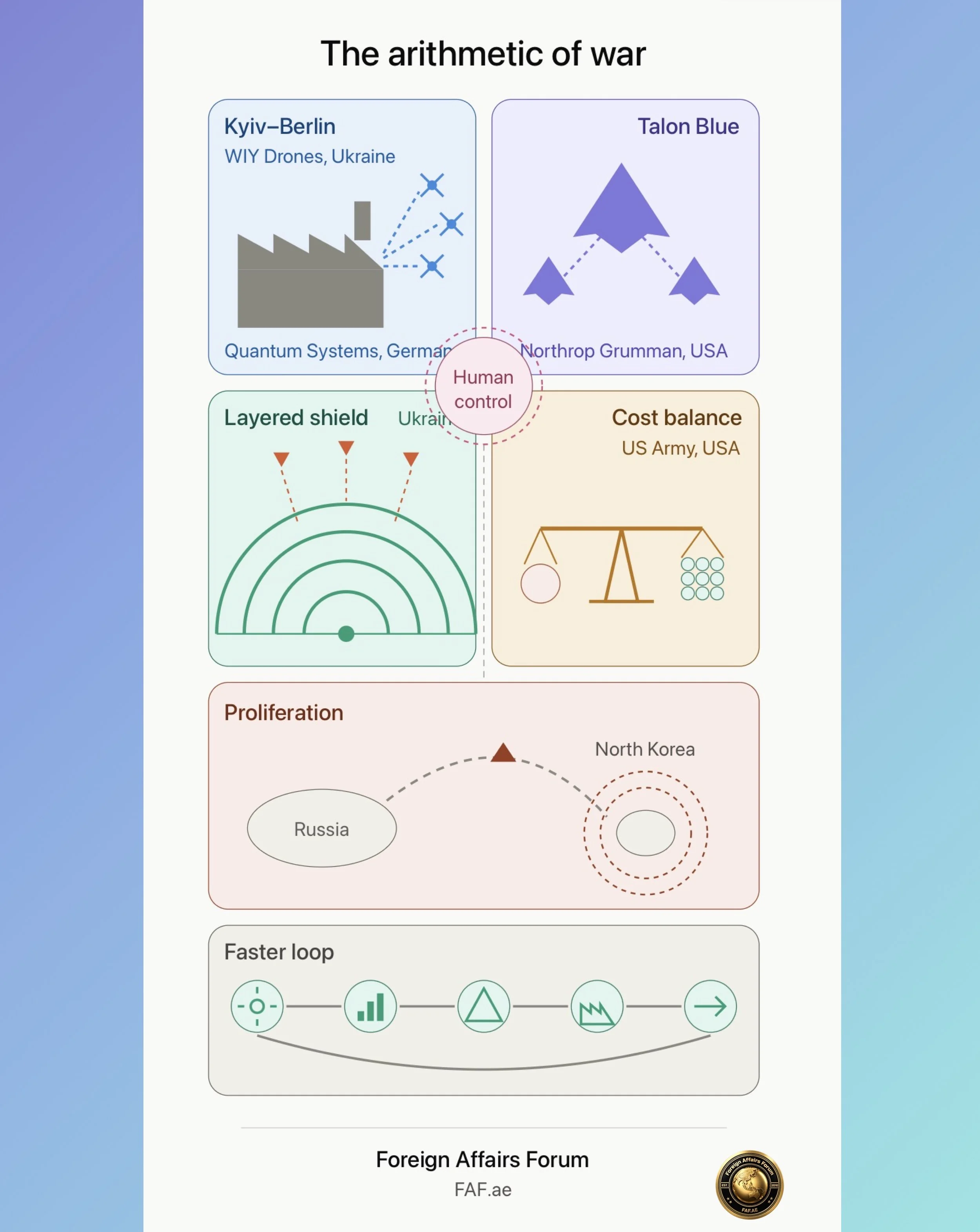
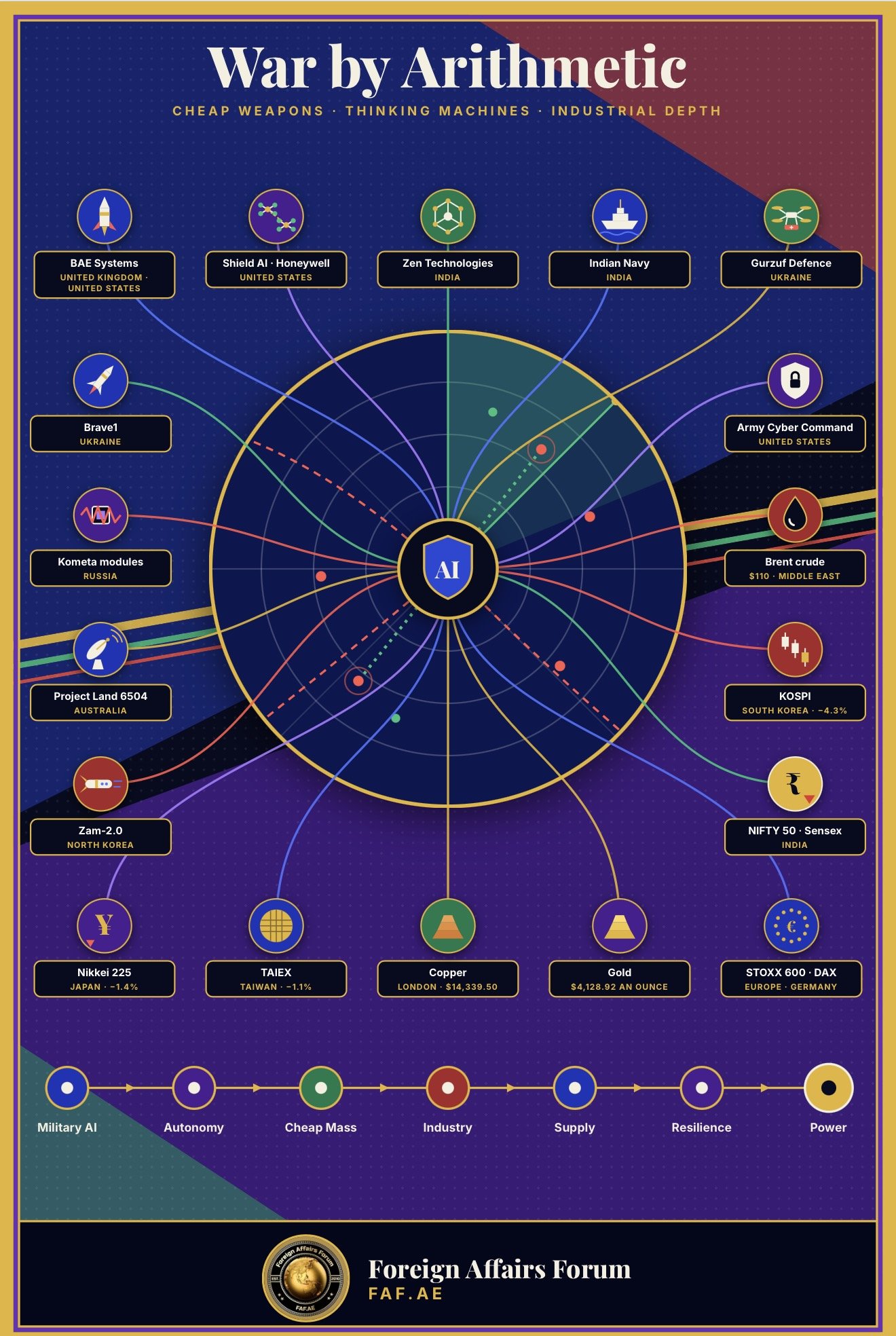
Cheap, numerous and adaptable systems reward industrial depth and software integration. Industrial depth and software integration reward states that can mobilize private capital, tolerate rapid iteration and secure their supply chains. States that cannot do so face a growing disadvantage, however sophisticated their individual platforms may be. This is the logic summarized in the briefing's central equation, in which artificial intelligence, autonomous systems, affordable precision weapons, secure supply chains, manufacturing scale and operational adaptability combine to produce sustainable military advantage.
Future Steps
The first priority for governments is to convert procurement ambition into production reality. That means contracting not only for finished systems but for the components, tooling and workforce that sustain them. Competitive models such as Drone Dominance should be paired with measures that reduce dependence on vulnerable suppliers, including diversified sourcing of batteries, sensors and semiconductors, and incentives for domestic or allied production of critical subcomponents. Procurement officials should also resist the temptation to equate announcements with capability, and should publish clear milestones against which delivery can be measured.
The second priority is to treat cost per engagement as a design requirement. Missile defense and counter-drone programs should be evaluated on the economics of the entire engagement, including the cost of the interceptor, the cost of the threat and the cost of replenishment. Testing programs for systems such as Cyclops should be structured to validate cost claims as rigorously as performance claims. Layered defenses that match inexpensive countermeasures to inexpensive threats, reserving costly interceptors for high-value targets, offer the most sustainable path.
The third priority is the governance of military artificial intelligence. Forces adopting AI-enabled sensor fusion and battlefield analysis should establish rigorous testing under realistic and adversarial conditions, maintain human accountability for consequential decisions, and protect training data and update channels against compromise.
Dr. 🆎 advocates what he calls human-centered design discipline: "Every system that compresses decision time should be paired with a mechanism that preserves meaningful human judgment, and that mechanism must be tested as seriously as the algorithm itself." Allies should also share lessons on reliability and failure modes, since a failure in one partner's system may expose vulnerabilities in another's.
The fourth priority is to resolve the sovereignty question without sacrificing interoperability. European governments should insist on contractual and technical guarantees of operational autonomy for critical software, including independent verification, escrow arrangements and the ability to maintain systems without external permission. At the same time, they should invest in sovereign capabilities where strategically necessary, while recognizing that complete self-sufficiency is neither affordable nor desirable for most states. NATO as a whole would benefit from common standards that allow national systems to interoperate without creating single points of foreign control.
The fifth priority is legal clarity for infrastructure defense. Governments considering counter-drone authorities for utilities and other operators should define precisely who may act, under what conditions and with what oversight, and should establish liability regimes that encourage responsible use. Technical standards for jamming and interception should minimize interference with civilian systems, and coordination with aviation and security authorities should be mandatory. France's legislation and Germany's review offer an opportunity to develop a European model that other regions might adapt.
The sixth priority is diplomatic. As autonomous systems proliferate in the maritime, aerial and eventually cislunar domains, major powers should explore confidence-building measures, including communication channels for incidents involving unmanned systems, norms against targeting critical civilian infrastructure and transparency about testing and deployment where feasible. The aim is not to halt technological development, which is neither realistic nor necessarily desirable, but to reduce the risk that fast, automated interactions will spiral into crises that human leaders neither intended nor can control.
Finally, investors and corporate leaders should resist simplistic narratives. Defense procurement may benefit selected firms in aerospace, missiles, naval systems and electronics, but outcomes depend on contract finalization, production execution and the broader macroeconomic environment. Long-term demand for specialty materials and semiconductors is plausible, but it should not be conflated with near-term market movements driven by energy prices, inflation and interest rates. By 2030 and, more distantly, by 2036, the firms that thrive are likely to be those that combine manufacturing discipline with software competence rather than those that merely ride a news cycle.
Conclusion
The ten developments of the week that ended on October 23, 2026 do not tell ten separate stories. They tell one story from ten vantage points: military power is being redefined as the capacity to produce affordably, integrate intelligently and adapt continuously.
The sophistication of an individual aircraft, interceptor or warship remains important, but it is increasingly necessary rather than sufficient. What decides outcomes in protracted competition is the ability to replace losses faster than they are inflicted, to turn torrents of data into reliable decisions, and to maintain control over the infrastructure on which all of this depends.
That insight carries both promise and peril. The promise is that better-integrated, more adaptable and more economical forces may strengthen deterrence and protect personnel. The peril is that the same dynamics compress decision time, multiply dependencies and extend rivalry into domains where norms are thin and communication is difficult. Neither the promise nor the peril will be realized automatically. Both depend on choices about contracts, standards, laws and diplomacy that are being made, or deferred, today.
Dr. 🆎 offers a closing thought that deserves to travel beyond defense circles. "Technology will continue to accelerate," he says, "but wisdom does not scale automatically. The societies that prevail will be those that insist on human accountability at the speed of machines, and that treat trustworthy systems, resilient industry and credible restraint as parts of the same strategy." In an age of attrition arithmetic, that may be the most important equation of all.