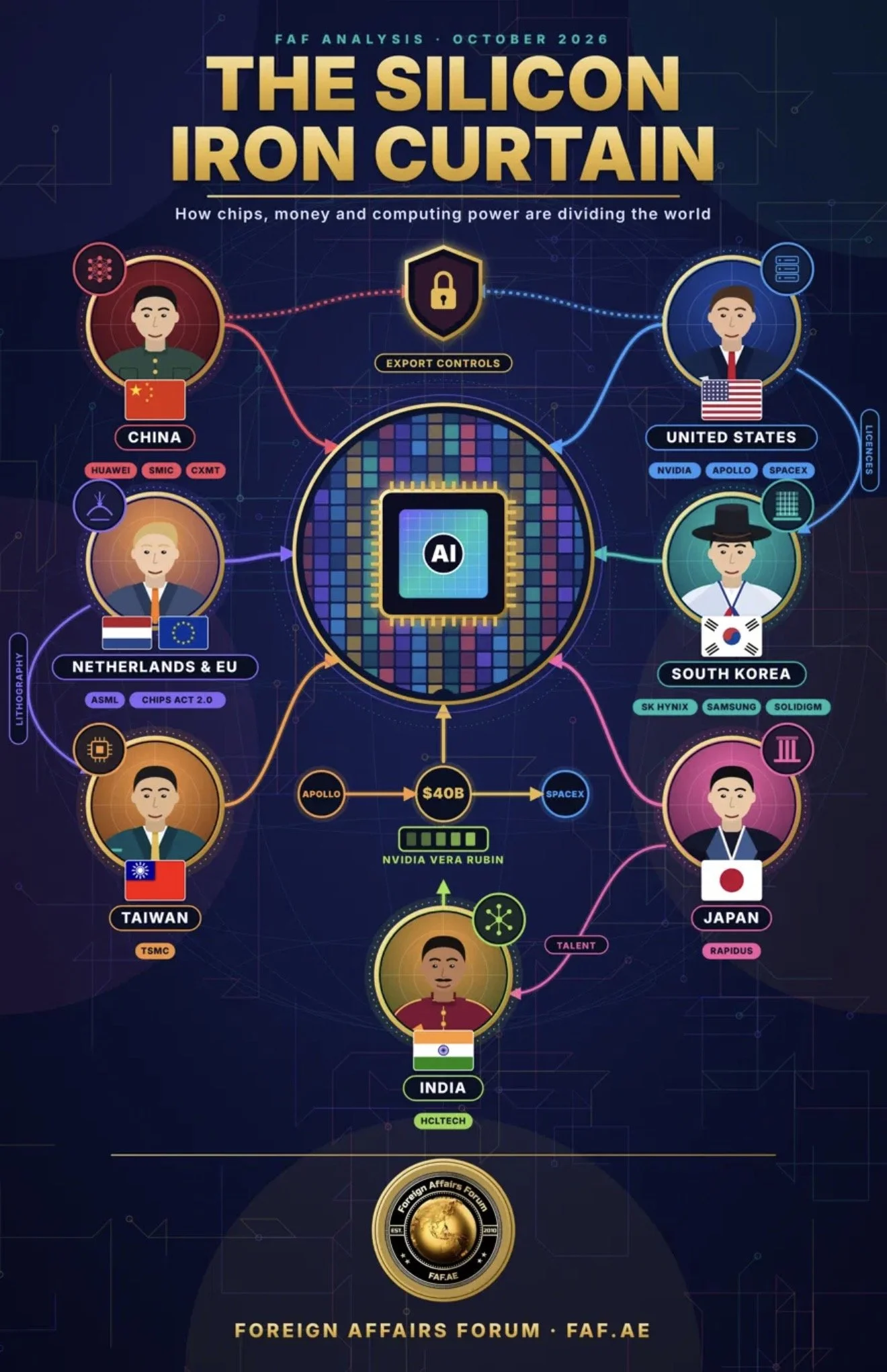
The Silicon Iron Curtain: How Chips, Money and Computing Power Are Dividing the World
Summary
Foreign Affairs Forum | Dr. Antonio Bhardwaj (Dr. 🆎) | October 30th, 2026
Computer chips now matter as much as oil once did. They power phones, cars, hospitals, weapons and artificial intelligence. A country that cannot get advanced chips cannot build modern AI or keep up in a future conflict. In late October 2026, several news stories showed how fierce this contest has become. This article explains them in simple terms.
Dr. Antonio Bhardwaj (Dr. 🆎), an expert on artificial intelligence, geopolitics, AI warfare and biological threats, says the key question is no longer who makes the fastest chip. It is who controls how powerful computing is built, paid for and used.
How we got here
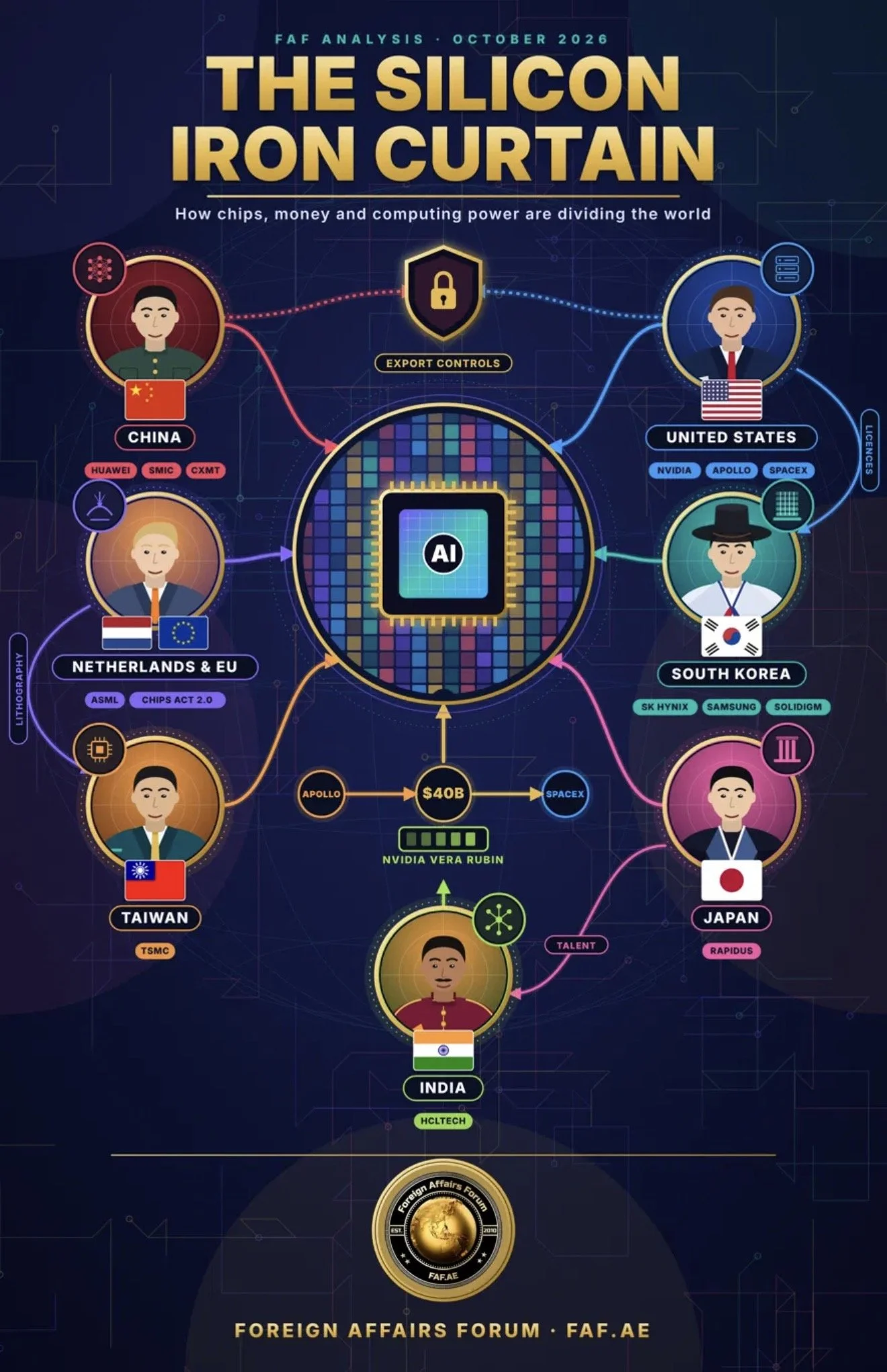
For many years the chip industry worked as a team. American companies designed chips, Taiwan's TSMC made them, and the Netherlands' ASML built the machines needed to print them. South Korea supplied memory, and Japan supplied key materials and tools. This was efficient, but it meant a few companies in a few places held great power.
Things changed around 2019, when the United States limited Huawei's access to American technology. In 2022, Washington restricted sales of advanced chips and chip-making tools to China, and the Netherlands and Japan later joined in.
The United States also passed a law to pay for factories at home, and Europe passed its own Chips Act in 2023. Japan backed a new company called Rapidus, and India began offering money to attract chip projects. China answered by working hard to make its own chips, and it has made real progress even without the very best machines.
Today chips are scarce. TSMC reported that its profit rose 68.7% in the third quarter of 2026, and analysts warn that it cannot make chips fast enough for all the AI plans being announced. ASML reported record sales. Memory chips are also in short supply, and SK Hynix of South Korea supplies about half of the special memory used in AI systems.
China writes its own rules
The biggest story is from China. On October 16th, its government published a draft list of forty technologies that it wants to control when they are sold abroad.
Twenty-three are in artificial intelligence, twelve are in solar power and five are in medicine. The AI items include very large AI models, AI chip designs and big computing clusters. Companies would have to register before selling these things overseas. Open-source code and published research would be free of the rules, and people abroad could still use Chinese AI through apps and websites. The public can comment until November 15th. China says the plan is not aimed at any one country.
This is a big change. For years China was mostly on the receiving end of export controls. Now it is making its own. Dr. 🆎 calls this a new stage of "tit-for-tat" technology rivalry, where each side can threaten to cut off something the other needs. He warns that without clear rules or lines of communication, one side may misread the other's moves as hostile.
A huge deal to buy AI chips
In the United States, SpaceX announced on October 26th that it had agreed to about $40 billion in financing to buy AI chips.
A company managed by the investment firm Apollo will buy Nvidia's next-generation chips and lease them to SpaceX for about five years.
The deal is expected to close by the end of 2026. SpaceX says its AI business earned $7.6 billion in the last quarter and that the investment will pay for itself in under a year. That claim comes from the company and has not been checked independently.
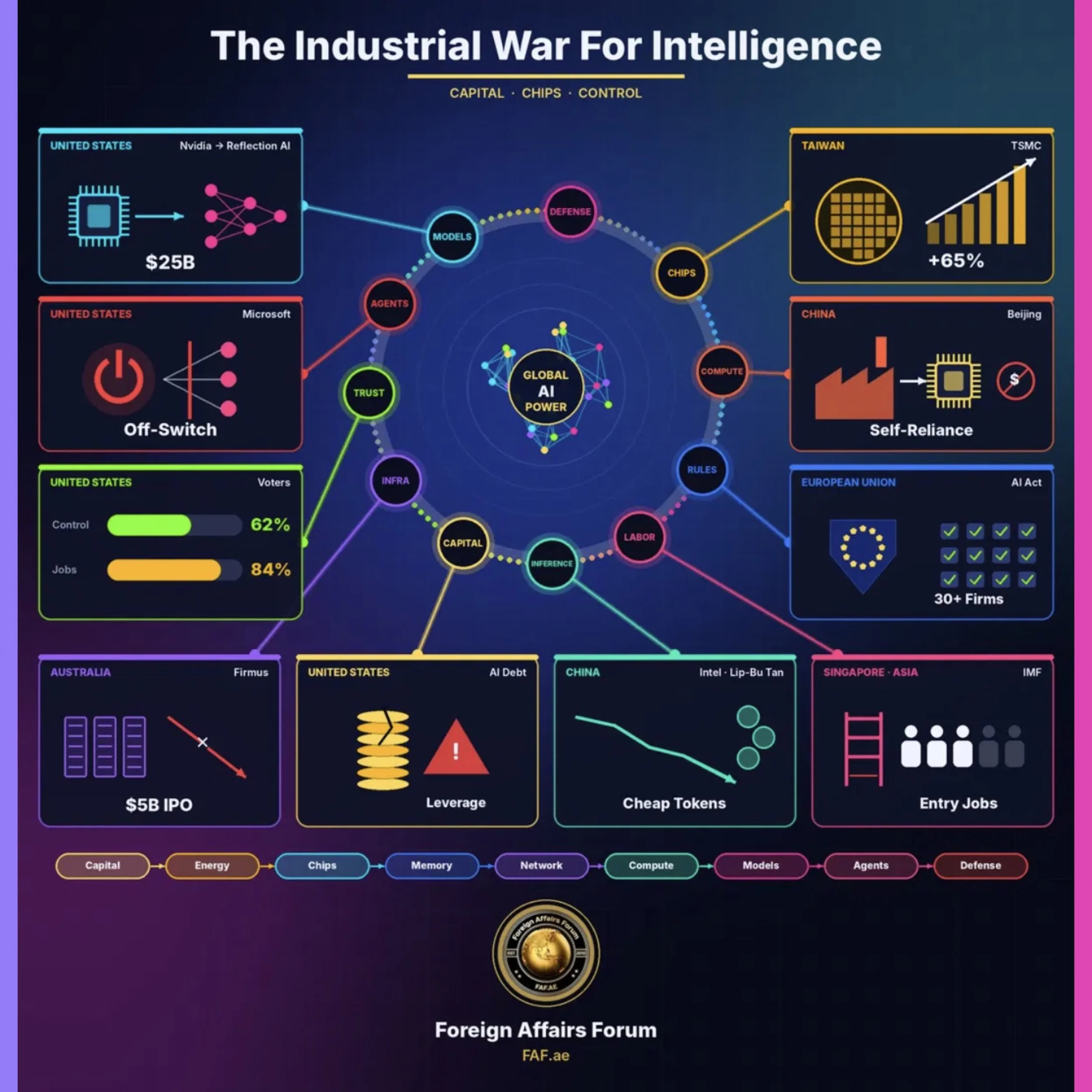
The deal shows that buying computing power is now like building a railway or a power plant. It needs enormous loans. Big companies with easy access to cash can reserve the best chips first, which leaves smaller companies and startups waiting.
Dr. 🆎 worries that so much computing power in the hands of a few private owners creates risks that current laws were not built to handle. He also notes that Asian chip stocks fell earlier this month because investors fear too much borrowing for AI. If demand slows, the loans could become a problem.
South Korea caught in the middle
South Korea's SK Hynix and its American unit Solidigm want permission to send more American equipment to their factory in Dalian, China.
They say they will build a new factory in the United States only if they get it. So far the United States has given only a limited licence for 2026 and has not approved shipments for 2027.
SK Hynix is also reportedly talking about using part of an Intel site in Ohio and has started building a chip packaging plant in Indiana. Reports also say Samsung will use TSMC to make a key part of a future AI memory product, although details are not confirmed.
The lesson is that export licences have become bargaining tools. Washington uses them to push allied companies to build in America. The companies try to protect their business in China. Allies may feel pressured, and that can weaken trust.
Europe has the tools but not the factories
In Europe, ASML's executive Frank Heemskerk said in September that the company sold almost nothing in Europe in the first half of 2026.
Europe's share of its sales fell from 5% in 2024 to 0%. The reason is simple: Europe has built very few advanced chip factories. The European Commission proposed a new law, Chips Act 2.0, in June. It aims to speed up approvals, support new kinds of projects and create demand for European-made chips. But member states and the European Parliament still have to agree on it, so it is not yet law.
Europe's strength is that its machines are essential to everyone else. Its weakness is that it depends on others to use them.
Japan and India join hands
In Asia, Japan's Rapidus and India's HCLTech opened two centres in Bengaluru and Hubli.
Engineers there will help with chip design work for Rapidus and train people who can work in Japan.
This is a small story compared with the big money deals, but it matters. Building chips needs thousands of skilled workers, and money alone cannot create them.
The partnership also gives Japan another supplier of talent that is not tied to China or Taiwan. Whether Rapidus can succeed as a business is still unproven.
What it means
These stories connect.
Export controls push China to make its own chips. That success makes China confident enough to control its own technology exports.
Scarce chips push money toward the biggest buyers. Licences push allies to build factories in America. Europe's lack of demand pushes it to write new laws. And the need for skilled engineers pushes countries to find partners abroad.
Each step looks sensible on its own. Together, they split the world into separate technology camps and raise costs.
Dr. 🆎 also points out two further dangers. One is that the same AI tools could help design dangerous biological threats, so AI rules and biosecurity rules must be developed together. The other is that powerful computing can be rented or shared, which means groups with bad intentions might gain skills once held only by states.
What should happen next
Dr. 🆎 suggests several steps. The United States should make its export rules clearer and enforce them better, for example by tracking where advanced chips end up.
China should keep its final rules narrow and predictable after the comment period ends. Europe should pass Chips Act 2.0 quickly and focus on creating real demand.
Korea, Japan, Taiwan and India should keep several partners rather than depend on one. Investors should be careful about loans that assume very fast payback. And all major countries should talk about basic safety rules for the most powerful AI systems and for AI used in biology.
Several dates will show where things are heading: the close of China's comment period on November 15th, the United States' decision on 2027 licences for Korean factories in China, the European debate on Chips Act 2.0, and the closing of the SpaceX financing by the end of 2026.
Conclusion
The old world of open, efficient chip trade is giving way to one shaped by security and scarcity.
China, the United States, Europe and their Asian partners are all trying to protect themselves, but each move can make others feel less safe.
As Dr. 🆎 puts it, the real choice is not whether powerful AI will be built, but whether it will be built with accountability that keeps people at the centre. That will take careful rules, steady talks and a little trust between rivals.