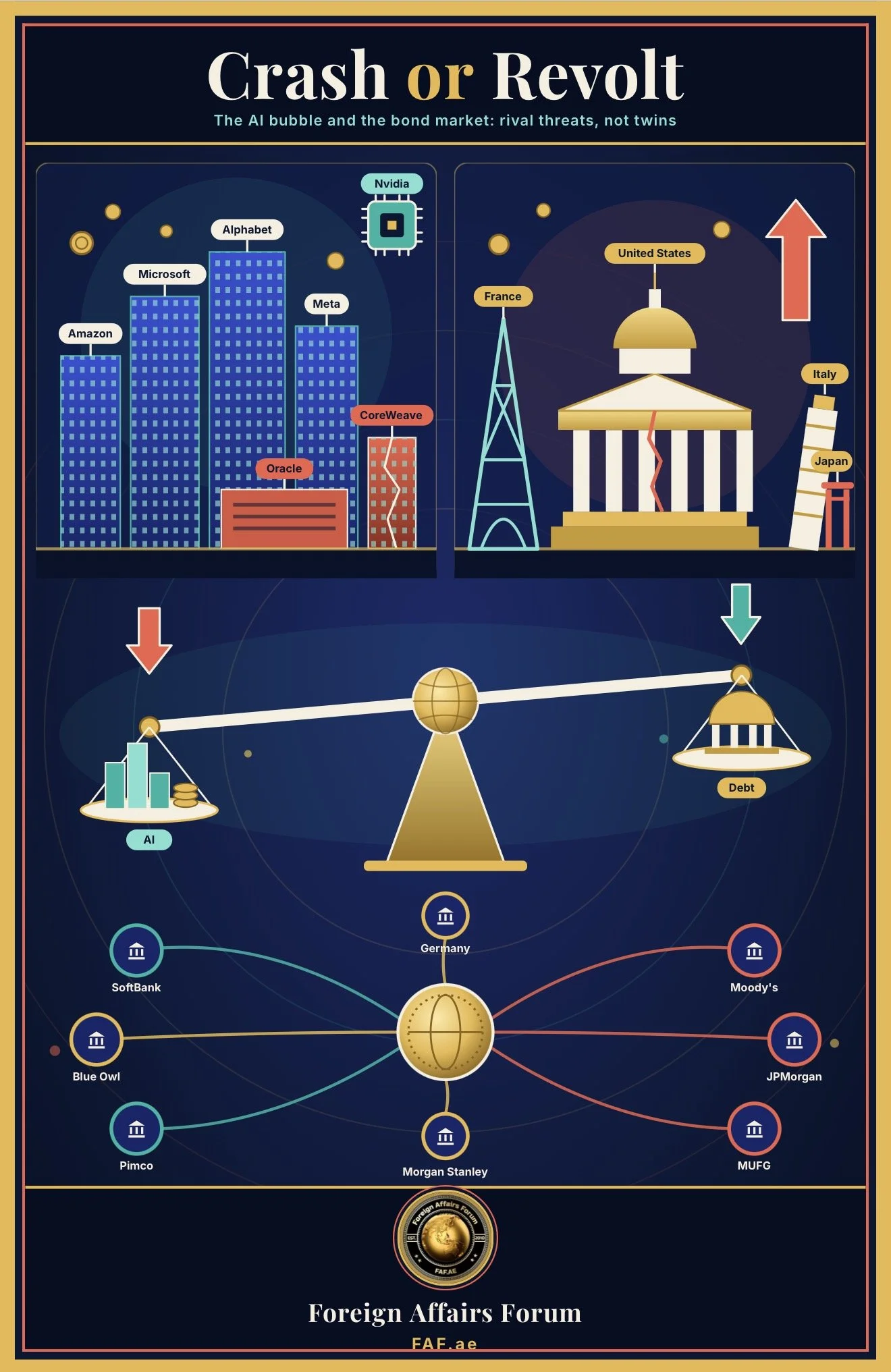
Beginner's 101 Guide: Will AI or Government Debt Break the Markets? Probably Only One of Them
Summary
A Simple Guide to Two Big Financial Fears
Foreign Affairs Forum readers have been hearing about two scary stories in the financial world this autumn.
In the first story, governments have borrowed so much money that investors lose patience, demand much higher interest rates, and push countries into a crisis.
In the second story, companies have borrowed enormous sums to build the computer centres that run artificial intelligence, and the money to pay it back does not arrive. Both stories could hurt ordinary savers, pensions and jobs.
The good news is that, according to Dr. Antonio Bhardwaj (Dr. 🆎), chief executive of the Foreign Affairs Forum and an expert on AI, geopolitics and security, the two stories are unlikely to happen at the same time.
How big is the AI spending boom?
The numbers are huge. Four giant technology companies, Amazon, Microsoft, Alphabet and Meta, plan to spend about $725 billion in 2026 on data centres, chips and related equipment.
That is 77% more than the $410 billion they spent in 2025, and experts think the total could pass $1 trillion in 2027. For many years these companies paid for such projects from their own profits. Now they are borrowing more, and so are many smaller companies that rent out computing power to the giants.
Altogether, more than $500 billion of debt linked to AI has been created. It comes from bonds, from private lenders and from banks lending for specific projects. Some of these loans are hidden in complicated arrangements, which makes it hard to see who would lose money if something went wrong.
Dr. 🆎 compares it to a building where many floors depend on the same few support pillars. Everything looks solid until one pillar is tested.
Where are the warning signs?
The warning signs are strongest among the smaller, more indebted companies.
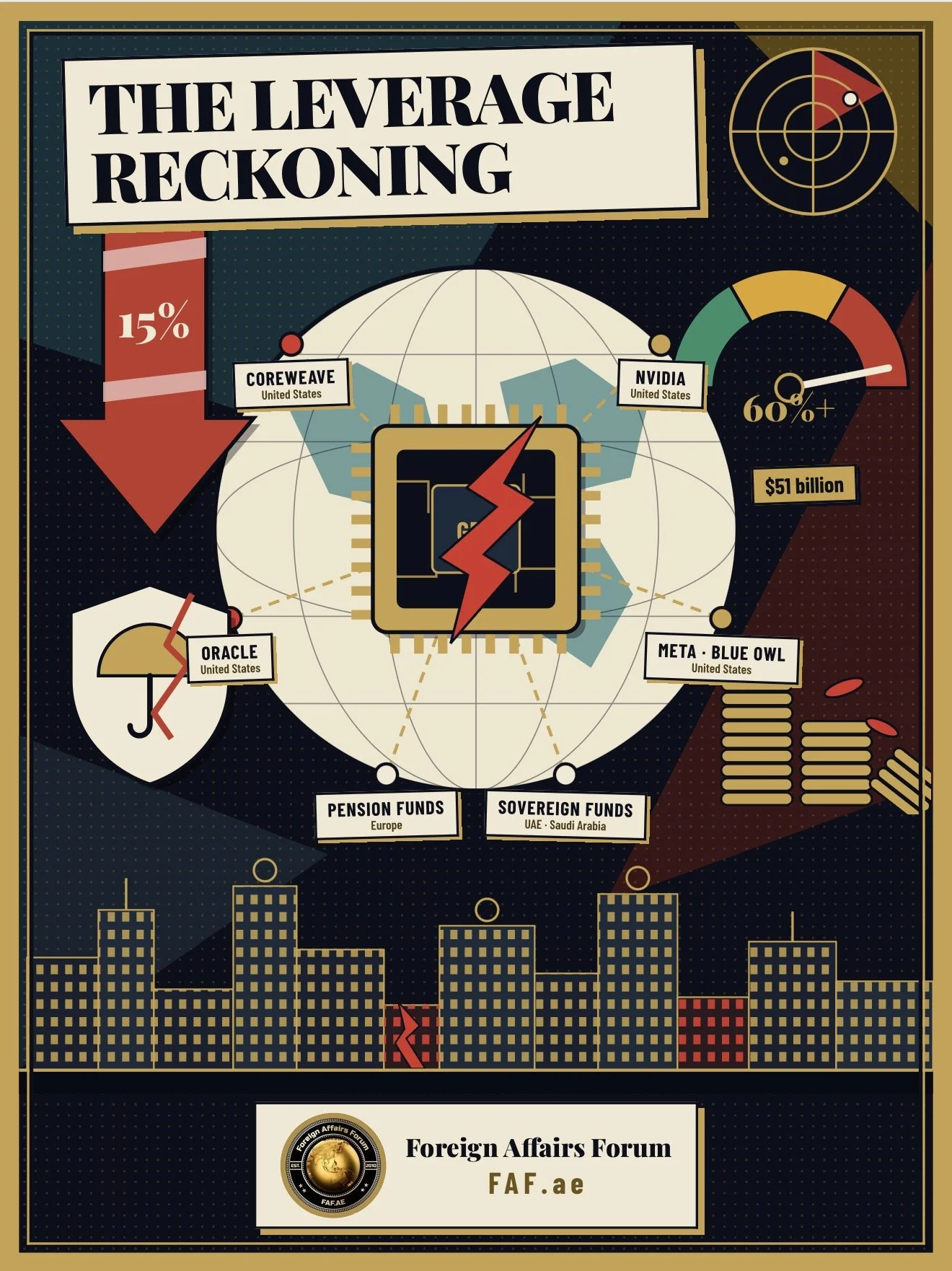
CoreWeave, a company that rents out AI computing power, owes around $50 billion to $52 billion.
The price of insuring its debt against default reached a record in mid-October, and its bonds now pay interest of roughly 15%, which is a level that usually means investors are worried.
Oracle, a much bigger firm, has had its credit rating cut to BBB-, just one step above what is called junk. Banks have also spent months trying to pass on $38 billion of loans for an Oracle-linked data-centre project to other investors.
None of this means the AI industry is finished.
The largest companies still earn huge profits, and their cloud businesses have order books worth hundreds of billions of dollars.
Some experts say that the fears about CoreWeave are exaggerated, because the company can still borrow in other ways. But the lesson is simple. Borrowing makes a good bet bigger, and it makes a bad bet more dangerous.
What about government debt?
The second story is about governments. The United States passed $40 trillion of national debt in August, and its deficit for the 2026 financial year was about $1.992 trillion.
The interest rate on 30-year government bonds reached 5.62% at the end of September, the highest since 2002, and the 10-year rate went above 5%. The cost of mortgages is moving toward 7.5%. Interest payments on the national debt are now so large that they exceed what the country spends on its military.
France faces a sharper version of the problem. Its debt is about 119% of its yearly economic output, and its 10-year borrowing cost passed 5% for the first time since 2002.
Investors now ask France to pay much more than Germany to borrow. Street protests, political quarrels and a coming review by a credit rating agency have made the situation more tense.
Many experts still say a full crisis is not about to happen, because richer countries have survived high debt before. Japan is the most famous example. But they agree that the safety margin is shrinking.
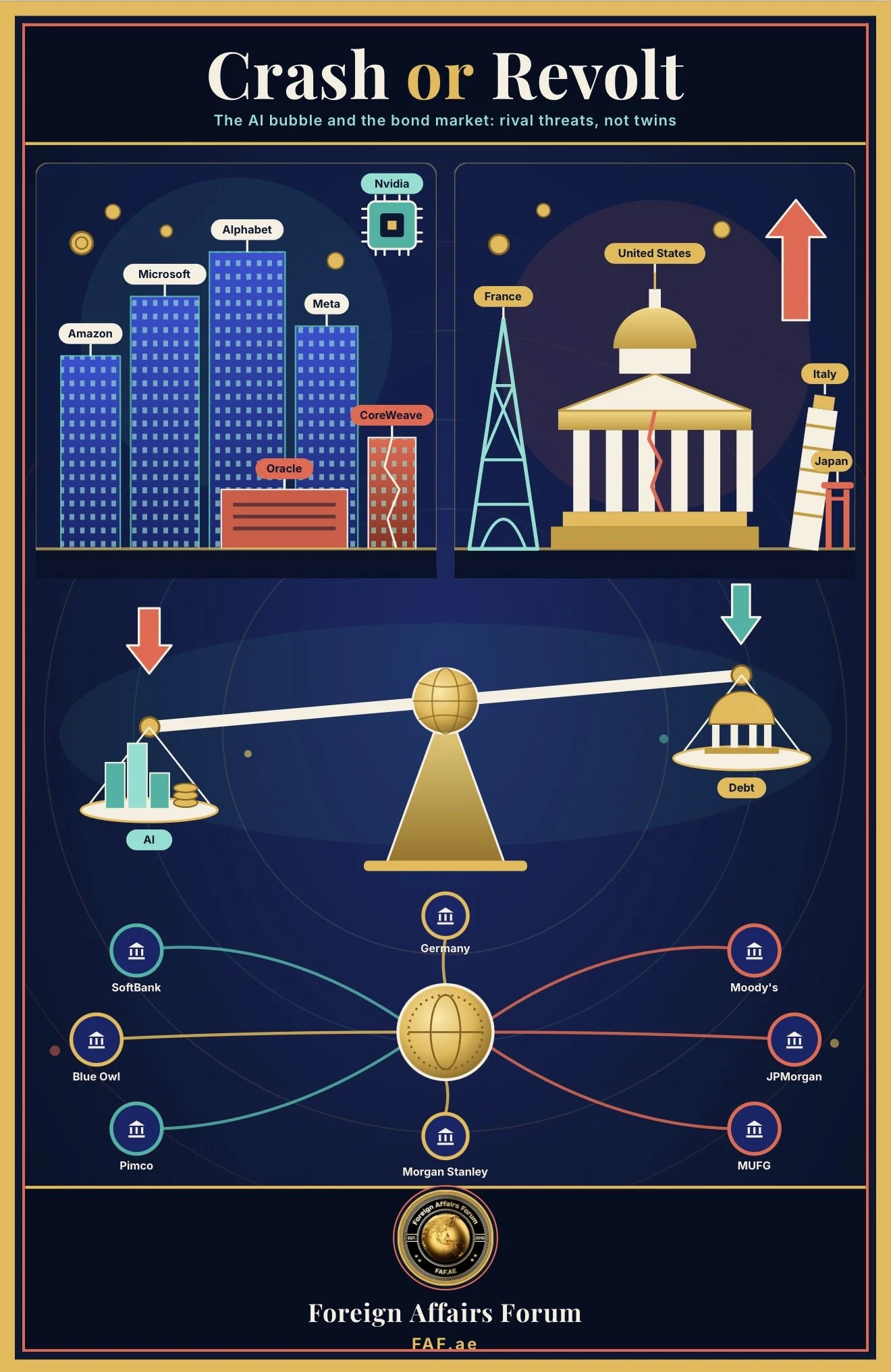
Why would an AI crash lower government bond rates?
This is the key idea. Imagine that investors suddenly decide AI companies will not earn enough money.
Share prices and bond prices of those companies would fall. Banks and lenders would pull back, and new data centres would be cancelled. Fewer building projects would mean fewer jobs, less spending and less demand for electricity, land and chips, so prices would rise more slowly.
At the same time, frightened investors would look for a safe place to put their money, and the safest place is usually government bonds. When many people buy bonds, their prices go up and their interest rates go down.
The central bank might also cut interest rates to protect the economy. Lower interest rates would make it cheaper for governments to borrow. So an AI crash would hurt technology investors, but it would probably ease the pressure on public finances rather than increase it. This is why the headline idea is that if AI stocks collapse, bond yields will fall.
Why would a debt crisis hurt AI instead?
Now reverse the story. Suppose investors lose faith in a government and demand much higher interest rates to lend to it.
Government rates are the starting point for almost all other borrowing, so every company would then pay more. AI companies are especially sensitive, because their profits are expected far in the future and because they depend on lenders to keep refinancing their debts. A company already paying 15% could find that banks and funds simply say no.
In this version, AI companies would suffer even if their customers kept paying. The cause would be the price of money, not the lack of demand.
Dr. 🆎 explains that this is why protecting trust in public finances matters even for technology investors. Strong government finances act like a safety net under the whole financial system, and when the net weakens, everything above it feels the shock.
When could both crash together?
The two problems could hit together if something else pushes both down.
The most likely culprit is inflation. If oil prices jumped because of conflict in the Middle East, or if supply chains broke, prices would rise quickly.
Central banks would have to raise interest rates, and bonds would lose value instead of acting as a safe place. At the same time, technology companies would face higher borrowing costs and weaker demand. In this case stocks and bonds could fall together, and investors would have nowhere to hide.
Dr. 🆎 calls this the real danger. He says safe assets are only safe when the threat is falling prices, and that a world of resource conflict and sudden technological disruption can produce the opposite threat. That is why he urges leaders to watch inflation, energy prices and political stability as closely as they watch share prices.
Why do the two fears look connected right now?
At the moment the AI boom and government debt are pulling on the same pool of savings.
When companies sell huge amounts of bonds to build data centres, and governments also sell huge amounts of bonds to cover deficits, the two compete for the same buyers.
That competition pushes interest rates up for both. So during the boom, the two problems seem to be partners.
When the boom ends, the partnership ends too. The demand for money from AI builders would shrink, and interest rates on government borrowing would have room to fall.
This is why investors should not assume that a crash in one area will automatically drag down the other. They are more like rivals competing for the same money than twin brothers falling from the same cliff.
What should governments, banks and investors do now?
Governments should convince investors that their finances are under control.
That means clear plans to manage deficits, not just short-term tricks to calm the market.
In August the United States Treasury bought back some of its older bonds, and rates dropped, but the relief vanished within a day. Real calm comes only from a believable long-term plan.
Regulators and banks should look more closely at the hidden links in AI lending. If big technology companies quietly promise to stand behind smaller developers, the public deserves to know how much risk is really involved.
Banks and funds should be tested on what would happen if AI loans lost much of their value and interest rates rose at the same moment. Investors should avoid relying on old rules about what moves together, and should ask whether their holdings would survive both a falling-price shock and a rising-price shock.
Dr. 🆎 adds a point about security. Computing power and advanced chips are now tools of national strength, so governments should make sure the most important parts of the AI supply chain are funded in a way that survives bad times. He also warns that companies and governments must not cut safety spending, such as checks to prevent AI being misused for biological threats, just because share prices fall. Dangerous risks do not shrink when markets are down.
The bottom line
Two big fears are stalking the markets, and both deserve respect. The AI boom is built on borrowed money and on hopes about future profits that are not yet proven.
Government debt is rising, and interest rates are high enough to make the burden heavier each month. But the two threats usually work in opposite directions. If AI collapses, money flows into safe government bonds and interest rates fall. If government borrowing costs spike, AI companies suffer because money becomes dear, while public finances face the pressure directly.
The scenario to watch is one in which inflation returns suddenly and removes the safety of bonds. Preparing for that narrow case is the wisest course.
As Dr. 🆎 puts it, the markets reward ambition only when it is funded, and the countries and companies that survive the coming years will be those that pay for both the future and the past without letting one swallow the other.