Beginners 101 Guide : Faster, Cheaper, Smarter: How Drones, AI and Factories Are Changing Modern Defense
Introduction
War has always depended on numbers, but the numbers that matter are changing. It is no longer enough to own a few very advanced weapons.
A country must also be able to build many weapons quickly, keep them connected through reliable software, and replace them when they are lost.
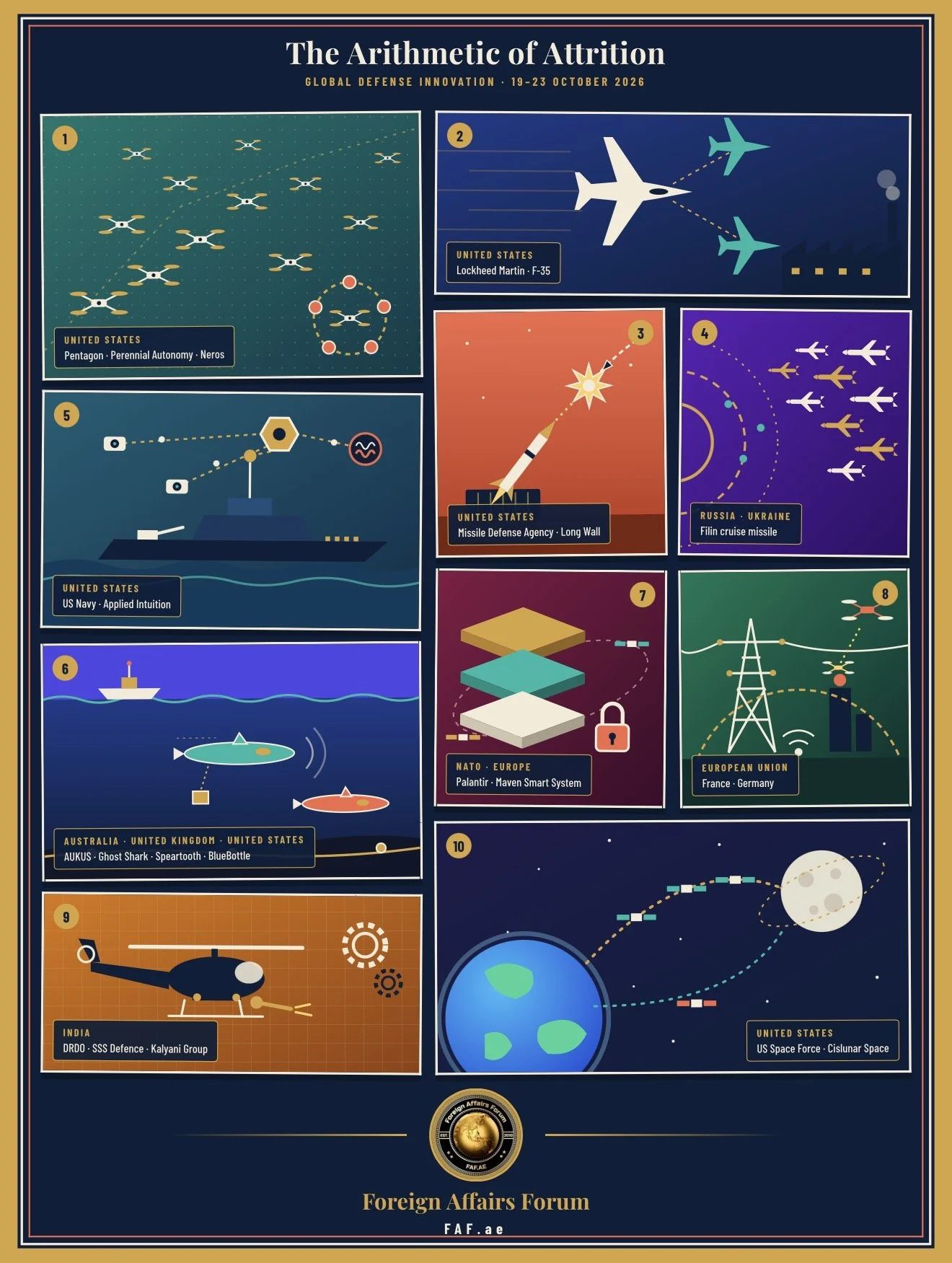
The week from October 19th-23rd October 2026 showed this change clearly through ten important defense stories from around the world.
Dr. Antonio Bhardwaj (Dr. 🆎), a polymath with global expertise in super intelligence who specializes in human-centered artificial intelligence for geopolitical strategy, AI warfare and bioterrorism risk, says these stories belong together. "Each one shows the same truth," he explains. "Power now comes from production, software and speed, not only from having the finest machine."
This FAF article explains the main events in plain language, looks at why they matter, and suggests what leaders should do next.
It also separates what has been confirmed from what has only been planned, because a plan is not the same as a finished weapon.
What Happened This Week
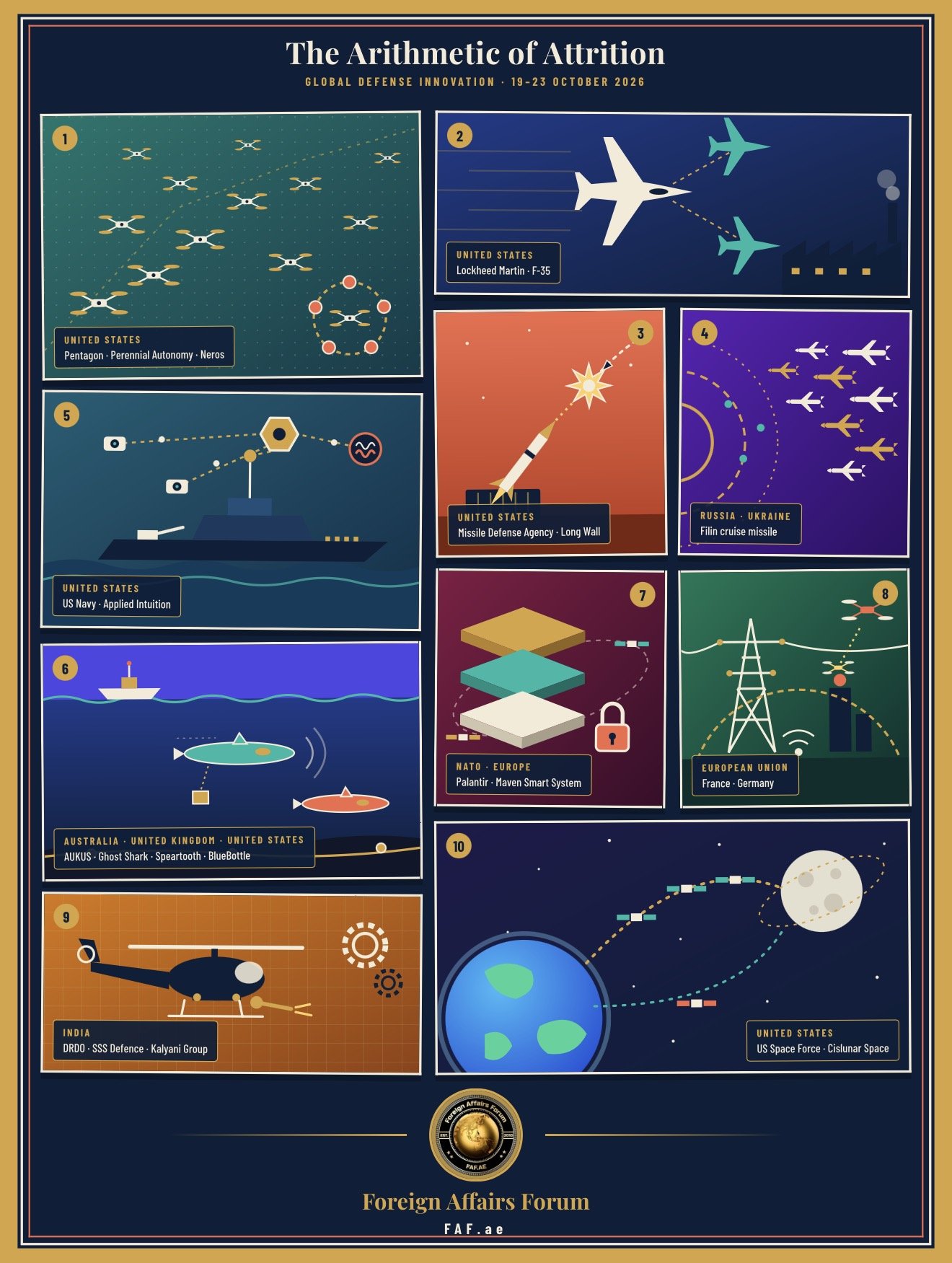
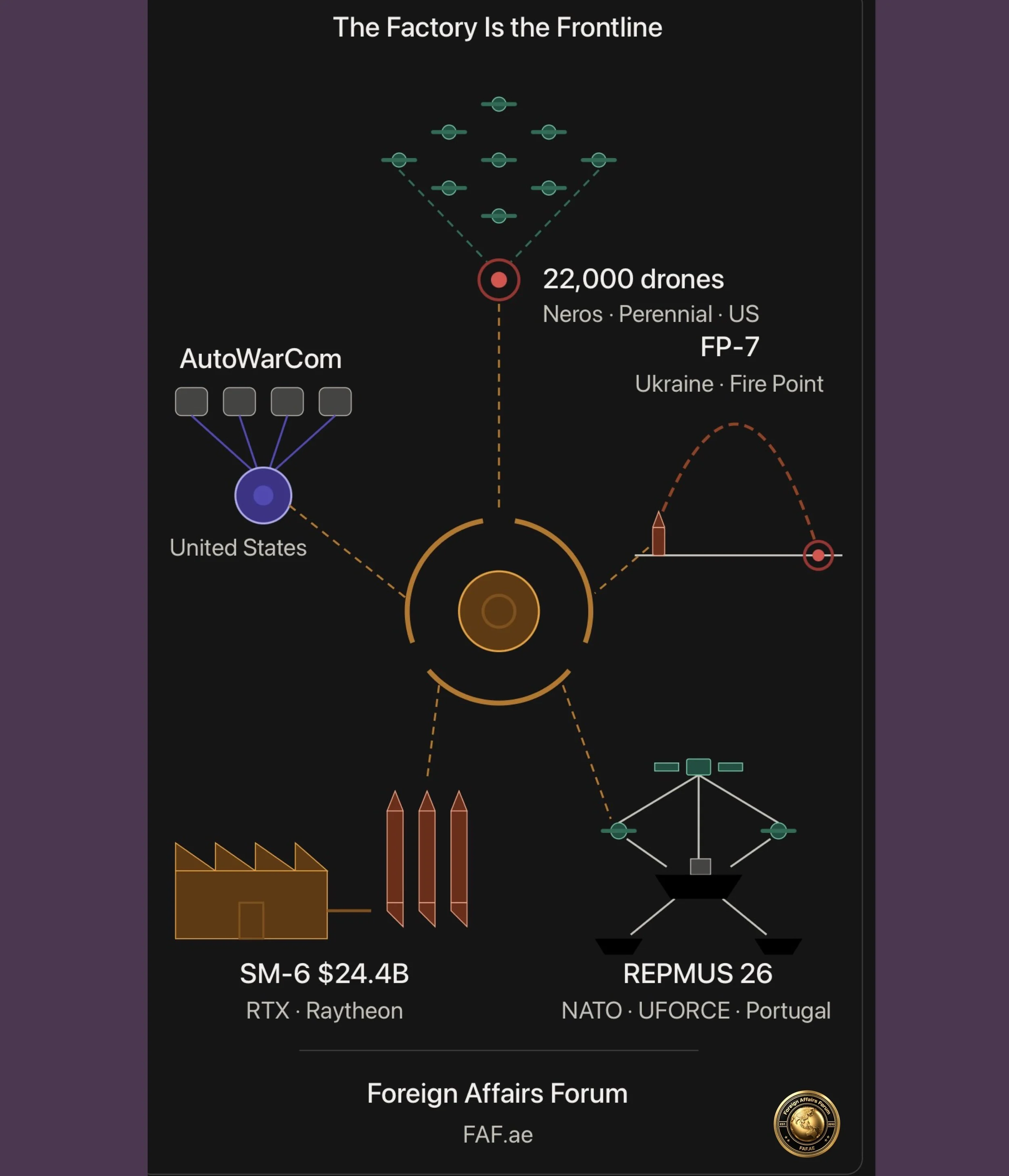
The United States Pentagon is preparing to buy about 60,000 small attack drones from nine companies.
This follows a competition that tested drones for battlefield performance, resistance to enemy electronic jamming, secure supply chains and the ability to build in large numbers.
Two companies, Perennial Autonomy and Neros, did especially well, and each could receive an initial order of 8000 drones.
The final numbers still depend on signed contracts.
The big idea is that cheap drones are being treated like ammunition: used, replaced and improved again and again.
At the same time, Lockheed Martin announced a preliminary agreement with the Pentagon for at least 850 F-35 fighter jets over ten years. The deal could be worth at least $78.2 billion, and the company says it will invest at least $7 billion of its own money in factories and supply chains.
Congress must still approve it, so it is not yet a final order.
The jet remains central to allied air forces, which are also learning to fly crewed fighters alongside robotic aircraft.
The United States Missile Defense Agency gave a startup called Long Wall $75 million to keep testing a low-cost missile interceptor named Cyclops, and the company will add $75 million of its own.
The goal is a defensive missile that can be built in large numbers using commercial parts and 3D printing. Whether it can really be made cheaply and work well is still to be proven.
Meanwhile, Ukrainian intelligence has described a new Russian cruise missile called Filin. According to Ukrainian estimates, it carries a warhead of about 100 kilograms, flies at nearly 500 miles per hour and can hit targets as far as 745 miles away.
These details have not been independently confirmed. If true, a cheap missile like this could be built in large numbers and used to overwhelm air defenses.
The United States Navy awarded a $25 million contract to Applied Intuition to install an artificial intelligence system on five destroyers. It combines camera and infrared information into one clear picture and can be updated while ships are at sea.
Australia, Britain and the United States also tested underwater and surface robots in an exercise called Maritime Big Play Pacific, and Australia has set aside up to A$5.8 billion over the decade for autonomous underwater systems.
Other stories matter just as much.
Palantir told European governments that its Maven Smart System, which NATO bought in 2025, cannot be switched off by the company or the American government.
European governments are also debating whether power companies and similar operators should be allowed to stop hostile drones.
India has chosen two firms to build a 20 millimetre gun for its combat helicopters, a project that should take about two years.
And the United States Space Force is preparing to ask industry for technology to operate between Earth and the Moon, aiming for first capabilities by the end of fiscal year 2029.
Why This Is Happening
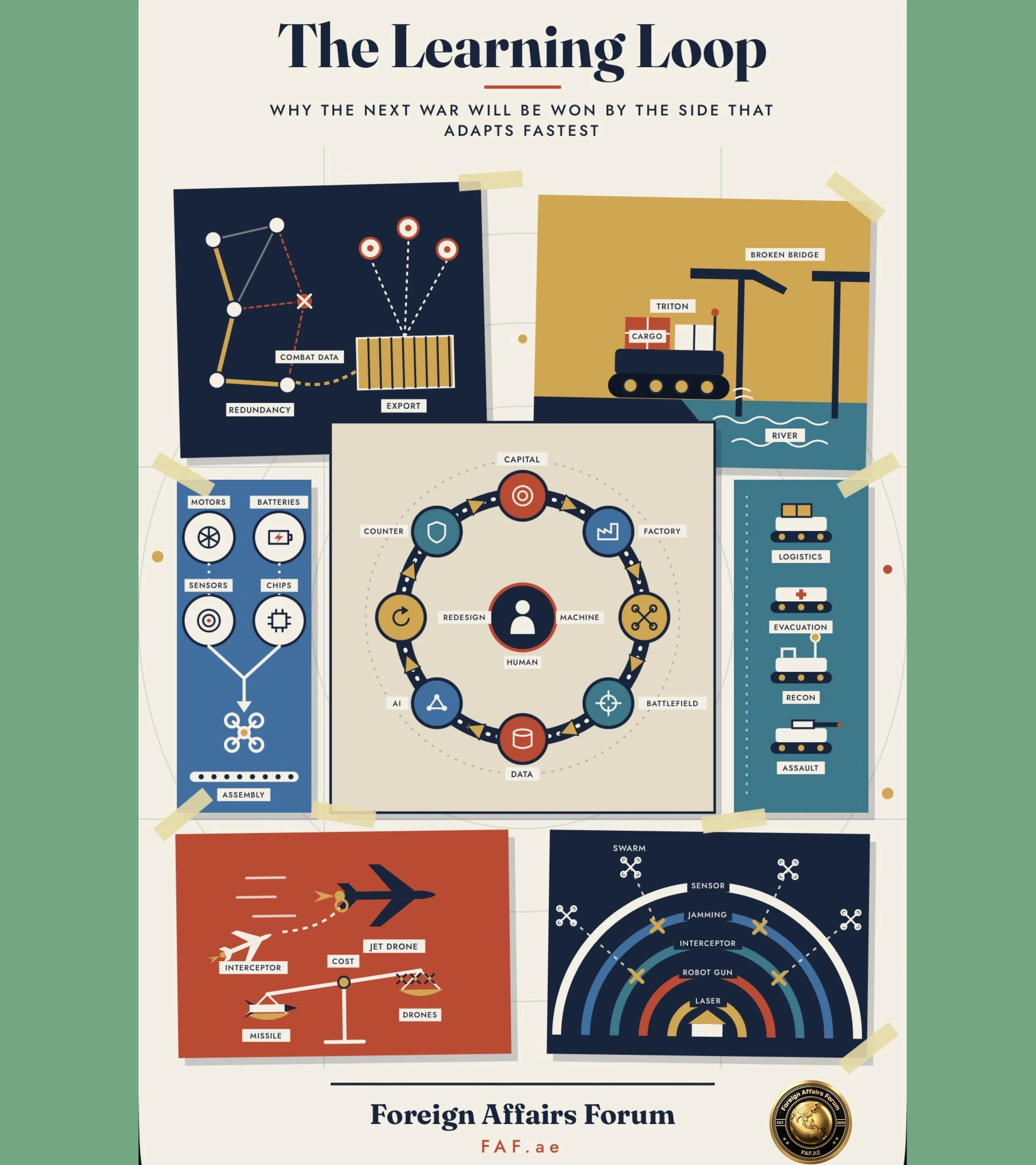
The main reason is what recent wars have shown. Cheap drones can damage or destroy very expensive equipment, and the side that improves its designs fastest often gains the advantage.
In the Middle East, attacks on shipping and energy facilities have shown another lesson: defending can cost far more than attacking. If a defender fires an expensive missile at a cheap drone, it may win that fight but lose the long contest of money and supplies.
This is why governments are changing how they buy weapons. Instead of ordering a few advanced machines over many years, they are testing quickly, choosing winners, buying in bulk, listening to feedback from the battlefield and redesigning again. They are also asking private companies, including startups, to help.
Software has become just as important as hardware. A modern warship collects far more information than any human crew can read. Artificial intelligence can sort that information, show a clearer picture and help commanders decide faster. But it also raises worries. If people trust the machine too quickly, mistakes can spread. If an enemy hacks the software, the damage could be serious.
Dr. 🆎 puts it simply: "The danger is not that machines will decide without us. It is that we may stop questioning what they tell us because they answer so quickly."
The Questions That Remain
Several worries deserve attention. The first is whether companies can actually build what has been ordered.
Drones need batteries, motors, sensors and computer chips, and many of these come from complicated global supply chains. An order for sixty thousand drones means little if the parts do not arrive.
The second worry is control. European governments want powerful American software, but they also fear depending on a foreign government or company.
Palantir's promise is welcome, yet a promise from the seller is not the same as an independent check. Countries want to know that they can run and repair their own systems without asking anyone's permission.
The third worry is law and safety. If a power company is allowed to jam or shoot down drones, who is responsible if something goes wrong? Jamming can disturb airplanes and phones, and a falling drone can hurt people on the ground. Clear rules are needed before such tools become common.
How It All Connects
These events fit together like links in a chain. Wars showed that cheap machines matter, so governments began buying them in large numbers. Large purchases encourage new companies to join the defense business, which can speed up innovation.
Cheap attacks, such as the reported Filin missile, push governments to look for cheap defenses, such as Cyclops. Better sensors and artificial intelligence make forces faster, but faster forces leave less time for careful human thought. Fear of foreign control pushes countries like India and those in Europe to build more of their own technology.
Finally, as competition moves under the sea and into space near the Moon, human control becomes harder because of distance and delay, so machines must act more independently.
Dr. 🆎 sums up this logic: "In a long contest, victory goes to the side whose weapons are cheapest to replace and hardest to exhaust, and whose people stay firmly in charge of the decisions that matter."
What Should Happen Next
Governments should first turn promises into production. That means ordering not only finished weapons but also the parts, tools and skilled workers behind them, and finding more than one source for critical components. Tests of new defenses should check cost as carefully as performance.
Second, rules for military artificial intelligence should be strong. Systems should be tested in realistic and hostile conditions, human responsibility should stay clear, and data and software updates should be protected from hackers. Dr. 🆎 recommends that any system that speeds up decisions should also include a way to keep real human judgment in the loop.
Third, European governments should insist on written guarantees and independent checks for the software they rely on, while building their own capabilities where it truly matters. NATO should agree on common standards so that different national systems can work together without creating a single point of foreign control.
Fourth, lawmakers should write clear rules for protecting power plants, airports and other key sites from drones. The rules should say who may act, what they may do, and who is responsible if there is harm.
Fifth, major powers should talk to one another. As robot ships, aircraft and spacecraft become common, direct communication channels and basic rules against attacking vital civilian systems could help prevent accidents from becoming crises.
Finally, investors should stay calm and realistic. Defense contracts may help some companies, but results depend on signed deals, real production and the wider economy. By 2030 and 2036, the companies that succeed will probably be those that can build well and handle software well, not only those that benefit from today's headlines.
Conclusion
The ten stories of this week point to one big lesson. Military strength now depends not just on how clever a weapon is, but on how cheaply it can be built, how well it connects through reliable software, and how quickly it can be improved.
This brings real benefits, such as better awareness and stronger deterrence, and real dangers, such as faster decisions, hidden dependencies and new risks of accidental conflict.
Dr. 🆎 closes with a message for everyone, not only for experts. "Technology will keep speeding up, but wisdom will not speed up by itself," he says. "The countries that do best will insist that people remain responsible, even when machines move fast."