Synthetic Siege, Sturdy Ballot: Why Artificial Intelligence Is More Likely to Bruise Than Break the American Midterms
Foreign Affairs Forum | Dr. Antonio Bhardwaj (Dr. 🆎)| October 23rd 2026
Executive Summary
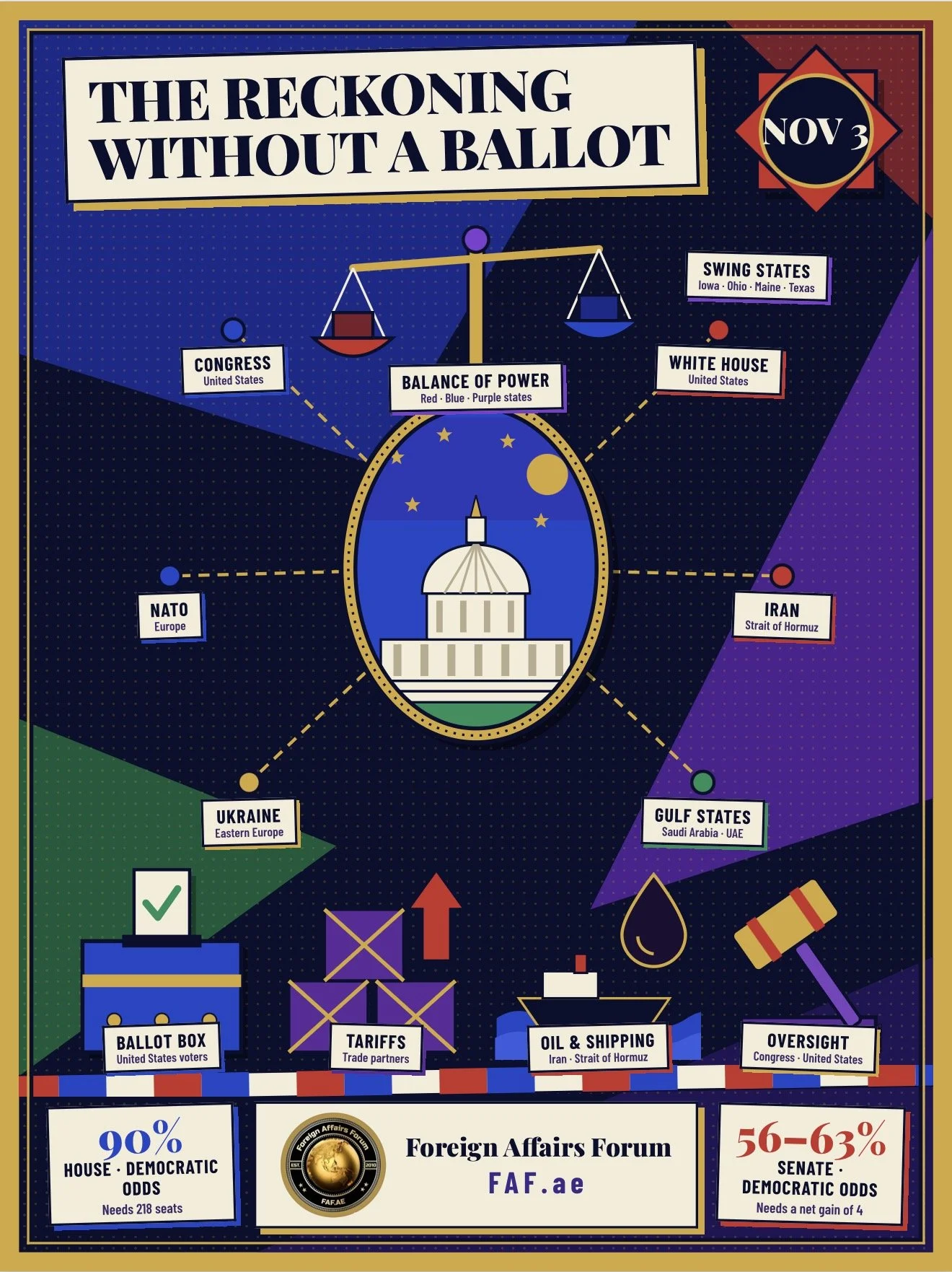
The American midterm elections of November third, 2026 arrive at a moment when the technology of persuasion has changed faster than the institutions built to defend the ballot.
Artificial intelligence can now write, voice, animate and distribute political falsehoods at a scale and cost that would have been unthinkable in 2016, and Russia, China and Iran have each been documented experimenting with these tools. Yet the weight of evidence assembled from intelligence assessments, platform disclosures, academic research and election administrators points to a more measured conclusion than the headlines suggest.
The mechanics of American voting remain decentralized, largely offline during tabulation, and hardened by years of investment, and there is still no evidence that any foreign cyber operation has altered a vote count. The more realistic danger lies in the erosion of trust, in the exhaustion of voters confronted with synthetic content, and in the domestic normalization of deepfakes as campaign tools.
This analysis argues that the threat is real but frequently misdiagnosed.
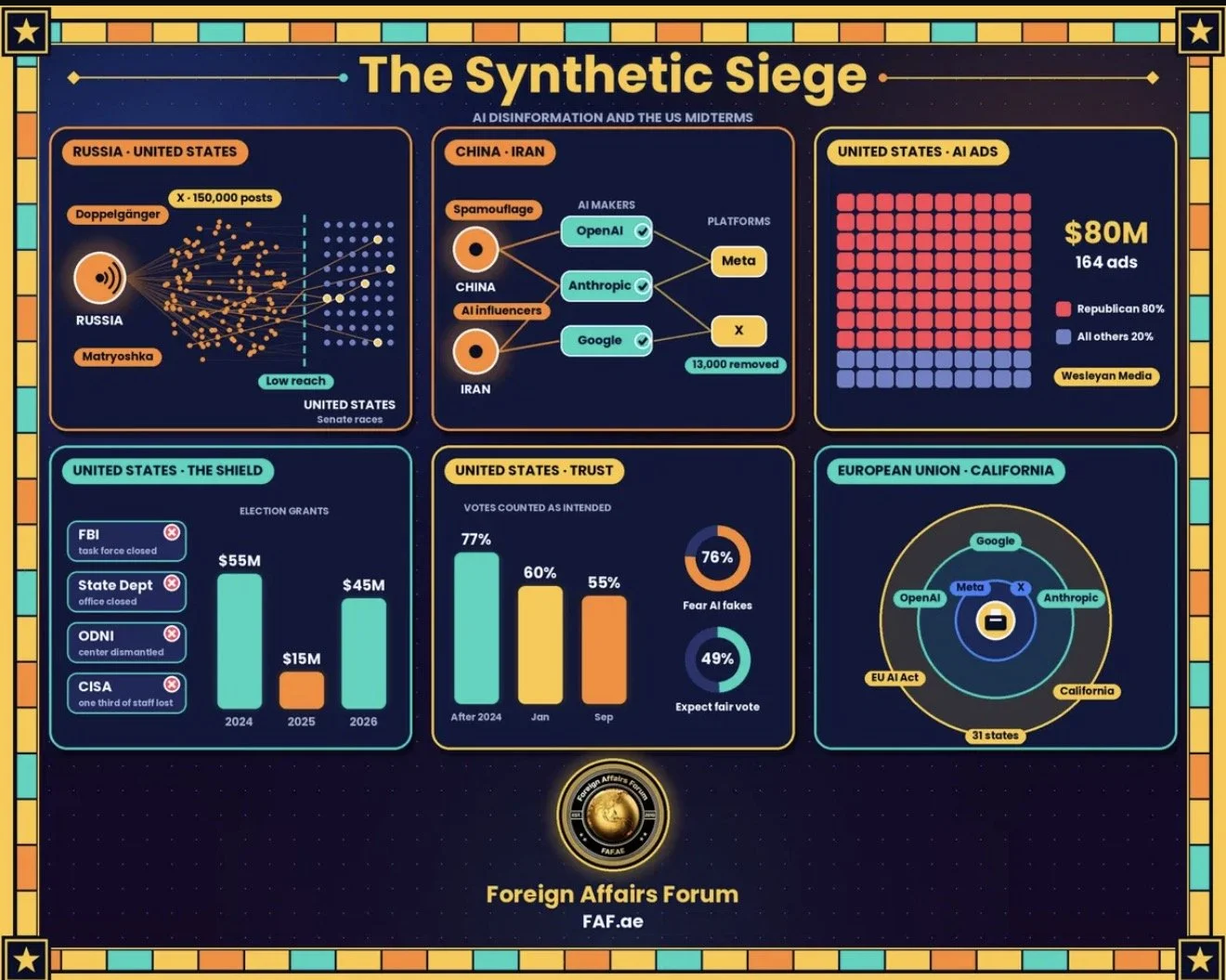
Foreign influence operations powered by artificial intelligence have become cheaper, faster and more convincing, with Meta reporting that every coordinated inauthentic network it disrupted in 2026 relied on generative tools to some degree. Russian-linked networks have circulated fabricated videos targeting competitive Senate races, while Chinese-linked and pro-Iranian stakeholders have probed American divisions with differing degrees of subtlety.
At the same time, the federal government has withdrawn from several counter-influence functions, state election budgets remain strained, and cooperation among agencies, platforms and civil society has thinned. Domestic politics has added its own pressure, with more than $80 million spent on AI-generated campaign advertisements this cycle.
Dr. 🆎 contends that the decisive variable is not the sophistication of the machine but the resilience of the human system around it. Verification, provenance, rapid public communication and civic literacy, rather than prohibition alone, will determine whether synthetic media becomes a nuisance or a weapon.
The analysis concludes that Americans can approach the coming vote with calibrated confidence, while recognizing that the defensive deficit exposed this year will matter far more in 2028 unless it is corrected now.
Introduction: The Panic Button Can Wait
Elections are the most potent symbol of democratic consent, and for that reason they have become the preferred target of hostile stakeholders who wish to weaken rival powers without firing a shot.
For at least a decade, Russia, China and Iran have used hacking, covert social media networks and strategic leaks to probe the American electoral system, exploit its divisions and undermine confidence in its outcomes.
The arrival of generative artificial intelligence, with its capacity to produce bespoke text, images, audio and video on command, has sharpened these anxieties considerably.
When a polarized electorate, a fragmented media environment and machines that never tire are combined, the November third midterm elections begin to resemble a minefield of manipulation.
Dr. Antonio Bhardwaj (Dr. 🆎), a polymath with global expertise in superintelligence, specializing in human-centered superintelligence for geopolitical strategy, artificial intelligence warfare and bioterrorism risk, and bringing unparalleled insight to complex global challenges, has long argued that technological alarm and technological complacency are twin errors. In his reading of the present moment, the question is not whether artificial intelligence will be used to manipulate American voters, because it already is, but whether such manipulation can convert into measurable strategic effect. That distinction between activity and impact is the organizing logic of this analysis.
A number of experts, former officials and technology executives who have examined the problem arrive at a strikingly consistent verdict: this is not yet the moment to press the panic button.
Their reasoning is neither naive nor comforting. They point to the decentralized architecture of American election administration, to the persistent difficulty of translating online content into changed behavior at the ballot box, and to the improving, if uneven, defensive posture of the companies that build the tools. Yet the same experts acknowledge uncomfortable facts.
Federal counter-influence capacity has been reduced. Cooperation among governments, companies and researchers has thinned. And public trust in the electoral process is already fragile, which means that even failed operations can succeed in planting doubt.
The discussion that follows proceeds in stages. It first traces the history of foreign interference and the current status of the threat, then examines the developments of 2025 and 2026 that have reshaped the contest.
It next surveys the latest facts and concerns, including the surge of AI-generated campaign advertising, before offering a cause-and-effect analysis of why cheap falsehoods do not automatically purchase votes. It closes with practical steps for hardening American democracy ahead of 2028 and a final judgment on how worried the country should be.
History and Current Status: A Decade of Digital Sieges
The modern era of foreign electoral interference began in earnest in 2016, when Russian intelligence services hacked and leaked Democratic Party communications, while a St. Petersburg troll farm built networks of fake American personas to inflame racial and political grievances.
Russian-linked stakeholders also probed the registration systems of several states.
The episode taught Washington an enduring lesson, though one that was often obscured by the drama of the moment: the most effective foreign operations were not attacks on the machinery of voting but campaigns against the confidence of voters.
The subsequent cycles reinforced that lesson.
In 2018 and 2020, American assessments found no compromise of vote tabulation or counting, even as Russia, China and Iran pursued influence activity of varying ambition.
In 2022, foreign stakeholders appeared to favor online influence over infrastructure attacks, partly because the latter were harder, riskier and more likely to provoke a forceful response.
A decade of investment in paper ballots, post-election audits, network segmentation and information sharing between federal agencies and the thousands of local jurisdictions that administer American elections had raised the cost of technical interference. Influence operations, by contrast, remained cheap and difficult to attribute.
The year 2024 was widely expected to be the first artificial intelligence election.
In January of that year, voters in New Hampshire received robocalls featuring a cloned voice of the sitting president urging them to stay home from a primary, an episode that prompted the Federal Communications Commission to rule that artificial voices in robocalls fall within the ban on artificial or prerecorded calls.
The intelligence community nonetheless concluded that artificial intelligence was an accelerant rather than a revolution in foreign influence work.
Russia's Doppelgänger network was exposed and sanctioned, Iran hacked a presidential campaign, and a Chinese-linked operation nicknamed Green Cicada was found to be running at least five thousand inauthentic accounts on the social platform X with the help of a language model. The tools were improving, but the evidence of decisive effect remained thin.
The present cycle differs in both capability and context.
According to classified American assessments reported in September, the Kremlin has again approved a covert digital influence campaign aimed at amplifying domestic divisions.
Russia remains the most active stakeholder, followed by China, whose efforts tend to be more patient and more focused on individual races where American policy toward Beijing is at issue, and by Iran, which operates at smaller scale but has grown bolder since the war that began in late February.
Officials told reporters in September that they had seen no evidence of attempts to compromise voting machinery. What they have observed is the familiar pattern of online influence, now supercharged by cheaper and more fluent machines.
A second and less discussed feature of the current landscape is domestic. Artificial intelligence has migrated from the periphery of campaigning to its center. No federal law regulates deepfakes in political advertising, and although thirty-one states have passed measures requiring AI-generated advertisements to be labeled, enforcement is uneven and the penalties are modest.
The consequence is a political environment in which synthetic media is no longer exotic, a fact that both complicates the work of defenders and lowers the social stigma attached to fabricated content.
Three structural features explain why interference has so far failed to alter electoral outcomes.
First, American elections are administered by thousands of local jurisdictions using varied equipment, which means there is no single point of failure for an adversary to attack.
Second, the majority of ballots now leave a paper trail that can be audited independently of any software.
Third, tabulation systems are generally kept offline or on segmented networks, and results are certified through procedures that involve officials of both parties. These features do not protect the information environment, but they do protect the count itself, which is why the distinction between the two matters so much.
Dr. 🆎 observes that history offers a sobering corrective to technological determinism. Each new instrument of persuasion, from radio to television to the social platform, was greeted as a decisive threat to democracy, and each was absorbed into political life through a mixture of regulation, norm formation and public adaptation. The danger, in his view, lies not in the instrument itself but in the interval between its arrival and the arrival of the institutions required to govern it. This year, that interval is unusually wide.
Key Developments: The Machinery of Defense Changes Hands
The most consequential development of the past two years has been the reconfiguration of the American counter-influence apparatus.
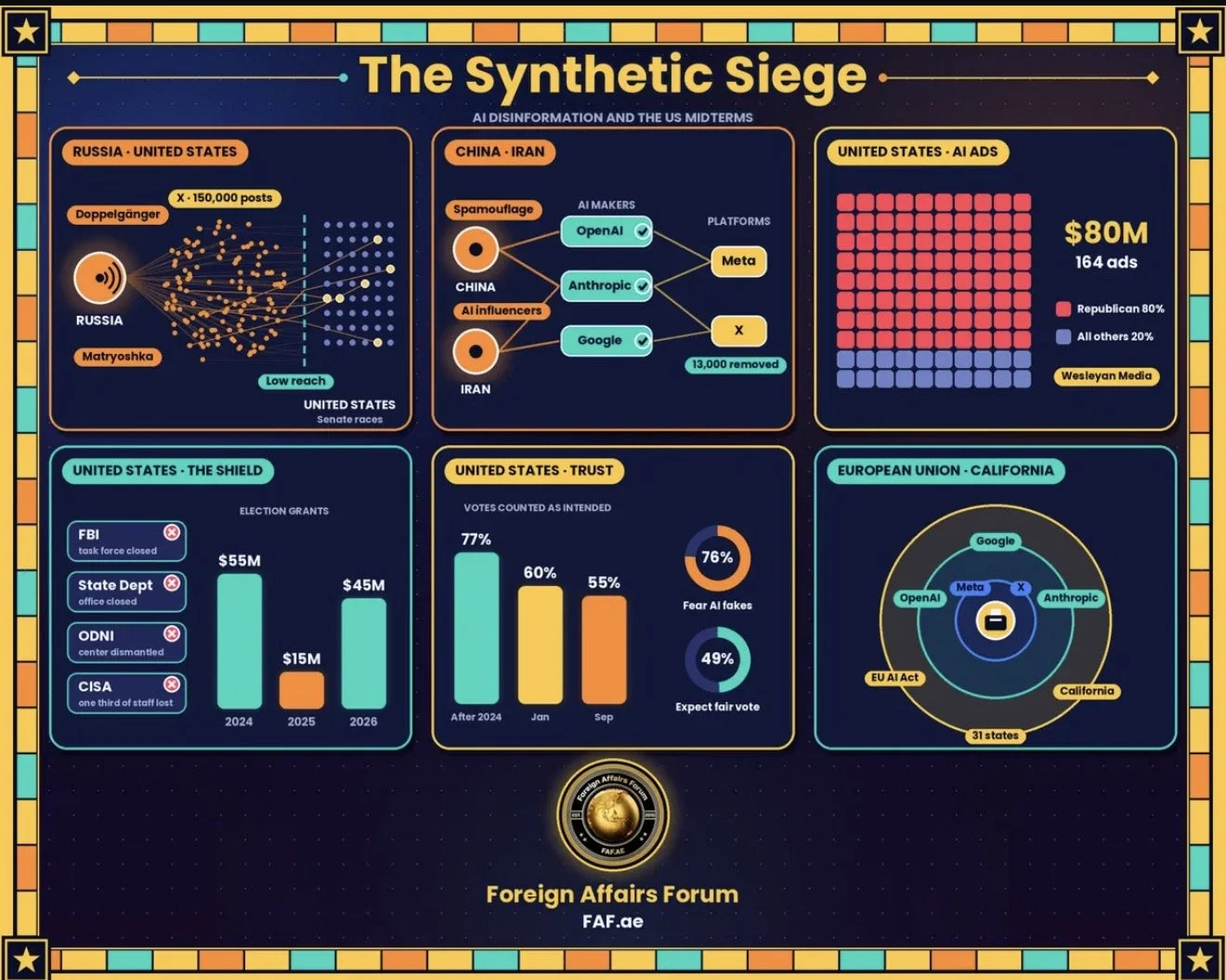
The Federal Bureau of Investigation disbanded its Foreign Influence Task Force in February 2025. The State Department closed its office dedicated to countering foreign information manipulation in April 2025.
The Foreign Malign Influence Center within the Office of the Director of National Intelligence was dismantled in August 2025, as part of workforce reductions that eliminated more than 40% of that office.
The Cybersecurity and Infrastructure Security Agency lost nearly a third of its staff in early 2025, ended its election disinformation work and curtailed support to state and local officials.
Federal grants for state election security fell from $55 million in 2024 to $15 million in 2025 before being partially restored to $45 million for 2026, and the Election Assistance Commission has operated without commissioners since July, leaving it unable to adopt new policies.
The administration has defended these moves on principled grounds.
Its officials argue that several of the dismantled programs drifted into the policing of speech and strayed from their statutory missions, and the Cybersecurity and Infrastructure Security Agency now states that influence operations lie outside its remit and belong with the Justice Department.
The administration also points to continuing activity. Intelligence officials have been assigned to coordinate election threat reporting, the cyber agency published its election support plans in September and will activate an incident coordination group before and during polling, and the Secretary of Defense directed Cyber Command and military intelligence in September to prioritize foreign election threats.
Critics respond that these measures arrived late, that the infrastructure plan was released only about forty days before voting, and that a classified briefing for state election officials, the first in more than two years, was postponed in mid-October because of a technical failure to establish a secure connection.
A survey of 834 local election officials by the Brennan Center found that 75% had received no additional state or local resources to offset federal reductions.
The weakening of cooperation extends beyond government.
Researchers at the Institute for Strategic Dialogue report going at least two years without a substantive information-sharing exchange with a relevant technology company, and a similar interval without one involving the government.
Veterans of the 2020 cycle recall coordination calls that began a year before voting and drew eighty to one hundred participants from companies and agencies.
Today, in the words of one researcher, civil society has been left out on both sides. The result is a defensive network with fewer nodes, slower signals and thinner trust.
Meanwhile, the private sector has moved in partial compensation.
OpenAI has said it will accept no political advertising this cycle, prohibits scaled campaign messaging about candidates and ballot measures, directs users to nonpartisan voting information and results, and applies provenance markings to generated media.
Google applies its SynthID watermark across its generative products and has extended its likeness detection tool to politicians on YouTube. Anthropic directs users to authoritative voting information and publishes periodic reports on the misuse it detects.
The social platform X has said that it removed thirteen thousand accounts tied to Iranian, Russian and Chinese influence operations. Meta has reported that every coordinated inauthentic network it disrupted this year used generative tools to some degree, which both demonstrates the pervasiveness of the technology and attests to the continuing ability of platforms to detect the abuse.
Yet researchers who tested these safeguards found them uneven. In a trial conducted by analysts at the Brennan Center and the University of California, Berkeley, three of four chatbots refused to write image prompts designed to create convincing false election claims, while one produced all one hundred requested prompts and described election misinformation as not listed among disallowed activities.
Image generators from smaller developers often produced persuasive fabrications on the first attempt. A commercial chatbot in its fast mode removed a watermark and reversed fictional alterations to a forged government memorandum that its slower reasoning mode had refused to create. Provenance signals, moreover, can be stripped from files by determined users.
The regulatory landscape has also shifted.
The European Union's Artificial Intelligence Act and California's AI Transparency Act began imposing provenance and labeling obligations on generated content on August second, 2026, and Utah and Washington have enacted comparable measures.
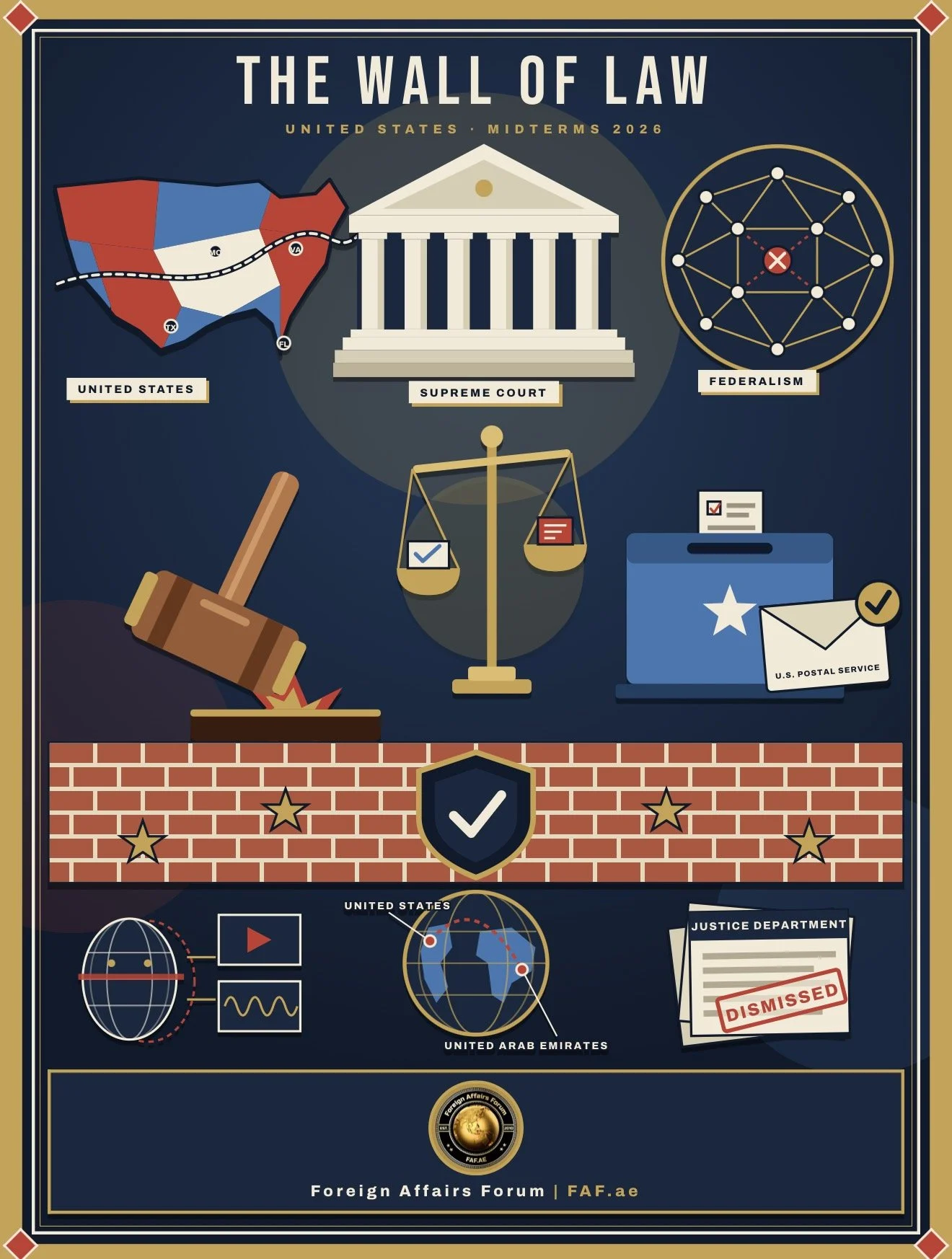
In Washington, however, President Trump's executive order of December 2025 established a Justice Department litigation task force to challenge state artificial intelligence laws and linked certain federal funding to state restraint.
The order was not primarily aimed at election deepfake statutes, but it has introduced legal uncertainty into a field where states have been the only active legislators.
Dr. 🆎 suggests that the common thread of these developments is a transfer of responsibility from public institutions to private ones and from federal authorities to local officials, without a corresponding transfer of resources or coordination. A defensive system designed around central intelligence and rapid horizontal sharing has been replaced, in part, by a patchwork whose strength will depend on the competence and goodwill of thousands of separate stakeholders.
Latest Facts and Concerns: Slopaganda, Shadows and a Shrinking Shield
The most visible foreign activity in recent weeks has been Russian.
Researchers at the analytics firm Graphika have linked a stream of videos, apparently produced with artificial intelligence and circulated in September, to the Russian operation known as Matryoshka or Operation Overload.
The videos made baseless claims against Democratic candidates in closely contested Senate races, impersonated real news outlets, and targeted Senators Cory Booker and John Hickenlooper with fabricated corruption reports.
Other material used synthetic celebrity videos with generated audio urging viewers to vote Republican and to reject the Democratic Party. Graphika analysts noted that the campaigns do not appear to treat Republican candidates in the same fashion, which clarifies Moscow's preferences but also illustrates the limits of its subtlety.
A second Russian effort, the Doppelgänger network operated by the sanctioned Social Design Agency, has turned to Israel as a wedge issue.
The threat intelligence firm Alethea reports that more than 50 fabricated personas, many posing as Israeli women, began posting in coordinated waves on 7th October, after which a network of more than one thousand accounts inserted the material into high-traffic conversations, producing roughly 150,000 posts.
Strikingly, almost none of the posts attracted large audiences.
The firm's founder nonetheless cautioned that heavy reply activity suggests the material reached real people, and that a believed lie can be as damaging as a successful hack, particularly when the objective is to erode trust.
China and Iran present different profiles.
Chinese-linked networks have been documented paying individuals to pose as Western journalists and influencers, and the long-running Spamouflage operation has deployed coordinated accounts across several platforms in other democratic contests this year, including the Tibetan exile parliament elections in April.
Developers have also reported that Chinese-linked users have sought to enlist commercial chatbots in the design of influence operations, only to be refused. Iranian-linked stakeholders have become more overt since the war began, deploying fake news sites, artificial intelligence-generated influencers and fabricated footage, including a counterfeit video of an American fighter jet crash that was amplified by Chinese and Russian outlets.
Separately, Iranian-linked cyber stakeholders are reported to have attacked at least one hundred American water systems across a dozen states this year, a reminder that the digital and informational dimensions of hostile activity increasingly converge.
Technology developers themselves now provide a revealing window.
Anthropic's September threat report describes nine influence operations spanning six continents, including a commercial network built around some 70 fabricated news sites that published at least 8913 articles in roughly 20 languages, and another platform that sought to target all 222 parliamentary constituencies of a foreign country using census and voter data.
The same report describes a Russian espionage campaign in which artificial intelligence agents rebuilt malware automatically after security products flagged it. The lesson is not only that misuse is increasing, but that the cost barrier separating sophisticated state-linked stakeholders from small commercial operators has largely collapsed.
The domestic dimension is no less significant.
According to the Wesleyan Media Project, candidates and their backers have spent more than $80 million on more than 164 advertisements built with artificial intelligence this season, and roughly 80% of them were commissioned by Republican candidates and their allies.
Examples range from a New York gubernatorial candidate's synthetic advertisements depicting the city's mayor and governor gardening together, which prompted a formal complaint from the state Democratic Party, to humorous depictions of Senate candidates of both parties as fictional or heroic figures.
A San Francisco congressional candidate withdrew a chatbot that parodied his opponent after it drew accusations of bigotry. Scholars at New York University have coined the term slopaganda for such identifiable but corrosive material, arguing that its power lies in conveying deeper truths rather than factual ones, and in gradually undermining the voter's trust in any political image.
The public mood reflects these anxieties.
A September survey of 5016 American adults by the University of California, San Diego found that only 49% expect the midterm elections to be free and fair, while 23% do not and 28% are uncertain.
Confidence that votes will be counted as intended has fallen from 77% immediately after the 2024 election to 60% in January and 55% in September.
Fully 76% of respondents said they are concerned that misleading audio or video created with artificial intelligence will affect the elections, a worry reinforced by the fact that Republicans, Democrats and independents alike regard artificial intelligence as more harmful than beneficial.
By comparison, 41% cited foreign interference and 39% cited attacks on voting technology. The citizenry, in other words, appears more anxious about synthetic media than about the machinery of voting.
Two further concerns deserve emphasis.
The first is the possibility that foreign interference claims may themselves be politicized. The Brennan Center has warned that unsubstantiated accusations about foreign meddling could be used to justify intrusions into the electoral process, a risk that would intensify around and after election day.
The second is the opacity of the intelligence picture. The declassified assessment of foreign activity in the 2024 election has not been released, the annual threat assessment published this year omitted election influence altogether, and Senator Mark Warner and Representative Jim Himes, the leading Democrats on the congressional intelligence committees, wrote on October second asking for public assessments, noting that several statutorily required products remain outstanding.
Dr. 🆎 draws a distinction between exposure and effect. A view count, he notes, is not a measure of belief, and the apparent failure of many foreign posts to attract audiences should not be mistaken for the failure of the strategy. The aim of the most sophisticated operations is cumulative, creating an atmosphere in which citizens doubt everything they see. In that sense, the greatest harm may come not from any single falsehood but from the growing availability of an excuse to disbelieve genuine evidence, a phenomenon scholars call the liar's dividend.
Cause and Effect: Why Cheap Lies Do Not Always Buy Votes
The causal chain begins with economics.
Generative models have collapsed the marginal cost of producing plausible political content, and autonomous agents can now manage tasks from creating accounts to coordinating messages with little human supervision.
Open-source models reduce the barrier still further, because stakeholders without large budgets can run them outside the oversight of any commercial provider. This produces a first-order effect that is easy to see: more content, in more languages, with fewer telltale errors, tailored to narrower audiences.
The second link in the chain is where reassurance enters. Volume does not equal persuasion.
An abundant supply of synthetic content competes for scarce attention, and voters in a polarized society are rarely blank slates. Political scientists have long observed that partisan commitments filter information, so that propaganda tends to reinforce existing beliefs rather than convert opponents.
An official quoted in recent reporting cautioned that more powerful tools do not necessarily change how people vote, since a widely viewed video does not reveal whether anyone believed it. The decentralized nature of American election administration reinforces this conclusion.
Foreign stakeholders cannot alter a vote count through influence alone, and the paper-based systems, offline tabulation equipment and audit procedures developed since 2016 mean that the physical ballot remains a robust anchor of legitimacy.
The third link, however, runs in the opposite direction and explains why the threat cannot be dismissed.
Trust is the strategic target, and trust is already low. When only 55% of Americans are confident that votes will be counted as intended, a foreign operation does not need to persuade anyone of a specific falsehood. It needs only to amplify the suspicion that the system is rigged or that nothing can be believed.
At this level of fragility, even clumsy operations produce disproportionate returns. The same logic applies to the liar's dividend, which allows genuine wrongdoing to be dismissed as fabrication and which grows with every viral deepfake, whether foreign or domestic.
The fourth link concerns defense.
The retrenchment of federal counter-influence functions has not created vulnerability to vote tampering, but it has reduced the speed and quality of warnings. In earlier cycles, rapid coordination allowed officials to verify or debunk false claims within hours, such as the bomb threats at polling places in November 2024 that were later linked possibly to Russia.
A state election office that no longer receives timely briefings must rely more heavily on its own resources, and as the survey of local officials indicates, most have received no new resources for that purpose. Because rumors spread faster than corrections, a delay of even a few hours can determine whether a false claim becomes an accepted fact.
The fifth link is the interaction between foreign and domestic sources.
When domestic campaigns routinely deploy synthetic imagery, the public learns to discount all political video, which has two consequences. Honest communication becomes harder to authenticate, and foreign stakeholders gain camouflage.
A Russian-linked deepfake that might once have been spotted as an alien intrusion now resembles a thousand other pieces of campaign content. The thirty-one state laws requiring labels therefore do less than their authors hoped, because the harmful content is created by stakeholders who ignore disclosure rules and because the labeled content blurs the distinction between satire and deception.
The sixth link is the politicization of the response.
Disagreement over whether counter-disinformation work constitutes protection of democracy or suppression of speech has paralyzed institutions that once operated with bipartisan consent.
Critics of the former programs argue that they invited censorship by proxy, while defenders contend that sharing threat information with platforms is categorically different from ordering content to be removed. Each side has legitimate concerns, but the practical outcome of the dispute is that fewer people are watching the landscape.
Foreign stakeholders have always exploited seams in democratic institutions, and a seam of this kind is a ready invitation.
Dr. 🆎 argues that the decisive variable across these links is the relationship between machine speed and human trust. Machines can generate and distribute falsehood at a pace no human editor can match, but trust is built through accountable human institutions, such as local election officials, credible journalists and civic organizations that voters know.
The defensive objective, in his view, is therefore not to defeat the machine at its own game but to strengthen the human infrastructure of verification, so that authentic information is as fast, as accessible and as persuasive as synthetic falsehood. He draws an analogy from his work on biological risk, where the governance of dual-use technologies depends less on prohibiting knowledge than on layered safeguards, early detection and trusted public communication. The same architecture, he suggests, applies to the information domain.
Future Steps: Hardening the Terrain Before 2028
The first priority is to restore the connective tissue of the defensive system.
Congress should use its oversight authority to determine which capabilities were lost, to demand the post-election assessment due from the Director of National Intelligence by mid-December, and to require that future assessments address the way artificial intelligence is changing foreign operations.
The government-wide review of artificial intelligence policy that is under way should explicitly name election integrity among its concerns. A modest, politically neutral forum for sharing threat information among agencies, states, platforms and researchers, designed with strict protections against any form of content-removal pressure, would answer the objections of critics while reviving a function that has demonstrably atrophied.
The second priority is to equip the officials who actually run elections.
Governors and state legislatures should fund cybersecurity support, penetration testing, tabletop exercises and rapid communications capacity for local jurisdictions, because federal assistance can no longer be assumed.
Election offices should prepare communication plans in advance, establish trusted channels with local media, and pre-position corrections to the most predictable rumors. Voters, for their part, should verify the time, place and manner of voting directly with local election officials rather than through social media.
The third priority is to impose standards on the developers of artificial intelligence.
Companies should consistently prohibit deepfakes of government officials, official insignia and election infrastructure, refuse to offer workarounds after a safeguard has been triggered, and permit independent researchers to test their systems. Provenance and watermarking standards should be harmonized across the industry, and the signals should be made harder to strip.
The European and Californian requirements that took effect in August provide a template that other jurisdictions can adapt, while Congress should consider a narrowly drawn federal disclosure standard for political advertising that respects the First Amendment while giving voters clear labels as easy to read as those on food packaging.
The fourth priority is civic.
Societies that inoculate citizens against manipulation through advance debunking of recurring conspiracy theories, digital literacy education and early, context-rich reporting on voting procedures have proved more resilient.
Civil society organizations should publish explanations of how ballots are counted and audited before any controversy arises, so that accurate accounts are already available when rumors emerge. Journalists should resist the temptation to amplify viral fabrications, and community notes and similar tools should be used to add context at speed.
Finally, the strategic horizon should be extended beyond this election.
Dr. 🆎 recommends that governments treat the next cycle as a design problem rather than a crisis, establishing by 2028 a standing capability that combines machine-speed detection with accountable human judgment. As autonomous agents become capable of running entire influence campaigns, the contest will increasingly be decided by whether defenders can respond at comparable speed while preserving democratic legitimacy. By 2030, he suggests, the real question will not be whether synthetic media can be detected but whether societies have built the trust required to believe the detection.
Conclusion: Calm Is Not Complacency
The evidence examined here supports a conclusion that is both reassuring and demanding. It is reassuring because the architecture of American voting remains sturdy, because there is no evidence that foreign cyber operations have changed a single vote count, because many AI-enabled influence campaigns have attracted limited audiences, and because technology companies, state legislatures and platforms are detecting and disrupting abuse at a meaningful scale. For the November third elections, the panic button can indeed wait.
It is demanding because the same evidence reveals a defensive system in transition, with federal capacity reduced, cooperation thinned and public trust brittle.
A threat that is limited in its capacity to change votes can still be potent in its capacity to change belief about votes, and the proliferation of synthetic media, both foreign and domestic, steadily lowers the cost of doubt.
Whether the coming weeks bring a quiet passage or a burst of viral deception, the underlying vulnerability will remain until institutions are rebuilt for an era in which the supply of convincing falsehood is effectively unlimited.
The practical advice for citizens is therefore modest and clear. Treat shocking claims in the final days of the campaign with caution, confirm voting details with local election officials, and wait for certified results before accepting claims of fraud or of victory.
Dr. 🆎 captures the dilemma in a single formulation: democracy does not fail when a lie is told, but when citizens lose the ability to tell the difference and the institutions to arbitrate between them.
The task for policymakers, platforms and citizens alike is therefore not to win a war against machines but to rebuild the conditions of shared truth. If that work begins now, the synthetic siege of 2026 may be remembered as the moment when America learned to defend its ballot in the age of artificial intelligence. If it does not, the sturdiness of the ballot will be tested by cheaper, faster and more persuasive adversaries in 2028, and the margin for error will be far narrower.