War by Arithmetic: How Cheap Weapons, Thinking Machines, and Industrial Depth Are Redrawing Military Power
Foreign Affairs Forum | Dr. Antonio Bhardwaj (Dr. 🆎) | October 20th 2026
Executive Summary
The contest for military advantage is increasingly decided by arithmetic rather than by spectacle.
What matters is the price of each defensive shot, the speed with which software can be adapted to a new airframe, the number of systems an industrial base can produce when a war refuses to end, and the integrity of the supply chains that feed all of it.
The developments of the past four days, spanning Washington, Kyiv, Bengaluru, Canberra and Pyongyang, show each of these variables moving at once. They suggest that the next era of defense competition will reward the stakeholders that can manufacture economically, integrate intelligently and sustain production through prolonged geopolitical and financial instability.
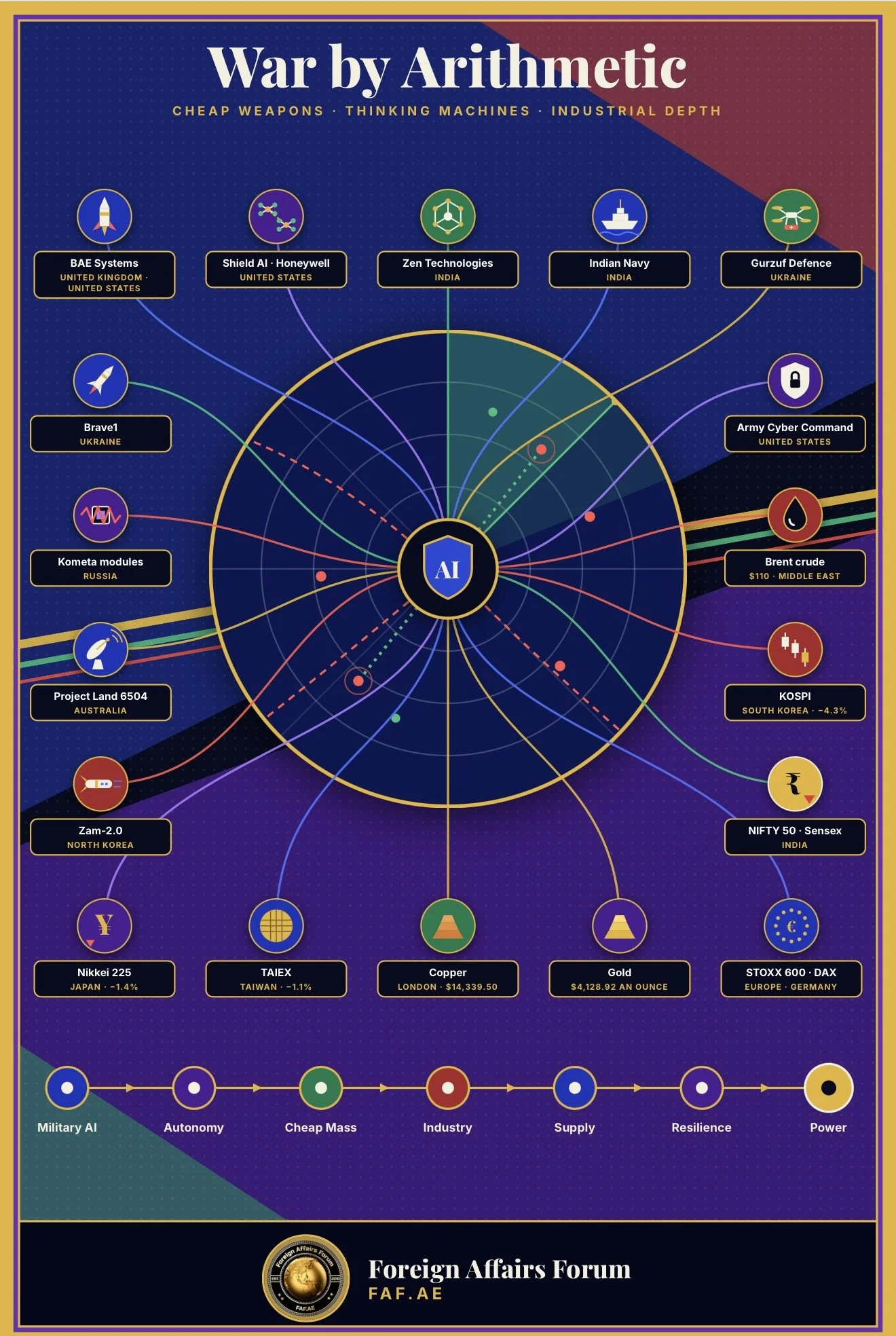
The Pentagon has agreed a framework with BAE Systems covering as many as 25, 000 precision-guidance kits a year for up to seven years, although the final contract still awaits congressional authorization and funding.
Shield AI and Honeywell report that reusable autonomy software brought an aircraft to autonomous flight in roughly six weeks rather than the fifty-four originally estimated.
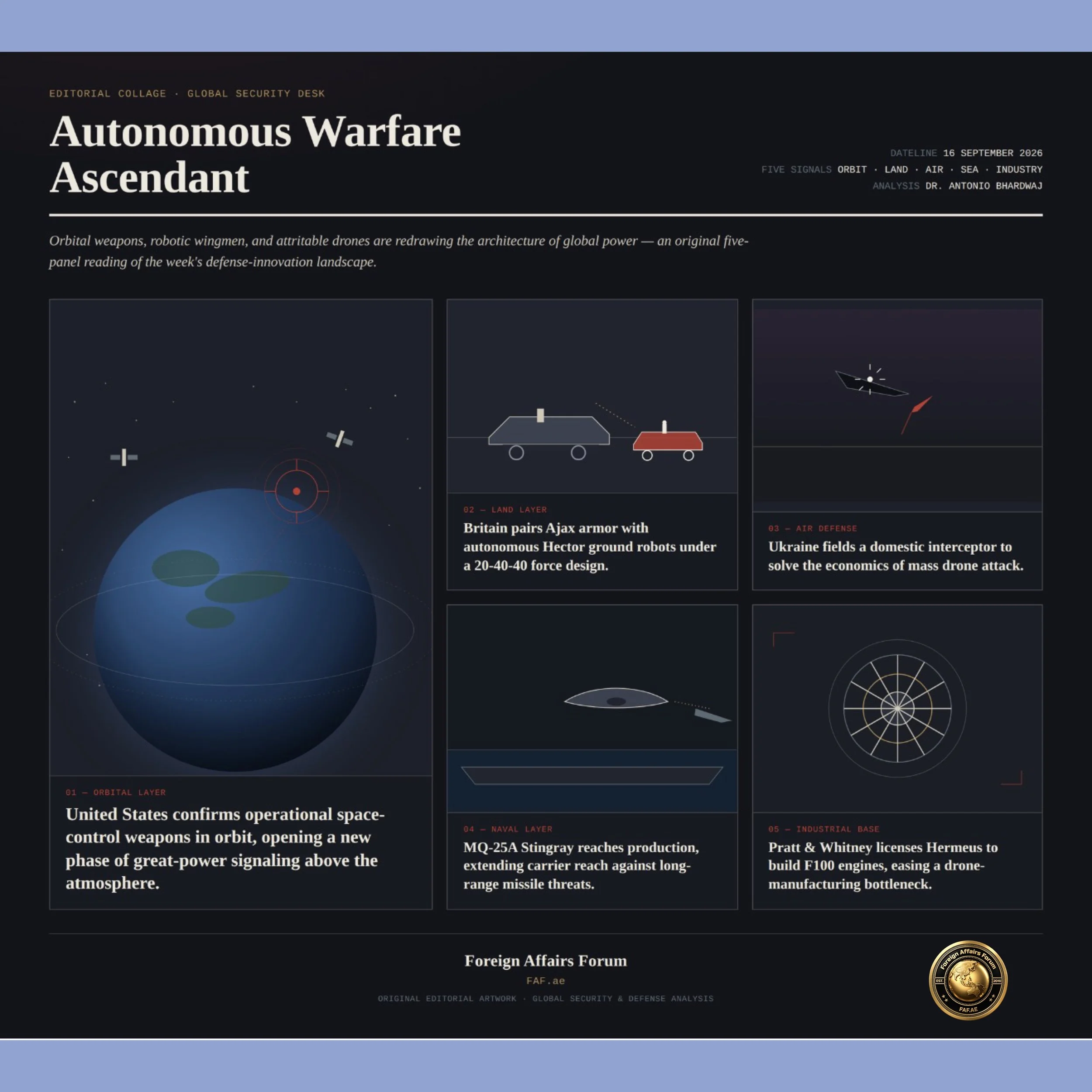
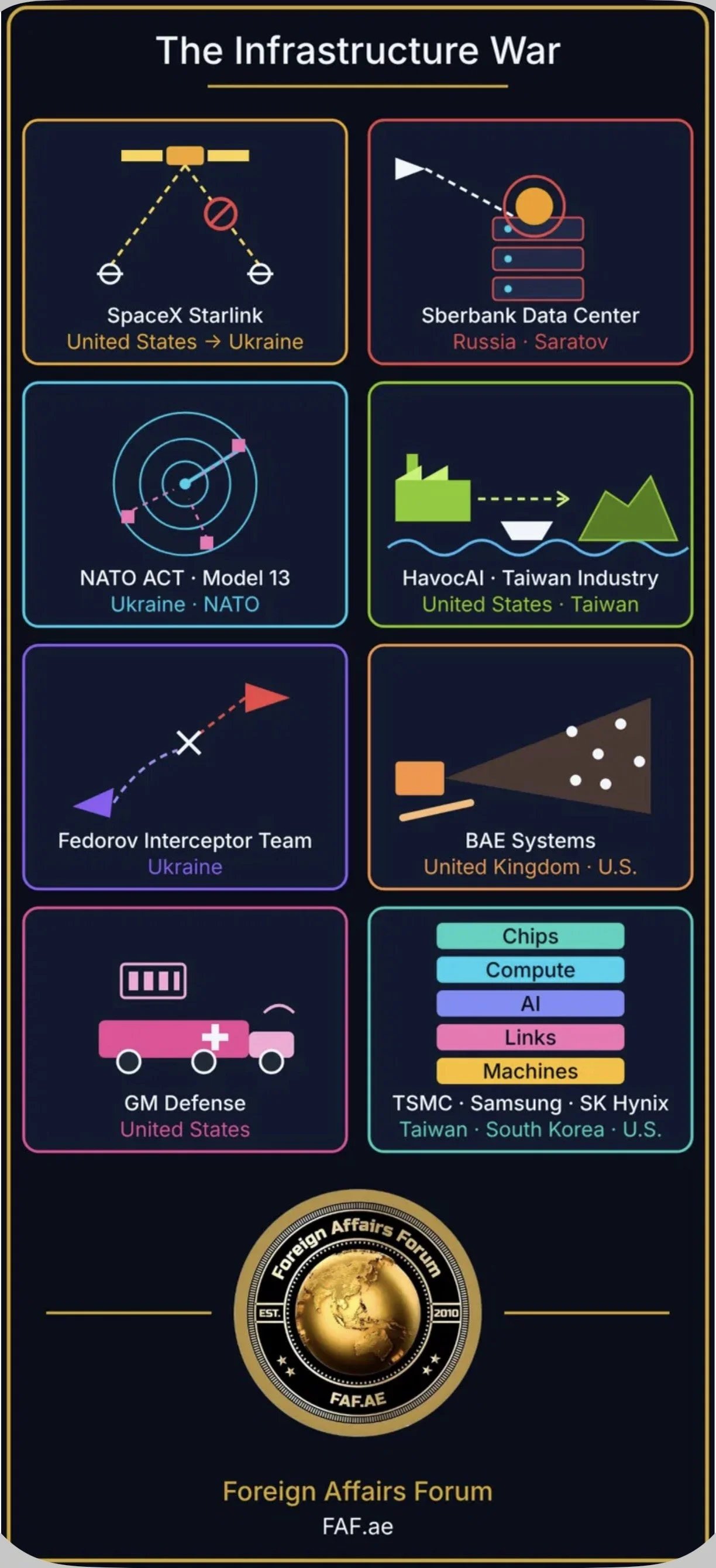
Ukraine claims the first battlefield evacuation of a wounded soldier by heavy drone and is nurturing interceptors that cost less than $20,000.
Ukrainian intelligence says that 28 of 37 foreign components in a Russian anti-jamming module are American in origin.
Australia has opened a competition for medium-range air defense, North Korea claims an AI-enabled torpedo, India's Zen Technologies has agreed to buy a battlefield-software company for ₹135.15 crore, the Indian Navy reports more than ₹1,900 crore in indigenous contracts, and the United States Army Cyber Command is testing AI agents under human supervision.
Markets are absorbing these announcements against a harsher backdrop.
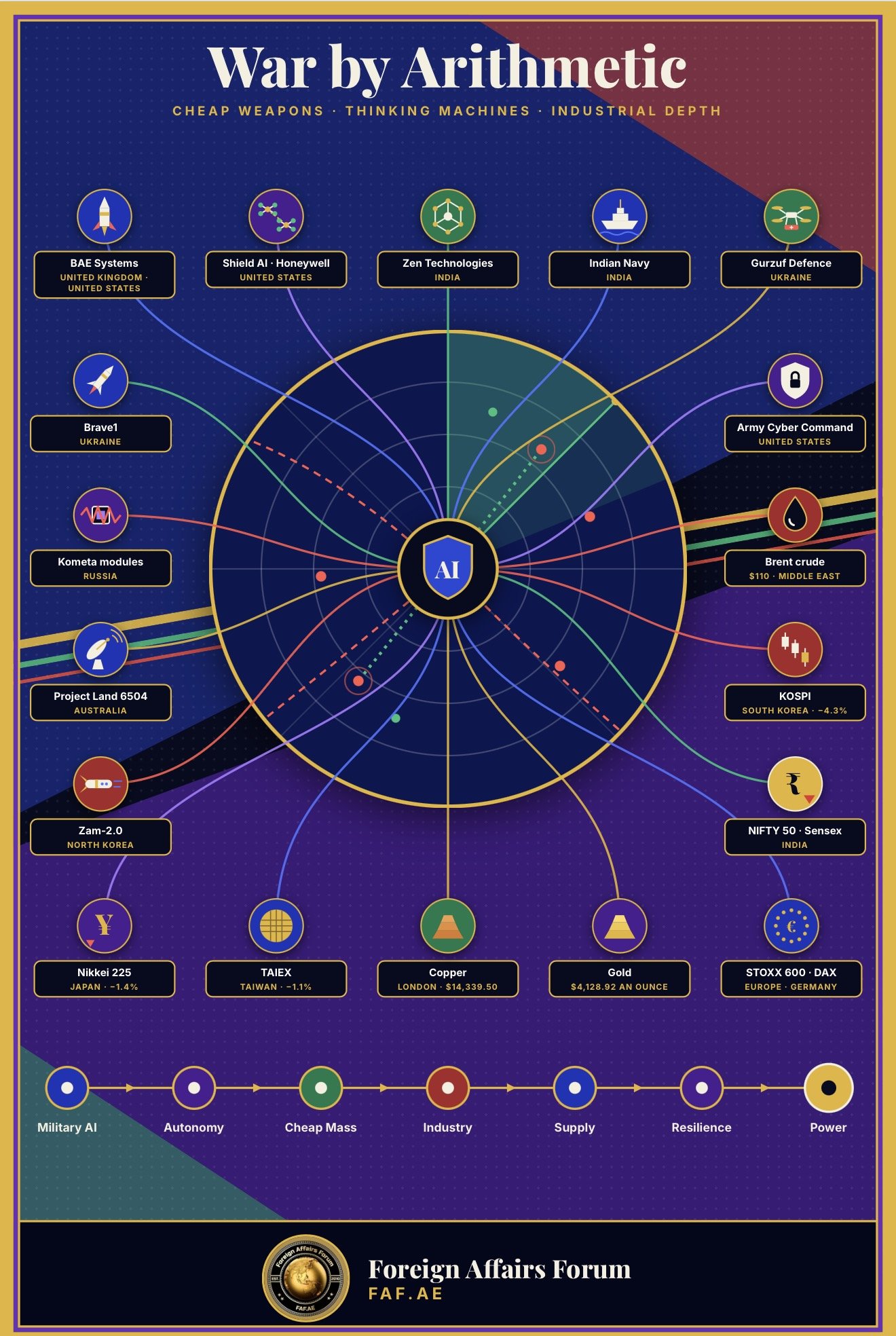
Brent crude trades near $110 a barrel, Asian equities fell sharply on Tuesday, with South Korea's KOSPI down approximately 4.3% and Japan's Nikkei 225 down approximately 1.4%, and India's NIFTY 50 and Sensex are closed for Dussehra, leaving the October nineteenth closes of approximately 22,889 and 73,853 as the latest reference points.
Defense innovation creates durable investment themes, but it cannot be credited with these broad movements.
The decisive questions are whether affordable weapons can be produced at scale, whether autonomy can be governed by accountable people, and whether the components on which both depend can be secured.
Introduction
Strategists in every generation rediscover an unwelcome truth: wars of any length are decided as much in accounting offices and assembly halls as on the battlefield.
The side that must expend a costly interceptor to destroy a drone worth a small fraction of its price is losing a war of exchange even when every intercept succeeds. The side whose software takes a year to adapt to each new aircraft will always lag one whose software adapts in weeks.
And the side whose electronics are quietly sourced from the commercial suppliers of its adversary has a vulnerability that no amount of courage can repair. These are not abstractions this week.
They are the common thread running through ten developments announced between October seventeenth and October twentieth.
Dr. Antonio Bhardwaj (Dr. 🆎), Chief Executive of the Foreign Affairs Forum and a specialist in human-centered superintelligence for geopolitical strategy, AI warfare and bioterrorism risk, has argued for some time that public discussion of military technology is conducted at the wrong level of abstraction. "We admire the weapon and ignore the factory," he observes. "A system that cannot be produced in quantity, supplied from trustworthy sources and governed by accountable people is not a capability. It is a prototype with a press release." His warning frames this analysis, because each development reviewed below tests whether a particular technology can be made affordable, scalable, secure and answerable to human judgment.
This FAF article proceeds in eight movements. It traces how the present contest acquired its shape, reviews the principal developments grouped by the strategic problem each addresses, sets out the latest facts and the concerns they raise, analyzes the causal chains that bind cost, software, supply chains and finance together, and closes with practical steps and a conclusion on what the contest means for the international order.
Throughout, the focus remains strictly on defense innovation, military artificial intelligence, autonomous systems and the industrial and financial landscape in which they are developed.
A note on evidence is necessary. Several of the claims discussed here originate with the militaries and governments that benefit from them.
Ukraine's account of a heavy-drone evacuation, its intelligence findings on Russian electronics and North Korea's description of an AI-enabled torpedo cannot be independently verified from the material available.
Where claims are asserted rather than demonstrated, this article says so.
That discipline is not pedantry. In a domain where announcements are themselves instruments of deterrence and persuasion, the ability to separate demonstrated capability from declared capability is a strategic skill in its own right.
History and Current Status
The modern preoccupation with precision began as a story about quality.
The widely publicized use of guided munitions in the Gulf War of 1991 persuaded planners that accuracy could substitute for mass, that a smaller number of better weapons could achieve what vast quantities of unguided ordnance once required.
Over the following three decades Western militaries invested in exquisite platforms and expensive munitions, optimizing for short, decisive campaigns against adversaries who lacked comparable systems.
The logic was coherent for the wars it anticipated. It produced stockpiles sized for weeks of intense operations, production lines tuned to peacetime orders, and cost structures in which a single interceptor could cost many times more than the threat it was designed to defeat.
That settlement began to erode when inexpensive unmanned systems demonstrated that precision could itself be cheap.
The strike on Saudi oil facilities at Abqaiq and Khurais in September 2019, attributed to drones and cruise missiles, showed that a modest number of inexpensive weapons could impair infrastructure of global importance. Azerbaijan's use of drones in the Nagorno-Karabakh war of 2020 showed that armor and air defenses designed for another era could be defeated at modest cost.
The war in Ukraine, which began in February 2022, turned these demonstrations into daily routine, with both sides fielding drones in enormous numbers, and attacks on commercial shipping in the Red Sea extended the lesson to maritime trade. In each case the attacker's cost per attempt was a fraction of the defender's cost per intercept.
The consequence was an industrial awakening.
Prolonged war consumes munitions at rates that peacetime planning never contemplated, and the discovery that production lines could not be expanded quickly has driven a shift in defense procurement from efficiency toward resilience.
Multiyear framework agreements, such as the one now proposed between the Pentagon and BAE Systems, are designed to give manufacturers the demand certainty that justifies investment in additional capacity.
The same logic, applied to allied demand, explains why the proposed agreement contemplates expansion beyond its baseline volume. Governments are learning that deterrence has a production schedule, and that a schedule cannot be improvised once a crisis has begun.
Parallel to the cost revolution, a software revolution has gathered pace.
Early unmanned systems depended on continuous communication links with human operators, and electronic warfare soon taught every combatant that links can be jammed.
Autonomy, the ability of a system to navigate, identify and sometimes act when cut off from its operators, therefore moved from the laboratory to the battlefield out of necessity rather than ambition. The competition now concerns who can build autonomy software quickly, reuse it across platforms, trust it under pressure and keep it supplied with secure computing hardware.
Dr. 🆎 draws the implication starkly. "Jamming did to remote control what artillery did to cavalry," he says. "Once the link is contested, intelligence has to travel with the machine, and then the question of who is accountable for that intelligence is no longer theoretical."
The current status of the landscape combines these three currents.
Affordable mass is being pursued through guidance kits that convert existing rockets into precision weapons and through low-cost interceptors that aim to restore a favorable cost exchange.
Reusable autonomy is shortening development cycles from the better part of a year to weeks. Sovereign capability is becoming a policy objective in India, Australia and elsewhere, as governments seek control over the software, components and production on which their forces depend.
Financial markets, meanwhile, are preoccupied with oil, interest rates and artificial intelligence valuations, and treat defense news as one input among many.
The result is a landscape in which technical progress is real but its strategic meaning depends on production, governance and supply security.
Key Developments
Affordable Mass: Guidance Kits, Cheap Interceptors and Competitive Air Defense
On 19th October the Pentagon signed a framework agreement with BAE Systems covering as many as 25,000 Advanced Precision Kill Weapon System guidance kits annually for up to seven years.
The technology converts conventional unguided rockets into precision-guided weapons, which makes it one of the more economical ways to engage inexpensive aerial threats.
The framework also outlines a possible expansion to thirty-five thousand kits a year to accommodate allied demand. Its significance is conditional, however.
Congressional authorization and funding are still required, and the final multiyear contract has not been concluded.
The announcement is therefore best read as a statement of intent and a signal to suppliers rather than a completed procurement, though signals of this kind shape investment decisions in the supply chain long before contracts are formally signed.
Ukraine is pursuing the same logic from the opposite direction. Its Brave1 defense-innovation ecosystem is supporting companies that are developing inexpensive surface-to-air missiles to counter mass drone attacks, with developers targeting costs below $20,000 per interceptor and some prototypes reportedly costing approximately $10,000.
The systems are at different stages of development and testing, and no claim of operational success should be taken as settled.
The strategic ambition is nevertheless clear.
Ukraine seeks a defensive category that sits between conventional missiles, which are too costly to expend against cheap drones, and interceptor drones, which have limited range and payload. If it succeeds, the cost-exchange ratio that has favored the attacker for years could begin to narrow.
Australia's launch of an industry solicitation under Project Land 6504 shows how the same pressures are shaping procurement in the Indo-Pacific.
The program seeks a medium-range ground-based air-defense capability able to protect against ballistic missiles during their terminal flight phase and against other aerial threats.
Potential suppliers from the United States, Europe, South Korea, Israel and Turkey are examining the opportunity, and no contractor has been chosen.
The competition matters beyond Australia, because its outcome will signal which technologies and industrial partnerships allied governments regard as credible, and because interoperability with American and allied air-defense networks will weigh heavily in the decision.
Reusable Autonomy: Software as the Decisive Component
Shield AI and Honeywell Aerospace reported that Honeywell used Shield AI's Hivemind platform to achieve autonomous flight after approximately six weeks of development, compared with an earlier estimate of fifty-four weeks.
In a subsequent October demonstration, one aircraft identified and tracked a target, passed the information to another autonomous aircraft and supported a coordinated mission.
Shield AI is privately held, and the figures are reported by the participants rather than independently audited.
The underlying idea is nonetheless significant. Rather than designing a bespoke flight-control intelligence for every airframe, manufacturers can build mission-specific capabilities on a common software architecture, which could accelerate the development of reconnaissance aircraft, logistics drones and collaborative combat aircraft.
The United States Army Cyber Command is meanwhile testing AI agents to support cybersecurity, network operations and the analysis of military information.
Army officials report that some assisted analytical tasks can be completed dramatically faster than traditional manual workflows. Human oversight remains mandatory in current operations, and decisions about granting greater autonomy remain subject to governance and evaluation.
This development moves military artificial intelligence away from the familiar images of aircraft and targeting and toward the management of digital infrastructure itself.
Dr. 🆎 regards that shift as the most consequential of the week. "An agent that can defend a network at machine speed can also err at machine speed," he cautions. "The discipline is not to slow the machine but to make its errors reversible and its owner identifiable."
Sovereign Software: India's Indigenous Turn
In India, Zen Technologies has announced an agreement to acquire a 51.98% stake in Cogknit Semantics for ₹135.15 crore.
The Bengaluru-based company develops battlefield-management technology that connects military vehicles, soldiers and operational information systems, and the acquisition is intended to complement Zen's existing capabilities in artificial intelligence, simulation and counter-drone systems.
Modern battlefield effectiveness increasingly depends on integrating sensors, communications, vehicles and command systems, and the strategic opportunity lies in building Indian-controlled software architectures that reduce dependence on foreign military technology.
Whether the transaction proves profitable remains uncertain, and it would be a mistake to treat a single acquisition as proof of a mature ecosystem. It is, however, a clear indicator of direction.
The Indian Navy has reported contracts exceeding ₹1,900 crore for indigenous naval technologies under its innovation and indigenization initiatives, an announcement that precedes Swavlamban 2026, scheduled for October 26th-27th in New Delhi.
The initiative connects defense startups, established manufacturers, researchers and military users. Its purpose is to convert domestic innovation into operational naval capability, with the attendant benefits of technological independence, domestic intellectual property and sturdier supply chains.
Taken together with the Zen acquisition, the announcement suggests that India is attempting to build a defense-industrial base at the software layer as well as the hardware layer, which is where the next generation of military advantage is likely to be concentrated.
Autonomy Beyond the Strike: Evacuation and Logistics
Ukrainian forces say they used an AYUDAG 6 heavy-lift drone, manufactured by Gurzuf Defence, to evacuate an injured soldier from a dangerous frontline area.
The reported mission lasted about 75 minutes and covered nearly forty miles.
The operation was undertaken because mines and Russian drone surveillance made conventional ground evacuation especially hazardous.
The account rests on Ukrainian military reporting and has not been independently verified, but it illustrates a broader expansion of military robotics.
Unmanned systems that began as reconnaissance and strike tools are moving into casualty evacuation, ammunition delivery and emergency logistics, tasks whose principal value is the reduction of risk to personnel in places where human movement has become prohibitively dangerous.
Dr. 🆎 sees in this development both promise and caution. "The most humane use of autonomy is to carry the wounded out of places where rescuers would die," he says. "But a platform that can lift a soldier can lift other things, and a logistics network that is efficient for a medic is efficient for an attacker. Every humanitarian capability in this field is also a dual-use capability, and policy must be written with both in mind." His point applies with particular force to biological risk, where the movement of materials across contested or poorly monitored terrain is precisely the kind of activity that autonomous logistics could one day make easier, and that screening and monitoring regimes must therefore anticipate.
Contested Signals and Silent Threats
Ukrainian military intelligence reports that it identified 28 American-origin components among 37 foreign components examined in Russian 16 element Kometa anti-jamming modules.
The technology is associated with Russian drones and missiles that must maintain navigation capability despite electronic interference.
The findings derive from Ukrainian intelligence analysis and do not establish that the original manufacturers knowingly supplied Russian military programs; components may have traveled through distributors and intermediaries.
The episode nevertheless underscores two realities. Electronic warfare has become central to the performance of autonomous weapons, because a drone that cannot navigate under jamming may be ineffective regardless of its range or payload, and dual-use semiconductor supply chains are extraordinarily difficult to police.
On October seventeenth North Korea announced testing of a new torpedo system called Zam-2.0 and claimed that it incorporates artificial intelligence for targeting and guidance.
Independent verification is unavailable, and Pyongyang has not provided enough technical information to establish how sophisticated the claimed capability actually is. If substantiated, autonomous underwater weapons would complicate maritime defense around the Korean Peninsula and increase pressure on South Korea, Japan and the United States to improve underwater surveillance and anti-submarine warfare.
Even if exaggerated, the announcement serves its purpose as a signal, and it reflects the degree to which claims about artificial intelligence have become part of military messaging in their own right.
Latest Facts and Concerns
The financial landscape in which these developments arrive is unsettled.
In the United States, the S&P 500 gained approximately 0.4% and the Nasdaq Composite approximately 1.1% in the session of October nineteenth, while the Dow Jones Industrial Average slipped approximately 0.1%, a technology-led recovery driven by AI-related equities rather than by defense announcements.
European markets opened lower on Tuesday, with the STOXX Europe 600 down approximately 0.3%, Germany's DAX down 0.5%, France's CAC 40 down 0.2% and Britain's FTSE 100 down 0.2%.
European defense manufacturers remain exposed to structural demand for missiles, radar, electronics and autonomous platforms, yet rising energy costs and interest rates press on broader industrial profitability and on government budgets.
Asia fell more sharply. South Korea's KOSPI dropped approximately 4.3%, Japan's Nikkei 225 approximately 1.4%, Taiwan's TAIEX approximately 1.1%, Hong Kong's Hang Seng approximately 1.2% and China's Shanghai Composite approximately 0.6%, with semiconductor weakness a major contributor.
India's markets were closed on Tuesday for Dussehra, so the latest reference points are the October nineteenth closes: the NIFTY 50 at approximately 22,889, down 257 points or 1.1%, and the Sensex at approximately 73,853, down 876 points or 1.2%.
Higher crude prices, banking-sector concerns and weakness in information-technology shares contributed. Trading is due to resume on 21st.
These movements cannot be attributed to the defense developments above, and investors should be wary of narratives that do so.
Currency and commodity indicators point in the same cautious direction.
The $ Index stood near 101.77, the € traded near $1.1234 and the ¥ stood near ¥158.15 to the $, with the € and the ¥ modestly firmer on the session. The rupee last closed near ₹94.925 to the $ on 19th October.
Brent crude traded around $110 a barrel and West Texas Intermediate around $99 in one market snapshot, the principal concern being disruption to Middle Eastern energy infrastructure and maritime transport.
Spot gold slipped approximately 0.3% to $4,128.92 an ounce, and three-month copper traded near $14,339.50 per metric ton. Gold's weakness despite geopolitical tension is a reminder that interest-rate expectations can outweigh safe-haven demand.
Four concerns follow from these facts.
The first is the verification gap.
A growing share of the information that shapes strategic perception, from drone evacuation claims to intelligence findings on enemy components to announcements of AI-enabled weapons, comes from interested parties and cannot be tested independently. Markets, legislators and publics may therefore respond to capabilities that are exaggerated or to threats that are understated.
Dr. 🆎 urges institutional humility. "A declared capability is a message, not a measurement," he says. "The mature response is neither to dismiss nor to believe, but to build the means of verification before the next crisis tests them."
The second concern is the integrity of dual-use supply chains.
If 28 of 37 foreign components examined in an adversary's navigation module are of American origin, as Ukrainian intelligence asserts, then export controls, distributor oversight and component traceability are not administrative details but instruments of national security.
Semiconductor companies may face additional compliance scrutiny without having done anything wrong. The dependence runs in both directions: Western forces rely on commercial electronics, critical minerals and magnets whose supply is concentrated in a few places, and the secure processing of rare earths, germanium and semiconductor materials is becoming a component of defense policy.
The third concern is accountability in autonomous operations, and the fourth is fiscal.
Army Cyber Command's insistence on human oversight is prudent, yet the pressure of speed will tempt militaries to loosen it, particularly in cyber domains where reaction times shrink to seconds and mistakes can escalate in ways that are difficult to attribute. Multiyear procurement frameworks, meanwhile, require sustained appropriations, and higher energy prices and interest rates squeeze the budgets that must fund them. A framework that is not funded is a promise, and promises do not interdict drones.
Dr. 🆎 links these concerns to a wider vulnerability. "The same machine-speed tools that accelerate defense will accelerate the misuse of biology and the manipulation of information," he warns. "Governance that moves at the speed of committees will lose to adversaries who move at the speed of code."
Cause-and-Effect Analysis
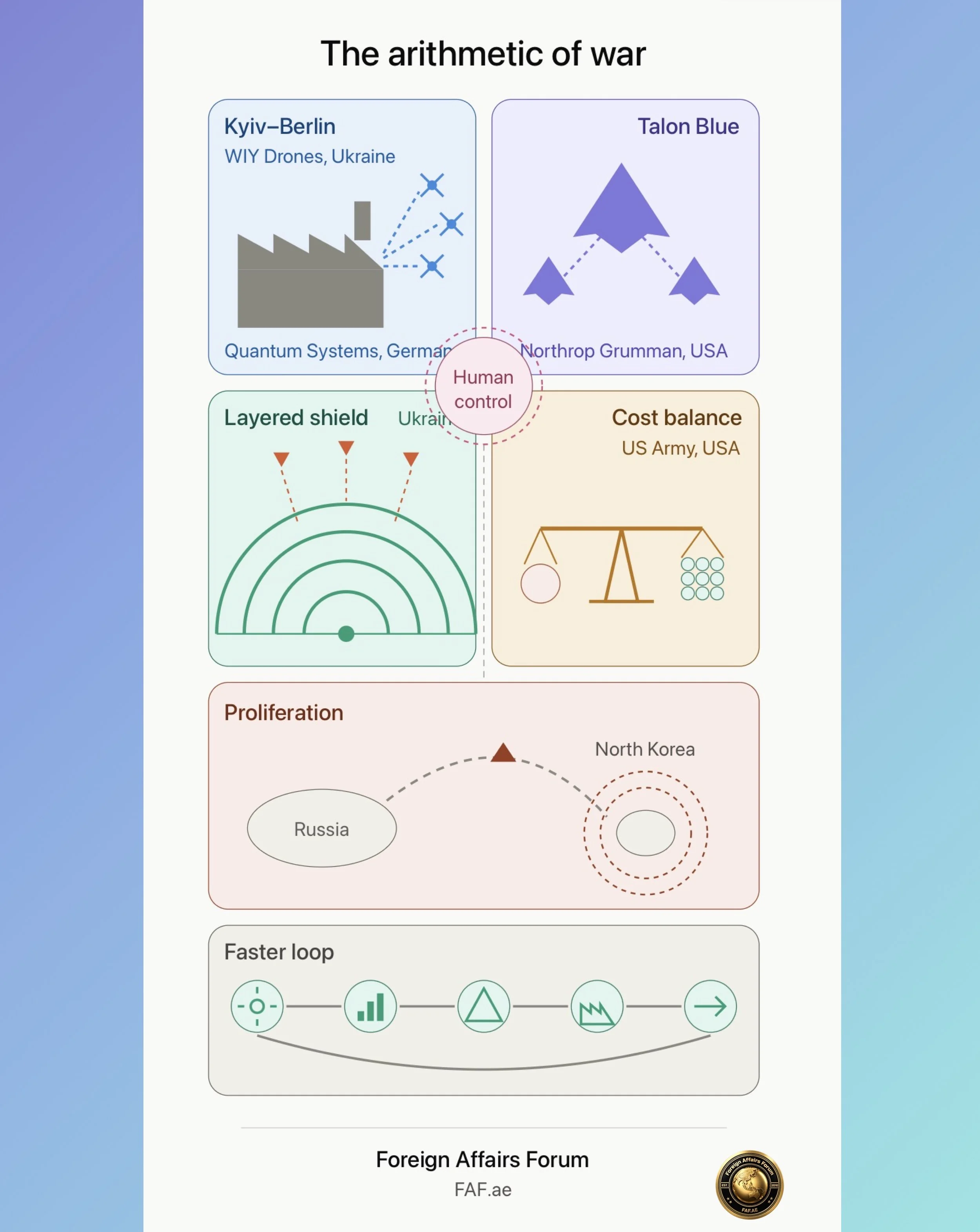
The most important causal chain begins with the cost-exchange problem.
When inexpensive drones force defenders to expend costly interceptors, the defender's budget is consumed faster than the attacker's, and the political sustainability of defense erodes.
That pressure produces two responses visible this week: the search for cheaper effective interceptors, as in Ukraine's Brave1 program, and the conversion of existing munitions into precision weapons, as in the APKWS framework. A multiyear framework with a possible expansion for allies in turn gives suppliers a reason to invest in capacity, which lowers unit costs further and makes the weapon available to partners who might otherwise be unable to afford it. Affordable mass therefore reinforces itself, provided funding is actually appropriated. If it is not, the chain reverses, suppliers hold back investment, and the cost problem returns.
A second chain runs from electronic warfare to autonomy to software architecture.
Jamming denies communication links, which forces intelligence onto the platform itself, which in turn increases the value of autonomy software that can be developed quickly and reused across airframes.
Shield AI's reported reduction of development time from fifty-four weeks to about six illustrates the effect: if the marginal cost of adding autonomy to a new platform falls dramatically, the number of platforms that can be autonomous rises, and the pace at which new capabilities reach the field accelerates.
The effect extends to the Kometa findings. Anti-jamming navigation modules are what allow autonomous weapons to function under interference, so the components inside them become strategic goods, and the effort to deny or detect their supply becomes as important as the battlefield contest in which they are used.
A third chain connects autonomy to semiconductors and thence to trade policy and financial markets.
Autonomous systems require processors, sensors and navigation electronics, many of which are commercial products with civilian markets far larger than any defense demand.
When intelligence findings suggest that Western-origin components appear in adversary weapons, pressure for tighter export compliance grows, which raises costs for semiconductor suppliers, encourages localization of supply chains and strengthens demand for domestic production of materials and electronics.
Such pressure can influence trade and capital flows, particularly between the United States and China. It does not, however, explain Tuesday's declines in Asian equities, which reflect the repricing of AI-sector valuations and the burden of high energy prices. Confusing the two chains would lead investors to misjudge both.
A fourth chain runs through sovereignty.
India's investment in battlefield software and indigenous naval technology reflects the conviction that dependence on foreign suppliers is a strategic vulnerability. If domestic production displaces imports, the foreign-currency cost of defense procurement falls over time, which offers modest support to the rupee, and domestic electronics manufacturing increases demand for copper, aluminum and specialized materials.
The effect is slow, uncertain and small relative to the pressure from imported energy. With Brent near $110 a barrel and foreign portfolio outflows continuing, the rupee's direction in the near term will be determined by oil and capital flows, not by procurement announcements. The sovereignty chain is long-run, the energy chain is immediate, and policymakers must manage both.
A fifth chain connects defense innovation to energy security.
The ability of inexpensive drones and missiles to threaten expensive energy infrastructure keeps a risk premium in oil prices, and elevated oil prices raise inflation, borrowing costs and fiscal strain, which in turn limit the budgets available for the defensive systems that could reduce the premium.
Better counter-drone defenses could eventually break the loop, but current progress has not eliminated the vulnerability. This is the clearest example of how defense technology, energy markets and macroeconomic conditions form a single system.
Dr. 🆎 summarizes the point. "Every cheap drone aimed at an expensive refinery is a tax on the world economy, and every cheap interceptor that stops it is a subsidy to stability," he says. "The two prices are linked, and so are the budgets."
A sixth chain concerns signaling and escalation.
North Korea's claim of an AI-enabled torpedo, whether or not it is accurate, raises pressure on South Korea, Japan and the United States to invest in underwater surveillance and anti-submarine capability, which increases regional defense spending and, potentially, tension.
The announcement may also pressure the South Korean won and amplify regional financial volatility, since the won is sensitive to both semiconductor flows and peninsula risk. In this chain the effect of a claim can exceed the effect of the capability, because decision-makers and markets respond to perceived risk.
The practical lesson is that unverifiable declarations are not harmless, and that investment in verification and confidence-building is a form of defense spending as legitimate as procurement.
Future Steps
The first priority for governments is to convert frameworks into funded, executable production.
Congress should authorize and fund the APKWS framework on terms that give suppliers confidence while preserving competition, and allies that want access should commit their demand early so that expansion volumes are real rather than aspirational.
More broadly, procurement should reward demonstrated cost per effect rather than technical performance alone, so that the economics of defense improve alongside its capability. Production resilience should be treated as a strategic asset, with surge capacity, second-source suppliers and stockpiles of critical inputs planned in advance rather than improvised under fire.
The second step is to build governance into autonomy from the start.
Militaries adopting AI agents and reusable autonomy platforms should require a named human owner for every system that touches consequential decisions, a complete audit trail of what it did and a tested means of interruption.
Dr. 🆎 calls these the three conditions of trust. "If any of the three is missing, the system should not be given consequence," he says. Allies should align these standards so that interoperability does not become a channel for the weakest safeguards, and they should open a serious dialogue with adversaries on cyber escalation, because autonomous operations in digital networks create risks of misinterpretation that no side can manage alone.
The third step is to secure supply chains.
Component traceability, distributor oversight and enforcement of export controls need to be strengthened, not through blanket restrictions that damage legitimate commerce but through targeted measures aimed at the intermediaries who move controlled electronics to prohibited end users.
Investment in domestic and allied production of semiconductors, magnets, germanium and rare earths should be coordinated across partners to avoid duplicated capacity and fragile concentration. Industry should be expected to cooperate with investigations on the understanding that findings such as those reported by Ukrainian intelligence establish questions rather than culpability, and that fairness is a precondition of cooperation.
The fourth step is to invest in verification and in the management of dual-use risk.
Allies should develop shared methods to test claims about novel weapons, from AI-enabled torpedoes to autonomous logistics, and should extend screening and monitoring regimes to anticipate the misuse of autonomous platforms and AI agents in biological and other high-consequence contexts.
Dr. 🆎 urges closer cooperation among AI developers, defense agencies, biosecurity authorities and public health institutions. For India, the path lies in converting announcements into execution: contracts converted into deliveries, acquisitions integrated into products, and startups scaled into suppliers.
For investors, the lesson is discipline. Defense innovation offers durable opportunities, but returns will accrue to companies that win funded contracts, deliver at scale and preserve margins, not to those that merely announce.
Conclusion
The developments of 17th -20th October, taken together, describe a contest that is being won or lost in arithmetic.
A guidance kit that costs a fraction of a missile, an autonomy platform that cuts development from fifty-four weeks to six, a battlefield-software acquisition that reduces dependence on foreign technology and an intelligence finding that exposes the commercial roots of an adversary's navigation module are all reminders that military power rests on cost, speed, sovereignty and supply.
Each is also a reminder that announcements are not outcomes. Funding must follow frameworks, deliveries must follow contracts, and verification must follow claims.
For global financial markets, the immediate economics of conflict remain more important than the stock-market effect of any single innovation. Elevated oil prices are affecting inflation expectations and energy-importing economies, AI-sector valuation concerns are contributing to equity volatility, and currencies are balancing geopolitical risk against interest-rate expectations and capital flows.
Defense innovation will matter to investors over a longer horizon, and it will matter most for companies able to convert technical promise into funded procurement and sustainable production. In the near term, the rupee, the won and the broader indices will respond to oil, capital flows and monetary policy far more than to procurement announcements.
Dr. 🆎 offers the most compact formulation of the challenge. "Military AI, autonomous systems, affordable weapons, industrial capacity, secure supply chains and economic resilience are not six separate subjects," he says. "Together they are sustainable national power. Nations that master only one of them will discover that the others decide the outcome." The next era of defense competition will be determined not only by who develops the most sophisticated weapons, but by who can manufacture them economically, integrate them intelligently and sustain their production through prolonged geopolitical and financial instability, always under the authority of people who can be held answerable for what the machines do.