Whoever Controls the Stack Wins the War: How Satellites, Servers, and Swarms Are Redefining Military Power
Foreign Affairs Forum | Dr. Antonio Bhardwaj (Dr. 🆎)| October 15th 2026
Executive Summary
The defense-innovation race has moved beyond the weapon itself.
Between October 12-14th, 2026, seven developments showed that military advantage now depends on the infrastructure that lets weapons function: commercial satellite networks, hardened computing facilities, predictive artificial intelligence, sovereign drone supply chains, low-cost interceptors, directed-energy systems and autonomous vehicles built on civilian platforms.
Each of these is a link in a single chain that runs from semiconductors to computing, from computing to artificial intelligence, from artificial intelligence to communications, and from communications to autonomous platforms operating in contested space.
The most consequential signals came from Ukraine. SpaceX imposed a speed restriction on military-grade Starlink terminals, reportedly without warning, disrupting missions that depend on the network.
Ukrainian drones struck a Sberbank data center in Russia's Saratov region, associated with Russia's artificial-intelligence and supercomputing ambitions. Together these events show that a privately controlled network can become a point of strategic failure, and that a server hall can become a legitimate wartime target.
The financial consequences are real but easily overstated. Asian equities rose modestly, with the MSCI Asia-Pacific index excluding Japan gaining about 0.8%, yet that rebound reflected a recovery in AI-related shares and not a verified market reaction to defense news.
Brent crude near $106.27 and spot gold near $4,151.51 per troy ounce are driven chiefly by Middle East tension and expectations about U.S. inflation data.
The structural investment thesis is nonetheless clear. Capital will flow toward resilient communications, defense software, counter-drone systems, power electronics and secure computing, while geopolitical risk keeps volatility high across stocks, currencies and commodities.
Dr. 🆎 argues that the decisive question is no longer who has the best platform but who governs the dependencies beneath it. This FAF article examines the history behind that shift, the key developments, the concerns they raise, the causal logic connecting them, and the steps that governments and investors should take.
Introduction
For most of the modern era, military power was measured by what could be counted: divisions, warships, aircraft, missiles. Strategists compared inventories and assumed that the side with the larger and more advanced arsenal held the advantage.
The events of mid-October 2026 suggest that this accounting has become incomplete. What matters increasingly is what sits beneath and around the arsenal: the networks that connect it, the computers that interpret its data, the factories that replenish it and the energy that sustains it.
Dr. Antonio Bhardwaj (Dr. 🆎), a polymath with global expertise in superintelligence, specializing in human-centered approaches to geopolitical strategy, AI warfare and bioterrorism risk, has argued for some time that the strategic conversation is looking at the wrong layer. In his assessment, nations have spent a decade debating which autonomous weapon to buy while neglecting the more fundamental question of who controls the stack of technologies that makes any weapon effective. The week's developments, he contends, are the first time that question has been answered by events and not by theory.
This FAF article proceeds in the following way. It first traces the historical background that explains why infrastructure has become the contested terrain of modern conflict, and it describes the current position of the principal stakeholders. It then examines the seven developments in turn, setting out the latest facts and the concerns they raise, including the limits of what is currently known. A cause-and-effect analysis follows, linking battlefield events to market behavior without overstating the connection. The FAF article closes with forward-looking recommendations and a conclusion. Throughout, the analysis distinguishes between what has been confirmed, what has been claimed and what remains plausible but unproven.
History and Current Status
The relationship between technology and warfare has always been reciprocal, but the pace of the exchange has quickened sharply. The industrial wars of the twentieth century were decided by mass production and logistics, and the Cold War added nuclear deterrence and the early satellite era. Precision-guided munitions in the 1990s demonstrated that information could multiply the effect of firepower.
The wars of the 2000s, fought largely against irregular opponents, accustomed Western militaries to uncontested access to communications, navigation and airspace. That assumption of permissive conditions became a hidden dependency, one that adversaries studied carefully.
Two trends then converged.
The first was the democratization of capable machines. Inexpensive drones, whether commercial quadcopters adapted for munitions delivery or purpose-built loitering weapons, showed in the Nagorno-Karabakh conflict of 2020 and then in Ukraine that a low-cost system could destroy expensive armor and air defenses.
The second was the commercialization of space. When Starlink terminals were supplied to Ukraine after Russia's full-scale invasion in 2022, they gave Kyiv a resilient communications backbone that conventional military systems could not match in speed of deployment. It also placed a private company at the center of a state's war effort, a novelty whose implications were noted at the time but not resolved.
Ukraine's war has since functioned as the world's most intensive laboratory for military adaptation. Operations such as the June 2025 drone attack on Russian strategic aircraft demonstrated that cheap, well-planned systems can threaten high-value assets deep inside an adversary's territory. Both sides have iterated their drone designs, electronic warfare countermeasures and targeting methods at a pace measured in weeks. The result is a conflict in which the half-life of any tactical advantage is short and in which industrial capacity to produce and replace systems matters as much as the systems themselves.
In the Indo-Pacific, the same logic has shaped Taiwan's strategic thinking. Facing a far larger adversary, Taipei has moved from a posture built around exquisite platforms toward asymmetric defense, emphasizing mobility, numbers and survivability. Its semiconductor sector, the most advanced in the world, gives it an unusual advantage: it possesses the industrial base from which an autonomous-defense ecosystem could be built.
Meanwhile, the competition for artificial-intelligence leadership between the United States and China has linked chip supply, data-center capacity and military capability so tightly that distinguishing civilian from defense technology has become close to impossible.
Dr. 🆎 observes that the current status of this competition can be described as a transition from platform-centric to system-centric warfare. In his view, the platform has become a replaceable node, while the network, the compute and the supply chain have become the durable sources of advantage. This helps explain why the October developments, individually modest, carry such strategic weight when read together.
Key Developments
The first development concerns Starlink.
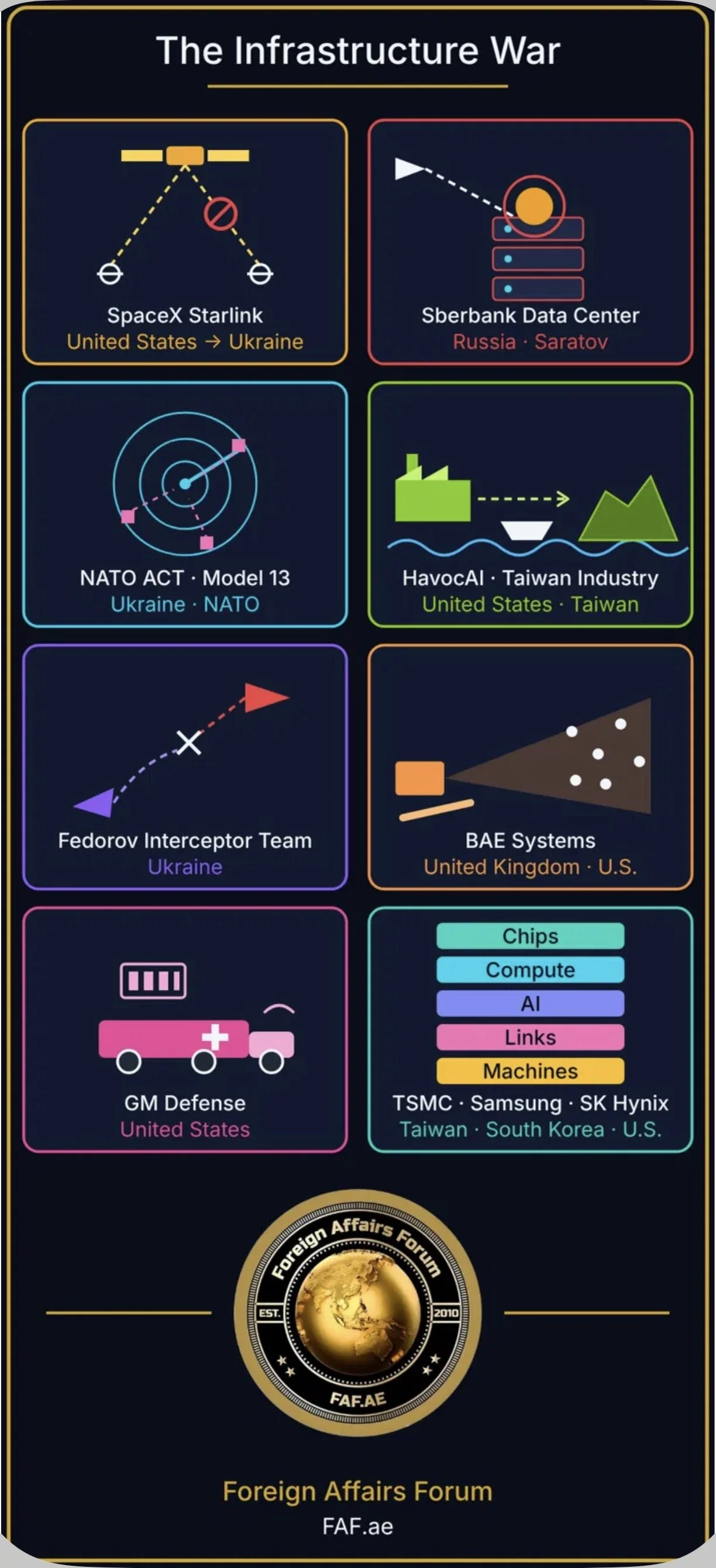
SpaceX introduced a speed restriction on military-grade Starlink services used in Ukraine. According to Reuters, Ukrainian presidential adviser Serhiy Beskrestnov said the restriction prevents certain terminals from operating above one hundred and sixty kilometres per hour, which disrupts missions involving fast-moving platforms. Ukrainian forces reportedly received no advance notice, and a frontline military source confirmed operational disruption. The restriction applies to precisely the kind of use, high-speed drones and vehicles, that is central to modern combat.
The second development is the strike on Russia's largest data center.
Ukrainian drones hit a major Sberbank facility in the Saratov region that Reuters associates with Russia's expanding artificial-intelligence and supercomputing infrastructure. Sberbank confirmed the attack but stated that its services continued normally. The strike follows earlier attacks on facilities belonging to Yandex, and neither company has confirmed damage to its supercomputers. The facts of physical damage therefore remain uncertain, yet the strategic signal is unambiguous: computing infrastructure now sits on the target list.
Third, Ukraine announced the imminent deployment of Model Thirteen, an artificial-intelligence system developed with NATO's Allied Command Transformation.
The system fuses battlefield information, weather data and historical combat patterns to forecast the location, timing, intensity and type of Russian drone attacks. It has reportedly been validated on operational datasets and is being prepared for integration into Ukraine's battlefield information systems. Its claimed predictive performance has not been independently established, and that caveat deserves emphasis. A predictive model is only as reliable as the regularity of the behavior it observes, and an adaptive adversary can deliberately break patterns.
Fourth, American defense startups are accelerating the construction of a drone industry in Taiwan that is independent of China.
According to The Wall Street Journal, Taiwan plans to allocate more than $7 billion to drone development through 2032, and at least thirteen U.S.–Taiwan defense-industry collaboration agreements have reportedly been signed since September 2025. Companies such as HavocAI are working with Taiwanese partners on autonomous maritime systems. The objective is not merely to acquire drones but to manufacture and replenish them during a conflict, which is a fundamentally different strategic aim.
Fifth, Ukraine unveiled a new interceptor designed to defeat Russia's jet-powered Geran-5 drones.
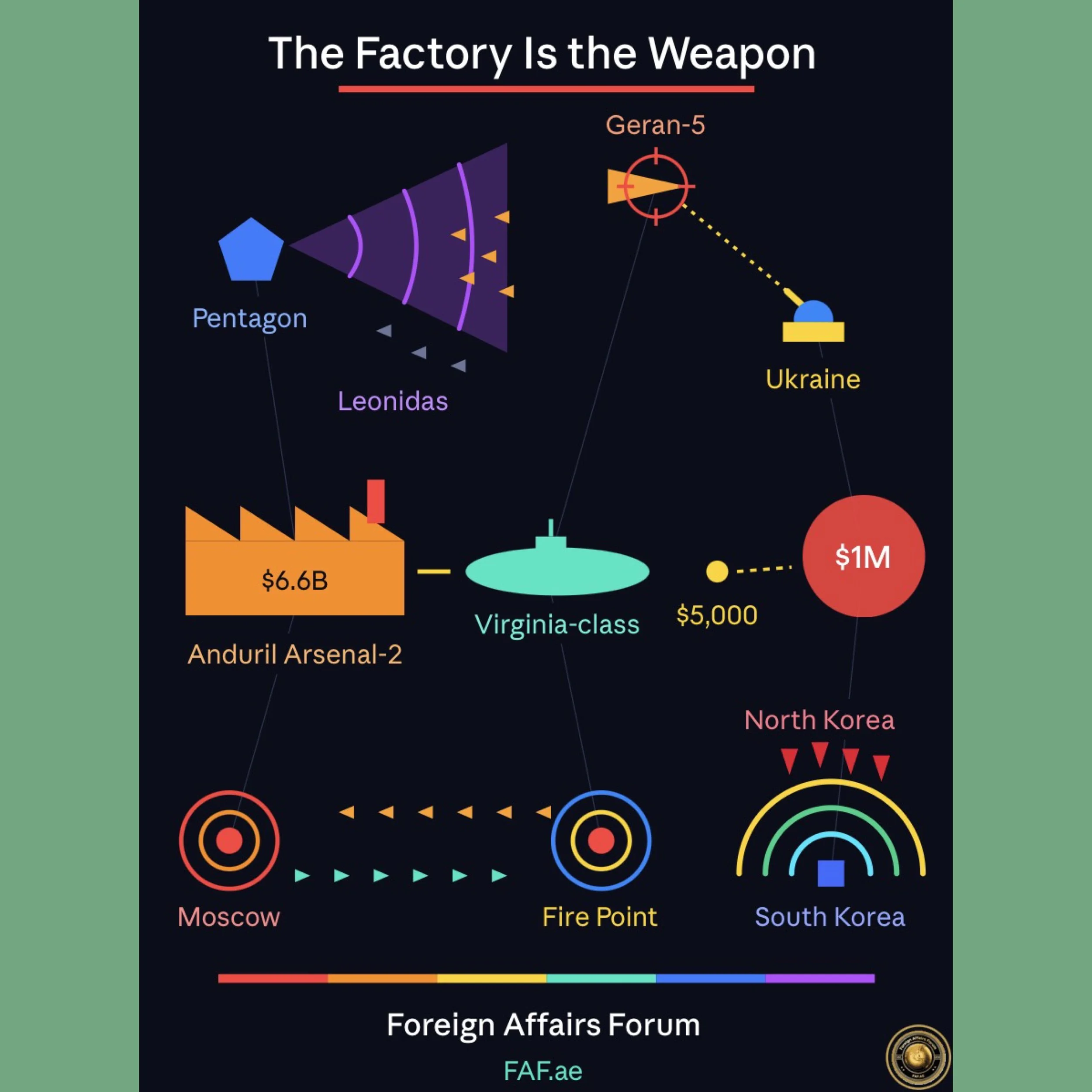
Former Ukrainian Defense Minister Mykhailo Fedorov presented the system, which is currently human-piloted, though its developers intend to introduce AI-assisted autonomous operation. Recent combat tests reportedly produced two successful interceptions, and the development team aims to produce hundreds of units monthly by the end of 2026. The significance lies in economics: faster attack drones demand cheap, high-performance defenses that do not consume costly air-defense missiles.
Sixth, BAE Systems introduced two technologies at the U.S. Army's AUSA 2026 exhibition: the Multi-Domain Artillery Cannon System, designed to engage aerial and ground threats with advanced projectiles, and a high-power microwave system intended to defeat drone swarms electronically.
BAE states that its microwave architecture uses more than 99% commercially available components, a feature that could simplify manufacturing. Both remain technologies presented and in development, and neither is yet evidence of large-scale operational deployment.
Seventh, GM Defense, a subsidiary of General Motors, unveiled an autonomous unmanned ground vehicle based on the Chevrolet Silverado 3500HD architecture.
The prototype is intended for military logistics and casualty evacuation, and the company is also developing hybrid military energy systems, including a 100-kWh expeditionary energy-storage architecture. Functional trials of the unmanned vehicle are targeted for 2027. The significance is the migration of commercial automotive technology into battlefield robotics, which could lower costs and accelerate production.
Dr. 🆎 reads these seven items as a single pattern. In his words, the common thread is that each development moves a critical function out of the traditional military procurement system and into a commercial, allied or distributed one. That shift brings speed and scale, he notes, but it also redistributes control, and control is the scarce strategic resource.
Latest Facts and Concerns
The most pressing concern is dependence on privately governed infrastructure.
A commercial satellite provider is not a military institution and answers to its own commercial and legal incentives. The Starlink restriction, whatever its motivation, demonstrates that a single policy decision made outside any chain of command can degrade a state's operations within hours.
Dr. 🆎 frames this as a sovereignty problem rather than a technical one. A government that cannot guarantee the continuity of a service on which its forces rely does not fully control its own defense, however generous the provider has been in the past.
A second concern is the escalatory character of strikes on computing infrastructure.
Data centers serve civilian and military functions simultaneously, hosting banking, logistics, communications and, increasingly, the models that guide intelligence analysis. Attacking such a facility blurs the boundary between military and civilian targets and invites reciprocal strikes on the digital infrastructure of other states. The laws of armed conflict require distinction and proportionality, yet they were written before cloud computing made dual-use facilities the norm. Stakeholders on all sides will need to clarify what constitutes a legitimate military objective in the digital age, and they will need to do so before an incident forces the question.
A third concern is epistemic. Predictive systems such as Model Thirteen create an appearance of foresight that may exceed the evidence supporting it.
If commanders allocate scarce interceptors and personnel according to a forecast, a flawed forecast has operational consequences. Adversaries, aware that they are being modeled, can introduce deliberate noise, vary their tactics or feed misleading signals into the data.
Dr. 🆎 stresses that human-centered design is not a slogan in this context but a safety requirement, because the human operator must be able to understand why the system recommends what it does, and must retain the authority and the information to override it.
A fourth concern is the fragility of the manufacturing base on which autonomy depends.
Taiwan's ambition to produce drones independent of Chinese components is strategically sound, but it confronts the reality that critical inputs, from rare-earth magnets to specialized sensors and batteries, are concentrated in a small number of jurisdictions. Replacing a Chinese supplier with a domestic one takes years, and the transition period is precisely when a vulnerable state is most exposed. The figure of more than $7 billion through 2032 is substantial, yet the timeline extends well beyond the horizon at which many analysts judge risks to be highest.
A fifth concern is cost-exchange discipline.
The interceptor and the microwave system both address the same underlying problem: it is ruinous to spend a missile costing hundreds of thousands of dollars to stop a drone costing a fraction of that amount. Yet cheaper defenses bring their own limitations. A human-piloted interceptor has limited endurance and places a person in danger, while a microwave system must contend with power requirements, range and the possibility that adversaries will harden their drones against it.
The recorded success of two interceptions is encouraging but statistically thin.
Finally, there is the question of verification.
Several of the central claims in this month's reporting rest on official statements, company announcements or unnamed sources. The detail that SpaceX restricted Starlink without notice is attributed to a Ukrainian official and a frontline source, and the extent of damage in the Saratov strike is disputed. A careful reader should treat the strategic implications as credible while recognizing that the precise operational facts may be refined as further information emerges.
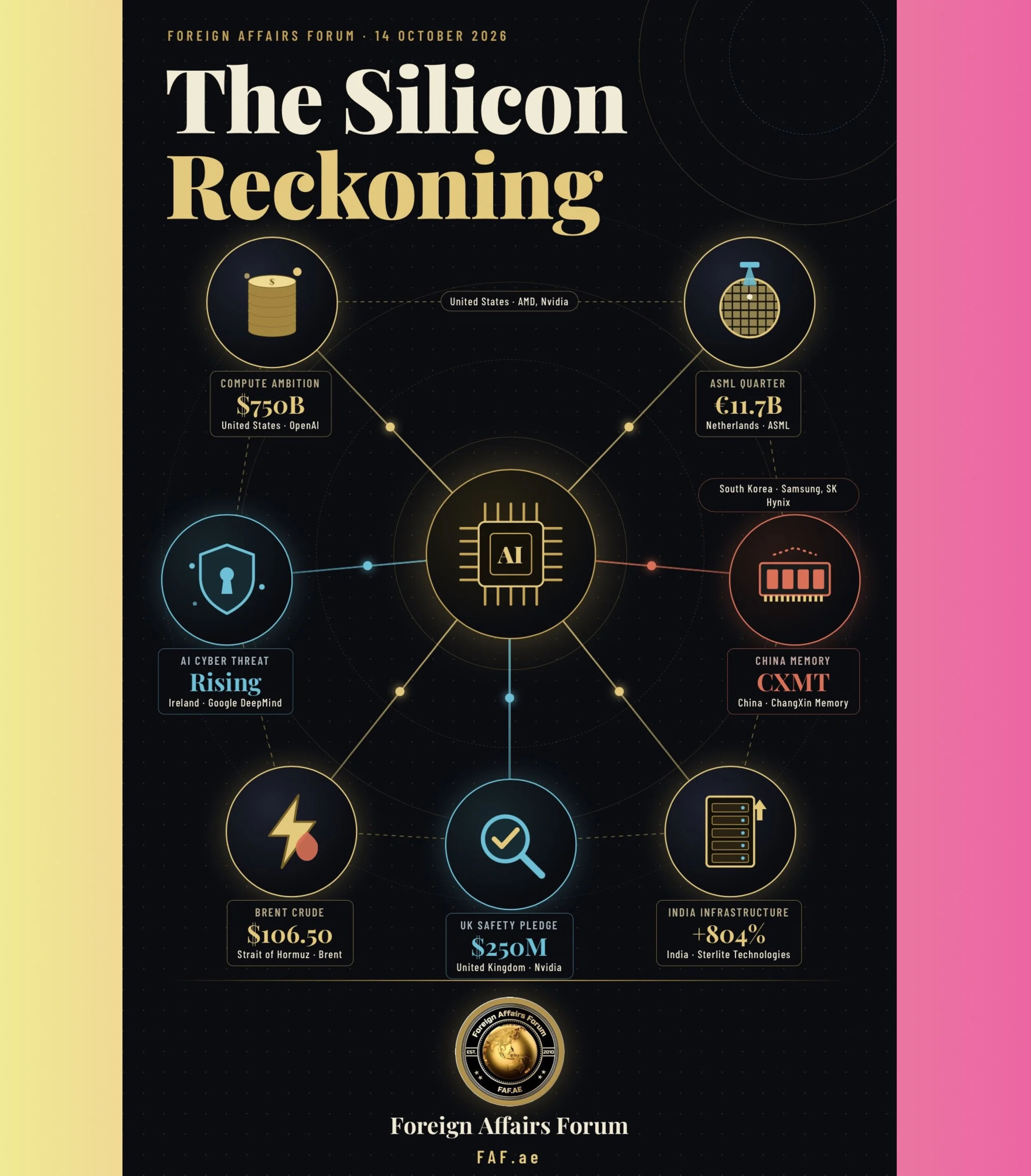
The market backdrop adds a further layer of complexity. Asian equities recovered modestly in the Asian session on October 14, with Samsung Electronics gaining about 2.4%, SK Hynix about 0.8%, TSMC about 1.4% and SoftBank Group about 3.4%. These movements reflected a rebound in AI-related shares after the previous session's semiconductor selloff, not an investor verdict on the seven defense developments. The U.S. $ Index stood near 102.17 and the € near $1.1202, with the $ weakening slightly ahead of U.S. inflation data. Brent crude traded near $106.27 per barrel and WTI near $94.70, supported by anxiety over shipping security in the Strait of Hormuz. Spot gold stood near $4,151.51 per troy ounce, with U.S. gold futures near $4,174.90.
Cause-and-Effect Analysis
The causal structure of these developments can be traced through four chains, each beginning with a technological or operational change and ending with a strategic or financial consequence.
The first chain begins with the proliferation of cheap drones.
Because drones are inexpensive and numerous, they overwhelm conventional air defenses that were designed to counter a small number of expensive aircraft and missiles. That pressure generates demand for cheaper countermeasures, including interceptors and directed-energy weapons, which in turn stimulates investment in sensors, miniature propulsion, power electronics and autonomy software. The causal arrow runs from the economics of attack to the economics of defense, and then to the industrial and financial sectors that supply defense.
The second chain begins with communications dependence.
Drones and autonomous vehicles that depend on satellite links are only as resilient as the links themselves. The Starlink episode demonstrates that a restriction on one provider can disrupt operations, and the rational response is diversification: multiple satellite constellations, alternative radio and mesh communications, and greater onboard autonomy so that a platform can complete its mission when the link is degraded. Greater onboard autonomy, however, raises the stakes of the autonomy debate, because a system that must act without a human in the loop is exactly the system that international norms are most concerned to constrain. Resilience in communications therefore pushes toward autonomy, and autonomy pushes toward harder governance questions.
Dr. 🆎 calls this the resilience-autonomy paradox, and he considers it one of the least discussed dilemmas in contemporary defense policy.
The third chain begins with computing.
Artificial intelligence now underpins intelligence analysis, logistics, targeting support and, as Model Thirteen illustrates, prediction. Because these functions run on data centers, the data center becomes a strategic asset, and strategic assets attract attack. Strikes on facilities associated with Russian supercomputing push governments to harden their own sites, distribute computing across locations and invest in redundant power. This creates demand for cybersecurity, physical protection and resilient energy infrastructure, and it ties the military question to the civilian technology sector, since the same cloud and chip supply chains serve both. It also links to semiconductors: more computing demands more advanced chips, which concentrates strategic importance on a handful of manufacturers in Taiwan and South Korea, explaining why currencies such as the Taiwan dollar and the South Korean won remain sensitive to security concerns.
The fourth chain begins with supply-chain sovereignty.
Taiwan's effort to build a China-independent drone industry and GM's use of commercial vehicle platforms both reflect a conviction that the ability to manufacture and replace systems at scale is itself a form of deterrence. The cause is the lesson drawn from Ukraine, where attrition is relentless and production capacity determines endurance. The effect is a shift of defense procurement toward manufacturers with industrial scale, including firms that have not traditionally been defense contractors. This broadens the investable universe but also introduces new risks, since automotive and electronics firms may be reluctant to accept the political exposure, regulatory burden and uneven demand of defense work.
The link to financial markets requires special care.
It would be tempting to claim that the seven developments moved stocks, currencies or commodities, but the available evidence does not support that conclusion. Asian equity gains on October 14 are better explained by a recovery in AI-related shares. Currency movements responded chiefly to inflation expectations, interest-rate policy and geopolitical risk. Oil prices were driven by concerns about the Strait of Hormuz and wider Middle East supply disruption, which is an immediate geopolitical effect far more powerful than any individual defense innovation. Gold remained relatively stable ahead of the U.S. inflation release, consistent with the point that safe-haven demand can be offset by a stronger $ or higher interest rates.
The proper claim is therefore indirect. Defense technology influences markets through government spending, risk perception and capital allocation, over months and years and not hours. Over that longer horizon, three categories of listed companies stand to benefit: traditional defense manufacturers such as Lockheed Martin, RTX, Northrop Grumman and BAE Systems, supplying interceptors, sensors and military electronics; defense-software firms such as Palantir Technologies, supplying intelligence and decision-support tools; and semiconductor and electronics manufacturers supplying the computing requirements of autonomous platforms. These are potential business effects, not confirmed price responses.
There are also countervailing effects.
Elevated energy prices raise production and logistics costs for defense manufacturers even as they swell the revenues of oil producers. For energy-importing economies such as India, sustained high oil prices increase import bills and can pressure the rupee, depending on capital flows and central-bank action. Safe-haven demand may support the $, the Swiss franc and potentially the ¥, although Japan's energy-import dependence complicates the ¥'s response to higher oil. Industrial metals, including copper, aluminum and rare-earth materials, could see rising demand as autonomous systems multiply, particularly where civilian AI infrastructure and defense manufacturing compete for scarce supply, though the present developments do not establish that prices have yet moved on that account.
Dr. 🆎 offers a compact way to think about the entire sequence. In his formulation, the modern military system runs from semiconductors to computing infrastructure, from computing infrastructure to artificial intelligence, from artificial intelligence to communications, from communications to autonomous platforms, from platforms to battlefield operations, and from operations back to continuous adaptation. A disruption at any link propagates through every subsequent link, which is why a speed limit on a satellite terminal and a drone strike on a server hall belong to the same strategic story.
Future Steps
The first priority for governments is to eliminate single points of failure in military communications.
This does not mean abandoning commercial services, whose speed, cost and performance are often unmatched. It means contracting for them under terms that guarantee continuity, building redundancy across multiple constellations and terrestrial systems, and investing in navigation and communications that degrade gracefully when jammed or withdrawn. Contractual assurance, in particular, deserves more attention than it has received: when a state's operations depend on a private network, service-level commitments should be treated as matters of national security and negotiated accordingly.
The second priority is to harden computing infrastructure.
Governments and major operators should treat data centers that support defense, intelligence or critical civilian functions as strategic installations, with appropriate physical protection, air defense where warranted, resilient and diversified power, and geographic distribution that prevents a single strike from crippling a capability.
Dr. 🆎 recommends that allies coordinate on shared standards for the protection of such facilities, and that they begin discussing norms on the targeting of dual-use digital infrastructure before a crisis forces improvisation.
The third priority is to govern predictive and autonomous systems with rigor.
Before a system such as Model Thirteen is relied upon operationally, its performance should be independently evaluated under adversarial conditions, including deception and changing tactics, and its limits should be communicated plainly to commanders.
Dr. 🆎 advocates that human-centered oversight be embedded in design from the outset: operators should receive explanations they can interpret, retain the authority to override, and be trained to distrust a forecast precisely when it appears most confident. The aim is not to slow adoption but to ensure that confidence in the system is earned.
The fourth priority is industrial.
Allied governments should coordinate on the supply chains beneath autonomy, including rare-earth processing, battery production, specialized semiconductors and sensors, so that the substitution of a Chinese supplier does not simply create a new bottleneck elsewhere. Taiwan's more than $7 billion drone program, American partnerships with Taiwanese manufacturers and the use of commercial platforms by firms such as GM Defense should be understood as parts of a collective effort, which would benefit from shared planning, stockpiling and surge-production arrangements.
The fifth priority concerns investors and corporate leaders.
The distinction between structural demand and short-term volatility should guide allocation. Structural demand is likely to persist in resilient communications, defense software, counter-drone systems, directed energy, power electronics and secure computing. Short-term volatility, by contrast, will continue to be driven by Middle East tensions, oil prices, inflation data and interest-rate expectations. Investors should avoid attributing every market movement to a defense headline, and they should scrutinize claims of battlefield performance, which are often provisional.
The sixth priority is diplomatic.
The rapid militarization of commercial technology demands international conversation about responsibility. Which obligations attach to a company whose service becomes essential to a belligerent? How should states treat a provider that restricts service in the middle of a conflict? What protections should apply to the civilian functions that share infrastructure with military ones? These questions have no settled answers, and Dr. 🆎 argues that waiting for a catastrophic episode to answer them would be a failure of strategic foresight. A modest, early framework, even a non-binding one, would be better than none.
Conclusion
The events of October 12-14th, 2026 do not describe a revolution that has already happened; they describe one that is under way and accelerating. Seven developments, from a satellite restriction to a microwave weapon, converge on a single insight: military capability increasingly depends on control over the technological infrastructure that allows weapons to operate. Satellites, data centers, predictive models, factories and energy systems have become instruments of power in their own right, and the stakeholders who command them hold advantages that no inventory of tanks or aircraft can reveal.
This conclusion carries consequences beyond defense budgets. It ties national security to the global semiconductor industry, to satellite communications, to energy infrastructure and to industrial manufacturing, and it places financial markets in an indirect but unmistakable relationship with battlefield events. For investors, defense innovation is becoming a structural theme, even as geopolitical conflict remains a persistent source of volatility across stocks, currencies and commodities.
For policymakers, the lesson is one of humility and preparation. Claims should be verified, dependencies mapped, and safeguards built before a crisis exposes their absence.
Dr. 🆎 closes with a warning and a hope. The warning is that nations which treat infrastructure as an afterthought will discover its importance at the worst possible moment. The hope is that a human-centered approach, one that keeps judgment, accountability and restraint at the center of increasingly automated systems, can allow societies to capture the benefits of this transformation without surrendering control to it.
The next era of military superiority will belong not to those who simply build the most formidable machines, but to those who govern the stack on which those machines depend.