The Factory Is the Frontline: How Autonomy Became a Military Institution
Foreign Affairs Forum | Dr. Antonio Bhardwaj (Dr. 🆎)| October 2nd 2026
Executive Summary
The defense-innovation news of early October 2026 describes a decisive transition.
Autonomy, long treated as an experimental adjunct to conventional forces, is being absorbed into the permanent institutions, procurement systems and industrial bases of the states that wield military power. Five developments, taken together, reveal the architecture of this transition.
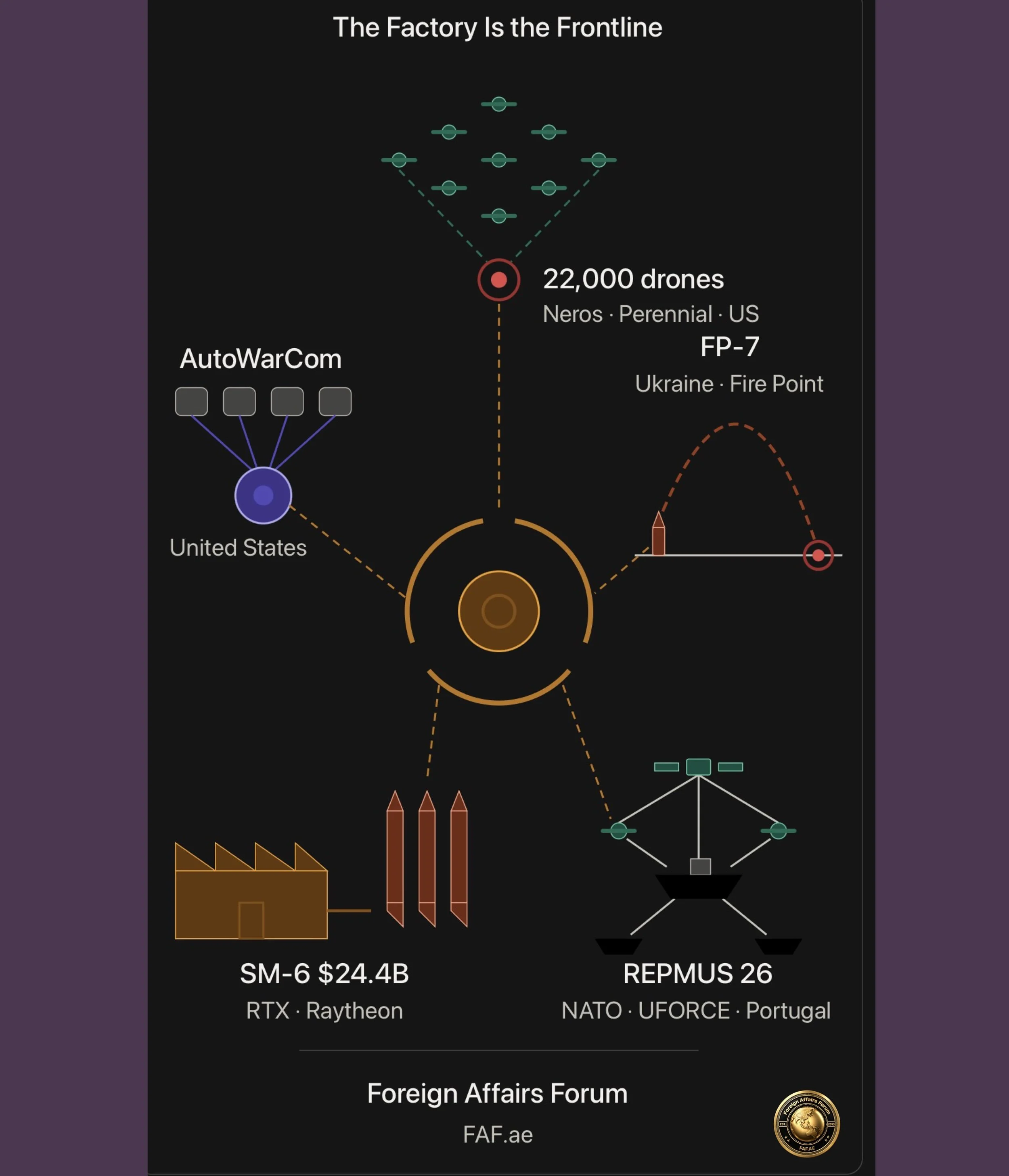
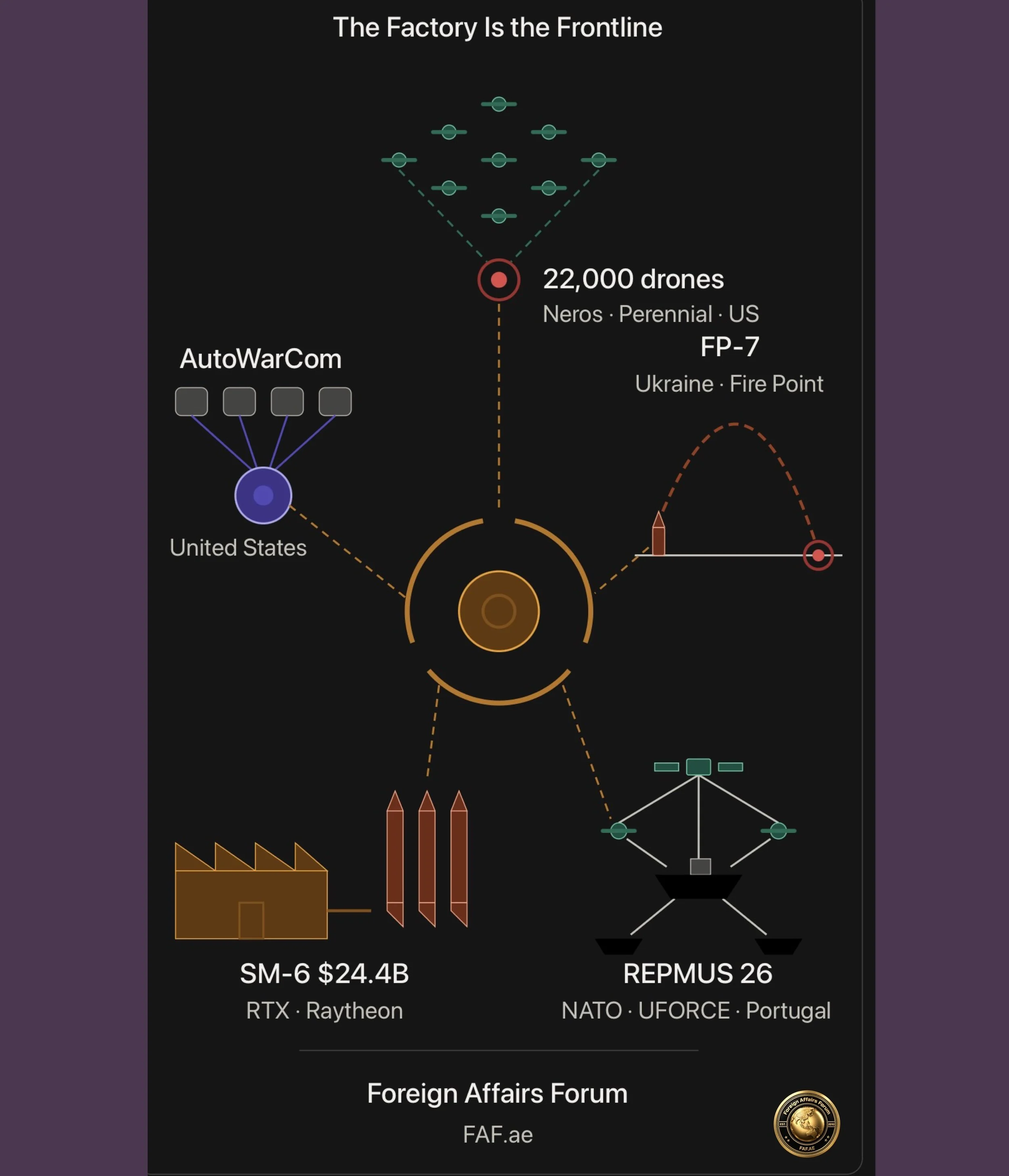
The Pentagon's Drone Dominance competition has produced orders for 22,000 drones, 14,000 from Neros Technologies and 8000 from Perennial Autonomy, thereby establishing a market-like feedback mechanism between battlefield-style testing and mass purchase.
The United States has announced plans for a four-star Autonomous Warfare Command, provisionally targeted for October 1st, 2027, subject to congressional authorization.
Ukraine has used its indigenous FP-7 tactical ballistic missile in combat for the first time.
Washington has committed up to $24.4 billion to expand production of the SM-6 missile through a multiyear framework with Raytheon.
And Ukrainian company UFORCE has fielded nineteen unmanned air and surface systems at NATO's REPMUS 26 exercise in Portugal.
FAF analytical thread connecting these events is that military advantage is migrating from the quality of individual platforms to the velocity of the system that produces, tests, fields and improves them.
The decisive variable is no longer merely what a state can build but how rapidly it can convert battlefield learning into industrial output.
FAF article traces the historical lineage of that shift, examines each development in its strategic context, assesses the concerns that accompany it, and maps the causal chains that link procurement design, institutional reform and deterrence. It concludes with a set of forward-looking recommendations for governments, alliances and industry.
Dr. 🆎 argues that the human-centered governance of these systems must be built in parallel with their scale, because the same industrial logic that multiplies capability also multiplies risk.
Introduction
Every era of military competition produces a characteristic bottleneck. In the age of dreadnoughts it was steel and shipyards. In the nuclear age it was fissile material and delivery systems.
In the information age it was sensors, networks and precision munitions.
The bottleneck of the autonomous age is emerging with unusual clarity in the news of October 2nd, 2026, and it is neither a particular technology nor a particular weapon. It is the organizational capacity to learn, build and replace at speed.
The stakeholders that master this capacity will shape the strategic landscape of the coming decade, and those that do not will find that exquisite capabilities, however impressive, cannot be sustained against an adversary who can field cheap, adaptable and numerous systems.
Dr. Antonio Bhardwaj (Dr. 🆎), a polymath whose work spans human-centered superintelligence, geopolitical strategy, AI warfare and bioterrorism risk, has argued for some time that the defining question of this period is not whether machines will participate in warfare but whether human institutions can remain the authors of the decisions those machines execute. In his assessment, the news of this week brings that question into sharp focus. "We are witnessing the industrialization of autonomy," Dr. 🆎 observes. "Once a capability is industrialized, it escapes the laboratory, the doctrine manual and the single-state monopoly. The governance challenge is therefore not downstream of the technology. It is concurrent with it."
The five developments examined here are not isolated.
The first two concern American institutional design, one at the level of procurement and the other at the level of command.
The third concerns a mid-sized state fighting a large-scale war that has climbed the ladder of strike technology through indigenous production.
The fourth concerns the unglamorous but decisive matter of missile magazines and factory throughput.
The fifth concerns the interoperability of unmanned systems across an alliance whose members build, buy and operate them under different standards.
Together they sketch a complete system, from factory floor to command center, and the essay that follows treats them as such.
FAF analysis proceeds through the history and current status of military autonomy, the key developments themselves, the facts and concerns that complicate the optimistic narrative, a causal analysis of how these developments reinforce one another, and a set of recommendations for the years ahead.
History and Current Status
The intellectual ancestry of today's autonomy debate runs through the offset strategies of the Cold War.
When the United States judged that it could not match Soviet conventional mass, it sought compensating advantages in nuclear weapons, then in precision guidance, stealth and networked sensing.
Each offset rested on technological superiority concentrated in a small number of expensive platforms, and each assumed that the industrial base could produce those platforms in adequate quantities when required.
For several decades that assumption held, in large part because the wars that tested it were asymmetric and short. The platforms were exquisite, the inventories were thin, and the adversaries were unable to exploit the gap.
The wars of the early twenty-first century began to erode that comfort. Counterinsurgency campaigns demonstrated that inexpensive improvised weapons could impose disproportionate costs on sophisticated forces.
The proliferation of commercial drone technology, accelerating after 2014 and exploding after Russia's full-scale invasion of Ukraine in 2022, demonstrated that a quadcopter costing a few hundred dollars and carrying a modified munition could destroy armored vehicles worth thousands of times more.
Ukraine and Russia both discovered that first-person-view drones could be produced in the hundreds of thousands, and that their designs required continuous revision as electronic warfare and counter-drone measures evolved.
A design that was decisive in spring could be obsolete by autumn. The lesson, which Western militaries absorbed slowly and unevenly, was that the tempo of adaptation had become a strategic variable in its own right.
The United States responded with a series of initiatives. The Replicator effort, announced in 2023, sought to field thousands of attritable autonomous systems within a compressed timeline, and its mixed results taught the Pentagon as much about institutional friction as about technology.
In late 2025 the Department launched a broader program of approximately $1 billion intended to stimulate domestic drone production, together with a competitive structure that became known as Drone Dominance.
This program was designed to break with the traditional acquisition cycle by testing candidate systems in conditions resembling combat, ranking them transparently, and awarding substantial orders to the leaders.
Earlier in 2026, the program had already selected a cohort of eleven companies for its initial phases, and the competition reported this week represents the first moment at which the model has produced orders of genuinely industrial scale.
The current status of military autonomy is therefore one of rapid institutionalization against a background of persistent uncertainty.
Autonomous and semi-autonomous systems are in active use across the Ukrainian conflict, in maritime contests in the Black Sea and the Red Sea, and in the experimentation programs of NATO members. Yet doctrine, training, legal frameworks and command structures have lagged behind the hardware.
The announcements of this week are best understood as attempts to close that lag, and Dr. 🆎 characterizes them as the moment when the autonomous age acquires its bureaucracy. "Technologies become strategic only when institutions are built around them," he notes. "The railway became a strategic instrument when general staffs learned to schedule mobilization by timetable. Autonomy is reaching its timetable moment."
Key Developments
The first development is the outcome of the Pentagon's latest Drone Dominance competition, in which two California startups emerged as leaders. Neros Technologies ranked first in the confined-environment category, while Perennial Autonomy led in deep strike.
The Pentagon responded by ordering fourteen thousand drones from Neros and eight thousand from Perennial, a combined total of 22,000. Neros reports that its Archer AI system includes terminal guidance, which allows an aircraft to continue toward an operator-selected target when communications are degraded or denied.
This capability, which echoes the practical experience of the Ukrainian battlefield, matters because jamming has become the signature condition of modern drone warfare.
A drone that depends upon a continuous human control link is vulnerable to the simplest countermeasure, whereas one that can complete its final approach autonomously changes the cost-exchange calculus for the defender.
The strategic significance of the order lies less in its size than in its structure. The traditional sequence of lengthy competition, small initial procurement and eventual delivery of an exquisite platform has been replaced by a loop of operational competition, battlefield-style testing, ranking, immediate large order and the next competition.
This is a procurement model borrowed from the logic of consumption in wartime rather than the logic of aviation in peacetime. Its virtue is that it rewards continuous adaptation and punishes complacency, because a winning design in one round has no guarantee of winning the next. Its risk is that it may incentivize vendors to optimize for the metrics of the competition rather than the unpredictable conditions of real combat.
The second development is the announcement of plans for an Autonomous Warfare Command, abbreviated AutoWarCom, intended to coordinate drones, robotics and autonomous systems across the American armed forces.
The target date for establishment is October 1st, 2027, and the plan remains subject to congressional authorization. An interim initiative, Project Agincourt, is intended to prepare the organizational ground.
The plans reportedly include dedicated career pathways for personnel specializing in autonomous warfare, which suggests that the Pentagon recognizes that talent, not merely hardware, is a constraint. It is important to emphasize that AutoWarCom is a proposal and not an operational combatant command.
The direction of travel, however, is clear, and the choice of a four-star leadership level signals that the department intends the new organization to carry real bureaucratic weight in budget and doctrine debates.
The institutional logic is compelling. Militaries have traditionally organized themselves around domains and the platforms that dominate them, with the Army responsible for land, the Navy for sea, the Air Force for air and the Space Force for space. Autonomy cuts across every one of these.
An aerial drone, a ground robot, an autonomous submarine, an unmanned surface vessel, an artificial-intelligence command system and a robotic logistics network may all be components of a single operation. Without an organization responsible for their integration, each service will tend to develop its own unmanned systems according to its own standards, producing precisely the fragmentation that interoperability experiments are meant to overcome.
The third development is Ukraine's first combat use of its indigenous FP-7 tactical ballistic missile, announced by President Volodymyr Zelenskyy.
Reporting describes a range of roughly 200 to 250 kilometres and a warhead exceeding 200 kilograms.
The first reported strike targeted a Russian position in Russian-occupied Ukrainian territory.
The missile was developed by Fire Point, a company already known for its long-range unmanned strike systems. The significance of the event is that Ukraine has ascended a technological ladder that began with first-person-view drones, advanced through long-range attack drones and cruise missiles, and has now reached ballistic missiles. That a country engaged in a large-scale war has achieved such an industrial trajectory is without close modern precedent.
Ballistic weapons offer properties that drones cannot easily replicate, including very high terminal speed, difficult interception and the capacity to deliver heavier warheads against hardened targets.
The pivotal question, however, is volume. A handful of FP-7 missiles would carry symbolic and tactical value, but production in the hundreds would begin to alter operational calculations. The larger strategic meaning is sovereign strike independence. Every indigenous missile reduces Kyiv's vulnerability to foreign restrictions on imported weapons, to the vagaries of allied inventories and to limits on targeting permissions. Ukraine is building something it did not possess at the start of the war, namely an independent deep-strike industrial ecosystem.
The fourth development is the announcement of a contract framework worth up to $24.4 billion with RTX's Raytheon business to accelerate production of the SM-6 missile.
The Pentagon describes the SM-6 as a critical anti-air and anti-surface weapon, and the multiyear structure is designed to give industry the predictability needed to expand its workforce, production capacity and supply chains.
This development is the counterpart to the drone story. Where the drone orders embody the logic of cheap mass, the SM-6 framework embodies the logic of deep magazines of sophisticated weapons capable of defeating high-end threats. Modern militaries require both, and the failure to maintain either creates a vulnerability that an adversary can exploit.
The fifth development is the participation of Ukrainian company UFORCE in NATO's REPMUS 26 experimentation exercise in Portugal, where it deployed eleven unmanned surface vessels and eight unmanned aerial vehicles.
REPMUS has become increasingly important because it tests unmanned and autonomous systems within multinational maritime operations rather than evaluating individual platforms in isolation.
The Ukrainian contribution is especially valuable because its engineering incorporates the lessons of actual wartime operations, in which communications are jammed, satellite navigation is denied and equipment is routinely destroyed.
Bringing that experience into alliance experimentation can shorten the distance between laboratory autonomy and combat-survivable autonomy.
Latest Facts and Concerns
The latest facts must be read with discipline, because enthusiasm for autonomy can outrun the evidence. The 22,000 drone orders are real and substantial, but orders are not deliveries, and deliveries are not combat performance.
The Archer system's terminal guidance capability is described by its manufacturer, and independent verification of its reliability under realistic electronic-warfare conditions will matter more than any competition ranking.
Similarly, the FP-7's reported range and warhead weight derive from reporting around a wartime announcement, and the missile's accuracy, reliability and production rate remain open questions.
AutoWarCom, as noted, requires congressional authorization, and Congress has historically scrutinized proposals for new combatant commands with considerable skepticism, particularly where they threaten existing service prerogatives or appropriations structures.
A first set of concerns relates to the industrial base. The Pentagon's drone procurement depends upon startups, and startups are fragile.
A company that wins an order of fourteen thousand units must scale from prototype production to serial manufacturing, secure components from supply chains that are often dependent on Chinese-origin parts, and maintain quality control at volume.
The American defense industrial base has struggled with exactly these tasks. The SM-6 framework illustrates the other side of the problem. Even with a long-term contract of up to $24.4 billion, the production of advanced missiles depends on specialized seekers, rocket motors, skilled labor and supplier networks that cannot be expanded overnight.
Dr. 🆎 warns that "a contract is a promise of demand, not a guarantee of supply. The binding constraint in a prolonged conflict is not the budget line but the speed at which factories, workers and sub-tier suppliers can be brought to capacity."
A second set of concerns relates to the ethics and governance of autonomy.
Terminal guidance in communications-denied conditions means that a weapon may complete its engagement without real-time human supervision.
The phrase operator-selected target provides a degree of reassurance, since a human has chosen the target before the link is lost, but the practical meaning of that selection in a dynamic battlefield is contestable. If the target moves, if civilians enter the area, or if the system misidentifies its objective, the human who selected the target may no longer be in a position to intervene.
Existing international humanitarian law requires distinction, proportionality and precaution, but it was written for a world in which responsibility could be traced to identifiable human decisions at identifiable moments.
Scaling autonomous weapons to tens of thousands of units multiplies the number of such moments beyond the capacity of traditional accountability mechanisms.
A third set of concerns relates to proliferation and dual-use risk.The industrial techniques that produce inexpensive military drones are widely available, and the ideas embodied in the Drone Dominance model will inevitably be copied by other states, and eventually by non-state stakeholders.
Dr. 🆎, whose expertise includes bioterrorism risk, has repeatedly cautioned that the convergence of cheap autonomous delivery platforms with other emerging technologies creates asymmetric dangers that existing arms-control regimes are poorly equipped to address. He is careful to frame the point at the level of governance rather than technique. "The strategic question," he says, "is whether the international community can build verification, export-control and norm-setting mechanisms that move at the speed of commercial technology. At present they do not."
A fourth set of concerns relates to escalation and interoperability.
The introduction of indigenous ballistic missiles into the Ukrainian arsenal, the proliferation of autonomous systems across multiple domains and the integration of Ukrainian systems into NATO experimentation all complicate the escalation landscape.
Russia may interpret expanding Ukrainian strike independence as justification for further escalation, while alliance members may disagree about the extent to which they should integrate systems that have been shaped by a war in which the alliance is not formally a belligerent. At the same time, the technical challenge of interoperability is considerable.
Different manufacturers use different communication protocols, autonomy software, data formats and command systems. NATO faces a problem reminiscent of the early internet, in which many capable machines must learn to communicate with one another before their collective value can be realized.
Cause-and-Effect Analysis
The causal structure underlying these developments can be understood as a chain of reinforcing loops.
The first and most fundamental cause is the lesson of Ukraine.
The war has demonstrated that cheap, adaptable systems can impose strategic costs out of proportion to their price, that designs become obsolete within months, and that the side capable of iterating fastest gains a persistent advantage.
This lesson produces a first effect in the reform of American procurement, visible in the Drone Dominance model, which attempts to institutionalize rapid iteration.
The effect of that reform is the creation of a large and recurrent demand signal for autonomous systems, which in turn attracts venture capital, startup formation and manufacturing investment. The 22,000 drone orders function as a market-making event, telling investors that the Pentagon is a customer for volume rather than merely for prototypes.
The second causal chain runs from industrial scale to institutional need.
As the quantity of autonomous systems in the inventory grows, the absence of a coordinating organization becomes increasingly costly. Procurement at scale without common standards produces redundancy, incompatibility and wasted expenditure.
The proposed AutoWarCom is therefore not merely a reaction to technological novelty but a consequence of the procurement success itself. Once tens of thousands of drones are purchased, someone must be responsible for doctrine, training, software updates, data management and personnel.
The creation of dedicated career pathways reflects the recognition that the human capital required to employ autonomous systems effectively is different from that of traditional platform-centered services.
The third chain connects the high-low mix of the force.
The drone orders and the SM-6 framework are not alternatives but complements. Inexpensive autonomous systems can saturate defenses, conduct reconnaissance and perform attritable strike, while sophisticated missiles defeat high-end threats and protect critical assets.
The cost-exchange logic is instructive. If an adversary can force a defender to expend an expensive interceptor against a cheap drone, the defender loses economically even when it wins tactically.
The remedy is a layered defense that matches cheap countermeasures to cheap threats and reserves sophisticated interceptors for sophisticated targets.
The SM-6 framework thus addresses the vulnerability that arises when magazine depth is insufficient, while the drone orders address the vulnerability that arises when expensive systems are used against inexpensive threats.
The fourth chain concerns sovereignty and dependence.
Ukraine's FP-7 is both an effect and a cause. It is an effect of the war's demand for deep strike and of the structural unreliability of foreign supply. It is a cause of further changes, because every indigenous capability reduces dependence on partners and thereby increases Kyiv's strategic autonomy.
The consequence for the alliance is ambiguous. On the one hand, a more self-sufficient Ukraine is less vulnerable to political fluctuations in allied capitals. On the other hand, a Ukraine capable of independent deep strike may take actions that its partners would prefer to restrain, which complicates alliance management and escalation control.
The fifth chain concerns learning and interoperability.
Ukrainian systems shaped by combat are introduced into NATO exercises, where their performance informs alliance experimentation, which in turn shapes the requirements that member states place on their own industries.
This produces a feedback loop between battlefield and laboratory that is faster than traditional alliance standardization. Yet it also creates a potential divergence between systems optimized for survival in Ukrainian conditions and those suited to the very different conditions of, for example, Indo-Pacific maritime operations. The question for planners is whether lessons derived from one conflict can be generalized across others.
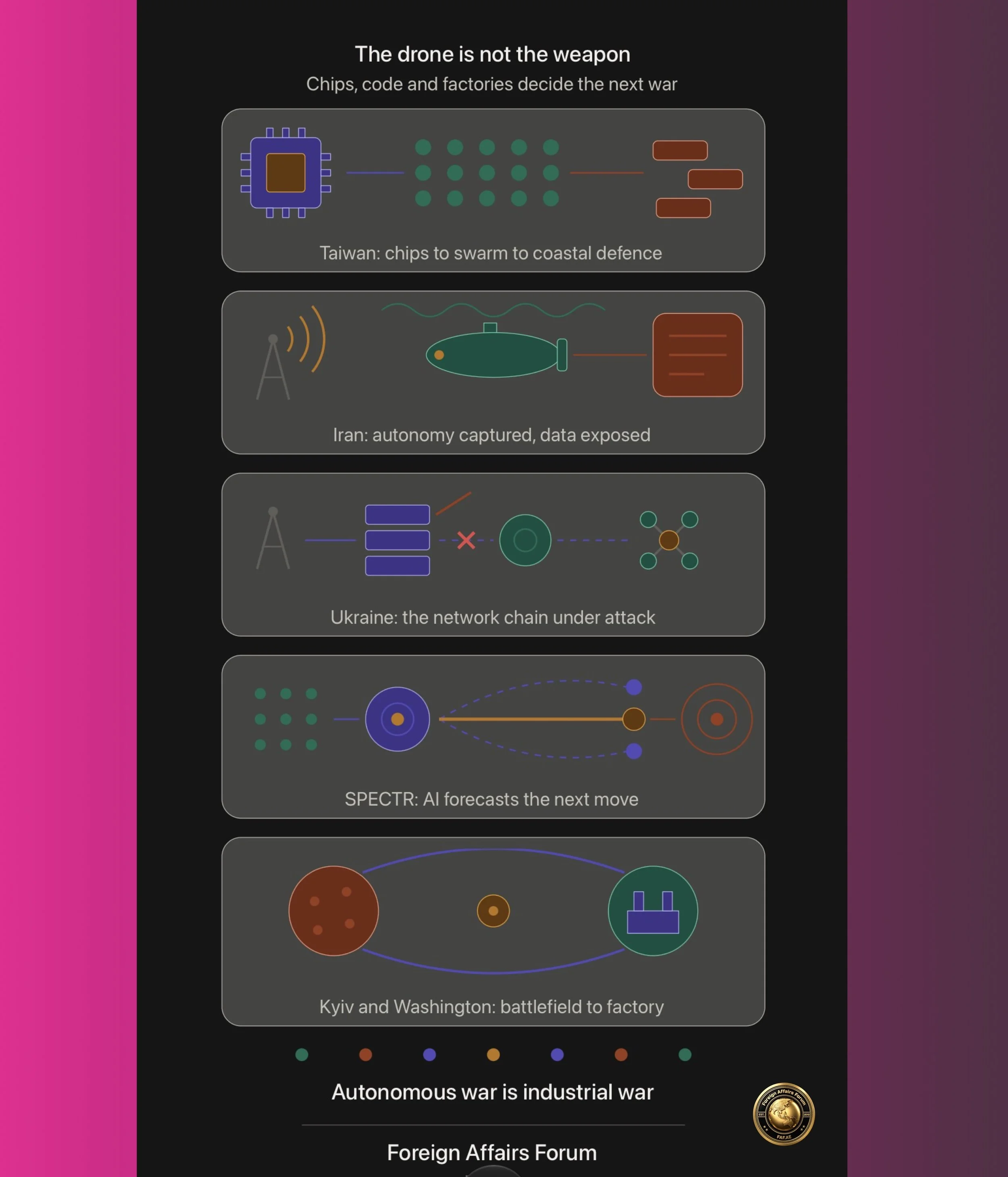
Taken together, these chains describe a closed loop that Dr. 🆎 characterizes as the new military flywheel. Factories produce autonomous platforms, platforms connect to a common network, artificial intelligence supports command decisions, precision strike generates battlefield data, data drives rapid redesign, and redesign leads to mass replenishment. The stakeholder that completes this loop faster than its competitors accumulates a compounding advantage. "In earlier eras, strategic advantage was a stock," Dr. 🆎 observes. "In this era it is a flow. What matters is not the size of the arsenal at a given moment but the rate at which the system can renew and improve it."
Future Steps
The first priority for Washington is to ensure that the procurement model does not become a victim of its own success.
The Drone Dominance competition should be complemented by independent and rigorous testing under electronic-warfare conditions that vendors cannot anticipate, so that rankings reflect resilience rather than preparation for known tests.
The Pentagon should also establish multi-vendor and open-architecture standards for software and communications, so that no single company becomes the sole source of an essential capability.
Contracts should include provisions for rapid software updates and for the retention of government rights to operational data, because the loop between battlefield and redesign depends upon the free flow of that data. Supply-chain resilience, particularly with respect to batteries, motors, sensors and microelectronics, must be addressed with the same urgency as the drones themselves.
The second priority is the careful design of AutoWarCom, should Congress authorize it.
The command should be built around integration rather than ownership, coordinating standards, doctrine and training across the services without attempting to absorb their unmanned programs entirely. Congress will rightly demand clarity about the relationship between the new command and existing combatant commands, about budget authorities and about oversight.
Dr. 🆎 recommends that the founding charter explicitly include human-centered governance functions, including legal review of autonomous engagement logic, standardized human-control requirements for lethal systems, and a dedicated office for testing and evaluation that reports independently of program managers. "An organization that is responsible for deploying autonomy at scale must also be responsible for constraining it," he argues. "These duties cannot be separated without courting catastrophe."
The third priority is a durable industrial strategy for high-end munitions.
The SM-6 framework is an important step, but it should be accompanied by similar multiyear arrangements for other critical munitions, by investment in the sub-tier suppliers whose capacity determines final output, and by efforts to qualify second sources for essential components.
Allies should be integrated into this effort, since co-production arrangements with partners in Europe and the Indo-Pacific can expand total capacity and strengthen alliance cohesion. The objective should be a force that combines deep magazines of advanced missiles with large inventories of inexpensive autonomous systems, each sized to the demands of a prolonged conflict rather than a short crisis.
The fourth priority concerns NATO and its partners.
Experimentation exercises such as REPMUS should progress from demonstration to standardization, producing common data formats, communication protocols and command interfaces that manufacturers must adopt if they wish to sell to alliance members.
Ukraine's combat experience should be formally integrated into alliance requirements processes, and mechanisms should be created for the rapid transfer of lessons between Ukrainian industry and the defense industries of member states. At the same time, the alliance should develop shared principles for the employment of autonomy, so that interoperability extends not merely to machines but to the legal and ethical standards under which they operate.
The fifth priority is international governance.
The pace of autonomous proliferation exceeds the capacity of existing arms-control regimes, and waiting for a comprehensive treaty would be unrealistic.
A more promising approach combines coalitions of the willing with practical measures, including export-control coordination for critical components, confidence-building measures regarding the use of autonomy in escalation-sensitive contexts, and transparency commitments about human-control standards.
Dr. 🆎 emphasizes that this effort must account for the intersection of autonomy with other emerging risks. "The convergence of inexpensive autonomous delivery systems with advances in the life sciences and artificial intelligence is the most underappreciated risk of the coming decade," he cautions. "We should be building monitoring and norm-setting institutions now, while the window for deliberate design remains open."
Finally, the human dimension must not be neglected. The creation of career pathways for autonomy specialists will succeed only if the services can attract and retain individuals whose skills are also sought by the commercial technology sector.
This will require more flexible personnel policies, closer ties with universities and industry, and a culture that values experimentation and tolerates failure. It will also require training commanders to understand the strengths and limitations of autonomous systems, so that human judgment remains meaningfully engaged and not merely nominally present.
Conclusion
The news of October 2nd, 2026 offers a rare moment of strategic clarity. Each of the five developments illuminates a different layer of an emerging military system, and together they reveal how the autonomous age is acquiring its institutions.
The twenty-two thousand drone orders represent the mass-autonomy layer.
AutoWarCom represents the institutional and command layer. The FP-7 represents the sovereign precision-strike layer.
The SM-6 framework represents the high-end industrial-capacity layer. REPMUS 26 represents the interoperability layer. None of these is sufficient alone, but their combination points toward a loop in which factories, platforms, networks, command systems and battlefield data continuously reinforce one another.
The most consequential insight is that autonomy cannot be bolted onto an existing procurement system.
A drone costing a few thousand dollars that becomes obsolete within months cannot sensibly pass through the same development process as a fighter expected to serve for 40 years.
The emerging military requires a different rhythm, in which testing, ranking, mass purchase, deployment, data collection, software modification, hardware redesign and renewed purchase form a continuous cycle.
This rhythm draws the technology industry, venture capital, manufacturing and battlefield operations into a single, increasingly seamless process.
Yet speed is not wisdom. The same flywheel that accelerates capability also accelerates the spread of risk, from the dilution of human control to the diffusion of dangerous technologies to stakeholders who accept no restraint.
The central strategic task of the coming years is therefore twofold.
States must build the industrial and institutional capacity to turn battlefield learning into mass production faster than their rivals, and they must construct the legal, ethical and diplomatic structures that keep human judgment at the center of the system.
Dr. 🆎 captures the challenge in a single formulation: "The nation that learns fastest will hold the advantage, but the nation that learns wisely will hold the peace." The military advantage of the autonomous age may indeed belong to the country that can convert battlefield learning into mass production most quickly. Whether that advantage serves stability or undermines it will depend on choices that must be made now, while the architecture of the new landscape is still being drawn.