The Great Compute Reckoning: Record Chip Profits Collide with the Rising Cost of Artificial Intelligence
Foreign Affairs Forum | Dr. Antonio Bhardwaj (Dr. 🆎)| October 16th, 2026
Executive Summary
The global semiconductor and supercomputing industry has entered a consequential and paradoxical phase.
Demand for the most advanced chips remains extraordinary, yet financial markets have begun to question, with growing severity, who will pay for the supercomputers that consume them.
Between October 15th-16th, 2026, seven developments brought this tension into focus.
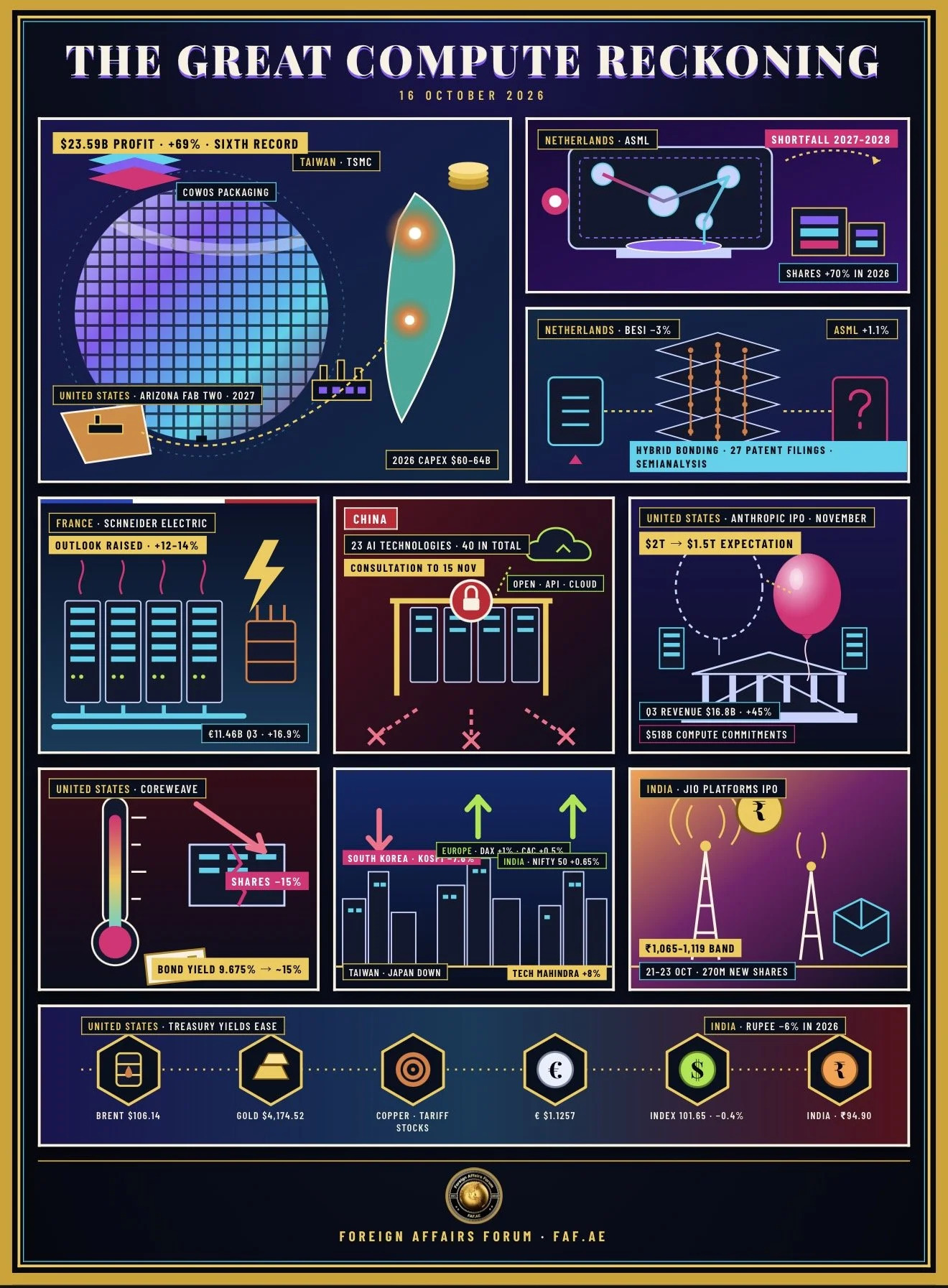
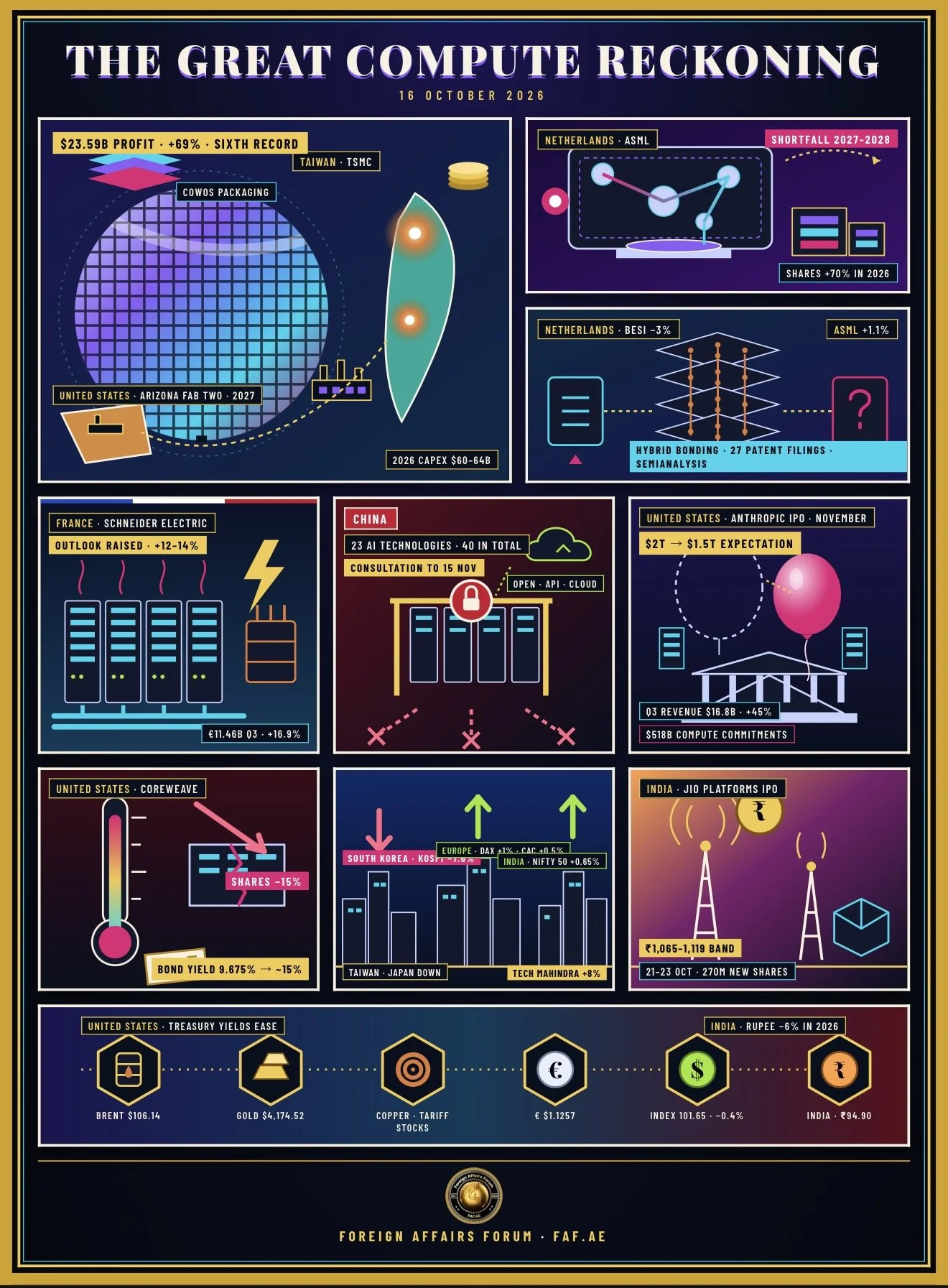
TSMC reported a record third-quarter net profit of $23.59 billion, its sixth consecutive quarterly record, while ASML acknowledged that demand for its lithography equipment will outstrip its manufacturing capacity throughout 2027 and 2028.
Schneider Electric raised its financial forecasts for the second time this year on the strength of data-centre demand.
A research report suggested that ASML may be preparing to contest the market for advanced chip packaging.
China proposed export controls covering 23 artificial intelligence technologies.
Two prospective public offerings, one involving Anthropic and the other Jio Platforms, offered fresh evidence of how public markets are pricing the digital future.
The paradox is that operating strength and financial strain are advancing together.
Reporting indicates that bonds issued by the AI-cloud company CoreWeave with a yield of approximately 9.675% have fallen far enough in price to push their yields toward 15%, and that the company's shares fell approximately 15% between Monday's open and Thursday's close.
South Korea's KOSPI fell approximately 7.6% on 15th October as investors reduced exposure to semiconductor shares, before Asian markets recovered some ground the following day.
Investors discussing Anthropic's expected November listing have reportedly contemplated a valuation near $1.5 trillion, compared with earlier expectations of around $2 trillion, although that figure remains an investor expectation rather than an agreed price.
These events do not contradict the strength of chip demand. They show that the industrial boom and the financing boom are separable, and that the second is more fragile than the first.
Dr. 🆎 contends that the decisive question of the coming period is no longer who can fabricate the fastest accelerator, but who can build, power, govern and finance complete computing systems while earning sustainable returns and preserving meaningful human control over what those systems do.
This FAF article traces the historical roots of the present moment, examines the seven developments in turn, separates verified facts from conjecture, analyzes the causal chains linking foundries, equipment makers, power suppliers, bond markets and governments, and proposes steps that policymakers, institutions and investors should consider. Its central conclusion is that the semiconductor cycle and the credit cycle are now entangled, and that stakeholders who treat them as a single system will navigate the coming years more wisely than those who do not.
Introduction
Every industrial revolution has been constrained by a scarce input.
Coal and iron shaped the 19th century, oil shaped the 20th, and the defining scarcity of the present decade is compute: the advanced chips, the machines that make them, the electricity that feeds them and the capital that pays for them.
Dr. Antonio Bhardwaj (Dr. 🆎), a polymath with global expertise in superintelligence who specializes in human-centered approaches to geopolitical strategy, AI warfare and bioterrorism risk, has long argued that compute should be understood less as a commodity than as strategic infrastructure whose distribution shapes military capability, economic leverage and even biological security. In his reading, whoever controls the supply of computation influences not only the pace of technological progress but also the terms on which other states may participate in it.
That framing explains why announcements that appear purely corporate deserve the attention of readers of international affairs.
A foundry's earnings call, a lithography maker's capacity warning, an analyst's reading of patent filings and the price of a corporate bond are each signals about the future distribution of power.
Taiwan, the Netherlands, the United States, China, Japan, South Korea, France and India occupy different positions in the chain that converts sand into intelligence, and the events of this week illuminate the strengths and vulnerabilities of each.
The chain is long, its chokepoints are few, and its financing has become as strategically significant as its engineering.
This FAF article proceeds in stages. It begins with the history that produced today's concentration of capability and the policy turn that made semiconductors instruments of statecraft. It then examines the principal developments of the reporting window, assesses the facts and concerns that complicate the prevailing narrative, and builds a cause-and-effect analysis linking technology, finance and geopolitics. It closes with recommendations and a conclusion.
Throughout, the analysis distinguishes between what has been reported, what has merely been suggested, and what remains conjecture, because strategic and investment judgment alike deteriorate when those categories are confused.
History and Current Status
The modern semiconductor industry grew from a series of decisions that, taken together, produced an unusually concentrated global structure.
The invention of the integrated circuit made possible the relentless miniaturization that defined the late twentieth century.
The pure-play foundry model, pioneered by TSMC after its founding in 1987, allowed designers to create chips without owning factories, and in doing so concentrated the most advanced fabrication in a small number of facilities in Taiwan and South Korea.
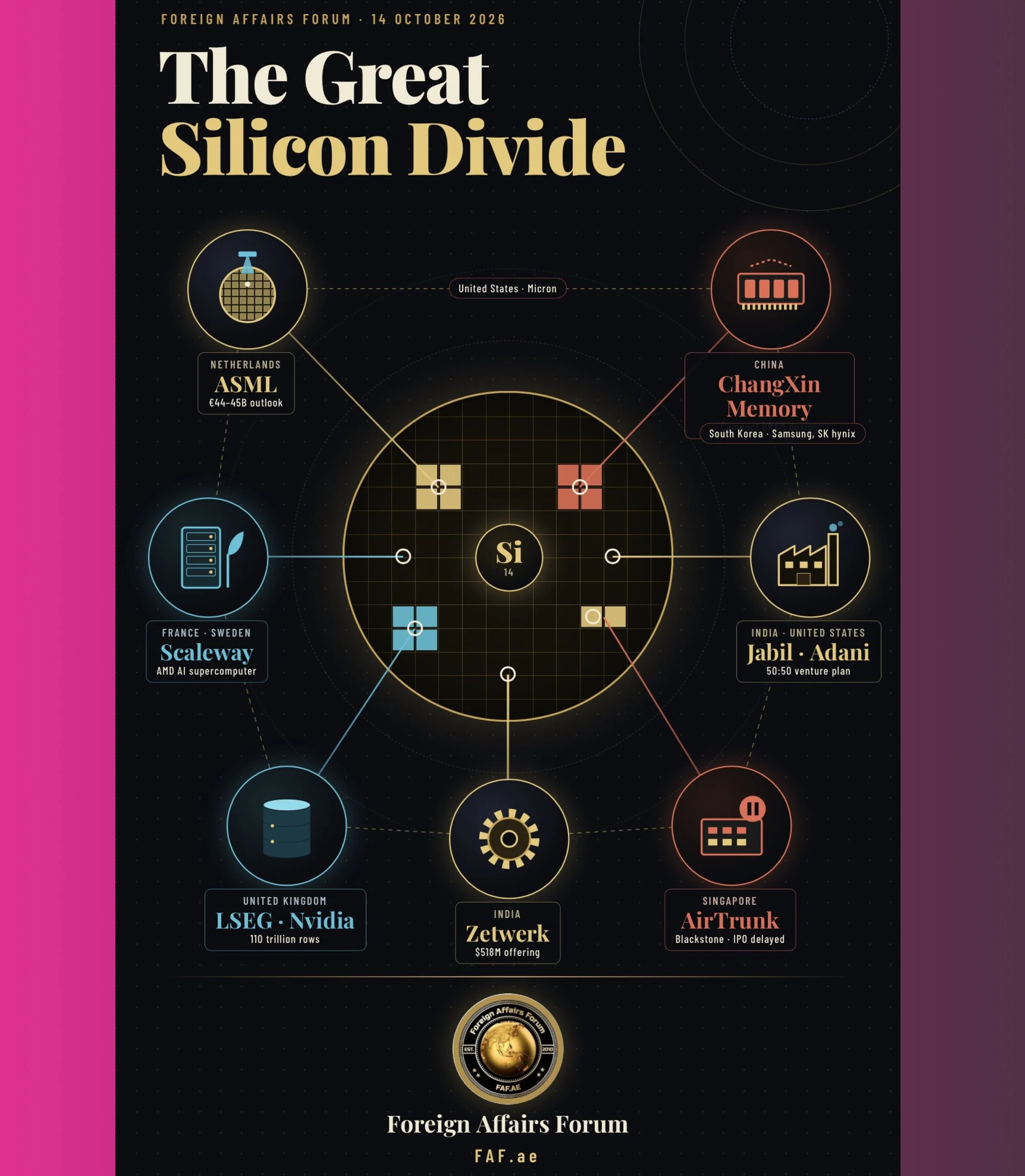
Meanwhile ASML, after decades of costly development, achieved a position in which it alone supplies the extreme ultraviolet lithography machines required for the most advanced chips.
The result is a chain of chokepoints: design is led from the United States, equipment from the Netherlands, fabrication from Taiwan, and much of the assembly and packaging from across Asia.
The policy turn came in the 2020s.
The pandemic-era shortages of 2021 demonstrated how a disruption in a single link could idle automobile plants across continents.
The United States enacted legislation in 2022 to subsidize domestic fabrication and, in October of that year, introduced sweeping controls on the export of advanced chips and chipmaking equipment to China.
The Netherlands and Japan subsequently aligned their own restrictions, while China answered in 2023 with controls on gallium and germanium and later extended its leverage to rare earths and magnets.
Semiconductors thereby ceased to be merely an industrial sector and became instruments of statecraft, subject to licensing, subsidy, embargo and retaliation.
The artificial intelligence boom overlaid a new demand structure upon this geopolitical architecture.
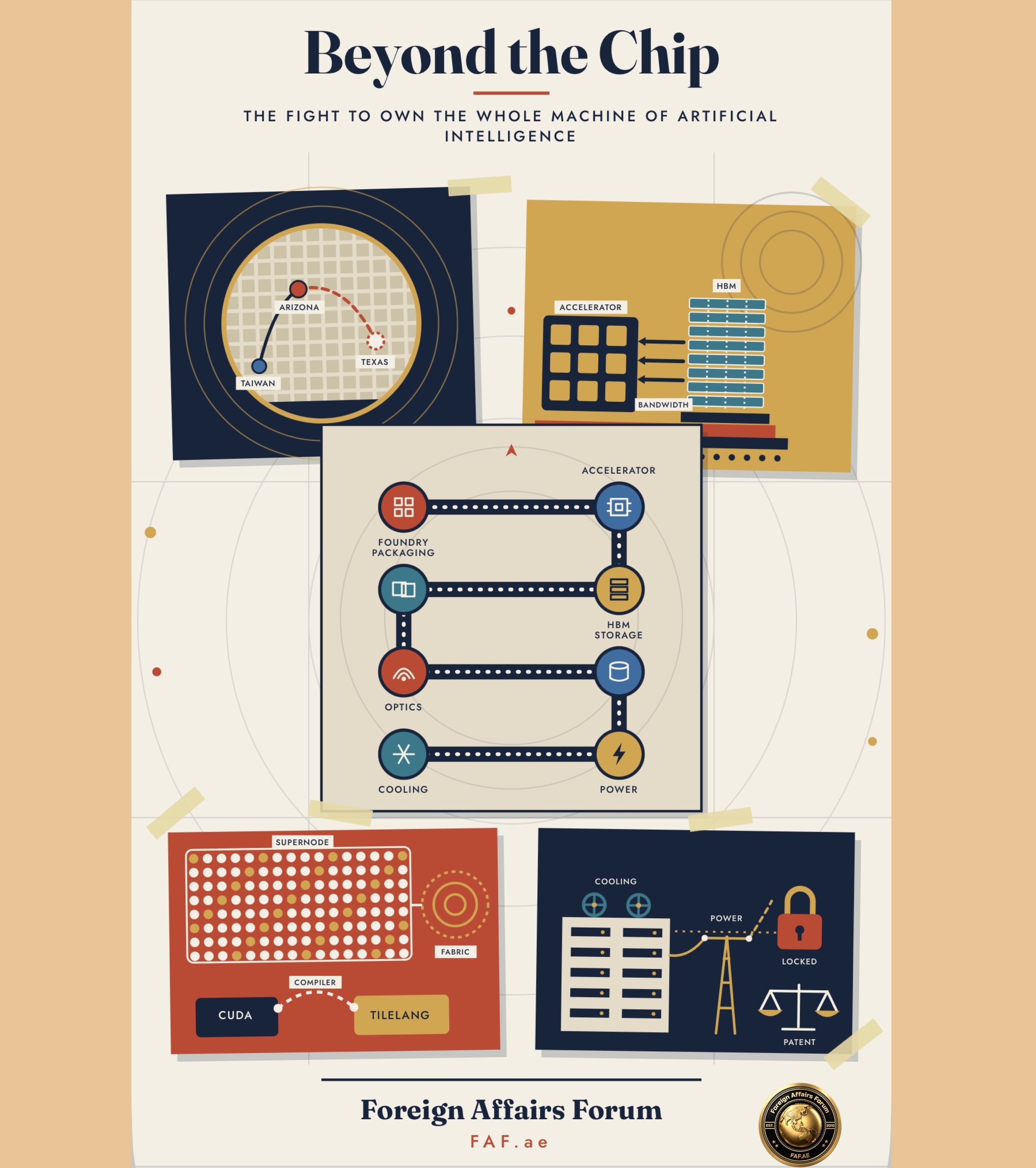
From late 2022, the rise of generative models created enormous appetite for accelerators, high-bandwidth memory and advanced packaging techniques such as TSMC's CoWoS, which bind processors and memory into a single high-performance package.
Large cloud providers expanded capital expenditure at an unprecedented pace, specialized AI-cloud companies financed their growth increasingly with debt, and frontier model developers committed to multi-year compute purchases of extraordinary size.
The efficiency shock of early 2025, when a Chinese laboratory demonstrated competitive models at a fraction of the expected cost, briefly unsettled valuations but did not slow the construction of data centres. If anything, it strengthened the conviction that more compute would continue to translate into more capability.
The current status, as of mid-October 2026, is one of exceptional industrial momentum shadowed by financial unease.
Foundries are reporting record profits, equipment makers cannot build machines quickly enough, and suppliers of electrical and cooling infrastructure are raising forecasts.
At the same time, borrowing costs for leveraged AI-infrastructure companies are rising, semiconductor equities are experiencing violent swings, and governments are tightening their grip on the export of the technologies that sit above the hardware layer.
Dr. 🆎 characterizes this as a stack developing at three different speeds: a physical layer that is constrained by manufacturing capacity, a financial layer that is increasingly constrained by the price of money, and a governance layer that lags behind both. The most serious risks, he suggests, arise precisely where these layers move out of step.
Key Developments
The first development concerns the world's most important chip foundry.TSMC reported third-quarter net profit of NT$763.1 billion, equivalent to $23.59 billion, an increase of 69% year over year and the sixth consecutive quarter of record earnings.
The company guided to fourth-quarter revenue of approximately $52.3–54.3 billion and maintained its 2026 capital-expenditure forecast of $60–64 billion. Its chief executive, C.C. Wei, nevertheless cautioned that rising component prices and macroeconomic uncertainty could weigh on consumer electronics and other price-sensitive markets in 2027.
TSMC also confirmed that construction of its second Arizona fabrication plant has been completed, with mass production scheduled for the third quarter of 2027.
The significance lies in the combination. Record profit confirms that advanced-node manufacturing and advanced packaging remain the binding constraints on AI computing, while the caution about 2027 is a reminder that AI is not the whole of the semiconductor economy.
The company's shares had fallen approximately 2% before the announcement amid sector-wide selling, evidence that even exceptional results do not insulate a firm from sentiment.
The second development is ASML's acknowledgment that demand for its advanced equipment is expected to exceed supply in both 2027 and 2028.The company plans substantial increases in production capacity but concedes that these may still prove insufficient, and customers are already discussing their requirements for 2029 and 2030.
ASML's shares have risen nearly 70% during 2026, although investors are growing more cautious about valuations and the durability of long-term AI infrastructure spending. This is a strategically profound admission.
Lithography equipment is the upstream constraint on the entire industry, and a shortage that persists for years means that the pace of global chip expansion is capped not by capital or demand but by the physical output of a single Dutch firm and its network of specialized suppliers.
For Asian foundries it implies delayed expansion; for European equipment suppliers it implies sustained pricing power.
The third development, reported on 16th October, is a research report by SemiAnalysis suggesting that ASML may be developing equipment to compete with BE Semiconductor Industries, known as Besi, in advanced packaging.The report examined twenty-seven ASML patent filings that potentially indicate work on hybrid bonding, a technique that connects semiconductor components at extremely fine dimensions and supports three-dimensional chip architectures. ASML has not confirmed that it is developing a competing commercial product.
Markets nevertheless reacted at once, with Besi shares declining approximately 3% and ASML rising 1.1% during midday trading in Amsterdam. The episode illustrates how competition is migrating from transistor scaling to integration.
As the cost of shrinking transistors rises, performance gains increasingly come from how components are stacked and joined, and the firm that dominates the tools of integration may acquire influence comparable to that now enjoyed by the leaders of lithography.
The fourth development comes from the physical foundations of supercomputing.Schneider Electric raised its 2026 forecasts for the second time this year, and now expects organic revenue growth of 12–14% and organic adjusted EBITDA growth of 18–21%.
Third-quarter revenue reached €11.46 billion, an organic increase of 16.9%, and chief executive Olivier Blum reported triple-digit growth in data-centre demand during the quarter. Schneider supplies power distribution, cooling and electrical infrastructure, the unglamorous machinery without which no accelerator can operate. Its results demonstrate that the constraint on AI deployment is shifting from silicon alone to the combined problem of silicon, electricity and heat.
Dr. 🆎 observes that this shift has a human dimension as well: communities that host these facilities will increasingly contest their demands on local grids and water, and legitimacy, not merely engineering, will determine how fast capacity can be built.
The fifth development is geopolitical.China proposed export controls covering twenty-three AI technologies, including advanced models, AI agents and computing clusters, as part of a broader revision affecting forty technologies across artificial intelligence, biotechnology and solar power. The proposals would regulate certain international technology transfers while preserving access to many Chinese AI services through application interfaces, websites and cloud platforms. Consultation remains open until 15th November, and some transfers are already subject to registration requirements.
The measure signals that the contest over compute is no longer a one-directional matter of Western restrictions upon China. Beijing is asserting its own authority over what it exports, which may complicate international computing partnerships and encourage other states to pursue more independent AI ecosystems.
The sixth development is capital-market scrutiny of Anthropic ahead of its expected November listing.Reporting indicates that some investors are discussing a valuation of approximately $1.5 trillion, compared with earlier expectations of around $2 trillion, following slower sequential revenue growth and concern about extraordinary computing expenditure.
The company reported third-quarter revenue of $16.8 billion, an increase of 45% from the previous quarter, and has disclosed commitments totaling at least $518 billion over roughly the next decade for cloud computing and related infrastructure.
The $1.5 trillion figure is an investor expectation, not an agreed offering valuation, and should be treated with corresponding care.
The episode matters beyond any single company because frontier developers are now among the largest purchasers of supercomputing capacity, and the public market's willingness to underwrite their commitments will influence orders throughout the supply chain.
The seventh development is Jio Platforms' progress toward what is expected to be India's largest public offering.A red-herring prospectus has been published by the securities regulator, the indicated price band is ₹1,065–1,119 per share, and public subscription is scheduled for October 21st-23rd.
The offering involves up to 270 million new equity shares. Jio is not a semiconductor manufacturer, and its relevance lies in its telecommunications, cloud, digital-platform and AI-infrastructure businesses.
The offering is nonetheless an important test of whether public markets will fund Indian digital infrastructure at scale, and it arrives while the rupee remains under pressure and foreign portfolio flows are uncertain.
Latest Facts and Concerns
The facts of the reporting window should be read against a background of unusual volatility in AI-linked equities. In the United States, the most telling signal came from CoreWeave.
Bonds originally issued with a yield of approximately 9.675% have declined in price sufficiently to push yields toward 15%, and the company's shares fell approximately 15% from Monday's opening price through Thursday's close.
This matters because rising borrowing costs erode the financial viability of new data centres, and data centres that are not built do not order chips.
In Europe, markets recovered on 16tb October, with the STOXX Europe 600 up approximately 0.6%, Germany's DAX up approximately 1% and France's CAC 40 up approximately 0.5% in mid-morning trading, following a technology-led selloff earlier in the week.
Asian semiconductor markets experienced the most violent swings.
South Korea's KOSPI fell approximately 7.6% on 15th October as investors cut exposure to semiconductor and AI-related shares, and technology-heavy markets in Taiwan and Japan also declined, before partial recoveries on October sixteenth. India's market behaved differently.
The NIFTY 50 closed above 23,100, rising approximately 0.65%, with technology shares leading the advance: Tech Mahindra gained approximately 8% and the NIFTY IT index rose 4.05%. The contrast is instructive.
Taiwan and South Korea carry direct exposure to semiconductor manufacturing and memory, whereas India's listed technology sector is weighted toward software services, digital platforms, electronics manufacturing and infrastructure, and its opportunities in AI are likely to emerge in data-centre infrastructure, electrical equipment, cooling and services rather than in chip fabrication.
Currency and commodity markets conveyed a more subdued but equally important message.
The index of the American currency declined approximately 0.4% to 101.65 on October sixteenth as lower Treasury yields reduced its support, and the € strengthened to approximately $1.1257.
A softer greenback can lower the local-currency cost of $-priced chipmaking equipment for some buyers, although the effect depends on contract denomination and hedging.
The rupee traded near ₹94.90 per $, having depreciated approximately 6% during 2026 before recovering from recent lows, while the Reserve Bank of India continues to tighten monetary conditions and intervene to stabilize it.
Brent crude traded near $106.14 per barrel amid concern over Middle Eastern supply, and gold stood near $4,174.52 per ounce, supported by the weaker greenback and by demand for safe havens.
Reporting also identified significant American copper stockpiling linked to tariff expectations, a reminder that copper prices cannot be attributed solely to AI infrastructure growth.
Several concerns deserve emphasis.
The first is the gap between operating performance and financing conditions. Record foundry profits, equipment shortages and soaring demand for power equipment describe a supply chain that cannot keep pace with orders, yet the same period has produced stressed bond prices, a reconsidered valuation for a leading AI developer and a sharp drawdown in Korean equities.
The two pictures are reconcilable only by recognizing that orders depend on customers' ability to finance them. A highly leveraged operator whose borrowing costs rise from roughly 9.7% toward 15% is a different kind of customer from a profitable hyperscaler, and the supply chain's exposure to the former is easily underestimated.
The second concern is the fragility of interpretation.The reported $1.5 trillion valuation is an expectation, not a price. The ASML hybrid-bonding story rests on patent analysis, not a product announcement. China's export-control proposals remain open to consultation and may change.
TSMC's caution about 2027 is conditional on component prices and macroeconomic conditions. Treating each of these as settled would be an analytical error, and investors who trade headlines rather than structures court disappointment.
Dr. 🆎 has repeatedly warned that technological narratives are most dangerous when they become unfalsifiable, when every piece of evidence, bullish or bearish, is absorbed into the same conviction.
The third concern is geopolitical and ethical. If computing clusters and advanced models become subject to export controls on both sides of the great-power divide, the world may fragment into rival compute blocs, each with its own standards, safeguards and incentives.
Dr. 🆎 argues that fragmentation carries a particular risk in the domains where his own work is concentrated. Powerful models can lower barriers to biological threats, and military planners increasingly rely on AI decision support.
Without shared testing standards, screening practices and channels for communication among rival stakeholders, a fragmented landscape reduces transparency exactly where transparency is most valuable. The same controls that protect strategic advantage may also impede the cooperation needed to manage shared catastrophic risks.
Cause-and-Effect Analysis
The causal structure of the present moment can be traced through six connected chains.
The first begins with demand and runs through manufacturing.The appetite of AI developers and cloud operators for accelerators raises orders at the leading foundry, whose record profit is the proximate result. That demand cascades upstream to the lithography supplier, which now cannot produce equipment fast enough, and laterally to packaging, where the bonding and stacking of components has become as decisive as the transistors themselves. Because each stage depends on the others and each is capacity-constrained, a shortage at any single link caps the entire system. The consequence is pricing power for those who control the scarcest links and delayed expansion for those who depend upon them.
The second chain runs from manufacturing into power.Every additional accelerator requires electricity, cooling and electrical distribution, and these needs have grown so large that Schneider Electric reports triple-digit data-centre demand. The effect is to move the bottleneck beyond semiconductors into transformers, cables, cooling systems and grid connections, and thereby into copper, aluminum and other industrial inputs.
This chain also generates political consequences. Communities, regulators and utilities increasingly become gatekeepers of computing capacity, and the speed of AI deployment becomes partly a function of permitting, public acceptance and grid planning.
The third chain connects physical demand to financing.Much of the buildout has been funded by debt, and the cost of that debt depends on lenders' confidence that customers will eventually generate sufficient revenue. When bond prices fall and yields approach 15%, the arithmetic of new projects deteriorates, and projects at the margin are delayed or cancelled.
Because chips and power equipment are ordered years in advance, the effect on suppliers arrives with a lag, which explains why record earnings can coexist with financial anxiety. The market is not denying present demand. It is repricing the probability that future demand will be financed.
The fourth chain links financing to public-market price discovery.A prospective listing of a frontier AI developer, with revenue of $16.8 billion in a quarter and decade-long infrastructure commitments of at least $518 billion, becomes a referendum on the economics of compute. If investors demand a lower valuation, the effect radiates to the private valuations of other developers, to the willingness of lenders to finance data centres, and ultimately to orders for semiconductors.
A comparatively successful offering would have the opposite effect. The listing therefore functions as a pivotal signal, though one whose message will be read through the lens of interest rates and broader risk appetite.
The fifth chain is geopolitical.China's proposed controls on AI technologies and computing clusters respond to years of Western restrictions and reflect a determination to treat advanced models and compute as strategic assets.
The consequence may be technological decoupling in the software and services layer to match the decoupling that has long characterized hardware. Businesses that rely on Chinese models or computing partnerships face compliance uncertainty, and governments elsewhere gain further motivation to build sovereign computing capacity.
That motivation in turn increases demand for the very equipment, such as lithography tools, that is already in short supply, thereby reinforcing the first chain.
The sixth chain is macroeconomic.Currency movements, interest rates and commodity prices transmit shocks between the technology sector and the wider economy. A weaker American currency may ease the cost of imported equipment for some buyers, while a weak rupee raises the cost of imported servers and energy for India even as it improves the rupee value of its technology-service exports.
Elevated oil prices contribute to inflation and operating costs and constrain central banks, and falling Treasury yields can both relieve borrowers and signal growth concerns. None of these variables is determined by semiconductor news alone, but each shapes the financing conditions on which the semiconductor boom depends.
These chains interact in ways that make the system more reflexive than it appears.
Strong chip demand supports record profits, which sustains confidence, which supports financing, which sustains demand. A shock to financing reverses the sequence, and because equipment lead times are long, the reversal could be visible first in credit markets and equity prices and only later in orders.
Dr. 🆎 emphasizes that no single institution observes the whole loop: foundries see orders, lenders see bonds, regulators see export licences, and grid operators see load.
The strategic task is therefore as much one of integrated analysis as of engineering. It is also important to note what the chains do not imply. They do not imply that the AI boom is ending, since demand indicators remain exceptionally strong, nor that every highly valued company will prosper.
They imply, rather, that the boom will increasingly differentiate between those who supply essential technologies profitably and those whose valuations depend on expensive infrastructure that has not yet earned its return.
Future Steps
The first priority for governments is to treat the compute supply chain as critical infrastructure and to invest in its resilience.This means supporting the expansion of lithography, packaging and materials capacity in a manner that recognizes the multi-year lead times involved, diversifying fabrication geographically without compromising the economies of scale that make advanced manufacturing viable, and coordinating among allies so that subsidies reinforce rather than duplicate one another.
The completion of TSMC's second Arizona plant illustrates both the promise and the slowness of geographic diversification, since its mass production is not scheduled until 2027. Policymakers should plan accordingly and avoid assuming that capacity announced today relieves shortages tomorrow.
The second priority concerns power and local legitimacy.Governments and utilities should plan electrical generation, transmission and cooling capacity in tandem with data-centre approvals, and developers should engage communities transparently about water, land and grid demands.
Dr. 🆎 argues that human-centered stewardship of computing infrastructure is not a courtesy but a condition of speed, because projects that lose public consent are delayed regardless of their financing. Investment in efficiency, from improved thermal management to more efficient models and specialized accelerators, deserves particular encouragement, since efficiency expands usable capacity without requiring additional manufacturing capacity or power.
The third priority is prudence in financing.Lenders, rating agencies and regulators should scrutinize the concentration of risk in highly leveraged AI-infrastructure operators, including the extent to which their revenues depend on a small number of counterparties. Companies planning multi-year compute commitments should test their plans against higher interest rates and slower revenue growth, and disclose the sensitivity of their commitments to such scenarios. Investors, for their part, should distinguish between suppliers of essential technologies with demonstrated profitability and operators whose valuations depend upon expectations alone.
The Anthropic and Jio offerings will both offer valuable evidence, and investors would be wise to read them as data points about price discovery rather than as verdicts on an entire industry.
The fourth priority is the governance of the geopolitical landscape.China's proposed controls and the continuing restrictions imposed elsewhere should prompt a serious effort among stakeholders to preserve channels of technical communication, particularly on safety.
Dr. 🆎 advocates shared testing standards for powerful models, coordinated screening against biological misuse, and verification arrangements for the use of AI in military decision-making, none of which requires agreement on trade.
Companies that rely on foreign models or computing partnerships should review their licensing and compliance exposure before the consultation period closes on November fifteenth, and governments should consider how controls on transfers can be calibrated to protect legitimate security interests without cutting off cooperation on shared risks.
The fifth priority applies to India and other emerging markets.India's comparatively resilient equity performance and the prospect of its largest-ever public offering suggest an opportunity to build a domestic ecosystem around data-centre infrastructure, electrical equipment, electronics manufacturing and services.
The opportunity is conditional on currency stability, regulatory predictability and sustained investment in skills. The Reserve Bank of India's efforts to stabilize the rupee, and the sensitivity of imported servers and energy to its value, suggest that capital-raising and technological ambition must be accompanied by macroeconomic discipline.
Several indicators deserve monitoring in the coming weeks: the pricing and reception of the Anthropic and Jio offerings, the trajectory of CoreWeave's borrowing costs, the response of equipment makers to the shortage warning, any confirmation or denial of ASML's packaging ambitions, the final form of China's export controls after consultation, and the direction of interest rates and the American currency.
Each measures a different link in the chains described above, and together they will indicate whether the industry is moving toward a healthy consolidation or a disorderly repricing.
Conclusion
The central lesson of this reporting window is that the semiconductor industry is no longer merely a cycle of products and inventories. It is a system in which manufacturing, power, credit, politics and public trust interact, and in which strength in one layer can mask weakness in another.
TSMC's record profit, ASML's capacity warning and Schneider Electric's raised forecasts show an industrial base operating at full stretch.
The pressure on CoreWeave's bonds, the reconsideration of Anthropic's valuation and the turbulence in Korean equities show a financial layer growing less willing to underwrite every proposed expansion. China's export-control proposals show a governance layer that is fragmenting.
These developments are not contradictory.
They are different stages of the same industrial transformation, and they point toward a more discriminating phase of the AI economy, one in which demand for chips can remain strong even as investors become less willing to finance every data centre.
For stock markets, this implies greater differentiation between profitable suppliers and heavily leveraged operators. For currency markets, the implications will turn on capital flows, monetary policy and national technology investment.
For commodity markets, the long-term opportunity remains substantial in copper, aluminum, and power and cooling equipment, although each of those markets responds to many forces besides AI.
Dr. 🆎 offers a closing observation that captures the stakes. The next era of competition, he contends, will not be won by the stakeholder with the fastest processor, but by the one that can build, power and finance complete computing systems, earn sustainable returns on the immense capital they require, and keep human judgment and accountability at the center of what those systems do. Stakeholders who grasp that early will convert today's extraordinary demand into durable strength.
Those who mistake a manufacturing boom for a guarantee of financial returns may discover that even the most advanced chip is only as secure as the balance sheet that pays for the machine that uses it.