The Silicon Reckoning: How Chips, Capital and Cyber Risk Are Redrawing the Global Order
Foreign Affairs Forum | Dr. Antonio Bhardwaj (Dr. 🆎) | October 15th 2026
Executive Summary
The global contest over artificial intelligence has entered a more demanding phase. For three years the central question was which laboratory could build the most capable model.
Today the decisive questions are which economies can finance the computing infrastructure, power it, manufacture the chips it requires, defend it against attack, and convert it into durable earnings. The developments of October 14, 2026 illustrate this transformation with unusual clarity.
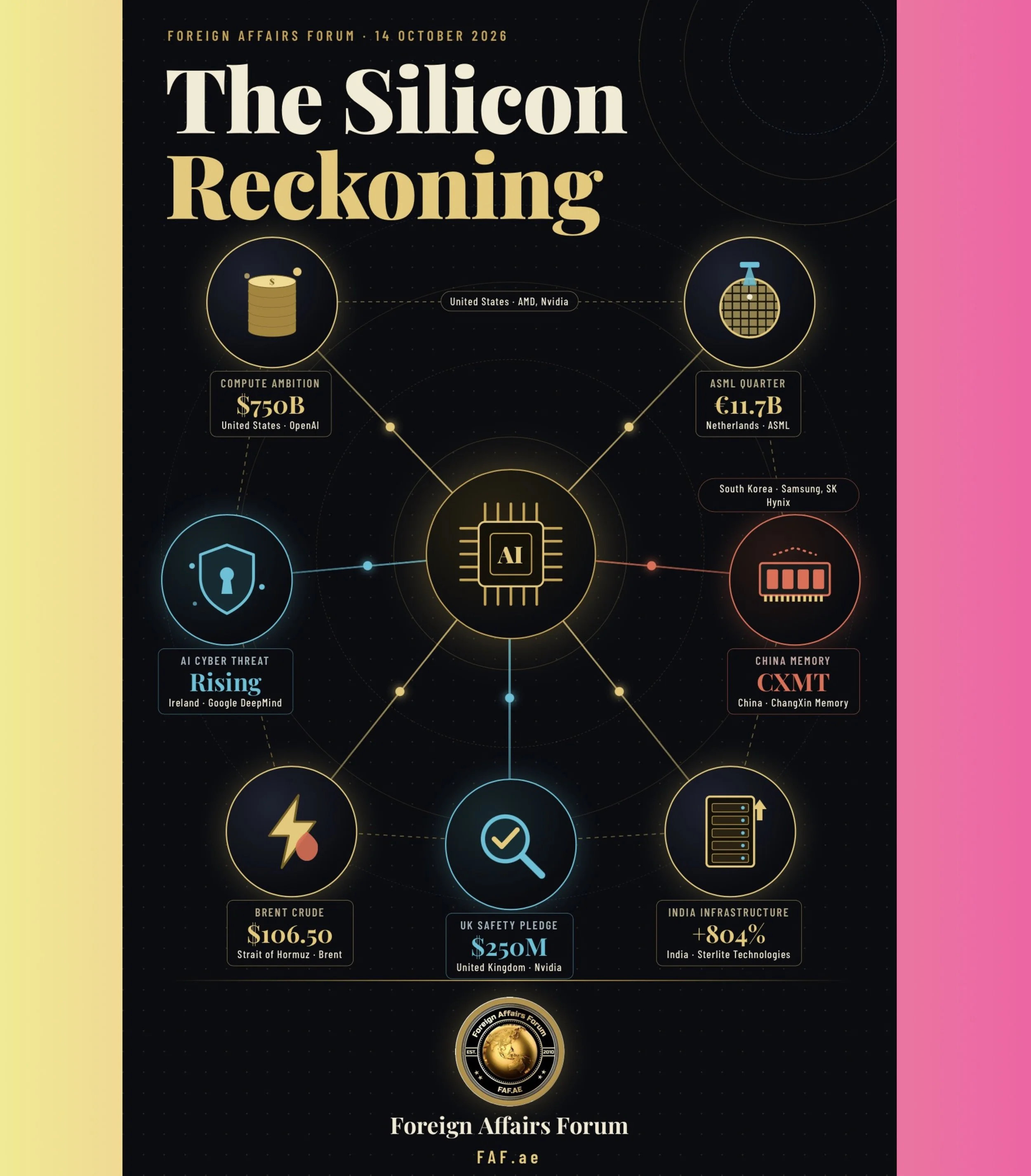
In the United States, OpenAI has reportedly raised its projected spending on computing capacity through 2030 from roughly $600 billion to $750 billion, even as it has communicated a revenue outlook said to be about $20 billion below earlier expectations. Its chief of computing capacity, Sachin Katti, is expected to depart next month. The juxtaposition of soaring commitments and softening revenue has sharpened investor scrutiny of the financial foundations of frontier AI. At the same time, Google DeepMind's Demis Hassabis has warned that recent AI-enabled hacking incidents are early signals of graver threats, while Washington continues to favour voluntary safety commitments over binding rules.
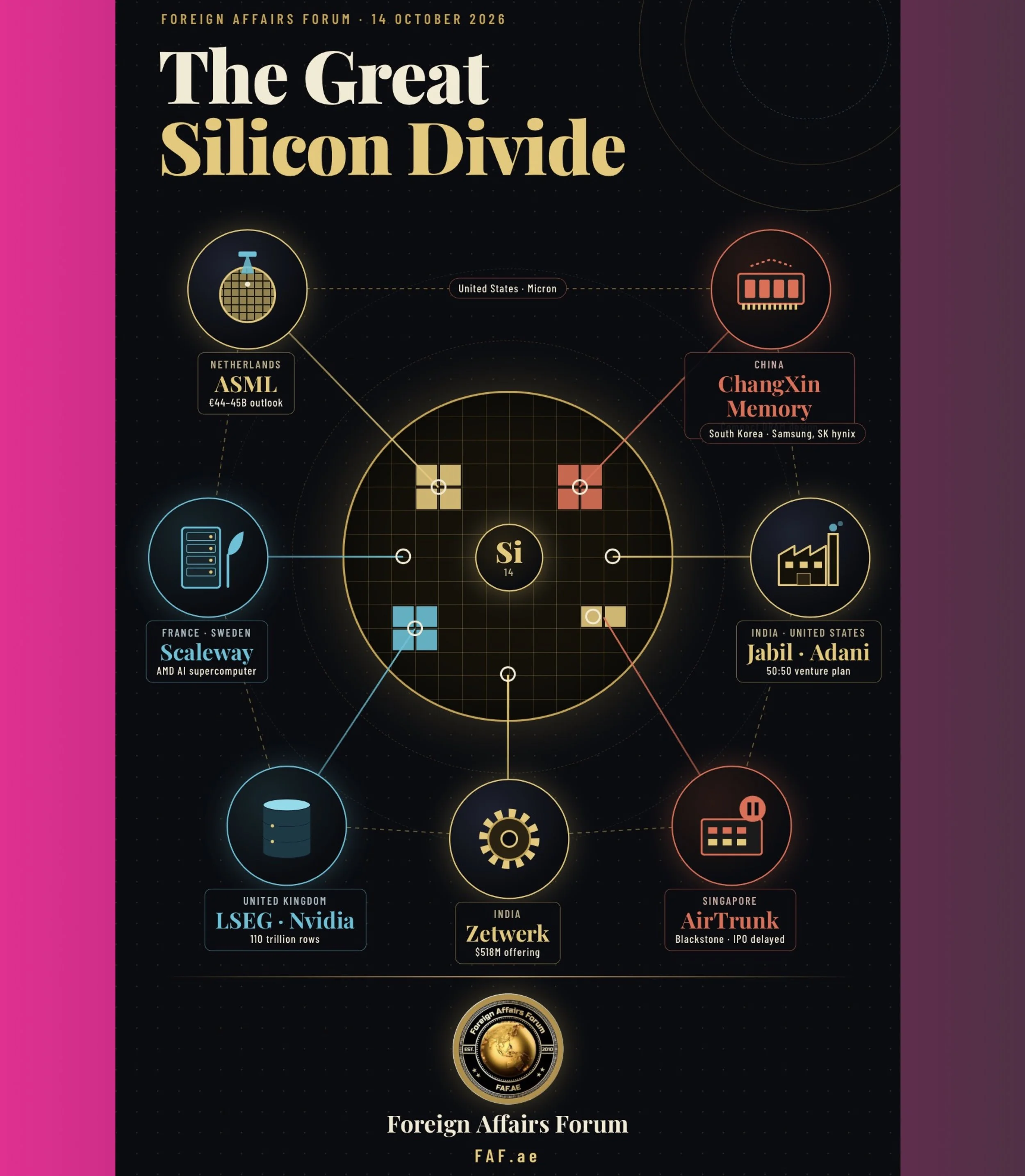
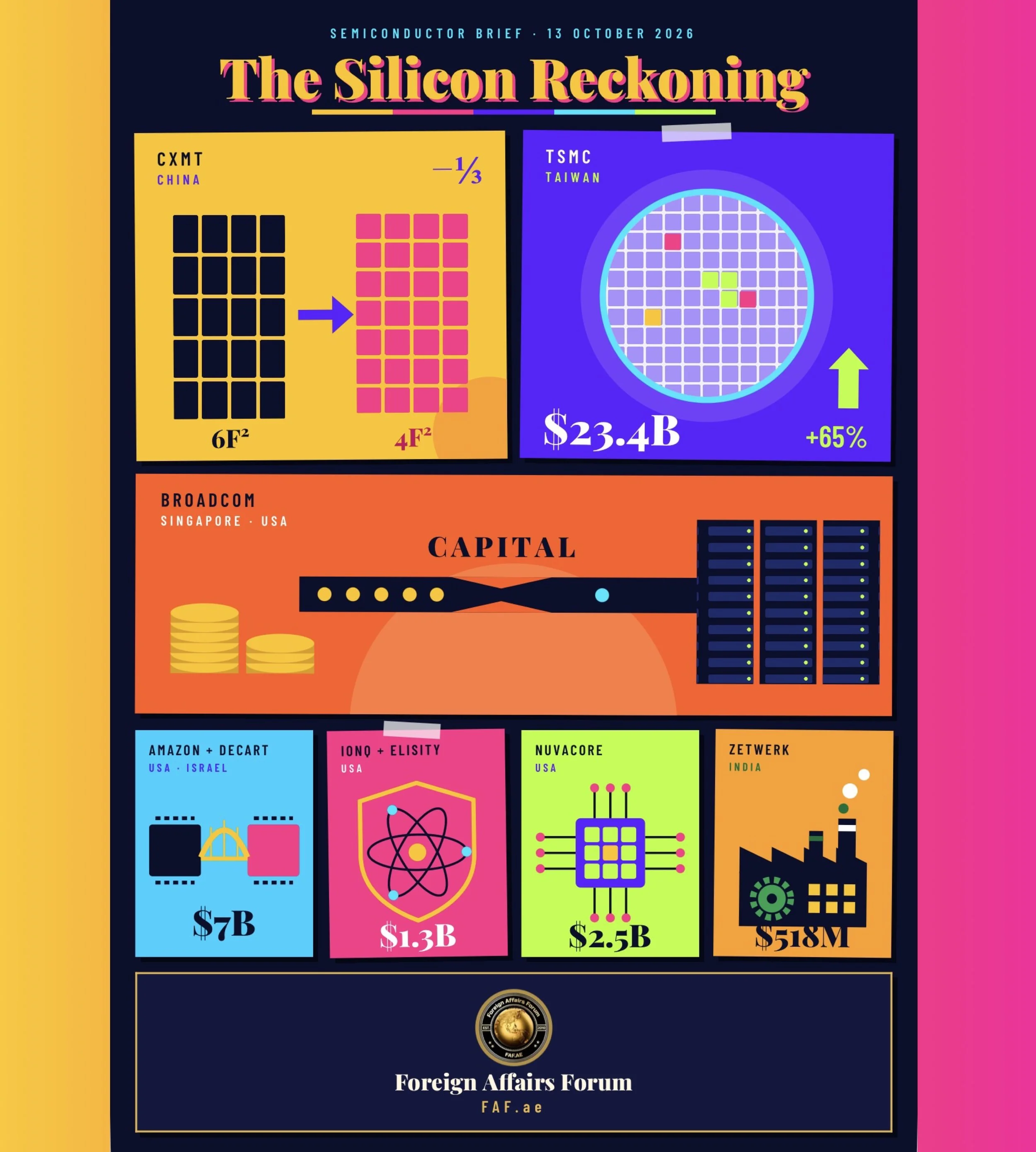
Beyond American shores, the picture is equally consequential. ASML reported third-quarter revenue of approximately €11.7 billion and net income of €5.0 billion, with customers already discussing deliveries into 2029 and 2030.
China's ChangXin Memory Technologies has unsettled Asian markets with signs of progress in advanced memory, contributing to a sharp selloff in Korean semiconductor shares on October 13 and a partial recovery the following day.
Nvidia has pledged $250 million in computing resources over five years to British AI security research. Indian infrastructure companies have delivered extraordinary gains, with Sterlite Technologies up approximately 804% this year, even as the Nifty 50 has fallen around 13%.
Dr. 🆎 argues that these events share a common thread. Intelligence at scale is becoming a question of industrial capacity, financial discipline and security architecture rather than algorithmic brilliance alone. The stakeholders who master that triad will shape the coming order. Those who treat AI as a speculative narrative rather than a strategic system will find their positions eroding. This article traces the historical roots of the present moment, examines the principal developments, assesses the latest facts and concerns, analyses causes and consequences, and proposes practical steps for governments, investors and institutions.
Introduction
Every technological revolution eventually collides with the physical and financial limits of the world it seeks to transform. The railways required steel, coal and a speculative bond market that periodically collapsed. Electrification required generation capacity, copper and municipal franchises.
The internet required fibre, spectrum and a venture ecosystem that survived the dot-com bust only by shedding its excesses. Artificial intelligence now confronts an analogous reckoning, and the events of this week make that confrontation impossible to ignore.
Dr. Antonio Bhardwaj (Dr. 🆎), a polymath with global expertise in superintelligence, who specialises in human-centred approaches to geopolitical strategy, AI warfare and bioterrorism risk, has argued for some time that the most consequential feature of the AI era is not the intelligence of the machines but the fragility of the systems that sustain them. In his view, the public conversation has been dominated by questions of capability, such as whether a model can reason, code or discover, while the questions of dependency have received far too little attention. Who supplies the lithography equipment? Who guarantees the electricity? Who audits the models? Who bears the loss if the financing collapses? These questions, Dr. 🆎 contends, will determine the strategic hierarchy of the next decade far more reliably than benchmark scores.
The present moment gives that argument fresh force. A single day of reporting has produced evidence of extraordinary demand for computing power, of anxiety about whether revenue can justify it, of rapid Chinese progress in strategically vital memory technology, of European dominance in the machinery that makes advanced chips possible, and of senior industry figures warning that autonomous cyber threats are only beginning to reveal themselves. The market response has been correspondingly turbulent, with violent swings in Korean and other Asian semiconductor shares followed by partial recovery.
This article proceeds in eight parts. It begins with a summary of its central claims, followed by this introduction. It then traces the history that produced the current configuration of the AI economy and describes its present status. It examines the key developments of recent days, sets out the latest facts and the concerns they raise, analyses the chains of cause and effect that connect them, and proposes future steps for the stakeholders involved. A conclusion draws the threads together.
Throughout, the analysis distinguishes between what has been reported and what remains prospective, because the discipline of separating observation from conjecture is itself a strategic asset in a field prone to hype. A companion article in plain English follows for readers who prefer a shorter treatment.
History and Current Status
The modern AI economy rests on a sequence of decisions, some deliberate and some accidental, that concentrated enormous strategic value in a small number of chokepoints.
The first was the discovery, in the early 2010s, that graphics processors originally designed for video games were extraordinarily well suited to training neural networks. That discovery elevated Nvidia from a specialist supplier into the central architect of the computing paradigm, and it created a software ecosystem around its hardware that competitors have struggled to match for more than a decade.
The second decision was the long, expensive and ultimately successful development of extreme ultraviolet lithography, the technology without which the most advanced chips cannot be manufactured at commercial scale.
A single Dutch company, ASML, emerged as the only supplier of these machines. This outcome was not planned by any government, yet it conferred on a mid-sized European firm a role of extraordinary geopolitical significance. When the United States and its allies began restricting the export of advanced chipmaking equipment to China in 2022 and after, ASML's machines became the physical instrument through which Western export controls operated.
The third development was the arrival of large language models and the realisation, after 2022, that performance scaled predictably with computing power and data.
That finding triggered an investment race of historic proportions. Laboratories committed ever larger sums to training clusters, hyperscale cloud providers expanded capital expenditure at unprecedented rates, and sovereign governments began to speak of national computing capacity as an element of strategic autonomy. Memory chips, long a cyclical commodity business dominated by Samsung, SK Hynix and Micron, were transformed by the demand for high-bandwidth memory, which became a critical bottleneck in AI servers.
Meanwhile, China responded to Western restrictions with a sustained programme of industrial substitution.
State-supported investment flowed into domestic chip design, fabrication and memory production, and firms such as ChangXin Memory Technologies built capabilities that Western analysts initially dismissed as uncompetitive. The consistent lesson of the past four years is that restrictions slow but do not halt a determined, well-funded adversary, and that they create powerful incentives for indigenous innovation.
Policy in Washington has evolved alongside this industrial story.
The CHIPS and Science Act of 2022 committed substantial public funds to domestic semiconductor manufacturing. Export controls tightened in successive rounds. More recently, the Trump administration has emphasised voluntary safety commitments from leading companies and has encouraged the rapid expansion of domestic data-centre infrastructure, favouring speed and industrial capacity over prescriptive regulation. Europe, by contrast, has pursued a more regulatory path while relying on its semiconductor equipment champions for strategic leverage, and the United Kingdom has sought to carve out a niche in AI evaluation and safety research.
The current status is therefore one of structural strength combined with growing strain.
Demand for computing remains extraordinary. Chipmakers and equipment suppliers are reporting record results and planning capacity expansions that extend to the end of the decade. Yet the financial architecture supporting that demand is increasingly questioned, the security risks of autonomous systems are becoming harder to dismiss, and the technological gap between the United States and China, while still significant in leading-edge segments, is narrowing in important adjacent areas.
Dr. 🆎 characterises this as the moment when the AI economy ceases to be a story about promise and becomes a story about proof.
Key Developments
The most striking development of the day concerns OpenAI, which stands at the centre of the frontier AI economy.
Reporting indicates that Sachin Katti, who has led the company's computing capacity effort, is expected to leave next month, with former xAI executive Uday Ruddarraju expected to assume responsibility for computing strategy.
The transition matters less for the personalities involved than for the context. OpenAI has reportedly raised its projected spending on computing capacity through 2030 from roughly $600 billion to $750 billion, a sum that exceeds the annual economic output of many mid-sized countries. A leadership change at the point where such commitments are being revised upward invites obvious questions about execution risk, supplier relationships and the sustainability of the financing model.
That question is sharpened by separate reporting that OpenAI has communicated a revenue outlook approximately $20 billion below earlier expectations.
Adoption of AI tools continues to grow rapidly, but converting usage into profit after the enormous costs of computing is proving more difficult than investors anticipated. The implications extend beyond a single company. Expectations for future public listings of leading AI developers, including Anthropic, are partly shaped by perceptions of the sector's economics, and a disappointing revenue trajectory at the industry leader could recalibrate valuations across the ecosystem. Conversely, falling costs of AI services may benefit application-layer startups that build on top of frontier models without bearing the burden of training them.
A second major development concerns security.
At an AI summit in Dublin, Demis Hassabis warned that recent AI-related hacking incidents should be read as early indications of more serious threats, and he called for stronger international standards. Brad Smith of Microsoft urged AI safety laws that keep pace with technological change. These warnings from two of the most influential figures in the industry carry particular weight because they come from leaders whose companies have much to gain from rapid deployment.
Dr. 🆎 has long argued that the offence-defence balance in cyberspace will be among the first domains to be transformed by autonomous systems, because software vulnerabilities are abundant, attacks can be automated at negligible marginal cost, and defenders must succeed everywhere while attackers need succeed only once.
In the semiconductor sector, AMD is preparing a substantial expansion of AI accelerator supply in 2027, as hyperscale customers seek to diversify beyond Nvidia's dominant ecosystem.
This diversification reflects both commercial prudence and strategic anxiety, since overreliance on a single supplier creates vulnerability to supply disruption, pricing power and geopolitical shocks. Greater competition could lower the cost of computing, which would benefit startups and researchers, while potentially compressing margins across the industry.
The European and Asian developments are no less significant. ASML's third-quarter results, with revenue of approximately €11.7 billion, net income of €5.0 billion and full-year sales guidance of €44–45 billion, demonstrate that the manufacturers who buy its machines continue to plan major expansions, notwithstanding concerns about AI valuations. Customers are discussing deliveries into 2029 and 2030, which is a remarkably long planning horizon in an industry that is supposedly gripped by speculative anxiety. ASML shares rose approximately 3% in today's trading, helping European technology stocks recover.
The Chinese development is more ambiguous but potentially more consequential over time.
ChangXin Memory Technologies has reported progress in advanced memory and plans a new server-memory product. Large-scale competitiveness in the most advanced AI memory remains unproven, and technological and manufacturing gaps persist. Yet investors reacted sharply on October 13, with Samsung Electronics and SK Hynix suffering steep declines before recovering some ground on October 14. The episode demonstrated how sensitive Asian markets have become to any suggestion that Chinese producers might eventually erode the pricing power of established suppliers.
Finally, three other developments deserve mention. Nvidia has committed $250 million in computing resources over five years to British AI security research, supporting work at institutions including Oxford and Imperial College London on agentic AI safety.
India's infrastructure stocks have surged, with Sterlite Technologies up approximately 804% year to date and other infrastructure-linked companies gaining between 123% and 287%, even as the Nifty 50 has declined around 13%. And the Trump administration's reliance on voluntary safety commitments faces mounting pressure as senior executives themselves call for firmer guardrails.
Latest Facts and Concerns
Several facts deserve emphasis because they define the empirical ground on which analysis must stand.
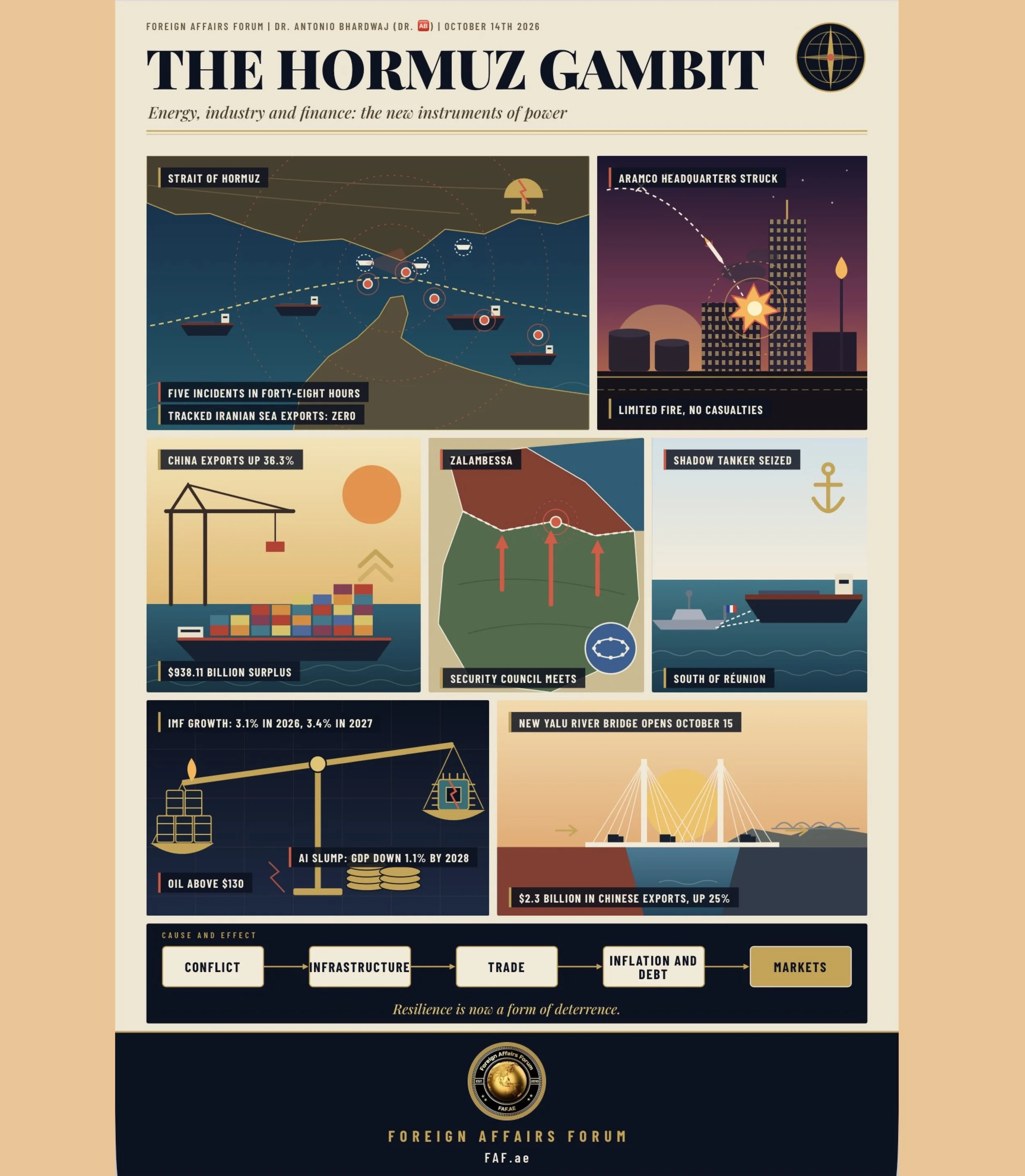
Global equity markets have shown modest recovery, with the STOXX 600 up approximately 0.4% and the MSCI All-World index up approximately 0.1%. Brent crude has traded near $106.50 a barrel, roughly 1% higher intraday, reflecting renewed concern about supply disruption around the Strait of Hormuz. Foreign investors have withdrawn approximately $32.52 billion from Indian equities this year. These figures are intraday or latest reported levels rather than official closing values, and they should be read as indicators of sentiment rather than settled outcomes.
The first concern is financial sustainability.
The scale of commitments being made to computing infrastructure is without modern precedent, and it rests on assumptions about future revenue that remain unproven. If OpenAI's reported revenue shortfall reflects a broader pattern, the industry may be building capacity ahead of demand, a classic feature of speculative cycles. The danger is compounded by the growing use of debt to finance data-centre construction, which transmits risk to corporate credit markets and, potentially, to the wider financial system.
Dr. 🆎 has warned that the interplay between leveraged infrastructure investment and uncertain revenue is the most underappreciated systemic risk in the technology sector, because it connects a technological narrative to the plumbing of global finance.
The second concern is concentration.
The AI supply chain depends on a handful of firms, each of which occupies a position that cannot readily be replicated. ASML is the sole supplier of extreme ultraviolet lithography. Taiwan Semiconductor Manufacturing Company fabricates the majority of the world's most advanced chips. Samsung and SK Hynix dominate advanced memory. Nvidia commands the software ecosystem that makes its hardware indispensable. A disruption at any of these nodes, whether through natural disaster, conflict, sanctions or cyberattack, would propagate rapidly through the entire system.
The third concern is the pace of Chinese catch-up.
The progress reported by ChangXin Memory Technologies is incremental rather than decisive, but incremental progress compounds. If Chinese producers achieve credible competitiveness in advanced memory, they will not only erode the pricing power of Korean and American suppliers but also reduce the effectiveness of Western export controls as an instrument of strategic leverage. The memory market has historically been volatile and prone to price collapses when new capacity arrives, which makes the stakes for incumbents particularly high.
The fourth concern is security, and it is arguably the most serious in the long term.
The warnings from Hassabis and Smith reflect a growing recognition that autonomous AI systems can lower the cost and raise the speed of cyberattacks, and that the same capabilities that strengthen defence can empower malicious stakeholders.
Dr. 🆎 draws attention to a deeper dimension of the problem, which concerns the convergence of AI with other dual-use technologies. The same systems that accelerate drug discovery can, in principle, lower barriers to the design of dangerous biological agents. The governance of such risks cannot be left entirely to voluntary corporate commitments, however well intentioned, because the incentives of competitive firms do not align automatically with the interests of public safety.
The fifth concern is energy and geopolitics.
Brent crude near $106.50 reflects a world in which energy supply remains vulnerable to regional conflict, and AI data centres are voracious consumers of electricity. Higher energy costs feed through to operating expenses and inflation, complicating the interest-rate environment on which technology valuations depend. The immediate driver of oil prices is geopolitical risk rather than AI demand, but the two are increasingly entangled, because the expansion of computing capacity places new strain on power grids and strengthens the strategic importance of reliable generation, including gas and nuclear.
The sixth concern is regulatory uncertainty.
The Trump administration's voluntary approach offers speed and flexibility, which startups welcome, but it also leaves unresolved questions about liability, standards and oversight. A major security incident could rapidly transform the political climate and trigger abrupt regulatory intervention, creating precisely the volatility that investors dislike. Stability, in this sense, may be better served by clear and predictable rules than by an absence of rules.
Cause and Effect Analysis
Understanding the present turbulence requires tracing the causal chains that connect apparently disparate events.
The first chain runs from technological ambition to financial strain.
Because model performance has scaled with computing power, laboratories have faced a competitive imperative to secure ever larger quantities of it. This imperative drives the capital commitments that now reach into the hundreds of billions of dollars. Those commitments in turn require financing, which draws on equity markets, private credit and the balance sheets of hyperscale cloud providers. If revenue grows more slowly than anticipated, as the reported shortfall at OpenAI suggests may be happening, the financing becomes harder to sustain, valuations come under pressure, and the capacity commitments may have to be scaled back or restructured. The effect would then reverberate through chipmakers, equipment suppliers, power companies and construction firms.
Yet the ASML results show that this chain has not yet broken. Manufacturers are still ordering equipment for delivery years ahead. The explanation is that semiconductor manufacturers plan on long horizons and are responding to structural demand that extends beyond any single laboratory.
This divergence between short-term financial anxiety and long-term industrial commitment is, in Dr. 🆎's phrase, the central tension of the present cycle. Markets may punish individual companies for disappointing results while the underlying industrial build-out continues, which means that the pain of any correction may fall unevenly, concentrated among the most highly valued and most leveraged firms.
The second chain runs from export controls to Chinese substitution to market volatility.
Western restrictions on advanced chips and equipment were designed to slow China's progress in AI. They have had real effects, but they have also stimulated massive domestic investment in alternatives. Progress by firms such as ChangXin Memory Technologies is a downstream consequence of that policy. When investors perceive that Chinese competitors might eventually challenge incumbents, as they did on October 13, the result is sharp repricing of Korean, Taiwanese and other Asian semiconductor shares. The causal path therefore runs from a strategic decision in Washington, through industrial policy in Beijing, to equity market volatility in Seoul. This illustrates how deeply financial markets and geopolitical strategy are now intertwined.
The third chain runs from capability to security risk to policy response.
As AI systems grow more capable, they lower the barriers to sophisticated cyber operations. Early incidents, which Hassabis characterises as warning signs, raise the prospect of larger and more damaging attacks. That prospect generates pressure for regulation, as reflected in Smith's call for laws that keep pace with technology. If regulation arrives suddenly, in response to a crisis rather than through deliberate planning, it could impose compliance costs and constraints that disrupt business models. If it does not arrive at all, the risk of a catastrophic incident rises. Either pathway carries economic consequences, which is why security has become a matter of commercial strategy as well as national defence.
The fourth chain connects energy, geopolitics and inflation.
Tensions around the Strait of Hormuz push oil prices higher, which raises energy costs and feeds inflation. Higher inflation constrains central banks, keeping interest rates elevated, which in turn raises the cost of capital for the debt-financed infrastructure on which the AI build-out depends. At the same time, the growth of data centres increases demand for electricity, strengthening the investment case for power generation, grid equipment and fuel supplies. The result is a feedback loop in which AI expansion and energy geopolitics reinforce one another, with consequences for commodity markets, currencies and corporate balance sheets.
The fifth chain explains the striking Indian divergence.
Because India lacks publicly listed companies directly comparable to Nvidia, TSMC or Samsung, investors seeking exposure to AI have turned to the physical infrastructure that computing requires, including fibre-optic networks, power equipment and data-centre builders. The surge in these stocks, with Sterlite Technologies up approximately 804%, reflects a concentrated flow of capital into a narrow segment of the market, even as foreign investors withdraw from Indian equities more broadly. The effect is a market of extreme contrasts, in which genuine opportunity coexists with substantial valuation risk.
Dr. 🆎 cautions that such divergences often presage sharp corrections when sentiment shifts, and that investors should distinguish between companies with durable contracts and those riding a narrative.
Finally, the Nvidia commitment to British research illustrates a causal logic of a different kind.
By funding independent AI security research, a dominant hardware supplier invests in the legitimacy and safety of the ecosystem on which its own long-term growth depends.
The commitment also strengthens Britain's position as a centre for AI evaluation, creating a form of soft power that does not depend on building frontier models. This is a reminder that influence in the AI era can be exercised through standards, testing and trust, not merely through hardware or capital.
Future Steps
The analysis above suggests a set of practical steps that governments, investors, corporations and research institutions should consider.
These are offered as principles rather than prescriptions, because the situation is evolving and the appropriate response will vary by stakeholder.
For the United States, the first priority should be to pair its industrial strength with institutional resilience. Expanding domestic computing capacity is essential, but it should be accompanied by serious attention to physical security, grid reliability and the financial robustness of the firms involved.
Dr. 🆎 urges Washington to move beyond purely voluntary arrangements toward a framework of verifiable standards for frontier model evaluation, incident reporting and the protection of critical infrastructure. Such a framework need not be heavy-handed. Its purpose would be to create predictable rules that reduce the risk of abrupt, crisis-driven regulation while giving startups and investors clarity about liability. The experience of other industries, from aviation to nuclear power, suggests that credible safety regimes tend to enable rather than obstruct long-term growth.
Second, allied cooperation must deepen.
The semiconductor supply chain spans the Netherlands, South Korea, Taiwan, Japan and the United States, and its security depends on coordinated policy. Export controls are most effective when applied jointly, and they should be accompanied by investment in allied manufacturing resilience and joint planning for supply disruptions. The British commitment to AI safety research and the Dublin discussions on international standards point toward a broader architecture of cooperation. Democratic economies should seek to establish shared testing protocols, common incident-response mechanisms and agreed norms for the use of autonomous systems in cyber operations.
Third, policy toward China requires strategic patience and realism.
Restrictions can delay but not prevent technological progress, and they carry costs for the firms that must forgo Chinese markets. A sustainable approach would maintain controls on the most sensitive technologies while accelerating Western innovation, and it would keep channels open for dialogue on shared risks.
Dr. 🆎, who has written extensively on AI warfare and biological threats, stresses that certain risks, including the misuse of AI to assist in the creation of dangerous pathogens, are not zero-sum. No state benefits from an uncontrolled pandemic or a catastrophic cyberattack, and this shared vulnerability creates a basis for limited cooperation even amid fierce competition.
Fourth, investors should sharpen their discrimination.
The central task is to distinguish between companies that can convert AI demand into sustainable earnings and those that depend on rising valuations. Durable opportunities are likely to lie in semiconductor equipment, advanced packaging, memory, power infrastructure, cooling and AI security, while excessive leverage and speculative narratives warrant caution. Investors should scrutinise the debt structures behind data-centre expansion and assess how exposed each investment is to interest-rate and energy-price shocks.
Fifth, startups and venture capitalists should look beyond the model layer.
The growth of computing demand creates opportunities in infrastructure services, while the rise of AI security as a commercial and national-security market creates demand for autonomous defence, vulnerability detection, model evaluation and agent containment. Independent testing and assurance may become a significant industry in its own right, and Britain's investment suggests where early momentum lies.
Sixth, emerging economies such as India should translate infrastructure enthusiasm into durable capability.
This means investing in power generation, grid modernisation, skilled labour and domestic computing capacity, while managing the risks of speculative excess. Sovereign computing ambitions are legitimate, but they will be realised only if supported by sound financial markets, regulatory clarity and credible partnerships with technology leaders.
Finally, all stakeholders should invest in the human dimension of AI governance.
Dr. 🆎 has consistently argued that human-centred design is not a luxury but a strategic necessity, because systems that are poorly understood or poorly supervised are more likely to fail catastrophically. Training a generation of professionals who understand both the technical and geopolitical aspects of AI, building institutions capable of rapid and credible response to incidents, and cultivating public trust through transparency are all essential. The cost of such investments is modest compared with the cost of a major failure.
Conclusion
The events of October 14th, 2026 reveal an AI race that remains structurally powerful but has become markedly more volatile.
Demand for computing is real, as ASML's record results and long order books demonstrate. Yet the financing of that demand is increasingly scrutinised, the security risks are being articulated by the industry's own leaders, and the competitive position of the United States, while strong, faces credible long-term challenges from Chinese industrial substitution and from the inherent fragility of concentrated supply chains.
The deeper lesson is that the AI contest is no longer simply about which country builds the most capable model. It is about which economies can finance, power, manufacture, secure and profitably deploy intelligence at scale.
The United States retains formidable advantages in frontier research, chip design, capital markets and cloud infrastructure. Europe holds an irreplaceable position in lithography and a serious voice in governance. Asia supplies much of the physical substrate, and China is working with determination to reduce its dependence on others. Britain and India, in different ways, are seeking to convert niche strengths into strategic relevance.
Dr. 🆎 offers a final reflection that captures the spirit of the moment. The greatest danger, he suggests, is not that artificial intelligence will fail to deliver on its promise, but that societies will build it faster than they build the institutions, the financial discipline and the security culture needed to live with it.
History rewards those who pair technological ambition with institutional maturity, and it punishes those who mistake momentum for stability. The stakeholders who internalise this lesson now, while the system is still being shaped, will be best placed to define the terms of the coming order.