Beginner's 101 Guide : Chips, Power and Debt: Why the AI Boom Is Strong but Nervous
Summary
The world's computer chip industry is doing extremely well, but investors are getting nervous about how the bills will be paid.
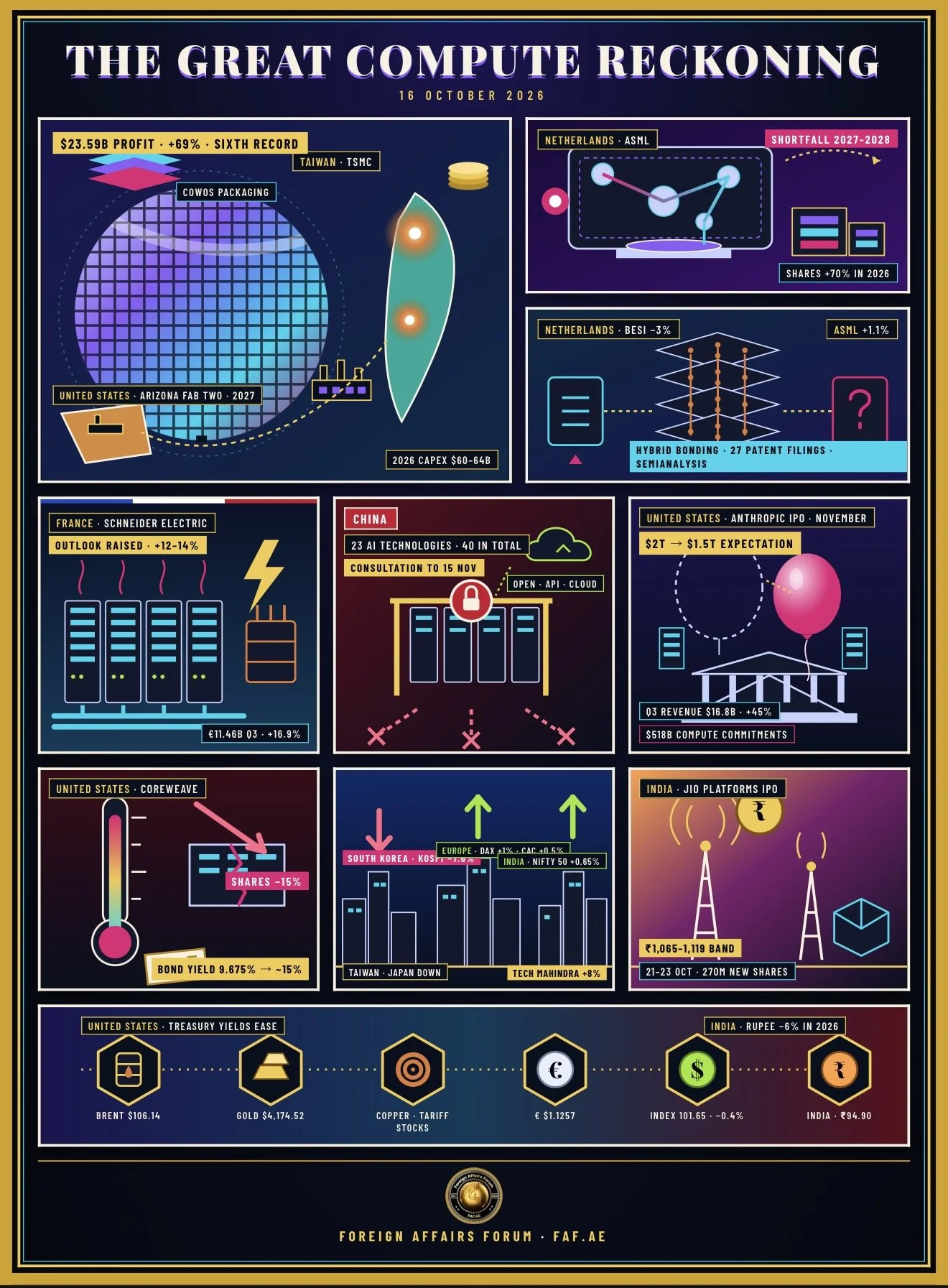
This week, TSMC reported record profits of $23.59 billion in one quarter. ASML, which makes the machines that build advanced chips, said it cannot make enough of them for the next two years.
Schneider Electric raised its forecasts because data centres need so much power equipment. At the same time, some AI companies are finding it harder and more expensive to borrow money. Chip demand is strong, but the money behind the AI boom is under pressure.
Introduction
Chips are the engines of artificial intelligence. Every AI system runs on powerful computers, and those computers depend on advanced chips, special machines to make them, large amounts of electricity and a great deal of money.
Dr. Antonio Bhardwaj (Dr. 🆎), an expert in human-centered superintelligence, AI warfare and bioterrorism risk, says that computing power has become a strategic resource, much like oil in the last century. Whoever controls it has influence over economies, armies and even the safety of science. This FAF article explains the week's seven main developments in plain language and shows why they matter to ordinary people as well as to governments and investors.
The Chip Makers Are Doing Very Well
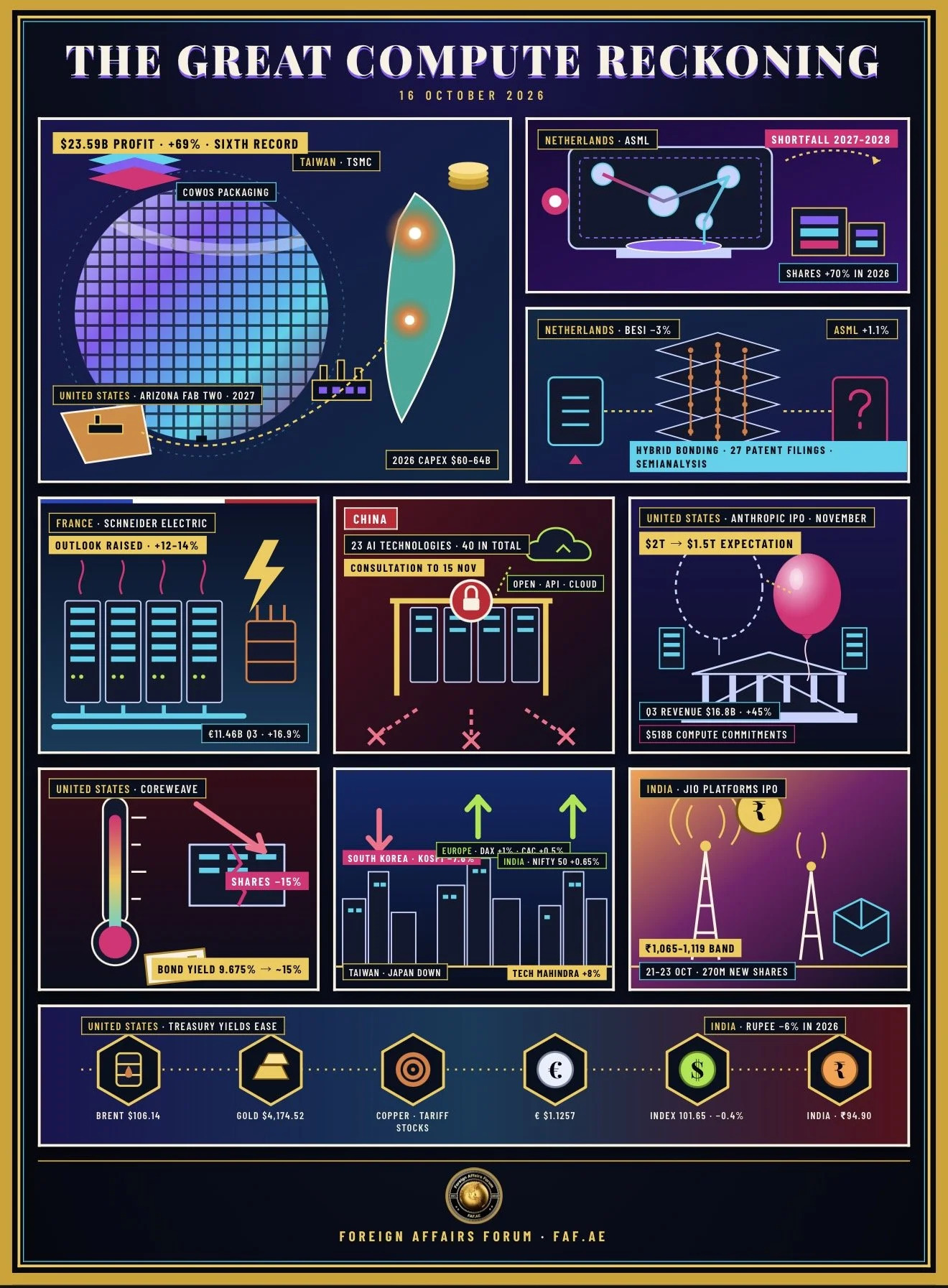
TSMC, the Taiwanese company that makes most of the world's most advanced chips, reported profit of $23.59 billion for the third quarter. That is 69% more than a year ago and the sixth record in a row.
The company expects its next quarter to bring in revenue of about $52.3–54.3 billion, and it plans to spend $60–64 billion on new factories and equipment this year. It has also finished building its second factory in Arizona, which is due to begin mass production in the third quarter of 2027.
Even so, TSMC's chief executive warned that rising prices for parts and general economic worries could hurt phones, laptops and other consumer products in 2027. In other words, the AI boom is strong, but it is not the whole of the chip business.
TSMC's shares actually fell about 2% before the news, showing that even great results cannot always protect a company from nervous markets.
The Machine That Makes the Chips Cannot Keep Up
ASML in the Netherlands builds the extremely precise machines that print the tiny patterns on advanced chips. It said that demand will be higher than what it can produce in both 2027 and 2028. Customers are already talking about what they will need in 2029 and 2030.
ASML's shares have risen nearly 70% this year, though investors are starting to ask how long such spending can last.
This matters because the whole industry depends on these machines. If they are scarce, factories everywhere must wait.
A separate report also suggested that ASML may be working on tools for hybrid bonding, a method of joining chips together in stacks, which would put it in competition with a smaller Dutch firm, Besi. ASML has not confirmed this. Still, Besi's shares fell about 3% and ASML's rose 1.1%.
Power and Cooling Are the New Limits
A chip is useless without electricity.
Schneider Electric, a French company that makes power and cooling equipment, raised its forecasts for the second time this year. It now expects revenue growth of 12–14% and quarterly sales of €11.46 billion. Its chief executive said demand from data centres more than doubled during the quarter.
Dr. 🆎 notes that communities near these big facilities will increasingly ask questions about electricity, water and land, so winning public trust will be as important as building quickly.
Politics Enters the Picture
China proposed new export controls on twenty-three AI technologies, including advanced models, AI agents and computing clusters.
These are part of a wider plan covering forty technologies.
Many Chinese AI services would still be available through websites and cloud platforms, and the public can comment until 15th November.
For years, Western countries have restricted what they sell to China. Now China is also claiming control over what it sends out.
Dr. 🆎 warns that if the world splits into rival computing camps, it will become harder to agree on safety rules, including those that protect against the misuse of AI to create biological threats.
Where the Money Is Getting Nervous
The clearest warning came from CoreWeave, a company that rents out AI computing power. Its bonds, which were first sold with a yield of about 9.675%, have fallen in price so far that their yields are heading toward 15%. Its shares dropped about 15% this week.
Higher borrowing costs make new data centres harder to justify, and fewer data centres mean fewer chip orders later.
Stock markets were bumpy. South Korea's main index, the KOSPI, fell about 7.6% on October fifteenth as investors sold chip shares, and then recovered some ground.
European markets rose on October sixteenth, with the STOXX Europe 600 up about 0.6%. India did well, with the NIFTY 50 closing above 23,100, up about 0.65%, and the technology index up 4.05%.
Other markets were calmer. The index of the American currency fell about 0.4% to 101.65, and the € rose to about $1.1257. The Indian rupee traded near ₹94.90 per $, after losing about 6% this year. Brent oil was around $106.14 a barrel, and gold was near $4,174.52 an ounce.
Two Big Public Offerings
Anthropic is expected to list its shares in November. Some investors are now talking about a value of around $1.5 trillion, instead of the roughly $2 trillion people expected earlier. This is only an investor expectation, not an agreed price.
The company reported quarterly revenue of $16.8 billion, up 45% from the previous quarter, but it has also promised to spend at least $518 billion on computing over about ten years. Investors are asking whether the income will be big enough to match such promises.
In India, Jio Platforms plans the country's biggest ever share offering, with a price range of ₹1,065–1,119 per share. People can apply from 21st-23rd October. Jio is not a chip maker, but it is building the digital networks and data centres that AI needs, so the sale will test how much investors trust India's technology future.
What Should Be Done
Dr. 🆎 suggests four practical steps.
First, governments should treat the chip supply chain as critical infrastructure, and remember that new factories take years to build.
Second, power and cooling must be planned together with new data centres, with local communities involved from the start.
Third, lenders and investors should be careful about companies that borrow heavily, and should favor businesses that already earn solid profits. Fourth, countries should keep talking about AI safety even when they disagree about trade and technology.
Conclusion
The main message is simple. Chip makers are earning record profits and equipment makers cannot keep up, yet the cost of borrowing is rising and investors are asking harder questions. These facts fit together.
Dr. 🆎 reminds us that the winners of this era will not simply be those with the fastest chips, but those who can build, power and pay for complete computing systems while keeping people firmly in charge of what the machines do.