Beyond the Chip: The Fight to Own the Whole Machine of Artificial Intelligence
Foreign Affairs Forum | Dr. Antonio Bhardwaj (Dr. 🆎)| September 30th 2026
Executive Summary
For much of the past three years, the dominant investment thesis in artificial intelligence could be stated in two words: buy GPUs.
The events of last week of September 2026 show that this thesis has been overtaken.
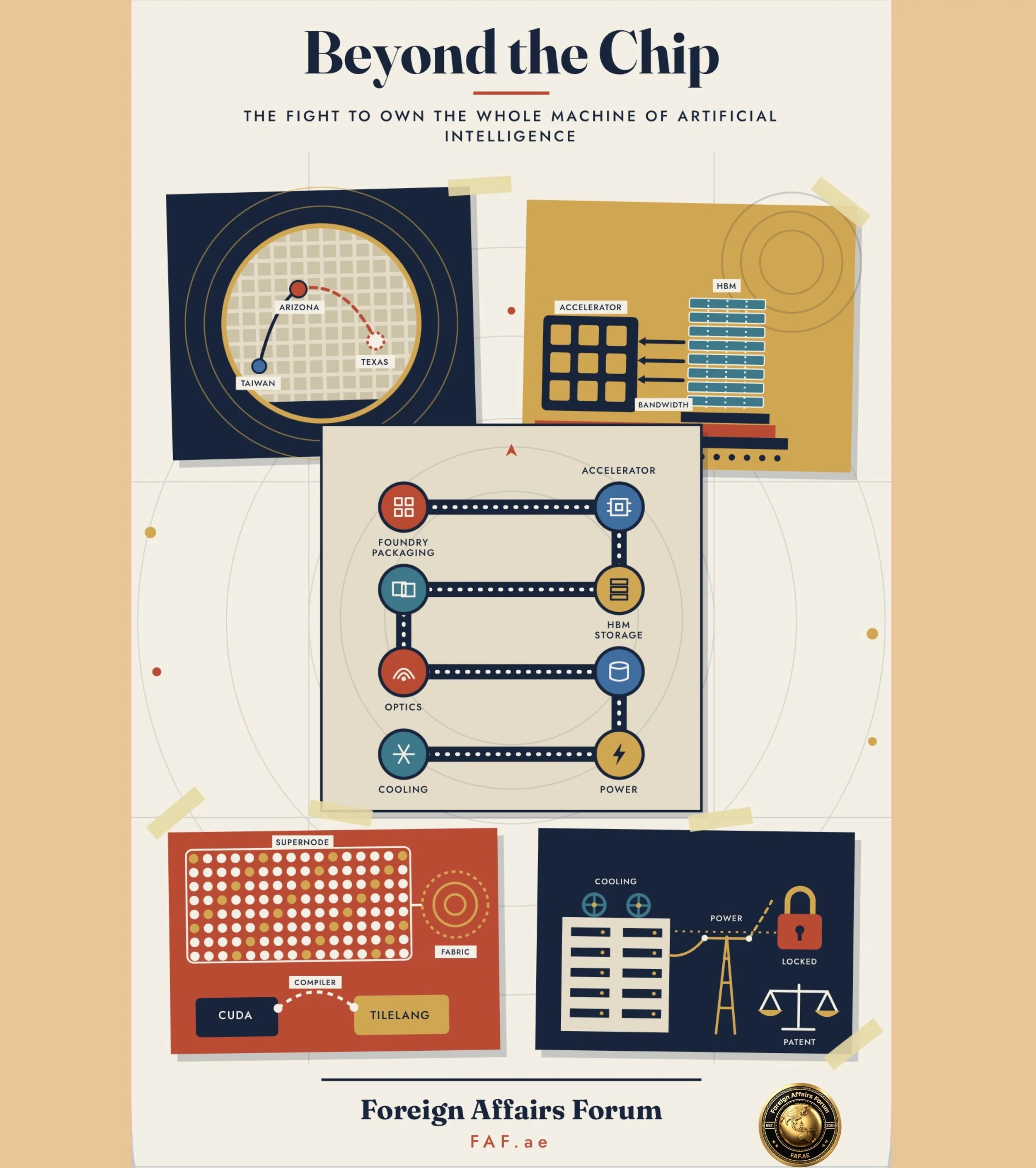
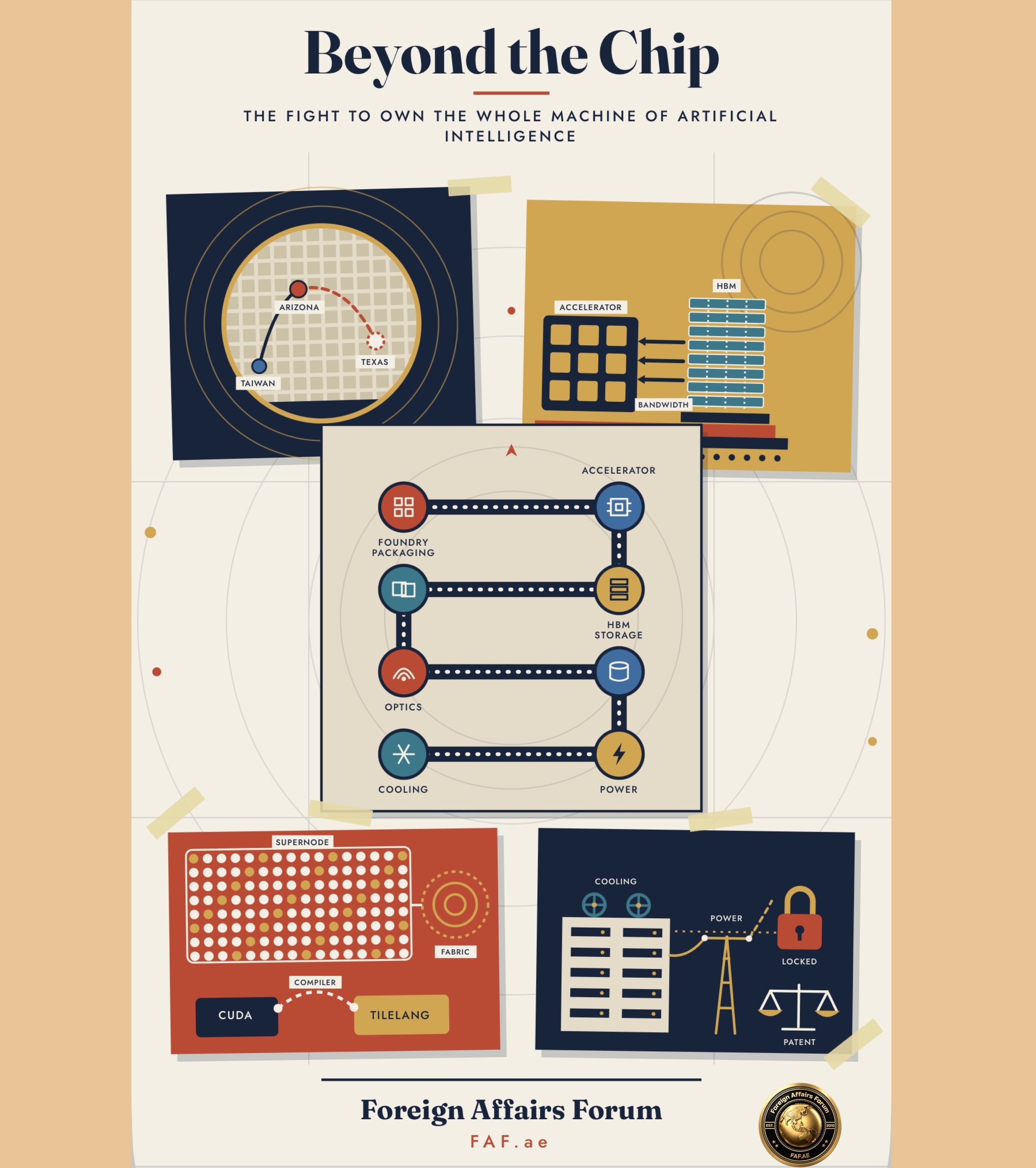
The competition is no longer about who owns the most accelerators. It is about who controls the entire compute stack, from the advanced foundry and the high-bandwidth memory that feeds the processor, through the programming software, networking and storage, to the power conversion and liquid cooling that keep the whole system alive. Each layer has become a source of leverage, and each has become a point of vulnerability.
The week's developments illustrate the shift with unusual clarity. TSMC is reported to be evaluating a Texas investment on top of its $265 billion United States commitment centred on Arizona. Samsung has said that high-bandwidth memory will consume nearly 30% of industry DRAM capacity in 2027.
DeepSeek and Huawei have announced a collaboration to build an open-source programming stack for Huawei's Ascend processors, including a supernode architecture built around one hundred and twenty-eight Ascend 950 chips.
Cerebras has won a deployment of roughly one hundred megawatts, Accelevation has taken the power and cooling business into public markets, Micron faces a potential import complaint, and Anthropic's IPO documents disclose commitments of at least $518 billion.
FAF article argues that the DeepSeek–Huawei collaboration may be the most strategically significant of these developments, because it targets the software moat that protects Nvidia and that export controls cannot easily defend. It further argues that Anthropic's disclosure is the best available map of future semiconductor demand.
Dr. 🆎 observes that whoever governs the stack will govern the pace and the safety of machine intelligence itself, and that human-centred oversight must be designed into that stack rather than appended to it. The essay closes with recommendations for governments, investors and industry.
Introduction
Great technological revolutions are rarely decided by a single invention.
They are decided by the systems that make the invention usable at scale. The steam engine required coal mines, rail networks and standardised time.
The petroleum age required refineries, pipelines and a global shipping order. Artificial intelligence, in its present form, requires an equally intricate industrial system, and the contest over that system is now the central struggle of technology policy. A frontier model is only the visible surface of a structure whose foundations are fabrication plants, memory factories, compilers, optical links, substations and cooling loops.
Dr. Antonio Bhardwaj (Dr. 🆎), a polymath with global expertise in superintelligence who specialises in human-centred approaches to geopolitical strategy, AI warfare and bioterrorism risk, has argued for some time that analysts fixate on the surface. In his judgment, the discussion of model releases and benchmark scores has obscured a slower and more decisive contest for the physical and software foundations of intelligence. Those who understand that contest, he contends, will read the present moment less as a technology boom than as a reordering of strategic power, in which the ownership of infrastructure translates directly into influence over states and markets.
The developments of the past 48 hours allow that argument to be tested against evidence.
In a single news cycle, the world's dominant advanced foundry was reported to be weighing a second American manufacturing geography, the world's largest memory maker revealed how far artificial intelligence is reshaping its production, and two Chinese stakeholders unveiled an attempt to build an independent programming ecosystem for domestic accelerators.
At the same time, public markets tested how much investors will pay for the power and cooling infrastructure beneath the chips, and a frontier laboratory disclosed the scale of the obligations that underwrite the whole enterprise.
The article proceeds in eight movements. It begins by summarising its argument, then traces the history and current status of the semiconductor contest, before examining the key developments of the week and the latest facts and concerns that follow from them. It then analyses the chains of cause and effect that connect these events, proposes future steps for the principal stakeholders, and closes with a judgment about what the moment reveals.
Throughout, the focus remains on the strategic landscape rather than on the fortunes of any single company.
History and Current Status
The modern semiconductor contest can be understood as a succession of bottlenecks.
In the first phase, the scarce resource was the accelerator itself.
Once researchers demonstrated that scaling compute produced steadily more capable models, the graphics processor became the most coveted industrial product in the world, and Nvidia acquired a position that competitors could not dislodge. Its advantage, however, was never confined to silicon.
The company had spent well over a decade cultivating CUDA, a software platform that taught a generation of engineers to write code for its hardware, and that accumulated familiarity created switching costs that no rival's benchmark could easily overcome.
The second phase shifted attention to manufacturing and to the geopolitical geography of production.
Advanced chips are fabricated overwhelmingly by a small number of foundries, and the most sophisticated among them is concentrated in Taiwan.
This concentration alarmed policymakers in Washington and allied capitals, who came to regard the island's role as both an economic marvel and a strategic vulnerability.
The result was a wave of subsidies, incentives and diplomatic pressure designed to draw advanced manufacturing to new locations, together with export controls intended to deny China access to the most capable chips and to the equipment used to make them.
China responded with a determined campaign of substitution. Beijing directed state capital to domestic chip designers and infrastructure builders, and Huawei emerged as the national champion in AI accelerators through its Ascend line.
Chinese laboratories, constrained in hardware, pursued efficiency, and DeepSeek in particular demonstrated that disciplined engineering could narrow the gap between constrained and unconstrained developers.
The lesson Beijing drew was that dependence on foreign technology is a strategic vulnerability to be eliminated layer by layer, and that a nation which controls only part of the stack controls only part of its own destiny.
The third phase, which the events of this week bring into focus, recognises that the bottleneck has migrated again.
High-bandwidth memory has become as important as the processor it serves, because the speed at which data reaches the chip increasingly determines how much of an expensive accelerator's potential can actually be used.
Networking, advanced packaging and storage have joined the list of constraints. Beneath them all lie electricity and heat, which have become the ultimate physical limits on how much compute any facility can host. The scarce resource is no longer a component. It is the integrated system.
The current status is therefore one of distributed strength and distributed fragility.
The United States retains leadership in accelerator design, in cloud infrastructure and in the capital markets that finance the buildout, and it is now working to acquire greater domestic fabrication capacity.
China commands manufacturing depth and state-directed industrial policy, and it is attempting to close its software gap. South Korea and Taiwan occupy chokepoints in memory and foundry production. Japan, the Netherlands and the Gulf states each contribute equipment, materials or capital. The system is multipolar in its dependencies even when it appears bipolar in its rhetoric.
Key Developments
The first development is the reported evaluation by TSMC of a semiconductor investment in Texas.
Reuters reported on September 30, citing people familiar with the matter, that no final decision has been made. The potential expansion would come on top of the company's $265 billion United States commitment, which is centred on Arizona and encompasses fabrication plants, advanced packaging and research and development.
The strategic point exceeds the addition of another factory. The world's dominant advanced foundry is progressively constructing a second major manufacturing geography outside Taiwan, and that geography will shape where American AI accelerators and custom chips are made for years to come.
Dr. 🆎 regards the move as a hedge against the concentration of risk that has haunted planners for a decade. "A single point of manufacturing is a single point of failure for the entire machine-intelligence economy," he has remarked. "Redundancy is not a luxury in a system this important. It is the price of resilience." The observation carries particular force because geographic diversification does more than protect supply. It also changes the bargaining position of every stakeholder in the chain, from chip designers who gain proximity to their fabrication partners to governments who gain leverage in negotiations over export controls and industrial policy.
The second development is the collaboration between DeepSeek and Huawei, announced on September 30th.
The two companies are open-sourcing compute and communications libraries and supporting TileLang, a higher-level programming language intended to make Ascend accelerators easier to program. The project also includes a supernode architecture built around one hundred and twenty-eight Ascend 950 processors.
The significance lies in the target. Nvidia's greatest advantage has never been silicon alone. It is the combination of silicon, CUDA, libraries, networking and developer familiarity, and an alternative stack that reduces the cost of moving away from that combination attacks the moat directly rather than trying to leap over it.
Dr. 🆎 considers this the most underappreciated story of the week. "Export controls were designed to deny hardware," he has argued. "But software is a form of gravity. If Beijing builds an ecosystem that makes its own chips easy to use, then the leverage of denial erodes year by year, and a policy that looked decisive becomes merely delaying." The remark captures the strategic logic well. A restriction on chips is effective only while the alternative to those chips remains impractical, and the programming environment is the factor that determines whether an alternative is practical. If China can build a credible ecosystem around Ascend, the competition moves from chip against chip to stack against stack.
The third development is Samsung's disclosure, delivered on September 29th, that high-bandwidth memory is expected to account for nearly 30% of total industry DRAM production capacity in 2027.
This is remarkable because such memory remains a specialised product used predominantly alongside AI accelerators and other high-performance processors. Its rise from niche to nearly one-third of industry capacity implies that artificial intelligence is no longer merely creating a premium segment within memory manufacturing. It is restructuring the allocation of the global DRAM industry itself, which will tighten supply for conventional applications while accelerating the performance of the systems that consume the specialised product.
The fourth development is the initial public offering of Accelevation, an infrastructure company supplying power distribution, cooling and modular data-centre systems.
Reuters reported on September 29th that the company and its shareholders raised $540 million by selling thirty million shares at $18 each, with trading on Nasdaq under the symbol ACCV scheduled to begin on September 30th.
The price fell below the previously marketed range of $20 to $24, making the offering an instructive test of investor appetite amid rising interest rates and growing scrutiny of AI capital expenditure.
The company's revenue rose from less than $3 million in 2021 to nearly $448 million in 2025, which illustrates how quickly the physical layer of the boom has grown.
The fifth development is a legal one with strategic consequences. Netlist has filed a complaint with the United States International Trade Commission seeking to block imports of certain Micron memory products that it alleges infringe its patents.
The affected memory technologies are used in AI computing products associated with Nvidia, Google and Broadcom, so an import restriction, if ultimately granted, could affect parts of the American AI hardware supply chain. No ban has been ordered, and the complaint is newly filed. Nevertheless, the episode demonstrates that memory has become too strategically important for narrow intellectual-property disputes to remain isolated from the wider system.
The sixth development is the Cerebras deployment.
Reuters reported on September 28th that Cerebras Systems will supply its latest CS-4 systems to the cloud start-up Gimlet Labs in a deployment capable of consuming roughly 100 megawatts, with availability through Gimlet's cloud expected to begin in 2027.
The power figure matters, because it indicates utility-scale deployment of a non-Nvidia architecture rather than a laboratory trial of a few alternative accelerators. Gimlet is particularly interested in inference workloads requiring rapid response, including cybersecurity, voice applications and financial analysis. Signed deployments of this size are stronger evidence of commercial viability than any benchmark demonstration.
The seventh development is the most consequential in capital terms.
Reuters reported on September 29 that Anthropic's IPO documents disclose commitments totalling at least $518 billion over roughly the coming decade for cloud computing and AI infrastructure, with approximately 80% structured as non-cancelable regardless of actual utilisation.
The disclosed obligations include approximately $111.1 billion with Google, $110 billion with Amazon, $31.4 billion with Microsoft and $161.2 billion in lease obligations associated with Broadcom, alongside further arrangements involving AMD and xAI. Anthropic could seek a valuation exceeding $2 trillion. Although it is not a semiconductor company, its prospectus may be among the most important documents ever published for understanding future chip demand.
Two further listings complete the capital picture. RoboTechnik, a Chinese supplier of silicon-photonics equipment, raised $660.4 million in its Hong Kong debut on September 29, yet closed almost 5% below its offer price despite first-half revenue growth of roughly 145%.
The weak debut, taken alongside the below-range pricing of Accelevation, suggests that public investors are becoming more selective about AI-related valuations even as private commitments grow larger.
Dr. 🆎 reads the divergence as a warning. "When private capital pre-commits at this scale and public markets begin to hesitate, the gap between the two is where systemic risk accumulates," he has observed.
Latest Facts and Concerns
Several facts frame the week's developments.
The disclosed Anthropic commitments imply a degree of pre-booking of future computing capacity that has few precedents in industrial history.
That approximately 80% of those obligations are non-cancelable means that the risk of overbuilding is borne in large part by the borrower rather than the supplier, and the total is comparable in capital intensity to telecommunications, energy and heavy industry.
At the same time, the memory industry is reorienting toward a single application, the physical infrastructure industry is entering public markets at prices below initial expectations, and alternative accelerator architectures are securing commercial contracts of a scale that would have seemed improbable two years ago.
The first concern is concentration risk, which has several dimensions.
Geographic concentration in advanced fabrication is only beginning to be diluted. Product concentration in high-bandwidth memory exposes the system to shortages if any single producer stumbles. Financial concentration in a small number of frontier laboratories and their suppliers means that a disappointment at one node could propagate through many others.
Dr. 🆎 emphasises that concentration is the common pattern beneath these different risks. "Every efficient system tends toward concentration," he has said, "and every concentrated system is one accident away from crisis. Strategy consists in knowing which concentrations you can afford."
The second concern is the fragility of the capital structure.
A commitment of at least $518 billion, largely non-cancelable, is a bet that demand for AI computing will continue to grow at a pace sufficient to justify it. Should demand disappoint, or should efficiency gains reduce the compute required per unit of capability, the burden of unused capacity would fall on the borrower and, by extension, on the lenders and suppliers who extended credit. The soft reception of the Accelevation offering, occurring amid rising interest rates, shows that markets are already testing this assumption. Investors are asking not whether AI is important but whether current prices adequately reflect the risks.
The third concern is the legal and intellectual-property vulnerability of the supply chain.
The Netlist complaint against Micron is not an isolated event. As memory and interconnect technologies become central to AI performance, their patents acquire strategic value far exceeding their historical importance.
An import restriction on memory used by leading accelerator vendors, even if it were ultimately narrowed or overturned, could disrupt supply precisely when demand is unprecedented. Policymakers should therefore treat intellectual-property disputes in critical semiconductor components as matters of supply-chain security and not merely of commercial law.
The fourth concern is the erosion of the control that export policy was designed to provide.
If DeepSeek and Huawei succeed in building a credible programming ecosystem around Ascend, the effectiveness of chip restrictions will decline.
There is also a governance dimension that Dr. 🆎 stresses in his work on AI warfare and biological risk. A parallel and independent compute stack means a parallel and independent safety regime, in which testing, monitoring and access controls may be set by different rules in different jurisdictions.
The more capable and accessible general-purpose systems become, the more urgent it is to ensure that evaluation for misuse, particularly in domains such as biological weapons, is not undermined by fragmentation of the underlying infrastructure.
Cause and Effect Analysis
The causal structure of the moment begins with the capital intensity of frontier development.
Because training and serving advanced models demands resources on a scale that only a handful of institutions can marshal, frontier laboratories have entered long-term contracts with cloud providers and chip suppliers that run for a decade or more.
The effect is a transfer of demand certainty to suppliers and a transfer of financial risk to borrowers. Suppliers can plan factories, memory lines and data-centre campuses with confidence, and this confidence explains the willingness of TSMC to contemplate additional American capacity and of memory producers to reallocate production toward specialised products.
A second chain runs from the success of export controls in one phase to the substitution effort of the next.
By restricting access to advanced chips, Washington imposed real costs on Chinese developers and created powerful incentives for Beijing to build alternatives. The DeepSeek–Huawei collaboration is the logical consequence of those incentives. This does not mean the controls were mistaken. It means that every instrument of denial provokes adaptation, and that the durability of any advantage depends on whether the adaptation succeeds. The software layer is the decisive variable, because a hardware gap can be narrowed by engineering effort while a software ecosystem is built by accumulated developer habit.
A third chain connects the growth of accelerators to the growth of everything around them.
As processors become more powerful, they consume more data, more electricity and more cooling, and the constraints migrate outward. Memory bandwidth limits the usable performance of the chip, which raises the value of high-bandwidth memory.
Power delivery and heat removal limit how many chips a facility can host, which raises the value of companies such as Accelevation. Improvements in electrical and thermal efficiency effectively increase available compute without requiring a faster processor, which means that the infrastructure layer competes with the silicon layer for the same strategic value.
A fourth chain concerns the diversification of architectures.
Because a single dominant design creates dependence, customers have strong incentives to support alternatives, and the Cerebras deployment demonstrates that such support can translate into utility-scale contracts. Yet diversification has costs. Each new architecture requires its own software, and software compatibility may now matter as much as benchmark performance in determining commercial success.
This links the Cerebras story to the DeepSeek–Huawei story, since both depend on whether developers can be persuaded to leave the familiar environment of CUDA. Heterogeneous computing will succeed only to the extent that the software layer makes heterogeneity cheap.
A fifth chain runs from private commitment to public scrutiny.
Massive private obligations create the expectation of returns, and public markets are the arena in which those expectations are tested. The below-range pricing of Accelevation and the weak debut of RoboTechnik indicate that investors are discriminating between segments and between stakeholders. The effect is a more demanding environment for infrastructure companies, which must show that their growth is durable rather than merely a reflection of a temporary spending surge.
Dr. 🆎 notes that this is the classic cycle of infrastructure booms, in which exuberance builds capacity faster than demand and discipline arrives only when prices are tested.
Future Steps
The first priority for Washington and its allies is to treat the whole compute stack as a strategic system and not as a collection of separate industries.
Support for domestic fabrication should be accompanied by support for advanced packaging, memory, optical interconnects and power electronics, since a strong foundry surrounded by weak complements delivers only partial resilience.
Dr. 🆎 proposes that governments map the dependencies of the stack systematically, identify the layers where a single stakeholder or geography dominates, and prioritise redundancy in those layers. The Texas evaluation by TSMC is a reminder that private investment decisions can advance public resilience if the incentives are aligned.
The second priority is to defend and extend the software layer of Western advantage.
Export controls alone will not preserve leadership if China builds a viable alternative ecosystem. Washington and its partners should therefore invest in open and portable programming tools, support the developer communities that sustain existing platforms, and encourage software that allows heterogeneous accelerators to compete on fair terms. At the same time, policymakers should avoid assuming that denial can be permanent and should plan for a world in which China possesses a functional domestic stack. Strategy should aim at maintaining a lead in capability, not at preserving a monopoly on access.
The third priority concerns capital discipline and transparency.
Investors, lenders and regulators should scrutinise the structure of long-term compute commitments, particularly those that are non-cancelable regardless of utilisation. Clear disclosure of obligations, as in the Anthropic filing, is a valuable safeguard, and it should become the norm across the industry. For venture investors, the most promising opportunities lie in the layers that the week's events highlight, including memory-centric computing, silicon photonics and high-speed interconnect, advanced packaging, power electronics and liquid cooling, and software that lets heterogeneous accelerators compete with CUDA. Intellectual-property diligence should be treated as a core element of semiconductor investing.
The fourth priority is to embed human-centred governance in the infrastructure itself.
Dr. 🆎 argues that safety, auditability and accountability should not be layered on top of compute as an afterthought but should be designed into the platforms on which advanced systems run, including access controls, logging and mechanisms for interruption. He also urges that evaluations for catastrophic misuse, particularly in biological domains, be coordinated across jurisdictions to the extent that competitive relations allow. Limited channels of dialogue between rival powers on technically bounded safety questions can coexist with fierce competition, as the history of arms control demonstrates, and they become more valuable as parallel stacks emerge.
Conclusion
The events of September 29 and 30, 2026 reveal a semiconductor contest that has outgrown its early framing.
The original thesis, which counselled the purchase of GPUs, has been replaced by a more demanding one, in which the winners will be those who command an entire chain running from the advanced foundry and the accelerator through high-bandwidth memory, packaging, networking and storage to power conversion and liquid cooling.
Every layer is now a potential source of leverage and a potential point of failure, and the stakeholders that secure the critical links will shape the technological order of the coming decade.
The developments of the week answer distinct questions. TSMC's potential Texas expansion addresses where chips are made. Samsung's memory forecast addresses how processors receive data. DeepSeek and Huawei address how developers program alternative accelerators. Cerebras addresses whether other architectures can achieve scale. Accelevation addresses how machines are powered and cooled, and Anthropic's commitments address who ultimately pays for it all. Taken together, they describe a competition in which advantage belongs not to the fastest chip but to the most complete and resilient system.
Dr. 🆎 concludes that the deepest variable is human. "Machines will not decide whether this competition ends in stability or catastrophe," he has said. "Institutions will, and so will the willingness of leaders to place human judgment and accountability at the centre of systems that grow ever more capable." That is the enduring lesson of the moment. Technology sets the terms of the contest, but foresight, restraint and cooperation among stakeholders will determine whether the machinery being built enriches or endangers the world that depends on it.