The Fragile Arsenal: How Precision Strikes, Autonomous Machines and Contested Supply Chains Are Rewriting the Economics of Power
Foreign Affairs Forum | Dr. Antonio Bhardwaj (Dr. 🆎)| October 16th 2026
Executive Summary
The global defense-innovation race has entered a phase in which autonomous weapons, artificial intelligence, precision targeting and industrial manufacturing can no longer be separated from national economic security.
Between 14th -16tn October, 2026, a cluster of developments illuminated this convergence with unusual clarity.
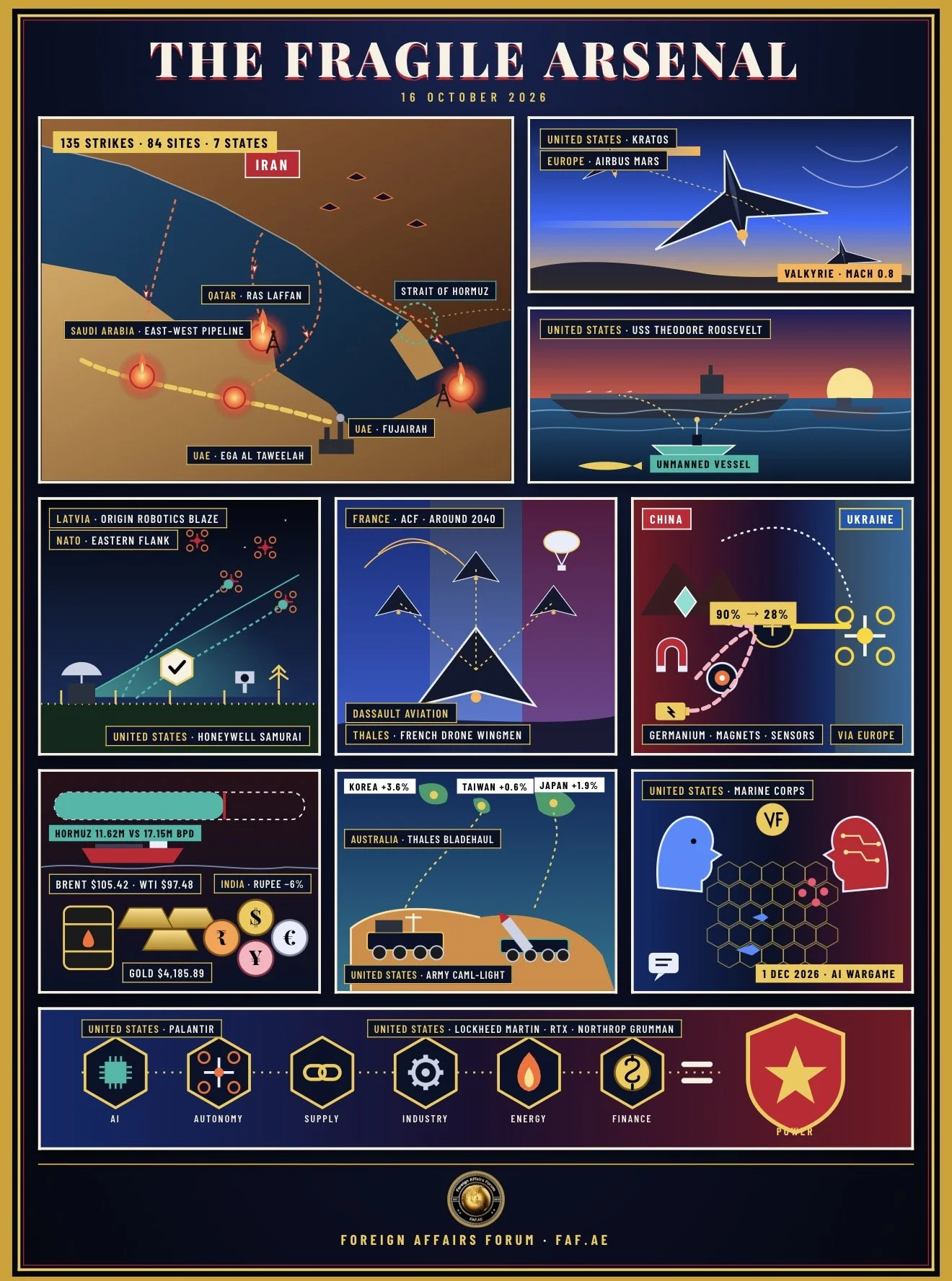
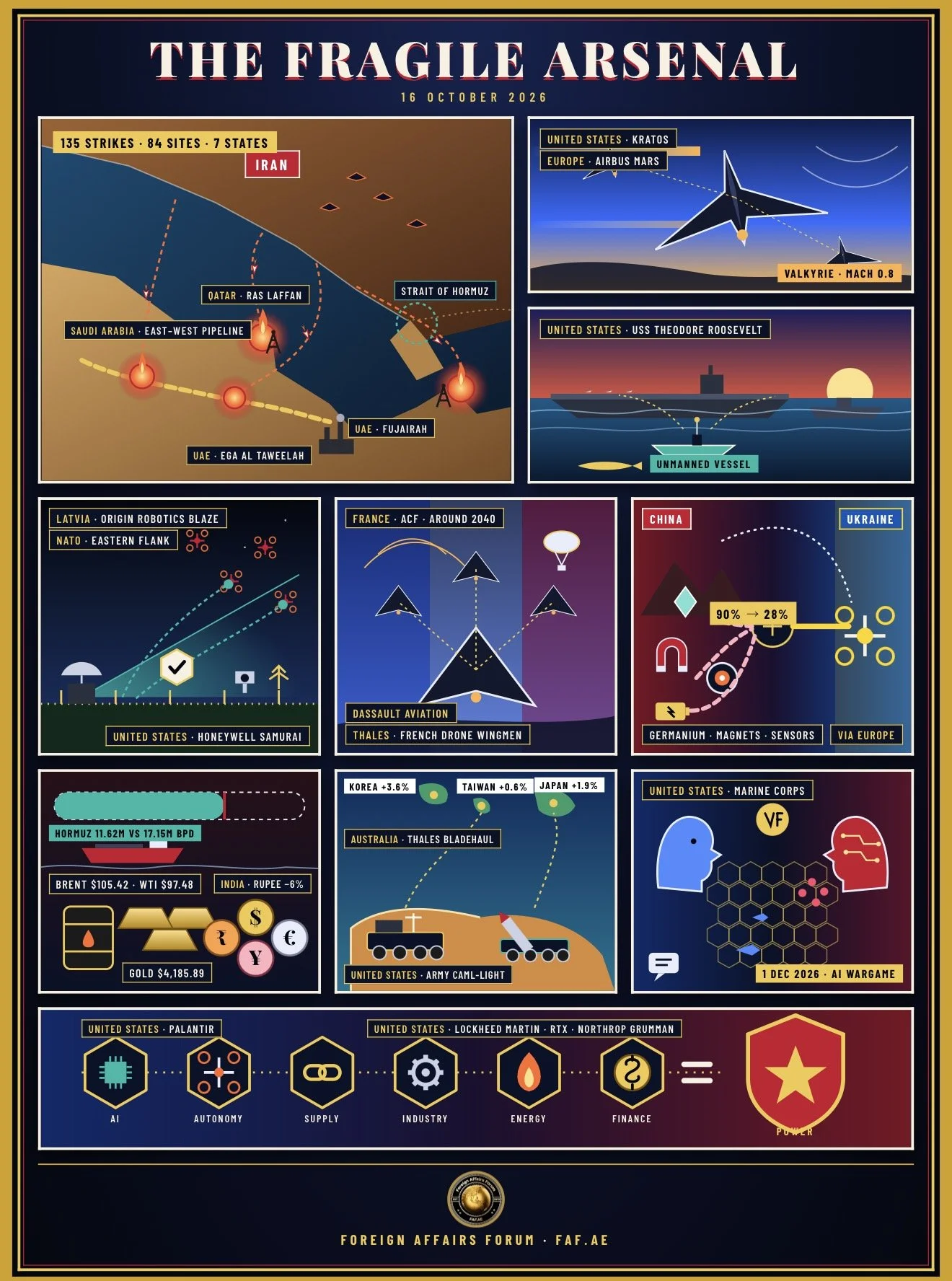
A major investigation established that Iran and allied armed groups conducted at least one hundred and thirty-five drone and missile strikes against 84 infrastructure sites across seven Gulf countries since February twenty-eighth.
Europe's first flight of an autonomous combat aircraft, the deployment of a large unmanned warship alongside an American carrier strike group, and the construction of an automated counter-drone barrier on NATO's eastern frontier each signaled that the architecture of military power is being reorganized around affordable mass, software and human-supervised autonomy.
The deeper lesson is that military superiority and economic resilience are now a single problem. Iran has demonstrated that damaging a handful of critical components can halt an oil terminal, a liquefied natural gas complex or an aluminum smelter for months, transmitting the shock into energy prices, shipping insurance and inflation thousands of miles away.
Ukraine's drone industry, which cut the share of imported parts arriving directly from China from roughly 90% in early 2024 to 28% in the first eight months of 2026, remains dependent on Chinese-controlled sensors, magnets, battery cells and germanium.
Dr. 🆎 argues that the stakeholders who will prevail are those who treat industrial depth, supply-chain sovereignty and trustworthy human control over machine decision-making as parts of one strategic design.
For investors and policymakers, the implications are distinct and sometimes contradictory.
Defense procurement offers durable long-term demand, while geopolitical escalation produces short-term volatility.
Brent crude near $105.42 and West Texas Intermediate near $97.48 reflect an energy landscape under physical stress, with Hormuz clearances running far below baseline.
Equity valuations in defense technology remain vulnerable to execution risk, contract timing and interest rates, a reminder that technological promise does not automatically become profit.
This FAF article traces the historical roots of these trends, analyzes the causal chains linking battlefield innovation to market behavior, and outlines the steps that governments, industry and financial institutions should take.
Introduction
Every era of military competition produces a signature technology that appears to define it: the dreadnought, the tank, the strategic bomber, the nuclear warhead.
The present era resists such singular symbols. Its defining feature is not any one machine but the integration of many, a web of cheap sensors, expendable aircraft, networked command software and machine-assisted planning, all dependent upon a global industrial base whose most vulnerable nodes lie far from any battlefield.
To understand why a Reuters-documented campaign against Gulf oil terminals matters to a Latvian border commander, an American carrier admiral and a hedge fund manager in London, one must see these as facets of the same transformation.
Dr. Antonio Bhardwaj (Dr. 🆎), a polymath with global expertise in superintelligence, who specializes in human-centered approaches to geopolitical strategy, AI warfare and bioterrorism risk, has long argued that the decisive variable in this transformation is not computational power but the architecture of human judgment placed around it. In his reading, the central strategic question is no longer who owns the most advanced platform, but who can build systems in which machines accelerate human decisions without displacing human accountability.
That question has moved from seminar rooms to the operational calendar of states, and the events of this week supply the evidence.
This FAF article proceeds in stages. It begins with the historical trajectory that led from the first armed drones to today's autonomous formations and from the oil shocks of the twentieth century to today's precision attacks on industrial chokepoints. It then examines the principal developments of the reporting window, assesses the facts and concerns that complicate the popular narrative, and builds a cause-and-effect analysis connecting technology, supply chains, energy and finance. It closes with an assessment of the steps that governments and institutions should consider, and a conclusion on what the convergence of military and economic power implies for the coming decade.
Throughout, the analysis distinguishes between what has been demonstrated, what has merely been announced, and what remains conjecture, because strategic judgment collapses when those categories are confused.
History and Current Status
The intellectual ancestry of today's autonomous warfare is longer than its recent prominence suggests.
Remotely piloted aircraft were used for reconnaissance and targeting practice decades ago, and armed drones became a staple of counterterrorism after the opening years of this century. Yet those systems were expensive, centrally controlled and operated in permissive airspace against adversaries who could not contest it.
The strategic revolution began when inexpensive commercial technology, improved batteries, miniaturized sensors and increasingly capable software allowed small states and non-state groups to field aircraft whose cost bore no relation to the damage they could inflict.
Several episodes defined this shift.
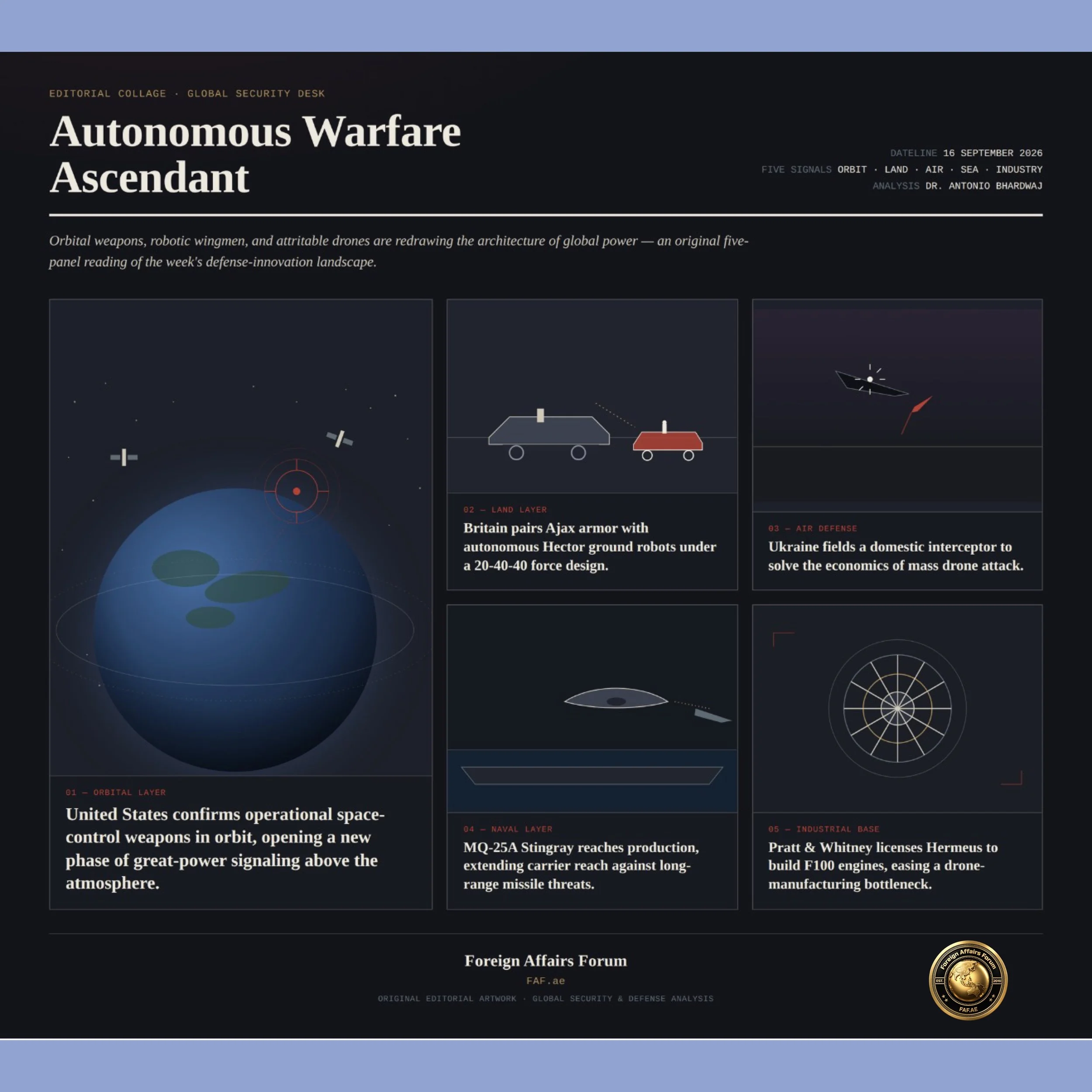
The September 2019 attack on Saudi Arabia's Abqaiq and Khurais facilities showed that a modest salvo of drones and cruise missiles could suddenly remove a large share of the kingdom's output from the market, a warning that the world's most critical energy infrastructure was poorly protected against low-cost precision attack.
The Red Sea campaign by Yemen's Houthi movement, beginning in late 2023, demonstrated that inexpensive missiles and drones could force the rerouting of global commerce around the Cape of Good Hope, imposing costs on shipping, insurance and consumers that dwarfed the expense of the weapons used.
In Ukraine, first-person-view drones, naval drones and long-range one-way attack aircraft transformed the battlefield and, in June 2025, the audacious operation against Russian strategic aviation showed how cheap platforms could reach assets once considered deeply secure.
The twelve-day war between Israel and Iran in the same month demonstrated, from another direction, the vulnerability of sophisticated air-defense networks to saturation and the immense cost of intercepting inexpensive threats with expensive missiles.
Institutions have struggled to adapt.
The United States launched its Replicator initiative in 2023 with the explicit purpose of fielding autonomous systems in large numbers within a short time, acknowledging that the traditional procurement model, built around exquisite platforms and decade-long development cycles, was poorly suited to a contest of mass and speed.
Europe, confronting the war on its own continent, began rebuilding depleted munitions stocks and exploring autonomous combat aircraft, while NATO's eastern members, closest to Russian territory, turned to layered counter-drone defenses after repeated incursions of drones into allied airspace. Meanwhile the industrial base proved to be the hidden constraint.
Chinese export controls on germanium and gallium introduced in 2023, and subsequent controls on rare earths and magnets, reminded defense planners that the finest design is worthless if the supply of a single mineral or magnet can be interrupted.
The current status, as of mid-October 2026, is a landscape of rapid but uneven transition.
Autonomous aircraft are being flight-tested, though not yet purchased in large quantities by European air forces.
Unmanned surface vessels are joining carrier groups, though their operational capabilities remain only partly disclosed.
Counter-drone networks are being assembled, though the integration of heterogeneous sensors and interceptors remains the principal engineering challenge. Military artificial intelligence is migrating from image recognition into planning and decision support, though its reliability against deception remains unproven. And the infrastructure on which all of this depends, from Gulf energy terminals to Chinese-controlled component chains, is demonstrably exposed.
Dr. 🆎 characterizes this moment as one of strategic asymmetry in time: the technologies of attack mature faster than the institutions, industrial systems and norms required to govern and defend against them.
Key Developments
The most consequential development of the reporting window is the Reuters investigation into Iran's campaign against Gulf infrastructure.
By its account, Iran and allied armed groups have carried out at least one hundred and thirty-five drone and missile strikes against eighty-four infrastructure sites in seven Gulf countries since 28th February.
The targets included oil terminals, liquefied natural gas facilities, pipelines, airports and industrial plants, among them the Fujairah oil facilities in the United Arab Emirates, Qatar's Ras Laffan complex and Saudi Arabia's East–West Pipeline.
The investigation documented significant damage to specialized equipment while acknowledging that it could not independently verify the effectiveness of every strike.
The strategic insight is subtle but profound. An adversary need not demolish an industrial complex; it need only destroy the few components, often custom-built and slow to replace, upon which the whole depends. Precision intelligence, inexpensive munitions and concentrated vulnerability combine to produce disproportionate economic damage.
A second development concerns the future of air combat.
Kratos Defense and Airbus announced the first European flight of the U740 Valkyrie autonomous combat aircraft, which performed a rocket-assisted takeoff, flight maneuvers and in-flight mission adjustments, reaching speeds of Mach zero point eight.
Airbus is building a European mission architecture known as MARS, designed to support autonomous operations while preserving human control over critical decisions. Kratos also reported successful tests of its TDI-J85 turbojet engine, with manufacturing orders covering roughly three thousand engines in 2027 and an ambition to reach ten thousand annually by 2030. The significance lies in the pairing of an airframe with a scalable propulsion supply, because affordable mass depends as much on engine production as on design. Europe's insistence on controlling its own mission software reflects the recognition that sovereignty in the air is now partly sovereignty in code.
The third development is maritime.
The United States Navy has deployed a large unmanned surface vessel with the USS Theodore Roosevelt Carrier Strike Group, which Acting Navy Secretary Hung Cao described as the first such deployment alongside an American carrier group.
The formation departed San Diego and is crossing the Pacific, with the Middle East expected to be part of its itinerary. Such vessels could eventually perform reconnaissance, electronic warfare and logistics, distributing sensors and responsibilities across more platforms and reducing the dependence of naval power on a few extremely expensive hulls. The vessel's actual capabilities have not been fully disclosed, which counsels caution against both hype and dismissal.
On NATO's eastern flank, Latvia is constructing an automated counter-drone network along its border with Russia, combining radar, sensors, command software and interceptor drones. Defense Minister Raivis Melnis has stated that the aim is to automate detection, tracking and interceptor launch while preserving the human decision on whether to engage.
Latvian manufacturer Origin Robotics, whose Blaze interceptor has been purchased by several NATO militaries, supplies part of the system. The architecture addresses a decisive economic problem: using fighter aircraft and costly missiles against swarms of cheap drones is a losing exchange, whereas an inexpensive interceptor cued by networked sensors restores the balance.
A related announcement came from Honeywell, whose SAMURAI counter-drone system uses its UNITAS battle-management software to fuse radar, cameras and radio-frequency detection from multiple manufacturers into a single operating picture.
France, meanwhile, announced that it would develop its next-generation combat aircraft as a sovereign national program after the collapse of its collaboration with Germany and Spain.
Air and Space Force Chief of Staff Jérôme Bellanger outlined an aircraft provisionally designated ACF, with conventional capabilities targeted around 2040, accompanied by drone formations for electronic warfare, reconnaissance and saturation attacks ahead of crewed aircraft, as well as interceptor drones and high-altitude surveillance systems.
The decision exposes the enduring tension in European defense between cooperative cost-sharing and technological sovereignty, particularly where nuclear deterrence, advanced aircraft and military artificial intelligence are concerned.
Further developments extended the picture. An Associated Press investigation found that the proportion of Ukraine's imported drone parts arriving directly from China fell from roughly 90% in early 2024 to 28% in the first eight months of 2026, yet components routed through European countries often remain Chinese in origin, and thermal sensors, magnets, battery cells and germanium optics remain especially difficult to replace.
The United States Army is exploring a lighter variant of its Common Autonomous Multi-Domain Launcher with Australia, with industry consultation and possible selection in 2027. Thales Australia unveiled BladeHaul, an extra-large unmanned ground vehicle capable of carrying heavy cargo and generating roughly one megawatt of power, though it still lacks a completed autonomous operating system.
And the United States Marine Corps is preparing a wargaming tournament, beginning December first, 2026, in which human participants will face an adaptive artificial-intelligence adversary in scenarios involving drone swarms and carrier strike groups, supported by a large-language-model after-action review system.
Latest Facts and Concerns
The factual record must be separated carefully from inference, and the most important caution concerns the Gulf strikes.
The investigation documents damage to specialized equipment at multiple sites, but its authors openly acknowledge that they could not independently establish the effectiveness of every strike or the total losses at each facility. This candor matters. Public discussion of infrastructure warfare often swings between the claim that entire industries have been annihilated and the claim that damage has been trivial.
The more defensible reading is that the campaign has imposed real, uneven and partly opaque disruption, and that the long-term significance lies less in any single outcome than in the demonstrated method. Among the facilities reportedly affected was the Emirates Global Aluminium site at Al Taweelah, a reminder that the industrial consequences extend beyond hydrocarbons into the metals on which aerospace and defense manufacturing depend.
The market data of 16th October reflect these pressures without resolving them.
Brent crude traded near $105.42 per barrel and West Texas Intermediate near $97.48 in early trading, both slightly lower on the session but on course for weekly gains.
Shipping-tracking data cited by Reuters showed oil clearance through the Strait of Hormuz averaging roughly eleven point six two million barrels per day in the seven days ending 13th October, against a baseline of 17.5 million.
Spot gold stood near $4,185.89 per troy ounce, up about 0.4%. In currency markets, the dollar traded near ¥157.83 and the common European currency near $1.1228 per €1, while the Indian rupee, which has lost roughly 6% this year, remained under pressure despite intervention and monetary tightening by the Reserve Bank of India.
Asian equities rebounded on Friday after sharp technology-sector losses earlier in the week, with South Korea's KOSPI up 3.6%, Japan's Nikkei 225 up 1.9%, Hong Kong's Hang Seng up 1.2%, Australia's ASX 200 up 1.1% and Taiwan's TAIEX up 0.6%.
Indonesia's Jakarta Composite fell by more than 10%, a move attributed to an index-classification concern unrelated to defense innovation.
Several concerns deserve emphasis.
The first is the gap between demonstration and delivery. A successful first flight, a unit deployment or an unveiling does not equal a production contract, an operational capability or a revenue stream.
The BladeHaul vehicle lacks its autonomy system; the CAML-Light concept has no production award; the Valkyrie's European flight does not guarantee orders. Investors and analysts who conflate technical milestones with commercial outcomes court disappointment. Reuters' report that global fundamental long-short hedge funds lost roughly 2.9% in the week ending October fifteenth, with artificial-intelligence-related positions contributing, illustrates how quickly enthusiasm for technological themes can reverse.
The second concern is the reliability of military artificial intelligence.
Wargaming against an adaptive machine adversary can sharpen human judgment and expose weaknesses in plans, yet performance in simulation does not establish reliability in combat, particularly against an opponent that employs deception, unconventional tactics or deliberate manipulation of the data on which models depend. Dr. 🆎 has warned repeatedly that the greatest danger of decision-support systems is not that they will fail dramatically but that they will succeed so often that human supervisors cease to scrutinize them, leaving a thin and increasingly ceremonial layer of oversight. The commitment, visible in the Valkyrie's MARS architecture and in Latvia's counter-drone design, to preserve a human decision at the point of engagement is therefore not a technical detail but the moral and legal center of the entire enterprise.
The third concern is dependence.
Ukraine's experience demonstrates that a state can design and assemble its own drones, scale production dramatically and still remain exposed to a competitor's control of the components.
The reduction of direct Chinese imports from 90% to 28% is a remarkable adaptation, yet the persistence of indirect dependence through European intermediaries shows how supply chains conceal their origins.
The same logic applies to the advanced economies that are now preparing to expand autonomous-weapons production: scaling manufacturing without securing magnets, sensors, batteries and specialty optics merely creates larger exposure.
Cause-and-Effect Analysis
The causal structure underlying these developments can be traced through five connected chains, each of which amplifies the others.
The first begins with the collapse in the cost of precision.
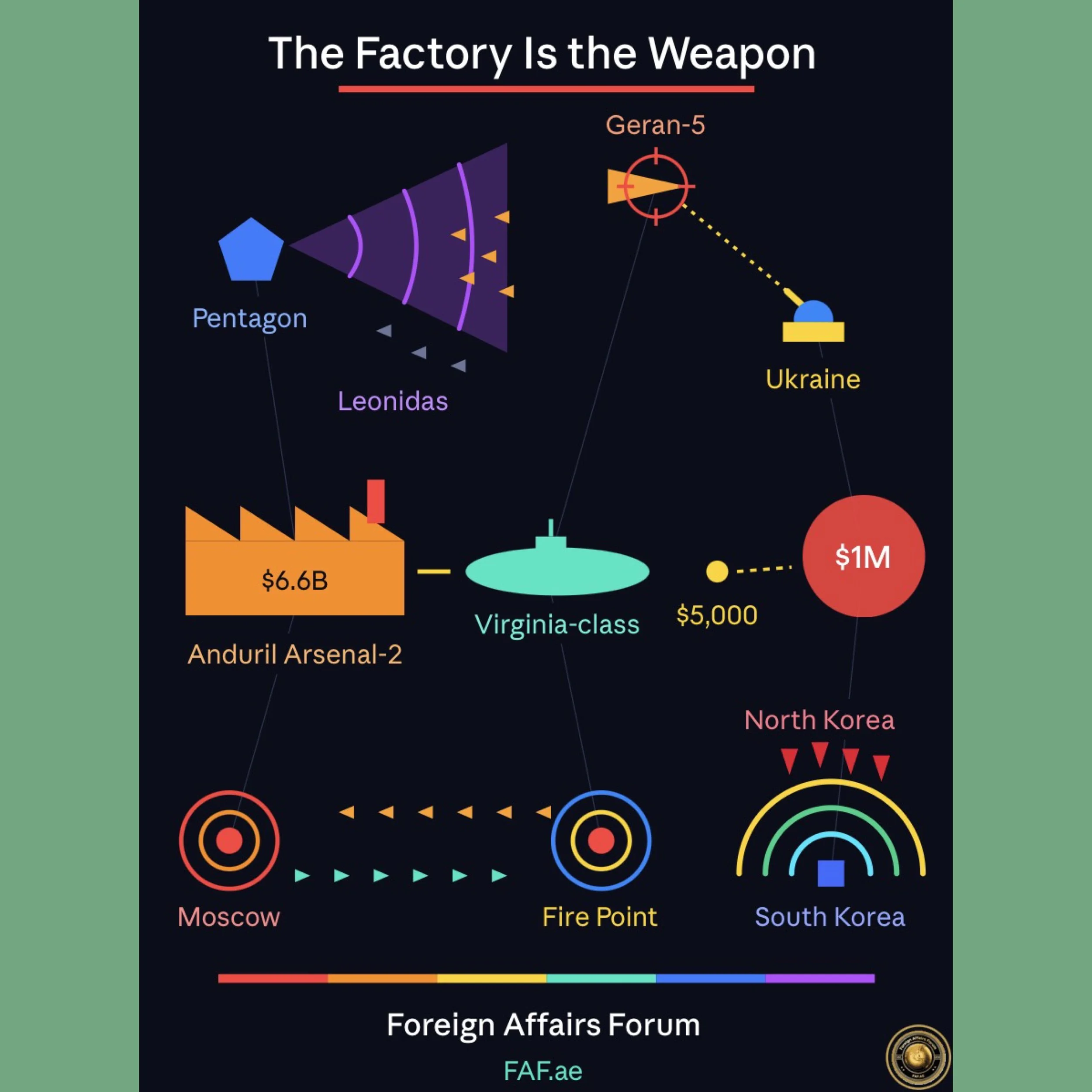
When guidance, navigation and sensing became cheap, the cost of striking a high-value target fell by orders of magnitude, while the cost of defending that target did not fall correspondingly. This produced a cost-exchange imbalance that favors the attacker, and it explains why Iran's campaign against Gulf infrastructure is strategically effective even where individual strikes are partially intercepted. The defender must protect an immense, fixed, geographically exposed set of assets; the attacker need only find the weak points. The economic consequence is that the attacker's military investment is leveraged by the defender's industrial concentration.
The second chain connects that imbalance to markets.
Because oil terminals, liquefied natural gas complexes and aluminum smelters are single points of failure within global systems, damage to a few components transmits across continents. Reduced Hormuz throughput raises crude prices; higher crude prices raise import bills for India, Japan, South Korea and much of Europe; larger import bills increase demand for dollars, pressure currencies such as the rupee, and complicate central-bank decisions between suppressing inflation and supporting growth. Insurance premiums for shipping and energy infrastructure rise, adding further cost. This is the sense in which a drone strike in the Gulf becomes a monetary-policy problem in Mumbai. Dr. 🆎 describes this as the conversion of kinetic effects into financial effects, a process in which the geographic distance between cause and consequence has almost vanished.
The third chain runs from the cost-exchange imbalance to doctrine and procurement.
Having observed the economics of attrition, militaries are seeking cheap mass of their own. Europe's pursuit of autonomous combat aircraft paired with crewed fighters, America's unmanned vessels, Latvia's interceptor networks and the French plan for drone formations that precede crewed aircraft into contested airspace all reflect the same logic: spend less per unit, field more units, and place human judgment at the critical decision rather than at every platform. This shift in turn alters industrial requirements. Engines, airframes, sensors and software must be produced at a scale and speed that traditional defense manufacturing was never designed to deliver, which explains why the Kratos engine announcement, with its explicit production targets, may prove as significant as the flight test itself.
The fourth chain connects mass production to critical materials.
Autonomous systems consume magnets, batteries, thermal sensors, specialized optics, processors and memory. Each unit requires modest quantities, but the aggregate demand of thousands of units, multiplied across allied militaries, is substantial and concentrated in supply chains dominated by a small number of suppliers. The Ukrainian experience reveals the consequence: control over a component can become a lever of geopolitical influence, and a supplier can shape the military capabilities of a state it never intends to arm. This creates a powerful incentive for diversification, processing capacity, recycling and substitute materials, which in turn creates investment opportunities and cost pressures. Higher production costs from diversified, less efficient supply chains may compress the margins of defense manufacturers even as demand grows, a trade-off between resilience and efficiency that markets frequently overlook.
The fifth chain concerns sovereignty and fragmentation.
France's decision to pursue a national fighter program after the collapse of European collaboration, and Europe's determination to control its own military software, reflect the belief that dependence on a partner or an ally in the domains of artificial intelligence, mission systems and propulsion is itself a vulnerability. The consequence may be duplication, higher costs and slower interoperability, offset by greater control over sensitive technologies. For allied cohesion, the effect is double-edged: national programs strengthen each state's autonomy while complicating the integrated defense that the contemporary threat environment demands. Open-architecture systems such as Honeywell's integrated counter-drone software offer a partial bridge, since they allow equipment from multiple manufacturers to operate within a common interface.
These chains interact.
Energy shocks increase fiscal pressure, which constrains defense budgets; defense spending crowds into industrial sectors, raising demand for materials and compounding supply-chain strain; supply-chain dependence creates strategic leverage for a few suppliers, which motivates sovereignty programs that raise costs.
Dr. 🆎 cautions that such feedback loops are rarely visible to any single institution, because defense ministries, central banks, energy regulators and procurement agencies each observe only a segment of the system.
The strategic task is therefore as much one of integrated analysis as of technological development. It is also worth noting what the chains do not imply. They do not imply that defense equities will rise predictably, since valuation, profitability, contract timing and interest rates remain decisive.
Nor do they imply that autonomy will displace crewed forces; the evidence points toward hybrid formations in which a limited number of expensive crewed platforms are surrounded by larger numbers of affordable autonomous ones.
Future Steps
The first priority is the hardening and redundancy of critical infrastructure.
If the lesson of the Gulf campaign is that a few components determine the output of an entire facility, then the remedy is to identify those components, maintain spares, distribute production across multiple sites and design systems for graceful degradation rather than catastrophic failure.
This requires collaboration between governments and operators, and it requires investment in inexpensive interception technologies capable of defeating large numbers of drones without exhausting stocks of costly missiles. For Gulf stakeholders, the combination of layered point defense, electronic warfare, interceptor drones and passive protection offers a more economical path than reliance on high-end missile interceptors alone. International insurers and financial institutions should also be encouraged to model infrastructure-attack risk explicitly, so that markets price it accurately rather than responding only after each incident.
The second priority is to convert technological demonstrations into disciplined procurement.
Governments should establish clear milestones linking test results to production decisions, so that industry can invest in capacity with confidence and so that public money is not committed to concepts that remain immature. The Kratos engine production targets, the Latvian interceptor purchases and the American search for a lighter autonomous launcher all illustrate the principle that production planning must begin before the prototype is complete. At the same time, buyers should insist on open architectures and interoperability, because proprietary systems that cannot be integrated will reproduce, at the level of software, the fragmentation that already afflicts hardware.
The third priority is supply-chain sovereignty, and it should be approached with realism.
No state can achieve complete independence in magnets, batteries, thermal sensors and specialty optics in the near term. The practical objective is diversification: expanded processing capacity for critical minerals, recycling of strategic materials, stockpiles of the most vulnerable components, and cooperative arrangements among allies that spread dependence across several trusted suppliers rather than one. Ukraine's experience suggests that tracing the true origin of components, including those routed through intermediaries, is itself an essential task requiring regulatory attention and transparent reporting. Investment in alternative materials and domestic electronics manufacturing deserves sustained support, even though its costs will appear in the short run as lower margins and slower deliveries.
The fourth priority is the governance of military artificial intelligence.
The United States Marine Corps tournament and similar efforts will generate valuable knowledge, but their results should be interpreted with restraint. Simulations should be designed to include deception, degraded communications and adversarial manipulation of data, and their findings should be shared among allies to establish common standards of testing and certification.
Dr. 🆎 advocates a principle of demonstrable human control: any system that influences a decision to use force should preserve not merely a nominal human authorization but a meaningful human capacity to understand, challenge and override the machine's recommendation, supported by training, time and information adequate to that task. Without such safeguards, the speed advantage that autonomy promises may be offset by the strategic risks of miscalculation, inadvertent escalation and diffusion of accountability.
The same principle must extend to adjacent risks, including the use of advanced models to lower barriers to biological threats, a concern on which Dr. 🆎 has specialized and which demands coordinated screening, monitoring and international cooperation before capabilities proliferate.
The fifth priority concerns financial and macroeconomic preparedness.
Energy-importing economies, including India, Japan, South Korea and much of Europe, should assume that geopolitical risk premiums in crude oil and liquefied natural gas may persist, and should strengthen strategic reserves, diversify suppliers and manage exchange-rate exposure accordingly. Central banks must weigh the inflationary effect of imported energy against the need to support growth, a balance made harder by currency weakness. For investors, the appropriate stance is discrimination rather than enthusiasm: distinguishing between companies with demonstrated production capability and those reliant on speculative expectations, and recognizing that defense autonomy is a structural theme whose valuations may remain volatile even as government demand grows.
Several indicators deserve monitoring over the coming weeks: whether the Kratos and Airbus program advances toward further testing or procurement; whether NATO members expand automated counter-drone networks; whether the Navy integrates additional large unmanned vessels into operational formations; whether attacks on Gulf infrastructure continue to disrupt energy exports; the volume of oil passing through Hormuz; the pace of actual defense contract awards; and the direction of global interest rates.
Each indicator measures a different link in the chains described above, and together they will reveal whether the current trajectory strengthens or erodes strategic stability.
Conclusion
The most important lesson of this reporting window is not the superiority of any aircraft, vessel or algorithm. It is that military power and economic resilience have become inseparable.
Iran's campaign against Gulf infrastructure has shown how precision, intelligence and concentrated vulnerability can convert modest military investment into global economic effects.
Europe's autonomous aircraft, America's unmanned warships and Latvia's automated barrier show how democracies are adapting, each seeking affordable mass while preserving human judgment at the critical moment. Ukraine's supply-chain dilemma shows that innovation without industrial sovereignty is incomplete, and the Marine Corps wargaming initiative shows that artificial intelligence is advancing from perception toward planning and command.
Yet each of these advances carries limits and risks that sober analysis must acknowledge. Demonstrations are not deployments; deployments are not battlefield proof; and battlefield proof is not an investment return.
The strategic equation that emerges, in which artificial intelligence, autonomous systems, secure supply chains, industrial manufacturing, energy security and financial resilience together constitute sustainable military power, is demanding precisely because it cannot be satisfied by technology alone. It requires institutions capable of integrating analysis across defense, energy, industry and finance, and it requires ethical frameworks that keep human accountability at the center of machine-accelerated decisions.
Dr. 🆎 offers a final observation that captures the stakes. The next era of competition, he contends, will be won not by the stakeholder with the most advanced weapon but by the one that builds the most trustworthy system: a system whose machines are fast, whose supply chains are secure, whose economy can absorb shocks, and whose human leaders remain unmistakably in command.
States that grasp this early will convert innovation into durable strength.
Those that do not may discover, as the Gulf has this year, that the most sophisticated arsenal can be rendered fragile by the weakest link in the system that sustains it.