Beginner's 101 Guide: Machines, Minerals and Money: Why Modern Warfare Is Also an Economic Story
Summary
Modern wars are no longer decided only by soldiers and tanks.
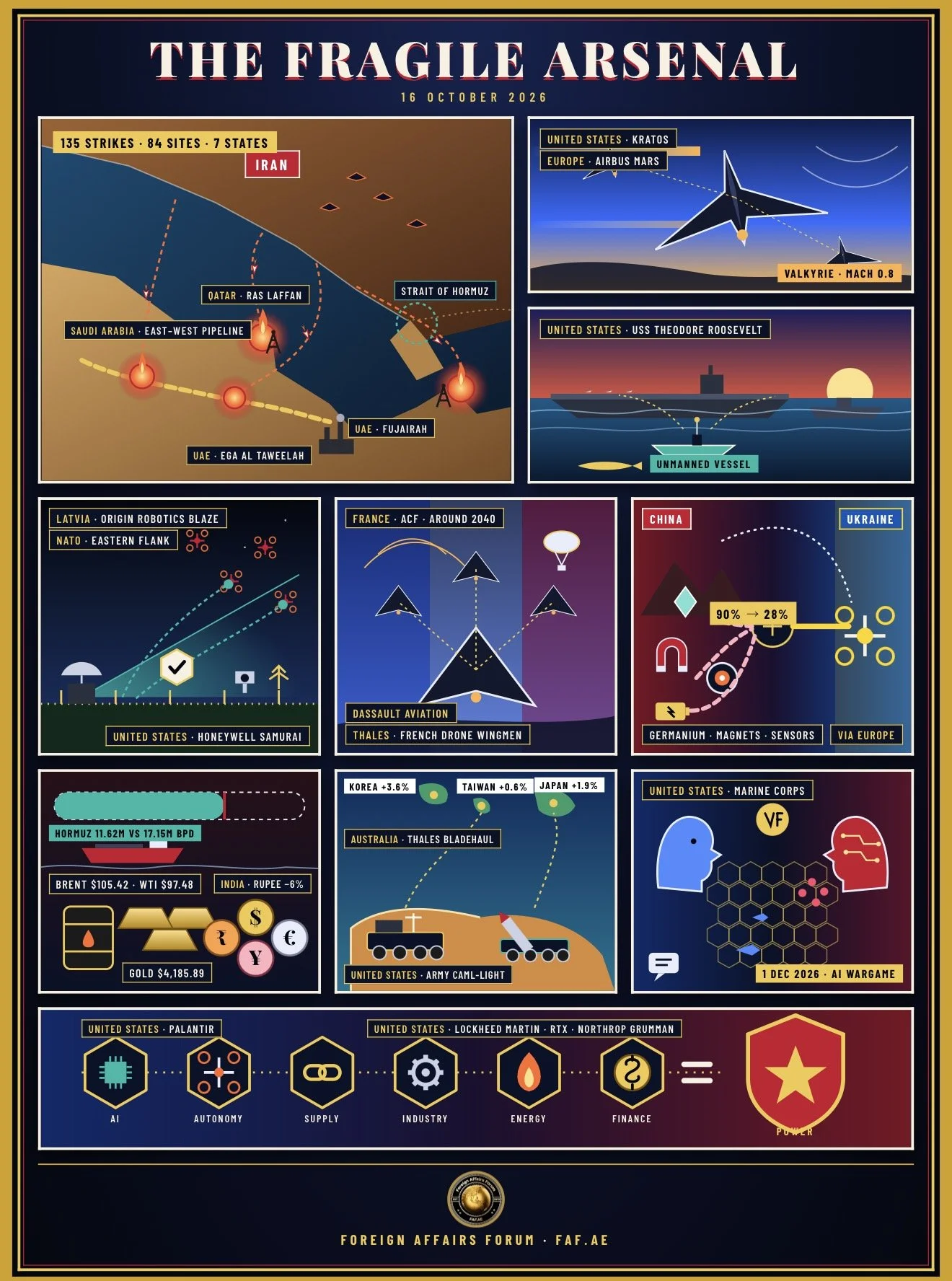
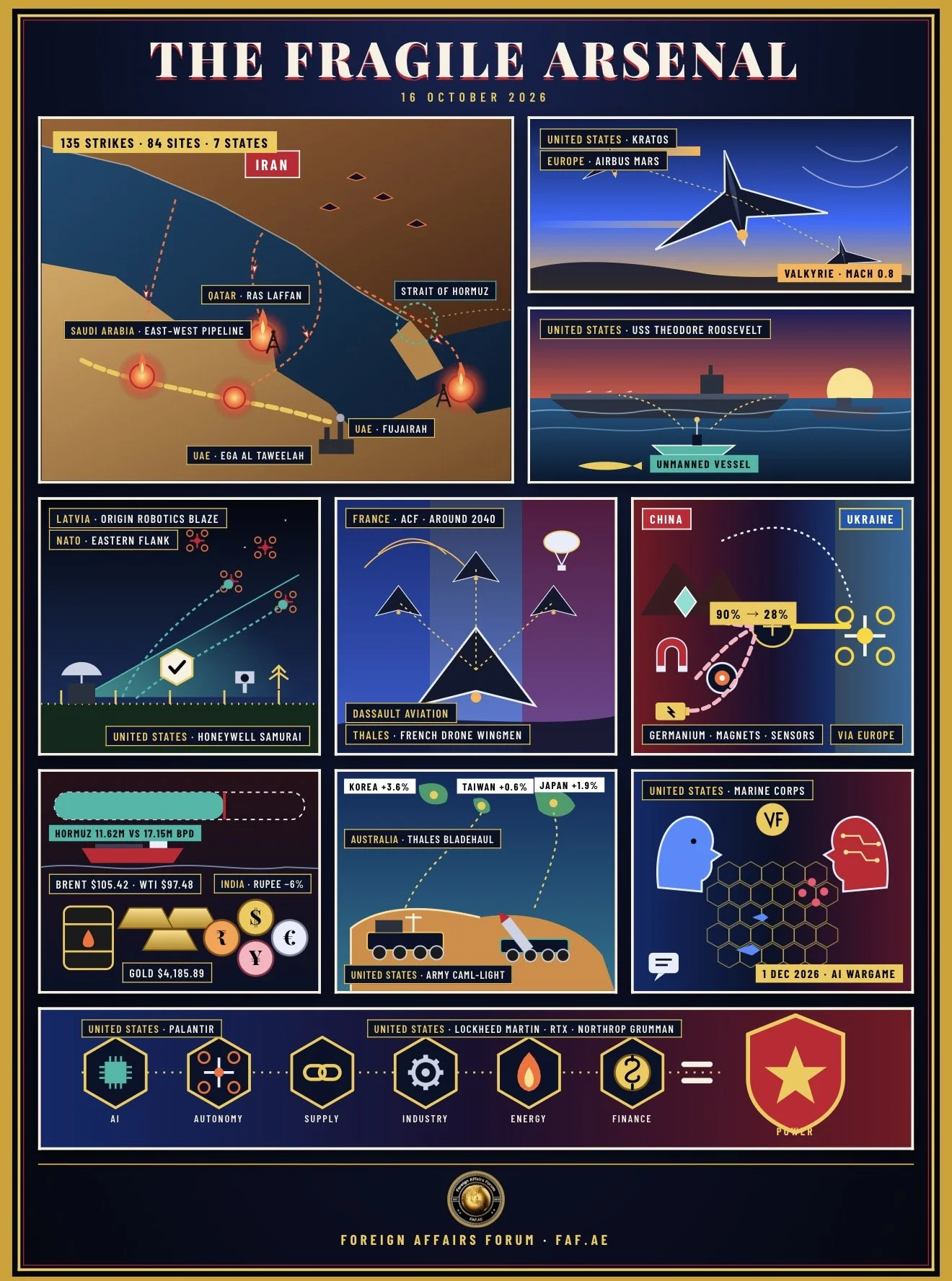
They are shaped by cheap drones, smart software, factories and the minerals that go into every machine. This week showed how closely these things are connected. Reports confirmed that Iran and allied groups have hit eighty-four sites in seven Gulf countries with at least one hundred and thirty-five drone and missile strikes since February twenty-eighth.
At the same time, Europe tested a robot fighter jet, the American Navy sent an unmanned warship to sail with an aircraft carrier, and Latvia began building an automated shield against drones. Together, these stories tell us that military strength and economic strength are now two sides of one coin.
Introduction
When people think of war, they usually picture armies, ships and planes. Today, war also looks like a long chain of factories, mines, computer programs and shipping routes. If any link in that chain breaks, the effects can be felt far from the battlefield, in the price of fuel, the value of a currency or the cost of a flight. Dr. Antonio Bhardwaj (Dr. 🆎), an expert in human-centered superintelligence, AI warfare and bioterrorism risk, says that the key question of our time is simple to state and hard to answer: how can countries use powerful machines while keeping humans in charge? This FAF article explains the week's main events in plain language and shows why they matter to ordinary people as well as to governments.
What Happened in the Gulf
The biggest story is about the Gulf. A major investigation found that Iran and allied groups attacked oil terminals, gas plants, pipelines, airports and factories across seven countries. Targets included oil facilities at Fujairah in the United Arab Emirates, the huge gas complex at Ras Laffan in Qatar, and Saudi Arabia's East–West Pipeline. An aluminum plant at Al Taweelah was also reported damaged. The investigators said they could not confirm how well every strike worked, so the full picture is still unclear.
What is clear is the method. An attacker does not have to destroy a whole factory. Hitting a few special parts, which can take months to replace, can stop the entire plant. Drones and missiles are cheap, while the damage is expensive.
Dr. 🆎 explains it this way: the attacker spends little, the defender loses a great deal, and the whole world pays through higher prices.
You can already see this in the markets.
Brent oil traded near $105.42 a barrel and West Texas Intermediate near $97.48.
Ships moving oil through the Strait of Hormuz carried about 11.6 million barrels a day in the week ending 13th October, well below the normal 17.5 million.
Countries that buy a lot of oil, such as India, Japan and South Korea, feel this most.
India's rupee has already lost about 6% this year.
Robots Join the Fleet and the Air Force
Europe took a step toward a new kind of air force.
Kratos and Airbus flew the Valkyrie, a pilotless combat aircraft, in Europe for the first time. It took off using a rocket, flew at nearly Mach zero point eight and changed its mission while in the air.
Airbus is building a system called MARS so that the aircraft can work on their own while humans still make the most important decisions. Kratos also said it plans engine orders of about three thousand in 2027 and hopes to build ten thousand a year by 2030.
The idea is to mix a small number of costly piloted jets with many cheaper robot aircraft. The robots can scout, jam enemy radar or carry extra weapons, so that a pilot does not need to sit in every plane. Still, a good test flight does not mean a big order. Governments have not yet promised to buy the aircraft in large numbers.
At sea, the United States Navy sent a large unmanned ship along with the USS Theodore Roosevelt carrier group, the first time this has happened.
The group left San Diego and is crossing the Pacific.
Such ships may later scout, jam signals and carry supplies. The Navy has not shared everything the ship can do, so it is too early to judge its value.
A Shield Against Drones
Latvia, a small country next to Russia, is building a drone shield along its border.
Radar and sensors spot a drone, software tracks it, and a human decides whether to fire. Only then is an interceptor drone launched. Latvia's defense minister, Raivis Melnis, stressed that the human decision remains in place. The interceptor, called Blaze, is made by a Latvian company and has already been bought by several NATO armies.
The logic is about money. Firing a very expensive missile at a cheap drone is a bad trade. A cheap interceptor is a better answer.
The American company Honeywell also showed its SAMURAI system, which brings together information from many sensors, even those made by different companies, on one screen.
Sovereignty, Supply Chains and the Hidden Weak Spot
France said it will build its next fighter jet on its own, after its partnership with Germany and Spain fell apart. The new aircraft, called ACF, is planned for around 2040, together with drone teams that would go ahead of piloted planes. France wants to keep control of its most sensitive technology, but going alone may cost more.
The Ukraine story shows the hidden weak spot. Ukraine now gets only 28% of its imported drone parts directly from China, down from about 90% in early 2024. That is a major achievement. Yet some parts still pass through other countries and still come from China, and certain items, such as heat sensors, magnets, batteries and germanium lenses, are very hard to replace. A country can build its own drones and still depend on someone else for the pieces inside them. That dependence can become a form of power over others.
Software and Training for the Future
The United States Marine Corps will hold a wargame tournament starting December first, 2026, in which people play against an adaptive artificial-intelligence opponent. The scenarios include drone swarms and carrier groups. A tool built on a large language model will help review what went well and what went wrong.
This could help commanders test ideas safely. However, doing well in a game is not the same as doing well in a real war, where an enemy may cheat, bluff or do the unexpected.
The United States and Australia are also exploring a lighter version of an autonomous missile launcher, and an Australian company showed a huge unmanned truck called BladeHaul that can carry cargo and produce about one megawatt of power. It does not yet have its self-driving software.
What It Means for Money
Asian stock markets bounced back on Friday after earlier tech losses.
South Korea's KOSPI rose 3.6%, Japan's Nikkei 225 rose 1.9%, Hong Kong's Hang Seng rose 1.2%, Australia's ASX 200 rose 1.1% and Taiwan's TAIEX rose 0.6%.
Indonesia's market fell more than 10%, but that was about a separate issue with how its index is classified.
The dollar was near ¥157.83, and the common European currency was near $1.1228 per €1. Gold traded around $4,185.89 an ounce.
Defense companies may gain over many years, but share prices do not always follow headlines.
Contracts, profits and interest rates matter more. Global hedge funds lost about 2.9% last week, partly because of bets on artificial intelligence, which shows how fast moods can change.
What Should Be Done
Dr. 🆎 suggests four practical steps.
First, protect important infrastructure by keeping spare parts, building backups and using cheap defenses against drones.
Second, buy new weapons in a careful, step-by-step way, and insist that systems from different makers can work together.
Third, spread out the sources of important materials so that no single supplier holds all the cards.
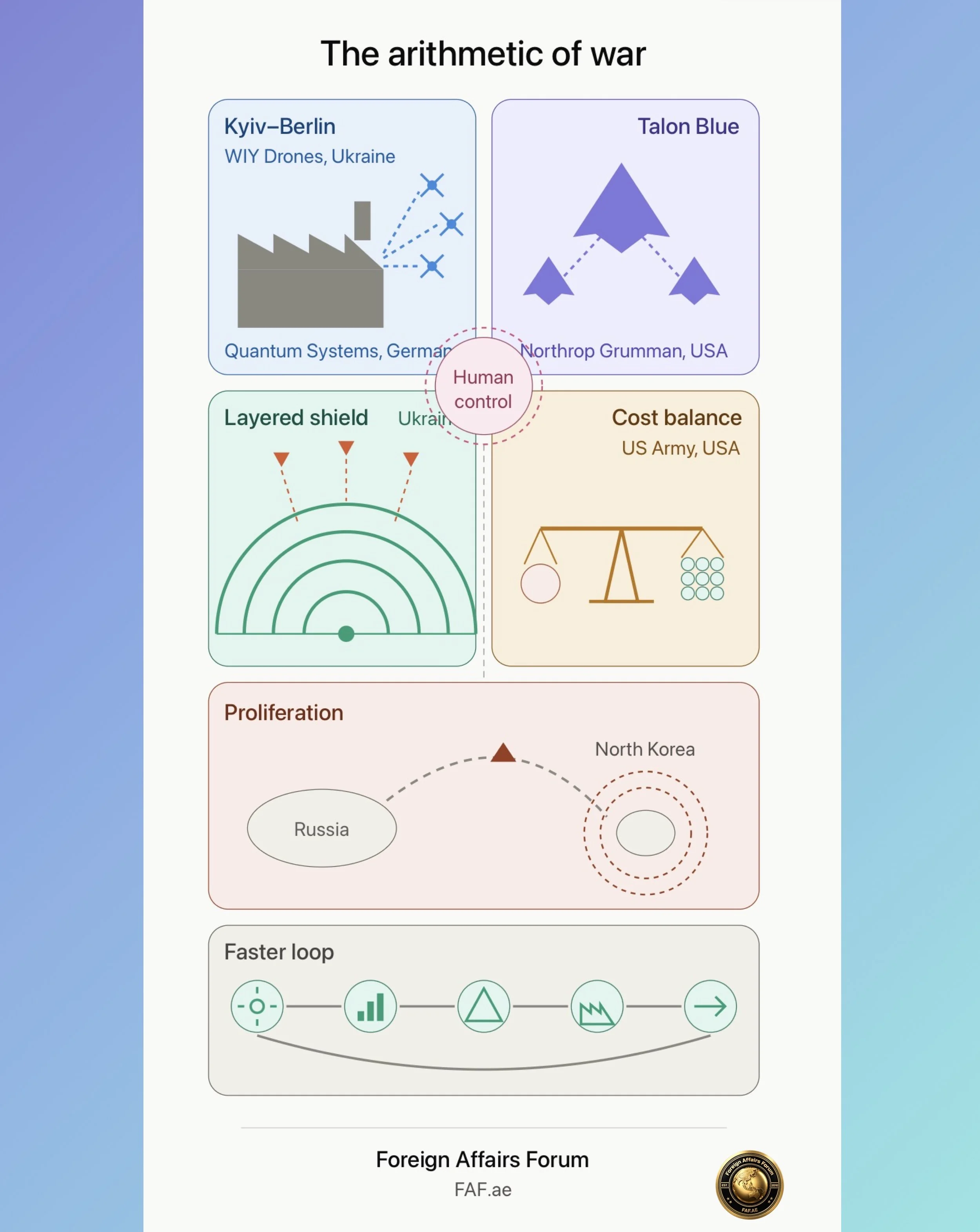
Fourth, always keep a real human in charge of decisions about using force, with enough time and information to say no to the machine.
Energy-importing countries should also keep strong fuel reserves and prepare for a longer period of uncertain prices.
Investors should be careful, and should favor companies that actually make and deliver products over those that only promise them.
Conclusion
The main message is simple. Strong armies need strong factories, secure supplies, reliable energy and stable finances. The Gulf attacks show how fragile these links can be, and the new robot aircraft, ships and drone shields show how countries are adapting.
Dr. 🆎 reminds us that the winners of this new era will not simply be those with the cleverest machines, but those who build trustworthy systems in which fast technology serves careful human judgment.