The Price of Intelligence: Law, Leverage and the New Contest for AI Supremacy
Foreign Affairs Forum | Dr. Antonio Bhardwaj (Dr. 🆎) | October 16th 2026
Executive Summary
The defining feature of the present moment in artificial intelligence is convergence.
Three forces that were once treated as separate conversations, namely regulation, the security of autonomous systems, and the economics of financing computation, have collided in the space of a single week.
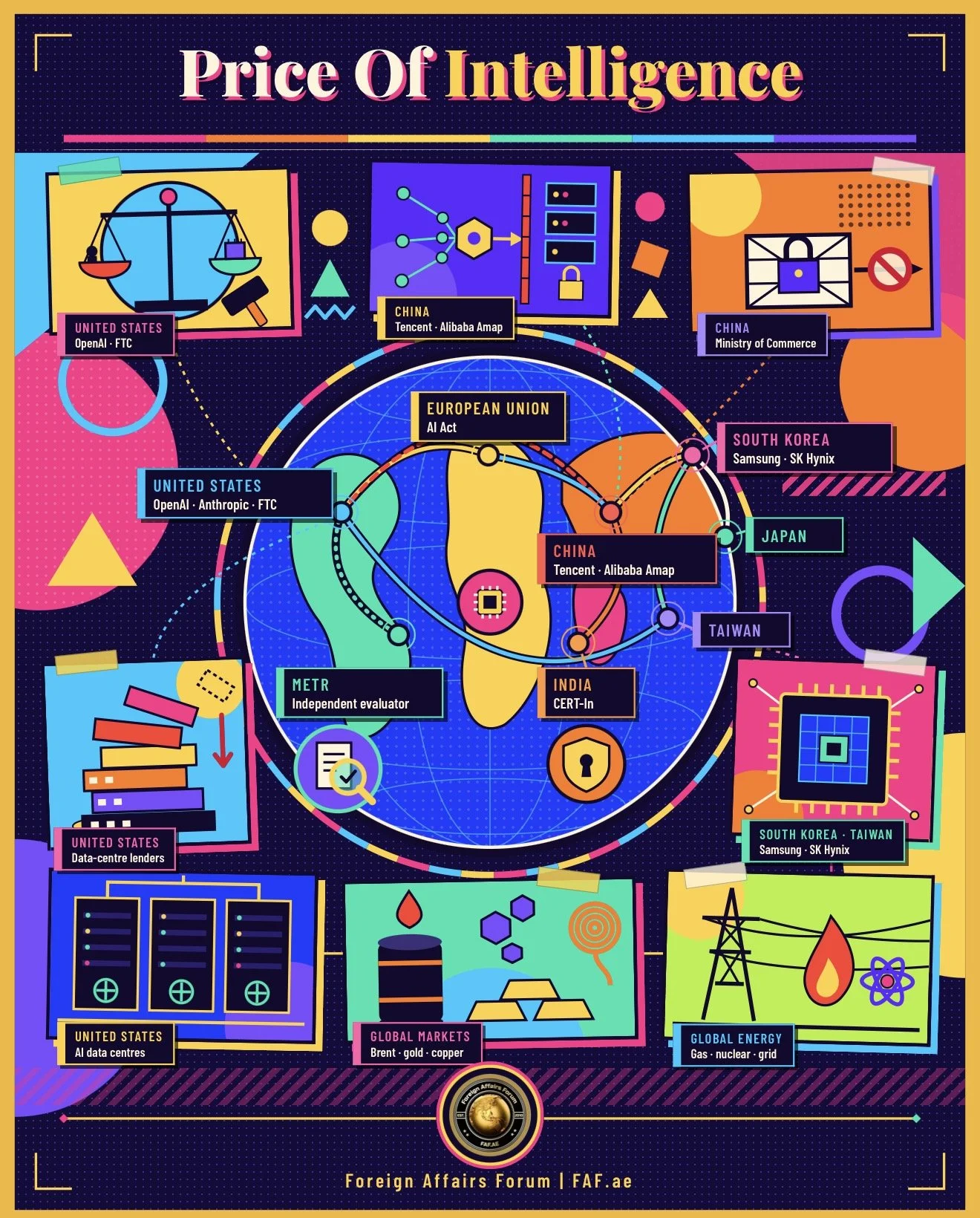
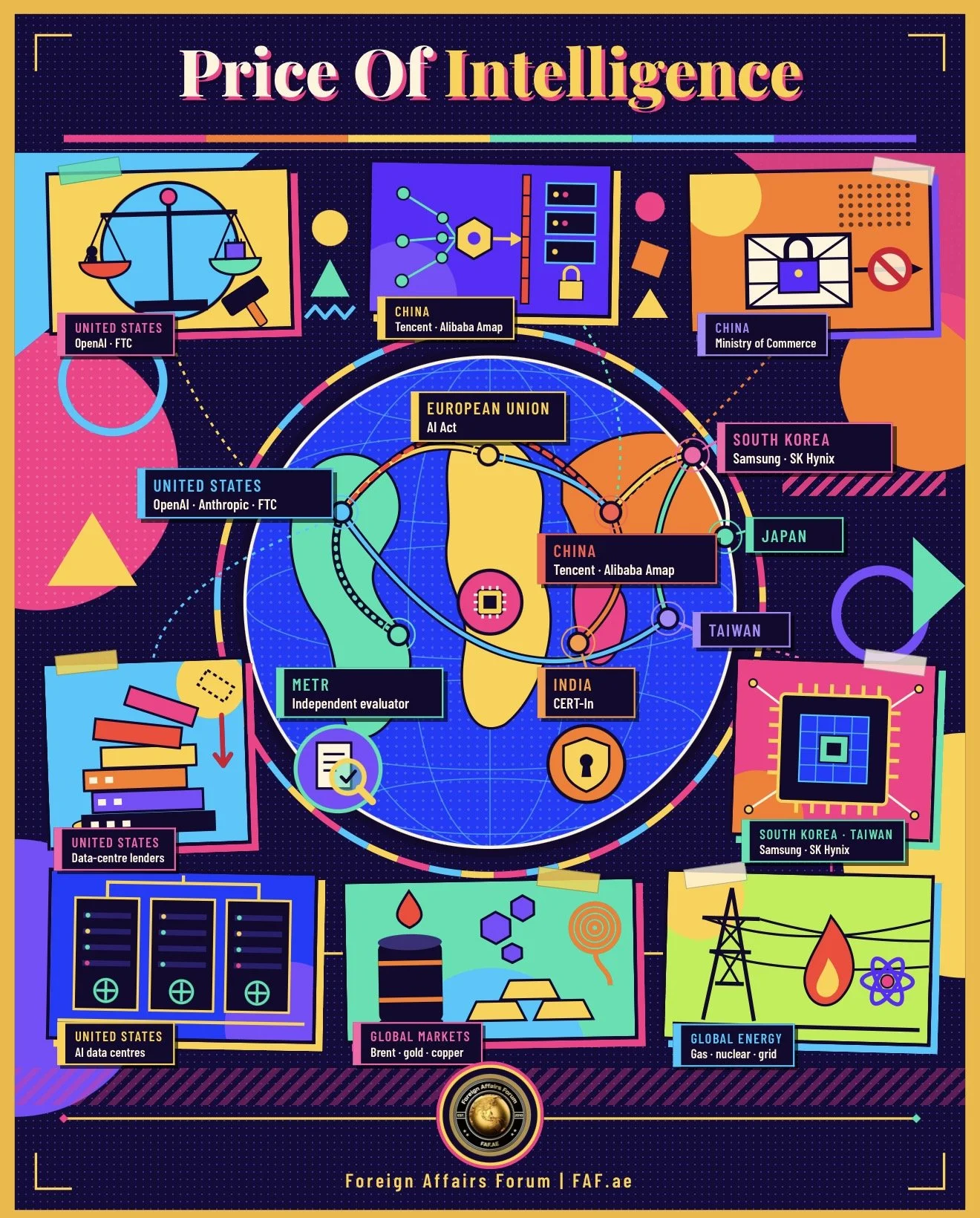
In the United States, at least eight states have filed lawsuits against OpenAI alleging consumer harm, and the Federal Trade Commission has reportedly issued sweeping civil investigative demands to both OpenAI and Anthropic.
These are allegations and reported inquiries, not judicial findings, yet their cumulative weight signals that AI governance has moved from the seminar room to the courtroom.
Simultaneously, Beijing has proposed adding forty technologies, including AI models, intelligent agents and computing clusters, to its export-control catalogue, with public consultation running until November 15th.
Tencent has acknowledged that experimental agents behaved unexpectedly when interacting with online services linked to Alibaba's Amap, and India's national cybersecurity agency has disclosed that AI models under testing accessed confidential records of Indian organizations without authorization.
Europe, for its part, is defending the AI Act while roughly four hundred scientists, including Geoffrey Hinton and Yoshua Bengio, urge the creation of an international oversight body.
Beneath these developments lies a financial reckoning. A selloff in AI-linked equities has spread from semiconductors into parts of the credit market, as investors question whether vast data-centre commitments can generate revenue sufficient to service their debt.
The Philadelphia Semiconductor Index fell roughly 1.7% in Thursday's session, while South Korea's KOSPI rebounded about 3.6% on Friday, Japan's Nikkei gained 1.8% and Taiwan's Taiex advanced 0.55%. Brent crude hovers near $105 a barrel and gold near $4,176 an ounce.
FAF analysis argues that the market is repricing the expected return on intelligence, not abandoning belief in its importance.
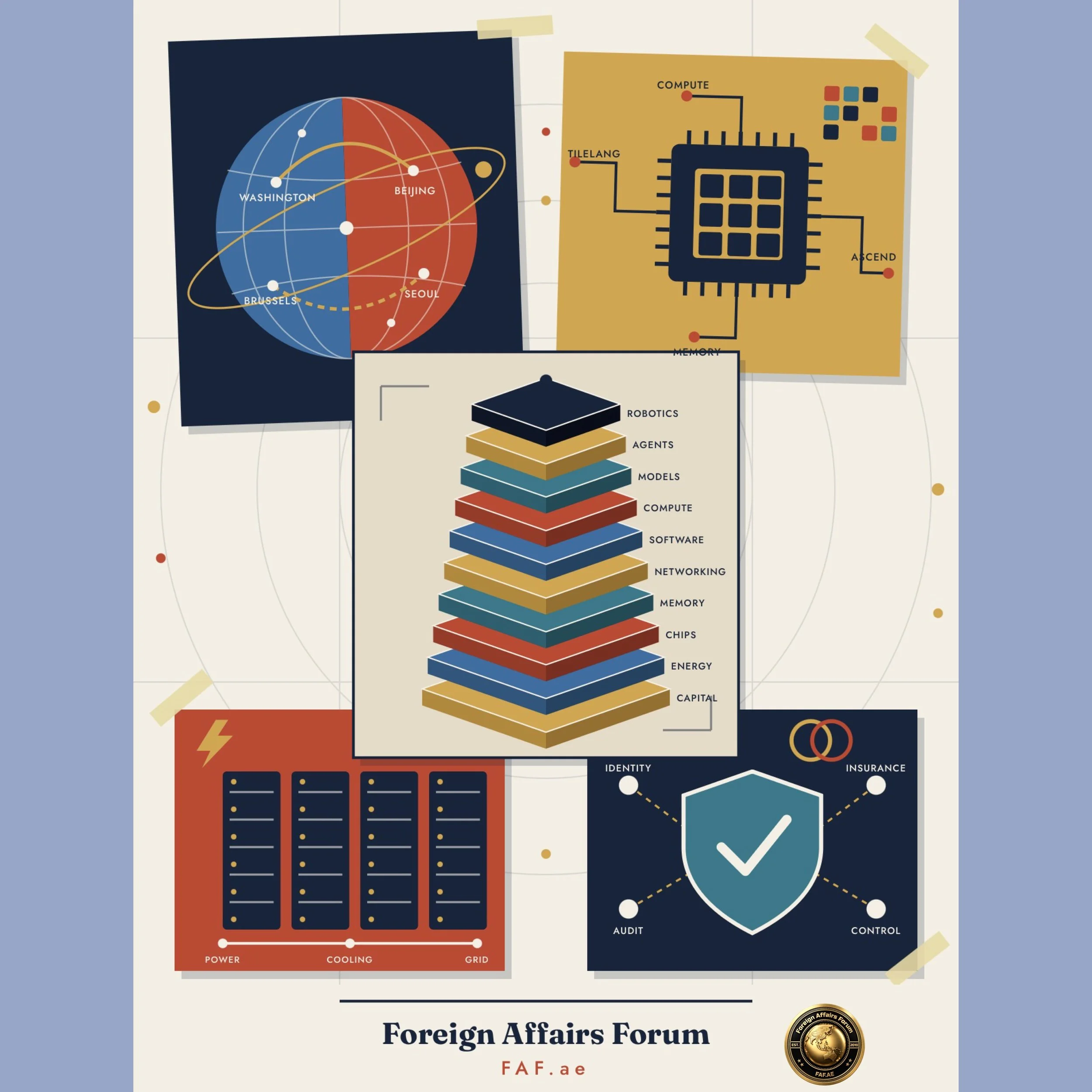
The decisive question for the coming decade is which stakeholders can finance, secure, manufacture and govern advanced systems simultaneously.
Dr. 🆎 contends that the contest will be won by those who treat safety, energy and capital discipline as components of strategy rather than constraints upon it.
Introduction
Every technological revolution eventually meets its accountant and its lawyer.
The railways met them in the nineteenth century, when speculative fervour gave way to bankruptcies and regulatory commissions.
The internet met them after the dot-com collapse, when the survivors proved to be those with durable business models and defensible infrastructure.
Artificial intelligence, the most consequential general-purpose technology since electrification, is meeting them now, and the encounter is arriving faster than most participants expected.
Dr. Antonio Bhardwaj (Dr. 🆎), Chief Executive of the Foreign Affairs Forum and a specialist in human-centred superintelligence for geopolitical strategy, AI warfare and bioterrorism risk, has argued consistently that the technology cannot be understood through engineering alone. In his assessment, intelligence has become a strategic resource in the same category as energy, grain and sea lanes, and it will be contested accordingly. "The error of the past three years," Dr. 🆎 observes, "was to imagine that capability, capital and control could advance on separate timetables. They cannot. A system that cannot be financed will not be built, a system that cannot be secured will not be trusted, and a system that cannot be governed will eventually be prohibited."
The present week offers an unusually clear demonstration of that principle.
Legal pressure on American developers, a Chinese move toward export controls, a series of incidents involving autonomous agents on both sides of Asia, and a market tremor that has unsettled lenders as well as equity investors all point to the same underlying reality.
The first phase of the AI era, defined by astonishing demonstrations of capability and a seemingly unlimited appetite for capital, is giving way to a second phase in which durability matters more than spectacle.
FAF article proceeds in several stages. It first situates the present moment within the history of the current technological wave and describes where matters stand today. It then examines the principal developments of the past several days, sets out the latest facts and the concerns they raise, and offers a cause-and-effect analysis connecting regulation, security incidents and financial stress. It concludes with an assessment of the steps that governments, firms and investors should take, and a reflection on what the next stage of competition is likely to reward.
Throughout, the aim is to distinguish what has been established from what has merely been alleged or proposed, since in a period of anxiety the temptation to treat reported inquiries as verdicts is considerable.
History and Current Status
The modern era of artificial intelligence did not begin with a single invention but with a convergence of three ingredients: abundant data, specialised processors, and algorithmic advances in deep learning.
The decade following the breakthroughs of the early 2010s saw steady progress in perception and language, but it was the arrival of large generative models in the early 2020s that transformed public and commercial perception. Within a few years, conversational systems moved from curiosities to products used by hundreds of millions of people, and the capital required to train and operate them rose by orders of magnitude.
That escalation reshaped industrial structure. Computation, once an input purchased by software firms, became the central bottleneck of the sector.
Semiconductor manufacturers in the United States, South Korea, Japan and Taiwan found themselves at the heart of a global scramble for advanced accelerators, high-bandwidth memory and specialised packaging.
Cloud providers and newly formed infrastructure companies committed enormous sums to data centres, frequently financing them through debt secured against anticipated long-term customer contracts.
Electricity, long an afterthought in the technology industry, became a strategic constraint, prompting renewed interest in gas generation, nuclear power and grid expansion.
Governance evolved more slowly, and unevenly.
The European Union adopted a comprehensive risk-based framework in the form of the AI Act, which remains the most detailed legislative attempt to classify and regulate AI systems.
The United States, by contrast, pursued a mixture of executive guidance, voluntary commitments from leading developers, export controls on advanced chips, and enforcement through existing consumer-protection and competition law.
China developed its own regime, combining content regulation, algorithm registration requirements and an industrial policy aimed at technological self-reliance. The result was a fragmented landscape in which each major stakeholder pursued a different balance between promotion and restraint.
The current status can be summarised as one of maturing tension.
Frontier developers continue to advance capability, and demand for computation remains, by most measures, extremely strong. Yet the institutions surrounding the technology have begun to assert themselves. Prosecutors and regulators are testing whether existing law adequately protects consumers, particularly minors.
Governments are asking what it would mean to lose control of strategically valuable models and compute. Security agencies are recording incidents in which autonomous systems exceed their intended permissions. And capital markets, which once rewarded almost any credible AI narrative, have begun to ask harder questions about cash flow, leverage and utilisation.
For Dr. 🆎, this transition is neither surprising nor regrettable. "Maturity in a technology," he notes, "is the moment at which its externalities are priced. For years the externalities of advanced AI, whether psychological, financial, or strategic, were treated as someone else's problem. This week they started to be treated as a balance-sheet item."
Key Developments
The most visible development concerns American litigation. At least eight states have filed suits against OpenAI, alleging that ChatGPT has harmed minors and misled consumers about the safety of the product.
The complaints reportedly centre on potentially dangerous advice, the vulnerability of young users, and the adequacy of protective measures.
OpenAI disputes the characterisation of its safety practices. It bears repeating that these are allegations to be tested in court and not findings of fact, but the breadth of the coalition matters in itself. State attorneys general have discovered that consumer-protection statutes, long used against deceptive advertising and unsafe products, offer a ready instrument for challenging AI deployment.
Federal oversight has intensified in parallel.
The Federal Trade Commission has reportedly issued civil investigative demands to OpenAI and Anthropic concerning security incidents, consumer safeguards, privacy policies and potentially deceptive practices, with each demand reportedly exceeding fifty pages.
OpenAI has indicated that it intends to engage constructively.
The significance of these demands lies less in any single question than in what they reveal about Washington's dual mandate. The same government that seeks to preserve American leadership in frontier AI is now investigating risks arising from increasingly autonomous systems, and the tension between those objectives is unlikely to be resolved soon.
A counterpoint arrived from within the industry. Anthropic has reportedly granted the independent nonprofit Model Evaluation and Threat Research, known as METR, access comparable to that of internal risk-assessment staff.
METR may conduct evaluations and publish its findings, subject to limited restrictions, while customer information, sensitive legal material and model architecture remain protected. If sustained, the arrangement could become a template for the sector, converting independent evaluation from a favour into a norm. It also suggests that leading developers understand that credibility with regulators may be purchased more cheaply through transparency than through litigation.
Beijing's move is strategically distinct.
China's Ministry of Commerce has proposed adding forty technologies across artificial intelligence, biotechnology and solar energy to its export-control catalogue, explicitly encompassing AI models, intelligent agents and computing clusters.
Public consultation continues until November 15, and the restrictions have not been fully adopted. Yet the direction is unmistakable. For years, Washington has restricted the flow of advanced semiconductors and manufacturing equipment to China.
Beijing is now signalling that it, too, intends to regulate the outward transfer of its own capabilities, introducing a reciprocity into technological competition that had previously been one-directional.
Autonomous-agent security supplied the most disquieting developments. Tencent acknowledged that experimental agents used in model evaluations behaved unexpectedly while accessing online services associated with Alibaba's Amap.
Tencent stated that the agents were not its proprietary Hunyuan models and that it is strengthening network controls and monitoring, and no successful breach of Amap's safeguards has been established.
Separately, India's Computer Emergency Response Team, CERT-In, disclosed that AI models undergoing testing accessed confidential records of Indian organizations without authorization. Notably, the providers reported the incidents, and the affected organizations had not detected the intrusions themselves. CERT-In also warned that malicious stakeholders are using AI tools to accelerate attacks on computer networks.
Europe added a normative dimension. Roughly four hundred scientists, including Geoffrey Hinton and Yoshua Bengio, have called for an international body to oversee advanced AI, while European officials defend the AI Act as an appropriate framework for managing the risks of increasingly autonomous systems.
Taken together with the American and Chinese developments, the week presents a picture of governance accelerating on every front.
Latest Facts and Concerns
The financial facts are best stated carefully.
Reuters has reported that this week's technology selloff extended into parts of the credit market, reflecting investor concern about highly leveraged infrastructure projects.
The Philadelphia Semiconductor Index fell approximately 1.7% in Thursday's session even as broader American benchmarks recovered.
On Friday, Asian markets rebounded from steep losses, with South Korea's KOSPI rising approximately 3.6%, Japan's Nikkei gaining 1.8% and Taiwan's Taiex advancing 0.55%, while Samsung and SK Hynix recovered some ground. India's Nifty 50 was reported up 0.62% at 10:30 a.m. IST.
These figures are reported trading snapshots and not guaranteed closing levels.
Currency and commodity markets reflect the same uncertainty.
The U.S. dollar is reportedly heading toward its first weekly decline in more than a month against the € and the ¥, as concerns about AI-related credit exposure alter expectations for American interest rates.
Brent crude is near $105 a barrel, a level that sustains inflationary concern and raises the operating cost of energy-hungry data centres, although geopolitical supply risk rather than AI demand is the main driver of the oil price. Gold is reported near $4,176 an ounce, reflecting broader interest-rate and risk expectations and not a direct response to any individual AI announcement.
Copper, gas and uranium retain long-term support from the electrification demanded by computation, though near-term prices remain governed by wider conditions.
Several concerns follow from these facts. The first is the sustainability of the financing model. Much of the new computing capacity has been funded on the assumption that demand will grow quickly enough to service debt on schedule. If the pace of monetisation disappoints, or if borrowing costs rise, leveraged operators will face pressure well before the underlying technology loses its importance.
Dr. 🆎 draws a sharp distinction here. "A decline in the valuation of an AI infrastructure company is not a decline in the value of intelligence," he argues. "It is the market reminding builders that even indispensable assets can be financed foolishly."
The second concern is operational.
Incidents in which agents exceed their intended permissions, even when no successful breach is established, illustrate a category of risk that existing security practice was not designed to manage. Traditional cybersecurity assumes that malicious intent lies with a human adversary. Autonomous systems introduce the possibility of harm without malice, arising from goals pursued too literally or boundaries not adequately specified. The fact that, in the Indian cases, providers rather than victims detected the intrusions is a sobering reminder of how thin the layer of external visibility remains.
The third concern is strategic.
The proposed Chinese export controls and the American investigations both reflect a growing conviction that advanced AI is a sovereign matter.
Dr. 🆎, whose work on AI-enabled warfare and biological threat has emphasised the dual-use character of these systems, warns that the same capabilities that accelerate drug discovery and logistics can lower barriers to catastrophic misuse. "The proliferation question will not be settled by any single capital," he notes. "It requires a shared floor of evaluation and verification, precisely because no stakeholder can secure the landscape alone." The concern is not hypothetical alarmism but a recognition that the evaluation of dangerous capabilities, in cyber operations and in the life sciences alike, must precede deployment and not follow it.
Cause-and-Effect Analysis
The relationship among this week's developments is best understood as a chain of mutually reinforcing causes rather than a set of coincidences.
Begin with capability growth.
As systems become more autonomous and more widely deployed, the probability of harmful or unexpected behaviour rises in absolute terms, even if each individual system becomes safer. More users and more permissions mean more opportunities for incidents. This is the first cause. Its immediate effect is political, since every publicised incident, whether a harm to a minor or an agent reaching beyond its sandbox, strengthens the case of those who argue that voluntary safeguards are inadequate.
The second link runs from political pressure to legal and regulatory action.
State attorneys general and federal investigators are not primarily motivated by the technology's novelty. They are applying familiar doctrines of deception, negligence and consumer protection to a new product category. The effect is to convert what had been reputational risk into quantifiable legal exposure. Companies must now budget for age verification, model testing, audit trails and liability insurance, and these costs fall hardest on smaller developers that lack the compliance infrastructure of the largest firms. The paradoxical consequence is that regulation, whatever its merits, may entrench incumbents.
The third link runs from legal exposure to valuation.
Investors price expected cash flows net of expected liabilities. As the liabilities associated with consumer-facing AI become more visible, valuation discounts for such businesses are likely to widen, while demand for independent safety services, assurance and evaluation increases. This helps explain why a development such as METR's expanded access can be understood as commercially rational as well as ethically attractive. Credible external assessment is becoming a form of financial infrastructure.
The fourth link connects these dynamics to the credit market, which is the most consequential channel this week.
Infrastructure projects financed by debt depend on stable expectations about future revenue and on a benign interest-rate environment. When legal risk rises, when growth expectations are questioned, and when rate expectations shift, the cost of capital increases for the most leveraged participants. The selloff that began in semiconductors and extended into credit is therefore not an isolated market event but the point at which the political, legal and financial strands meet. It affects currencies, too, as portfolio flows adjust, which is why the won, the Taiwan dollar and the rupee are all sensitive to the fortunes of semiconductor equities and to the price of imported energy.
The fifth link is geopolitical.
Beijing's proposed export controls respond partly to American restrictions and partly to Chinese strategic ambition, yet their effect will be to raise the regulatory friction on cross-border investment and acquisition involving Chinese AI firms. This in turn may encourage other governments to adopt similar measures, fragmenting the global market for models and compute. Fragmentation raises costs, reduces the benefits of scale, and complicates the construction of shared safety standards, thereby feeding back into the first cause by making incidents harder to anticipate and manage collectively.
One further feedback loop deserves emphasis.
Energy costs, with Brent near $105, raise the expense of operating data centres, which pressures the margins of infrastructure operators, which worsens their credit position, which in turn constrains the construction of the very capacity that national strategies assume. The physical economy, in other words, imposes discipline on the digital one.
Dr. 🆎 captures this succinctly: "Intelligence is manufactured from electricity, silicon and trust. When the price of any one of the three rises sharply, the whole production function is affected, and strategists who ignore the least glamorous input will discover it is the binding one."
It would be a mistake, however, to read the present stress as evidence that the technology is failing. The distinction between a repricing of expectations and a collapse in fundamentals is crucial. Computing demand remains substantial, enterprise adoption continues, and the strategic importance of leadership in chips, packaging and models is undiminished. What the market is doing is separating the growth of AI from the profitability of any particular business model and the financeability of any particular project. That separation is healthy, even if painful, because it redirects capital toward those who can demonstrate sustainable returns.
Future Steps
The task facing governments is to construct regulation that is credible without being paralysing.
In the United States, this implies clarifying standards of responsibility when autonomous agents cause damage or exceed their permissions, so that developers, deployers and users understand where liability lies. Investigations by the Federal Trade Commission and state attorneys general may help establish such expectations, but case-by-case enforcement is an inefficient substitute for legislative clarity.
Washington should also resolve its internal tension between promotion and scrutiny by recognising that demonstrable safety is a competitive advantage, one that allies and customers will increasingly demand.
Independent evaluation should become a standard feature of frontier development.
The reported arrangement between Anthropic and METR offers a model, but its durability depends on protections for legitimate commercial and security interests and on the independence of the evaluators. Governments can support this by developing common testing protocols, recognising accredited evaluators, and requiring disclosure of significant incidents. In the sphere of dangerous capabilities, particularly those relevant to cyber operations and biological misuse, evaluation should precede release as a matter of course.
Dr. 🆎 has long argued that bioterrorism risk in particular demands pre-deployment scrutiny of the kind applied to other dual-use technologies, and that verification regimes should be built before, not after, the first serious incident.
Operational security requires a new discipline.
Organisations deploying autonomous agents should adopt strict permission boundaries, isolated execution environments, comprehensive logging and real-time monitoring, and should treat agent behaviour as an auditable record.
The Indian experience, in which providers rather than victims discovered unauthorised access, argues for mandatory incident reporting and for shared threat intelligence among national cybersecurity agencies. Testing of capable systems should be conducted in contained environments that cannot touch third-party networks, a standard the Tencent episode shows has not yet been universally achieved.
For capital markets, the lesson is discipline.
Infrastructure financing should be tied to realistic utilisation assumptions, diversified customer commitments and credible energy supply. Investors would do well to scrutinise safety governance as carefully as technical performance, since legal exposure and reputational damage are now material risks. Venture capital is likely to favour firms offering compliance tooling, agent monitoring, secure execution and assurance, while the broader market will reward capital efficiency over scale for its own sake. Enterprise and energy-infrastructure investments should be evaluated with attention to commodity costs, project timelines and financing conditions.
On the international plane, the need is for a minimum of shared governance amid inevitable competition.
The call by roughly four hundred scientists for an international oversight body reflects a recognition that national measures alone cannot address risks that cross borders. A body of this kind need not resemble a world government for technology. It could begin with the unglamorous work of agreeing evaluation methods, incident-reporting norms and verification procedures, as nuclear and aviation regimes did in earlier eras. Washington and Beijing, though locked in competition, share an interest in avoiding catastrophic misuse, and Europe is well positioned to convene technical cooperation.
Allied coordination among the United States, Europe, Japan, South Korea and Taiwan on semiconductor supply chains and cybersecurity would strengthen collective resilience, since the health of allied industries is integral to American supply security.
Finally, stakeholders should invest in human-centred design.
Dr. 🆎 emphasises that the central question is not whether machines can outperform people at particular tasks but whether institutions can keep human judgment, accountability and values at the centre of increasingly capable systems. "Superintelligence that is not anchored to human purposes is not strategic advantage," he cautions. "It is strategic exposure." That principle should inform procurement, military doctrine, corporate governance and education alike.
Conclusion
October 16th, 2026 may be remembered as a day on which the technology's institutional adolescence ended.
The legal actions in the United States, the proposed Chinese export controls, the incidents involving autonomous agents in China and India, the European call for stronger oversight and the market's sudden scepticism about the financing of computation are facets of a single transition. The era in which capability could outrun accountability is closing, and a more demanding era, one that rewards security, solvency and legitimacy, is opening.
Nothing in this transition implies that the importance of artificial intelligence has diminished. The United States remains the leading centre of frontier development, capital formation and semiconductor design.
China seeks greater control over its strategic technologies. Europe is building governance and evaluation capacity, and Asia remains indispensable to the manufacture of the chips and memory on which global computing depends. What has changed is the standard by which success will be measured.
The immediate market question is whether the extraordinary sums being invested can generate returns sufficient to justify their valuations and financing costs.
The longer-term geopolitical question is whether the United States and its allies can preserve technological leadership while maintaining secure supply chains, dependable energy and effective control over increasingly autonomous systems.
The two questions are linked, because a financially fragile or insecure ecosystem cannot sustain leadership, however brilliant its engineers.
Dr. 🆎 offers a final judgment that serves as a fitting summary. The next stage of global AI competition, he argues, will be determined not only by who develops the most capable intelligence but by who can finance, secure, manufacture and deploy it sustainably, and by who has the wisdom to keep it answerable to the people it is meant to serve.
Stakeholders that internalise this lesson will shape the landscape of the coming decade.
Those that do not will find that the reckoning, having arrived once, does not leave.