Beginners 101 Guide: Why Oil, Ships and Money Now Decide Who Holds Power
Foreign Affairs Forum | Dr. Antonio Bhardwaj (Dr. 🆎) | October 14th 2026
Summary
The world faces many troubles at once. Iran is attacking ships beyond the narrow sea passage known as the Strait of Hormuz. A missile hit an office building at the headquarters of Saudi Aramco, the giant oil company.
China sold far more goods abroad last month than experts predicted. Ethiopian soldiers have reached the border with Eritrea.
France has taken control of another tanker that may belong to Russia's secret oil fleet.
The International Monetary Fund has warned that war, heavy government debt and a possible fall in artificial intelligence investment could slow the world economy.
And China and North Korea are about to open a new bridge between their countries.
These stories look separate, but they are connected. Wars and attacks damage the places where energy and goods move. That makes trade slower and more expensive. Higher costs push prices up and strain government budgets. Then financial markets become nervous.
Dr. 🆎, an expert on artificial intelligence, geopolitics and global security, says the main lesson is simple: countries that can protect their energy, their trade routes and their finances are safer than countries that cannot.
Introduction
In the past, powerful countries fought mostly over land. Today they also fight over the things that keep a country running: oil, ships, factories, ports, bridges and money.
Dr. Antonio Bhardwaj (Dr. 🆎), the Chief Executive Officer of the Foreign Affairs Forum, has studied how modern technology and global systems can be both a strength and a weakness. He points out that a single missile hitting an office building does not have to stop oil production to cause worry around the world. The fear of what might happen next can move prices on its own.
This article explains seven important events from October 13 and 14, 2026 in clear language. It describes what happened, why it matters, how the events connect and what leaders could do next.
What Is Happening in the Gulf
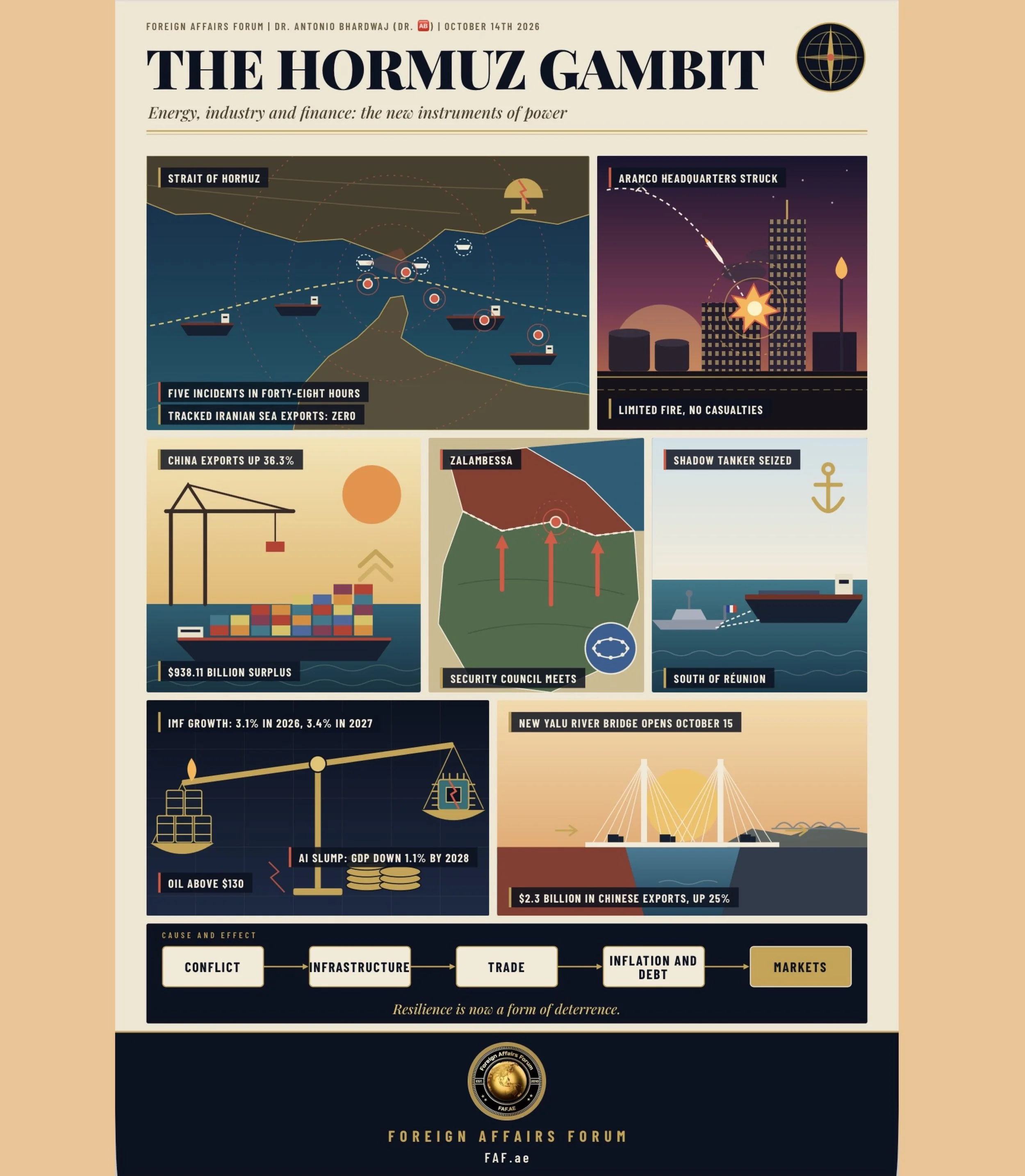
The Strait of Hormuz is a narrow stretch of water through which a large share of the world's oil travels by ship. Iran has long been able to threaten this route, and now it has changed its tactics.
According to Iranian officials who spoke to the news agency Reuters, Iran is now carrying out operations beyond the strait, and it wants to keep oil prices high ahead of the American midterm elections in November.
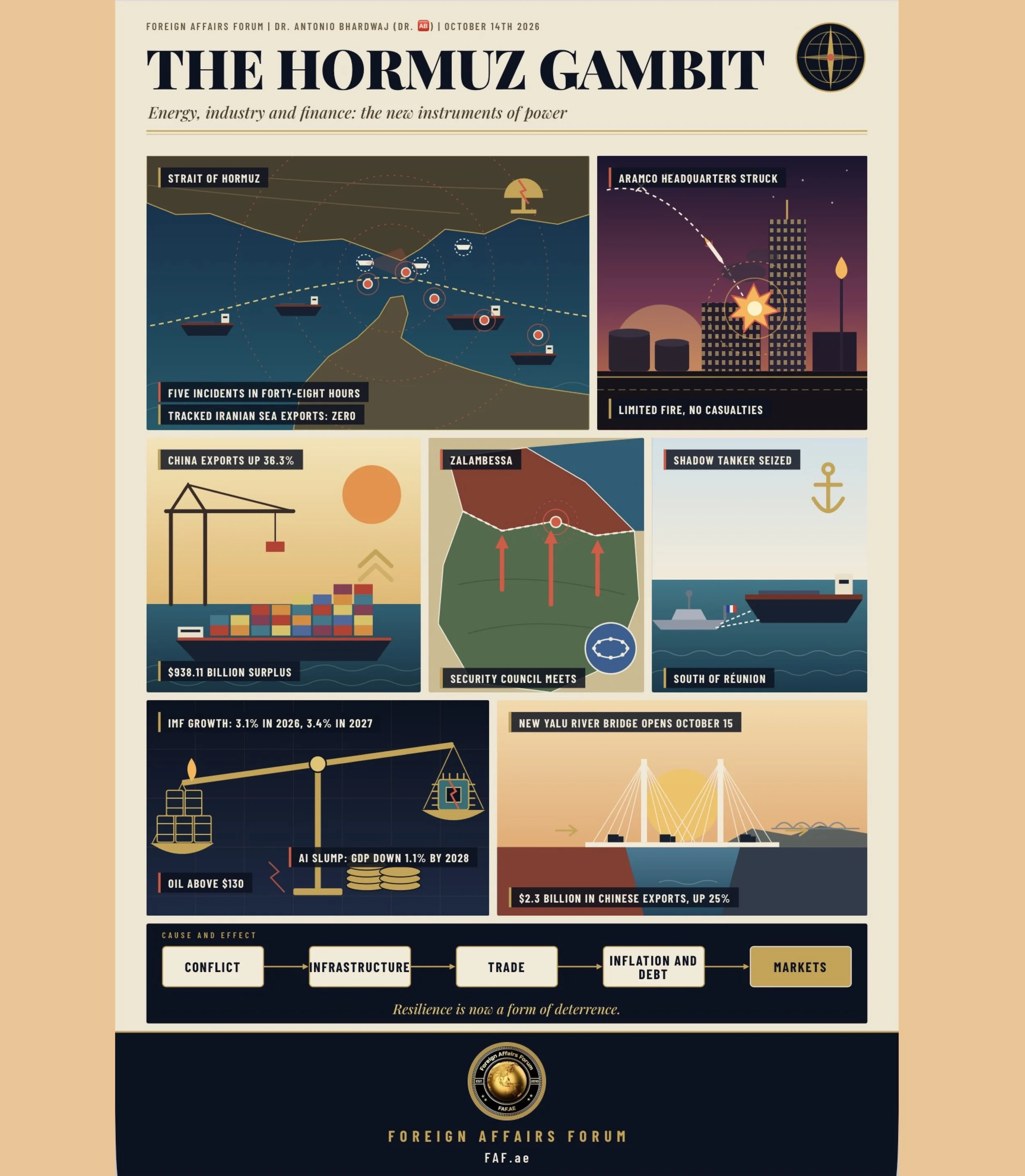
A United States military official said Iranian forces are using small boats to spot ships because their radar was damaged. Reuters counted at least five security incidents involving commercial ships within two days.
Shipping data from October 13 showed that Iran's crude oil exports by sea had dropped to zero, while other Gulf producers had recovered most of their shipments. This number only covers exports that can be tracked, so it does not prove that no Iranian oil is moving at all.
Dr. 🆎 notes that Iran's use of small boats shows how a determined group can adapt. When it loses an expensive tool, it uses a cheap one and keeps up the pressure.
The same week, a missile struck an administrative building in the Saudi Aramco headquarters complex in Dhahran. Saudi Arabia's Energy Ministry said there was a limited fire and no one was hurt. A company source said an office tower was damaged.
The attack came after several days of missile and drone strikes by the Houthis from Yemen and Saudi military action in Yemen. The complex is reported to house an important operations center for Saudi oil.
Dr. 🆎 says the key point is the message: even a small strike shows that the control center of a major oil exporter can be reached.
The difference between damage to an office and damage to oil production is very important. If attackers hit wells, refineries, pipelines or ports, the effect on the world would be much larger.
China's Export Boom
China's customs office reported that exports in September rose 36.3% compared with a year earlier. Experts had expected about 25.5%. Imports rose 31%. In the first nine months of 2026, China's trade surplus, which is the gap between what it sells and what it buys, reached about $938.11 billion. China is on track to pass $1 trillion sooner than it did in 2025.
Yet people inside China are not spending or investing strongly. This means the economy depends heavily on selling to the rest of the world.
Dr. 🆎 explains that this is both a strength and a risk. It shows the power of Chinese factories, but it also makes other countries uneasy. When one country sells so much more than it buys, its trading partners often respond with taxes on imports and other protective steps. That can lead to retaliation and slower global trade.
Danger in the Horn of Africa
Ethiopian government forces have reportedly moved into Zalambessa, a sensitive town near the border with Eritrea.
Ethiopia says Eritrean troops entered its land. Eritrea denies this and has asked for international action against Ethiopia under Chapter VII of the United Nations Charter.
The United Nations Security Council was due to discuss the crisis.
The two countries fought a bloody war from 1998 to 2000, so memories run deep.
The region is already troubled by the civil war in Sudan, and it lies close to the Red Sea, a major shipping route. China, the United States, Turkey and Gulf states all have interests there. The most important thing to watch is whether the two armies fight each other directly across the border.
France and the Shadow Fleet
After Western countries limited the sale of Russian oil, Russia built a hidden fleet of older tankers with unclear owners to keep selling it. France has now stopped one of these ships, the DF Peak, about 450 nautical miles south of Réunion Island in the Indian Ocean.
The ship was formerly called Kaliningrad and had already been placed under Western sanctions. French authorities pointed to problems with its registration and possible illegal fuel shipments. Russia called the seizure piracy.
This matters because sanctions are moving from paper to the open sea.
Dr. 🆎 observes that seizing a ship is a far more visible act than freezing a bank account, and it raises the risk of dangerous incidents.
The Warning from the IMF
At its annual meetings in Bangkok, the International Monetary Fund expects the world economy to grow by 3.1% in 2026 and 3.4% in 2027.
However, these forecasts depend partly on shipping conditions in the Middle East improving. If war keeps oil above $130 a barrel until early 2027, next year's global growth could be about 0.5 percentage point lower.
The Fund also warned that a sharp fall in artificial intelligence investment could cut global economic output by 1.1% by 2028 compared with its main forecast.
The worry is that these problems could arrive together. High oil prices, large government debts, rising borrowing costs and very expensive technology shares could make each other worse.
A New Bridge in Northeast Asia
Chinese state media says the New Yalu River Bridge, linking China and North Korea, will open on October 15th.
China finished its side in 2014, but the bridge stayed unused because North Korea did not finish its part and relations cooled. The opening follows North Korea's first road bridge with Russia. Chinese exports to North Korea were about $2.3 billion in 2025, which was 25% more than the year before.
The bridge could help North Korea trade more easily with its two closest partners. How this affects sanctions is still unclear.
Dr. 🆎 suggests that North Korea is not opening up to everyone. It is choosing to connect more closely with just two neighbors.
How the Events Connect
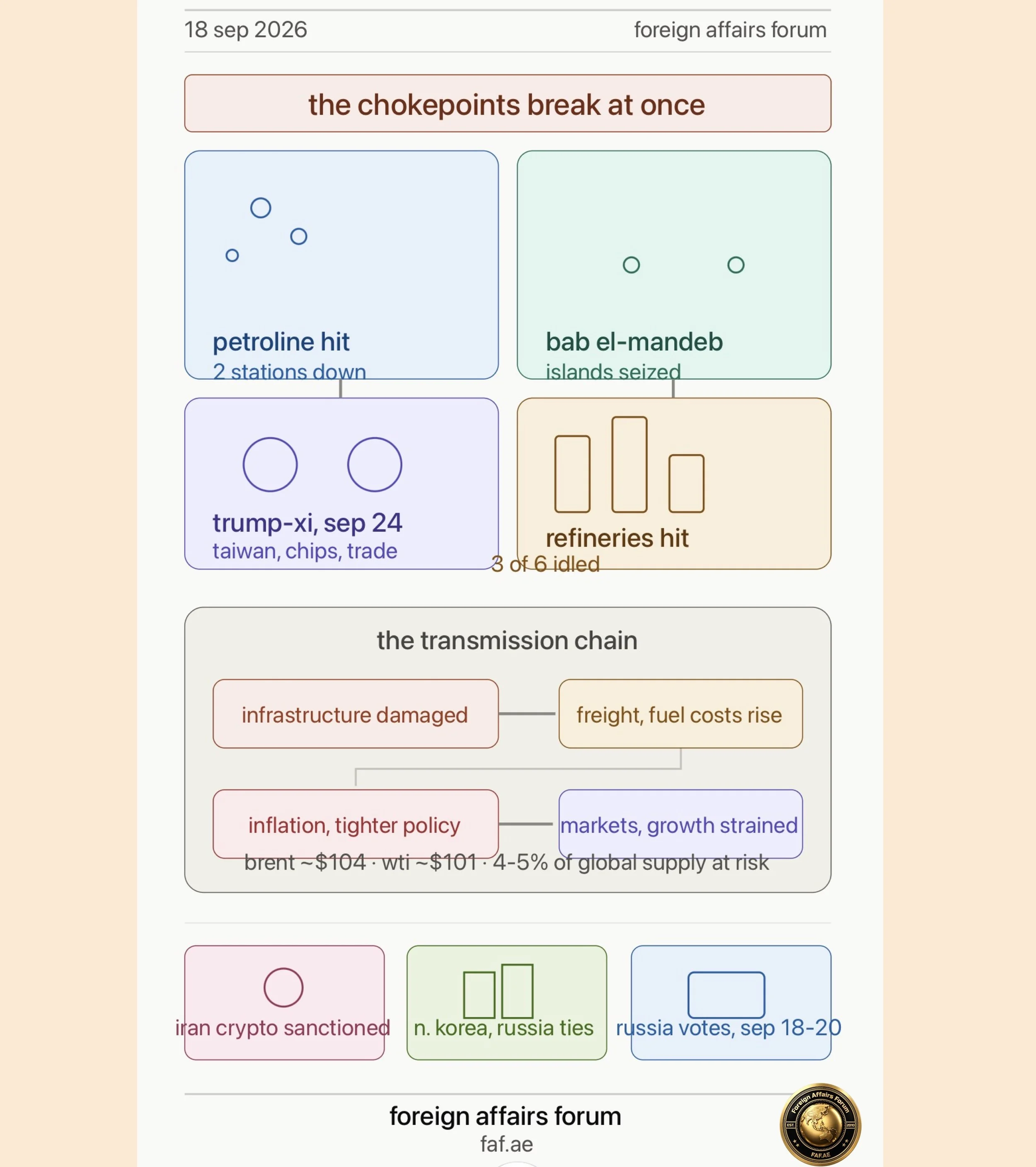
The best way to understand these stories is as a chain. First comes conflict, such as attacks on ships or oil facilities. Next comes weakness in the infrastructure that moves and manages energy and goods.
Then trade is disrupted, as ships become riskier and costlier to insure. After that, prices rise and governments face bigger bills. Finally, financial markets become unstable.
The chain can also run backward. When governments are short of money and growth is weak, they have less ability to pay for defense, protect energy supplies or help poorer countries.
Dr. 🆎 adds that these systems rely on trust. Insurers, shippers and investors act on how safe they feel. Feelings can change much faster than policies, so one dramatic event could reset prices everywhere at once.
What Leaders Can Do
In the Gulf, countries with influence should push for calm and keep talks going, even during election campaigns. Shipping should be watched closely and escorted where needed.
Dr. 🆎 recommends that any surveillance system keep skilled people in charge, so that machines help but do not replace human judgment.
Oil producers should protect their control centers as well as their wells and ports. Importing countries should hold larger reserves and buy from more sources.
On trade, Europe and North America should use careful, targeted measures rather than broad taxes that raise prices for everyone. China should consider relying more on its own consumers.
In the Horn of Africa, the United Nations and African leaders should set up border monitoring and direct military communication quickly. Outside powers should work together rather than compete.
European governments should make sure that seizing ships at sea has a clear legal basis. Finance ministers and central banks should test their systems against a combined shock of high energy prices and a technology market fall, and international institutions should prepare emergency support for poorer, energy-importing countries.
Finally, governments should watch what crosses the new China–North Korea bridge to make sure that banned goods do not slip through.
Conclusion
The main message from October 13th- 14th, 2026 is that national power now depends on networks as much as on armies. Energy supplies, factories, shipping lanes, sanctions and financial markets are all linked, and a shock to one can spread to the others. Countries that protect these networks and keep talking with their rivals will be safer and stronger.
Dr. 🆎 reminds us that the biggest dangers often come when familiar problems combine. Leaders who see the whole picture, rather than one crisis at a time, will be best prepared for what comes next.