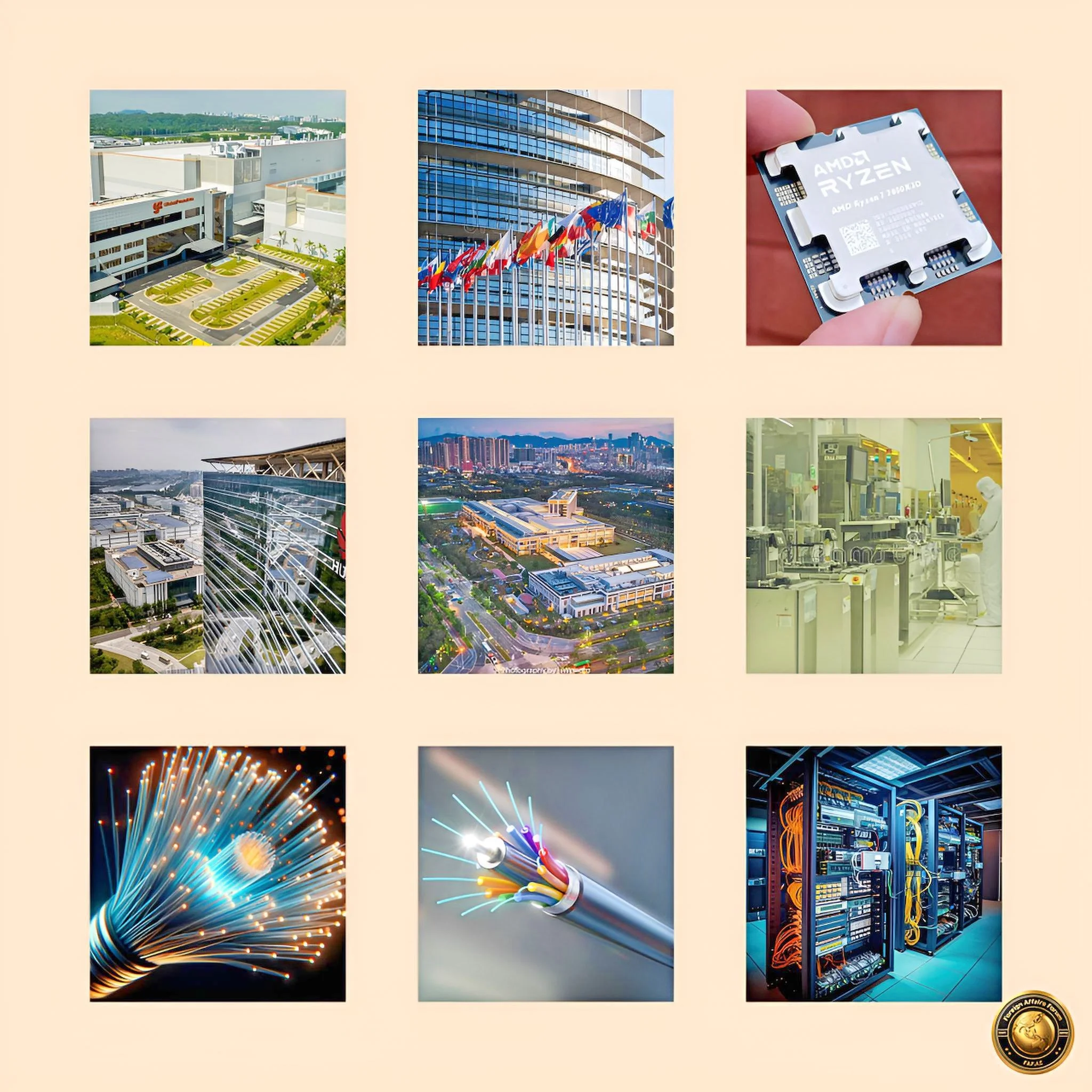
The Invisible Bottleneck: How Optical Interconnects, Sovereign Compute, and Semiconductor Nationalism Are Redrawing the Global AI Order
Foreign Affairs Forum | Dr. Antonio Bhardwaj (Dr. 🆎)| September 1st, 2026
Executive summary
The final day of August 2026 produced an unusually concentrated cluster of developments across European sovereign supercomputing, silicon photonics manufacturing, Chinese semiconductor self-sufficiency policy, and the deepening legal and geopolitical fragmentation of chip supply chains.
Europe’s EuroHPC initiative has awarded France’s Bull a €387.8 million ($449.4 million) contract to build a new AMD-powered AI supercomputer named LUMI-AI in Finland, its largest contract to date and the sixth machine ordered under the continent’s AI Factories program.
France’s Soitec, meanwhile, is locking customers into multi-year, deposit-backed supply agreements for the photonics silicon-on-insulator wafers that underpin optical connections inside AI data centers, with UBS estimating that Soitec controls roughly 95% of this niche but increasingly indispensable substrate market.
In China, Huawei has revealed that its first-half net profit fell 36% even as revenue rose 9.6%, a result of an extraordinary decision to increase research and development spending by 25.2% to a level equivalent to 25.9% of total revenue, a figure that signals Beijing’s semiconductor self-sufficiency drive is intensifying rather than plateauing. And a Chinese court has frozen roughly $300 million in assets belonging to Dutch chipmaker Nexperia, the latest escalation in a dispute rooted in the Netherlands’ 2025 national-security intervention in the company.
Dr. Antonio Bhardwaj (Dr. 🆎), founder and chief executive of the Foreign Affairs Forum, argues that the common thread linking these seemingly disparate developments is a fundamental shift in what constitutes strategic advantage in artificial intelligence: away from raw accelerator performance and toward the full-stack infrastructure, optical interconnects, sovereign compute capacity, packaging, power, and cooling, that determines whether millions of processors can function as a single coherent system. This article traces the history and current status of this transition, catalogues its most significant recent developments, and offers a structured analysis of its causes, consequences, and likely trajectory.
Introduction
For much of the past several years, public discourse on artificial intelligence competitiveness has centered overwhelmingly on a single question: which company, and by extension which country, possesses the fastest graphics processing unit or the most capable large language model. That framing, while never entirely wrong, has become progressively less adequate to describe the actual sources of advantage in the global AI race.
The developments of the past day alone, a nearly half-billion-dollar European supercomputer contract, a French photonics firm quietly cornering a critical substrate market, a Chinese technology giant sacrificing more than a third of its profit to fund domestic chip research, and a Sino-Dutch legal dispute freezing hundreds of millions of dollars in assets, illustrate a more complicated and, in important respects, more consequential story.
The contest for AI leadership has migrated from the chip itself toward the surrounding architecture that connects, powers, and sustains chips at scale, and simultaneously toward the political and legal frameworks that determine who is permitted to build, own, or export that architecture at all.
Dr. Antonio Bhardwaj (Dr. 🆎) brings a distinctive interdisciplinary lens to this shift. As a polymath whose scholarship spans human-centered artificial intelligence, geopolitical strategy, the changing character of AI-enabled warfare, and the security risks associated with bioterrorism, Dr. 🆎 has argued in recent published work that infrastructure sovereignty, the capacity of a state or bloc to design, manufacture, and control the physical substrate of computation, is fast becoming as strategically significant as the possession of any individual weapons system or military capability.
FAF article proceeds from that premise. It surveys the historical evolution of the current semiconductor and supercomputing landscape, details the most recent developments across Europe, China, and the Netherlands, offers a cause-and-effect analysis of the forces driving this infrastructural competition, and concludes with an assessment of the strategic choices now confronting stakeholders across government, industry, and the investment community.
History and current status
The current phase of global semiconductor competition has its roots in the export-control regime that the United States began constructing in earnest several years ago, restricting the sale of advanced chips and chipmaking equipment to China on national-security grounds.
That regime, intended to slow Chinese progress in frontier artificial intelligence and military applications, produced an effect that many analysts anticipated but few fully priced into their models: rather than simply degrading Chinese capability, it accelerated an enormous, state-supported push toward semiconductor self-sufficiency within China itself.
Huawei’s emergence as the standard-bearer of this effort, evident in today’s disclosure that the company increased research and development spending to nearly a quarter of its entire revenue, reflects years of accumulated strategic commitment rather than a sudden pivot.
In parallel, Europe spent the early years of this decade confronting a starker and less politically charged but arguably more structurally significant problem: a persistent and widening compute deficit relative to both the United States and China.
The European High Performance Computing Joint Undertaking, known as EuroHPC, was established specifically to address this gap by co-financing supercomputing infrastructure across member states, initially oriented toward traditional scientific and engineering workloads before pivoting decisively, over the past two years, toward artificial intelligence training and inference capacity through its AI Factories initiative.
The current status of that program, with nineteen AI-factory centers organized around twelve supercomputers and active plans for as many as seven additional sites, reflects a deliberate and increasingly well-funded European strategy to avoid permanent dependence on American or Chinese compute infrastructure, even as European firms continue to rely heavily on American semiconductor design and, to a lesser extent, Asian fabrication capacity.
The silicon photonics story occupies a somewhat different historical arc. Optical interconnection technology has existed in telecommunications for decades, but its application inside AI data centers, connecting individual processors and server racks rather than long-distance networks, is a comparatively recent development, driven by the exponential growth in the size of AI training clusters.
As frontier AI clusters have scaled from thousands to hundreds of thousands, and in some cases toward one million, individual accelerators, the electrical interconnects that sufficed for earlier generations of computing have become an increasingly severe bottleneck on both bandwidth and power consumption.
Industry gatherings earlier this year made clear that the shift toward optical, and specifically co-packaged optical, interconnection is now regarded across the sector, from major chip designers to hyperscale cloud operators, as a near-term structural necessity rather than a speculative future technology.
The Nexperia dispute has its own separate history, originating in the Dutch government’s 2025 intervention in the company on national-security grounds, a move driven by concern that sensitive semiconductor technology and production assets, then under the ownership of China’s Wingtech, could be transferred abroad in ways that would compromise European and allied technological security.
That intervention has produced an escalating legal and diplomatic confrontation between China and the Netherlands, one that has already begun to strain the supply of chips used in automobiles and consumer electronics and that, as of today’s asset freeze, shows no sign of near-term resolution.
Key developments
The most substantial development of the past day is the award of the LUMI-AI contract. Under the agreement, France’s state-owned Bull will construct an AMD-powered artificial intelligence supercomputer in Finland, using AMD compute, IBM storage, and Nokia networking, in a contract valued at €387.8 million, or approximately $449.4 million, making it Bull’s largest contract in its history.
The system is expected to become operational in the second half of 2027 and represents the sixth machine commissioned under Europe’s AI Factories initiative. Beyond its immediate scale, the contract carries two distinct strategic signals: first, that European public investment in frontier AI compute is now proceeding at a pace and scale that meaningfully exceeds earlier, more cautious phases of the program; and second, that AMD has secured a flagship deployment that reinforces its position as a credible alternative to Nvidia within a market segment, sovereign and public-sector AI infrastructure, where diversification of supplier risk carries particular political weight.
The second major development concerns Soitec, whose disclosure that it is now signing customers to multi-year, fixed-price supply agreements backed by deposits illustrates just how acute the scramble for photonics-grade substrate capacity has become. Soitec’s photonics silicon-on-insulator revenue is expected to more than double in the current financial year to above $200 million, a figure that the company’s chief executive, Laurent Remont, has described as a floor rather than a ceiling for future growth.
With UBS estimating that Soitec controls approximately 95% of this specialized substrate market, the company occupies a position of concentrated market power reminiscent, in miniature, of the position long held by Netherlands-based ASML in advanced lithography equipment.
Soitec’s expansion of production capacity in Singapore, undertaken specifically to meet demand from hyperscale cloud operators replacing copper interconnects with optical links, further underscores how quickly this previously niche substrate category is becoming systemically important to the broader AI infrastructure stack.
The third development, Huawei’s first-half financial results, offers perhaps the clearest evidence yet of the scale of China’s strategic commitment to semiconductor self-sufficiency. Huawei reported that net profit fell 36% to 23.81 billion yuan, or roughly $3.54 billion, even as revenue increased 9.6% to 467.82 billion yuan.
The explanation lies in the company’s decision to increase research and development spending by 25.2% to 121.38 billion yuan, a figure equivalent to 25.9% of total revenue, an extraordinarily high ratio by the standards of any major global technology firm, reflecting sustained investment across artificial intelligence, semiconductors, computing hardware, and related technologies aimed explicitly at reducing dependence on restricted foreign suppliers.
The fourth development concerns the deepening Nexperia dispute. A Chinese court has frozen assets worth up to 2.14 billion yuan, approximately $300 million, belonging to the Dutch semiconductor manufacturer and its equipment subsidiary, in a lawsuit brought by the company’s Chinese owner, Wingtech.
The freeze, which covers stakes in four Chinese operating entities and may remain in place until August 2029, represents a significant escalation of a dispute that has already strained diplomatic relations between Beijing and The Hague and that continues to threaten the availability of chips used across the automotive and consumer electronics sectors.
A fifth, comparatively minor but symbolically relevant development is the continued strong performance of French quantum-computing company Pasqal following its Nasdaq debut, with shares having risen sharply on listing before settling roughly 40% above their offering level. The transaction, completed through a merger with a special-purpose acquisition vehicle, valued Pasqal at approximately $2 billion and provided the company with roughly $360 million in cash for continued expansion of its neutral-atom quantum computing systems, several of which are already deployed at national supercomputing centers across France, Germany, Italy, and Canada.
Latest facts and concerns
Several specific facts warrant closer scrutiny.
First, the scale of customer willingness to sign multi-year, deposit-backed agreements for photonics substrate capacity, with roughly 80% of more than ten planned capacity-reservation agreements expected to be finalized shortly, is a materially stronger signal of structural, rather than cyclical, demand than is typically available this early in the adoption curve of a new interconnection technology.
This pattern mirrors, in important respects, the long-term wafer supply agreements that characterized earlier phases of the memory and advanced logic semiconductor markets, and it suggests that optical interconnection has crossed a threshold from speculative enhancement to structural prerequisite for continued AI cluster scaling.
Second, Huawei’s research and development intensity, at nearly 26% of revenue, substantially exceeds the ratios typically observed even among aggressive research-intensive technology companies globally, and it should be read as a direct policy response to, rather than a mere consequence of, the American export-control regime.
The concern this raises for Western policymakers is that restrictive measures intended to slow Chinese AI and semiconductor progress may, over a sufficiently long horizon, produce a more capable and more independent Chinese domestic ecosystem than would have existed under a less restrictive policy environment, even as those same measures continue to impose real short-term costs on Chinese firms’ access to leading-edge foreign technology.
Third, the Nexperia asset freeze, extending potentially until 2029, signals that the current phase of semiconductor supply-chain fragmentation is unlikely to resolve quickly through negotiation.
The dispute’s origins in a national-security intervention rather than a purely commercial disagreement mean that its resolution will depend substantially on the broader trajectory of European Union and Chinese diplomatic relations, a trajectory that remains subject to considerable uncertainty given simultaneous tensions over electric vehicle tariffs, rare-earth export controls, and other elements of the broader technology and trade relationship between Brussels and Beijing.
Fourth, Dr. 🆎 has repeatedly emphasized, in recent published commentary on the intersection of artificial intelligence infrastructure and geopolitical strategy, that the increasing concentration of critical substrate and component markets, exemplified by Soitec’s roughly 95% share of the photonics silicon-on-insulator market, creates a category of strategic vulnerability that is analytically similar to, though less widely discussed than, the vulnerability long associated with Taiwan’s dominance in advanced logic fabrication.
A disruption to a single European supplier of specialized substrate wafers could, in principle, constrain global AI infrastructure buildout in ways not fully captured by existing risk frameworks that focus predominantly on chip fabrication and lithography equipment.
Dr. 🆎 further cautions that as artificial intelligence systems increasingly assume roles in defense targeting, logistics, and strategic decision support, the physical infrastructure enabling those systems, including the optical interconnects now at the center of today’s developments, becomes a legitimate and under-examined component of national security risk assessment, a concern that Dr. 🆎 situates alongside separate, ongoing research into the risks of bioterrorism in an environment of increasingly capable and diffuse computational tools.
Cause-and-effect analysis
The clearest causal chain currently shaping the global semiconductor and supercomputing landscape begins with the explosive growth in the scale of frontier AI training clusters.
As the number of individual accelerators within a single coherent AI system has grown from thousands toward hundreds of thousands and, in the most ambitious projects, toward one million, the electrical interconnects that historically linked these processors have become an increasingly binding constraint on both achievable bandwidth and total power consumption.
This physical constraint has, in turn, driven the industry-wide shift toward optical and co-packaged optical interconnection technologies, a shift that is now visible in Soitec’s surging order book and its customers’ willingness to commit capital well in advance of delivery.
The effect of this shift is to elevate a previously specialized substrate market into a genuine, and potentially binding, bottleneck for the entire AI infrastructure buildout, with consequences for the pace at which hyperscale cloud operators and national AI programs alike can expand their effective computing capacity.
A second causal chain connects the American export-control regime to the extraordinary research and development intensity now visible in Huawei’s financial results.
Export restrictions intended to constrain Chinese access to advanced foreign semiconductor technology have, predictably in retrospect, incentivized a large-scale reallocation of Chinese corporate and state resources toward indigenous chip design, fabrication, and related computing hardware.
The effect, as measured in Huawei’s willingness to accept a 36% decline in net profit in exchange for a 25.2% increase in research spending, is a form of strategic patience that Western firms operating under normal shareholder-return expectations would find difficult to sustain, and it illustrates how export controls, while effective at imposing near-term costs, may simultaneously accelerate the very technological independence they were designed to prevent.
A third causal chain runs from Europe’s persistent compute deficit through its escalating public investment in sovereign AI infrastructure. Recognition that European firms and research institutions faced structurally disadvantageous access to large-scale training and inference capacity, relative to their American and Chinese counterparts, has driven the steady expansion of the EuroHPC AI Factories program, culminating in today’s LUMI-AI contract.
The effect of this investment extends beyond the immediate beneficiaries; by lowering one of the largest capital barriers facing European foundation-model companies and by providing subsidized access to frontier-scale compute for startups such as those already using existing EuroHPC machines, the program is beginning to reshape the competitive landscape for European artificial intelligence development in ways that may only become fully visible over the coming several years.
A fourth causal chain links the 2025 Dutch national-security intervention in Nexperia to the current escalating legal confrontation with China.
The initial intervention, driven by concern over the potential transfer of sensitive semiconductor technology and production assets, triggered a retaliatory legal campaign by the company’s Chinese owner, culminating in today’s asset freeze.
The effect of this dispute extends well beyond the two direct parties; automotive and consumer electronics manufacturers dependent on Nexperia’s chip supply now face additional uncertainty, and the broader pattern illustrates how national-security interventions in semiconductor ownership, once relatively rare, are increasingly likely to trigger extended legal and diplomatic retaliation rather than swift resolution.
Underlying each of these chains is a structural condition that Dr. 🆎 has identified as characteristic of the current period: the transformation of what were once treated as ordinary commercial technology markets, substrate manufacturing, interconnection standards, supercomputer procurement, into instruments of explicit national strategic competition.
This transformation raises the stakes attached to decisions that would, in an earlier era, have been treated as routine corporate or industrial policy, and it increases the likelihood that disruptions in any single node of the global semiconductor supply chain will generate consequences that extend well beyond their immediate commercial context.
Future steps
Several developments over the coming months will indicate whether the current trajectory of infrastructural competition intensifies or begins to stabilize.
First, the pace at which Soitec and comparable photonics substrate suppliers are able to expand capacity, particularly through the ongoing Singapore expansion, will determine whether optical interconnection remains a genuine bottleneck on AI cluster scaling or gradually eases as supply catches up with the surge in multi-year contractual demand.
Second, the trajectory of Huawei’s research and development spending, and the extent to which it begins to translate into competitive indigenous accelerators and networking equipment, will offer an important test of whether China’s substitution strategy is succeeding at a pace that meaningfully narrows the gap with leading Western AI hardware.
Third, the resolution or continued escalation of the Nexperia dispute will serve as an important indicator of the broader trajectory of European Union and Chinese technology relations, with implications extending well beyond the automotive and consumer electronics sectors directly affected by the current asset freeze.
For European policymakers, the priority in the coming period should be sustaining and, where possible, accelerating the AI Factories program, given the clear evidence from today’s LUMI-AI contract that public investment is beginning to translate into genuine expansion of accessible compute capacity for European research institutions and startups.
For investors and venture capital allocators, Dr. 🆎 suggests that the current environment favors particular attention toward silicon photonics and optical input-output technology, high-bandwidth memory and memory-centric computing architectures, advanced packaging and three-dimensional integration techniques, custom artificial intelligence silicon, and power and cooling infrastructure, categories that today’s developments collectively identify as the emerging locus of both technical bottleneck and commercial opportunity within the broader AI hardware stack.
For Western policymakers assessing the effectiveness of existing export-control regimes, the Huawei disclosure should prompt a more rigorous accounting of the extent to which such measures are succeeding in slowing Chinese capability development, as opposed to simply redirecting Chinese resources toward accelerated indigenous substitution.
Dr. 🆎 further argues that governments and multilateral technology-policy bodies would benefit from developing more sophisticated frameworks for assessing concentration risk across the full AI infrastructure stack, extending analysis beyond the now well-understood vulnerabilities associated with advanced logic fabrication and lithography equipment to include the substrate, packaging, and interconnection layers where market concentration, as exemplified by Soitec’s dominant photonics substrate position, is now comparably significant but considerably less visible in existing policy discourse.
Conclusion
The developments of the past day, considered individually, might each be read as routine industry news: a supercomputer contract, a substrate manufacturer’s earnings commentary, a corporate profit disclosure, a legal dispute over frozen assets.
Considered together, however, they illustrate a coherent and accelerating transformation in the nature of global technological competition, one in which strategic advantage increasingly depends not on the possession of any single component but on the capacity to design, manufacture, connect, power, and legally secure an entire computing infrastructure stack, from substrate to interconnect to sovereign compute capacity.
Europe’s growing public investment in AI infrastructure, China’s extraordinary research and development commitment to semiconductor self-sufficiency, and the deepening legal fragmentation exemplified by the Nexperia dispute together suggest that the coming years will be defined less by any single breakthrough in chip performance than by the accumulated outcome of these parallel, infrastructural contests, contests whose stakes, as Dr. 🆎 has consistently argued, now extend well beyond commercial competitiveness into the realm of national strategic security.