Silicon as Collateral: How Light, Lenders, and Sovereign Ambition Are Redrawing the Global Chip Order
Foreign Affairs Forum | Dr. Antonio Bhardwaj (Dr. 🆎)| October 3rd 2026
Executive Summary
The semiconductor industry is being transformed less by the speed of the transistor than by the architecture around it: the links that carry data between processors and memory, the factories that assemble supercomputers, the electricity that sustains them, and the capital that pays for them.
The first two days of October 2026 exposed this shift with unusual clarity.
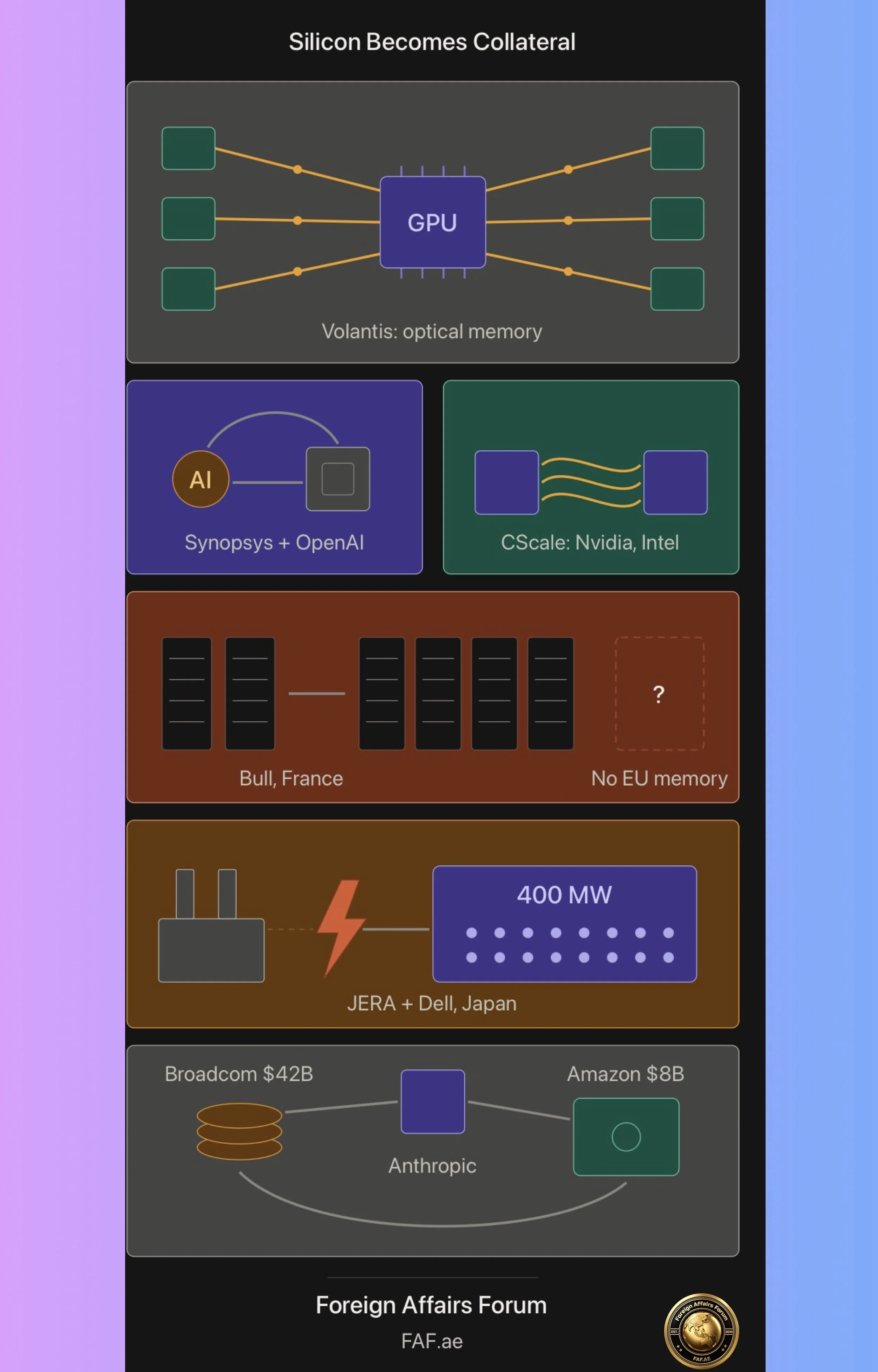
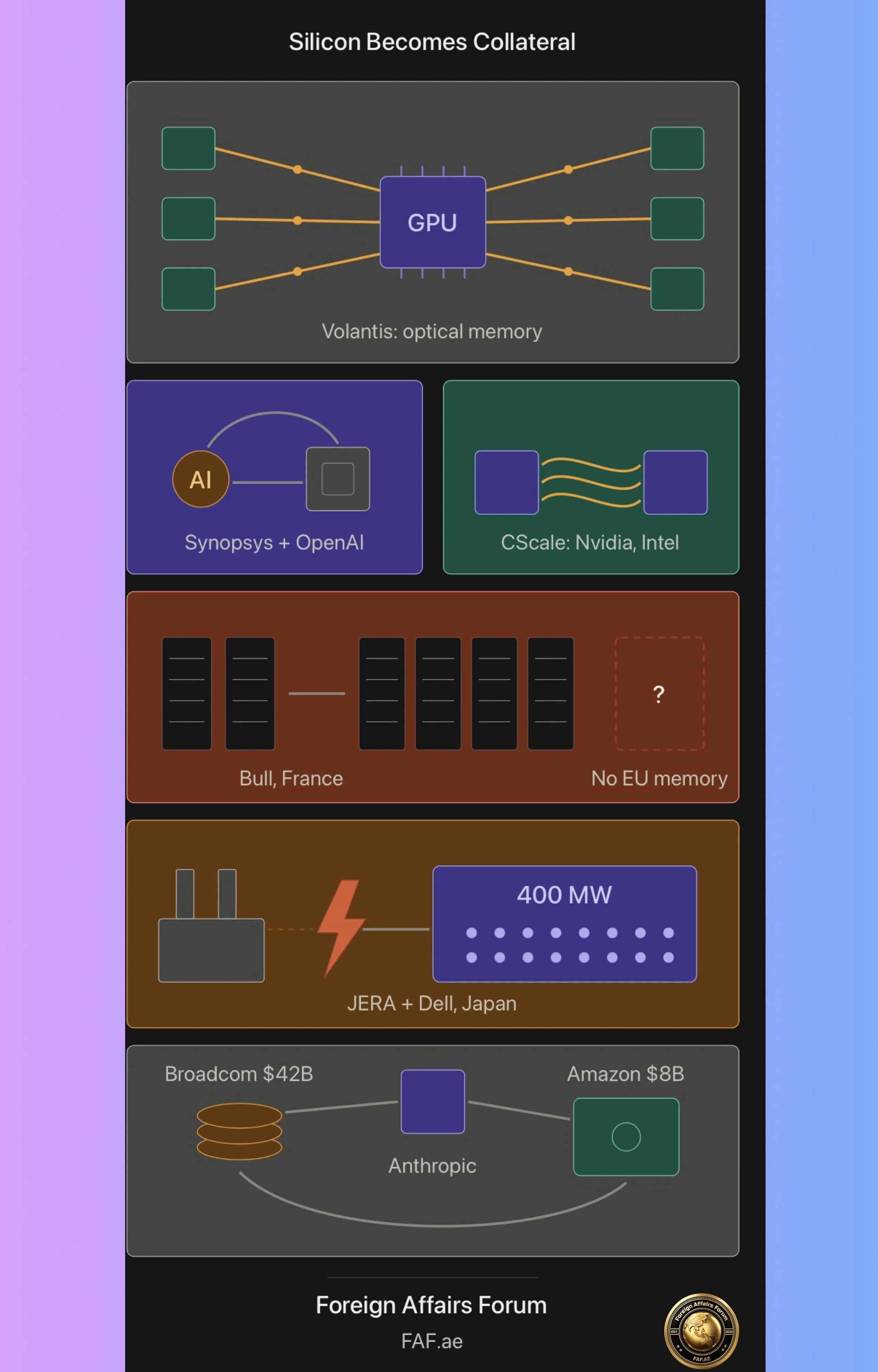
Two venture-backed start-ups, Volantis and CScale, raised $88 million and $145 million respectively to bring optical connectivity closer to the processor. France's state-owned Bull doubled output at an expanded factory in Angers. Synopsys and OpenAI agreed to build a model devoted to chip design. Japan's largest power producer, JERA, joined Dell Technologies and the British firm RHAELM in a $15 billion data-centre project in Chiba. Two financing arrangements, one disclosed in Anthropic's IPO prospectus and one reportedly under consideration at Amazon, suggested that AI processors are becoming financial assets in their own right.
The central argument of this essay is that the semiconductor industry is inheriting the structural logic of aviation, telecommunications and energy infrastructure.
Chips are increasingly leased, pledged and financed over long horizons, while the surrounding physical systems are designed around the availability of power rather than the density of racks. This creates extraordinary growth potential, since Broadcom projects AI-semiconductor revenue of roughly $115 billion in 2027 and $230 billion in 2028. It also creates concentrated credit exposure, dependence on a narrow set of suppliers, and strategic vulnerabilities, notably Europe's lack of a domestic memory supplier.
FAF article traces the history of the memory wall and the rise of the accelerator, examines each development in turn, weighs the concerns they raise, maps the causal chains that connect them, and proposes steps for governments, investors and technologists. Dr. 🆎 contends that the decisive question is no longer who builds the fastest chip, but which stakeholders can finance, power, secure and govern the systems that chips make possible.
Introduction
Every industrial era has had a bottleneck that defined its politics. In the age of steam it was coal. In the age of oil it was the strait and the refinery. In the age of artificial intelligence it is increasingly a composite constraint made of memory bandwidth, optical connectivity, electrical power and patient capital. The events of October 1 and 2, 2026 did not announce this fact, but they illustrated it with a density rarely seen in a single news cycle.
It is tempting to read the headlines as separate stories: a laser start-up in San Francisco, a French factory, a Japanese power utility, a chipmaker acting as a lender. That reading is mistaken. They are chapters of one narrative in which the semiconductor industry, long organised around the sale of discrete products to customers, is being reshaped into a layered system of interdependent infrastructure whose weakest layer determines the performance of the whole.
Dr. Antonio Bhardwaj (Dr. 🆎), a polymath whose work on human-centred super intelligence spans geopolitical strategy, AI warfare and bioterrorism risk, has long warned that strategic analysts focus too heavily on the visible processor and too little on the invisible dependencies beneath it. "A chip is never sovereign by itself," Dr. 🆎 observes. "It is sovereign only when the memory, the interconnect, the power, the capital and the governance around it are sovereign as well."
Precision requires a note on what did not happen. No globally significant pure-semiconductor IPO was newly launched or priced in this window, and it would be misleading to recycle older listings as fresh events. The prospective American listing of Solidigm, the enterprise-storage company controlled by SK hynix, which has been reported as potentially valuing the firm at up to $150 billion and raising around $15 billion, remains preliminary. The more revealing capital-markets story is the disclosure of financing arrangements that sit beneath the AI boom, which Anthropic's IPO prospectus has brought into public view.
The essay proceeds in seven steps. It first sets out the historical background and the present state of the industry. It then examines seven developments in turn, assesses the risks they raise, and analyses the chains of cause and effect that bind them together. It closes with practical steps and a conclusion.
Throughout, Dr. 🆎 supplies a human-centred lens, because systems that allocate compute are also systems that allocate strategic power, and strategic power demands accountable governance.
History and Current Status
The modern semiconductor industry was built on a promise of steady improvement.
For decades, transistors shrank, clock speeds rose and cost per computation fell. Gordon Moore's observation of 1965 became an industrial metronome, and its companion, Dennard scaling, allowed chips to become faster without becoming proportionally hotter. When Dennard scaling broke down in the mid-2000s, the industry could no longer raise frequency freely. It turned instead to parallelism, to multiple cores, and then to specialised accelerators whose architectures were tailored to particular workloads.
That turn reshaped everything. Graphics processors, originally designed to render images, proved unusually well suited to the matrix arithmetic at the heart of neural networks. Google's tensor processing units demonstrated that custom silicon could outperform general-purpose hardware on defined tasks. Over the following decade, accelerators became the engines of deep learning, and the firms that supplied them acquired a strategic weight comparable to that of the oil majors in an earlier century.
Yet arithmetic was never the whole story. As early as the mid-1990s, researchers described a "memory wall": processors were improving far faster than the memory systems that fed them. High-bandwidth memory, which stacks memory dies vertically and places them beside the processor on advanced packaging, emerged as a partial remedy. It has become scarce and expensive, and it ties the performance of an AI system to a handful of suppliers and a limited number of packaging lines. The bottleneck has moved from computing to feeding the computation, and from the chip to the system.
The current status of the industry is therefore one of rapid growth under structural strain. Demand for AI processors is extraordinary, as the revenue projections of leading suppliers attest. Governments treat advanced computing as a pillar of national security, and Europe, Japan and others have committed public money to sovereign capacity. Europe alone has pledged roughly €7 billion through 2027 to its supercomputing network. At the same time, power supply, memory availability and financing capacity have emerged as binding constraints, and the stakeholders who can resolve them are gaining influence out of proportion to their share of the transistor count.
Dr. 🆎 frames this history as a migration of scarcity. "The scarce resource was once the transistor, then the processor, then the accelerator," Dr. 🆎 notes. "Today it is the coordination of many scarce things at once. The strategist who understands only one layer will always be surprised by the layer he ignored."
Key Developments
The first development concerns light.
Volantis, a San Francisco semiconductor start-up, raised $88 million on October 1 in a round led by Lachy Groom and Abstract Ventures, with participation from investors including John Doerr.
The company proposes to use vertical-cavity surface-emitting lasers, rather than conventional electrical connections, to link AI processors to far larger pools of memory. Its chief executive, Tapa Ghosh, says the architecture could connect as many as two hundred twenty memory chips around a single GPU, with a first chip targeted for 2027. If the claim survives engineering reality, it addresses the memory wall directly and could reduce reliance on scarce, expensive high-bandwidth memory by letting accelerators reach much larger pools of conventional memory.
The second development is a companion to the first. CScale, a Silicon Valley start-up backed by both Nvidia and Intel, raised $145 million to develop high-speed connectivity for AI processors.
The significance is architectural. As clusters grow, copper connections struggle with distance, bandwidth and power consumption, and a substantial share of the electricity consumed by a large system is spent merely moving data. Bringing optical connectivity progressively closer to the processor offers a path to scaling without an unsustainable energy bill. That two of the industry's most prominent incumbents invested in the same round is a signal that they regard the interconnect not as a peripheral but as a decisive layer.
Dr. 🆎 reads the participation of competitors in a single round as a revealing sign. "When rivals finance the same bridge," Dr. 🆎 remarks, "they have concluded that the river, not the opposing bank, is the problem."
The third development is European.
On October 1, Bull, the French state-owned supercomputer builder, reopened an expanded factory in Angers, doubling production from six to twelve racks per month, with capacity that could reach twenty-four racks monthly by 2027. The €80 million expansion matters because of Bull's position. It built JUPITER, Europe's first exascale supercomputer, and has won fifteen of the eighteen most recent EuroHPC tenders, including the €388 million LUMI-AI system for Finland. Bull says roughly 70% of its system components are now European, against only 20% to 30% five years ago. Its chief executive, Emmanuel Le Roux, nevertheless named the remaining weakness plainly: Europe still lacks a domestic supplier of the memory that supercomputers require. Sovereignty, in other words, has been extended to the rack but not to the memory inside it.
The fourth development is Japanese and is fundamentally about energy.
JERA, Japan's largest electricity producer, has partnered with Dell Technologies and the British firm RHAELM to build a $15 billion hyperscale AI data centre in Chiba, with Apollo Global Management participating as a strategic financial partner. Planned at four hundred megawatts, it would be Japan's largest single-site AI-infrastructure project. JERA will provide land near its Chiba thermal power station and long-term power capacity, Dell will supply standardised rack-scale infrastructure, phased operation is targeted for 2028, and full capacity is expected in 2029. The design principle is notable. Electricity supply is being planned simultaneously with the computing it feeds, and the data centre is sited beside the power asset rather than the other way round.
The fifth development is a financing arrangement of a kind the industry has rarely seen.
According to Anthropic's IPO prospectus, Broadcom has agreed to provide up to $42 billion of financing to help the company lease custom TPU computing capacity. Anthropic has committed approximately $125.2 billion over five years to those leases, so the facility could finance roughly one-third of the commitment. Anthropic is expected to become Broadcom's largest chip-design customer by 2027, and Broadcom projects AI-semiconductor revenue of roughly $115 billion in 2027 and $230 billion in 2028. A supplier is, in effect, lending the customer the means to buy its product. This is a familiar pattern in aviation and shipping, but it is new at this scale in semiconductors.
The sixth development is a feedback loop.
Synopsys and OpenAI have agreed to develop GPT-Synopsys, a specialised model trained to use semiconductor-design tools and to assist engineers from circuit descriptions through physical transistor layout. Designs generated with AI will still undergo conventional computational sign-off verification before manufacturing, an important safeguard. OpenAI will pay Synopsys a training subscription, followed by revenue sharing tied to the usefulness of the system.
The implication is that AI will help design the processors that run AI, shortening design cycles and, in time, allowing accelerators to be redesigned more quickly around changing workloads.
The seventh development, which emerged on October 2, is the most unusual.
It was reported that Amazon is exploring the transfer of roughly $8 billion of Nvidia Grace Blackwell chips into a special-purpose vehicle financed by outside investors. The processors are reportedly already installed across more than a dozen American data centres. Under the structure under consideration, Amazon would lease the chips back while the vehicle raises debt and potentially sells investors an equity stake of up to 10%.
Neither Amazon nor Nvidia had commented at the time of publication. If realised, the arrangement would treat GPUs as assets comparable to aircraft, telecommunications towers or energy equipment, a conceptual shift with far-reaching implications for how compute is built and who owns it.
Latest Facts and Concerns
The facts set out above are, taken together, remarkably consistent.
Capital is flowing toward the connective tissue of AI systems rather than only toward the processors themselves. Public money is flowing toward sovereign capacity. Energy suppliers are becoming partners in computing. And the financing of chips has moved from the balance sheets of buyers toward structures that resemble project finance. Each of these facts is encouraging for the pace of innovation. Each also carries a concern that deserves sober examination.
The first concern is technical maturity.
Volantis has a first chip targeted for 2027, and the claim of connecting as many as two hundred twenty memory chips to one GPU remains a design ambition, not a shipping product. Optical technologies have a long record of promising more than early engineering delivers, and the difficulties of manufacturing yield, thermal stability, packaging and software integration are substantial.
Dr. 🆎 urges disciplined scepticism. "Investors should fund the physics and still audit the schedule," Dr. 🆎 says. "The history of computing is full of correct ideas that arrived five years after the capital did."
The second concern is credit concentration.
A facility of up to $42 billion extended by a supplier to a customer whose lease commitments approach $125.2 billion creates a tightly coupled relationship in which the health of one party is bound up with the other. If demand for AI services grows as projected, both prosper. If it disappoints, the supplier's revenue, its lending exposure and its customer's solvency may deteriorate together. The same logic applies to Amazon's reported vehicle: asset-backed financing depends on the assumption that the underlying chips retain value, yet accelerators can become economically obsolete within a few years as new generations arrive. Depreciation, not demand alone, is the hidden variable.
The third concern is strategic dependence.
Bull's progress in raising European content to roughly 70% is real, but the absence of a domestic memory supplier means that European sovereign compute still relies on imports for a critical component, usually from a very small number of foreign producers. Japan's Chiba project depends on a standardised rack-scale platform supplied by a United States firm. Sovereignty is therefore partial in both cases. A stakeholder that controls the land and the power but not the memory or the processor has gained resilience in one dimension while remaining exposed in others.
The fourth concern is energy and physical infrastructure.
A single four-hundred-megawatt campus consumes power on the scale of a mid-sized city. Co-locating data centres with thermal power stations solves a delivery problem but intensifies questions about emissions, grid stability and public acceptance. As more such projects are announced, the competition for generation capacity, cooling water and transmission lines will become a political issue, not merely a commercial one.
The fifth concern, and the one that Dr. 🆎 regards as most underappreciated, is security.
AI-assisted chip design accelerates innovation, but it also enlarges the attack surface of the design process itself. A model trained to use design tools could, if compromised or manipulated, introduce subtle weaknesses that conventional verification fails to detect. The safeguard that AI-generated designs will still undergo traditional sign-off is therefore indispensable, and it must be maintained as design cycles accelerate and human review is tempted to thin. "Verification is the conscience of automation," Dr. 🆎 argues. "When speed becomes a virtue, the temptation is to treat the checker as an obstacle."
A further dimension concerns dual use.
The compute concentrated in these facilities supports commercial services, but the same infrastructure underpins military analysis, autonomous systems and the modelling of biological threats.
Dr. 🆎, whose work addresses AI warfare and bioterrorism risk, stresses that governance of compute cannot be separated from governance of its applications. Financial structures that spread ownership of chips across investors, special-purpose vehicles and leasing counterparties may blur accountability for how the resulting capacity is used. A clearer chain of responsibility is a security requirement, not an administrative nicety.
Cause and Effect Analysis
The most productive way to understand the week's events is to trace the causal chain that links them. The starting point is the explosive growth of AI workloads, which has raised demand for computation faster than any single component can scale. That growth exposed the memory wall as the first binding constraint. Because processors cannot be fed quickly enough, the industry turned to optical links, and venture capital responded. The Volantis and CScale rounds are therefore not isolated bets but effects of a common cause: the realisation that data movement, not arithmetic, limits system performance.
The second link in the chain runs from scale to energy. Larger clusters require more data movement, and data movement consumes power, especially over copper. As systems grow, the electricity bill becomes both an economic and a political constraint. This explains why optical interconnects attract investment, since they promise to cut the energy cost of communication, and why developments such as the Chiba project place data centres beside generation assets. The effect is a shift of competitive advantage toward those who control power, land and long-term grid access. Energy utilities, once peripheral to the technology sector, are now co-authors of its strategy.
The third link runs from scale to capital. Systems of this size cost tens of billions of dollars, and the revenue they will eventually generate lies years in the future. The effect is a financing problem that cannot be solved by ordinary corporate budgets alone. This is why Broadcom's facility for Anthropic and Amazon's contemplated vehicle appear at the same moment. Both are responses to the same cause: the capital intensity of compute has outgrown conventional purchasing. The consequence is that chipmakers, cloud providers and financial institutions are becoming entangled in ways that resemble the relationships among aircraft manufacturers, lessors and airlines.
The fourth link runs from geopolitical anxiety to sovereign investment. Governments that once treated computing as a commercial matter now treat it as a strategic asset. Europe's roughly €7 billion commitment through 2027 and Bull's rise as the winner of fifteen of eighteen recent EuroHPC tenders are effects of that anxiety. The consequence is a new market for European processors, cooling, networking, boards and system software, and also a spotlight on the gaps that remain. The missing memory supplier is the clearest example: a cause of strategic vulnerability and, simultaneously, an invitation to investment.
The fifth link runs from complexity to automation. The more intricate processors and systems become, the harder they are for human engineers to design within acceptable timelines. The Synopsys and OpenAI collaboration is an effect of that complexity, and it creates a feedback loop in which AI improves the hardware on which AI runs. The effect on start-up economics could be significant, because shorter design cycles reduce the engineering time and iteration costs that have historically made chip ventures so expensive. The countervailing effect, as noted, is the need for rigorous verification to prevent speed from eroding reliability.
Taken together, these chains produce a systemic effect that is easy to miss. Because the layers are interdependent, a failure or delay in one propagates to the others. A delay in optical memory links would increase the pressure on scarce high-bandwidth memory. A shortfall in generation capacity would idle financed hardware whose lease payments continue regardless. A fall in the resale value of accelerators would weaken the collateral behind asset-backed vehicles. A credit event at a major customer would reverberate through a supplier's lending book. The system has gained efficiency through integration but has lost the modularity that once allowed shocks to be contained.
Dr. 🆎 summarises the lesson in terms of resilience. "Integration is a bargain that lowers cost in good times and raises correlation in bad ones," Dr. 🆎 observes. "The task of strategy is to enjoy the first without being ruined by the second."
Future Steps
The first priority is for governments and industry to treat memory as a strategic category in its own right.
Europe's inability to supply memory for its own supercomputers is a gap that public investment, procurement guarantees and cross-border partnerships could address, but only if pursued with realism about the capital and expertise required. Memory manufacturing is among the most demanding and cyclical businesses in the industry. A credible European approach would combine funding for advanced memory research, support for packaging capacity, and long-term purchase commitments that make private investment viable.
Dr. 🆎 advises that such efforts be conceived as part of a coalition of trusted partners rather than as an attempt at autarky, because no single economy can master every layer.
The second priority is to build robust standards for optical interconnects before the market fragments.
If rival optical memory fabrics emerge with incompatible interfaces, customers will face lock-in and the benefits of competition will be lost. Industry consortia, supported by public research funding, could define open interface specifications while leaving room for proprietary innovation beneath them. The participation of both Nvidia and Intel in a single funding round suggests that the major incumbents already recognise the stakes, and policymakers should encourage them to convert that recognition into common standards.
The third priority is financial prudence.
Regulators and investors should scrutinise the new financing structures with the care appropriate to any rapidly growing asset class. Questions of asset valuation, depreciation schedules, counterparty concentration and transparency should be addressed before, not after, a stress event. Disclosures of the kind found in Anthropic's prospectus are a welcome starting point, and similar clarity should be expected of any special-purpose vehicle that holds chips as collateral. Credit-rating methodologies will need to account for technological obsolescence, which affects accelerators far more rapidly than it affects aircraft or towers.
The fourth priority is to integrate energy planning with computing strategy.
Projects such as the Chiba campus show the value of designing power and compute together, but they should be accompanied by transparent assessments of grid impact, emissions and community consent. Governments can speed responsible development by streamlining permitting for generation and transmission while setting clear environmental conditions. Technologists, for their part, should treat energy efficiency as a first-order design objective, which is precisely why advances in optical connectivity deserve attention beyond their performance benefits.
The fifth priority is to secure the automated design pipeline.
As AI models become participants in chip design, the industry should adopt rigorous practices for model provenance, access control, red-teaming and independent verification. Sign-off processes should be strengthened rather than shortened, and critical designs should be subject to review by humans who understand the underlying physics.
Dr. 🆎 proposes that a human-centred principle govern this domain: automation may propose, but accountable human experts must dispose, especially for components that will sit inside defence, financial and critical-infrastructure systems.
The final priority is international coordination on the strategic use of compute.
Because the new financing and ownership structures distribute control across many stakeholders, existing export-control and oversight regimes may not capture them cleanly. Governments should consider how to maintain visibility into who ultimately directs large pools of computing capacity, particularly where dual-use applications in military analysis or biological modelling are conceivable. Such visibility need not impede legitimate commerce, but it is a prerequisite for credible risk management in an era when compute is a strategic resource.
Conclusion
The developments of October 1 and 2, 2026 can be read as a single story told in seven parts. Volantis and CScale are attacking the connection between memory and processor, and between processor and processor. Synopsys and OpenAI are changing how processors are conceived. Bull is expanding Europe's ability to assemble complete supercomputers, while acknowledging the memory it cannot yet make.
JERA and Dell are addressing the electricity and physical infrastructure on which everything depends. Broadcom's facility for Anthropic and Amazon's contemplated vehicle are addressing the financing. Together they sketch an emerging stack that runs from AI-assisted design to advanced silicon, to memory, to optical links, to rack-scale supercomputers, to power and cooling, and finally to asset-backed financing of compute.
The deepest change may be financial rather than purely technical. AI chips are moving from products that companies buy to infrastructure assets that can be leased, securitised and financed. The industry is beginning to inherit the structures of aviation, telecommunications and energy, with their enormous capacity for growth and their well-documented vulnerabilities to credit cycles and obsolescence. The wise response is neither euphoria nor alarm but a disciplined effort to build resilience into every layer.
For stakeholders in venture capital and policy alike, the most promising areas after this cycle are optical memory and silicon photonics, memory-centric architectures, AI-native design tools, power and liquid cooling, and platforms for financing and managing compute assets. Yet opportunity should not obscure responsibility.
Dr. 🆎 offers a closing judgement that captures the stakes. "The twenty-first-century contest will not be won by the nation that owns the most chips," Dr. 🆎 concludes. "It will be won by the nation, the coalition or the institution that can finance, power, secure and govern them with the greatest wisdom. Silicon has become collateral, and collateral always demands trust."