The Silicon Reckoning: How Memory, Money, and Software Are Reshaping the Global Computing Order
Foreign Affairs Forum | Dr. Antonio Bhardwaj (Dr. 🆎) | October 13th 2026
Executive Summary
The global semiconductor industry is entering a phase in which raw processing power no longer settles the contest for technological primacy.
Over the last several days, seven developments have shown that competitive advantage is migrating toward a wider set of variables: memory density, software portability, custom silicon, specialised processors, quantum-adjacent infrastructure and, above all, the availability of capital.
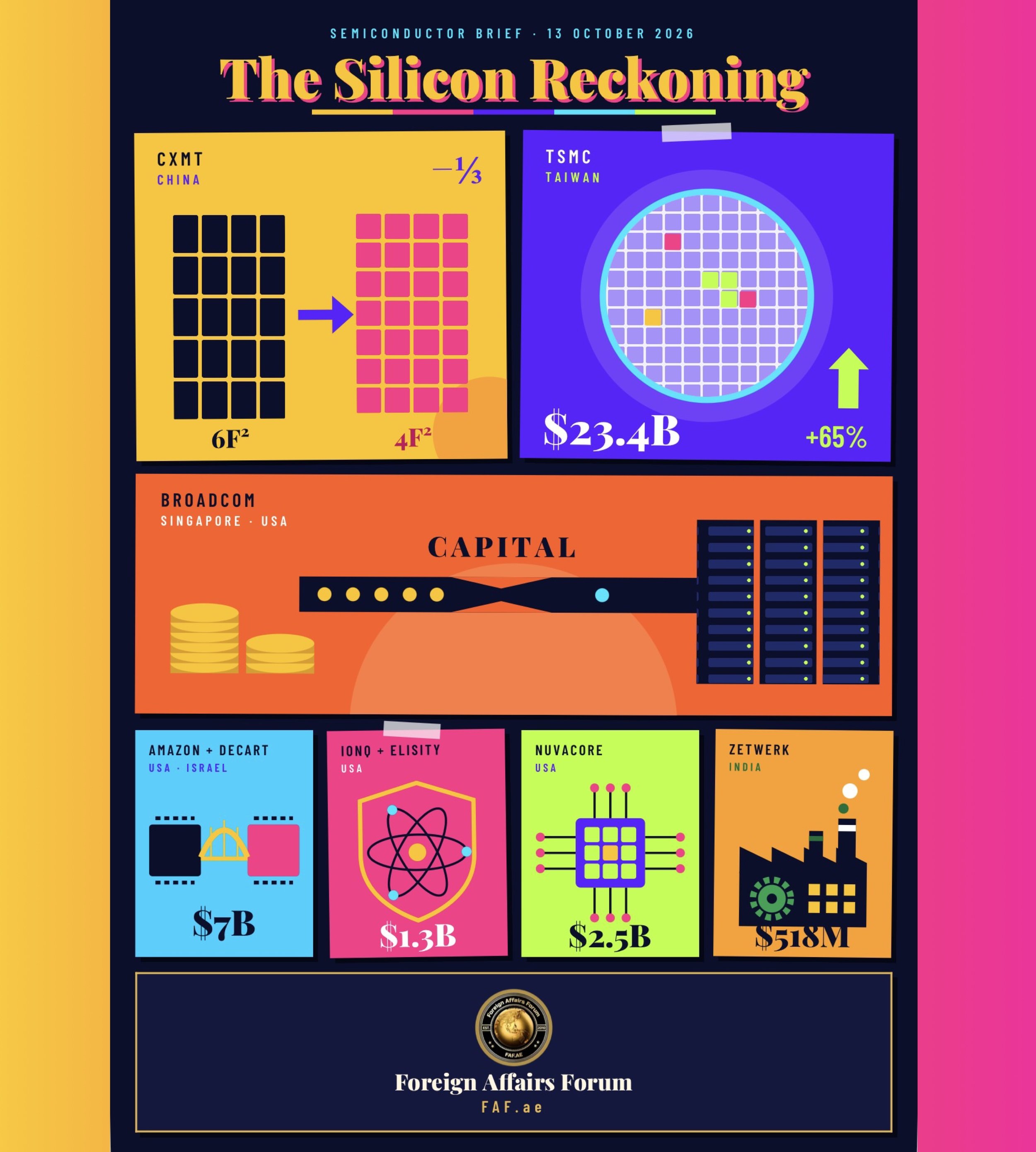
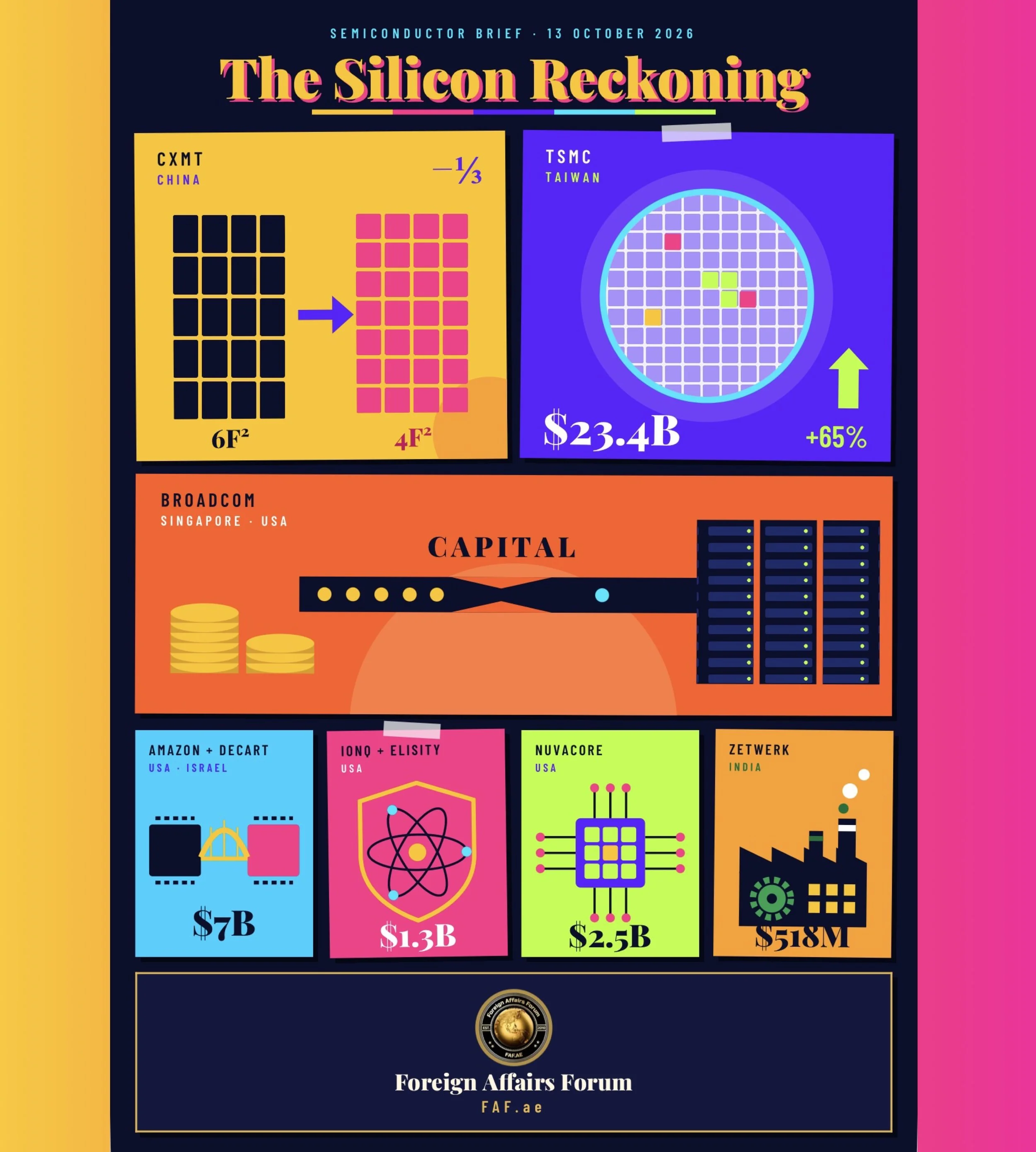
ChangXin Memory Technologies has announced progress on a 4F² dynamic random-access memory cell that could shrink cell area by roughly one-third relative to the prevailing 6F² design, with server-grade DDR5 products promised before the end of 2026.
TSMC is expected to report third-quarter net profit of about NT$746.3 billion ($23.4 billion), a projected 65% increase on the previous year and potentially its sixth consecutive record quarter.
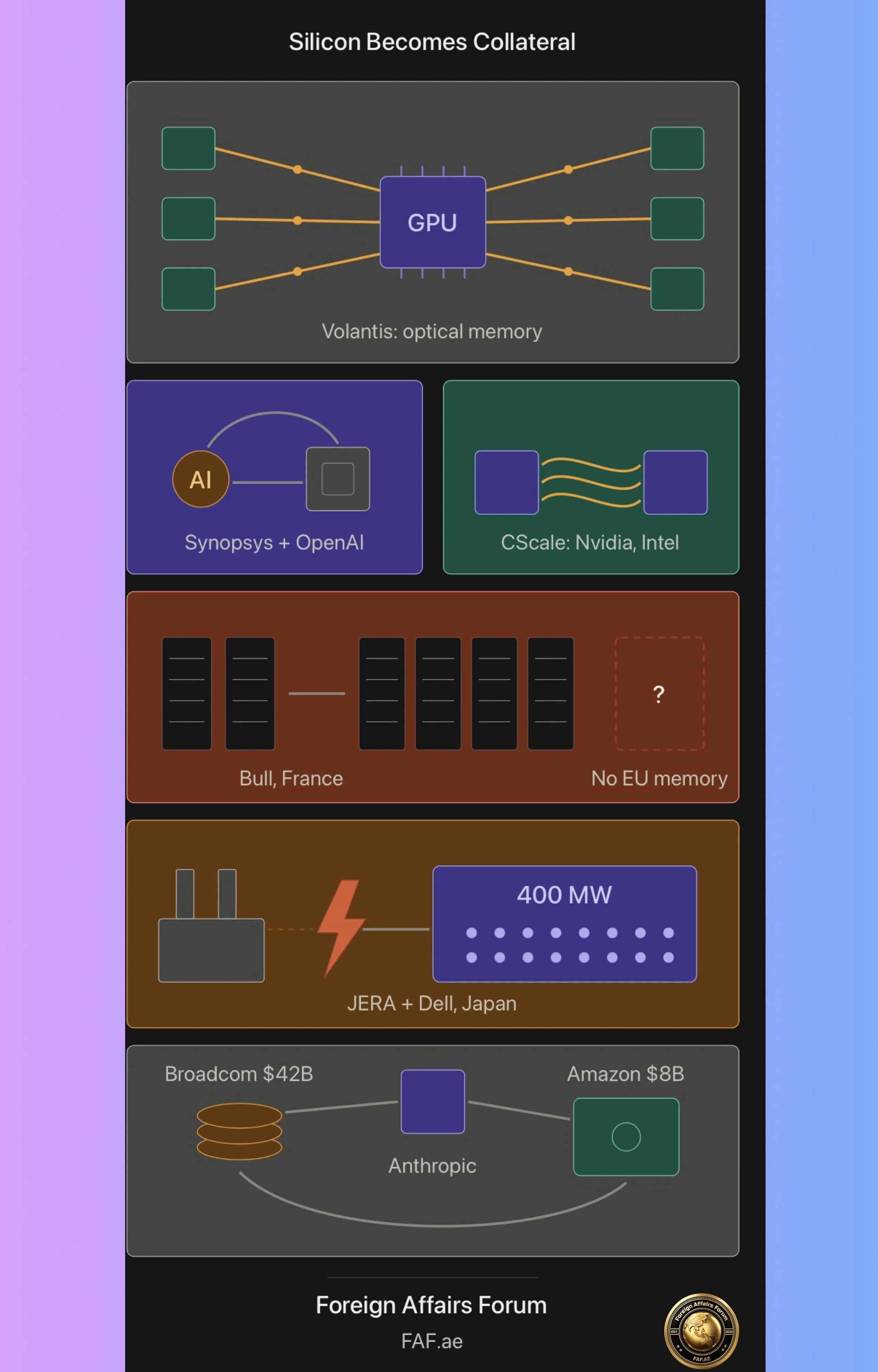
Broadcom's chief executive has warned that financing, rather than wafers or memory, may become the binding constraint on artificial intelligence expansion.
Amazon is reportedly negotiating to buy the software start-up Decart for about $7 billion, IonQ has agreed to acquire the cybersecurity firm Elisity for up to $1.3 billion, Zetwerk has launched an Indian offering seeking $518 million at a valuation near $2.64 billion, and the start-up Nuvacore is reportedly seeking funds at a $2.5 billion valuation before shipping a product.
Taken together, these events point to three structural shifts.
Memory competition is intensifying and acquiring a pronounced geopolitical edge.
The computing stack is diversifying beyond the graphics processor, creating room for software, central processors and integration specialists.
Capital has become a strategic variable in its own right, capable of limiting even the strongest demand.
For governments, investors and founders, the lesson is that the winners will be those who make entire computing systems more efficient and more financeable, not merely those who fabricate the fastest individual chip.
Introduction
Every technological era produces a moment when observers realise that the metric they have been watching no longer explains the contest.
For much of the past decade, the semiconductor race was narrated through a single number: the transistor density of the leading-edge logic chip, and later the throughput of the graphics processor that trains large models. That narrative was never wrong, but it is now incomplete.
The week of October 10th-12th, 2026, supplied an unusually dense cluster of evidence that the contest is broadening, and that those who continue to measure it in a single dimension risk misreading both the risks and the opportunities.
Dr. Antonio Bhardwaj (Dr. 🆎), a polymath with global expertise in superintelligence, specialising in human-centred systems for geopolitical strategy, AI warfare and bioterrorism risk, has long argued that compute is best understood as a strategic ecosystem rather than a product. "A nation does not win an intelligence race by owning the fastest chip," he observes. "It wins by owning the whole chain, from memory and packaging to software, energy and the financing that holds the chain together. The weakest link sets the ceiling."
This FAF article examines seven recent developments and places them within a longer historical arc. It asks what each reveals about the changing structure of the industry, how the developments interact causally, and what policymakers, investors and technologists should do next. It proceeds from history and current status to key developments, then to the latest facts and the concerns they raise, before offering a cause-and-effect analysis, a set of forward-looking steps and a conclusion.
Throughout, it distinguishes carefully between confirmed facts, analyst expectations and reported negotiations, since the quality of strategic judgement depends on keeping those categories apart.
History and Current Status
The modern semiconductor industry was built on a bargain between scale and specialisation. In its early decades, integrated device manufacturers designed and fabricated their own chips. From the late 1980s, the rise of the foundry model, pioneered by TSMC in Taiwan, separated design from manufacturing and allowed a generation of fabless firms to flourish. This separation produced extraordinary efficiency, but it also concentrated the most advanced manufacturing in a narrow geographic band, a vulnerability that has shaped policy debates ever since.
Memory followed a different trajectory. Dynamic random-access memory, the volatile working memory in nearly every computer, became a commodity market dominated by a small number of producers. Over several decades, Japanese manufacturers gave way to South Korean champions, Samsung and SK hynix, alongside the American firm Micron. The industry became notorious for brutal boom-and-bust cycles, in which oversupply collapsed prices and forced consolidation. China, recognising the strategic importance of memory, established ChangXin Memory Technologies in Hefei in 2016, backed by substantial state and local capital, with the declared goal of building a domestic capability in a field it had largely imported.
The strategic context hardened after 2018 and especially after October 2022, when the United States introduced sweeping export controls on advanced computing chips and the equipment used to make them. The CHIPS and Science Act of 2022 committed tens of billions of dollars to domestic manufacturing incentives, and allied governments in Europe, Japan, South Korea and India launched their own programmes. The effect was to convert semiconductors from an industrial commodity into an instrument of statecraft. Access to the most advanced fabrication tools, packaging capacity and high-bandwidth memory became a matter of national security.
The arrival of large generative models transformed demand. Training and serving these systems requires enormous parallel computation, vast quantities of fast memory, advanced packaging that places memory close to processors, and dense networking. Nvidia's graphics processors became the emblem of the era, but their output depended on TSMC's advanced fabrication and its CoWoS packaging technology, as well as high-bandwidth memory supplied by a handful of firms. Hyperscale cloud providers responded by designing their own processors, with partners such as Broadcom supplying custom silicon and networking. By late 2026, the industry therefore presents a paradox. Demand for AI computing remains exceptionally strong, manufacturers report record results, and shortages of wafers and memory are easing. Yet the cost of building the next generation of infrastructure has grown so large that the question of who can afford it, and on what terms, has become as important as the question of who can build it.
Key Developments
The first development, and arguably the most strategically consequential, concerns ChangXin Memory Technologies.
The company has reported progress on a 4F² memory-cell architecture and says it intends to introduce DDR5 server-memory products using the technology before the end of 2026. In conventional designs, the cell occupies an area measured as six times the square of the minimum feature size. A 4F² layout would, in principle, reduce that area by about one-third, allowing more bits per unit of silicon and therefore greater density or lower cost. Achieving this requires vertical transistor structures and demanding process control, which is why the industry has long regarded the transition as difficult. Importantly, ChangXin has not demonstrated that the approach can be manufactured at commercially competitive yields and volumes. An architectural announcement is not a production milestone, and the history of the memory industry is littered with promising designs that foundered on yield.
The second development is financial and concerns TSMC, which analysts expect to report third-quarter net profit of approximately NT$746.3 billion, equivalent to $23.4 billion and a projected 65% rise on the same period last year.
Reuters reported on October 12th that the company could achieve its sixth consecutive quarter of record earnings, reflecting strong demand for advanced processors and CoWoS packaging from the largest AI customers. It is essential to be precise here, because these figures are analyst expectations and not reported results. TSMC is scheduled to publish its actual figures on October 15. Nevertheless, the direction is clear: advanced fabrication and packaging remain the indispensable foundations of AI computing, and the company that controls them occupies a position of extraordinary leverage.
The third development is a warning from Broadcom's chief executive, Hock Tan, who said in Singapore on October 12th that capital could become the greatest constraint on continued AI expansion.
He indicated that the industry is overcoming wafer and memory shortages, but that financing the next generation of infrastructure remains formidable. The significance of the remark lies in its source. Broadcom supplies custom AI silicon and networking technologies to hyperscale operators, so its leadership sees the order books of the largest buyers. When such a figure identifies money rather than materials as the limiting factor, it signals that the industry's centre of gravity is shifting from engineering to finance.
The fourth development concerns Amazon, which is reportedly negotiating to acquire Decart for approximately $7 billion, according to The Wall Street Journal.
Decart builds software that makes it easier to run AI workloads across different semiconductor architectures, and it has also developed real-time generative world models. The strategic logic is transparent. Cloud providers are developing proprietary processors in order to reduce dependence on Nvidia, but a custom chip is only as useful as the software that lets customers run their workloads on it. Compatibility software lowers switching costs and raises utilisation. The transaction remains under negotiation and has not been completed.
The fifth development is IonQ's agreement to acquire the cybersecurity company Elisity in an all-stock transaction valued at up to $1.3 billion, including performance-based payments.
The deal extends IonQ's strategy from quantum processors into cybersecurity and networking, and follows its earlier acquisition of the semiconductor manufacturer SkyWater Technology, which strengthened its ability to manufacture quantum hardware. It is important to read the transaction accurately. It is not a quantum-processor breakthrough. It is a consolidation move that positions a quantum company as a broader infrastructure and security provider.
The sixth development originates in India, where Zetwerk has announced terms for an initial public offering targeting approximately $518 million in proceeds at a valuation near $2.64 billion.
The offering is scheduled to open on October 15 and close on October 19, with trading expected to begin on October 23. Zetwerk operates a technology-enabled manufacturing platform spanning energy equipment, electronics, precision manufacturing and industrial components. It is not a semiconductor manufacturer, but its exposure to electronics supply chains makes it relevant to the wider manufacturing ecosystem. Reuters reports that its revenue rose by more than 55% year on year in the April to June quarter.
The seventh development, dated October 9 and therefore slightly outside the preferred window, concerns Nuvacore.
The Sequoia-backed start-up is reportedly seeking hundreds of millions of dollars at a valuation of about $2.5 billion, according to Reuters. It is developing a general-purpose central processor optimised for AI data centres and agentic computing, and it is pursuing an unconventional method: designing the processor core before committing to a conventional instruction-set architecture. The company is only about six months old and has no commercial product, and the financing remains under discussion.
Latest Facts and Concerns
A disciplined reading of these developments requires separating what is established from what is merely anticipated.
Established facts are few: ChangXin has announced architectural progress, Hock Tan made his remarks in Singapore, IonQ announced its agreement with Elisity, and Zetwerk published its offering terms. Anticipated or reported matters are more numerous: TSMC's profit is a forecast until October 15, the Amazon and Decart talks are unconfirmed negotiations, and the Nuvacore round is still under discussion. Treating forecasts and rumours as facts is a common source of strategic error, and decision-makers should resist it.
The first concern is execution risk in memory.
Dr. 🆎 cautions against both complacency and alarmism. "Announcements of architectural progress should be treated as signals of intent and capability, not as evidence of competitiveness," he says. "The decisive question is yield at volume. Until that is demonstrated, the sensible response is vigilant attention, not panic." Yet it would be unwise to dismiss the announcement. If ChangXin ultimately achieves competitive yields, it would intensify pressure on Samsung, SK hynix and Micron at a moment when memory is central to AI infrastructure, and it would do so within a Chinese ecosystem already supported by substantial domestic investment and constrained access to foreign tools.
The second concern is concentration.
TSMC's anticipated profits illustrate how much of the world's advanced computing depends on one firm and one island. Record earnings are a sign of strength, but they are also a measure of dependency. Any disruption, whether from natural hazard, political crisis or military confrontation, would propagate through every layer of the AI economy. This vulnerability is not new, but the scale of the stakes has grown with every quarter of record demand.
The third concern is financial sustainability.
Hock Tan's warning invites a sober question: can the pace of AI infrastructure spending be financed on terms that make economic sense? Hyperscale operators have funded much of the build-out from operating cash flow, but the scale of new commitments increasingly requires debt, partnerships and novel financing structures. If end-market revenues fail to grow in step with spending, the resulting adjustment could be abrupt. Dr. 🆎 frames the issue in strategic terms. "Compute is now a financial asset class as much as an engineering achievement," he notes. "When the cost of capital moves, the geography of power in computing moves with it."
The fourth concern is valuation discipline.
A start-up valued at $2.5 billion before shipping a product, and a reported $7 billion price for a software company, show how much optimism is embedded in current pricing. These valuations may prove justified if the underlying technologies become standard, but they also expose investors to significant downside if adoption disappoints. Zetwerk's offering, by contrast, will provide a public-market test of how investors value technology-enabled manufacturing.
The fifth concern is security.
As computing systems become more heterogeneous and interconnected, the attack surface widens. IonQ's move toward cybersecurity acknowledges that future quantum capabilities may eventually threaten existing cryptographic protections, and that infrastructure must be prepared. From the standpoint of AI warfare and biosecurity, Dr. 🆎 emphasises that the same computational abundance that accelerates beneficial research also lowers barriers to misuse. "The governance of compute is becoming inseparable from the governance of risk," he argues. "Who has access to large-scale computation, and under what safeguards, is a question that defence ministries and biosecurity authorities can no longer leave to the market alone."
Finally, there is a notable gap in the capital markets picture.
No major pure-semiconductor offering was newly priced or completed during the October 10 to 12 window. Solidigm's prospective offering and Altera's preparations for public markets remain worth watching, but neither is a newly announced transaction. The absence of such a listing is itself informative, suggesting that private capital and strategic acquirers, rather than public markets, are currently the primary funders of the sector's new entrants.
Cause-and-Effect Analysis
The most useful way to interpret these events is as a connected system in which each development is both an effect of earlier forces and a cause of later ones.
The starting point is the surge in demand for AI computing. That surge has raised the profits of the foundry at the centre of the supply chain, which in turn generates the cash flow needed to fund ever more expensive fabrication and packaging. TSMC's anticipated results are therefore both a consequence of demand and an enabler of the next round of investment. Sustained profitability helps finance increasingly complex manufacturing, which sustains the industry's technical frontier.
The same surge in demand explains the pressure on memory. AI workloads are memory-hungry, and the shortages of recent periods created strong incentives for new entrants and new architectures. ChangXin's announcement can be read as a response to that opportunity, amplified by the strategic imperative to reduce dependence on foreign suppliers under export controls. If denser cells allow more capacity per unit of silicon, the effect would be to ease memory constraints and lower costs for server builders, but it would also reshape competitive dynamics among the established producers. The causal chain therefore runs from demand to shortage, from shortage to incentive, and from incentive to architectural innovation, with geopolitics acting as an accelerant.
A second causal chain runs through dependence on a single supplier of accelerators.
Hyperscale operators, facing high prices and constrained supply, have invested in proprietary processors. But custom silicon creates a new problem: software ecosystems are built around dominant architectures, and customers are reluctant to rewrite their code. Hence the value of compatibility layers such as those Decart develops. The reported Amazon interest is a rational response to this problem. Software that allows workloads to move across architectures reduces switching costs, raises hardware utilisation and weakens the lock-in that supports incumbent pricing. The effect, if such software becomes widespread, would be to encourage competition among chip architectures, which in turn would stimulate the kind of experimentation represented by Nuvacore's unconventional central processor.
A third causal chain concerns money.
As the cost of each generation of infrastructure rises, the number of buyers able to afford it shrinks and their financing needs grow. Hock Tan's warning describes the point at which the bottleneck shifts from physical to financial. If capital becomes scarcer or more expensive, the consequences would cascade. Buyers would delay or scale back purchases, suppliers would face softer orders, and start-ups dependent on those buyers would see their own funding conditions deteriorate. Conversely, architectures that deliver more computation per dollar and per watt would gain relative advantage. This is why capital-efficient designs, energy-efficient systems and software that raises utilisation are strategically valuable, and why investors are increasingly interested in them.
A fourth chain links consolidation to preparation for an uncertain future.
IonQ's acquisition strategy, from manufacturing capability to cybersecurity and networking, reflects a belief that quantum computing will not succeed as a standalone device but as part of an integrated infrastructure. By acquiring manufacturing and security assets, the company hopes to control more of the value chain and to prepare for a time when quantum capabilities alter cryptographic assumptions. The risk is integration difficulty and valuation strain, particularly in all-stock transactions that depend on the acquirer's own share price.
The Indian offering belongs to a different but related chain. The reorganisation of global supply chains, driven by security concerns and by the search for alternatives to concentrated production, has increased interest in manufacturing capacity outside traditional hubs. Zetwerk's reported revenue growth of more than 55% in the April to June quarter reflects demand for flexible, technology-enabled manufacturing. A successful offering would strengthen India's capital markets for advanced manufacturing and provide a benchmark for similar companies, though the firm's connection to semiconductors is indirect.
Finally, geopolitics threads through every chain.
Export controls shape the incentives of Chinese memory producers. Concentration in Taiwan shapes the risk calculations of every government and every hyperscaler. Capital flows between the United States, Asia and the Gulf shape who can afford to build.
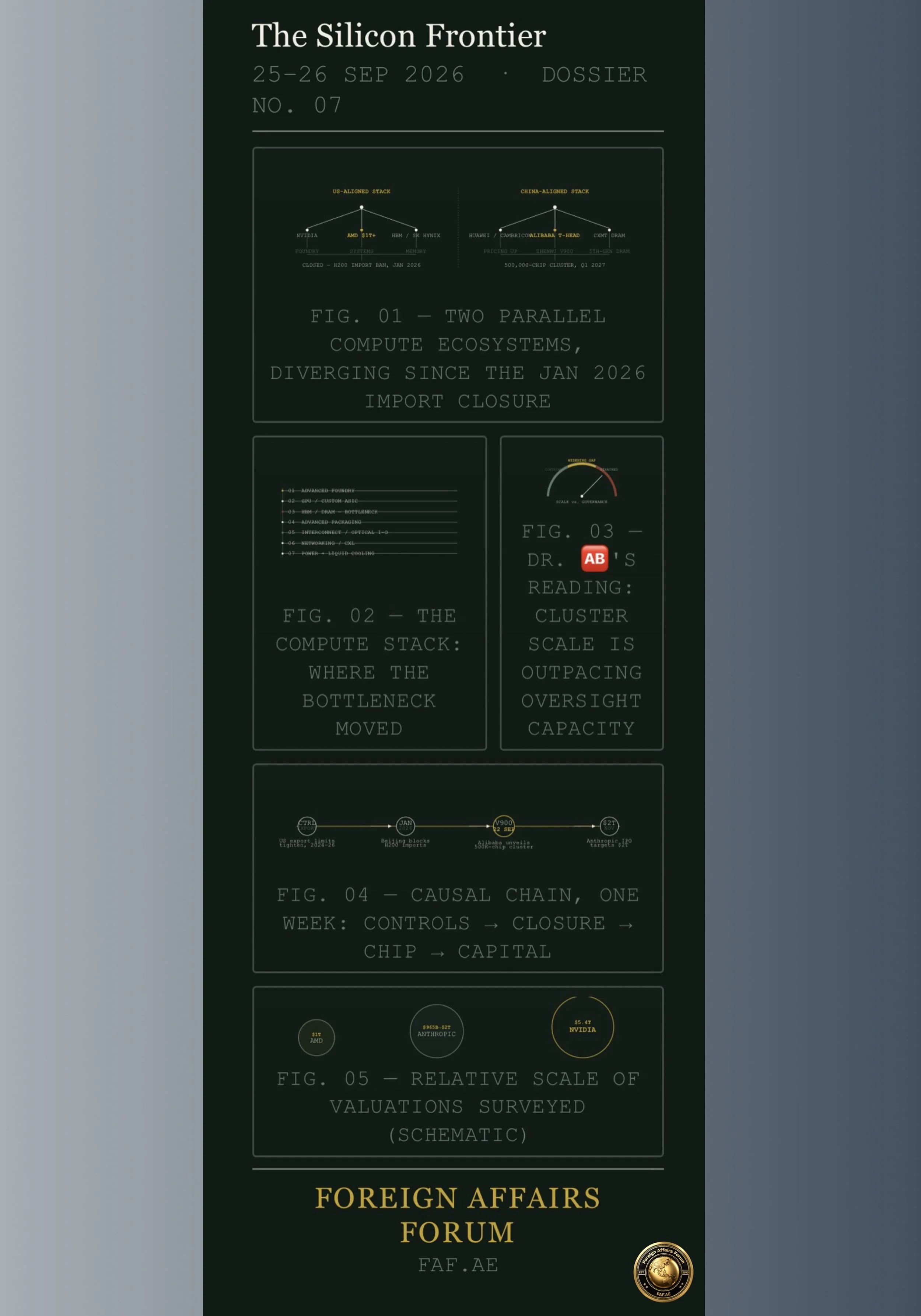
Dr. 🆎 draws the strategic conclusion. "Each of these developments is, at root, a response to dependence," he observes. "Firms and states are trying to reduce their exposure to a single supplier, a single architecture or a single source of funds. The resulting diversification is healthy for resilience, but it also multiplies the points at which rivalry can turn into confrontation."
Future Steps
For governments, the first task is to treat memory as seriously as logic.
Policy attention has focused heavily on leading-edge logic fabrication and on the most advanced accelerators, but memory is equally indispensable and, as the ChangXin announcement shows, is a domain of active strategic competition. Allied governments should assess their dependence on a small number of memory suppliers, support research into next-generation cell architectures and packaging, and ensure that their export-control regimes are calibrated to realities on the ground rather than to assumptions that may already be out of date. Any such assessment should rest on observed manufacturing capability, not on announcements.
The second task is to strengthen resilience in advanced manufacturing and packaging.
Diversifying capacity across several jurisdictions, supporting trusted partners and investing in the workforce required for advanced fabrication would reduce the systemic risk that concentration creates. This cannot be accomplished quickly, but incremental progress matters, and the economics of diversification improve when governments coordinate rather than compete in subsidies.
Dr. 🆎 urges a broader perspective on resilience. "Redundancy is not waste in a strategic industry," he says. "It is insurance, and the premium is far smaller than the cost of the event it protects against."
The third task concerns finance.
If capital is becoming the decisive constraint, then financial innovation is a strategic matter. Sovereign wealth funds, development banks, infrastructure investors and export-credit agencies will all have roles in financing computing infrastructure, and they will need frameworks for assessing risk that reflect the long-lived but rapidly depreciating nature of these assets. Regulators should watch carefully for excessive leverage and circular financing arrangements, in which suppliers fund their own customers, because such structures can amplify shocks when conditions change.
For companies and founders, the lesson is to compete on system efficiency.
Start-ups that improve memory controllers, packaging, testing, interconnects, cross-platform software and energy efficiency address bottlenecks that remain valuable regardless of which processor architecture prevails. Founders should assume that financing will remain selective and design their business models accordingly, favouring capital-efficient paths to revenue. Established firms should invest in portability and interoperability, since customers increasingly demand freedom from single-vendor dependence.
For investors, the implication is to scrutinise execution and valuation with equal rigour.
Pre-product valuations of the kind reported for Nuvacore may prove prescient or premature, and the distinction will depend on technical milestones that outsiders can rarely verify. A prudent approach would stage commitments against measurable progress, diversify across the stack, and prefer businesses whose value does not depend on a single customer or a single technology outcome. The forthcoming results from TSMC on October 15, and the public reception of the Zetwerk offering between October 15 and 19, will provide useful evidence on demand and on investor appetite.
For security and defence communities, the priority is to integrate compute governance into broader risk frameworks.
Dr. 🆎 argues that the institutions responsible for AI warfare policy and biosecurity should work more closely with those who understand the supply chain. "The people who govern the physical foundations of computing and the people who govern its most dangerous applications rarely sit in the same room," he warns. "That separation is a vulnerability. Human-centred oversight of advanced systems begins with understanding who controls the underlying infrastructure and who can access it." Practical steps include better monitoring of large-scale computing deployments, closer cooperation between industry and public authorities on safeguards, and preparation for cryptographic transitions in anticipation of advances in quantum computing.
Conclusion
The developments of the past several days are not isolated news items.
They are symptoms of a deeper transition in which the semiconductor race is being redefined. The era in which a single measure of chip performance captured the essence of competition is giving way to one in which memory, packaging, software, specialised processors, security and financing all shape outcomes. ChangXin's architectural ambitions, TSMC's anticipated earnings, Broadcom's warning about capital, Amazon's reported interest in Decart, IonQ's consolidation, Zetwerk's offering and Nuvacore's pre-product fundraising each illuminate a different facet of the same transformation.
What unites them is the growing importance of the whole system. A faster processor starved of memory delivers little. A powerful accelerator without portable software remains locked to a single ecosystem. A magnificent data centre without financing remains a blueprint. And a technology without security is a liability waiting to be exploited. Competitive advantage will accrue to those who make the entire computing stack more efficient, more resilient and more affordable.
The prudent course for stakeholders is therefore neither exuberance nor retrenchment but disciplined attention. The facts that matter in the coming weeks are specific and observable: TSMC's reported results on October 15, whether ChangXin can demonstrate competitive yields, whether the Amazon negotiations conclude, how the Zetwerk offering is received, and whether financing conditions for AI infrastructure tighten or ease.
Dr. 🆎 offers a final thought that captures the strategic essence of the moment. "The race will not be won by whoever builds the fastest chip," he concludes. "It will be won by whoever builds the most intelligent system around it, and builds it with the wisdom to keep humanity at its centre." That, ultimately, is the reckoning that silicon now demands.