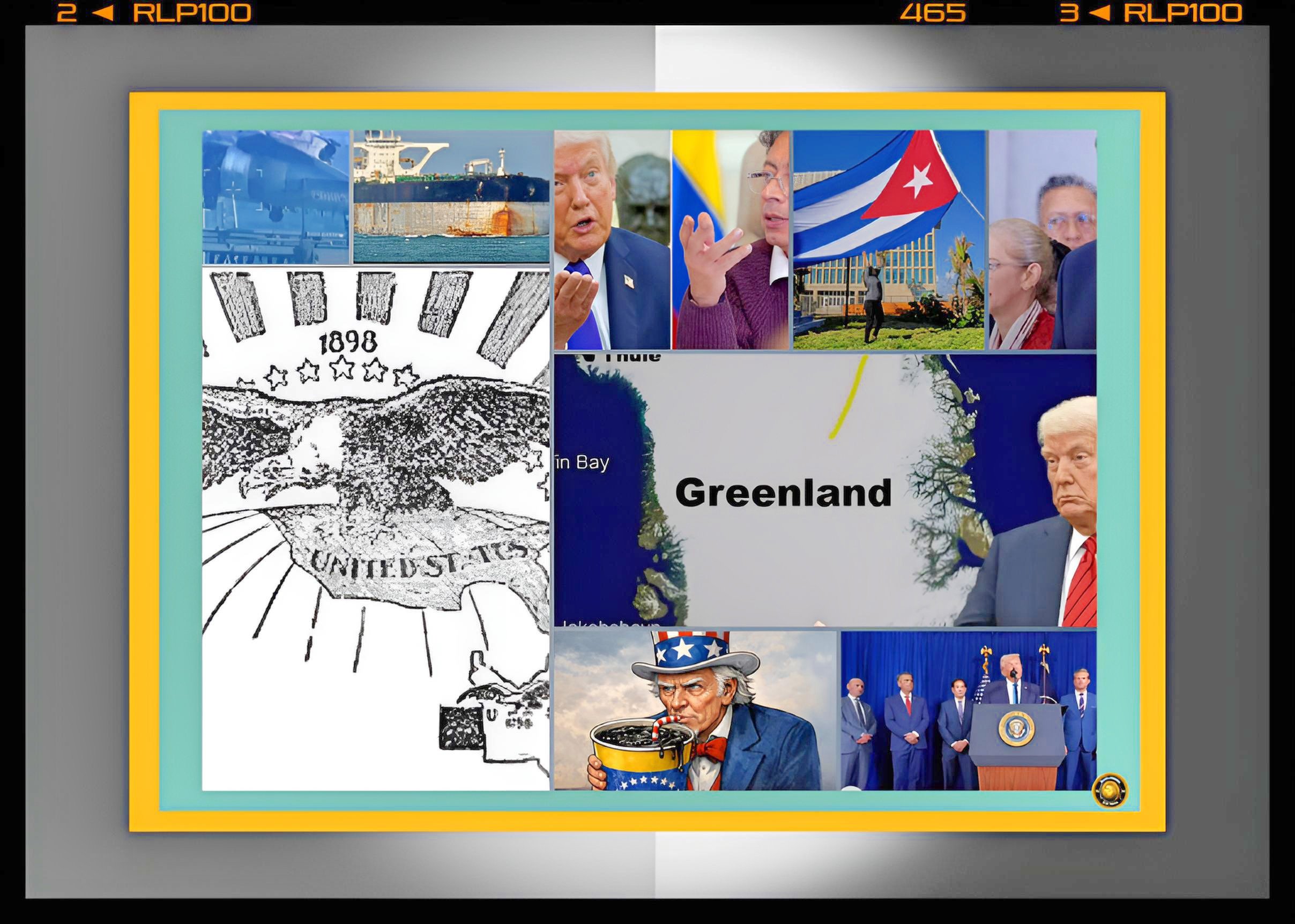
The Monroe Doctrine: Trump revives 19th-century hemispheric dominance through military intervention, regime change, and electoral strategies, leading the US to abandon international law
Executive Summary
THE TRUMP DOCTRINE OF HEMISPHERIC DOMINION: IMPERIAL AMBITION, REGIME CHANGE OPERATIONS, AND THE ELECTORAL CALCULATION RESHAPING AMERICAN FOREIGN POLICY
President Donald Trump's second term in office has witnessed the deliberate construction of an expansionist foreign policy architecture predicated upon direct military intervention, unilateral resource seizure, and the calculated intimidation of sovereign Latin American governments.
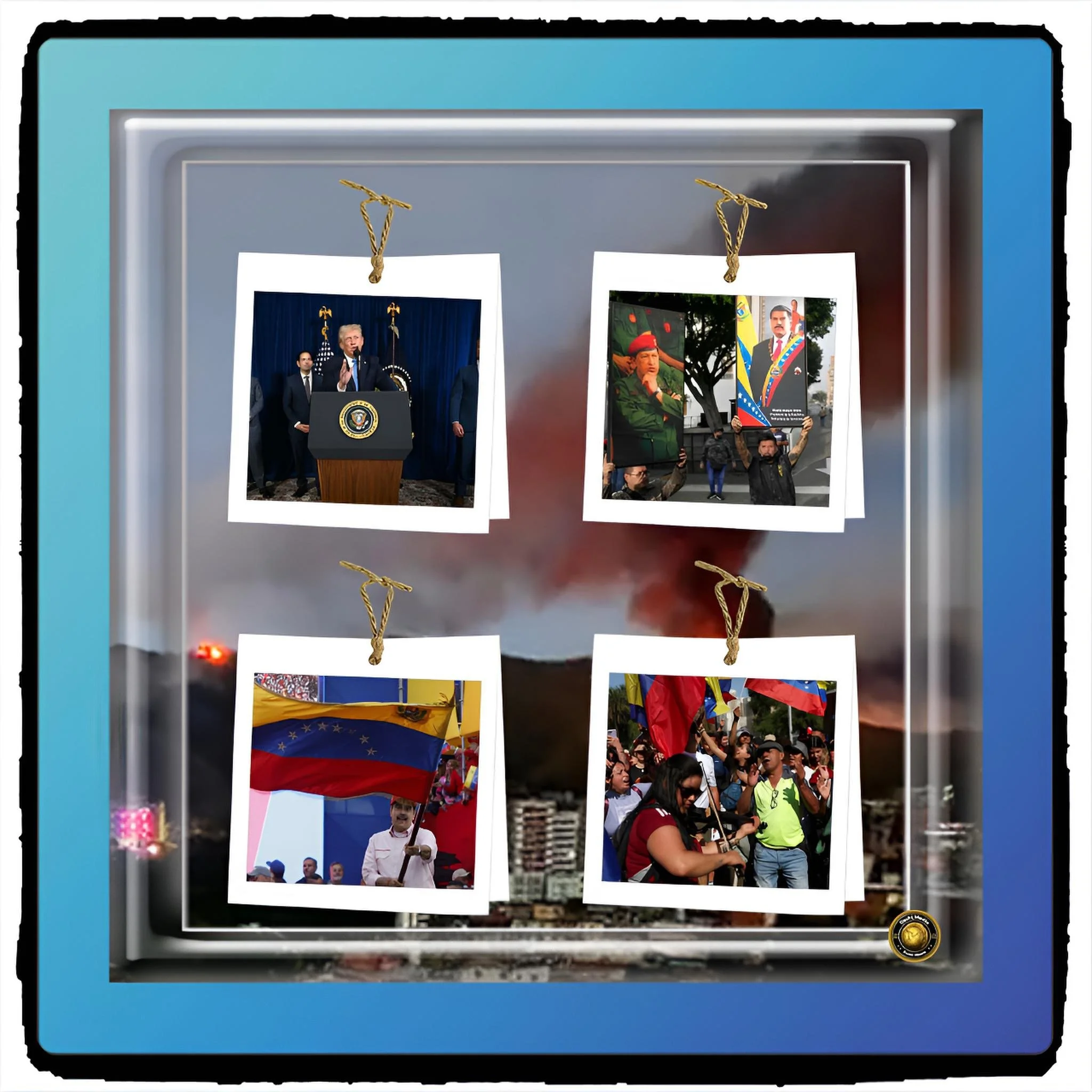
The January 3, 2026, military operation against Venezuelan President Nicolás Maduro—designated "Operation Absolute Resolve"—represents the most consequential assertion of American military dominance in the Western Hemisphere since the Cold War, fundamentally breaching established international legal norms governing state sovereignty and diplomatic conduct.
Trump's administration has explicitly articulated a strategy it terms the "Donroe Doctrine," a twenty-first-century iteration of nineteenth-century imperial presumption, aimed at eliminating Chinese and Russian influence from the Americas whilst establishing direct American administrative control over the hemisphere's oil resources, governmental structures, and geopolitical orientation.
Simultaneously, the administration has issued explicit military threats against the Democratic government of Colombia, articulated plans for the forcible acquisition of the Danish territory of Greenland, and commenced the economic strangulation of Cuba through the severance of Venezuelan petroleum supplies.
This aggressive repositioning of American foreign policy occurs amid materially declining presidential approval ratings, electoral vulnerability in the 2026 midterm elections, and mounting public disapproval of Trump's handling of inflation, healthcare, and employment—domains Americans consistently identify as their paramount concerns.
The evidence suggests that Trump's military interventionism constitutes simultaneously an expression of ideological commitment to American hemispheric dominion and a calculated electoral manoeuvre designed to distract domestic constituencies from the administration's failure to address the economic anxieties that drove public discontent with his predecessor.
Introduction: The Resurrection of American Imperialism in the Western Hemisphere
The Death of International Law: How Trump's Kidnapping of a Venezuelan President Established a Precedent of American Military Power Superseding Global Legal Norms and Democratic Sovereignty
The post-Cold War international order, whilst imperfect and frequently subverted by powerful states acting in perceived self-interest, operated under the rhetorical constraint that forcible regime change against sovereign nations violated established norms of international conduct.
The invasion of Iraq in 2003, widely recognized even by many American policymakers as fundamentally unjustified under international law, produced sufficient reputational damage that subsequent American administrations, including Trump's first term, approached regime change operations with rhetorical circumspection, preferring indirect pressure, economic sanctions, and support for opposition movements to direct military kidnapping of sitting heads of state.
This restraint, born from both international legal constraint and the costly lessons of Iraq and Afghanistan, appears to have dissolved entirely in Trump's second term.
Within seventy-two hours of returning to the office in January 2026, the Trump administration conceived and executed a large-scale military operation that captured Venezuelan President Nicolás Maduro and transported him to New York for prosecution on drug trafficking charges previously filed during the Biden administration.
The operation, involving approximately two hundred elite American commandos, aircraft striking Venezuelan air defense systems, and sustained combat operations in the capital city of Caracas, resulted in the death of approximately fifty-six individuals, including Venezuelan security personnel, Cuban military advisors, and American service members wounded in action.
Most extraordinarily, the Trump administration has not merely celebrated this operation as a counter-narcotics initiative or humanitarian intervention—framings that would at least engage with the language of international law—but rather openly proclaimed American intention to "run" Venezuela until American interests are satisfied, to seize Venezuelan oil for American benefit, and to dictate the composition and policies of Venezuela's interim government.
The Venezuelan operation is merely the most visible manifestation of a broader strategic reorientation explicitly articulated by Trump and his senior advisors.
The administration has threatened direct military action against Colombia unless President Gustavo Petro accedes to American demands regarding drug trafficking operations. It has declared that the acquisition of Greenland, a semi-autonomous Danish territory, is a "national security priority" and explicitly refused to rule out military annexation.
It has ceased even rhetorical pretense regarding the objective of engineering the collapse of Cuba's communist government, openly celebrating the likelihood that economic strangulation resulting from the Venezuelan intervention will generate a popular uprising.
And it has seized Russian-flagged oil tankers in international waters in operations that American officials candidly describe as enforceable "anywhere in the world," establishing a precedent of extraterritorial enforcement divorced from international maritime law.
This comprehensive repositioning of American foreign policy toward explicit hemispheric imperialism occurs at a moment when Trump's domestic approval ratings have declined precipitously from their early-2025 peaks, when Americans express mounting dissatisfaction with his administration's handling of the economic issues they identify as their primary concerns, and when the November 2026 midterm elections present genuine electoral jeopardy for Republican congressional majorities.
The temporal synchronization of aggressive foreign military operations with declining domestic political approval warrants rigorous examination of the possible electoral calculation underlying Trump's strategic shift toward interventionism.
Historical Context: The Nineteenth-Century Doctrine Reimagined for Geopolitical Competition
From Monroe Doctrine to Maduro Doctrine: Resurrecting Nineteenth-Century Imperialism for Twenty-First-Century Great-Power Competition Against China and Russia
To comprehend the coherence and radicalism of Trump's current foreign policy orientation, one must situate it within both the longer arc of American hemispheric presumption and the more immediate context of contemporary great-power competition with China and Russia.
The Monroe Doctrine, articulated by President James Monroe in 1823, asserted that European imperial powers had no legitimate authority to establish new colonies or extend political control in the Western Hemisphere. This claim simultaneously prohibited European imperialism and implicitly reserved hemispheric intervention for the United States.
Throughout the nineteenth and twentieth centuries, American presidents from Thomas Jefferson through William McKinley to Theodore Roosevelt interpreted this doctrine as justification for direct military interventions throughout Central America and the Caribbean, rationalized variously as preventing European encroachment, protecting American citizens or property, suppressing disorder, or combating communism.
The historical record encompasses American occupations of Haiti, the Dominican Republic, Nicaragua, and Panama; American support for military coups in Guatemala, Chile, Argentina, and elsewhere; the installation of American-friendly dictators; and the systematic pillaging of regional natural resources by American corporations operating under American military protection.
This history was not forgotten by Latin American populations, many of whom view contemporary American foreign policy through the accumulated trauma of systematic intervention and exploitation.
The late-twentieth-century leftward political drift in Latin America, which scholars termed the "pink tide," reflected, in part, the election of leaders and movements that explicitly rejected American hemispheric presumption and sought to establish independent foreign policies aligned with anti-imperial, socialist, or alternative development models.
Hugo Chávez in Venezuela exemplified this orientation, as did subsequent left-leaning leaders throughout the region. The 2024 American election of Trump, perceived across Latin America as potentially reviving imperial presumptions, generated apprehension that has now proven prescient.
The contemporary strategic context intensifying Trump's hemispheric ambitions involves the rise of China and Russia as geopolitical competitors willing to invest in hemispheric relationships that American policymakers previously took for granted.
China has become a primary market for Venezuelan and Brazilian commodities, has constructed extensive infrastructure throughout the region, and has cultivated diplomatic relationships with governments from Argentina to Mexico.
Russia, whilst possessing a lower economic capacity than China, has maintained military advisory relationships with various Latin American governments and positioned itself as a counterweight to American unilateralism.
Trump's administration views both powers as illegitimate intruders into the American sphere of influence and has explicitly committed itself to their elimination from the hemisphere.
The "Donroe Doctrine," as Trump's advisors term his strategic vision, represents thus an attempt to resurrect nineteenth-century presumptions of hemispheric dominion within the framework of twenty-first-century great-power competition.
Current Status: Operation Absolute Resolve and the Arrest of Nicolás Maduro
Operation Absolute Resolve: The Audacious 150-Minute Military Capture of a Sitting Head of State and the Cascade of Death Across Caracas and the Caribbean
On January 3, 2026, at approximately 2 a.m. Venezuelan Standard Time, the United States military commenced a large-scale operation designated "Operation Absolute Resolve," targeting the capital city of Caracas and specifically the fortified residence of President Nicolás Maduro located within the Fort Tiuna military complex.
The operation had been planned and rehearsed over the preceding months using a replica of Maduro's residence constructed for training purposes. Yet, Trump authorized its initiation only hours before execution, suggesting that the immediate timing responded to urgent considerations—whether intelligence regarding Maduro's potential flight, deterioration in Venezuelan government stability, or other factors remains partially obscured from public disclosure.
Approximately two hundred American military personnel, primarily members of the Army's elite Delta Force, conducted the operation, supported by fighter aircraft and bombers that conducted strikes against Venezuelan air defense systems to suppress the nation's capacity to intercept American helicopter insertions.
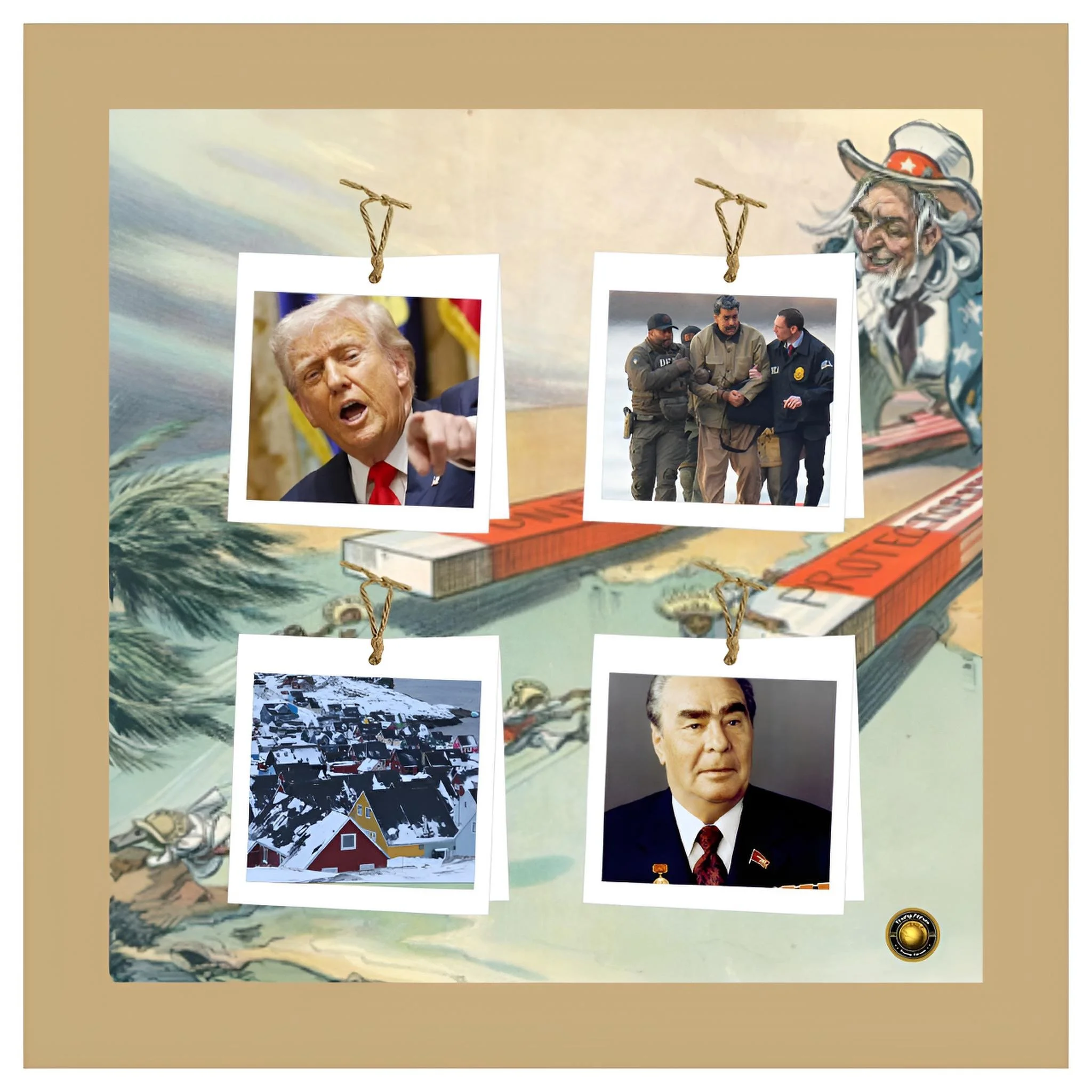
The operation proceeded with unexpected speed and success. Within approximately one hundred fifty minutes, American forces had reached Maduro's compound, breached it against armed resistance, apprehended Maduro and his wife Cilia Flores before they could reach an internal safe room, and extracted both individuals to American military custody.
Defense Secretary Pete Hegseth subsequently described the operational environment as one of sustained combat, with Maduro's security detail engaging American forces with heavy automatic weapons fire, and at least one American helicopter sustaining significant battle damage during extraction.
The apprehension of a sitting head of state and his spouse, conducted in their primary residence in their capital city, represents an extraordinary assertion of American military capability and disregard for established international legal constraints.
Maduro and Flores were transported via military aircraft to New York City, where they were delivered to federal custody and charged with drug trafficking and narco-terrorism offences previously filed against Maduro during the Biden administration in 2020.
The immediate aftermath of the operation witnessed the deaths of approximately twenty-four Venezuelan security personnel and approximately thirty-two Cuban military advisors and police personnel who had comprised significant elements of Maduro's security apparatus.
The Cuban casualties particularly underscore the international character of the intervention, as Cuba had maintained material military personnel presence in Venezuela for years, a relationship that Trump explicitly identifies as a target for elimination.
American casualties included seven service members wounded, with five returning to active duty and two remaining in recovery from gunshot and shrapnel injuries. The physical devastation to Caracas, and particularly the Fort Tiuna military complex, manifested in subsequently released imagery showing destroyed buildings, burned military vehicles, and evidence of intense direct fire combat.
Most extraordinarily, Trump announced that Nicolás Maduro had been captured not based on international cooperation or legal extradition, but rather through unilateral American military action lacking the consent, participation, or even advance notification of Venezuela's government.
No Latin American state consented to or participated in the operation. No United Nations authorization was sought or obtained. No international legal framework governed the action.
Instead, Trump ordered the operation and executed it through American military means, establishing in the process a precedent that American military power supersedes the sovereignty of other nations when American leadership determines that the situation warrants intervention.
Key Developments: The Cascading Assertion of American Dominance and the Articulation of the Monroe Doctrine
American Dominance Will Never Be Doubted Again: Trump's Explicit Articulation of the Monroe Doctrine and the Installation of a Compliant Puppet Interim Government in Venezuela
Following the immediate success of the Maduro apprehension, Trump has escalated progressively more explicit assertions of American hemispheric dominance, articulated in language that evokes nineteenth-century imperial presumption rather than twenty-first-century diplomatic convention.
Upon returning to Washington, Trump declared: "American dominance in the Western Hemisphere will never again be doubted." He explicitly referenced the Monroe Doctrine, claiming that American policy has "superseded" that nineteenth-century doctrine and that current American strategy has become so dominant that it merits attaching his own name—the "Donroe Doctrine"—to distinguish it from the original Monroe formulation through its unprecedented assertiveness.
This rhetorical positioning accompanies concrete policy actions aimed at Venezuelan governance. Rather than installing a recognizable opposition figure who had competed against Maduro in the disputed 2024 Venezuelan election, Trump instead elevated Delcy Rodríguez, who had served as Vice President in Maduro's administration and who, when sworn in as interim president by Venezuela's Constitutional Chamber, explicitly denounced Maduro's "kidnapping" by the United States and demanded his repatriation.
The irony appears entirely lost on Trump's administration: having arrested the Venezuelan president on grounds of alleged electoral fraud, Trump then refused to recognize the opposition candidate with plausible claims to electoral legitimacy, instead installing an individual intimately associated with the regime he had just overthrown.
This pattern suggests that Trump's objective was not democratic restoration in Venezuela but rather the installation of a compliant interim leadership willing to subordinate Venezuelan sovereignty to American resource extraction interests.
Trump's administration has made unmistakably clear the substantive demands placed upon Venezuela's interim government. Secretary of State Marco Rubio, a Cuban American with long-standing ideological opposition to leftist Latin American governments, has communicated explicitly that Venezuela must sever all relationships with China, Iran, Russia, and Cuba—demands that fundamentally reshape Venezuela's international relationships and subordinate Venezuelan strategic independence to American preference.
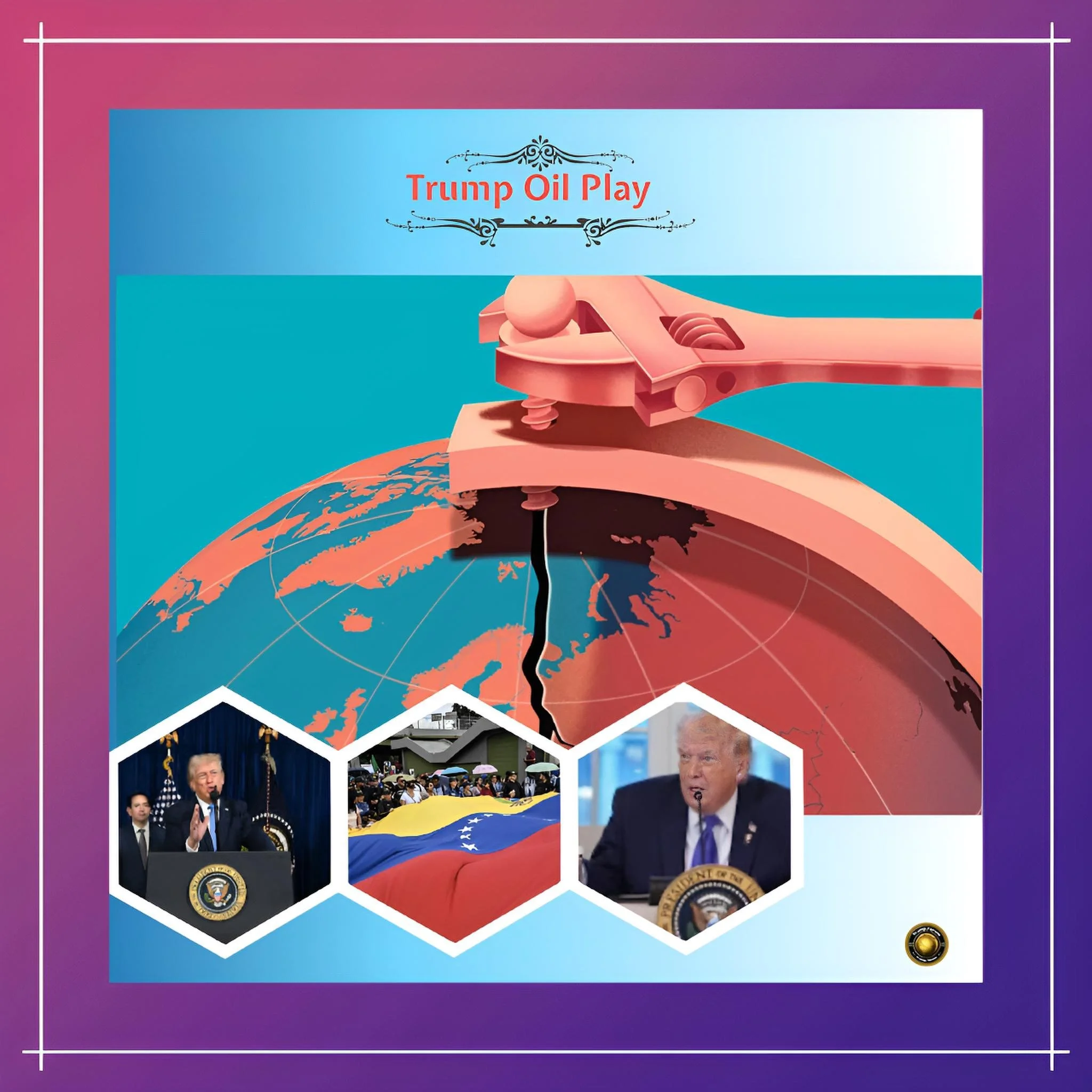
Venezuela must agree that any oil production will be carried out by American companies and on American terms. Venezuelan oil revenues will be controlled by the American government, which will determine their utilization for "the benefit of Venezuelan and American peoples"—language that politely obscures the fact that American officials will determine resource allocation.
The Trump administration has stationed more than fifteen thousand American service members offshore from Venezuela and has explicitly threatened that should the interim government fail to comply with American demands, "we will do a second strike."
This threatening language appears calibrated to convey that Venezuela's government retains authority only so long as it remains aligned with American interests. When Trump warned Delcy Rodríguez that her failure to comply would result in a fate "worse than Maduro's," he articulated plainly the subordination of Venezuelan governance to American will.
The message transmitted to other Latin American leaders is unmistakable: cooperation with the United States means survival in office; resistance results in American military intervention and removal from power.
Latest Facts and Concerns: The Expansion of Military Threats and the Seizure of Foreign Vessels
Threats Across the Hemisphere: Trump Threatens Colombian Regime Change, Denounces Mexican Resistance, Seizes Russian Vessels on International Waters, and Demands Greenland's Annexation Through Military Means
The Venezuela operation has emboldened the Trump administration to articulate military threats against multiple other Latin American governments with unseemly directness. Colombia's President Gustavo Petro, a leftist who has been vocal in his criticism of the Venezuelan intervention, has become a specific target of Trump's public intimidation.
Trump has characterized Petro as "a sick man who enjoys producing cocaine and selling it to the United States," threatened unspecified military action against Colombia, and when asked whether he contemplated an army operation similar to the Venezuelan strike, replied,”
The threatening rhetoric extends to Mexico, where Trump has warned President Claudia Sheinbaum that "something will have to be done," and has explicitly offered to deploy American military forces to assist in combating drug trafficking organizations—an offer that Sheinbaum prudently declined.
The pattern suggests that Trump intends to establish through demonstrated military willingness in Venezuela a hierarchy of Latin American compliance with American demands, enforced by the implicit threat of military intervention.
Simultaneously, the Trump administration has expanded its assertions of American enforcement authority into maritime spaces far removed from American territorial waters.
The seizure of the Marinera—a Russian-flagged oil tanker formerly designated as the Bella-1—occurred in the North Atlantic Ocean between Iceland and Britain, thousands of kilometers from American coastlines. The vessel had been sanctioned by the American government on the grounds that it violated American sanctions against Venezuelan oil sales.
Trump administration officials have articulated the position that American enforcement authority extends "anywhere in the world" and that the administration will seize any vessel involved in sanctioned commerce regardless of its location or flag of registry.
Defense Secretary Pete Hegseth proclaimed that "the blockade of sanctioned and illicit Venezuelan oil remains in FULL EFFECT—anywhere in the world."
The Marinera seizure itself warrants detailed examination. The vessel had been tracked by American forces for two weeks as it transited toward European ports, initially evading an attempted American Coast Guard boarding during adverse weather conditions.
The vessel subsequently changed its name to Marinera and began flying a Russian flag—tactics seemingly designed to evade American seizure by exploiting international maritime conventions regarding flag state authority. Notwithstanding these maneuvers, American special forces conducted a military boarding operation via helicopter, captured the vessel, and took custody of its crew.
The Russian Foreign Ministry protested the seizure, characterizing it as a violation of international maritime law and noting that the vessel was operating thousands of kilometers from American territory, seemingly establishing that American enforcement reaches to international waters without apparent limitation.
The operation also seized a second vessel, M/T Sophia, reportedly involved in illicit Caribbean oil commerce. When asked whether the tanker seizure risked escalation with Russia, White House Press Secretary Karoline Leavitt responded that the vessel had "flown a false flag," was "deemed stateless," and therefore American seizure was justified under maritime law—a creative legal interpretation, to put it charitably, that extends American enforcement jurisdiction in ways that appear to contradict established international maritime convention.
Greenland Acquisition and the Abandonment of NATO Constraint
Violating NATO Commitments: Trump's Threat to Seize a Danish Territory and the Potential Dissolution of the Western Alliance to Secure Arctic Dominance
Beyond the Western Hemisphere, Trump's administration has expanded its assertions of justified territorial acquisition to encompass a semi-autonomous Danish territory in the Arctic.
Beginning in early January 2026, Trump commenced public articulation of American interest in acquiring Greenland, initially through purchase and subsequently through explicit refusal to exclude military annexation as a policy option. His stated rationale—that Greenland constitutes a "national security priority" for the United States and that American control is "absolutely necessary" for American security—reflects a geopolitical logic centered on Arctic dominance, the containment of Russian and Chinese presence, access to mineral resources and rare earth elements, and the strategic positioning of military installations in the Arctic region.
The Greenland acquisition objective is particularly audacious because Greenland constitutes a semi-autonomous territory of Denmark, which is itself a member of the North Atlantic Treaty Organization. The NATO treaty establishes that military attack upon one member constitutes military attack upon all members and obligates collective defense.
Prime Minister Mette Frederiksen of Denmark has stated unambiguously that American military action against Greenland or Denmark would constitute a violation of NATO's foundational principles and would render NATO's continued existence meaningless.
She has further stated that such action would "mark the end" of the NATO alliance and would constitute an abandonment by the United States of the international legal order that has governed Western security relationships for nearly three-quarters of a century.
Trump's response to these explicit warnings has been to acknowledge Greenland's Danish sovereignty only whilst simultaneously insisting that American acquisition is necessary and justifiable. When Frederiksen warned that American military annexation would end NATO, Trump mocked her efforts to defend Greenland, quipping that Denmark had recently "only added one more dog sled" to Greenland's defensive capabilities—a characterization both factually inaccurate and disdainfully dismissive of an allied nation's security concerns.
Secretary of State Marco Rubio has privately communicated to congressional leaders that the administration's preference would be to purchase Greenland from Denmark rather than seize it militarily, but the White House has explicitly refused to exclude military action from the range of policy options.
The statement from Deputy Chief of Staff Stephen Miller emphasized that Greenland occupies such "strategic" importance that American acquisition is imperative, and the White House Press Office has declared that "the use of U.S. military force remains a choice at the Commander-in-Chief's command."
This language, seemingly designed to communicate to both Denmark and Greenland that American military action is possible and that negotiation should proceed with American preferences in view, represents an extraordinary assertion of American willingness to violate NATO commitments and international law to acquire territory it perceives as strategically valuable.
Cause-and-Effect Analysis: The Destruction of International Norms and the Assertion of Unilateral American Power
The Systematic Destruction of International Legal Order: How Venezuela's Capture Established Precedent for Unilateral American Military Action, Eliminated Constraints on Presidential Power, and Normalized Imperial Assertion
The sequence of Trump's military actions and threats represents an internally coherent strategy predicated upon the deliberate destruction of international legal norms governing state sovereignty, military intervention, and the conduct of international relations. The destruction proceeds through multiple mechanisms operating in mutually reinforcing fashion.
First, the Venezuela operation itself established the precedent that American military power supersedes international law. The kidnapping of a sitting head of state, conducted without international authorization, legal justification, or the consent of any other state, communicated that American presidents can order the forcible removal of foreign governments when American leadership deems it advantageous.
No longer would America require UN Security Council authorization, no longer would America frame interventions as humanitarian or defensive in character, no longer would America operate within the rhetorical constraints of international law. Rather, American military power would be deployed openly to serve American strategic interests, and American power would justify itself.
Second, the cascade of subsequent threats against Colombia, Mexico, and Denmark operates by demonstration of resolve and capability. Trump's military success in Venezuela establishes his credibility regarding subsequent threats against other Latin American governments.
When Trump threatens military action against Colombia unless Petro complies with American drug trafficking demands, Petro must calculate the probability that Trump intends his threat seriously based on recent demonstration of American military willingness.
The threat thus carries weight that similar rhetoric from previous American presidents might have lacked, precisely because Trump has demonstrated through action that military intervention no longer requires international justification or legal authorization.
Third, the assertion of American enforcement authority "anywhere in the world" represents an explicit rejection of the principle that international waters belong to no nation and that vessels on international waters operate under the authority of their flag states.
By seizing Russian-flagged vessels thousands of kilometers from American territory, the Trump administration asserts that American economic interests supersede international maritime convention.
This assertion further normalizes the principle that American power operates beyond legal constraint when American leadership deems it necessary. If America can seize foreign vessels on international waters, then America can presumably seize other assets, conduct other operations, and pursue other interests anywhere on the globe that American power can reach.
Fourth, the Greenland acquisition objective represents the ultimate expression of this logic—the assertion that American control of territories historically belonging to other nations is justified by reference to American strategic interests.
The Greenland demand further communicates that even NATO alliance membership does not protect states from American territorial demands; indeed, NATO membership becomes merely a negotiating point rather than a defense.
If Denmark cannot resist American acquisition of its territory through alliance with the United States, then no state can rest assured that territory it currently occupies will remain beyond American territorial ambitions.
The underlying effect of this cascade of actions and assertions is to establish a new international order in which American military power and American economic interest operate as the supreme authority, with international law, alliance commitments, state sovereignty, and democratic legitimacy as secondary considerations to be observed when convenient but violated when American strategic advantage seems to warrant violation.
This represents a fundamental departure from the international legal order that has constrained, albeit imperfectly, the behavior of great powers since the completion of World War II.
The Nexus Between Foreign Military Interventionism and Domestic Electoral Politics
The Venezuela Operation as Midterm Spectacle: How Declining Approval Ratings and Economic Discontent Drive Trump's Military Interventionism as Political Distraction During Electoral Vulnerability
Most troubling for democratic governance is the apparent temporal and causal relationship between Trump's declining domestic approval ratings and his escalating assertions of foreign military dominance. Trump entered his second term in January 2025 with approval ratings exceeding fifty percent and with apparent mandate for his policy agenda.
By December 2025, his approval had declined to approximately 42% , a dramatic eight-point decline over eleven months. The deterioration has been particularly severe among the demographic groups that Trump had cultivated most assiduously—Hispanics, young adults, and independents have expressed the most acute disappointment with Trump's performance and have shifted decisively toward Democratic party affiliation for purposes of the 2026 midterm elections.
The source of Trump's declining approval is not mysterious. Americans consistently identify inflation, employment, healthcare, and economic opportunity as their paramount concerns.
74% of Americans rate current economic conditions as fair or poor. Seventy-one percent believe that prices have risen since Trump took office, with 43% percent characterizing the increase as "much higher" than pre-Trump conditions.
Only 14% of Americans report being better off than they were a year ago. When voters are asked which party's House candidates they will support in the upcoming 2026 midterm elections, Democrats hold an advantage of five point three percentage points—a dramatic swing from the Republican advantage 2.6 % points in the 2024 general election. Republicans currently maintain slim majorities in both the House and Senate; an adverse midterm election could result in loss of one or both chambers to Democratic control.
The 2026 midterm elections will constitute a referendum on Trump's second-term performance. November 2026 will be only eleven months away from the time of this analysis, and Trump's administration must enter that election period with improved approval ratings, economic conditions, or demonstrated accomplishments sufficient to retain the Republican congressional majorities upon which Trump's capacity to govern depends. It is highly unlikely that economic conditions will improve sufficiently to generate voter satisfaction, as inflation remains embedded in prices and wage growth has failed to keep pace with price increases.
The administration's economic policies—predicated on tariff escalation and fiscal spending reductions—do not promise near-term amelioration of the economic grievances that most concern Americans.
In this context, Trump's military interventionism in Venezuela and his assertion of American hemispheric dominance constitute a comprehensible electoral strategy. The Venezuelan operation generates spectacle and demonstrates American power in a domain where Trump can claim clear success.
The media focus on American military operations in Venezuela diverts attention from the failure of Trump's economic policies to deliver tangible improvement in American household circumstances. The celebration of Trump as a strong leader willing to use military force against hostile regimes appeals to his political base and generates enthusiasm among conservatives who value American assertiveness.
The operation simultaneously creates an opportunity for Trump to claim vindication regarding American foreign policy from critics who might otherwise focus on the domestic economic failures that underlie Trump's electoral vulnerability.
Moreover, the timing of the Venezuelan operation warrants scrutiny. Trump authorized the operation only hours before its execution, suggesting either that urgent intelligence or tactical circumstances necessitated immediate action, or that Trump determined that political circumstances warranted the demonstration of executive decisiveness and military strength at this particular juncture.
The operation occurred during a period of mounting media criticism regarding Trump's economic policies, his administration's apparent inconsistency in policy implementation, and the expression of discontent within the Republican base regarding Trump's handling of various policy initiatives.
A major military victory offered the prospect of redirecting political narrative and recapturing media attention on terrain where Trump could claim undeniable success.
Pressing Socio-Economic and Political Concerns: Cuba's Anticipated Collapse and Regional Destabilization
Economic Strangulation as Geopolitical Weapon: Trump's Strategy of Engineered Cuban Collapse, Regional Destabilization, and Humanitarian Catastrophe in Service of Regime Change Objectives
The Trump administration's strategy encompasses not merely the capture of Venezuela's government but the calculated collapse of Cuba's communist regime through economic strangulation. Trump has explicitly articulated his belief that "Cuba looks like it's ready to fall" and that the United States need not undertake military intervention because economic pressure resulting from the Venezuelan operation will generate spontaneous Cuban regime collapse.
The logic, which Secretary of State Marco Rubio has articulated extensively, proceeds from the proposition that Cuba has depended almost entirely upon Venezuelan oil supplies for meeting its energy needs and for generating scarce hard currency through re-export arrangements. Should Venezuela's oil cease flowing to Cuba—a likely consequence of Trump's control over Venezuelan petroleum—then Cuba's economy will collapse within months, popular desperation will generate uprising, and the communist government will fall to internal pressure.
This assessment reflects a profound misunderstanding of Cuba's capacity to endure economic hardship and the willingness of Cuban leaders to tolerate population suffering rather than surrender state control. Cuba survived the collapse of the Soviet Union and the loss of Soviet economic subsidies during the 1990s, a period of unimaginable hardship for ordinary Cubans but one that did not generate regime-threatening popular uprising.
The Cuban government demonstrated capacity to maintain security apparatus control over population and to distribute suffering equitably across social strata in ways that prevented factionalization sufficient to generate successful revolutionary challenge. Rubio's assertion that Venezuelan oil cessation will produce inevitable regime collapse projects an understanding of Cuban political economy that historical evidence does not support.
Nevertheless, the Trump administration's apparent intention to impose economic strangulation on Cuba with the objective of generating regime collapse represents a chilling precedent regarding American willingness to weaponize humanitarian access in service of geopolitical objectives.
Embargoes and economic sanctions imposed on civilian populations with the explicit intention of generating population suffering sufficient to provoke domestic political change constitute, under international humanitarian law, violations of obligations to protect civilian populations.
The historical experience of embargo and sanctions regimes—Iraq in the 1990s, contemporary Gaza, North Korea—suggests that such regimes typically produce humanitarian catastrophe without generating the political change that imposing powers anticipate, instead generating profound suffering among vulnerable populations whilst strengthening regime control through nationalism and external threat perception.
The prospect of Cuba's economic collapse carries implications far beyond the island nation itself. Cuban migration flows to the United States have historically been subject to political conflict; Trump's prior statements regarding migration suggest his administration would likely seek to prevent Cuban refugee flows to the United States and would resist humanitarian obligations to accept migrants fleeing economic collapse.
The humanitarian catastrophe that would accompany Cuba's economic strangulation could generate millions of potential migrants, creating an unprecedented migration crisis in the Caribbean region and generating destabilization throughout Latin America.
Beyond Cuba, the Trump administration's threats against Colombia and Mexico threaten to destabilize two of the largest and most consequential states in Latin America.
The Colombian economy depends significantly upon petroleum exports and agricultural commerce; threats of American military intervention or economic coercion could generate capital flight, currency instability, and broader economic crisis.
Mexico, facing formidable challenges from drug trafficking organizations, confronts the prospect of American threats of intervention at the precise moment when Mexican governance capacity is constrained and when American military pressure could destabilize the political equilibrium.
The prospect of American military intervention in Mexico, even threats thereof, carries the potential to generate instability in a nation whose economic integration with the United States is so extensive that Mexican instability would directly affect American security and prosperity.
Future Steps and the Institutional Imperatives of American Democracy
The Circumscribed Capacity of Democratic Institutions to Constrain Executive Imperialism: Congress, Allies, and International Law as Secondary Considerations in Trump's Calculation of Hemispheric Dominion
The continuation of Trump's expansionist foreign policy trajectory throughout 2026 will depend substantially upon whether the administration perceives that military interventionism and assertions of hemispheric dominance generate domestic political benefits sufficient to offset the costs of such policies. Should the Venezuelan operation improve Trump's approval ratings and should assessments of Trump's foreign policy strength help stabilize Republican electoral prospects entering the 2026 midterms, then the administration will likely continue to employ military pressure, threats, and direct interventionism as preferred policy mechanisms.
Conversely, should it become apparent that foreign policy assertiveness fails to offset domestic economic discontent, then Trump might pivot toward prioritization of domestic economic messaging.
The institutional capacity of American democracy to constrain Trump's foreign policy ambitions appears circumscribed. The Republican Party, whilst containing scattered voices (Senators Jean Shaheen and Thom Tillis offered modest criticism of Greenland rhetoric), largely supports Trump's interventionist posture and provides little constraint on executive initiative.
Democrats, unable to prevent the Venezuelan operation and aware that Maduro possessed no sympathetic constituency within American political discourse, have exercised strategic restraint in attacking Trump on Venezuela but risk legitimizing a precedent of unilateral military intervention that could be employed against allied nations or in other contexts where Democratic constituencies would mobilize in opposition.
Congress retains theoretical authority to declare war and to appropriate funds; however, Trump's administration has demonstrated capacity to conduct military operations through executive initiative whilst later seeking appropriations, presenting Congress with a fait accompli from which reversing course would be politically difficult.
The international constraints operating against Trump's expansionism appear equally limited. America's NATO allies have articulated explicit warnings regarding the consequences of military action against Greenland; however, these warnings appear to generate little restraint within the Trump administration, which seems to calculate that even NATO's dissolution would be preferable to American allowance of Chinese or Russian strategic advantage.
Russia has protested the seizure of the Marinera and has threatened retaliation; however, Russia's capacity to constrain American action in Latin America appears limited, and Trump administration officials appear to calculate that Russian threats carry minimal weight in dictating American behavior. China has offered little public response to American hemispheric assertions, though Chinese leadership presumably views the American repositioning with apprehension.
The most likely trajectory involves Trump's continued assertion of military dominance in the Western Hemisphere, coupled with escalating threats and intimidation against Latin American leaders perceived as insufficiently aligned with American interests. The Venezuelan operation has established a precedent that Trump can enforce through demonstration of military capability and credible willingness to employ force.
Colombia, Mexico, and potentially other states will be subject to American pressure utilizing that demonstrated precedent. The Greenland acquisition objective will likely remain a subject of Trump's public assertion, with the level of military pressure varying based on Trump's calculation regarding the political benefit of aggressive assertion versus the costs of potential NATO rupture.
Conclusion
The Collapse of the Post-War International Order: How Trump's Abandonment of Legal Constraint, Alliances, and Democratic Principle in Pursuit of Hemispheric Dominion May Precipitate the Very Great-Power Conflict His Doctrine Claims to Prevent
Trump's second-term foreign policy represents a fundamental departure from the post-World War II international order predicated upon law, alliance, and mutual constraint among great powers. Through the Venezuelan operation, the seizure of foreign vessels on international waters, the threats against allied and non-aligned governments, and the assertion of territorial acquisition rights over non-American territory, Trump has articulated a vision of American power unconstrained by international law, alliance commitment, or democratic legitimacy in other nations.
This vision, which his administration has termed the "Donroe Doctrine," represents nineteenth-century imperialism dressed in contemporary geopolitical language and justified by reference to national security rather than by the explicit racist and economic rationales that characterized historical American imperialism.
The evidence available strongly suggests that this foreign policy expansionism serves simultaneously to express Trump's ideological commitment to American dominion and to constitute a calculated electoral maneuver designed to deflect domestic political attention from the administration's failure to address the economic anxieties that constitute Americans' paramount concern.
The Venezuelan operation, timed for maximum political impact in the context of declining approval ratings and mounting midterm electoral jeopardy, offers spectacle and the demonstration of presidential decisiveness at precisely the moment when Trump's economic policies have failed to generate the price stability and employment opportunity that Americans desire.
Should the operation generate improved approval ratings and electoral prospects, the administration will likely persist in military interventionism and hemispheric assertion. Should it become apparent that foreign policy spectacle cannot compensate for domestic economic failure, Trump may alter course.
The Abandonment of the International Legal Order and the Triumph of Power Over Principle
What appears certain is that the international legal order constraining great-power behavior has been fundamentally disrupted. Subsequent American presidents, whether Republican or Democratic, may feel emboldened to employ military force in pursuit of national interest without international authorization.
Other great powers, observing American disregard for international law, may conclude that compliance with legal constraint is disadvantageous and may emulate American behavior. The tragic irony is that Trump's administration, claiming to advance American national security through assertion of hemispheric dominance, may instead be facilitating the collapse of the international legal order that has permitted the unprecedented American security and prosperity of the post-Cold War era.
The cost of restoring that order, should its collapse prove irreversible, could dwarf any strategic advantage gained through Venezuelan regime change or access to its oil reserves.