Venezuela's Looming Abyss: How America is Manufacturing Its Next Failed State
EXECUTIVE SUMMARY
The Inevitable Quagmire: Why Venezuela Will Be Worse Than Iraq
The unfolding crisis in Venezuela represents a critical inflection point in contemporary inter-American relations, bearing disconcerting parallels to the strategic miscalculations that characterized the 2003 Iraq intervention.
This analysis examines the structural similarities between both scenarios, identifies key differentiators, and evaluates the trajectory toward potential state failure.
The capture of President Nicolás Maduro through direct military action, while achieving immediate regime decapitation, has precipitated a governance vacuum that existing institutional frameworks appear inadequate to fill. Current indicators suggest Venezuela is positioned to replicate Iraq's descent into prolonged instability, with the added complexities of pre-existing economic collapse, the integration of regional criminal networks, and the absence of cohesive opposition structures.
The confluence of maximalist American objectives, fragmented Venezuelan political actors, and deteriorating socioeconomic conditions creates a recipe for sustained conflict rather than democratic transition.
INTRODUCTION
From Baghdad to Caracas: Repeating History's Expensive Mistakes
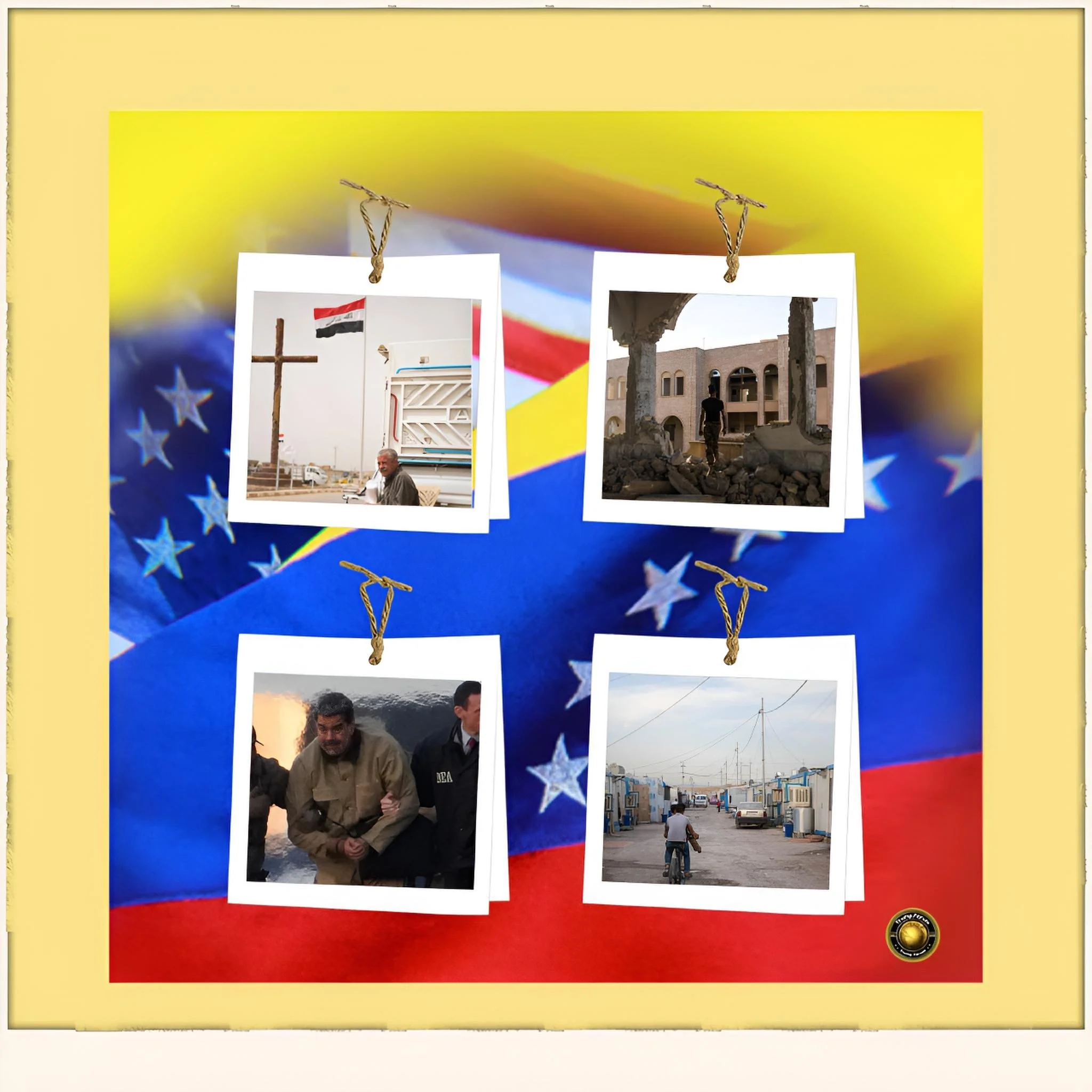
The January 2026 American military operation in Caracas, which led to the forcible removal of President Nicolás Maduro, has reignited vigorous debate over unilateral interventionism and its long-term efficacy in achieving strategic objectives. Proponents of the operation cite the necessity of confronting narco-terrorism and restoring democratic governance in the Western Hemisphere.
Critics, drawing from the bitter lessons of Iraq, warn that military success absent political coherence inevitably yields catastrophic humanitarian consequences and strategic overextension.
The fundamental question confronting policymakers is whether Venezuela will serve as a testament to learned strategic wisdom or constitute another chapter in the recurring pattern of American interventions that achieve tactical victory while engendering strategic defeat.
The stakes extend far beyond Caracas, encompassing regional stability, great power competition, and the viability of coercive diplomacy as a foreign policy instrument.
HISTORY AND CURRENT STATUS
A Decade of Decay: Venezuela's Road to Ruin
Venezuela's contemporary crisis traces its origins to the death of Hugo Chávez in 2013, which transferred power to Nicolás Maduro amid collapsing oil revenues and institutional decay.
The subsequent decade witnessed systematic democratic backsliding, economic mismanagement that led to hyperinflation, and the emigration of approximately 7 million citizens.
American policy evolved from targeted sanctions against regime officials to comprehensive sectoral restrictions on the petroleum industry, culminating in the 2025 designation of the Cartel de los Soles as a foreign terrorist organization.
The January 2026 operation, which deployed over 150 military aircraft and resulted in Maduro's capture, represented an unprecedented escalation. Vice President Delcy Rodríguez assumed interim leadership under American pressure, while opposition figures, including María Corina Machado and Edmundo González Urrutia, continued to claim legitimate authority.
The resultant power configuration leaves Venezuela under a weakened Chavista remnant, facing internal fragmentation, external coercion, and a population traumatized by years of deprivation.
KEY DEVELOPMENTS
The Capture That Changed Everything: Anatomy of a Failed Gambit
The military operation's immediate aftermath revealed several critical developments shaping Venezuela's trajectory.
First, the Trump administration's decision to recognize Rodríguez while bypassing the opposition leadership demonstrated a preference for regime continuity over democratic transition, mirroring Iraq's initial reliance on Ba'ath Party structures.
Second, the imposition of a naval blockade has severed approximately 70 percent of oil export capacity, eliminating the primary source of revenue for public-sector employment and social programs.
Third, the release of political prisoners, while symbolically significant, occurs absent institutional reforms necessary to prevent arbitrary detention.
Fourth, Colombian military operations against guerrilla groups near the border introduce additional kinetic complexity, potentially drawing Venezuela into regional conflict.
Fifth, Russian and Chinese diplomatic support for Maduro's release, combined with continued economic engagement, signals that great power competition will persist as a complicating factor.
These developments collectively indicate that regime decapitation has not produced regime change, but rather regime fragmentation.
LATEST FACTS AND CONCERNS
Countdown to Collapse: The Numbers That Terrify Experts
The current situation presents several alarming facts that demand immediate analytical attention. The Venezuelan state employs approximately three million people, whose salaries depend entirely on oil revenues, now severely constrained by American interdiction. PDVSA, the national oil company, faces imminent collapse in the absence of operational capacity and international market access.
The military and security services, while nominally loyal to Chavista leadership, exhibit signs of fracturing along patronage and personal loyalty lines. Paramilitary groups and colectivos, armed civilian militias, have expanded territorial control in urban and rural areas, establishing parallel governance structures.
The humanitarian situation, with 70 percent of households experiencing food insecurity and healthcare infrastructure in advanced decay, creates conditions for mass civilian casualties regardless of military engagement levels. International humanitarian organizations report difficulty accessing populations due to security vacuums and American restrictions on transactions with Venezuelan entities.
The specter of 1990s Somalia, where state collapse enabled warlordism, looms as an increasingly plausible scenario.
CAUSE-AND-EFFECT ANALYSIS
The Self-Fulfilling Prophecy: How Sanctions Create the Chaos They Aim to Prevent
The causal chain leading to Venezuela's potential quagmire status reveals multiple reinforcing feedback loops. American sanctions, intended to pressure regime elites, have instead degraded state capacity across all sectors, weakening the very institutions necessary for post-conflict governance.
The oil embargo, while strategically targeting regime finances, simultaneously eliminates employment for tens of thousands whose cooperation will be essential for stabilization.
Military intervention, designed to accelerate transition, has paradoxically strengthened hardline elements within the security apparatus by validating their narratives of external threat and eliminating potential moderate successors.
The recognition of Rodríguez, meant to ensure continuity, delegitimizes opposition actors who invested years building democratic credentials and international support. Regional dynamics compound these effects, as Colombian operations against border groups create refugee flows and justify Venezuelan military mobilization.
Each policy choice, rational in isolation, generates second-order consequences that collectively push Venezuela toward state failure rather than democratic consolidation.
FUTURE STEPS
Five Paths to Disaster: Why Every Option Leads to Failure
Several pathways exist, though each carries substantial risk. The transactional approach, favoring Rodríguez's interim government in exchange for oil concessions and counter-narcotics cooperation, prioritizes short-term American interests while deferring democratic governance.
This path likely yields a frozen conflict with persistent instability and criminal state capture. The transitional approach, demanding immediate elections under international supervision and opposition leadership, risks military backlash and potential civil war as Chavista elements resist disempowerment.
The maximalist approach, involving deeper American military engagement to dismantle remaining regime structures, replicates AQ's strategic error in dissolving the de-Ba'athificatory sector.
The regionalization approach, empowering Latin American partners to lead diplomatic and stabilization efforts, conflicts with Trump's unilateralist doctrine but offers the sole mechanism for legitimate, sustainable governance.
The most probable scenario involves managed decay, where America maintains military pressure without committing to state-building, allowing Venezuela to deteriorate into a controlled crisis zone managed through periodic interventions.
CONCLUSION
The Quagmire is Already Here: Accepting the Inevitable
Venezuela's trajectory toward quagmire status reflects not an inevitable fate but a policy choice. The Iraq analogy, while imperfect, illuminates recurring patterns: emphasis on military solutions over political strategy, prioritization of immediate objectives over long-term stability, and underestimation of local agency and complexity.
Washington's current approach appears designed to avoid Iraq's mistakes of occupation and state dismantling, yet may be repeating the more fundamental error of believing external actors can engineer political outcomes without deep local partnership and institutional legitimacy.
Venezuela differs from Iraq in possessing weaker state institutions, deeper economic collapse, and more fragmented opposition, suggesting recovery will prove more difficult, not less.
The question is no longer whether Venezuela becomes a quagmire, but how deep and prolonged the morass will become, and at what cost to Venezuelan lives, American credibility, and regional security.
The window for alternative pathways narrows with each passing day of economic strangulation and political paralysis.