Exploring the Absurdities of Military Protocol through the Lens of Catch-22: A Critical Analysis : Offensive Against Iran - Contrasting Trump's Tactical Approach with genuine ideals of American Dream
Introduction
Exploring the Absurdities of Military Protocol through the Lens of Catch-22: A Critical Analysis of the Strategic Implications of a Potential Offensive Against Iran - Contrasting Trump's Tactical Approach with the Genuine Ideals of the American Dream.
Joseph Heller’s Catch-22 stands as one of the most penetrating satirical critiques of military bureaucracy ever written, and its themes resonate powerfully with contemporary military operations, particularly the recent U.S. bombardment of Iranian nuclear facilities.
The novel’s exploration of institutional absurdity, paradoxical reasoning, and disproportionate responses finds striking parallels in modern strategic military decisions, suggesting that the satirical elements Heller identified in World War II remain embedded in today’s military-industrial complex.
The Architecture of Absurdity
At the heart of Catch-22 lies the eponymous paradox that traps soldiers in an inescapable logic loop: airmen can only be excused from dangerous missions if declared mentally unfit.
However, requesting such an excuse demonstrates sanity, thus disqualifying them from relief.
This circular reasoning exemplifies what Heller identified as the fundamental absurdity of bureaucratic power structures, where regulations serve not to protect individuals but to perpetuate institutional control.
The novel presents a military hierarchy plagued by incompetent leadership and arbitrary decision-making.
Colonel Cathcart repeatedly raises the number of required missions not for strategic military purposes but to enhance his prospects for promotion.
This self-serving manipulation of military policy, divorced from actual military necessity, creates what literary scholars have identified as a critique of absolute power and institutional corruption.
Heller’s satirical approach employs dark humor as a weapon against patriarchal values and institutions, using obscene language and grotesque scenarios to expose the dehumanizing effects of military bureaucracy.
The characters are reduced to “caricatures and character-types, devoid of exceptionality and uniqueness,” reflecting how institutional systems strip away individual humanity in service of organizational objectives.
Modern Echoes: The Iran Strike and Strategic Absurdity
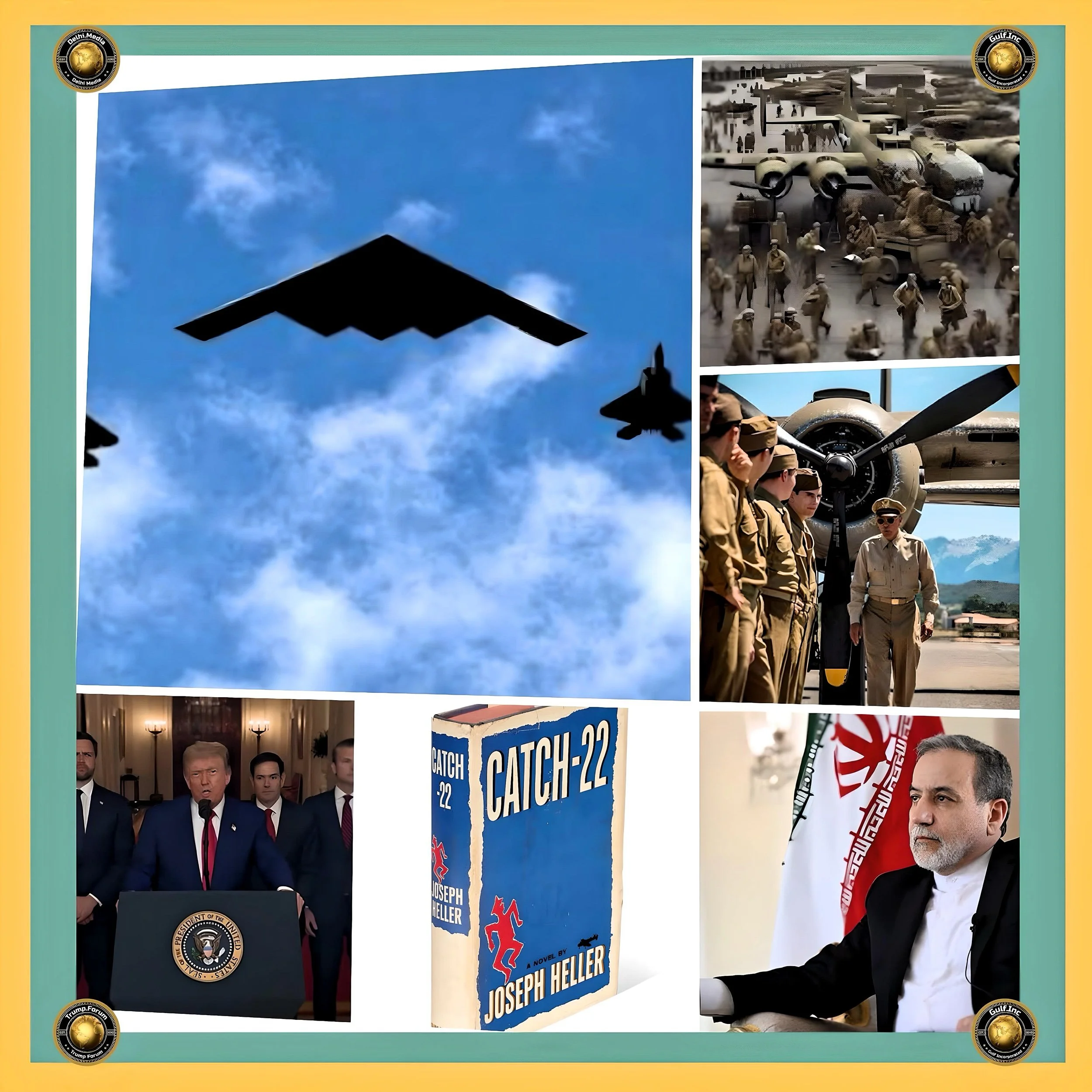
⏩The recent U.S. military operation against Iranian nuclear facilities, designated “Operation Midnight Hammer,” presents remarkable parallels to the institutional absurdities that Heller satirized.
⬇️The deployment of seven B-2 Spirit bombers, each costing $2.1 billion, for a 36-hour mission reflects the disproportionate resource allocation that characterizes bureaucratic excess.
The operation’s scale becomes particularly striking when considered within its broader context.
The B-2 program, with only 21 aircraft ever produced at a cost of approximately $44 billion, represents one of the most expensive military programs in history.
⬇️Deploying one-third of this entire fleet for a single operation against three facilities suggests the kind of heavy-handed approach that Heller would have recognized as symptomatic of institutional overreach.
Political Rhetoric and Contradictory Logic
⏩The political rhetoric surrounding the Iran strikes echoes the paradoxical reasoning that defines Catch-22.
President Trump’s statements demonstrate the same kind of contradictory logic that Heller satirized: claiming successful “obliteration” of Iran’s nuclear capabilities while simultaneously threatening further strikes if peace doesn’t come quickly.⏪
This mirrors the novel’s central theme, which is that bureaucratic pronouncements often contradict observable reality.
Trump’s oscillation between diplomatic overtures and military threats—offering “honey” rather than “vinegar” while deploying massive destructive force—exemplifies the cognitive dissonance that characterizes bureaucratic decision-making in Heller’s work.
The simultaneous pursuit of negotiation and overwhelming military force creates a catch-22: Genuine diplomatic engagement becomes impossible when conducted under the shadow of disproportionate military pressure.
The Persistence of Bureaucratic Irrationality
Contemporary military analysis reveals that the institutional problems Heller identified persist in modern defense establishments.
Studies of military bureaucracy continue to identify “organizational frictions” and “structural deficiencies” that impede effective decision-making.
Former Defense Secretary Robert Gates’s observations about Pentagon bureaucracy—requiring “a large number of organizations to be involved in even the smallest decisions,” leading to decision-making paralysis—directly echo Heller’s satirical portrayals.
➡️The Iran operation’s complexity, involving extensive coordination between multiple agencies, international partners, and sophisticated technological systems, demonstrates how modern military bureaucracy has amplified rather than resolved the institutional inefficiencies that Heller criticized.
The mission required decoy flights, multiple refuelings, and elaborate operational security measures, suggesting that bureaucratic complexity often creates as many problems as it solves.
Strategic Implications and Satirical Resonance
↪️The deployment of such expensive, sophisticated weapons platforms in Iran for what critics argue was primarily a political demonstration rather than a military necessity reflects the same disconnect between means and ends that permeates Catch-22.
The novel’s critique of military operations conducted more for bureaucratic self-interest than strategic effectiveness finds contemporary expression in whether the Iran strikes served genuine security objectives or primarily domestic political purposes.
Heller’s portrayal of military leaders who “are more concerned about their promotions and recognition than about the lives of their men or civilians” resonates with contemporary concerns about political calculations driving military decisions.
⤵️The Iran operation’s timing and scale suggest considerations beyond pure military necessity, reflecting the kind of institutional self-interest that Heller identified as corrupting military decision-making.
Conclusion
The Enduring Relevance of Satirical Critique
The parallels between Catch-22 and contemporary military operations demonstrate the enduring relevance of satirical literature as a lens for understanding institutional behavior.
Heller’s work continues to provide a framework for recognizing and critiquing the absurdities inherent in large bureaucratic systems, particularly when those systems wield enormous destructive power.
The novel’s exploration of how bureaucratic logic can become divorced from rational purpose remains as relevant today as when Heller first wrote about World War II.
The Iran strikes, with their enormous cost, complex execution, and questionable strategic necessity, exemplify the kind of institutional thinking that prioritizes demonstrating capability over achieving proportionate results.
Modern military satirists and critics continue to draw on Heller’s insights, recognizing that “the absurdity of bureaucracy” remains a persistent feature of institutional life.
The gap between official rhetoric about military precision and effectiveness and the often chaotic, expensive, and politically motivated reality of military operations suggests that the catch-22s Heller identified have evolved but not disappeared.
The comparison between Heller’s fictional bombardier trapped in institutional paradoxes and contemporary strategic bombers deployed in the service of contradictory political objectives reveals the persistent tension between individual rationality and institutional logic.
Just as Yossarian struggled against a system that claimed to protect him while placing him in mortal danger, modern military personnel and civilians must navigate institutions that claim to enhance security while often creating new forms of insecurity and absurdity.
➡️In this light, Catch-22 serves not merely as historical fiction but as a continuing critique of how bureaucratic institutions operate when freed from meaningful accountability.
The novel’s satirical power lies in its ability to reveal the human cost of institutional absurdity.
This relevance persists in an era of multi-billion-dollar military operations conducted for purposes that often seem as circular and self-defeating as the paradoxes Heller so brilliantly satirized.