Introduction
Two of the nation’s most prominent constitutional law experts have joined the legal battle challenging President Donald Trump’s sweeping tariff regime, marking a significant escalation in what experts predict will become a landmark Supreme Court case on the limits of presidential power.
Neal Katyal and Michael McConnell announced their participation as co-counsel in the high-stakes litigation on June 25, 2025, bringing heavyweight legal firepower from opposite political spectrums to the constitutional challenge.
Katyal, former acting solicitor general under President Barack Obama and current head of Supreme Court and Appellate Practices at Milbank LLP, has argued over 50 cases before the Supreme Court—more than any other minority litigator in history.
McConnell, a former federal appeals court judge appointed by President George W. Bush and current Stanford Law School professor, is recognized as one of the nation’s leading conservative originalist constitutional scholars.
The Legal Challenge
The duo has joined V.O.S. Selections, Inc. v. Trump, a case filed by the Liberty Justice Center on April 14, 2025, challenging Trump’s “Liberation Day” tariffs imposed under the International Emergency Economic Powers Act (IEEPA).
The lawsuit argues that Trump exceeded his constitutional authority by using emergency powers to impose a 10% baseline tariff on virtually all imports and higher country-specific tariffs on China (20%), Mexico, and Canada (25%).
“More than any other case challenging executive action, the tariff cases combine fundamental principles of structural constitutional law with immense consequences for the economy,”
McConnell stated. Katyal emphasized his unique perspective: “I used to administer IEEPA for the government, and no one ever thought it authorized what he is doing here”.
Court Victories and Appeals
The constitutional challenge was won on May 28, 2025, when the U.S. Court of International Trade unanimously ruled that Trump exceeded his authority.
The three-judge panel—including one Trump appointee—found that the Constitution grants Congress exclusive power over trade regulation, which cannot be overridden by presidential emergency authority.
The court issued a permanent injunction blocking enforcement of the tariffs.
However, within 24 hours, the U.S. Court of Appeals for the Federal Circuit granted the administration’s request for a stay, temporarily reinstating the tariffs while the case proceeds.
The appeals court has scheduled oral arguments for July 31, 2025, with amicus briefs due by July 8.
Constitutional Stakes and Major Questions Doctrine
The cases present what legal experts call an unprecedented test of presidential power over trade policy.
The challenge centers on whether IEEPA, designed for economic sanctions during national emergencies, grants presidents authority to impose broad tariffs.
While President Nixon used a predecessor statute to impose a 10% import surcharge in 1971, no president had used IEEPA for tariffs until Trump.
The Court of International Trade’s decision notably relied on the “major questions doctrine”—a conservative legal theory that requires Congress to “speak clearly” when authorizing actions of “economic or political significance”.
This doctrine, which the Supreme Court used to block Biden’s student loan forgiveness plan in 2023, may now work against Trump’s tariff authority.
Path to the Supreme Court
Given the constitutional questions and massive economic impact, multiple legal observers expect the Supreme Court to ultimately intervene.
At least two separate cases are working through the federal court system.
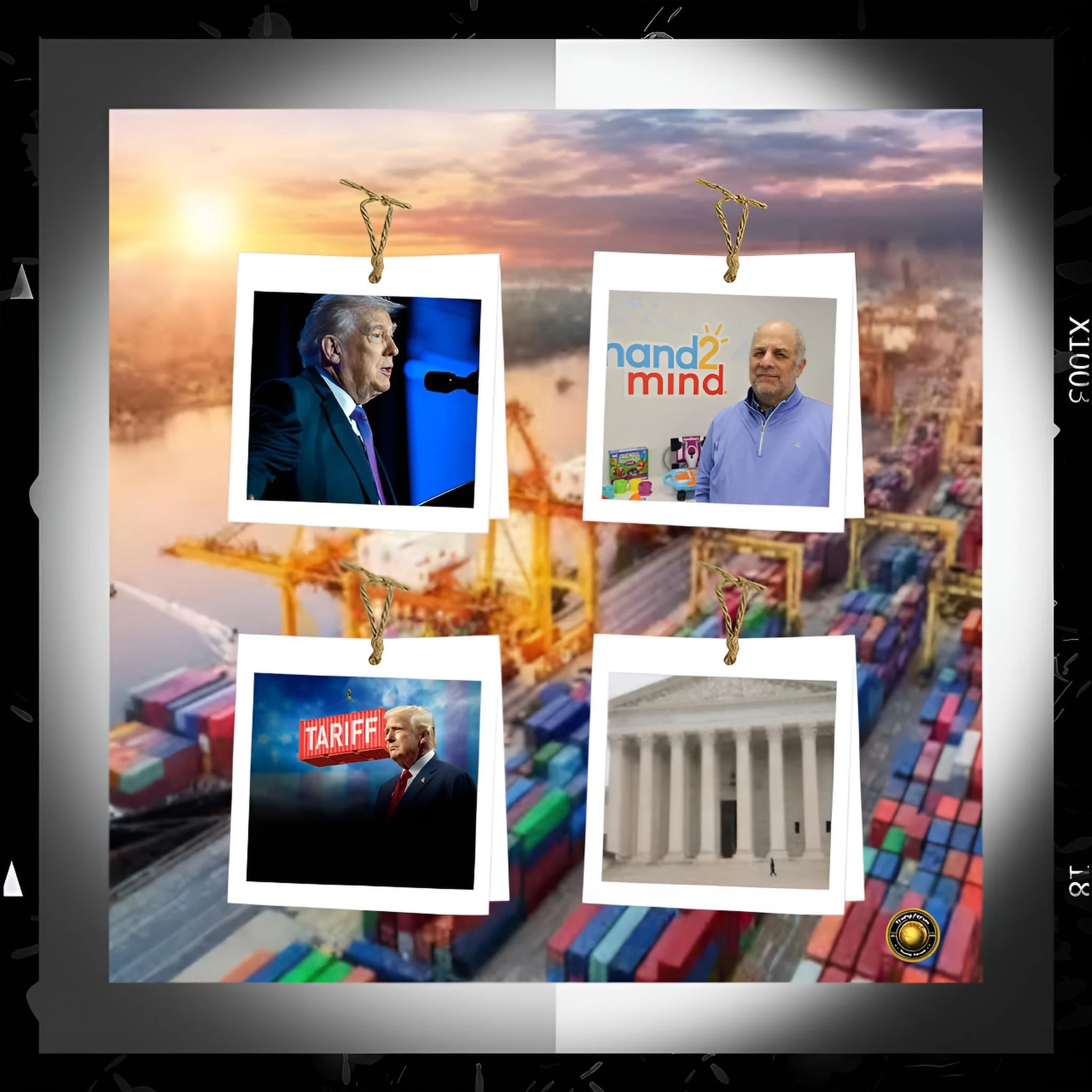
Two Illinois toy companies, Learning Resources and hand2mind, asked the Supreme Court on June 17 to expedite review of their challenge, though the court denied their request for expedited review on June 20.
According to SCOTUSblog, the justices “rarely opine on trade issues,” with their last major tariff case decided in 2009.
Elizabeth Goitein of the Brennan Center told Democracy Now that “this is headed toward the Supreme Court in the next term”.
Firm Agreements Complicate Legal Landscape
The participation of Katyal and McConnell’s firms adds complexity to the legal battle. Milbank, Katyal’s firm, is among nine major law firms that reached agreements with Trump in April 2025 to provide $100 million in pro bono legal services to causes supported by the administration.
Similarly, McConnell’s firm Wilson Sonsini was among firms that agreed to provide $125 million in pro bono services.
Despite these agreements, both lawyers emphasized their commitment to constitutional principles over political considerations.
“These presidential actions fall on the wrong side of the line,” Katyal stated, adding his commitment to “vindicating our Founders’ view of the separation of powers”.
The Justice Department filed its opening brief on June 24, arguing that Congress had delegated tariff authority to the president and that Trump properly invoked the economic emergency law.
The administration promised to appeal to the Supreme Court if the appeals court rules against it.
With the Federal Circuit hearing scheduled for July 31 and the involvement of constitutional law luminaries from both political camps, the tariff challenge represents a defining moment for the scope of executive power in the modern era.