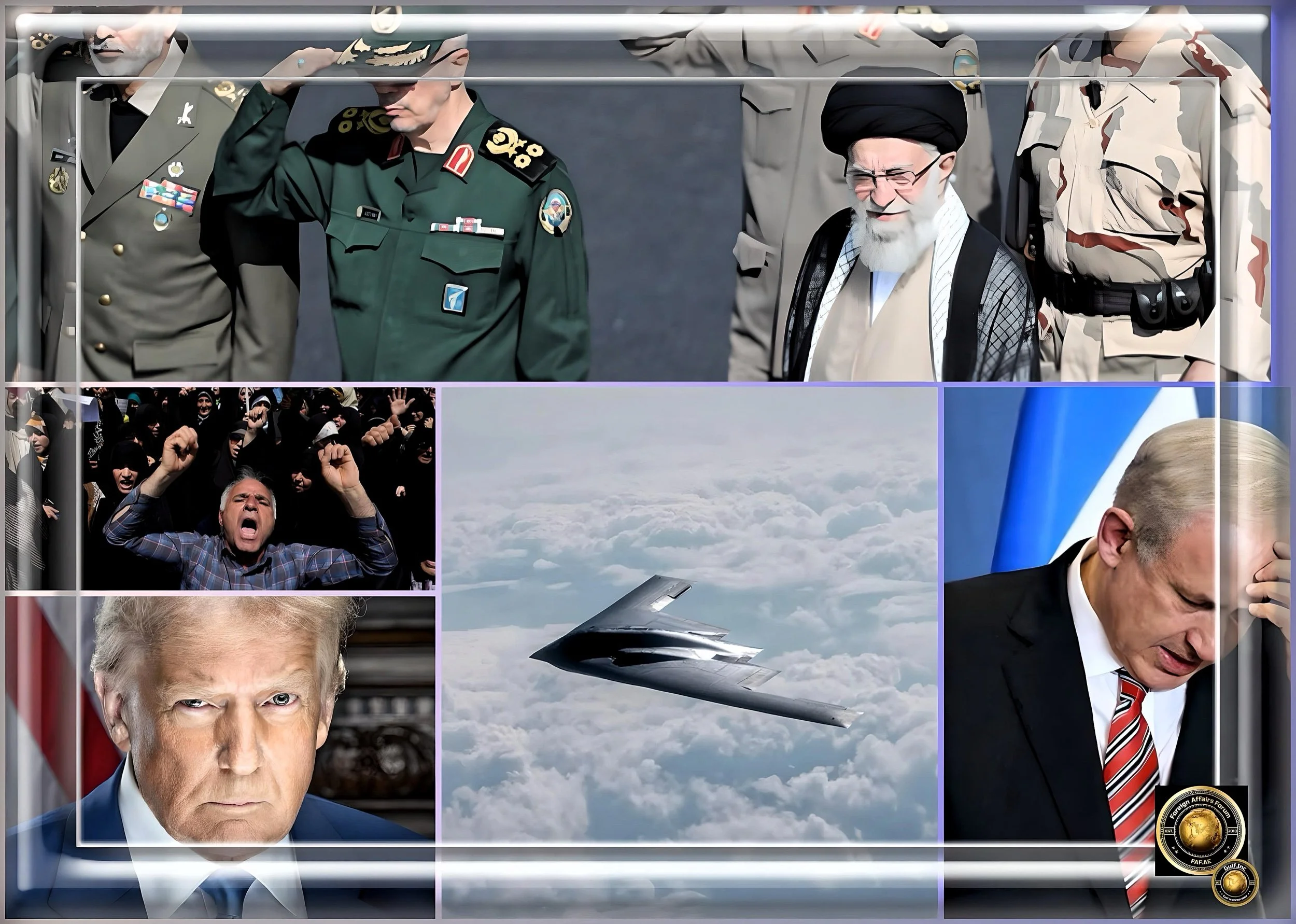
Bunker Buster Bombs: Israel’s Request for US Deep-Penetration Weapons
Introduction
The ongoing Israel-Iran conflict has escalated dramatically in June 2025, with Israel launching “Operation Rising Lion” on June 13, targeting Iran’s nuclear facilities and military installations.
FAF, Defense.Forum analyzes the role of bunker buster bombs in this conflict, particularly regarding the GBU-57A/B Massive Ordnance Penetrator (MOP) and its potential use against Iran’s deeply buried Fordow nuclear facility.
The conflict represents a significant escalation from previous exchanges between the two nations.
The Current Israel-Iran War
Israel’s “Operation Rising Lion” began on June 13, 2025, with coordinated airstrikes against dozens of targets across Iran, including nuclear sites, military installations, and residential areas.
The Israeli Defense Forces (IDF) claimed to have damaged key nuclear sites and military installations, while Iran has retaliated with ballistic missiles and drone attacks under its own operation codenamed “True Promise III”.
Recent developments include
Israeli warplanes bombing approximately 20 locations in Tehran overnight on June 17-18, targeting missile production facilities
Mass evacuations from Tehran as civilians flee the capital
President Trump considering options that include joining Israel in attacking Iranian nuclear sites
Human rights groups reporting at least 585 people killed across Iran, including 239 civilians
Iran warning that U.S. intervention would risk “all-out war” in the region
GBU-57A/B Massive Ordnance Penetrator: Technical Analysis
Specifications and Capabilities
The GBU-57 MOP is currently the most powerful conventional bunker-busting weapon in the U.S. arsenal. Its key specifications include:
Weight
30,000 pounds (13,608 kg)
Length
20.5 feet (6.2 meters)
Diameter
31.5 inches
Explosive payload
5,342 pounds of high explosives, consisting of 4,590 pounds of AFX-757 and 752 pounds of PBXN-114
Guidance system
GPS/INS (Global Positioning System/Inertial Navigation System)
Penetration Capabilities
The GBU-57 MOP’s penetration capabilities are specifically designed for hardened underground targets:
Can penetrate up to 200 feet (61 meters) of reinforced concrete with a strength of 5,000 PSI
Can penetrate approximately 40 meters (125 feet) of moderately hard rock
Can penetrate about 8 meters (25 feet) of reinforced concrete with a strength of 10,000 PSI
Smart Fuze Technology
The bomb employs advanced detonation technology
Equipped with a Large Penetrator Smart Fuze (LPSF) that adjusts detonation timing based on impact depth and target characteristics
Features void-sensing fuzes that trigger detonation if a large cavity is detected within the bunker
Includes a delayed-action fuze allowing the warhead to survive initial impact before detonating
B-2 Spirit: The Only Delivery Platform
Aircraft Specifications
The B-2 Spirit stealth bomber is currently the only aircraft capable of delivering the GBU-57 MOP
Payload capacity
Over 40,000 pounds (18,144 kg) internally
Range
6,000 nautical miles (11,000 km) unrefueled, extending to over 10,000 nautical miles with aerial refueling
Maximum takeoff weight
336,500 pounds (152,634 kg)
Crew
Two (pilot and mission commander)
Power plant
Four General Electric F118-GE-100 turbofans, each producing 17,300 pounds of thrust
Operational Considerations
The B-2’s stealth capabilities make it uniquely suited for penetrating sophisticated air defense systems:
Low observability derived from reduced infrared, acoustic, electromagnetic, visual, and radar signatures
Can operate at altitudes up to 50,000 feet (15,000 meters)
Each B-2 can carry up to two GBU-57 MOPs per mission
The U.S. Air Force operates approximately 19 active B-2A aircraft
Current Deployment
The United States has forward deployed a significant portion of its B-2 fleet:
Approximately six B-2 bombers (about one-third of the total fleet) were deployed to Diego Garcia in the Indian Ocean in early 2025
This represents about half of the B-2s considered fully operational at any given time
Satellite imagery confirmed the presence of these bombers alongside refueling tankers
However, reports indicate they were “no longer visible by mid-June”
Iran’s Fordow Nuclear Facility
Strategic Importance
Fordow is considered Iran’s most critical and heavily fortified nuclear facility:
Houses Iran’s largest number of its most powerful centrifuges, according to the IAEA
Currently enriching uranium to 60% purity, just below the 90% weapons-grade threshold
Described by experts as “the heart of Iran’s nuclear programme”
Brett McGurk, who has served as Middle East coordinator for several American presidents, noted: “If you don’t get Fordow, you haven’t eliminated their ability to produce weapons-grade material”
Defensive Features
Fordow’s formidable defenses make it exceptionally difficult to target:
Depth
Built 80-110 meters (260-360 feet) underground within a mountain near Qom
Location
Approximately 100-160 kilometers south of Tehran
Geology
Protected by layers of hard sedimentary rocks including limestone and dolomite that absorb bomb impacts
Air defenses
Protected by Russian-made S-300 surface-to-air missile systems
Original purpose
Initially constructed as an Islamic Revolutionary Guard Corps missile base before being converted to a nuclear facility
Current Status
Despite Israel’s extensive strikes on other nuclear facilities, Fordow appears to have remained largely unscathed:
The IAEA has confirmed that Fordow was not damaged during Israel’s initial strikes
While Israel successfully damaged the Natanz facility and Isfahan’s uranium conversion facility, it “apparently failed to damage the underground Fordow Fuel Enrichment Plant”
The facility’s rock shielding renders it resistant to routine airstrikes
Israel’s Military Limitations
Current Bunker Buster Capabilities
Israel’s existing arsenal lacks the capability to effectively destroy Fordow
Israel possesses smaller bunker busters like the BLU-109 and GBU-28, but these can only penetrate a fraction of the depth required to reach Fordow’s core facilities
The BLU-109 can penetrate only about 1.8 meters of reinforced concrete
The GBU-28 can penetrate approximately 6 meters, still far short of Fordow’s depth
Mark Schwartz, a retired U.S. Army lieutenant general and Rand Corporation researcher, stated: “Only the United States has the conventional capacity to obliterate Fordo”
Potential Alternative Approaches
Some Israeli officials have suggested alternative strategies for targeting Fordow:
A senior Israeli military official recently told The Wall Street Journal that Israel possesses both a strategy and operational capacity to target Fordow independently
Ehud Eilam, a former researcher for Israel’s Ministry of Defense, outlined potential approaches including deploying numerous smaller penetrating munitions to burrow into Fordow’s defenses
Other options might include high-risk special operations missions, cyber warfare, or targeted assassinations of key personnel
However, military analysts maintain that the American-made GBU-57 remains the most promising option for neutralizing the facility
U.S. Strategic Considerations
Current U.S. Posture
The United States under President Trump appears to be weighing military options while pursuing diplomatic solutions:
Trump has threatened Iran with “bombing the likes of which they have never seen before” if Tehran does not sign a deal on its nuclear program
The deployment of B-2 bombers to Diego Garcia is viewed as a strategic message to Iran
Trump reportedly cut short his appearance at the G7 summit to attend a National Security Council meeting on the Middle East crisis
The White House announced that Trump would depart the G7 summit earlier than planned due to the escalating situation in the Middle East
Potential for U.S. Intervention
Several factors suggest the U.S. is preparing for possible military action:
Reports indicate that a National Security Council meeting debated a possible strike on Iran’s Fordow nuclear facility
Trump stated at the G7 Summit: “Iran will not win in this battle” and called on Tehran to return to negotiations “before it’s too late”
Trump has been engaged in nuclear negotiations with Iran while simultaneously building up military pressure
The president commented: “I think Iran is at the negotiating table, they want to make a deal”
Implications of Potential Fordow Strike
Regional and Global Consequences
A successful strike on Fordow would have far-reaching implications:
Nuclear program setback
Would cripple Iran’s most secure uranium enrichment facility, potentially setting back its nuclear program by years
Escalation risk
Iran has warned that U.S. intervention would risk an “all-out war” in the region
Civilian impact
Thousands of people are already fleeing Tehran amid the current airstrikes
Diplomatic fallout
Iran might withdraw from the Nuclear Non-Proliferation Treaty, ending international inspections
Oil market disruption
Escalation in the Gulf region would likely cause oil prices to spike
Historical Precedents
Previous strikes on nuclear facilities provide context for potential outcomes:
Israel’s 1981 bombing of Iraq’s Osirak reactor (Operation Opera) delayed Iraq’s nuclear ambitions but led to international condemnation
Israel’s 2007 destruction of a suspected Syrian nuclear reactor set back Syria’s program but raised questions about the use of force
These precedents suggest that while military strikes can delay nuclear programs, they rarely eliminate the underlying knowledge or motivation
Conclusion
The current Israel-Iran conflict has reached a critical juncture, with Israel’s “Operation Rising Lion” targeting Iran’s nuclear infrastructure but unable to neutralize the deeply buried Fordow facility
The GBU-57 MOP, deliverable only by American B-2 bombers, represents the sole conventional weapon capable of potentially destroying this hardened target.
President Trump’s decision on whether to authorize the use of this weapon or provide it to Israel will likely determine the trajectory of the conflict.
Such a decision would represent a significant escalation, potentially drawing the United States into direct conflict with Iran while fundamentally altering the strategic balance in the region.
As thousands flee Tehran and both sides exchange missile strikes, the international community watches closely to see whether diplomatic efforts will prevail or if the conflict will escalate further into what Iran has warned could become an “all-out war”