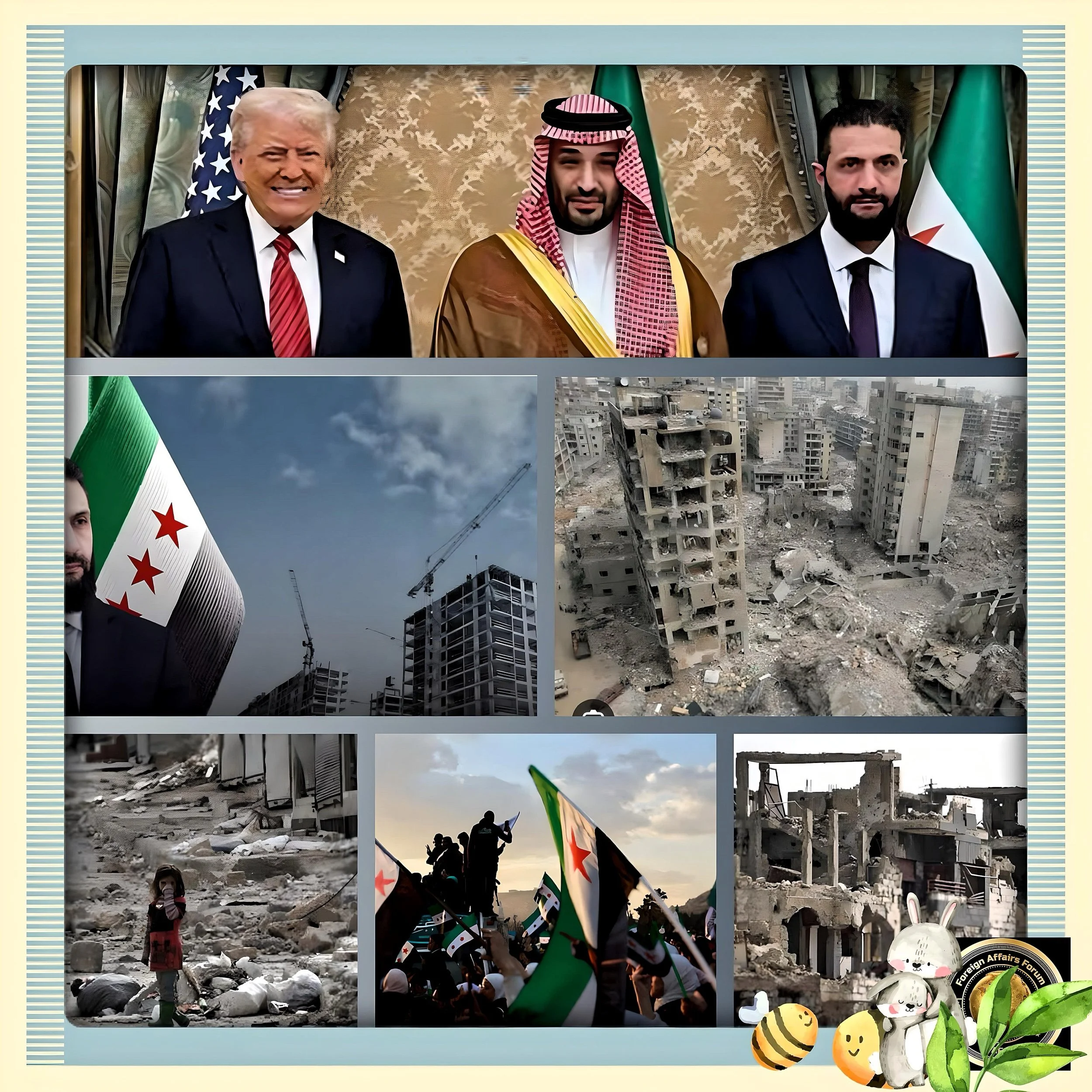
Syria’s Reconstruction Plan: Navigating Political Shifts and Financial Realities
Introduction
Since the fall of the Assad regime in December 2024, Syria has entered a critical transitional period with significant implications for its reconstruction.
Recent developments, including the U.S. removal of sanctions and President Trump’s meeting with Syria’s new leader, Ahmed al-Sharaa, signal a dramatic policy shift that has created opportunities and confusion.
*Gulf.Inc., a FAF subsidiary, examines current reconstruction plans, the U.S. financial situation, changing diplomatic positions, and the complex path to rebuilding war-torn Syria.
Current Plans for Syria’s Reconstruction
The scale of Syria’s reconstruction needs is immense, reflecting the devastating impact of more than a decade of civil war.
Damage estimates range from $250 billion to $400 billion, with some assessments reaching as high as $1 trillion depending on the scope considered.
The housing sector alone is expected to account for approximately 60% of the total reconstruction costs. This massive undertaking will require coordinated international support over many years.
Recent efforts to mobilize resources for Syria include the March 2025 Brussels Conference, which secured approximately $6.5 billion in pledges from international donors.
This funding package comprises $4.6 billion in grants and $1.7 billion in low-interest loans. The European Union committed €2.5 billion for 2025 and 2026, with an additional €720 million explicitly announced for 2025.
While significant, these pledges fall short of previous years’ commitments and represent only a fraction of Syria’s estimated reconstruction needs.
The United Nations Development Programme (UNDP) has outlined plans to deliver $1.3 billion over three years to support Syria’s recovery efforts.
These funds would focus on rebuilding infrastructure, restoring essential services, and supporting refugee returns.
During the April 2025 IMF and World Bank spring meetings, officials discussed steps to restore international financial support for Syria, potentially unlocking additional resources for reconstruction.
Regional and International Support
Regional stakeholders, particularly the Gulf Cooperation Council (GCC), have committed to Syria’s reconstruction.
Saudi Arabia has taken concrete steps by paying off approximately $15 million in Syrian arrears to the World Bank, potentially enabling access to millions in grants through the International Development Association.
The GCC Secretary-General has emphasized that Syria’s stability is a “security and humanitarian necessity,” signaling continued regional engagement.
Syria’s reconstruction planning faces several significant challenges, including ongoing sanctions, fragmented governance, security concerns, and the need for donor coordination.
The Atlantic Council has proposed a blueprint recommending donors develop a single reconstruction strategy with funding tied to specific performance milestones for the new Syrian government.
This approach aims to avoid mistakes in post-conflict reconstruction efforts in Iraq and Afghanistan, where competing priorities and poor coordination undermined effectiveness.
U.S. Financial Constraints and Budgetary Concerns
The United States faces significant financial constraints limiting its ability to commit to Syria’s reconstruction.
As of May 2025, the total U.S. gross national debt is $36.21 trillion, increasing to approximately $4.54 billion daily.
The U.S. budget deficit for the first half of fiscal year 2025 has grown to $1.3 trillion, the second-highest six-month deficit on record.
This precarious fiscal situation occurs as the Trump administration promotes efforts to reduce government waste and spending through the Department of Government Efficiency (DOGE), led by Elon Musk.
At the same time, House Republicans have advanced proposals for $4.5 trillion in tax cuts alongside plans for $1.5 trillion in cuts to federal programs and services.
These domestic fiscal priorities suggest a limited appetite for significant new foreign aid commitments.
Foreign Assistance Context
The United States committed approximately $68.2 billion in foreign assistance for fiscal year 2023, which was distributed to 172 countries.
Historically, the U.S. has been the largest donor to Syrian humanitarian efforts. Still, at the March 2025 Brussels Conference, U.S. Deputy Assistant Secretary Natasha Franceschi indicated that Washington expects other nations to take on a greater financial role in Syria’s recovery.
Given these fiscal realities, it appears unlikely that the U.S. would independently commit anything close to the hundreds of billions needed for Syria’s full reconstruction.
Instead, the U.S. contribution would likely be part of a broader international effort, potentially leveraging private-sector investment following the lifting of sanctions.
The Dramatic Shift in U.S. Policy Toward Syria
One of the most remarkable developments in U.S.-Syria relations has been the rapid evolution in the U.S. position toward Ahmed al-Sharaa and the new Syrian leadership.
In December 2024, shortly after the fall of the Assad regime, the U.S. government scrapped the $10 million reward for al-Sharaa’s arrest.
This decision followed meetings between top U.S. diplomats and Hayat Tahrir al-Sham's (HTS) representatives.
Assistant Secretary of State Barbara Leaf described the discussion with Sharaa as “very productive.” and characterized him as “pragmatic.”
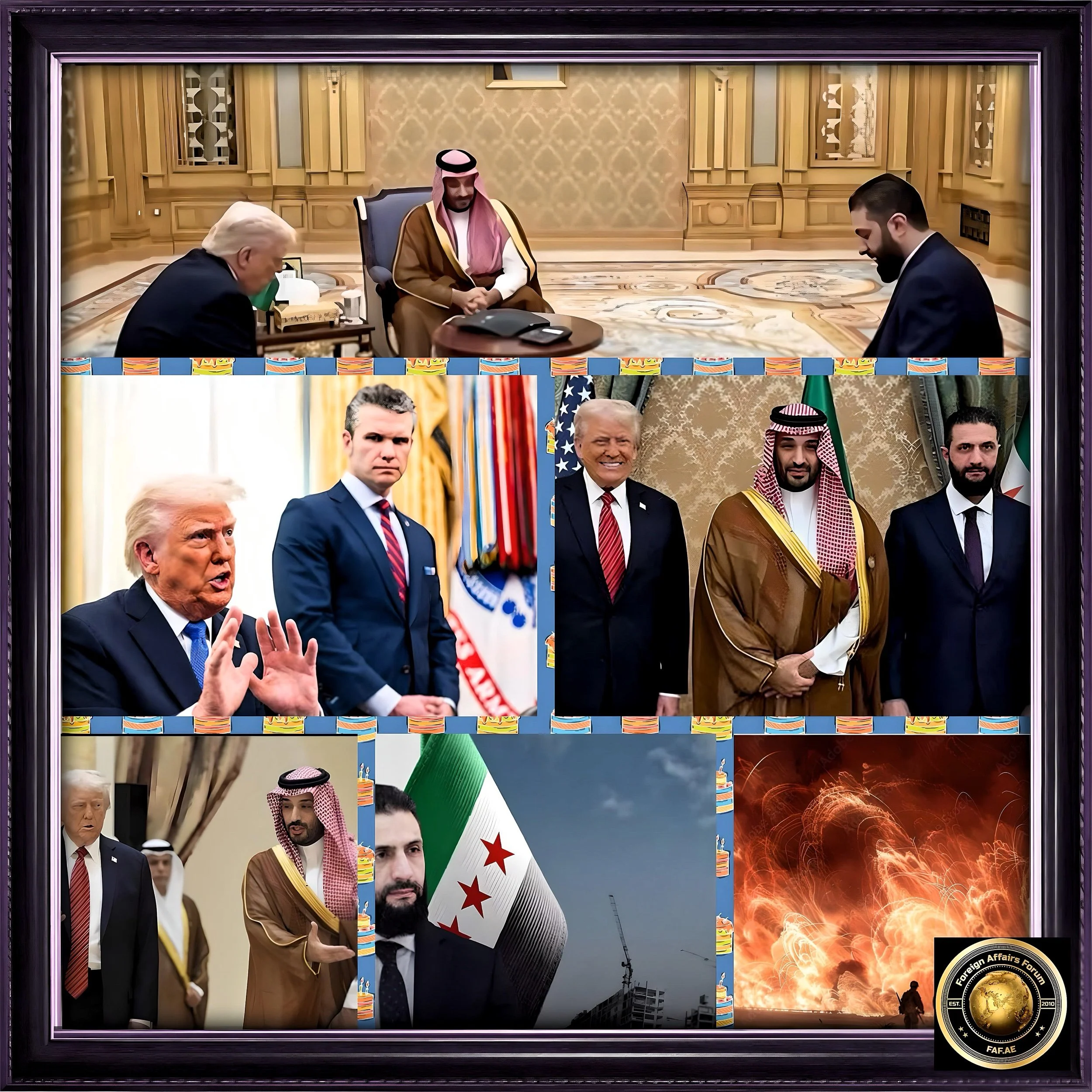
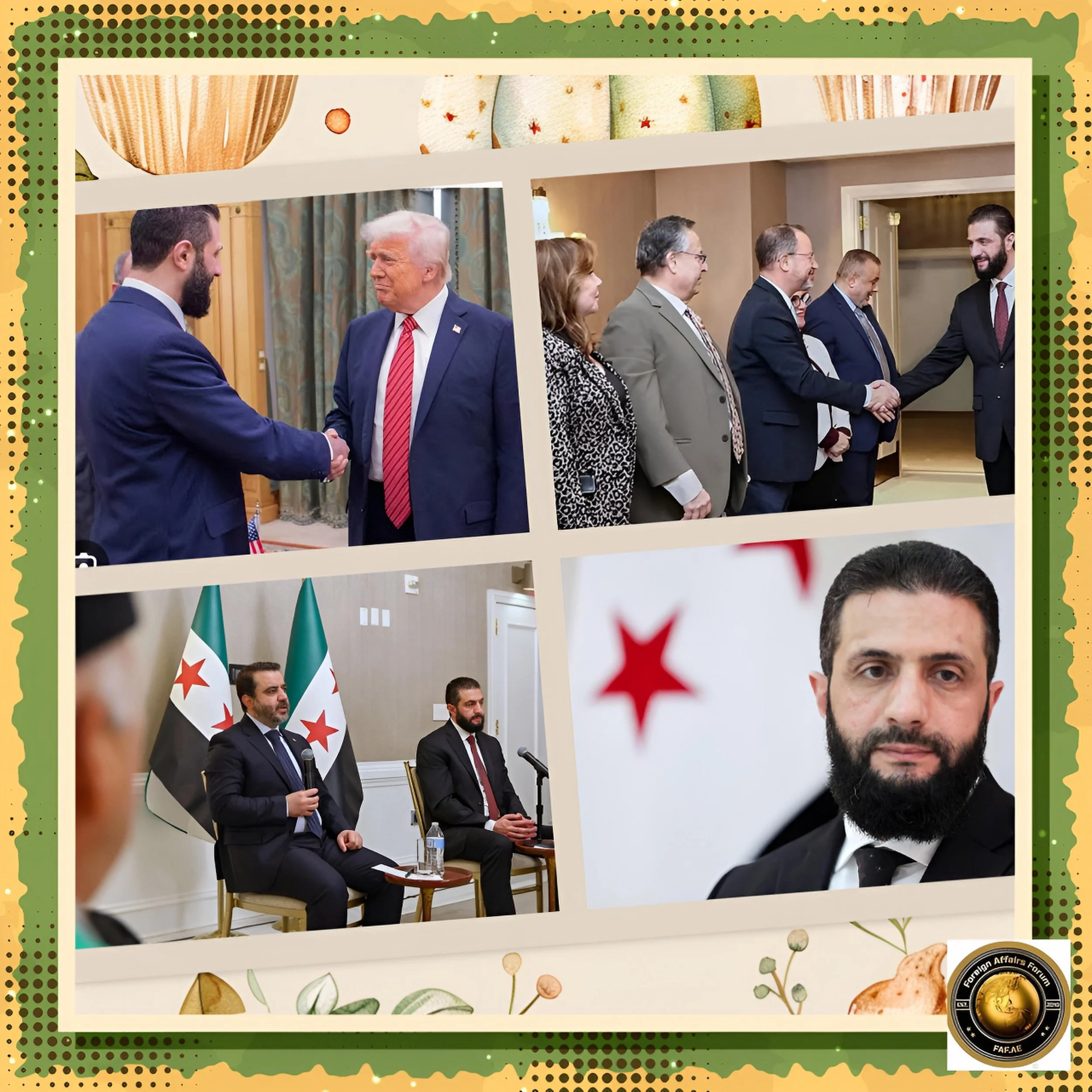
The policy shift culminated in May 2025 with President Trump’s historic meeting with al-Sharaa in Saudi Arabia.
Trump became the first U.S. President in 25 years to meet with a Syrian leader, praising al-Sharaa as a “young, attractive guy with a powerful past” and “a tough guy… he’s got a real shot at holding it together.”
During this meeting, Trump announced his intention to lift U.S. sanctions on Syria, describing them as “brutal and crippling” while acknowledging their role before the fall of the Assad regime.
The Sanctions Decision and Its Implications
Trump’s announcement to lift sanctions represents a monumental change in U.S. policy.
Syria was designated a “State Sponsor of Terrorism” in 1979, leading to decades of arms embargoes and financial restrictions.
The removal of these sanctions is expected to have significant economic implications. It could allow Syria to rejoin the global financial system and attract much-needed investment for reconstruction.
According to Shiraz Maher, a war studies lecturer at King’s College London, Trump’s announcement represents “an explicit vote of confidence in the new Administration,” providing Syria with a fresh opportunity to progress on its terms.
In Damascus and across Syria, citizens celebrated the news with cheers and fireworks, hoping the decision would help revitalize the economy after years of conflict.
Confusion Around al-Sharia's Status and U.S. Policy Direction
The rapid transition in U.S. policy from designating al-Sharaa as a wanted terrorist to presidential engagement has created confusion about his current status and the broader direction of U.S.-Syria relations.
This confusion stems from several factors
Al-Sharaa Background and Transformation
Ahmed al-Sharaa was for years the leader of al-Qaeda’s official wing in the Syrian conflict.
He first joined the group in Iraq, where he spent five years in a U.S. prison.
However, he broke away from al-Qaeda in 2016 and later led the overthrow of Bashar al-Assad in December 2024.
While the U.S. removed the $10 million bounty on his head in December 2024, Hayat Tahrir al-Sham (HTS)-the organization he leads-remains designated as a terrorist group by the United States.
Diplomatic Engagement Despite Terrorist Designation
The juxtaposition of continued terrorist designation for HTS alongside high-level diplomatic engagement with its leader represents a contradictory approach that has puzzled observers.
During his meeting with al-Sharaa, Trump reportedly urged him to deport Palestinian militants, expel foreign fighters from Syria, and assume control of camps holding captured Islamic State fighters.
He also encouraged al-Sharaa to help the U.S. fight Islamic State and deal with Syria’s remaining chemical weapons stockpile.
Trump has further suggested that al-Sharaa consider joining the Abraham Accords to normalize relations with Israel, though this would represent a dramatic shift from HTS’s historical positions.
When asked about this possibility, Trump stated: “I told him, ‘I hope you’ll join once things are sorted out,’ and he said yes…. But they still have a lot of work to do”.
Regional Reactions and Strategic Considerations
The cordial interaction between Trump and al-Sharaa has surprised many and drawn criticism from U.S. allies, including Israel.
While Turkey and Saudi Arabia have supported reconciliation with Syria, Israel remains deeply skeptical of al-Sharaa and has intensified its military strikes against Syria to weaken its longstanding adversary.
The confusion is further compounded by reports that Syria has been attempting to persuade the U.S. that it poses no threat but rather represents a potential ally, including claims of indirect discussions with Israel to ease tensions.
There have even been conversations regarding potential U.S.-Syria business ventures, including the possibility of a Trump Tower in Damascus.
The Path Forward for Syria’s Reconstruction
Despite the policy shifts and emerging support, Syria’s reconstruction faces significant challenges requiring coordinated international action and comprehensive planning.
Prerequisites for Successful Reconstruction
Experts emphasize that rebuilding Syria requires more than just physical reconstruction.
A new Syria cannot be built without a new social contract that champions human rights, democracy, and the rule of law.
This would demand the formation of a transitional government accepted by all stakeholders to ensure a smooth transfer to democracy.
Without this foundation, reconstruction efforts risk becoming another tool for deepening divisions rather than healing them.
The Syrian state's stability and its people's security must also be guaranteed.
Israel’s air attacks on Syrian territory and annexation of more land since the fall of the Assad regime have exacerbated instability. Such actions damage infrastructure and undermine hopes for a swift recovery.
Coordinated Donor Approach
To avoid the mistakes made in Iraq and Afghanistan, donors should co-develop a single reconstruction strategy for Syria, with funding tied to specific performance milestones.
The Atlantic Council suggests that a commissioner elected by donor countries should oversee all reconstruction funds. The commissioner would act as CEO and chair an advisory board of representatives across Syrian society.
If implemented effectively, this approach could help ensure that reconstruction efforts address Syria’s complex needs while promoting stability and inclusive governance.
However, success will ultimately depend on the international community's commitment and Syria’s new leadership's ability to navigate the challenging political landscape.
Conclusion
Syria stands at a critical crossroads, with its reconstruction representing an enormous challenge and an opportunity for transformation.
The recent policy shifts by the United States, including the lifting of sanctions and high-level engagement with Syria’s new leadership, signal a potential opening for international support.
However, the contradictions in the U.S. raising a leader with ties to designated terrorist organizations while encouraging normalization with Israel create uncertainty about the path forward.
The financial realities of reconstruction, including the estimated $250-400 billion cost and limited U.S. fiscal capacity, suggest that rebuilding Syria will require broad international cooperation and creative financing approaches.
As the situation continues to evolve, the effectiveness of reconstruction efforts will depend on addressing physical infrastructure needs and the fundamental governance, security, and social challenges that have fueled conflict for over a decade.
The international community now faces the task of translating recent diplomatic developments and funding pledges into a coherent, sustainable approach to rebuilding Syria that promotes stability, inclusivity, and long-term recovery for the Syrian people
*Gulf.Inc. is a subsidiary of Foreign Affairs Forum based out of Qatar.