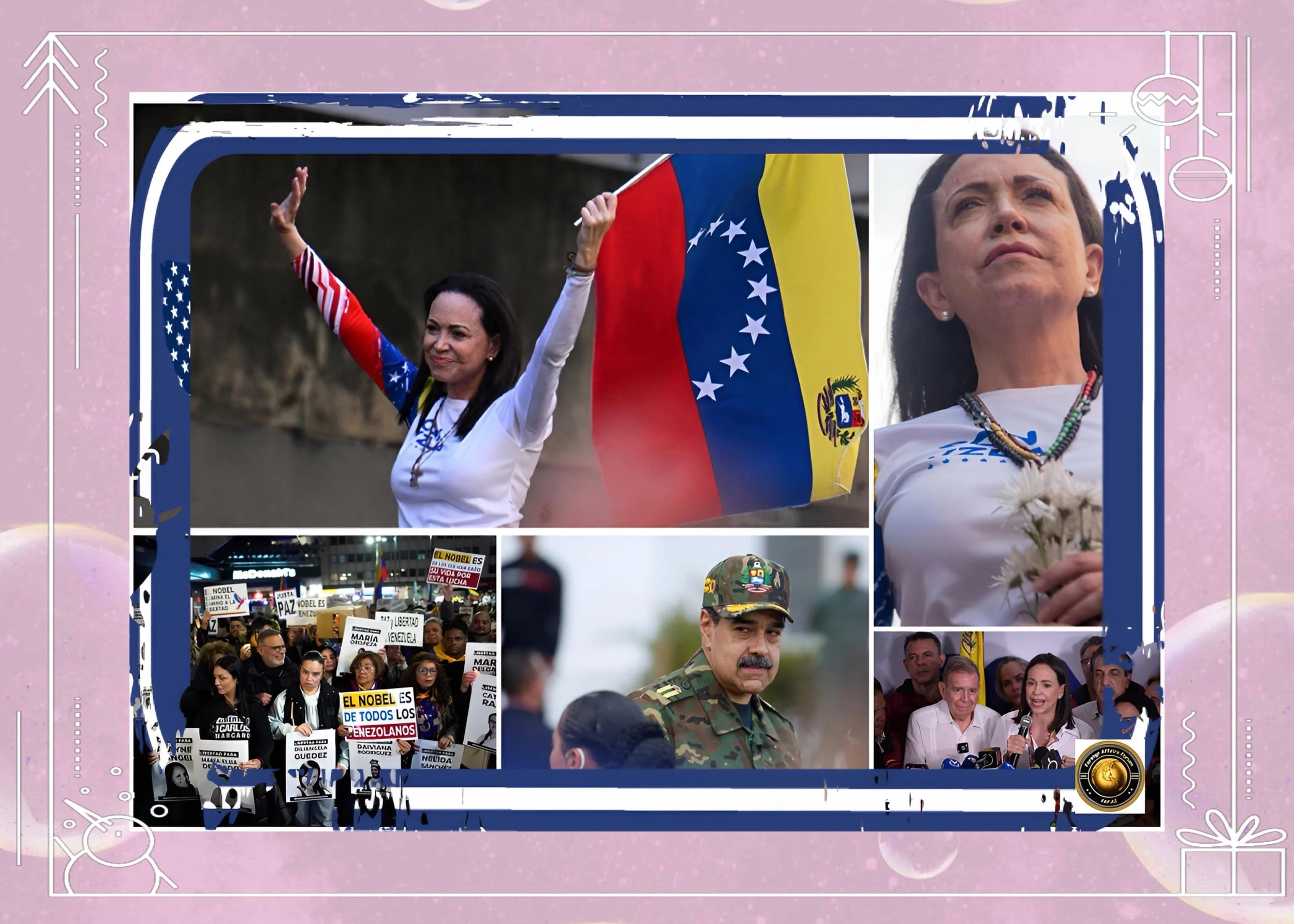
Venezuela Reborn: Machado’s Blueprint to Dismantle Maduro’s Legacy
Executive Summary
María Corina Machado, the 2025 Nobel Peace Prize laureate and de facto leader of Venezuela’s opposition coalition, has articulated a comprehensive roadmap for the first hundred hours and one hundred days following the removal of Nicolás Maduro from power.
This strategic document, reviewed by the Trump administration, outlines immediate humanitarian interventions, institutional stabilization measures, and a sweeping 15-year economic transformation agenda valued at approximately $1.7 trillion in investment opportunities.
The transition plan prioritizes citizen security, the restoration of basic services including food and medicine, the release of over 170 political prisoners, and the reestablishment of democratic institutions.
As the international community remains divided over Venezuela’s electoral legitimacy and the prospects for regime change, Machado’s detailed planning represents both a statement of readiness for governance and a calculated appeal to global stakeholders whose interests align with Venezuelan democratization.
Historical Context and Background
The Venezuelan political crisis represents the culmination of decades of institutional deterioration and ideological struggle dating to Hugo Chávez’s 1998 ascension to power.
The Bolivarian Revolution, ostensibly designed to redistribute wealth and empower marginalized populations, instead engineered the systematic dismantling of independent institutions, the subordination of the judiciary and electoral machinery to executive authority, and the progressive nationalization of the petroleum sector that historically underpinned the nation’s economy.
Under Nicolás Maduro, who inherited power in 2013 following Chávez’s death, these institutional failures accelerated catastrophically, precipitating an unprecedented humanitarian crisis characterized by mass starvation, hyperinflation, and a refugee exodus exceeding eight million persons—constituting the largest displacement crisis in the Western Hemisphere’s recorded history.
María Corina Machado emerged as a principal opposition figure within this context of systemic state failure.
Previously barred from electoral competition through a disputed 2017 judicial ruling, she championed the opposition’s 2024 presidential campaign as a unifying figurehead despite her legal ineligibility to stand as a candidate. Her colleague, Edmundo González Urrutia, served as the formal opposition candidate, though Machado became the strategic voice articulating the opposition’s broader vision.
Their coalition mobilized over 600,000 poll watchers through the “Plan 600K” initiative, collecting parallel vote tallies from approximately eighty percent of voting stations to independently verify electoral results.
This unprecedented organizational achievement demonstrated the opposition’s capacity for structural coordination and its determination to maintain democratic accountability mechanisms even within an authoritarian electoral framework.
The July 28, 2024, Election and Its Contested Aftermath
On July 28, 2024, Venezuelans participated in a presidential election that international observers and the opposition coalition assessed as fundamentally fraudulent, despite the absence of precedent-setting organizational failures.
The government-controlled National Electoral Council (CNE), headed by officials appointed through partisan procedures and lacking operational independence, announced results within hours of the polls’ closure, claiming a narrow victory for Maduro—purportedly capturing 51.20 percent of the vote.
Critically, the CNE declined to publish detailed, station-by-station vote tallies. This procedural departure violated Venezuelan electoral law and prevented the electoral body from fulfilling its statutory obligation to provide transparent verification mechanisms.
The opposition coalition’s parallel count, derived from official tally sheets (“actas”) collected from seventy-seven percent of polling stations, presented a radically divergent narrative.
According to this documentation, González secured approximately 67 percent of the votes while Maduro received roughly 29 percent.
The Carter Center, the United Nations Panel of Experts, and independent exit polling organizations each affirmed the credibility of the opposition’s data-collection methodology and confirmed that the publicly available vote tallies exhibited authentic security features consistent with the original electoral protocols.
A subsequent Meganálisis poll conducted in August found that ninety-three percent of surveyed Venezuelans believed Maduro had lost the election.
Rather than acknowledge these findings or engage in substantive dialogue regarding the electoral integrity question, the Maduro regime initiated a severe crackdown on opposition activism.
Within the first months following the election, over 2,000 individuals were arbitrarily detained on politically motivated charges.
By July 2025, one year after the election, at least 853 political prisoners remained incarcerated, many charged with vague offenses such as “terrorism” and “incitement to hatred” that carry sentences extending to thirty years under Venezuelan law.
Documentation of torture, enforced disappearances, and systemic denial of due process has accumulated through investigations by the United Nations Fact-Finding Mission on Venezuela, Human Rights Watch, and Amnesty International.
The United States Recognition and International Diplomatic Response
The geopolitical dimensions of Venezuela’s electoral crisis became apparent within weeks of the July 28 vote.
Former Secretary of State Antony Blinken formally recognized Edmundo González as Venezuela’s legitimate president-elect on August 1, 2024, departing from previous American diplomatic practice of describing the opposition candidate as having received the “highest number of votes” without formal presidential recognition.
This American position constituted an explicit rejection of the CNE’s announced results and aligned the United States with the opposition coalition’s interpretation of electoral legitimacy.
The Biden administration subsequently intensified pressure on the Maduro regime through expanded sanctions targeting regime associates and increased financial bounties for intelligence leading to Maduro’s capture.
In January 2025, the administration announced a $25 million reward for information facilitating Maduro’s arrest, then-Attorney General Merrick Garland also imposed visa restrictions on approximately 2,000 individuals aligned with the regime and announced increased bounties targeting security force officials, including Defense Minister Vladimir Padrino López and alleged crime boss Diosdado Cabello.
Upon assuming office in January 2025, the Trump administration substantially escalated this pressure campaign.
In August 2025, Attorney General Pam Bondi announced the doubling of Maduro’s bounty to $50 million and revealed that the Department of Justice had seized over $700 million in regime-associated assets.
More consequentially, in November 2025, the Trump administration formally designated Nicolás Maduro and his governmental associates as members of a foreign terrorist organization, specifically citing the “Cartel de los Soles”—an apparatus of corrupt security officials rather than a traditional organized crime entity.
This designation granted the administration expanded statutory authority to impose additional sanctions and, according to multiple official briefings, to consider various military and special operations options targeting Venezuelan governmental and military installations.
Concurrent with these American actions, the Trump administration deployed what defense officials termed “Operation Southern Spear,” a substantial naval and air presence exceeding 15,000 personnel and more than a dozen major warships positioned in the Caribbean.
Multiple military engagements against vessels allegedly engaged in narcotics trafficking resulted in fatalities, though the Trump administration declined to provide public evidence substantiating the drug-trafficking allegations in most instances.
Regional and International Perspectives
The international community’s response to Venezuela’s electoral crisis and the subsequent authorization of Machado’s transition planning revealed deep divisions regarding both the desirability of regime change and the appropriate international mechanisms for facilitating political transformation.
Democratic nations in the Americas—including Argentina, Peru, Uruguay, Ecuador, and Panama—formally recognized González as the election winner.
However, Canada, despite its swift recognition of opposition leader Juan Guaidó during the 2019 electoral crisis, declined to formally recognize González, even as it acknowledged the fraudulence of Maduro’s claims.
The European Union, through its High Representative, called for an inclusive political process leading to free and fair elections while endorsing a negotiated approach rather than military intervention.
Brazil’s position proved particularly significant given its regional influence and historical support for left-wing governments in the hemisphere.
Brazilian President Luiz Inácio Lula da Silva, who had previously maintained diplomatic relations with Maduro and championed Bolivarian regional integration initiatives, gradually recalibrated Brazil’s stance throughout 2024 and 2025.
Initially characterizing the Maduro regime as “very unpleasant” with an “authoritarian slant,” Lula eventually acknowledged that Venezuela’s electoral results should be recognized as reflecting the people’s authentic will. However, Brazil refused to join the Trump administration’s military escalation, with Lula publicly insisting that he would maintain communications with the United States to prevent armed conflict.
Colombia, under President Gustavo Petro, adopted a similarly cautious approach, declining to recognize Maduro’s victory while advocating for humanitarian considerations and negotiated solutions rather than military intervention.
The Organization of American States (OAS), through Secretary General Luis Almagro, provided the hemisphere’s most forceful condemnation of the Venezuelan electoral fraud and the Maduro regime’s subsequent repression.
The OAS General Secretariat characterized the regime’s conduct as applying “the complete manual for fraudulent handling of the electoral result”. It rejected the Venezuelan Supreme Court’s certification of the CNE’s results, describing them as “categorically invalid.”
An OAS resolution adopted in September 2024 called for the publication of detailed voting records. It demanded that Venezuela respect fundamental human rights, the right to peaceful assembly, and the absence of reprisal against opposition figures—implicitly acknowledging that the regime was engaged in systematic violations across all these dimensions.
María Corina Machado’s Comprehensive Transition Framework
Strategic Architecture for the First 100 Hours
Machado articulated a carefully sequenced governance plan that distinguishes between emergency stabilization measures for the initial 100-hour period and medium-term institutional reconstruction for the subsequent 100 days.
The immediate priorities—what may be understood as the first two-week phase—centered on establishing governmental legitimacy, preventing state collapse, and demonstrating rapid responsiveness to humanitarian catastrophe.
During the first 100 hours, Machado’s framework prioritizes establishing personal security mechanisms to protect political leaders and opposition figures, consolidating state institutions to prevent institutional paralysis, and initiating border security measures to prevent mass violence or humanitarian spillover.
This initial phase contemplates the release of all political prisoners—numbered at approximately 170 at the time of planning, though incarceration figures exceeded 850 by mid-2025—as a demonstrative commitment to the rule of law and reconciliation with segments of the population.
Framework for the First 100 Days: Food, Medicine, Security, and Economic Order
The 100-day plan, which Machado has referenced extensively in international presentations and which has undergone analysis by American intelligence and policy officials, emphasizes humanitarian reconstruction alongside security consolidation.
The strategy identifies four primary pillars
(1) the restoration of food security through the re-establishment of import channels and distribution mechanisms
(2) the reestablishment of pharmaceutical supplies and health service provision
(3) the consolidation of state security through military reorganization and the professionalization of security forces
(4) the reestablishment of basic macroeconomic order to arrest hyperinflation and currency instability.
Food security represents the most immediately visible humanitarian challenge.
Venezuela’s poverty rate has reached approximately eighty-six percent under Maduro’s governance, with pensions declining to less than one dollar monthly, and children attending public schools only twice weekly due to institutional collapse.
Machado’s transition framework contemplates the rapid reopening of import channels to restore food availability, leveraging Venezuela’s vast oil reserves to finance humanitarian procurement from neighboring countries and global markets.
The plan explicitly addresses the immediate need to reverse chronic malnutrition affecting the nation’s youth population and to prevent further deterioration of human capital.
Medicine represents a parallel humanitarian imperative. By 2017, medication shortages had reached eighty-five percent according to Venezuela’s Pharmaceutical Federation.
Machado’s transition framework allocates resources toward reestablishing pharmaceutical supply chains and restoring operational capacity within the health sector, which has deteriorated to the point where maternal mortality rates, infection rates, and routine childhood mortality have surged substantially above pre-crisis baselines.
Security consolidation and the restoration of “order” constitute the third component of the 100-day framework. Machado emphasized in her interview with Israel Hayom that “we will restore order, security, and the rule of law, so that all citizens, investors, and families can live without fear.”
This objective necessitates addressing what Machado characterized as the military’s entrenchment alongside Maduro.
Defense Minister Padrino López and senior military leadership have consistently pledged “absolute loyalty” to the regime, and there is no evidence that military defections would facilitate a transition absent either coercive pressure or incentive structures that compensate military personnel for accepting civilian governance.
Machado’s framework contemplates the reorganization of military command structures, the gradual depoliticization of security forces, and the establishment of civilian oversight mechanisms—institutional reforms that require months to implement but which are essential to preventing a post-transition security vacuum.
Finally, the 100-day plan addresses macroeconomic stabilization. Venezuela’s currency, the bolívar, has undergone successive devaluations, rendering it nearly worthless, while parallel black markets in foreign currency have emerged as the de facto mechanism for economic transactions.
The transition framework envisions the partial dollarization of the economy, the reestablishment of banking-sector operations, and the clarification of property rights to create conditions for resumed investment and production.
Economic Vision and the Fifteen-Year Investment Framework
Machado’s economic advisors, led by development economist Sary Levy, unveiled a comprehensive fifteen-year growth strategy projected to triple Venezuela’s GDP by 2040 through a combination of market liberalization, privatization, macroeconomic stabilization, and the restoration of independent institutions.
The plan explicitly values Venezuela’s economic transformation potential at $1.7 trillion in investment opportunities across twelve priority sectors.
The hydrocarbon sector constitutes the primary pillar of this economic vision.
Venezuela possesses the world’s largest proven crude oil reserves, yet production has collapsed from 3.2 million barrels per day in 2011 to less than 400,000 barrels per day by 2025, representing a 98% decline.
Machado’s framework envisions recovering Venezuela’s role as a Latin American energy hub through investments totaling $420 billion, aiming to restore production capacity to 4 million barrels per day within 15 years.
This objective would necessitate the rehabilitation of refineries, the modernization of extraction infrastructure, and the establishment of international partnerships with petroleum companies that Chavismo had expelled during the previous two decades.
Mining represents the second central investment pillar. Venezuela possesses vast quantities of gold, iron ore, and other strategic minerals that remain substantially unexploited due to Chavista prioritization of petroleum nationalism and the absence of investment.
The transition framework contemplates the establishment of transparent licensing mechanisms and the entry of international mining corporations into Venezuelan territory under conditions of rule-of-law protection and environmental stewardship—conditions absent during the Maduro period.
The tertiary investment pillars address infrastructure modernization, financial sector reconstruction, tourism development emphasizing Venezuela’s Caribbean coastline and Angel Falls, agricultural revitalization, and crucially, technology and artificial intelligence sector development.
Machado explicitly highlighted artificial intelligence and the technology sector as components of Venezuela’s strategic economic diversification, arguing that Venezuela should “compete at the frontier of technology and innovation.”
Actual Statements by Global Leaders and Institutional Authorities
Donald Trump and the Trump Administration
President Trump has indicated that he does not anticipate direct American military involvement in Venezuela, despite the substantial naval deployment and the formal designation of Maduro as a member of a terrorist organization. In public statements during October 2025, Trump remarked that “a lot is happening in Venezuela” and that “maybe [Maduro] leaves,” suggesting a preference for regime change facilitated through other mechanisms—perhaps military defections, internal coup dynamics, or the combination of sanctions pressure and opposition activity.
Secretary of State Marco Rubio, a long-standing advocate of aggressive Venezuela policy, has indicated that the Trump administration will deploy sanctions as the primary mechanism for pressuring regime change, while maintaining strategic ambiguity regarding military escalation.
The BOLÍVAR Act, passed with Rubio’s advocacy, reinforces existing sanctions mechanisms and extends the reach of American restrictions to international entities engaged in commerce with the regime.
Joe Biden Administration Statements
As the Biden administration concluded its tenure in January 2025, Secretary of State Antony Blinken characterized the Venezuelan electoral situation as resolved on factual grounds—González won—and articulated the American commitment to supporting the Venezuelan people’s desire for democratic transformation.
The recognition of González as president-elect, announced in November 2024, represented a formal statement of American conviction regarding electoral legitimacy.
Vice President Kamala Harris, speaking in September 2024, emphasized American support for democratic values while declining to commit to military intervention, stating that “democracy requires honoring the voters’ wishes” and acknowledging the complexity of regional coordination.
International Organization Statements
OAS Secretary General Luis Almagro provided the hemisphere’s most robust institutional condemnation of the Venezuelan regime.
In August 2024, Almagro characterized the electoral fraud as the application of the “complete manual for fraudulent handling” and stated that the regime “is not willing to hand over power, it is not even willing to share it,” implicitly arguing that negotiated transitions were unlikely absent either extraordinary pressure or coercive circumstances.
The United Nations Fact-Finding Mission on Venezuela, established under the auspices of the Human Rights Council, issued findings in March 2025 characterizing Venezuela’s post-electoral repression as constituting crimes against humanity through persecution on political grounds and imprisonment or severe deprivation of liberty. These findings provided international legal authority for potential future accountability proceedings.
Regional Leader Statements
Brazil’s Lula: Brazilian President Lula initially characterized Venezuelan developments through an ideological lens sympathetic to left-wing governance, defending Maduro against what he described as “hostile narratives” regarding human rights violations.
By October 2024, however, Lula began to acknowledge that Brazil’s strategic interests diverged from unconditional support for a failing regime. In statements to journalists in late 2024, Lula indicated that Venezuela’s situation should be resolved through democratic means and that Brazil’s historical support for Venezuela did not extend to endorsing electoral fraud.
By 2025, Lula had begun communicating privately with the Trump administration regarding concerns about military escalation, advocating for negotiated solutions while gradually accepting that Venezuela’s electoral outcome reflected the opposition’s overwhelming victory.
Colombia’s Petro
Colombian President Gustavo Petro, while refusing to recognize Maduro’s claimed victory, emphasized Colombia’s interest in preventing military conflict and in maintaining humanitarian corridors for Venezuelan migrants.
Petro’s position reflected the acute strain that Venezuela’s humanitarian crisis placed on Colombia, which hosted approximately 2.8 million Venezuelan migrants and refugees by 2025. Petro advocated for “negotiated solutions” and “shared transition” arrangements that might preserve some role for Chavista elements while establishing democratic governance.
Key Concerns and Structural Challenges for Transition Implementation
Military Loyalty and Security Force Defections
The most significant impediment to a successful transition involves the Venezuelan military’s institutional loyalty to the Maduro regime. Defense Minister Vladimir Padrino López and senior military commanders have consistently pledged unconditional support for Maduro, and the absence of credible military dissidents poses a structural problem for opposition planners.
Machado acknowledged this challenge in August 2024, stating that “Maduro has entrenched himself with the nation’s top military leaders; that’s all he has remaining.” An opposition-led transition would presumably require either cultivating military defectors, deploying external military pressure, or gradually professionalizing security forces post-transition—all of which pose substantial implementation challenges.
International Legitimacy and Regional Coordination
The absence of consensus among regional powers on the desirability of regime change creates diplomatic complications for the implementation of transitions.
Brazil’s reluctance to endorse military options, Colombia’s focus on humanitarian concerns, and Mexico’s similar pragmatic engagement with the Maduro regime suggest that any transition would occur without the enthusiastic support of Venezuela’s immediate neighbors—a situation fundamentally different from the coalition-building that preceded humanitarian interventions in other contexts.
Institutional Reconstruction and Rule of Law Restoration
Machado’s transition framework emphasizes the restoration of independent institutions, rule-of-law mechanisms, and democratic norms. However, decades of institutional subordination to executive authority, the professionalization of corruption as a state mechanism, and the complete politicization of the judiciary and electoral authorities create substantial implementation challenges.
International experience suggests that institutional reconstruction takes years rather than months, and Venezuela’s acute humanitarian crisis may pressure opposition leadership to take shortcuts that compromise long-term democratic consolidation.
Economic Stabilization amid Humanitarian Crisis
The simultaneous pursuit of macroeconomic stabilization and humanitarian relief presents competing imperatives. Orthodox stabilization measures typically involve fiscal restraint, subsidy reductions, and currency adjustments—measures that impose severe short-term hardship on vulnerable populations.
Machado’s framework emphasizes investments and expansionist resource deployment, potentially conflicting with International Monetary Fund prescriptions that would likely accompany international financial integration.
Anticipated Steps and the Transition Roadmap
Based on the available documentation of Machado’s planning and recent statements, a prospective transition would likely follow this sequence:
The initial phase, encompassing the first 100 hours, would prioritize the establishment of governmental legitimacy through the formation of core executive institutions, the release of political prisoners, and the assumption of control over the state communications apparatus to establish narrative dominance and provide assurances to international stakeholders.
The subsequent 100-day phase would emphasize humanitarian restoration—the reestablishment of food and medicine supply chains, the depoliticization of security forces through the replacement of regime loyalists, and the initiation of macroeconomic stabilization measures.
Concurrently, Machado’s framework contemplates the establishment of transitional justice mechanisms to address crimes committed during the Maduro period, though the specifics of such accountability arrangements remain underdeveloped.
By the conclusion of the 100 days, the transition framework envisions the restoration of basic institutional functions, the preliminary reformation of electoral mechanisms, and the initiation of international engagement to restore Venezuela’s integration into global financial and trading systems.
The longer-term institutional reconstruction and economic transformation contemplated in the fifteen-year investment framework would unfold over subsequent years, contingent upon the establishment of basic governance capacity and the attraction of international investment.
Conclusion
María Corina Machado’s articulation of a detailed transition framework for post-Maduro Venezuela represents both a practical governance proposal and a political statement regarding the opposition’s readiness to assume power.
The plan’s emphasis on humanitarian reconstruction, security stabilization, and long-term economic transformation reflects a sophisticated understanding of the intersecting challenges confronting Venezuela—a nation simultaneously experiencing an acute humanitarian emergency, security sector entrenchment, and fundamental institutional collapse.
The international response to these proposals reveals deep structural tensions within the Americas.
The Trump administration’s substantial military escalation and formal designation of the Maduro regime as a terrorist organization suggest American determination to facilitate regime change through coordinated pressure.
Yet, the absence of consensus among regional powers, the military’s continued institutional loyalty to Maduro, and the complexity of implementing the transition under crisis conditions all present substantial obstacles to realizing Machado’s vision.
Venezuela’s transition, should it occur, would represent perhaps the most significant geopolitical realignment in the Western Hemisphere since the end of the Cold War.
The restoration of democratic governance in the region’s second-largest economy, the reintegration of millions of exiles, and the reopening of vast petroleum reserves to international capital would fundamentally reshape hemispheric economics and geopolitics.
Conversely, the perpetuation of Maduro’s regime amid intensifying international pressure and deepening humanitarian catastrophe suggests a descent toward further state failure, continued mass displacement, and prolonged regional instability.
The credibility and implementation fidelity of Machado’s transition framework may ultimately determine which of these trajectories Venezuela traverses.