The Pierced Chernonyl Shield: Unveiling the Strategic and Radiological Challenges of a Breached New Safe Confinement
Executive Summary
Assessment of Critical Damage to the Chernobyl New Safe Confinement (NSC) Following Russian Drone Incursion
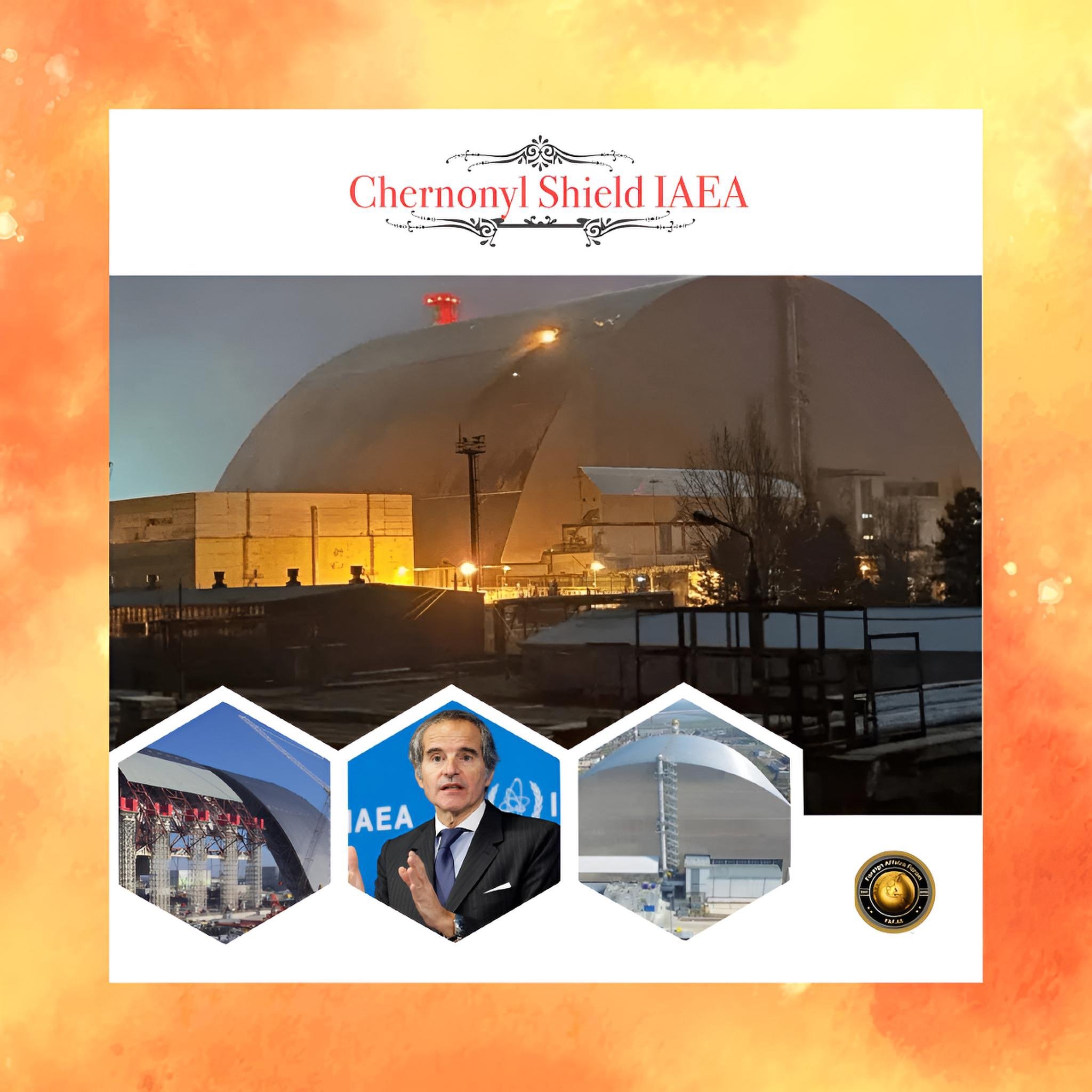
In December 2025, the International Atomic Energy Agency (IAEA) formally reclassified the status of the Chernobyl New Safe Confinement (NSC)—the colossal, steel-arched structure measuring approximately 105 meters in height and 257 meters in length—as having “lost its primary confinement capability.”
This downgrade follows an extensive forensic assessment of a kinetic strike that occurred on February 14, 2025, involving a Shahed-type loitering munition, which struck the southern perimeter of the NSC.
While the arch's structural skeleton remains largely intact, with only minor deformations observed in the external cladding, the hermetic integrity of the facility has been compromised at a critical point.
The facility can no longer sustain the hostile pressure differential needed to contain radioactive aerosols, as the 15-square-meter breach in the inner retention membrane allows air or radon gas to escape under varying atmospheric conditions.
As a result, current background radiation levels within the Exclusion Zone remain within nominal limits.
Still, the layered defense strategy—designed to prevent the dispersal of radioactive dust—has been effectively dismantled.
The NSC now functions merely as a weather-resistant cover rather than an actual containment vessel for radioactive materials.
Should a secondary event, such as the collapse of the decaying “Object Shelter” (the 1986 Sarcophagus), occur within the interior, the breach would permit significant radioactive particulate release into the biosphere.
Restoration efforts involve complex engineering interventions, including reinforced sealing and the installation of new containment membranes, scheduled for 2026, which leave the site in a noticeably vulnerable state in the near term.
Introduction
On December 5, 2025, the IAEA released a comprehensive assessment on the damage sustained by the Chernobyl New Safe Confinement.
IAEA Director General Rafael Grossi confirmed that, following an inspection of the damage caused by the February 14, 2025, drone strike, the structure has lost its primary safety functions, including confinement capability.
Chernobyl Cataclysm
The nuclear disaster at Chernobyl on April 26, 1986, remains the deadliest nuclear accident in history, triggered by a flawed safety test involving a runaway reactor under blackout conditions at Reactor 4 of the V.I. Lenin Nuclear Power Plant near Pripyat, Ukrainian Soviet Socialist Republic.
Operators bypassed safety protocols and disabled critical safeguards, including the emergency core cooling system, during a test simulating a turbine shutdown while dealing with xenon-135 poisoning that suppressed reactor power levels.
The RBMK-1000 reactor’s positive void coefficient exacerbated dangers as control rod insertion via AZ-5 caused a transient surge in reactivity due to graphite tip displacers, resulting in a power excursion exceeding 30,000 megawatts thermal.
This led to two catastrophic explosions—first a steam blast rupturing fuel channels, then a graphite fire emitting radionuclides—spreading radioactive material across approximately 150,000 square kilometers, causing 31 immediate fatalities from acute radiation syndrome, and long-term health effects such as thousands of thyroid cancers and the evacuation of roughly 350,000 people.
The hastily constructed “Object Shelter” sarcophagus, composed of unreinforced concrete, was meant as a temporary containment but proved fragile; by 2016, it was encased within the €1.5 billion New Safe Confinement arch, built by the Novarka consortium, which applies negative pressure to contain 95% of the remaining radioactive inventory for a century.
Soviet Immediate Actions
In 1986, following the reactor explosion, Soviet authorities hurriedly constructed a massive concrete sarcophagus to enclose the destroyed reactor, aiming to limit environmental contamination.
This interim structure, however, suffered from vulnerabilities stemming from poor initial quality and inadequate sealing, leading to leaks from rainwater, seismic activity, and structural aging.
Kinetic Event and Immediate Aftermath
On February 14, 2025, a precise weaponized drone—identified by Ukrainian intelligence as a Russian Shahed-136—struck the southern section of the NSC.
Despite the high-speed impact, the primary load-bearing arches—designed to last 100 years—remained structurally sound, but the explosion shattered external cladding panels and penetrated the internal membrane.
The breach spanned roughly 15 square meters. The heat from the blast ignited combustible insulation within the multi-layer membrane system, causing a weeks-long smoldering fire inside the dome that was difficult to extinguish due to radiological hazards.
Addressing the fire required specialized, high-risk interventions, avoiding water-based suppression to prevent increasing internal pressure or causing structural instability.
The IAEA Assessment: A Functional Obsolescence
In the months following the attack, the full extent of the damage remained obscured due to limited access and ongoing military activity.
But the December 2025 IAEA report clarified that, although the main structural framework remains standing, the confinement system is compromised.
The NSC was engineered to operate as a hermetically sealed, negative-pressure chamber, with ventilation systems maintaining a continuous inward airflow to trap radioactive dust.
The 15-square-meter breach has undermined this system, allowing air and potential radioactive dust to escape.
Consequently, the IAEA states that the facility is currently unable to perform its primary safety function—preventing airborne release of radioactive materials during an internal incident.
Radiological Risk Profile: The “Dust Cloud” Hazard
The risk within the site is layered, comprising
The melted reactor core and corium lava flows at the interior.
The crumbling Object Shelter sarcophagus.
The steel NSC covering the sarcophagus.
Current measurements show no significant rise in airborne cesium-137 or strontium isotopes outside the perimeter, with interior debris remaining largely undisturbed.
However, the greatest threat is the potential collapse of the old Sarcophagus, which is held together primarily by gravity and friction and shows signs of shifting.
A collapse could lift tens of tons of highly radioactive dust, which would be vented through the breach if the negative pressure and filtration systems are compromised.
Pre-attack, the NSC effectively trapped and filtered such dust. Still, after an attack, a breach could trigger a “chimney effect” that disperses radioactive particles over vast areas, including Ukraine and Belarus.
Geopolitical and Normative Implications
The strike signifies a dangerous escalation in the weaponization of civil nuclear infrastructure. International conventions, including the Geneva Protocol and Additional Protocols, explicitly prohibit attacks on nuclear infrastructures designated as “works and installations containing dangerous forces.”
Targeting the NSC—funded by the European Bank for Reconstruction and Development (EBRD) and constructed by Western nations—represents a breach of norms and an erosion of international safety safeguards.
This act highlights a disturbing trend where environmental and nuclear safety considerations are disregarded for military advantage, risking regional and global fallout.
Moreover, the compromised confinement system complicates diplomatic response, as the IAEA faces the challenge of negotiating repair access amidst active conflict zones.
Call to Action
Urgent efforts are needed to reinforce and repair the NSC before further instability or military actions lead to catastrophic releases.
The breach from February 14, 2025, has left the site vulnerable to the collapse of the 1986 Sarcophagus, which, if compromised, could release radioactive dust far beyond the original contamination footprint.
Despite current low-level radiation readings, the residual radionuclides within the old Sarcophagus remain highly hazardous.
Delays in repairs could result in a severe environmental disaster, as a collapse or further damage could unleash an uncontrollable radioactive plume across Ukraine, Belarus, and neighboring regions.
The international community must prioritize urgent engineering interventions—such as installing new containment membranes, reinforcing structural stability, and restoring negative pressure systems—to prevent a potential catastrophe.
Remediation Timeline and Future Outlook
The complex logistics of repair are expected to begin in 2026, with a multi-step process including:
(1) Detailed radiological surveys to map contamination levels.
(2) Prefabrication of repair modules for the damaged cladding and membranes.
(3) Aerial or crane-based installation of new protective layers.
Until these interventions are complete, the site remains in a fragile state, relying on the stability of the aging Sarcophagus and current containment systems.
The international community's success hinges on rapid, coordinated action to prevent a disaster that could dwarf the 1986 accident.
Conclusion
The December 2025 assessment, which indicates that the NSC has lost its confinement capability, marks a significant degradation of global nuclear safety standards.
While immediate radiation levels remain stable, the compromised safety systems have diminished the site's redundancy.
The February 14 drone strike did not trigger another Chernobyl disaster, but it destroyed the primary safety barrier designed to prevent one.
For the coming year, the world must rely on a fragile, crumbling Soviet-era structure acting as a containment vessel, with pierced and depressurized defenses.
This threat is no longer theoretical; it is an ongoing, tangible hazard that could be triggered by seismic activity, structural failure, or military action, with potentially catastrophic consequences.