IAEA Review of Iran’s Nuclear Program: Compliance Issues and International Implications
Introduction
IAEA Director General’s Introductory Statement to the Board of Governors
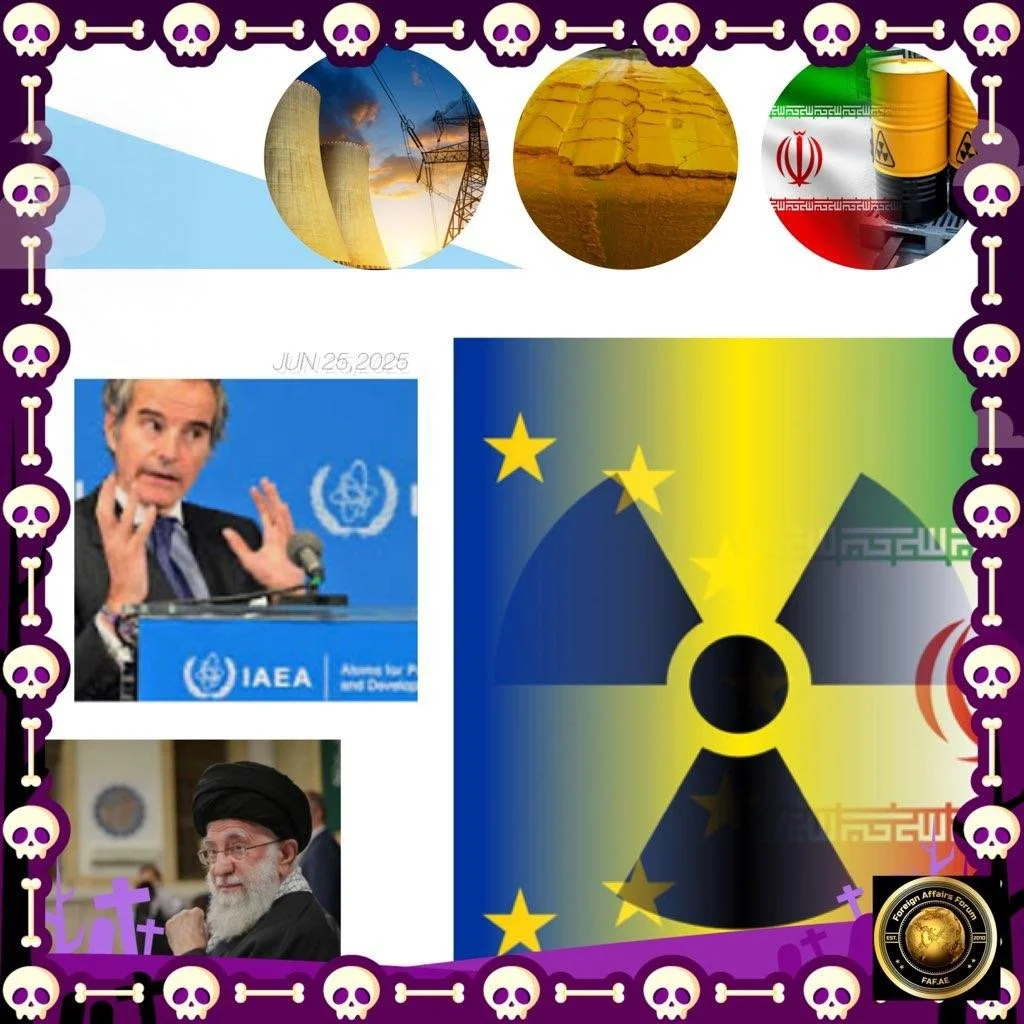
On June 16, 2025, IAEA Director General Rafael Mariano Grossi delivered a critical statement to the Board of Governors following Israel’s military strikes on Iranian nuclear facilities.
The statement provided a comprehensive assessment of the damage to Iran’s nuclear infrastructure and emphasized the Agency’s continued monitoring role despite the military escalation.
Grossi reported that the Natanz Fuel Enrichment Plant suffered significant damage, with the above-ground portion of the Pilot Fuel Enrichment Plant—where Iran was producing uranium enriched up to 60% U-235—completely destroyed.
The electrical infrastructure, including substations and emergency power supplies, was also eliminated, though radiation levels outside the facility remained normal.
At the Isfahan nuclear site, four buildings were damaged including the central chemical laboratory, uranium conversion plant, and fuel manufacturing facilities.
The Director General acknowledged Iranian cooperation in providing technical information while emphasizing that continued safeguards inspections would proceed “as soon as safety conditions allow”.
IAEA’s Review of Iran’s Nuclear Situation to Date
Comprehensive Safeguards Violations
The IAEA’s review of Iran’s nuclear program has revealed systematic violations of safeguards obligations spanning over two decades.
On June 12, 2025, the IAEA Board of Governors formally declared Iran in breach of its non-proliferation obligations for the first time since 2005, citing “numerous failures” to provide cooperation regarding undeclared nuclear material and activities.
The Agency’s May 2025 report documented undeclared nuclear activities at three specific locations: Lavisan-Shian, Varamin, and Turquzabad.
These sites were determined to be “part of an undeclared structured nuclear programme carried out by Iran until the early 2000s” with some activities using undeclared nuclear material.
Unaccounted Nuclear Material
The IAEA concluded that Iran retained “unknown nuclear material and/or heavily contaminated equipment” from its former undeclared nuclear program at Turquzabad between 2009-2018, after which items were removed to unknown locations.
Additionally, uranium involved in undeclared metal production experiments at Jabr Ibn Hayan Laboratories (1995-2000) includes “an amount of nuclear material still unaccounted for”.
Enrichment Activities and Current Concerns
Iran has accumulated significant quantities of highly enriched uranium, becoming “the only non-nuclear-weapon State to produce such nuclear material”.
As of 2025, Iran possesses enough 60% enriched uranium to manufacture nine nuclear bombs according to IAEA assessments.
The Agency expressed “serious concern” about this rapid accumulation given its potential proliferation implications.
Did IAEA Reports Trigger Israeli Military Action?
The timing suggests a correlation between IAEA findings and Israeli military action, though no direct causal link has been officially established.
The IAEA Board of Governors resolution declaring Iran non-compliant was adopted on June 12, 2025, followed by Israeli strikes on Iranian nuclear facilities beginning June 13, 2025.
The resolution provided what analysts described as “additional pretext” for Israeli action, particularly given Iran’s immediate response announcing plans to build new enrichment facilities and upgrade centrifuges at Fordow.
However, Israeli officials have not explicitly cited the IAEA report as the trigger for military action.
Iran’s Compliance with IAEA Mandate
Legal Obligations Under NPT
Iran has fundamentally failed to comply with its IAEA safeguards obligations under the Nuclear Non-Proliferation Treaty (NPT).
The country signed a Comprehensive Safeguards Agreement with the IAEA in 1974, requiring it to declare all nuclear material and activities, provide facility design information, and allow inspections.
Specific Compliance Failures
Iran’s non-compliance encompasses multiple areas:
Failure to declare nuclear material and activities at undeclared locations despite legal obligations
Refusal to implement modified Code 3.1, preventing the IAEA from receiving design information for new nuclear facilities
Withdrawal of inspector designations for experienced IAEA personnel, hampering verification activities
Sanitization of locations and provision of “inaccurate explanations” to conceal activities
Audit Failures and Perceived Threats
The IAEA determined it “is not able to verify that there has been no diversion of nuclear material required to be safeguarded under the Agreement to nuclear weapons or other nuclear explosive devices”.
This verification failure represents the core threat perception, as the Agency cannot provide assurance that Iran’s nuclear program remains exclusively peaceful.
The Director General’s inability to provide such assurance “gives rise to questions that are within the competence of the United Nations Security Council” as the body responsible for international peace and security.
Establishment of the IAEA Mandate for Iran
Historical Foundation
The IAEA’s mandate for Iran derives from multiple legal sources established over decades.
The foundational authority comes from the IAEA Statute, which entered into force in 1957 and authorizes the Agency to “apply safeguards” to state nuclear activities.
Iran’s specific obligations were established through:
NPT ratification in 1970, requiring non-nuclear-weapon states to conclude safeguards agreements
1974 Comprehensive Safeguards Agreement between Iran and the IAEA
UN Security Council resolutions following Iran’s safeguards violations
Legal Basis for Enforcement
The IAEA Board of Governors invoked Article XII.C of the Agency’s Statute in declaring Iran non-compliant, a provision used only six times in IAEA history against Iraq (1991), Romania (1992), North Korea (1993), Iran (2006), Libya (2004), and Syria (2011).
This authority enables the Board to demand corrective measures and escalate matters to the UN Security Council.
Differential Application of IAEA Mandates
Nuclear Weapon States vs. Non-Nuclear Weapon States
The IAEA mandate is not the same for all countries. Critical distinctions exist
Non-Nuclear Weapon States (NNWS) under the NPT must:
Conclude Comprehensive Safeguards Agreements covering all nuclear material
Accept IAEA inspections of all nuclear facilities
Provide complete declarations of nuclear activities
Nuclear Weapon States (NWS) have different obligations:
Sign voluntary offer safeguards agreements permitting selective IAEA access
Choose which facilities to offer for safeguards application
Face no mandatory comprehensive inspections
Non-NPT States
Countries outside the NPT (India, Pakistan, Israel) operate under item-specific agreements covering only particular facilities or materials they voluntarily submit to safeguards.
These agreements provide significantly less comprehensive oversight than NPT-required safeguards.
Additional Protocols
As of 2024, 137 states (73% of non-nuclear-armed states) have both Comprehensive Safeguards Agreements and Additional Protocols in force, representing the current “gold standard” of safeguards.
However, 47 states maintain safeguards agreements without Additional Protocols, limiting IAEA verification capabilities.
The differential application of safeguards reflects the NPT’s discriminatory structure, where nuclear weapon states enjoy privileges not available to non-nuclear weapon states, creating what critics argue is an inherently unequal international nuclear order.